REVIEW 4 major objections 5 minor 53 references
Contrastive Learning for Robust Representations of Neutrino Data
T0 review · 4 major / 5 minor · reviewed 2026-08-08 · deepseek-v4-flash
Pith's one-line read The paper claims that contrastive learning produces representations robust to detector simulation variations, so neutrino models trained on simulation degrade far less than standard classifiers when detector parameters shift.
desk verdict Solid, honest empirical study of contrastive pretraining for neutrino simulation shifts; the robustness result is real but only demonstrated on synthetic throws, so the sim-to-real framing overreaches. read the letter →
The pith
A machine-rendered reading of the paper's core claim, the machinery that carries it, and where it could break.
The reading
What carries the argument
The load-bearing mechanism is a SimCLR-style contrastive pretraining stage applied to sparse 3D voxel images of neutrino events, followed by fine-tuning a small logistic-regression classifier on frozen features. In SimCLR, two augmented views of the same event define a positive pair and all other events in the batch act as negatives; the NT-Xent contrastive loss pulls the positive views together in an embedding space. The paper also uses the supervised contrastive variant, where same-class events act as additional positives. The encoder is a sparse 3D convolutional backbone in the ConvNeXt V2 family, and the augmentations are generic spatial and energy perturbations: rotation, masking, translation, and voxel-energy scaling. The claim is that this objective forces the representation to depend on the stable, topology-level signatures of the particle interactions, rather than on detector-specific response parameters.
What would settle it
A direct test would be to evaluate the same four pipelines on real detector events with known particle identities, for example stopping-particle or through-going muon samples from a running LArTPC experiment whose detector conditions are monitored; if the contrastive advantage over the augmented classifier shrinks or disappears when the test data are real rather than simulated throws, the claimed robustness to data-MC discrepancy is not established.
Extended reading notes
Core claim
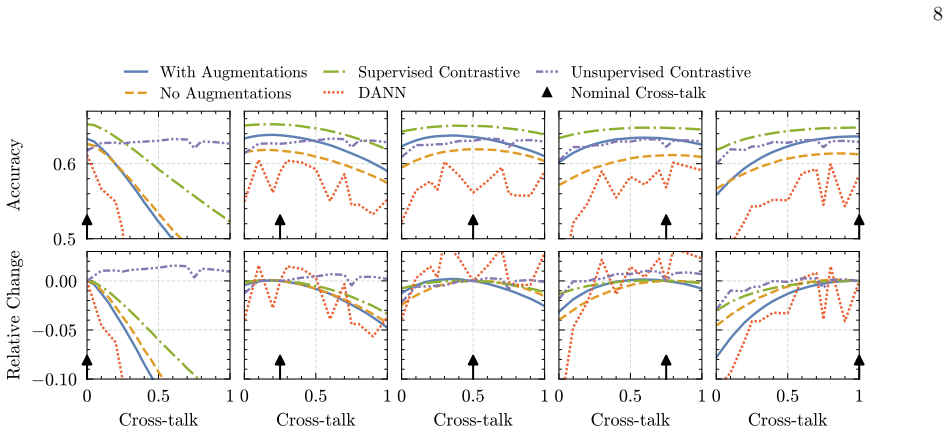
The central claim is that the representations learned by contrastive methods capture the physical properties of the particle interaction rather than the superficial response of the detector electronics, so they degrade far less than a supervised classifier when the detector simulation is perturbed. Concretely, on the LArTPC dataset the supervised contrastive model stays within 84.5-87.3% accuracy across parameter throws while the augmented classifier collapses to 54% on throw 2, and on the scintillator dataset both contrastive setups maintain superior accuracy as cross-talk varies from 0 to 1. The paper also claims that this robustness comes from the contrastive objective itself and the generic augmentations, not from pretraining on unlabeled target-distribution data, and that the approach outperforms DANN, a standard adversarial domain-adaptation baseline.
Load-bearing premise
The load-bearing premise is that the simulated 'throws', random shifts in detector response parameters such as gain and cross-talk drawn from normal distributions, faithfully reproduce the kind of distribution shift the model would face on real detector data, because the paper only evaluates robustness on these simulations, never on real experimental data.
Editorial extensions
If this is right
- Training a classifier by fine-tuning a contrastively pretrained backbone should keep accuracy nearly flat when detector electronics parameters drift, where an augmented supervised classifier can lose tens of points.
- Unsupervised contrastive learning offers near-zero degradation under cross-talk variation in the scintillator study, so it can be used without labels even when target-distribution unlabeled data are unavailable during pretraining.
- Supervised contrastive learning gives the best of both robustness and nominal accuracy, making it the recommended default among the tested setups.
- Adversarial domain adaptation (DANN) is the weakest tested option, losing accuracy overall while adding training instability, so contrastive pretraining is the more practical route for this data type.
Reading between the lines
- Because the robustness is driven by generic augmentations rather than by exposure to target data, the same recipe may also soften 'unknown unknowns' that are not captured by the parametrized throws; this is an extrapolation, since the paper does not test mismodellings outside its throw distribution.
- The contrastive loss in Eq. (2) has an interpolation weight between same-image and same-class positives; tuning this weight between 0 and 1 may let an experiment trade nominal accuracy for robustness, a degree of freedom the paper only explores at its endpoints.
- Extending the same pretraining to regression tasks such as energy or direction reconstruction would test whether the robust representations stabilize quantities beyond classification, which the paper does not report.
Editorial analysis
A structured set of objections, weighed in public.
Referee Report
Summary. The manuscript studies whether contrastive pretraining (SimCLR and supervised contrastive) on sparse-voxel neutrino detector simulations yields representations that are more robust to detector-response variations than an augmented supervised classifier or a domain-adversarial network. Experiments use two simulated datasets: a pixelated LArTPC with six random 'throws' of electronics and noise parameters, and a segmented scintillator detector with varying cross-talk levels. The reported accuracies indicate that the contrastive models maintain accuracy across the tested shifts, while the augmented classifier drops sharply on one throw and DANN underperforms throughout. The paper concludes that contrastive learning extracts features tied to fundamental physical properties and is a promising tool for simulation-to-real adaptation.
Significance. The practical claim, if supported, would be useful: contrastive pretraining requires no target labels, uses generic augmentations, and the paper provides public code and dataset links. The study is also honest in reporting that re-simulation augmentations were too weak to be useful. However, the evidence is currently limited to synthetic target distributions generated by the same simulators used for training, and the central quantitative comparisons are reported without any statistical uncertainty. The headline conclusion that the representations depend on fundamental physics rather than detector specifics is more an interpretation than a demonstrated property.
major comments (4)
- [Section VI, Figure 3] No error bars, confidence intervals, or repeated-seed results are reported for any accuracy value. For example, the comparison between the augmented classifier (54% on Throw 2) and supervised contrastive learning (84-87%) is the paper's central evidence of stability, but without seed variability or statistical intervals the magnitude of this difference cannot be assessed; this is a load-bearing missing quantity for the robustness claim.
- [Section VI and Table I] All target distributions are synthetic throws from the same simulator used to generate the training data; no evaluation on real experimental detector data is presented. Since the abstract and Section I motivate the method by simulation-to-real adaptation, the demonstrated stability is conditional on these throws faithfully representing real data-MC discrepancies. The text should either add a real-data test or explicitly limit the conclusion to simulated distribution shifts.
- [Section V and Figure 2] The generic augmentations used in pretraining (rotation, masking, energy scaling, and translation) closely correspond to the effects of the throws described in Figure 2: ADC scaling, dropping of voxels, and shifting of voxel positions. Enforcing invariance to exactly these transformations makes robustness to test-time throws partly by construction; the claim in Section VI that features 'depend more on the fundamental physical properties' needs a test on shift types not representable by the chosen augmentation family, such as an unmodeled physics process or a correlated electronics effect.
- [Section VI, Figure 4] The scintillator protocol is ambiguous: the text says separate models are trained for each cross-talk level and evaluated across all levels, but Figures 4 and 5 appear to display only one curve per method. Please clarify what each curve represents (e.g., a model trained at nominal cross-talk evaluated across test levels) and state how many target samples are available to DANN; without this, the 'consistently outperform' claim cannot be checked.
minor comments (5)
- [Section III] The values of the temperature parameter tau and the weighting factor alpha are not given; please report their values and the number of augmentations sampled per event, or point to a configuration file in the repository.
- [Section VI] The sentence 'The unsupervised contrastive learning approach resulted in a 3./% drop in accuracy' contains a typo ('3./%') and should read '3%'.
- [Table I] The heading 'Throw 1 sigma' is unclear; specify whether the listed percentages are relative to the nominal parameter values and state how many throws were generated.
- [Abstract and Section VII] The abstract and conclusion promise 'theoretical insights', but the paper contains no theoretical analysis beyond stating standard loss definitions; either add a theoretical contribution or soften this claim.
- [Section IV, Figure 2] The figure caption and surrounding text should explicitly state that the displayed throw effects are a composition of ADC scaling, voxel dropping, and position shifting, since that relationship is central to interpreting the robustness results.
Circularity Check
No significant circularity; robustness result is empirical, though partly reflecting the training augmentations.
full rationale
The paper has no equation-level circularity. The contrastive losses (Eqs. 1 and 2) are standard SimCLR/supervised contrastive objectives and are not derived from the evaluation metrics. The detector throws and cross-talk levels are generated by the simulator with parameters randomly sampled from normal distributions (Table I) and are not used to fit the contrastive models; no fitted parameter is relabeled as a prediction. The DANN baseline is given target-domain throws during training and still underperforms, so the comparison is not rigged. The only mild by-construction element is that the augmentation family (energy scaling, masking, translation, Sec. V) overlaps with the test-time shifts (ADC scaling, voxel dropping, position shifts, Fig. 2), so part of the demonstrated robustness is the invariance the contrastive loss was explicitly designed to enforce. The paper itself reports that physics-driven re-simulation augmentations were too weak to learn useful features, which weakens the physical grounding of the sim-to-real inference but does not constitute circular reasoning. The few self-citations are contextual and not load-bearing.
Assumptions & free parameters
free parameters (5)
- Contrastive temperature tau
- Weight alpha for supervised positives =
1 (or 0 for unsupervised)
- Number of sampled augmentations per event =
3
- Batch size =
672
- Representation dimension =
768
assumptions (5)
- domain assumption SimCLR and supervised contrastive losses produce transferable representations when trained with positive pairs from augmentations.
- domain assumption The simulation chains (edep-sim with Geant4, larnd-sim for the LArTPC; custom simulation for the scintillator) are faithful enough to represent real neutrino detector response.
- domain assumption Randomly thrown detector parameters (Section VI, Table I) and cross-talk levels emulate the data-MC distribution shift.
- domain assumption Sparse voxel representation with a ConvNeXt V2 backbone is an appropriate and sufficient encoder family for neutrino detector images.
- domain assumption A frozen pretrained representation followed by logistic regression is a valid probe of representation quality.
Cite this review
Pith. "Pith review of Contrastive Learning for Robust Representations of Neutrino Data." pith.science (2026). https://pith.science/paper/RU5ESXJO
@misc{pith2026250207724,
  author       = {Pith},
  title        = {Pith review of: Contrastive Learning for Robust Representations of Neutrino Data},
  year         = {2026},
  howpublished = {\url{https://pith.science/paper/RU5ESXJO}},
  note         = {Machine review of arXiv:2502.07724}
}
read the original abstract
In neutrino physics, analyses often depend on large simulated datasets, making it essential for models to generalise effectively to real-world detector data. Contrastive learning, a well-established technique in deep learning, offers a promising solution to this challenge. By applying controlled data augmentations to simulated data, contrastive learning enables the extraction of robust and transferable features. This improves the ability of models trained on simulations to adapt to real experimental data distributions. In this paper, we investigate the application of contrastive learning methods in the context of neutrino physics. Through a combination of empirical evaluations and theoretical insights, we demonstrate how contrastive learning enhances model performance and adaptability. Additionally, we compare it to other domain adaptation techniques, highlighting the unique advantages of contrastive learning for this field.
Figures


Figures from the paper (2 more)

Reference graph
Works this paper leans on
-
[1]
V. Daniel Elvira, Impact of detector simulation in parti- cle physics collider experiments, Physics Reports 695, 1 (2017), impact of Detector Simulation in Particle Physics Collider Experiments
work page 2017
-
[2]
B. Nachman and C. Shimmin, Ai safety for high energy physics (2019), arXiv:1910.08606 [hep-ph]
arXiv 2019
-
[3]
N. M. Coyle, S. W. Li, and P. A. Machado, The impact of neutrino-nucleus interaction modeling on new physics searches, Journal of High Energy Physics 2022, 1 (2022)
work page 2022
-
[4]
A. Ershova, S. Bolognesi, A. Letourneau, J.-C. David, S. Dolan, J. Hirtz, K. Niewczas, J. T. Sobczyk, A. Blanchet, M. B. Avanzini, et al. , Study of final- state interactions of protons in neutrino-nucleus scatter- ing with incl and nuwro cascade models, Phys. Rev. D 106, 032009 (2022)
work page 2022
-
[5]
A. Ershova et al. , Role of deexcitation in the final-state interactions of protons in neutrino-nucleus interactions, Phys. Rev. D 108, 112008 (2023), arXiv:2309.05410 [hep- ph]
arXiv 2023
-
[6]
A. Aurisano, A. Radovic, D. Rocco, A. Himmel, M. D. Messier, E. Niner, G. Pawloski, F. Psihas, A. Sousa, and P. Vahle, A convolutional neural network neutrino event classifier, Journal of Instrumentation 11 (09), P09001
-
[7]
B. Abi, R. Acciarri, M. Acero, G. Adamov, D. Adams, M. Adinolfi, Z. Ahmad, J. Ahmed, T. Alion, S. Alonso Monsalve, et al. (DUNE), Neutrino interac- tion classification with a convolutional neural network in the DUNE far detector, Physical Review D 102, 10.1103/physrevd.102.092003 (2020)
-
[8]
S. Alonso-Monsalve, D. Sgalaberna, X. Zhao, A. Molines, C. McGrew, and A. Rubbia, Deep-learning-based decom- position of overlapping-sparse images: application at the vertex of simulated neutrino interactions, Communica- tions Physics 7, 173 (2024)
work page 2024
Show all 53 references
-
[9]
T. Chen, S. Kornblith, M. Norouzi, and G. Hinton, A simple framework for contrastive learning of visual rep- resentations (2020), arXiv:2002.05709 [cs.LG]
2020 arXiv
-
[10]
Bousquet and A
O. Bousquet and A. Elisseeff, Stability and generaliza- tion, J. Mach. Learn. Res. 2, 499–526 (2002)
2002
-
[11]
Xu and S
H. Xu and S. Mannor, Robustness and generalization, Machine learning 86, 391 (2012)
2012
-
[12]
Y. Y. Bay and K. A. Yearick, Machine learning vs deep learning: The generalization problem (2024), arXiv:2403.01621 [cs.LG]
2024 arXiv
-
[13]
Psihas, M
F. Psihas, M. Groh, C. Tunnell, and K. Warburton, A review on machine learning for neutrino experiments, In- ternational Journal of Modern Physics A 35, 2043005 (2020), https://doi.org/10.1142/S0217751X20430058
2020 doi
-
[14]
Karagiorgi, G
G. Karagiorgi, G. Kasieczka, S. Kravitz, B. Nachman, and D. Shih, Machine learning in the search for new fun- damental physics, Nature Reviews Physics 4, 399 (2022). 9
2022
-
[15]
Goodfellow, Y
I. Goodfellow, Y. Bengio, and A. Courville, Regulariza- tion for deep learning, Deep learning , 216 (2016)
2016
-
[16]
Kukaˇ cka, V
J. Kukaˇ cka, V. Golkov, and D. Cremers, Regularization for deep learning: A taxonomy (2017), arXiv:1710.10686 [cs.LG]
2017 arXiv
-
[17]
Zhang, S
C. Zhang, S. Bengio, M. Hardt, B. Recht, and O. Vinyals, Understanding deep learning (still) requires rethinking generalization, Commun. ACM 64, 107–115 (2021)
2021
-
[18]
L. Duan, D. Xu, and I. W.-H. Tsang, Domain adaptation from multiple sources: A domain-dependent regulariza- tion approach, IEEE Transactions on Neural Networks and Learning Systems 23, 504 (2012)
2012
-
[19]
Ben-David, J
S. Ben-David, J. Blitzer, K. Crammer, and F. Pereira, Analysis of representations for domain adaptation, in Advances in Neural Information Processing Systems , Vol. 19, edited by B. Sch¨ olkopf, J. Platt, and T. Hoff- man (MIT Press, 2006)
2006
-
[20]
Farahani, S
A. Farahani, S. Voghoei, K. Rasheed, and H. R. Arab- nia, A brief review of domain adaptation, in Advances in Data Science and Information Engineering , edited by R. Stahlbock, G. M. Weiss, M. Abou-Nasr, C.-Y. Yang, H. R. Arabnia, and L. Deligiannidis (Springer Interna- tional...
2021
-
[21]
Csurka, Domain adaptation for visual applications: A comprehensive survey (2017), arXiv:1702.05374 [cs.CV]
G. Csurka, Domain adaptation for visual applications: A comprehensive survey (2017), arXiv:1702.05374 [cs.CV]
2017 arXiv
-
[22]
Ganin, E
Y. Ganin, E. Ustinova, H. Ajakan, P. Germain, H. Larochelle, F. Laviolette, M. Marchand, and V. Lem- pitsky, Domain-adversarial training of neural networks, Journal of Machine Learning Research 17, 2096–2030 (2016)
2016
-
[23]
K. M. Borgwardt, A. Gretton, M. J. Rasch, H.-P. Kriegel, B. Sch¨ olkopf, and A. J. Smola, Integrat- ing structured biological data by kernel maximum mean discrepancy, Bioinformatics 22, e49 (2006), https://academic.oup.com/bioinformatics/article- pdf/22/14/e49/48838711/bioinfo...
2006
-
[24]
Hospedales, A
T. Hospedales, A. Antoniou, P. Micaelli, and A. Storkey, Meta-learning in neural networks: A survey, IEEE Trans- actions on Pattern Analysis and Machine Intelligence 44, 5149 (2022)
2022
-
[25]
Y. Tian, X. Zhao, and W. Huang, Meta-learning ap- proaches for learning-to-learn in deep learning: A survey, Neurocomputing 494, 203 (2022)
2022
-
[26]
Singh and D
K. Singh and D. Malhotra, Meta-health: learning-to- learn (meta-learning) as a next generation of deep learn- ing exploring healthcare challenges and solutions for rare disorders: a systematic analysis, Archives of Computa- tional Methods in Engineering 30, 4081 (2023)
2023
-
[27]
K. Shen, R. M. Jones, A. Kumar, S. M. Xie, J. Z. Haochen, T. Ma, and P. Liang, Connect, not collapse: Explaining contrastive learning for unsupervised domain adaptation, in Proceedings of the 39th International Con- ference on Machine Learning , Proceedings of Machine Learning...
2022
-
[28]
Thota and G
M. Thota and G. Leontidis, Contrastive domain adap- tation, in Proceedings of the IEEE/CVF Conference on Computer Vision and Pattern Recognition (CVPR) Workshops (2021) pp. 2209–2218
2021
-
[29]
B. M. Dillon, G. Kasieczka, H. Olischlager, T. Plehn, P. Sorrenson, and L. Vogel, Symmetries, safety, and self- supervision, SciPost Phys. 12, 188 (2022)
2022
-
[30]
Harris, J
P. Harris, J. Krupa, M. Kagan, B. Maier, and N. Wood- ward, Resimulation-based self-supervised learning for pretraining physics foundation models, Phys. Rev. D 111, 032010 (2025)
2025
-
[31]
Z. Zhao, F. Mokhtar, R. Kansal, H. Li, and J. Duarte, Large-scale pretraining and finetuning for efficient jet classification in particle physics (2024), arXiv:2408.09343 [hep-ex]
2024 arXiv
-
[32]
Chopra, R
S. Chopra, R. Hadsell, and Y. LeCun, Learning a similar- ity metric discriminatively, with application to face veri- fication, in 2005 IEEE Computer Society Conference on Computer Vision and Pattern Recognition (CVPR’05) , Vol. 1 (2005) pp. 539–546 vol. 1
2005
-
[33]
Schroff, D
F. Schroff, D. Kalenichenko, and J. Philbin, Facenet: A unified embedding for face recognition and clustering, in 2015 IEEE Conference on Computer Vision and Pattern Recognition (CVPR) (2015) pp. 815–823
2015
-
[34]
Sohn, Improved deep metric learning with multi- class n-pair loss objective, in Advances in Neural Infor- mation Processing Systems , Vol
K. Sohn, Improved deep metric learning with multi- class n-pair loss objective, in Advances in Neural Infor- mation Processing Systems , Vol. 29, edited by D. Lee, M. Sugiyama, U. Luxburg, I. Guyon, and R. Garnett (Curran Associates, Inc., 2016)
2016
-
[35]
K. He, H. Fan, Y. Wu, S. Xie, and R. Girshick, Mo- mentum contrast for unsupervised visual representation learning (2020), arXiv:1911.05722 [cs.CV]
2020 arXiv
-
[36]
Grill, F
J.-B. Grill, F. Strub, F. Altch´ e, C. Tallec, P. H. Richemond, E. Buchatskaya, C. Doersch, B. A. Pires, Z. D. Guo, M. G. Azar, B. Piot, K. Kavukcuoglu, R. Munos, and M. Valko, Bootstrap your own latent a new approach to self-supervised learning, in Proceedings of the 34th Int...
2020
-
[37]
Pedregosa, G
F. Pedregosa, G. Varoquaux, A. Gramfort, V. Michel, B. Thirion, O. Grisel, M. Blondel, P. Prettenhofer, R. Weiss, V. Dubourg, J. Vanderplas, A. Passos, D. Cour- napeau, M. Brucher, M. Perrot, and E. Duchesnay, Scikit-learn: Machine learning in python, J. Mach. Learn. Res. 12, ...
2011
-
[38]
Ereditato and A
A. Ereditato and A. Rubbia, The liquid argon tpc: a pow- erful detector for future neutrino experiments and proton decay searches, Nuclear Physics B-Proceedings Supple- ments 154, 163 (2006)
2006
-
[39]
Blondel, M
A. Blondel, M. Bogomilov, S. Bordoni, F. Cadoux, D. Douqa, K. Dugas, T. Ekelof, Y. Favre, S. Fedotov, K. Fransson, et al., The superfgd prototype charged par- ticle beam tests, Journal of Instrumentation 15 (12), P12003
-
[40]
Adams, K
C. Adams, K. Terao, and T. Wongjirad, Pilarnet: Public dataset for particle imaging liquid argon detectors in high energy physics, arXiv preprint arXiv:2006.01993 (2020)
2020 arXiv
-
[41]
Domin´ e, K
L. Domin´ e, K. Terao, and D. Collaboration), Scalable deep convolutional neural networks for sparse, locally dense liquid argon time projection chamber data, Physi- cal Review D 102, 012005 (2020)
2020
-
[42]
Drielsma, K
F. Drielsma, K. Terao, L. Domin´ e, and D. H. Koh, Scal- able, end-to-end, deep-learning-based data reconstruc- tion chain for particle imaging detectors, arXiv preprint arXiv:2102.01033 (2021)
2021 arXiv
-
[43]
Babicz, S
M. Babicz, S. Alonso-Monsalve, S. Dolan, and K. Terao, Adversarial methods to reduce simulation bias in neu- trino interaction event filtering at liquid argon time pro- jection chambers, Phys. Rev. D 105, 112009 (2022). 10
2022
-
[44]
Abratenko et al
P. Abratenko et al. (The MicroBooNE Collaboration), Semantic segmentation with a sparse convolutional neu- ral network for event reconstruction in microboone, Phys. Rev. D 103, 052012 (2021)
2021
-
[45]
S. Woo, S. Debnath, R. Hu, X. Chen, Z. Liu, I. S. Kweon, and S. Xie, Convnext v2: Co-designing and scaling con- vnets with masked autoencoders, in Proceedings of the IEEE/CVF Conference on Computer Vision and Pattern Recognition (2023) pp. 16133–16142
2023
-
[46]
Chollet, Xception: Deep learning with depthwise sep- arable convolutions, in Proceedings of the IEEE Con- ference on Computer Vision and Pattern Recognition (CVPR) (2017)
F. Chollet, Xception: Deep learning with depthwise sep- arable convolutions, in Proceedings of the IEEE Con- ference on Computer Vision and Pattern Recognition (CVPR) (2017)
2017
-
[47]
C. Choy, J. Gwak, and S. Savarese, 4d spatio-temporal convnets: Minkowski convolutional neural networks, in Proceedings of the IEEE Conference on Computer Vision and Pattern Recognition (2019) pp. 3075–3084
2019
-
[48]
Paszke, S
A. Paszke, S. Gross, F. Massa, A. Lerer, J. Bradbury, G. Chanan, T. Killeen, Z. Lin, N. Gimelshein, L. Antiga, et al. , Pytorch: An imperative style, high-performance deep learning library, Advances in neural information processing systems 32 (2019)
2019
-
[49]
Khosla, P
P. Khosla, P. Teterwak, C. Wang, A. Sarna, Y. Tian, P. Isola, A. Maschinot, C. Liu, and D. Krishnan, Super- vised contrastive learning, Advances in neural informa- tion processing systems 33, 18661 (2020)
2020
-
[50]
Perdue et al., Reducing model bias in a deep learning classifier using domain adversarial neural networks in the minerva experiment, Journal of Instrumentation 13 (11), P11020
G. Perdue et al., Reducing model bias in a deep learning classifier using domain adversarial neural networks in the minerva experiment, Journal of Instrumentation 13 (11), P11020
-
[51]
McGrew et al
C. McGrew et al. , edep-sim : An energy deposition sim- ulation, https://github.com/ClarkMcGrew/edep-sim
-
[52]
Agostinelli et al
S. Agostinelli et al. (GEANT4), GEANT4 - A Simulation Toolkit, Nucl. Instrum. Meth. A 506, 250 (2003)
2003
-
[53]
A. A. Abud, B. Abi, R. Acciarri, M. A. Acero, M. R. Adames, G. Adamov, M. Adamowski, D. Adams, M. Adi- nolfi, C. Adriano, et al., Highly-parallelized simulation of a pixelated lartpc on a gpu, Journal of instrumentation 18, P04034 (2023)
2023
Reviewed August 8, 2026 · model on record in the stance chip above.
Discussion (0). Continue with ORCID to comment.