REVIEW 4 major objections 4 minor 68 references
Joint Modelling Histology and Molecular Markers for Cancer Classification
T0 review · 4 major / 4 minor · reviewed 2026-08-08 · deepseek-v4-flash
Pith's one-line read Jointly predicting molecular markers and histology features from whole slide images, with explicit modeling of their co-occurrence and interaction, yields 78.6% internal and 98.1% external accuracy on four-class WHO 2021 glioma…
desk verdict Genuine extension with a clinically relevant goal, but the internal split and co-occurrence matrix need verification before the headline numbers can be trusted. read the letter →
The pith
A machine-rendered reading of the paper's core claim, the machinery that carries it, and where it could break.
The reading
What carries the argument
The load-bearing mechanism is a four-part hierarchy. A multi-scale disentangling module splits 10X (tissue-level) and 20X (cellular-level) patch features into shared, molecular-specific, and histology-specific components using a disentanglement loss. An attention-based hierarchical multi-task multi-instance learning (AHMT-MIL) backbone pools up to 2,500 patches per slide per magnification to produce slide-level embeddings. A co-occurrence probability-based label-correlation graph (CPLC-Graph) network, with adjacency entries $A^i_j = \frac{1}{2}(p(F^i|F^j)+p(F^j|F^i))$ computed from the internal dataset, ties the three molecular markers together, and a label-correlation (LC) loss aligns the cosine similarity of their output features to that matrix. Finally, a cross-modal interaction module couples the histology and molecular streams: a dynamic confidence constrain (DCC) loss forces the top attention patches of IDH wild-type and NMP to overlap, while cross-modal gradient modulation (CMG-Modu) projects each task's gradients perpendicular to the other's depending on whether NMP is present.
What would settle it
Re-run M3C2 and all baselines on the internal dataset with a strict patient-level split (all WSIs of a case in the same fold, repeated over several seeds) and recompute the accuracy gap; if the at-least-5.6-point advantage over the best baseline shrinks or disappears, the headline result was inflated by patient-level leakage, and the external IvYGAP result would remain fair only if its split is likewise case-level.
Extended reading notes
Core claim
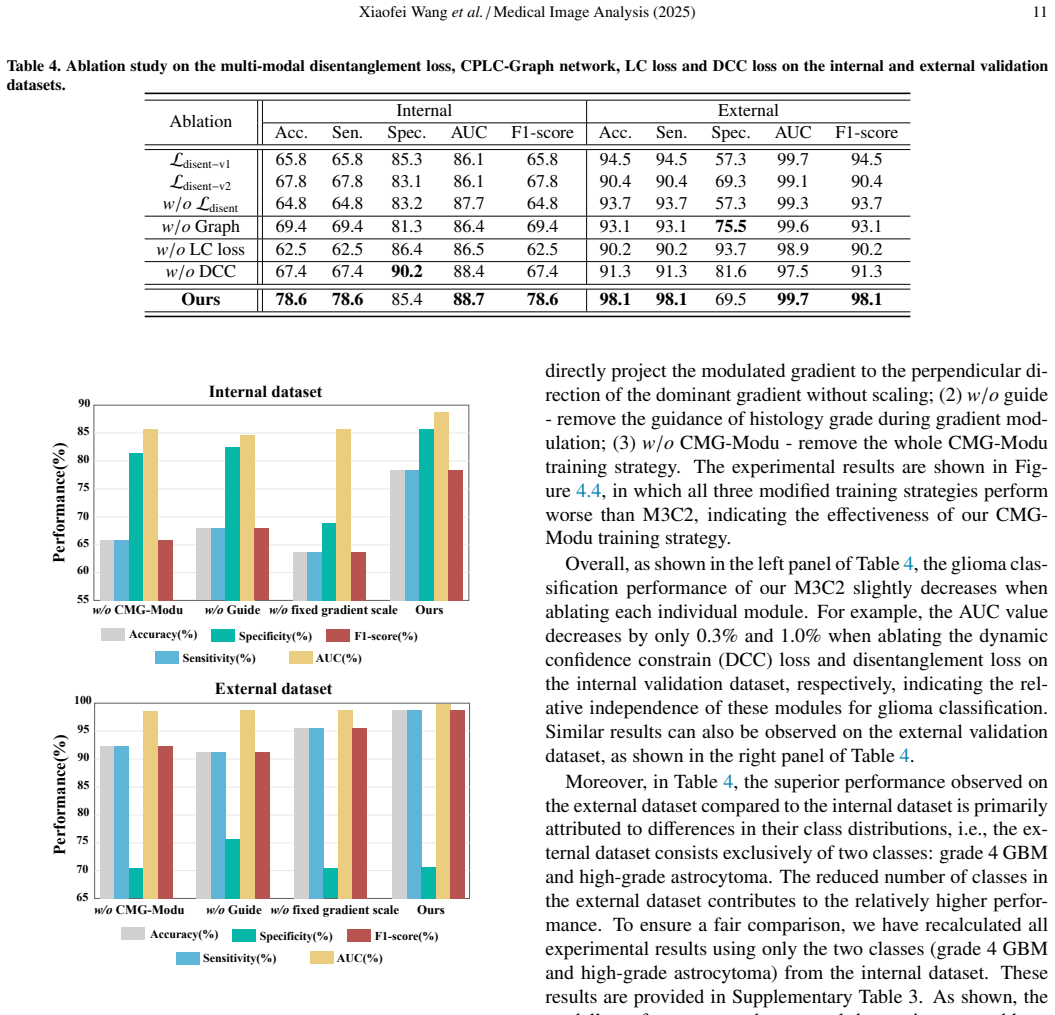
On the paper's own terms, the central discovery is that a whole-slide-image model can outperform separate predictors by treating histology features and molecular markers as jointly predicted, interacting targets rather than as inputs or independent tasks. The empirical claim is that the four WHO 2021 glioma classes can be classified at 78.6% internal accuracy, at least 5.6 points higher in accuracy, sensitivity, and F1 than any of thirteen compared methods, and 98.1% accuracy on an external cohort, while simultaneously predicting IDH mutation, 1p/19q co-deletion, CDKN homozygous deletion, and the histology feature of necrosis and microvascular proliferation with AUCs of 95.0%, 90.9%, 76.0%, and 98.1%. The interaction itself is the point: removing either the molecular or the histology branch drops internal accuracy by about ten points, and ablating any of the cross-modal coupling mechanisms degrades performance further.
Load-bearing premise
The reported gains assume that the internal train/test split keeps every slide of a patient in the same fold, but the paper merges multi-regional TCGA and CPTAC sets (3,578 WSIs from 1,054 cases) without ever stating that the split is at the patient level.
Editorial extensions
If this is right
- A single whole-slide-image pipeline can replace separate molecular-sequencing and histology workflows for the four WHO 2021 glioma classes, reducing cost and turnaround time.
- The same joint-prediction-plus-interaction recipe is directly applicable to other cancers whose classification now depends on histology-molecular pairs, such as endometrial, renal, and thyroid tumors.
- Multi-scale input (10X tissue-level plus 20X cellular-level) with disentangled shared and task-specific features outperforms single-magnification training and simple feature concatenation.
- Explicit co-occurrence modeling through the CPLC-Graph and LC loss improves each molecular marker's prediction, not just the final glioma label.
- The cross-modal interaction mechanisms (DCC loss and CMG-Modu) are each necessary: removing any one of them lowers internal accuracy by multiple points.
Reading between the lines
- If the internal gains survive a strict patient-level split, treating biomarker prediction as an auxiliary task with explicit cross-modal coupling could be adopted as a general regularizer for WSI classifiers beyond glioma.
- The CPLC-Graph's co-occurrence matrix is computed once from the merged TCGA set; on a new population these probabilities should be re-estimated, and the reported gains may depend on that prior.
- The 98.1% external accuracy is on a two-class subset (glioblastoma versus high-grade astrocytoma); an external cohort containing all four classes would be a stronger test of the full WHO 2021 scheme.
- The DCC loss couples only IDH and NMP, so the paper's claim that the mechanism generalizes to other histology-molecular pairs is plausible but untested by the reported experiments.
Editorial analysis
A structured set of objections, weighed in public.
Referee Report
Summary. The paper proposes M3C2, a multi-task multi-instance learning framework that jointly predicts WHO 2021 glioma classes, histology features (NMP), and molecular markers (IDH, 1p/19q, CDKN) from multi-magnification whole-slide images. It introduces a multi-scale disentangling module, a co-occurrence probability-based label-correlation graph (CPLC-Graph) with an LC loss, a dynamic confidence constrain (DCC) loss, and a cross-modal gradient modulation (CMG-Modu) strategy. The authors validate on an internal dataset merging TCGA GBM-LGG and CPTAC (3,578 WSIs from 1,054 cases) and an external IvYGAP dataset, reporting state-of-the-art accuracy (78.6% internal, 98.1% external) and improved molecular marker and histology prediction. Code is released.
Significance. If the empirical claims hold, M3C2 would be a valuable contribution to computational pathology, aligning with the WHO 2021 diagnostic paradigm by jointly modeling histology-molecular interactions and predicting markers from WSIs alone. The paper is commendable for its broad experimental scope (13 baselines, ablations, subgroup and magnification analyses, external validation, released code). However, the central claim of superiority on the internal dataset is currently weakened by an unspecified split unit, a potentially leaking co-occurrence matrix, and the absence of uncertainty quantification; these issues need to be resolved before the results can be taken as evidence for the method's advantage.
major comments (4)
- [Section 4.1] The internal dataset is described as 3,578 WSIs from 1,054 cases, but the paper never states whether all WSIs from a single case are confined to the same train/validation/test fold; if the split is at the WSI level, the same patient's slides can appear in both training and testing, and the reported internal gains (Table 1, 78.6% vs 73.0%) could be inflated by memorizing patient-specific appearance. The authors must specify the split unit and, if it is not case-level, re-run the experiments with a case-level split.
- [Section 3.4, Eq. (4)] The co-occurrence matrix A is 'calculated using our internal large-scale TCGA dataset' with no statement that the calculation is restricted to the training fold; since A is used both as graph adjacency and as the target of the LC loss (Eq. 5), estimating it from the full cohort (including test cases) would leak aggregate label information into training. Please report how A is computed and confirm it uses only the training split, or provide a cross-validation scheme for A.
- [Section 4.3, Tables 1 and 2] All reported metrics are single-point estimates with no error bars, confidence intervals, or significance tests; the headline margin of 5.6% in accuracy over the best baseline could be within seed-level variation. The authors should report mean plus/minus standard deviation over multiple runs (or at least bootstrap confidence intervals) and a significance test for the main comparisons.
- [Section 4.4, Table 4] The ablation for LC loss shows a drop from 78.6% to 62.5% accuracy (16.1%), which is unusually large for a loss term and may be a symptom of the leakage in A described above; the authors should re-evaluate this ablation under a training-fold-only A and discuss whether the large effect persists.
minor comments (4)
- [Section 4.4] The CMG-Modu ablation text refers to 'Figure 4.4' but the actual figure is numbered Figure 7 in the manuscript; the cross-reference should be corrected.
- [Table 5] The column header 'w/o GMC-Modu' appears to be a typo for 'w/o CMG-Modu'.
- [Section 4.3] The sentence 'the middle panel of Table 1 shows that shows that M3C2 performs the best' contains a duplicated phrase and should be edited.
- [Introduction] The claim that this is 'the first attempt to classify cancer via modeling the interaction of histology and molecular markers predictions' is too strong given that the conference version (Wang et al., 2023) already models such interactions; please rephrase to avoid overclaiming.
Circularity Check
Internal co-occurrence matrix A is computed from the evaluation cohort and used as both graph adjacency and LC-loss target, so the reported internal molecular-marker and glioma gains are partly fitted to the internal test-label statistics; external validation is independent but two-class only.
-
fitted input called prediction
[Section 3.4 (CPLC-Graph network and LC loss), Section 4.1 (internal dataset definition)]
"Note that A is a shared value calculated using our internal large-scale TCGA dataset. ... LLC = MSE(A, Dcos) ... A j i = 1/2 (p(Fin_i|Fin_j) + p(Fin_j|Fin_i))."
The LC loss is literally the MSE between the co-occurrence matrix A and the cosine similarity of the predicted molecular-marker features. A is defined from the co-occurrence probabilities of the three molecular-marker labels, and the paper states it is calculated using the internal large-scale TCGA dataset. The internal dataset is the same cohort on which the reported predictions are evaluated (3,578 WSIs from 1,054 cases, Section 4.1), and no statement restricts A to the training fold. Therefore, unless A is computed only from training labels, the marker-prediction head is trained to reproduce the aggregate label statistics of the evaluation cohort, and the reported internal gains (78.6% vs.
full rationale
This is an empirical methods paper, not a first-principles derivation, and most supervised components are standard multi-task losses with independent data. The main circularity-adjacent issue is the CPLC-Graph matrix A: it is computed from the internal TCGA cohort and used both as graph adjacency and as the MSE target for the cosine similarity of predicted marker features. Because the paper does not state that A is restricted to the training fold, the reported internal marker and glioma metrics can benefit from the test-label co-occurrence statistics; the LC-loss ablation shows this pathway is load-bearing for the headline internal improvement. No self-citation chain is load-bearing: the conference version (Wang et al. 2023) is used as a baseline, and the reported improvements over it are empirical. The external IvYGAP evaluation is independent of the internal A construction and partly supports generalizability, although the paper itself notes the external set contains only two classes. The unconfirmed case-level split of multi-regional WSIs is a separate evaluation-integrity concern about leakage, not a circularity pattern, so it does not raise the circularity score itself.
Assumptions & free parameters
free parameters (4)
- co-occurrence matrix A =
3x3 pairwise co-occurrence probabilities from internal TCGA labels
- graph balancing weight alpha =
not reported in the main text, set to 0 in the w/o Graph ablation
- DCC curriculum hyperparameters M0, beta, p0 =
not reported in the main text
- MIL patch count N and sampling strategy =
2,500 patches per WSI, with biological repeat and 2D average sampling
assumptions (5)
- domain assumption WHO 2021 glioma classes can be defined by IDH, 1p/19q, CDKN and NMP as described in the label pipeline
- domain assumption Molecular markers are visually inferable from H&E histology
- domain assumption The clinical prior that more than 95% of NMP-positive tumors are IDH wildtype (Alzial et al., 2022)
- domain assumption Merging TCGA GBM-LGG and CPTAC into one internal dataset is valid
- domain assumption Pretrained ResNet-50 features transfer to pathology images
Cite this review
Pith. "Pith review of Joint Modelling Histology and Molecular Markers for Cancer Classification." pith.science (2026). https://pith.science/paper/M4YZEMWM
@misc{pith2026250207979,
  author       = {Pith},
  title        = {Pith review of: Joint Modelling Histology and Molecular Markers for Cancer Classification},
  year         = {2026},
  howpublished = {\url{https://pith.science/paper/M4YZEMWM}},
  note         = {Machine review of arXiv:2502.07979}
}
read the original abstract
Cancers are characterized by remarkable heterogeneity and diverse prognosis. Accurate cancer classification is essential for patient stratification and clinical decision-making. Although digital pathology has been advancing cancer diagnosis and prognosis, the paradigm in cancer pathology has shifted from purely relying on histology features to incorporating molecular markers. There is an urgent need for digital pathology methods to meet the needs of the new paradigm. We introduce a novel digital pathology approach to jointly predict molecular markers and histology features and model their interactions for cancer classification. Firstly, to mitigate the challenge of cross-magnification information propagation, we propose a multi-scale disentangling module, enabling the extraction of multi-scale features from high-magnification (cellular-level) to low-magnification (tissue-level) whole slide images. Further, based on the multi-scale features, we propose an attention-based hierarchical multi-task multi-instance learning framework to simultaneously predict histology and molecular markers. Moreover, we propose a co-occurrence probability-based label correlation graph network to model the co-occurrence of molecular markers. Lastly, we design a cross-modal interaction module with the dynamic confidence constrain loss and a cross-modal gradient modulation strategy, to model the interactions of histology and molecular markers. Our experiments demonstrate that our method outperforms other state-of-the-art methods in classifying glioma, histology features and molecular markers. Our method promises to promote precise oncology with the potential to advance biomedical research and clinical applications. The code is available at https://github.com/LHY1007/M3C2
Figures


Figures from the paper (3 more)


Reference graph
Works this paper leans on
-
[1]
author Alzial, G. , author Renoult, O. , author Paris, F. , author Gratas, C. , author Clavreul, A. , author Pecqueur, C. , year 2022 . title Wild-type isocitrate dehydrogenase under the spotlight in glioblastoma . journal Oncogene volume 41 , pages 613--621
work page 2022
-
[2]
author Berger, T.R. , author Wen, P.Y. , author Lang-Orsini, M. , author Chukwueke, U.N. , year 2022 . title World health organization 2021 classification of central nervous system tumors and implications for therapy for adult-type gliomas: a review . journal JAMA oncology
work page 2022
-
[3]
author Bhattacharyya, R. , author Roy, P. , author Banerji, S. , author Mitra, S. , year 2024 . title Efficient grading of prostate cancer wsi with deep learning , in: booktitle Medical Imaging 2024: Digital and Computational Pathology , organization SPIE . pp. pages 20--26
work page 2024
-
[4]
author Chen, R.J. , author Lu, M.Y. , author Wang, J. , author Williamson, D.F. , author Rodig, S.J. , author Lindeman, N.I. , author Mahmood, F. , year 2020 . title Pathomic fusion: an integrated framework for fusing histopathology and genomic features for cancer diagnosis and prognosis . journal IEEE Transactions on Medical Imaging volume 41 , pages 757--770
work page 2020
-
[5]
author Chen, R.J. , author Lu, M.Y. , author Weng, W.H. , author Chen, T.Y. , author Williamson, D.F. , author Manz, T. , author Shady, M. , author Mahmood, F. , year 2021 . title Multimodal co-attention transformer for survival prediction in gigapixel whole slide images , in: booktitle 2021 IEEE/CVF International Conference on Computer Vision (ICCV) , pp...
arXiv 2021
-
[6]
author Coudray, N. , author Ocampo, P.S. , author Sakellaropoulos, T. , author Narula, N. , author Snuderl, M. , author Feny \"o , D. , author Moreira, A.L. , author Razavian, N. , author Tsirigos, A. , year 2018 . title Classification and mutation prediction from non--small cell lung cancer histopathology images using deep learning . journal Nature medic...
work page 2018
-
[7]
author Deng, S. , author Zhang, X. , author Yan, W. , author Chang, E.I.C. , author Fan, Y. , author Lai, M. , author Xu, Y. , year 2020 . title Deep learning in digital pathology image analysis: a survey . journal Frontiers of medicine volume 14 , pages 470--487
work page 2020
-
[8]
author Ding, K. , author Zhou, M. , author Metaxas, D.N. , author Zhang, S. , year 2023 . title Pathology-and-genomics multimodal transformer for survival outcome prediction , in: booktitle International Conference on Medical Image Computing and Computer-Assisted Intervention , organization Springer . pp. pages 622--631
work page 2023
Show all 68 references
-
[9]
, year 2020
author Dosovitskiy, A.e.a. , year 2020 . title An image is worth 16x16 words: Transformers for image recognition at scale . journal arXiv preprint arXiv:2010.11929
2020 arXiv
-
[10]
, author Bar, E.E
author Eberhart, C.G. , author Bar, E.E. , year 2020 . title Spatial enrichment of cellular states in glioblastoma . journal Acta neuropathologica volume 140 , pages 85--87
2020
-
[11]
, author Vu, Q.D
author Graham, S. , author Vu, Q.D. , author Raza, S.E.A. , author Azam, A. , author Tsang, Y.W. , author Kwak, J.T. , author Rajpoot, N. , year 2019 . title Hover-net: Simultaneous segmentation and classification of nuclei in multi-tissue histology images . journal Medical im...
2019
-
[12]
, author Liu, X
author Hao, F. , author Liu, X. , author Li, M. , author Han, W. , year 2023 . title Accurate kidney pathological image classification method based on deep learning and multi-modal fusion method with application to membranous nephropathy . journal Life volume 13 , pages 399
2023
-
[13]
, author Zhang, X
author He, K. , author Zhang, X. , author Ren, S. , author Sun, J. , year 2016 . title Deep residual learning for image recognition , in: booktitle Proceedings of the IEEE conference on computer vision and pattern recognition , pp. pages 770--778
2016
-
[14]
, author Jiang, C
author Hollon, T. , author Jiang, C. , author Chowdury, A. , author Nasir-Moin, M. , author Kondepudi, A. , author Aabedi, A. , author Adapa, A. , author Al-Holou, W. , author Heth, J. , author Sagher, O. , year 2023 . title Artificial-intelligence-based molecular classificati...
2023
-
[15]
, author Liu, Z
author Huang, G. , author Liu, Z. , author Van Der Maaten, L. , author Weinberger, K.Q. , year 2017 . title Densely connected convolutional networks , in: booktitle Proceedings of the IEEE conference on computer vision and pattern recognition , pp. pages 4700--4708
2017
-
[16]
, author Tomczak, J
author Ilse, M. , author Tomczak, J. , author Welling, M. , year 2018 . title Attention-based deep multiple instance learning , in: booktitle International conference on machine learning , organization PMLR . pp. pages 2127--2136
2018
-
[17]
, author Nastic, D
author Imboden, S. , author Nastic, D. , author Ghaderi, M. , author Rydberg, F. , author Siegenthaler, F. , author Mueller, M.D. , author Rau, T.T. , author Epstein, E. , author Carlson, J.W. , year 2021 . title Implementation of the 2021 molecular esgo/estro/esp risk groups ...
2021
-
[18]
, author Vaidya, A
author Jaume, G. , author Vaidya, A. , author Chen, R.J. , author Williamson, D.F. , author Liang, P.P. , author Mahmood, F. , year 2024 . title Modeling dense multimodal interactions between biological pathways and histology for survival prediction , in: booktitle Proceedings...
2024
-
[19]
, author Liu, S
author Jose, L. , author Liu, S. , author Russo, C. , author Cong, C. , author Song, Y. , author Rodriguez, M. , author Di Ieva, A. , year 2023 . title Artificial intelligence--assisted classification of gliomas using whole slide images . journal Archives of Pathology & Labora...
2023
-
[20]
, author Toyokawa, G
author Kanavati, F. , author Toyokawa, G. , author Momosaki, S. , author Rambeau, M. , author Kozuma, Y. , author Shoji, F. , author Yamazaki, K. , author Takeo, S. , author Iizuka, O. , author Tsuneki, M. , year 2020 . title Weakly-supervised learning for lung carcinoma class...
2020
-
[21]
, author Reddy, K
author Khalighi, S. , author Reddy, K. , author Midya, A. , author Pandav, K.B. , author Madabhushi, A. , author Abedalthagafi, M. , year 2024 . title Artificial intelligence in neuro-oncology: advances and challenges in brain tumor diagnosis, prognosis, and precision treatmen...
2024
-
[22]
, author Ba, J
author Kingma, D.P. , author Ba, J. , year 2014 . title Adam: A method for stochastic optimization . journal arXiv preprint arXiv:1412.6980
2014 arXiv
-
[23]
, author Sutskever, I
author Krizhevsky, A. , author Sutskever, I. , author Hinton, G.E. , year 2012 . title Imagenet classification with deep convolutional neural networks . journal Advances in neural information processing systems volume 25
2012
-
[24]
, author Li, C
author Li, X. , author Li, C. , author Rahaman, M.M. , author Sun, H. , author Li, X. , author Wu, J. , author Yao, Y. , author Grzegorzek, M. , year 2022 a. title A comprehensive review of computer-aided whole-slide image analysis: from datasets to feature extraction, segment...
2022
-
[25]
, author Wu, H
author Li, X. , author Wu, H. , author Li, M. , author Liu, H. , year 2022 b. title Multi-label video classification via coupling attentional multiple instance learning with label relation graph . journal Pattern Recognition Letters volume 156 , pages 53--59
2022
-
[26]
, author Chen, H
author Lin, H. , author Chen, H. , author Dou, Q. , author Wang, L. , author Qin, J. , author Heng, P.A. , year 2018 . title Scannet: A fast and dense scanning framework for metastastic breast cancer detection from whole-slide image , in: booktitle 2018 IEEE winter conference ...
2018
-
[27]
, author Wang, H
author Liu, W. , author Wang, H. , author Shen, X. , author Tsang, I.W. , year 2021 . title The emerging trends of multi-label learning . journal IEEE transactions on pattern analysis and machine intelligence volume 44 , pages 7955--7974
2021
-
[28]
, author Ohgaki, H
author Louis, D.N. , author Ohgaki, H. , author Wiestler, O.D. , author Cavenee, W.K. , author Burger, P.C. , author Jouvet, A. , author Scheithauer, B.W. , author Kleihues, P. , year 2007 . title The 2007 who classification of tumours of the central nervous system . journal A...
2007
-
[29]
, author Perry, A
author Louis, D.N. , author Perry, A. , author Reifenberger, G. , author Von Deimling, A. , author Figarella-Branger, D. , author Cavenee, W.K. , author Ohgaki, H. , author Wiestler, O.D. , author Kleihues, P. , author Ellison, D.W. , year 2016 . title The 2016 world health or...
2016
-
[30]
, year 2021
author Louis, D.N.e.a. , year 2021 . title The 2021 who classification of tumors of the central nervous system: a summary . journal Neuro-oncology volume 23 , pages 1231--1251
2021
-
[31]
, author Williamson, D.F
author Lu, M.Y. , author Williamson, D.F. , author Chen, T.Y. , author Chen, R.J. , author Barbieri, M. , author Mahmood, F. , year 2021 . title Data-efficient and weakly supervised computational pathology on whole-slide images . journal Nature biomedical engineering volume 5 ...
2021
-
[32]
, author Liu, Y
author Lv, Q. , author Liu, Y. , author Sun, Y. , author Wu, M. , year 2024 . title Insight into deep learning for glioma idh medical image analysis: A systematic review . journal Medicine volume 103 , pages e37150
2024
-
[33]
, author Jiang, L
author Mao, Y. , author Jiang, L. , author Chen, X. , author Li, C. , year 2023 . title Disc-diff: Disentangled conditional diffusion model for multi-contrast mri super-resolution , in: booktitle International Conference on Medical Image Computing and Computer-Assisted Interve...
2023
-
[34]
, author Rojas-Valenzuela, I
author Mart \' nez-Fernandez, E. , author Rojas-Valenzuela, I. , author Valenzuela, O. , author Rojas, I. , year 2023 . title Computer aided classifier of colorectal cancer on histopatological whole slide images analyzing deep learning architecture parameters . journal Applied...
2023
-
[35]
, author Taylor, J.W
author Molinaro, A.M. , author Taylor, J.W. , author Wiencke, J.K. , author Wrensch, M.R. , year 2019 . title Genetic and molecular epidemiology of adult diffuse glioma . journal Nature Reviews Neurology volume 15 , pages 405--417
2019
-
[36]
, author Zhao, J
author Nasrallah, M.P. , author Zhao, J. , author Tsai, C.C. , author Meredith, D. , author Marostica, E. , author Ligon, K.L. , author Golden, J.A. , author Yu, K.H. , year 2023 . title Machine learning for cryosection pathology predicts the 2021 who classification of glioma ...
2023
-
[37]
, author Khadka, R
author Nguyen, T. , author Khadka, R. , author Phan, N. , author Yazidi, A. , author Halvorsen, P. , author Riegler, M.A. , year 2023 . title Combining datasets to improve model fitting , in: booktitle 2023 International Joint Conference on Neural Networks (IJCNN) , organizati...
2023
-
[38]
, author Can, S
author Ozyoruk, K.B. , author Can, S. , author Gokceler, G.I. , author Basak, K. , author Demir, D. , author Serin, G. , author Hacisalihoglu, U.P. , author Kurtulu s , E. , author Darbaz, B. , author Lu, M.Y. , et al., year 2021 . title Deep learning-based frozen section to f...
2021 arXiv
-
[39]
, author Jones, K.A
author Pei, L. , author Jones, K.A. , author Shboul, Z.A. , author Chen, J.Y. , author Iftekharuddin, K.M. , year 2021 . title Deep neural network analysis of pathology images with integrated molecular data for enhanced glioma classification and grading . journal Frontiers in ...
2021
-
[40]
, author Wesseling, P
author Perry, A. , author Wesseling, P. , year 2016 . title Histologic classification of gliomas . journal Handbook of clinical neurology volume 134 , pages 71--95
2016
-
[41]
, author Rizzoli, S.O
author Phan, N.T. , author Rizzoli, S.O. , year 2020 . title High-resolution molecular imaging and its applications in brain and synapses . journal Volume Microscopy: Multiscale Imaging with Photons, Electrons, and Ions , pages 37--58
2020
-
[42]
, author Zhao, L
author Qiu, L. , author Zhao, L. , author Zhao, W. , author Zhao, J. , year 2024 . title Dual-space disentangled-multimodal network (ddm-net) for glioma diagnosis and prognosis with incomplete pathology and genomic data . journal Physics in Medicine & Biology volume 69 , pages 085028
2024
-
[43]
, author Kim, S
author Ren, E. , author Kim, S. , author Mohamad, S. , author Huguet, S.F. , author Shi, Y. , author Cohen, A.R. , author Piddini, E. , author Salas, R.C. , year 2021 . title Deep learning-enhanced morphological profiling predicts cell fate dynamics in real-time in hpscs . jou...
2021
-
[44]
, author Madesta, F
author Schmitz, R. , author Madesta, F. , author Nielsen, M. , author Krause, J. , author Steurer, S. , author Werner, R. , author R \"o sch, T. , year 2021 . title Multi-scale fully convolutional neural networks for histopathology image segmentation: from nuclear aberrations ...
2021
-
[45]
, author Han, Z
author Shao, W. , author Han, Z. , author Cheng, J. , author Cheng, L. , author Wang, T. , author Sun, L. , author Lu, Z. , author Zhang, J. , author Zhang, D. , author Huang, K. , year 2019 . title Integrative analysis of pathological images and multi-dimensional genomic data...
2019
-
[46]
, author Bian, H
author Shao, Z. , author Bian, H. , author Chen, Y. , author Wang, Y. , author Zhang, J. , author Ji, X. , author Zhang, Y. , year 2021 . title Transmil: Transformer based correlated multiple instance learning for whole slide image classification . journal Advances in neural i...
2021
-
[47]
, author Liu, W
author Szegedy, C. , author Liu, W. , author Jia, Y. , author Sermanet, P. , author Reed, S. , author Anguelov, D. , author Erhan, D. , author Vanhoucke, V. , author Rabinovich, A. , year 2015 . title Going deeper with convolutions , in: booktitle Proceedings of the IEEE confe...
2015
-
[48]
, author Vanhoucke, V
author Szegedy, C. , author Vanhoucke, V. , author Ioffe, S. , author Shlens, J. , author Wojna, Z. , year 2016 . title Rethinking the inception architecture for computer vision , in: booktitle Proceedings of the IEEE conference on computer vision and pattern recognition , pp....
2016
-
[49]
, author Chen, B
author Tan, M. , author Chen, B. , author Pang, R. , author Vasudevan, V. , author Sandler, M. , author Howard, A. , author Le, Q.V. , year 2019 . title Mnasnet: Platform-aware neural architecture search for mobile , in: booktitle Proceedings of the IEEE/CVF conference on comp...
2019
-
[50]
, author Czerwi \'n ska, P
author Tomczak, K. , author Czerwi \'n ska, P. , author Wiznerowicz, M. , year 2015 . title Review the cancer genome atlas (tcga): an immeasurable source of knowledge . journal Contemporary Oncology/Wsp \'o czesna Onkologia volume 2015 , pages 68--77
2015
-
[51]
, author Hes, O.e.a
author Trpkov, K. , author Hes, O.e.a. , year 2021 . title New developments in existing who entities and evolving molecular concepts: The genitourinary pathology society (gups) update on renal neoplasia . journal Modern Pathology volume 34 , pages 1392--1424
2021
-
[52]
, author Bychkov, A
author Uegami, W. , author Bychkov, A. , author Ozasa, M. , author Uehara, K. , author Kataoka, K. , author Johkoh, T. , author Kondoh, Y. , author Sakanashi, H. , author Fukuoka, J. , year 2022 . title Mixture of human expertise and deep learning—developing an explainable mod...
2022
-
[53]
, author Puerto, I
author Verdugo, E. , author Puerto, I. , author Medina, M. \'A . , year 2022 . title An update on the molecular biology of glioblastoma, with clinical implications and progress in its treatment . journal Cancer Communications volume 42 , pages 1083--1111
2022
-
[54]
, author Lam, A.K
author Volante, M. , author Lam, A.K. , author Papotti, M. , author Tallini, G. , year 2021 . title Molecular pathology of poorly differentiated and anaplastic thyroid cancer: what do pathologists need to know? journal Endocrine pathology volume 32 , pages 63--76
2021
-
[55]
, author Zhang, H
author Wang, P. , author Zhang, H. , author Zhu, M. , author Jiang, X. , author Qin, J. , author Yuan, Y. , year 2024 a. title Mgiml: Cancer grading with incomplete radiology-pathology data via memory learning and gradient homogenization . journal IEEE Transactions on Medical Imaging
2024
-
[56]
, author Huang, X
author Wang, X. , author Huang, X. , author Price, S. , author Li, C. , year 2024 b. title Cross-modal diffusion modelling for super-resolved spatial transcriptomics , in: booktitle International Conference on Medical Image Computing and Computer-Assisted Intervention , organi...
2024
-
[57]
, author Price, S
author Wang, X. , author Price, S. , author Li, C. , year 2023 . title Multi-task learning of histology and molecular markers for classifying diffuse glioma , in: booktitle International Conference on Medical Image Computing and Computer-Assisted Intervention , organization Sp...
2023
-
[58]
, author Chen, X
author Wei, Y. , author Chen, X. , author Zhu, L. , author Zhang, L. , author Sch \"o nlieb, C.B. , author Price, S. , author Li, C. , year 2023 . title Multi-modal learning for predicting the genotype of glioma . journal IEEE Transactions on Medical Imaging volume 42 , pages ...
2023
-
[59]
, author van den Bent, M
author Wesseling, P. , author van den Bent, M. , author Perry, A. , year 2015 . title Oligodendroglioma: pathology, molecular mechanisms and markers . journal Acta neuropathologica volume 129 , pages 809--827
2015
-
[60]
, author Chen, Z
author Xing, X. , author Chen, Z. , author Zhu, M. , author Hou, Y. , author Gao, Z. , author Yuan, Y. , year 2022 . title Discrepancy and gradient-guided multi-modal knowledge distillation for pathological glioma grading , in: booktitle MICCAI 2022 , organization Springer . p...
2022
-
[61]
, author Tsai, H.W
author Yang, T.L. , author Tsai, H.W. , author Huang, W.C. , author Lin, J.C. , author Liao, J.B. , author Chow, N.H. , author Chung, P.C. , year 2022 . title Pathologic liver tumor detection using feature aligned multi-scale convolutional network . journal Artificial intellig...
2022
-
[62]
, author Meng, Y
author Zhang, H. , author Meng, Y. , author Zhao, Y. , author Qiao, Y. , author Yang, X. , author Coupland, S.E. , author Zheng, Y. , year 2022 a. title Dtfd-mil: Double-tier feature distillation multiple instance learning for histopathology whole slide image classification , ...
2022
-
[63]
, author Yan, R
author Zhang, J. , author Yan, R. , author Perelli, A. , author Chen, X. , author Li, C. , year 2024 a. title Phy-diff: Physics-guided hourglass diffusion model for diffusion mri synthesis , in: booktitle International Conference on Medical Image Computing and Computer-Assiste...
2024
-
[64]
, author Fritah, S
author Zhang, L. , author Fritah, S. , author Nazarov, P.V. , author Kaoma, T. , author Van Dyck, E. , year 2023 . title Impact of idh mutations, the 1p/19q co-deletion and the g-cimp status on alternative splicing in diffuse gliomas . journal International Journal of Molecula...
2023
-
[65]
, author Wei, Y
author Zhang, L. , author Wei, Y. , author Fu, Y. , author Price, S. , author Sch \"o nlieb, C.B. , author Li, C. , year 2022 b. title Mutual contrastive low-rank learning to disentangle whole slide image representations for glioma grading . journal arXiv preprint arXiv:2203.04013
2022 arXiv
-
[66]
, author Xu, Y
author Zhang, Y. , author Xu, Y. , author Chen, J. , author Xie, F. , author Chen, H. , year 2024 b. title Prototypical information bottlenecking and disentangling for multimodal cancer survival prediction . journal arXiv preprint arXiv:2401.01646
2024 arXiv
-
[67]
, author Chen, H
author Zhou, F. , author Chen, H. , year 2023 . title Cross-modal translation and alignment for survival analysis , in: booktitle Proceedings of the IEEE/CVF International Conference on Computer Vision , pp. pages 21485--21494
2023
-
[68]
write newline
" write newline "" before.all 'output.state := FUNCTION n.dashify 't := "" t empty not t #1 #1 substring "-" = t #1 #2 substring "--" = not "--" * t #2 global.max substring 't := t #1 #1 substring "-" = "-" * t #2 global.max substring 't := while if t #1 #1 substring * t #2 gl...
Reviewed August 8, 2026 · model on record in the stance chip above.
Discussion (0). Continue with ORCID to comment.