REVIEW 3 major objections 5 minor 22 references
Equivariant Masked Position Prediction for Efficient Molecular Representation
T0 review · 3 major / 5 minor · reviewed 2026-08-08 · deepseek-v4-flash
Pith's one-line read EMPP claims that deleting one atom's 3D coordinate from a molecular graph and training the GNN to predict it from neighboring equivariant embeddings yields a well-posed self-supervised task that improves quantum property prediction beyond…
desk verdict A genuinely new masked-position self-supervision for molecular GNNs with solid auxiliary-task gains, but the pretraining headline is undercut by an unmatched Lmax upgrade. read the letter →
The pith
A machine-rendered reading of the paper's core claim, the machinery that carries it, and where it could break.
The reading
What carries the argument
The load-bearing object is the equivariant position-prediction module. For each neighboring atom k of the masked atom i, the module maps the neighbor's SO(3)-equivariant embedding through an equivariant MLP (gate plus linear plus Clebsch-Gordan tensor product with the masked atom's embedding), converts high-degree spherical-harmonic features into a gridded directional distribution on $S^{2}$, and predicts a binned radius distribution from the type-0 channel; the predicted position is pk plus the predicted relative vector. Spherical harmonics' Wigner-D steerability guarantees the distribution rotates with the molecule, and the zero-force equilibrium condition is what the paper invokes to make the target unique. Sequential single-atom masking keeps the task well-posed while producing O(MN) training examples.
What would settle it
Compute, for a large sample of atoms in the target datasets, how many distinct zero-force positions are consistent with fixed neighboring atoms; if a substantial fraction of atoms admit two or more such positions (rotatable bonds, multi-conformer systems), the well-posedness premise fails exactly there. A behavioral test: pre-train with EMPP on a flexible-molecule dataset with many rotatable bonds and compare downstream property prediction against the same backbone pre-trained by denoising; if the premise is load-bearing, EMPP's advantage should shrink or reverse on that dataset.
Extended reading notes
Core claim
EMPP's central discovery is that masked position prediction is a viable replacement for both attribute masking and denoising as a molecular self-supervised objective. The paper masks only the position of an atom, deletes that node from the graph, injects the masked atom's attributes into the surviving nodes' type-0 embeddings, and predicts the position as a distribution over 128 radius bins between 0.9 and 5 Å plus a directional distribution on the sphere built by spherical-harmonic Fourier transform from each neighbor's equivariant embedding. The training target is a softened Dirac distribution around the true relative vector, optimized by KL divergence. The paper reports consistent gains: on QM9 without extra data, EMPP with the Equiformer backbone improves all 12 properties and achieves the best result on 11; on MD17 it improves most energy and force errors; pre-trained on PCQM4Mv2 with a TorchMD-Net backbone, it outperforms AttrMask, DP-TorchMD-Net, and Frad on most QM9 transfer tasks.
Load-bearing premise
The load-bearing premise, which the paper itself notes is only approximate (Appendix B.1), is that in an equilibrium molecule a masked atom's position is usually uniquely determined by its identity and the neighboring atoms, so the training target is one well-defined location rather than several nearly equal possibilities.
Editorial extensions
If this is right
- Used as an auxiliary loss on QM9 with the Equiformer backbone, EMPP improves accuracy on all 12 quantum properties and reports the best result on 11 of them without extra pre-training data.
- On MD17, EMPP improves energy and force predictions for most molecules, and encoding only energy into the backbone further improves energy prediction.
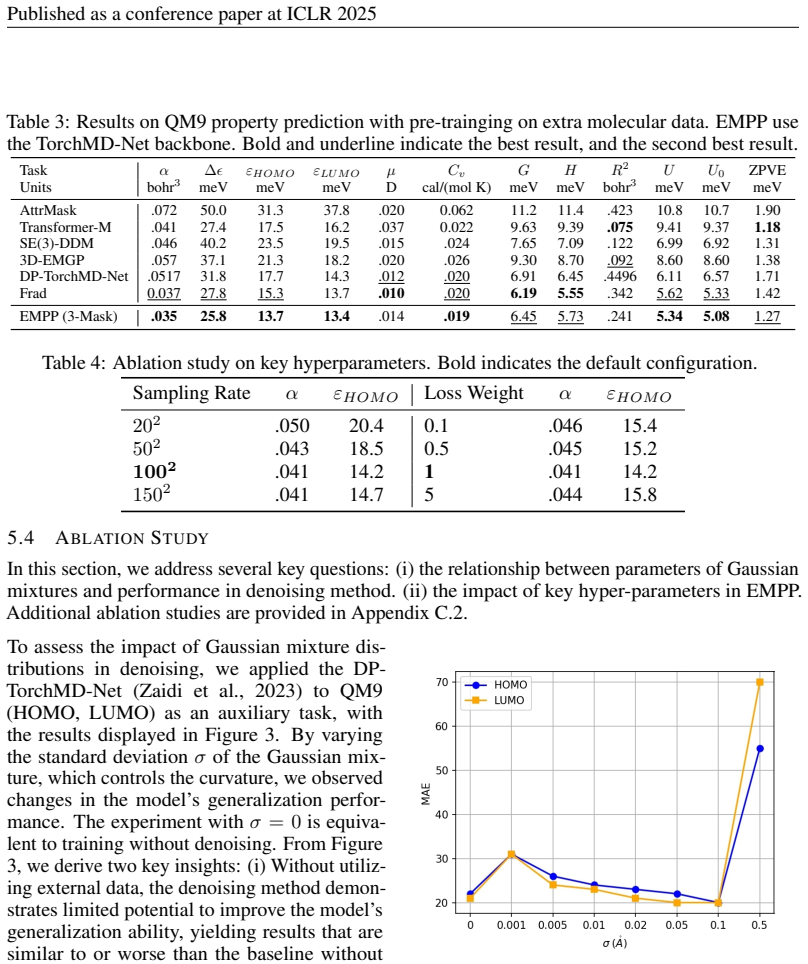
- Pre-trained on PCQM4Mv2 with a TorchMD-Net backbone, EMPP transfers better to QM9 than attribute masking and denoising baselines, including DP-TorchMD-Net and Frad.
- Masking one atom at a time is essential: simultaneously masking several atoms degrades performance, consistent with the paper's claim that multi-atom masking is ill-posed.
- The EMPP loss costs roughly the same per iteration as property-prediction or denoising losses, so using n masks multiplies training time by about n.
Reading between the lines
- Editorial inference: the empirical gains may not actually depend on the zero-force uniqueness argument; deleting an atom and reconstructing its position is a strong geometric data augmentation that forces the model to encode pairwise distances and angles, so the method might keep working on flexible molecules even where the target is multimodal.
- Editorial inference: because the prediction module already outputs a full spatial distribution, it could be adapted to conformer generation or ensemble prediction by replacing the single soft target with a mixture or a latent-conditioned target.
- Editorial inference: the same objective could be used as a pretraining signal for downstream tasks beyond static properties, such as molecular dynamics simulation or force-field fitting, especially for non-equilibrium conformations where energy and force labels are available.
Editorial analysis
A structured set of objections, weighed in public.
Referee Report
Summary. The paper introduces Equivariant Masked Position Prediction (EMPP), a self-supervised task in which one atom's 3D position is masked (its node is removed from the graph) and predicted from the equivariant embeddings of the remaining atoms using spherical-harmonic-based distributions over radius and direction. The authors argue that this position-prediction task is better posed than attribute masking and avoids the Gaussian-mixture approximation used by denoising methods. EMPP is evaluated in two modes: as an auxiliary loss during supervised property prediction on QM9, MD17, and GEOM-Drug, and as a pretraining task on PCQM4Mv2 followed by fine-tuning on QM9. The paper reports consistent improvements over baselines with Equiformer and TorchMD-Net backbones and claims state-of-the-art performance among self-supervised pretraining methods.
Significance. If the central claims hold, EMPP offers a conceptually appealing alternative to attribute masking and denoising for molecular representation learning, with a clean formulation that avoids the need to tune a Gaussian-mixture noise scale. The paper is strengthened by releasing code, by the breadth of ablations (masking count, label distributions, hyperparameters, neighbor choice, molecular size, transferability), and by consistent improvements on QM9 and MD17 without extra pretraining data. However, the central 'surpasses state-of-the-art self-supervised approaches' claim rests on the pretraining comparison in Table 3, and that comparison is confounded by an un-matched architecture upgrade, so the significance of the headline claim is currently not established.
major comments (3)
- [§5.3, Table 3, Appendix B.3] The pretraining results in Table 3 are confounded. The EMPP row uses a TorchMD-Net backbone with the spherical-harmonic degree raised from Lmax=1 to Lmax=3 (Appendix B.3), whereas the comparison methods (AttrMask, DP-TorchMD-Net, Frad, etc.) are evaluated with the standard lower-degree backbone from their source papers. Because no matched control is provided (e.g., an Lmax=3 TorchMD-Net trained and fine-tuned under the identical protocol without the EMPP loss, or Frad at Lmax=3), the improvements over these baselines cannot be attributed to the EMPP objective; they may stem entirely from the architecture upgrade. This directly affects the abstract claim that EMPP 'surpasses state-of-the-art self-supervised approaches.' I recommend adding such control experiments or substantially weakening the claim.
- [§3.3, Eq. (19)–(20), Table 2] The MD17 experiments encode the ground-truth energy and force labels into the GNN embeddings via Eq. (19)–(20) during training. The paper does not state how this label injection is handled at inference time, when the target properties are unknown. If the label injection is used only during training, the train/test distribution shift in the embeddings is not addressed; if it is used at inference, the model would need access to the labels it is supposed to predict. This creates a potential information leak that could explain part of the gains in Table 2 over plain Equiformer. The manuscript must specify the inference procedure and, ideally, include a control with random label injection or no injection.
- [§3.2.1, Appendix B.1, footnote 2] The paper motivates EMPP with the argument that a masked atom's position is uniquely determined by the zero-force condition because 'the number of unknown variables matches the number of equations.' This argument is contradicted by the manuscript's own statements: Appendix B.1 concedes that rotatable bonds and multi-conformer systems produce multiple energetically similar positions, and the footnote on page 5 admits that masking multiple atoms can make position prediction ill-posed. For atoms with such flexibility, the true position label is a mixture, and the claim that EMPP 'bypasses Gaussian mixture approximations' is therefore overstated as a general statement. The empirical gains may still hold (the method can act as a strong data augmentation), but the theoretical well-posedness framing needs to be restricted to rigid local environments or supported by additional evidence.
minor comments (5)
- [Table 4] The sampling-rate entries '202', '502', '1002', and '1502' are almost certainly meant to be '20^2', '50^2', '100^2', and '150^2'; please fix the typography.
- [§5.3, Table 3] The text says EMPP 'surpasses denoising methods in nine tasks,' but in Table 3 EMPP achieves the best value in seven tasks and is second-best in the remaining ones; please clarify the counting.
- [Appendix B.3] Stating that raising Lmax from 1 to 3 'does not change the core operations' underestimates the effect of increasing representational capacity and computational cost; please quantify the change in parameters and runtime.
- [Eq. (9) and surrounding text] There are minor typographical issues, including 'R epresents' and 'RˆS' missing a space, and the notation for the spherical-harmonics representation in Eq. (17) is inconsistent with Eq. (4).
- [Tables 1–3] No error bars or multiple-seed results are reported; given that many improvements are small (e.g., Table 1, εHOMO: 13 vs 14 meV), reporting standard deviations would substantially strengthen the empirical claims.
Circularity Check
No circular derivation: EMPP's position-prediction target is ground-truth geometry, not a function of the downstream property labels.
full rationale
EMPP is a self-supervised pretext task: the training target for a masked atom is its ground-truth 3D position, taken from the same molecular geometry, and the loss (Eqs. 16 and 18) is minimized against that observed coordinate. The downstream property prediction (Eq. 1) is evaluated on held-out labels and is not used to define any pretraining target, so no fitted parameter is renamed as a prediction and no construction forces the property output to reproduce the pretraining loss. The well-posedness discussion in Section 3.2.1 ('there exists a unique optimal position under the force condition, since the number of unknown variables matches the number of equations') is a physical motivation rather than a derivation of the empirical gains; Appendix B.1 and Table 8 explicitly concede that multi-atom masking is ill-posed, which weakens that motivation but does not make the method circular. The self-citations in the paper (An et al. 2024 in the preliminaries; 'HDGNN' in Appendix A.2.3) appear only in background and implementation details and are not load-bearing for the central claim. The use of an Lmax=3 TorchMD-Net backbone in Table 3 (Appendix B.3) is a potential experimental confound relative to lower-degree baselines, but that is an internal-validity concern, not a circularity: the superior numbers are not forced by definition or by a self-citation chain. Overall, the derivation is self-contained against external benchmarks and no circular step is present.
Assumptions & free parameters
free parameters (6)
- sigma_radius =
0.5 Å
- temperature_tau =
0.1
- empp_loss_weight =
1 (QM9), 50 (MD17)
- spherical_grid_sampling =
100^2
- maximum_degree_lmax =
2 (Equiformer), 3 (TorchMD-Net)
- mask_count_n =
1 or 3
assumptions (5)
- domain assumption The equilibrium position of an atom is uniquely determined by the identities and positions of its neighbors via the zero-force condition.
- domain assumption Minimizing the position prediction loss is equivalent to learning interatomic forces and quantum mechanical features.
- ad hoc to paper Soft Gaussian and spherical-Gaussian label distributions are adequate surrogates for the deterministic ground-truth position vector.
- standard math Spherical harmonics form a complete orthonormal basis on S2 and the Fourier transform is invertible for the gridded signal.
- standard math Operations on the sphere (shared MLP, softmax) preserve SO(3) equivariance of the predicted distribution.
Cite this review
Pith. "Pith review of Equivariant Masked Position Prediction for Efficient Molecular Representation." pith.science (2026). https://pith.science/paper/IJNZ5OKE
@misc{pith2026250208209,
  author       = {Pith},
  title        = {Pith review of: Equivariant Masked Position Prediction for Efficient Molecular Representation},
  year         = {2026},
  howpublished = {\url{https://pith.science/paper/IJNZ5OKE}},
  note         = {Machine review of arXiv:2502.08209}
}
read the original abstract
Graph neural networks (GNNs) have shown considerable promise in computational chemistry. However, the limited availability of molecular data raises concerns regarding GNNs' ability to effectively capture the fundamental principles of physics and chemistry, which constrains their generalization capabilities. To address this challenge, we introduce a novel self-supervised approach termed Equivariant Masked Position Prediction (EMPP), grounded in intramolecular potential and force theory. Unlike conventional attribute masking techniques, EMPP formulates a nuanced position prediction task that is more well-defined and enhances the learning of quantum mechanical features. EMPP also bypasses the approximation of the Gaussian mixture distribution commonly used in denoising methods, allowing for more accurate acquisition of physical properties. Experimental results indicate that EMPP significantly enhances performance of advanced molecular architectures, surpassing state-of-the-art self-supervised approaches. Our code is released in https://github.com/ajy112/EMPP
Figures


Figures from the paper (3 more)


Reference graph
Works this paper leans on
-
[1]
In Table 1 and Table 2, the results of baselines is from (Liao & Smidt, 2023)
Hyper-parameters of Baselines. In Table 1 and Table 2, the results of baselines is from (Liao & Smidt, 2023). In Table 3, the results of baselines is from (Feng et al., 2023). Additionally, the result of AttrMask is from (Luo et al., 2022). In the ablation study, we verified the relationship between the denoising method and the standard deviation. The exp...
work page 2023
-
[6]
Graphmae: Self-supervised masked graph autoencoders
11 Published as a conference paper at ICLR 2025 Zhenyu Hou, Xiao Liu, Yukuo Cen, Yuxiao Dong, Hongxia Yang, Chunjie Wang, and Jie Tang. Graphmae: Self-supervised masked graph autoencoders. In Proceedings of the 28th ACM SIGKDD Conference on Knowledge Discovery and Data Mining, pp. 594–604,
work page 2025
-
[7]
Strategies for pre-training graph neural networks
Weihua Hu, Bowen Liu, Joseph Gomes, Marinka Zitnik, Percy Liang, Vijay Pande, and Jure Leskovec. Strategies for pre-training graph neural networks. In International Conference on Learning Representations, ICLR 2020,
work page 2020
-
[8]
Table 13: Ablation study on hyper-parameters in label distribution. Method α ε HOM O Without self-supervision .046 15.4 Baseline (τ = 0.1/σ = 0.5) .041 14.2 (τ = 0.1/σ = 0.3) .041 14.2 (τ = 0.1/σ = 0.1) .041 14.3 (τ = 0.1/σ = 0.05) .042 14.2 (τ = 0.1/σ = 0.01) .042 14.3 (τ = 0.5/σ = 0.5) .041 14.2 (τ = 0.3/σ = 0.5) .041 14.1 (τ = 0.05/σ = 0.5) .042 14.3 (...
work page 2025
-
[9]
Molecular Geometry Pretraining with SE(3)-Invariant Denoising Distance Matching
Shengchao Liu, Hongyu Guo, and Jian Tang. Molecular geometry pretraining with se (3)-invariant denoising distance matching. arXiv preprint arXiv:2206.13602,
-
[10]
Highly accurate quantum chemical property prediction with uni-mol+
Shuqi Lu, Zhifeng Gao, Di He, Linfeng Zhang, and Guolin Ke. Highly accurate quantum chemical property prediction with uni-mol+. arXiv preprint arXiv:2303.16982,
-
[12]
Tensor field networks: Rotation-and translation-equivariant neural networks for 3d point clouds
Nathaniel Thomas, Tess Smidt, Steven Kearnes, Lusann Yang, Li Li, Kai Kohlhoff, and Patrick Riley. Tensor field networks: Rotation-and translation-equivariant neural networks for 3d point clouds. Neurips 2018,
work page 2018
-
[13]
Spherical channels for modeling atomic interactions
C Lawrence Zitnick, Abhishek Das, Adeesh Kolluru, Janice Lan, Muhammed Shuaibi, Anuroop Sriram, Zachary Ulissi, and Brandon Wood. Spherical channels for modeling atomic interactions. Neurips 2022,
work page 2022
Show all 22 references
-
[14]
14 A.2 Equivariant Operation
13 Published as a conference paper at ICLR 2025 APPENDIX A The Mathematics 14 A.1 The Mathematics of Spherical Harmonics . . . . . . . . . . . . . . . 14 A.2 Equivariant Operation . . . . . . . . . . . . . . . . . . . . . . . . . . 15 B Model Details 18 B.1 The Position Distri...
2025
-
[15]
128x0e+64x1e+32x2e
to implement the corresponding tensor product. It is crucial to emphasize that the formulation of CG tensor product is devoid of any learnable parameters, as CG coefficients remain constant. In the context of e3nn, learnable parameters are introduced into each path, represente...
2025
-
[16]
It constructs a fragment sequence by iteratively masking atoms, with each subsequent fragment masking one additional atom
proposes a molecular generation framework based on equivariant representations. It constructs a fragment sequence by iteratively masking atoms, with each subsequent fragment masking one additional atom. Symphony then uses spherical harmonic projections of high- degree equivari...
2025
-
[17]
Most of our training configurations are the same as those of the Denoising method (Zaidi et al., 2023)
The validation set of PCQM4MV2 is used to evaluate the accuracy of position prediction. Most of our training configurations are the same as those of the Denoising method (Zaidi et al., 2023). During the fine-tuning phase on QM9, we use the training parameters from Denoising me...
2023
-
[19]
20 Published as a conference paper at ICLR 2025 Table 6: Hyper-parameters for MD17 dataset without pre-train. Hyper-parameters Value or description Optimizer AdamW Learning rate scheduling Cosine learning rate with linear warmup Warmup epochs 10 Maximum learning rate 5×10⁻⁴ Ba...
2025
-
[21]
Consequently, employing n-mask EMPP as an auxiliary task is expected to roughly multiply the training time by a factor of n
The findings indicate 22 Published as a conference paper at ICLR 2025 that the time taken to compute EMPP is similar to that of calculating losses for property prediction or denoising tasks. Consequently, employing n-mask EMPP as an auxiliary task is expected to roughly multip...
2025
-
[300]
Baseline
The absolute energy of each conformation is used as the target label. Table 7: Hyper-parameters for PCQM4MV2 dataset. Hyper-parameters Value or description Optimizer AdamW Learning rate scheduling Cosine learning rate with linear warmup Warmup steps 10000 Maximum learning rate...
2025
-
[2017]
Spherical cnns
Taco S Cohen, Mario Geiger, Jonas K ¨ohler, and Max Welling. Spherical cnns. arXiv preprint arXiv:1801.10130,
-
[2019]
Open catalyst 2020 (oc20) dataset and community challenges
Lowik Chanussot, Abhishek Das, Siddharth Goyal, Thibaut Lavril, Muhammed Shuaibi, Morgane Riviere, Kevin Tran, Javier Heras-Domingo, Caleb Ho, Weihua Hu, et al. Open catalyst 2020 (oc20) dataset and community challenges. ACS Catalysis, 11(10):6059–6072,
2020
-
[2020]
Motif-aware attribute masking for molecular graph pre-training
Eric Inae, Gang Liu, and Meng Jiang. Motif-aware attribute masking for molecular graph pre-training. arXiv preprint arXiv:2309.04589,
-
[2021]
Schnet–a deep learning architecture for molecules and materials
12 Published as a conference paper at ICLR 2025 Kristof T Sch ¨utt, Huziel E Sauceda, P-J Kindermans, Alexandre Tkatchenko, and K-R M ¨uller. Schnet–a deep learning architecture for molecules and materials. The Journal of Chemical Physics, 148(24):241722,
2025
-
[2022]
Catrin Hasselgren and Tudor I Oprea
URL https://doi.org/10.5281/zenodo.6459381. Catrin Hasselgren and Tudor I Oprea. Artificial intelligence for drug discovery: Are we there yet? Annual Review of Pharmacology and Toxicology, 64(1):527–550,
-
[2023]
Fast and uncertainty-aware directional message passing for non-equilibrium molecules
Johannes Gasteiger, Shankari Giri, Johannes T Margraf, and Stephan G ¨unnemann. Fast and uncertainty-aware directional message passing for non-equilibrium molecules. arXiv preprint arXiv:2011.14115,
2011 arXiv
-
[2024]
BERT: Pre-training of deep bidirectional transformers for language understanding
Jacob Devlin, Ming-Wei Chang, Kenton Lee, and Kristina Toutanova. BERT: Pre-training of deep bidirectional transformers for language understanding. In Proceedings of the 2019 Conference of the North American Chapter of the Association for Computational Linguistics: Human Langu...
2019
Reviewed August 8, 2026 · model on record in the stance chip above.
Discussion (0). Continue with ORCID to comment.