REVIEW 3 major objections 5 minor 51 references
Hierarchical Learning-based Graph Partition for Large-scale Vehicle Routing Problems
T0 review · 3 major / 5 minor · reviewed 2026-08-08 · deepseek-v4-flash
Pith's one-line read The paper claims that adding K levels of local two-way re-partition after a global partition fixes compounding misclusterings in neural CVRP solvers, and that the supervised variant reaches about 10% cost improvement on 10,000-customer…
desk verdict A promising hierarchical partition mechanism with strong large-scale CVRP results, undermined by an invalid proof step in the SL objective. read the letter →
The pith
A machine-rendered reading of the paper's core claim, the machinery that carries it, and where it could break.
The reading
What carries the argument
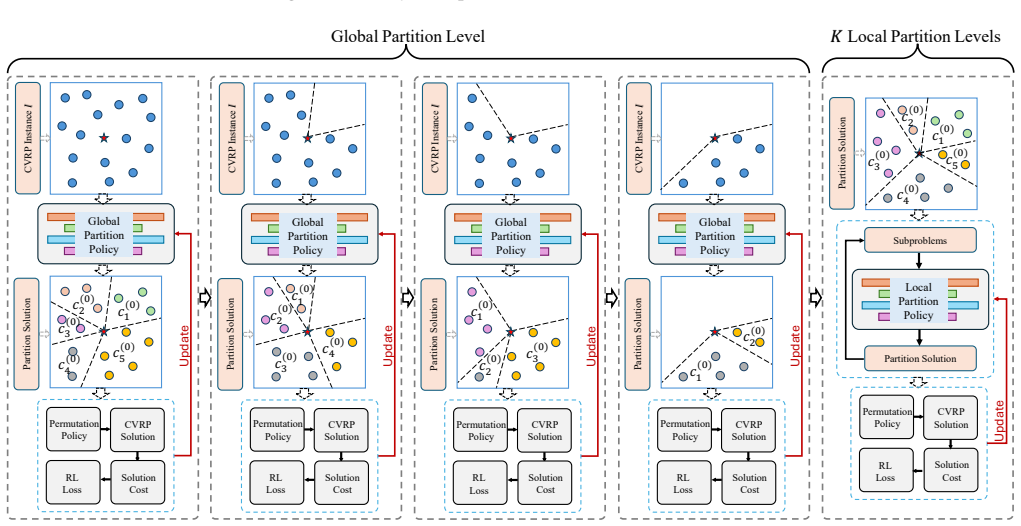
The load-bearing objects are the feasible cost function $f(C)$, which sums the optimal local route cost $g(c_i)$ over the subgraphs of a partition, and the multi-level partition hierarchy that forms subproblems by merging neighboring subgraphs. At each local level $k$, subproblems are two-way: $I_j^{(k-1)} = (G_j, D, 2)$ is composed of two adjacent subgraphs, with the vehicle allowed only two returns to the depot, and a local policy re-partitions each pair; adjacent levels use staggered pairings so that different pairs are revisited. The machinery does its work through Theorem 2's telescoping identity, $f(C^{(K)}) = f(C^{(0)}) + \sum_k [f(C^{(k)}) - f(C^{(k-1)})]$, which turns the opaque end-to-end objective into per-level improvement terms, and through surrogate initial distributions that decouple the global and local policies during REINFORCE training. In the SL variant, beam search over the policy hierarchy produces the labels, and each encountered subproblem is treated as an individual training instance rather than as a step inside one long trajectory.
What would settle it
A reader could compute, on the paper's 128-instance benchmarks, the average per-level difference $f(C^{(k)}) - f(C^{(k-1)})$ for $k=1,\dots,K$ using LKH3 as the local permutation policy: if later levels often increase cost rather than decrease it, the central claim that local re-partition levels progressively alleviate compounded misclusterings would be contradicted.
Extended reading notes
Core claim
The paper's central claim is that the partition policy, not the local construction policy, determines the quality of large-scale neural CVRP solvers, and that partition errors are compounded over the multi-step decoding used by learned partitioners. To fix this, HLGP first samples a coarse feasible partition $C^{(0)}$ with the global policy, then, at each of $K$ levels, forms subproblems by reuniting neighboring subgraphs from the previous partition and asks a local partition policy to split each two-way subproblem, updating $C^{(k-1)}$ to $C^{(k)}$. Theorem 1 shows that if an optimal local permutation policy is available for every subproblem, minimizing the original routing cost is equivalent to minimizing the expected sum of per-subgraph optimal costs over the partition. Theorem 2 telescopes this objective into per-level cost differences, giving each policy a direct training signal, and Theorem 3 shows the supervised objective factorizes into a global log-likelihood plus a sum of local log-likelihoods. Empirically, SL-driven HLGP reaches average cost 227.07 on CVRP10K against 254.17 for INViT and 266.06 for LEHD, and approaches HGS cost within a few percent while being far faster.
Load-bearing premise
The load-bearing premise is that the local permutation policy used to score each subproblem is near-optimal; if it is not, Theorem 1's reduction of the routing objective to partition cost is misspecified and the local refinement steps optimize the wrong quantity.
Editorial extensions
If this is right
- SL-driven HLGP solves 10,000-customer CVRP instances in about 3.4 minutes on average, producing costs roughly 10% better than the strongest learned baselines and close to HGS.
- Training only on 1,000-node problems generalizes to 2K, 5K, 7K, and 10K instances and to Gaussian, explosion, and rotation distributions, so hierarchical partition refinement reduces the need to retrain for each scale.
- Because the joint objective decouples into per-level terms, the global and local policies can be trained separately, avoiding the instability of joint hierarchical reinforcement learning.
- Using encountered subproblems as individual training instances shortens policy-gradient training and narrows the support-set mismatch identified in REINFORCE's regret bound.
- Both RL and SL training fit the same objective, so practitioners can choose a reward-based or imitation-based update without changing the partition hierarchy.
Reading between the lines
- The same staggered two-way re-partition idea likely transfers to other partition-then-solve combinatorial pipelines, such as TSP variants or pickup-and-delivery problems, though the paper only lists CVRPTW and min-max CVRP as future targets.
- The paper's reported numbers suggest the SL variant's advantage over RL grows with instance size; a direct ablation holding the local solver fixed would clarify whether this comes from beam-search labels or from the Transformer backbone, a distinction the paper leaves implicit.
- If the compounding-error story is correct, error should correlate with the number of autoregressive partition steps; tracking a clustering-agreement metric between consecutive levels as $K$ increases would provide a cheap diagnostic for when added levels stop helping.
Editorial analysis
A structured set of objections, weighed in public.
Referee Report
Summary. The paper proposes HLGP, a hierarchical divide-and-conquer framework for large-scale capacitated vehicle routing problems (CVRP). A global partition policy produces a coarse multi-way partition, and then K levels of a local partition policy successively re-partition pairs of neighboring subproblems, using local topological features to incrementally correct compounded misclusterings. The framework is trained either by reinforcement learning (RL-driven HLGP) or by a supervised/self-imitation loss (SL-driven HLGP), with the claimed advantage that both training modes optimize a single unified objective. Experiments on uniform and shifted distributions up to 10,000 customers show that SL-driven HLGP obtains average cost 227.07 on CVRP10K, about 10% better than the previous learning-based state of the art (INViT at 254.17) and close to HGS. The paper includes ablations, hyperparameter studies, and visualization, and the source code is publicly available.
Significance. If the empirical results hold, HLGP is a practical advance for large-scale neural routing: it is among the first learning-based methods to approach HGS quality on 10K-node CVRP within minutes, and it demonstrates that a hierarchical partition policy can mitigate compounded misclusterings. The paper ships code, reproduces many baselines, and provides ablations separating the contributions of the local partition levels and the 'subproblem-as-instance' training technique. However, the theoretical claim of a unified RL/SL objective rests on the proof in Appendix C.3, which contains an invalid equality; the SL loss currently lacks a sound derivation. The empirical contribution may still be valid, but the paper's framing as a principled unified-objective framework needs substantial revision.
major comments (3)
- [Appendix C.3, Eq. (14)] The equality E[1(C(K)=bar C)] = (1/(K+1)) E[1(C(K)=bar C)+...+1(C(0)=bar C)] is not valid in general. For K=1, a deterministic policy that always outputs bar C at level 0 and never at level 1 gives the left-hand side as 0 and the right-hand side as 1/2. Consequently, the recursive decomposition in Eq. (15) does not follow, and Theorem 3 (stated as Theorem 6 in the appendix, Eq. (11) in Section 4.3) is not established. Since Eq. (13) is the loss actually used to train the SL-driven HLGP whose results are reported in Tables 1 and 2, the theoretical grounding of the headline variant is missing. The loss may remain a plausible self-imitation surrogate, but the paper's statement that the framework optimizes a unified objective for both RL and SL is unsupported and should be corrected or explicitly reframed as a heuristic.
- [Section 4, first paragraph; Theorem 1 in Appendix C.1] The transformation of the original CVRP objective into the partition objective in Eq. (1) assumes that an optimal local permutation policy pi*_perm is available for every subproblem, including subproblems of widely varying sizes and capacities produced by the K-level hierarchy. The paper states this assumption is satisfied by using LKH3 or the GLOP neural solver, but it offers no evidence that the neural solver is near-optimal on the actual subproblems encountered. If the local solver deviates from optimality, Eq. (1) is a misspecified surrogate and the theoretical rationale for the decomposition is weakened. I recommend reporting the gap between the local solver and LKH3 on the set of subproblems sampled from the evaluation instances (e.g., average per-subproblem cost ratio) to quantify the deviation.
- [Section 4.3, Eq. (13); Algorithm 2 in Appendix B] The SL labels bar C are generated by beam search over the same global and local policies being trained, which is a self-imitation loop. The paper mitigates this only by a curriculum stage on 100-node instances (Appendix A.1). Table 8 compares variants with and without the large-scale stage but does not measure whether the beam-search labels improve in cost over successive iterations or how far they are from LKH3/HGS solutions. Without such a measurement, it is difficult to rule out the possibility that the reported gains come partly from the policy imitating its own mistakes. Please add label-quality statistics and, if possible, an off-policy correction or a small set of externally generated labels.
minor comments (5)
- [Throughout] Theorem numbering is inconsistent between the main text and the appendix: main-text Theorem 1 appears as 'Theorem 4' in Appendix C.1, Theorem 2 as 'Theorem 5' in C.2, Theorem 3 as 'Theorem 6' in C.3, and Proposition 1 as 'Proposition 2' in C.4. Please align the numbering.
- [Section 4.3, Eq. (11)] The notation bar C_i = {bar c_i, bar c_{i%N_c+1}} uses a modulo operator that is not explained; please clarify the indexing convention so that the cyclic pairing of subgraphs is unambiguous.
- [Section 5.2, Table 1] In Table 1, HGS achieves 226.59 on CVRP10K, which is slightly lower than the SL-driven HLGP value of 227.07; the text in Section 5.2 should state this explicitly rather than implying HLGP is superior to all classical heuristics on this dataset.
- [Appendix A.3, Tables 3-6] The hyperparameter studies for K, lambda_G, and lambda_L are conducted only on uniform and Gaussian distributions; please add a sentence noting whether the selected values transfer to the Explosion and Rotation distributions.
- [Appendix A.7, baselines] The baseline description contains a typo: 'ELO-POMO' should be 'ELG-POMO' to match the method name used elsewhere.
Circularity Check
No significant circularity: the RL objective is grounded in an external route-cost oracle and the SL self-imitation is disclosed; the main derivation flaw in Appendix C.3 is a correctness issue, not a circular reduction.
full rationale
The paper's central partition objective (Eq. 1) is grounded in an external local permutation oracle: 'we assume the optimal local permutation policy pi*(perm) is obtainable by leveraging LKH3 or the neural solver used in GLOP' (Sec. 4). Theorems 1 and 2 are algebraic rewritings of this external cost; they do not define the target in terms of the model's own outputs. The RL training rewards are route costs from the pretrained permutation policy or LKH3, so the learning signal is external. The SL pipeline is explicitly a self-imitation loop, not a disguised fit: 'pi*(part) is practically unavailable ... our goal is to acquire high-quality labeled instances from a behavioral policy pi_hat(part)' (Sec. 4.3), with labels produced by beam search and selected by the external route cost. This is disclosed, and the final benchmark numbers are evaluated on held-out instances against external solvers. The only load-bearing derivation concern is in Appendix C.3, Eq. 14: the proof of Theorem 3 asserts E[1(C(K)=Cbar)] = 1/(K+1) E[sum_{k=0}^K 1(C(k)=Cbar)], which is false in general; the claimed reduction of the SL objective to per-level log-probabilities is therefore not established. That is a proof/validity flaw, not a circular reduction by construction. GLOP appears both as backbone and baseline and is coauthored by one of the present authors, but it is an externally published, code-released system that the paper also compares against, so the self-citation is not load-bearing in the sense of an unverified uniqueness claim.
Assumptions & free parameters
free parameters (4)
- K (number of local partition levels) =
5
- lambda_G (entropy coefficient for global partition policy) =
0.1
- lambda_L (entropy coefficient for local partition policy) =
0.005
- SL evaluation beam sizes =
16, 16, 8, 4, 4 for CVRP1K/2K/5K/7K/10K
assumptions (3)
- domain assumption Optimal local permutation policy is available for every subproblem via LKH3 or GLOP's neural solver.
- domain assumption Each subproblem can be solved independently with a vehicle returning to the depot at most once or twice, and costs add across subproblems.
- ad hoc to paper SL labels generated by beam search over the current policies are of sufficient quality to supervise training.
Cite this review
Pith. "Pith review of Hierarchical Learning-based Graph Partition for Large-scale Vehicle Routing Problems." pith.science (2026). https://pith.science/paper/S2P7KOB4
@misc{pith2026250208340,
  author       = {Pith},
  title        = {Pith review of: Hierarchical Learning-based Graph Partition for Large-scale Vehicle Routing Problems},
  year         = {2026},
  howpublished = {\url{https://pith.science/paper/S2P7KOB4}},
  note         = {Machine review of arXiv:2502.08340}
}
read the original abstract
Neural solvers based on the divide-and-conquer approach for Vehicle Routing Problems (VRPs) in general, and capacitated VRP (CVRP) in particular, integrates the global partition of an instance with local constructions for each subproblem to enhance generalization. However, during the global partition phase, misclusterings within subgraphs have a tendency to progressively compound throughout the multi-step decoding process of the learning-based partition policy. This suboptimal behavior in the global partition phase, in turn, may lead to a dramatic deterioration in the performance of the overall decomposition-based system, despite using optimal local constructions. To address these challenges, we propose a versatile Hierarchical Learning-based Graph Partition (HLGP) framework, which is tailored to benefit the partition of CVRP instances by synergistically integrating global and local partition policies. Specifically, the global partition policy is tasked with creating the coarse multi-way partition to generate the sequence of simpler two-way partition subtasks. These subtasks mark the initiation of the subsequent K local partition levels. At each local partition level, subtasks exclusive for this level are assigned to the local partition policy which benefits from the insensitive local topological features to incrementally alleviate the compounded errors. This framework is versatile in the sense that it optimizes the involved partition policies towards a unified objective harmoniously compatible with both reinforcement learning (RL) and supervised learning (SL). (*Due to the notification of arXiv "The Abstract field cannot be longer than 1,920 characters", the appeared Abstract is shortened. For the full Abstract, please download the Article.)
Figures


Figures from the paper (5 more)



Reference graph
Works this paper leans on
-
[1]
Jieyi Bi, Yining Ma, Jiahai Wang, Zhiguang Cao, Jinbiao Chen, Yuan Sun, and Yeow Meng Chee. 2022. Learning generalizable models for vehicle routing problems via knowledge distillation. Advances in Neural Information Processing Systems 35 (2022), 31226–31238
work page 2022
-
[2]
Diego Cattaruzza, Nabil Absi, Dominique Feillet, and Jesús González-Feliu. 2017. Vehicle routing problems for city logistics. EURO Journal on Transportation and Logistics 6, 1 (2017), 51–79
work page 2017
-
[3]
Xinyun Chen and Yuandong Tian. 2019. Learning to perform local rewriting for combinatorial optimization. Advances in neural information processing systems 32 (2019)
work page 2019
-
[4]
Hanni Cheng, Haosi Zheng, Ya Cong, Weihao Jiang, and Shiliang Pu. 2023. Select and optimize: Learning to solve large-scale tsp instances. In International Conference on Artificial Intelligence and Statistics . PMLR, 1219–1231
work page 2023
-
[5]
Darko Drakulic, Sofia Michel, Florian Mai, Arnaud Sors, and Jean-Marc An- dreoli. 2024. Bq-nco: Bisimulation quotienting for efficient neural combinatorial optimization. Advances in Neural Information Processing Systems 36 (2024)
work page 2024
-
[6]
Han Fang, Zhihao Song, Paul Weng, and Yutong Ban. 2024. INViT: A Gener- alizable Routing Problem Solver with Invariant Nested View Transformer. In Forty-first International Conference on Machine Learning
work page 2024
-
[7]
Marshall L Fisher and Ramchandran Jaikumar. 1981. A generalized assignment heuristic for vehicle routing. Networks 11, 2 (1981), 109–124
work page 1981
-
[8]
Zhang-Hua Fu, Kai-Bin Qiu, and Hongyuan Zha. 2021. Generalize a small pre-trained model to arbitrarily large tsp instances. In Proceedings of the AAAI conference on artificial intelligence , Vol. 35. 7474–7482
work page 2021
Show all 51 references
-
[9]
Chengrui Gao, Haopu Shang, Ke Xue, Dong Li, and Chao Qian. 2024. Towards generalizable neural solvers for vehicle routing problems via ensemble with transferrable local policy. In The 33rd International Joint Conference on Artificial Intelligence (IJCAI-24)
2024
-
[10]
Thierry Garaix, Christian Artigues, Dominique Feillet, and Didier Josselin. 2010. Vehicle routing problems with alternative paths: An application to on-demand transportation. European Journal of Operational Research 204, 1 (2010), 62–75
2010
-
[11]
Nathan Grinsztajn, Daniel Furelos-Blanco, Shikha Surana, Clément Bonnet, and Tom Barrett. 2023. Winner takes it all: Training performant RL populations for combinatorial optimization. Advances in Neural Information Processing Systems 36 (2023), 48485–48509
2023
-
[12]
Keld Helsgaun. 2017. An extension of the Lin-Kernighan-Helsgaun TSP solver for constrained traveling salesman and vehicle routing problems. Roskilde: Roskilde University 12 (2017), 966–980
2017
-
[13]
André Hottung and Kevin Tierney. 2020. Neural large neighborhood search for the capacitated vehicle routing problem. In ECAI 2020. IOS Press, 443–450
2020
-
[14]
Qingchun Hou, Jingwei Yang, Yiqiang Su, Xiaoqing Wang, and Yuming Deng
-
[15]
Yuan Jiang, Zhiguang Cao, Yaoxin Wu, Wen Song, and Jie Zhang. 2024. Ensemble- based deep reinforcement learning for vehicle routing problems under distribu- tion shift. Advances in Neural Information Processing Systems 36 (2024)
2024
-
[16]
Yuan Jiang, Zhiguang Cao, Yaoxin Wu, and Jie Zhang. 2023. Multi-view graph contrastive learning for solving vehicle routing problems. In Uncertainty in Artificial Intelligence. PMLR, 984–994
2023
-
[17]
Chaitanya K Joshi, Thomas Laurent, and Xavier Bresson. 2019. An efficient graph convolutional network technique for the travelling salesman problem. arXiv preprint arXiv:1906.01227 (2019)
2019 arXiv
-
[18]
Minsu Kim, Jinkyoo Park, et al. 2021. Learning collaborative policies to solve np-hard routing problems. Advances in Neural Information Processing Systems 34 (2021), 10418–10430
2021
-
[19]
Minsu Kim, Junyoung Park, and Jinkyoo Park. 2022. Sym-nco: Leveraging sym- metricity for neural combinatorial optimization. Advances in Neural Information Processing Systems 35 (2022), 1936–1949
2022
-
[20]
Wouter Kool, Herke van Hoof, and Max Welling. 2019. Attention, Learn to Solve Routing Problems!. In International Conference on Learning Representations
2019
-
[21]
Yeong-Dae Kwon, Jinho Choo, Byoungjip Kim, Iljoo Yoon, Youngjune Gwon, and Seungjai Min. 2020. Pomo: Policy optimization with multiple optima for reinforcement learning. Advances in Neural Information Processing Systems 33 (2020), 21188–21198
2020
-
[22]
Gilbert Laporte and Yves Nobert. 1983. A branch and bound algorithm for the capacitated vehicle routing problem. Operations-Research-Spektrum 5 (1983), 77–85
1983
-
[23]
Andrew Levy, Robert Platt, and Kate Saenko. 2019. Hierarchical Reinforcement Learning with Hindsight. InInternational Conference on Learning Representations
2019
-
[24]
Sirui Li, Zhongxia Yan, and Cathy Wu. 2021. Learning to delegate for large-scale vehicle routing. Advances in Neural Information Processing Systems 34 (2021), 26198–26211
2021
-
[25]
Ling Liu, Kunpeng Li, and Zhixue Liu. 2017. A capacitated vehicle routing prob- lem with order available time in e-commerce industry. Engineering Optimization 49, 3 (2017), 449–465
2017
-
[26]
Qidong Liu, Chaoyue Liu, Shaoyao Niu, Cheng Long, Jie Zhang, and Mingliang Xu. 2024. 2D-Ptr: 2D Array Pointer Network for Solving the Heterogeneous Capacitated Vehicle Routing Problem. In Proceedings of the 23rd International Conference on Autonomous Agents and Multiagent Syst...
2024
-
[27]
Hao Lu, Xingwen Zhang, and Shuang Yang. 2019. A learning-based iterative method for solving vehicle routing problems. In International conference on learning representations
2019
-
[28]
Fu Luo, Xi Lin, Fei Liu, Qingfu Zhang, and Zhenkun Wang. 2024. Neural com- binatorial optimization with heavy decoder: Toward large scale generalization. Advances in Neural Information Processing Systems 36 (2024)
2024
-
[29]
Fu Luo, Xi Lin, Zhenkun Wang, Tong Xialiang, Mingxuan Yuan, and Qingfu Zhang. 2024. Self-Improved Learning for Scalable Neural Combinatorial Opti- mization. arXiv preprint arXiv:2403.19561 (2024)
2024 arXiv
-
[30]
Yining Ma, Zhiguang Cao, and Yeow Meng Chee. 2024. Learning to search feasible and infeasible regions of routing problems with flexible neural k-opt. Advances in Neural Information Processing Systems 36 (2024)
2024
-
[31]
Yining Ma, Jingwen Li, Zhiguang Cao, Wen Song, Le Zhang, Zhenghua Chen, and Jing Tang. 2021. Learning to iteratively solve routing problems with dual-aspect collaborative transformer. Advances in Neural Information Processing Systems 34 (2021), 11096–11107
2021
-
[32]
Sahil Manchanda, Sofia Michel, Darko Drakulic, and Jean-Marc Andreoli. 2022. On the generalization of neural combinatorial optimization heuristics. In Joint European Conference on Machine Learning and Knowledge Discovery in Databases . Springer, 426–442
2022
-
[33]
Mohammadreza Nazari, Afshin Oroojlooy, Lawrence Snyder, and Martin Takác
-
[34]
Xuanhao Pan, Yan Jin, Yuandong Ding, Mingxiao Feng, Li Zhao, Lei Song, and Jiang Bian. 2023. H-tsp: Hierarchically solving the large-scale traveling salesman problem. In Proceedings of the AAAI Conference on Artificial Intelligence , Vol. 37. 9345–9353
2023
-
[35]
Shubham Pateria, Budhitama Subagdja, Ah-hwee Tan, and Chai Quek. 2021. Hierarchical reinforcement learning: A comprehensive survey. ACM Computing Surveys (CSUR) 54, 5 (2021), 1–35
2021
-
[36]
Ruizhong Qiu, Zhiqing Sun, and Yiming Yang. 2022. Dimes: A differentiable meta solver for combinatorial optimization problems. Advances in Neural Information Processing Systems 35 (2022), 25531–25546
2022
-
[37]
Jiwoo Son, Minsu Kim, Hyeonah Kim, and Jinkyoo Park. 2023. Meta-sage: Scale meta-learning scheduled adaptation with guided exploration for mitigating scale shift on combinatorial optimization. In International Conference on Machine Learning. PMLR, 32194–32210
2023
-
[38]
Thibaut Vidal, Teodor Gabriel Crainic, Michel Gendreau, Nadia Lahrichi, and Walter Rei. 2012. A hybrid genetic algorithm for multidepot and periodic vehicle routing problems. Operations Research 60, 3 (2012), 611–624
2012
-
[39]
Oriol Vinyals, Meire Fortunato, and Navdeep Jaitly. 2015. Pointer networks. Advances in neural information processing systems 28 (2015)
2015
-
[40]
Ronald J Williams. 1992. Simple statistical gradient-following algorithms for connectionist reinforcement learning. Machine learning 8 (1992), 229–256
1992
-
[41]
Liang Xin, Wen Song, Zhiguang Cao, and Jie Zhang. 2020. Step-wise deep learning models for solving routing problems. IEEE Transactions on Industrial Informatics 17, 7 (2020), 4861–4871
2020
-
[42]
Liang Xin, Wen Song, Zhiguang Cao, and Jie Zhang. 2021. Neurolkh: Combining deep learning model with lin-kernighan-helsgaun heuristic for solving the trav- eling salesman problem. Advances in Neural Information Processing Systems 34 (2021), 7472–7483
2021
-
[43]
Haoran Ye, Jiarui Wang, Helan Liang, Zhiguang Cao, Yong Li, and Fanzhang Li
-
[44]
Junzi Zhang, Jongho Kim, Brendan O’Donoghue, and Stephen Boyd. 2021. Sample efficient reinforcement learning with REINFORCE. In Proceedings of the AAAI conference on artificial intelligence , Vol. 35. 10887–10895
2021
-
[45]
Zhi Zheng, Changliang Zhou, Tong Xialiang, Mingxuan Yuan, and Zhenkun Wang. 2024. UDC: A Unified Neural Divide-and-Conquer Framework for Large- Scale Combinatorial Optimization Problems. In The Thirty-eighth Annual Confer- ence on Neural Information Processing Systems
2024
-
[46]
Jianan Zhou, Yaoxin Wu, Wen Song, Zhiguang Cao, and Jie Zhang. 2023. Towards omni-generalizable neural methods for vehicle routing problems. InInternational Conference on Machine Learning . PMLR, 42769–42789
2023
-
[47]
G" denotes the Gaussian distribution. “U
Zefang Zong, Hansen Wang, Jingwei Wang, Meng Zheng, and Yong Li. 2022. Rbg: Hierarchically solving large-scale routing problems in logistic systems via reinforcement learning. In Proceedings of the 28th ACM SIGKDD Conference on Knowledge Discovery and Data Mining . 4648–4658. ...
2022
-
[51]
# $Partition Solution 𝐶 ( $ ) CVRP Instance 𝐼 𝐼!(#) 𝐼%(#)𝐼&(#) 𝑐%(#)𝑐!(#) 𝑐'(#)𝑐((#)𝑐)(#)𝑐&(#) Global Partition Policy LocalPartition 𝐾 = 1 Subproblems 𝐼 !
interleaves the use of heuristic destroy operators and a set of learning-based repair policies to generate a new solution. Moreover, DACT [31] focuses on the expressive representation of solution encodings provided to the RL policy. Additionally, both Neural- LKH [42] and Neur...
-
[2018]
Advances in neural information processing systems 31 (2018)
Reinforcement learning for solving the vehicle routing problem. Advances in neural information processing systems 31 (2018)
2018
-
[2023]
InThe Eleventh International Conference on Learning Representations
Generalize learned heuristics to solve large-scale vehicle routing problems in real-time. InThe Eleventh International Conference on Learning Representations
-
[2024]
In Proceedings of the AAAI Conference on Artificial Intelligence, Vol
Glop: Learning global partition and local construction for solving large- scale routing problems in real-time. In Proceedings of the AAAI Conference on Artificial Intelligence, Vol. 38. 20284–20292
Reviewed August 8, 2026 · model on record in the stance chip above.
Discussion (0). Continue with ORCID to comment.