REVIEW 3 major objections 6 minor 2 cited by
Referring Remote Sensing Image Segmentation via Bidirectional Alignment Guided Joint Prediction
T0 review · 3 major / 6 minor · reviewed 2026-08-08 · deepseek-v4-flash
Pith's one-line read BTDNet claims state-of-the-art results on both public referring remote-sensing segmentation benchmarks, with the largest gains on strict overlap thresholds.
desk verdict BTDNet is a sensible RRSIS architecture, but its SOTA claim is compromised by model selection on the test set; treat the headline margins as optimistic until ablations are rerun on validation. read the letter →
The pith
A machine-rendered reading of the paper's core claim, the machinery that carries it, and where it could break.
The reading
What carries the argument
The load-bearing mechanism is the mask-then-reconstruct loop built around a Bidirectional Spatial Correlation module. The text encoder and the Swin-based image encoder interact in four stages, where each stage computes fine-grained affinity matrices between local patches of image features and token features under multiple receptive fields, then reweights the other modality and passes it back through a residual connection. A second stream encodes the text with key noun phrases masked out; these category-agnostic embeddings become learnable background prompts that are matched against the visual features to predict background regions jointly with the foreground. A reconstruction head then uses multimodal features to regenerate the masked text, forcing the model to retain the object's semantic identity in the aligned representation. The ablation study attributes roughly three mIoU points on RefSegRS to the full foreground-background joint prediction and an additional gain to the reconstruction loss.
What would settle it
Compute the background-branch prediction on the masked text alone, without showing the foreground branch or the ground-truth target; if the background prediction still correlates strongly with the referred object's location or category across the validation set, the masking assumption fails. A simpler quantitative version: retrain BTDNet on RefSegRS with random tokens masked instead of noun phrases; if Pr@0.8 and Pr@0.9 drop only slightly, the claimed background-prior effect is largely an artifact of leaky masking.
Extended reading notes
Core claim
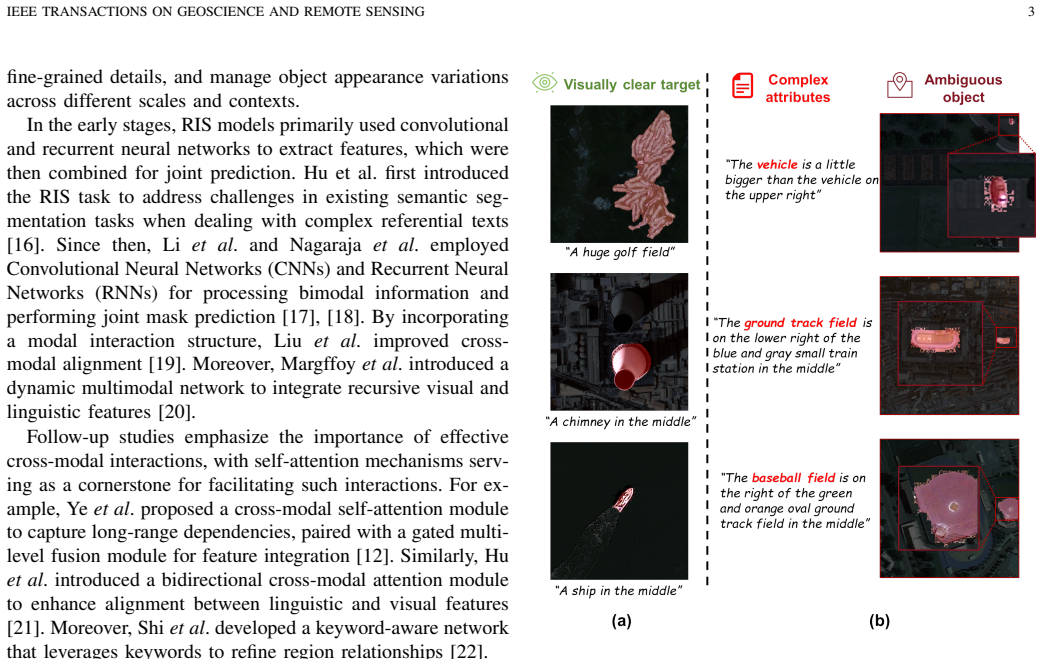
On its own terms, the paper's central claim is that BTDNet outperforms all existing methods on RefSegRS and RRSIS-D: overall IoU improves to 80.57 and 79.23, and mean IoU to 67.95 and 66.04, with gains of 5.37 and 1.84 percentage points over the previous best in mIoU. The decisive gains appear at Pr@0.8 and Pr@0.9, the strictest overlap thresholds, where BTDNet roughly doubles some earlier scores on RefSegRS. The authors attribute these gains to three interacting designs: bidirectional spatial correlation for staged vision-text alignment, a target-background twin-stream decoder that separates the referred object from unmentioned distractors, and dual-modal object learning that reconstructs masked text from visual features. The paper also identifies categories such as road markings and low vegetation where it still performs poorly, because those are broadly distributed and visually redundant.
Load-bearing premise
The whole background-prior mechanism assumes that masking the key noun phrase with an off-the-shelf language tool actually removes the target's identity from the text: if the masked sentence still hints at the category, the background branch can leak target information and make the reported strict-threshold gains look bigger than the alignment modules deserve.
Editorial extensions
If this is right
- BTDNet becomes the current state of the art on both public RRSIS benchmarks, so future comparisons in this task should include it as the baseline to beat.
- The Pr@0.8 and Pr@0.9 improvements imply the design helps most where predicted masks must agree tightly with object boundaries, not just where coarse localization succeeds.
- Category-level results indicate strong gains on small or ambiguous instances such as vehicles, trucks, and sidewalks, while widely distributed visually redundant classes remain weak.
- Removing either the background prior from masked text or the text reconstruction loss degrades mIoU, so both are necessary components of the reported final score rather than incidental additions.
Reading between the lines
- The masking step is the hinge of the background-branch design: if the noun-masking procedure leaks category identity through the language model's context, the background branch could indirectly encode the target, and the strict-threshold gains might partly come from an easier foreground-background separation rather than from better alignment.
- A testable extension would apply BTDNet to natural-image referring segmentation benchmarks: the architecture is not remote-sensing-specific apart from the multi-scale interaction, so consistent gains there would strengthen the claim that the mechanism is general.
- A practical follow-up would replace the fixed noun-masking tool with a learned masker or with multiple masked descriptions per image, allowing the background branch to model several distractors mentioned in one sentence.
- One could also probe the background branch directly: if its predictions on masked text alone still correlate with the ground-truth target location, that would indicate the background prior is not category-agnostic.
Signed reviews
Editorial analysis
A structured set of objections, weighed in public.
Referee Report
Summary. This manuscript proposes BTDNet for referring remote sensing image segmentation (RRSIS). The architecture combines (1) a Bidirectional Spatial Correlation (BSC) module inserted at four Swin/BERT stages for vision-text interaction, (2) a Target-Background TwinStream Decoder (T-BTD) that predicts foreground and background masks using a masked text prior, and (3) a Dual-Modal Object Learning Strategy (D-MOLS) with a reconstruction loss. Experiments on RefSegRS and RRSIS-D report oIoU of 80.57 and 79.23 and mIoU of 67.95 and 66.04, which the authors interpret as state-of-the-art, with particularly large gains at strict IoU thresholds (Pr@0.8 and Pr@0.9). The paper includes full comparison tables, per-category results, ablations, and qualitative examples.
Significance. The proposed method addresses a real and recognized problem, and the reported margins over LGCE and RMSIN are large enough to be practically meaningful if they are unbiased. Strengths include the use of two public benchmarks, results at multiple IoU thresholds, per-category breakdowns, and a public code link. The architectural components are clearly motivated, and the ablation coverage is extensive. However, because the ablations and hyperparameter choices are made on the test split, the headline SOTA numbers are not an independent evaluation, and no variance estimates are provided for the small RRSIS-D margin. The contribution is therefore potentially strong, but the evidence as presented does not yet establish the central claim.
major comments (3)
- [Section IV.D, Tables V-VII and Figs. 9-10] The ablation study is explicitly performed on the test subset of RefSegRS ('We conducted a series of ablation experiments on the test subset of the RefSegRS dataset'), and the configuration with B=5 background tokens, bidirectional BSC at all four stages, inclusion of Lbg and Lre, and the MCI module is selected using test metrics 67.95/80.57. In addition, lambda=0.6 and eta=0.1 are fixed in Section IV.B without a validation-based sensitivity analysis. As a result, the final numbers in Tables I and II are not independent hold-out estimates: they include selection on the test labels, while the competing LGCE and RMSIN results were not given the same test-set tuning opportunity. The reported gains of +3.76 oIoU/+5.37 mIoU on RefSegRS and +1.44 oIoU/+1.84 mIoU on RRSIS-D may therefore be optimistically biased. Please rerun the ablations on the validation split, or otherwise demonstrate that the selected configuration does not rely on test labels, and report all final hyperparameters chosen by validation.
- [Section III.C and Eq. (8), Table VI] The T-BTD background branch is built on the assumption that NLTK-based masking of 'key objects' completely removes referring target information, producing a category-agnostic Lm. The paper provides no examples of masked text and no quantitative check of masking quality. Table VI shows that removing this prior costs 1.49 mIoU (67.95 to 66.46) and 1.05 oIoU (80.57 to 79.52), so the prior is load-bearing. If masking is incomplete, the background branch can exploit target identity, and the improvement attributed to 'category-agnostic background prediction' would instead reflect a second target-specific classifier. Please provide representative masked/unmasked sentence pairs and a leakage test, for example by training a probe model on Lm to predict the target category or by comparing against masking random nouns.
- [Section IV.C, Tables I and II] No measure of variability is reported. The method is evaluated with a single training run per dataset, and the margins over the previous best method on RRSIS-D are small (1.44 oIoU and 1.84 mIoU). Without multiple seeds or a statistical test, it is impossible to know whether these differences are significant. Please report mean and standard deviation over at least three seeds for BTDNet and for the closest baselines, or otherwise justify why training variability is negligible.
minor comments (6)
- [Table I caption] The caption says 'PROPOSED REFSEGRS DATASET', but RefSegRS is introduced in [1], not in this paper; please change it to 'RefSegRS dataset'.
- [Section IV.C.1] The sentence 'improvements of 75.07%, 62.69%, and 34.40%' reports the method's absolute Pr@0.6, Pr@0.7, and Pr@0.8 values, not improvements; please rephrase.
- [Section IV.B] Please report which learning rate applies to which module and whether the batch size of 8 is per GPU or global; the current description is ambiguous.
- [Reference [40]] Reference [40] is PartImageNet, but the text cites it for ImageNet-22K pretraining of Swin Transformer; please use the correct reference for the Swin backbone.
- [Eq. (9)] Please state the output shapes of Iproj and Rproj; as written, the element-wise product of an H1W1 x D visual feature and a D-dimensional prototype, and the reduction to an H1W1 score map, are not explicit.
- [Section III.C] The Unfold operation is defined for image feature maps; please clarify how it is applied to BERT token sequences of length N.
Circularity Check
No circular derivation: the SOTA claim rests on external benchmarks; test-set model selection is a protocol caveat, not a circularity.
full rationale
The paper's central claim is an empirical comparison on public benchmarks with fixed test splits: BTDNet is trained with cross-entropy and reconstruction losses (Eqs. 10-14) supervised by ground-truth masks, and no component of the architecture is defined in terms of the reported metrics. The masked-text background branch (Eq. 8) is a design assumption about category-agnostic prior knowledge, not a definitional reduction to the target masks. The authors cite no prior work of their own as load-bearing evidence; Refs. [1] and [2] are external datasets/baselines. The main protocol weakness is that ablations in Section IV-D are run on the RefSegRS test subset, and the final test numbers in Table I are the same numbers used to choose design variants, which can bias the reported margins via model selection. That is a statistical evaluation concern rather than a circular derivation: the test scores are not forced to equal the training objective or to follow from the paper's own equations by construction. The Limitations section (V) does not acknowledge this protocol risk, but this omission does not make the derivation circular. No circular step can be exhibited with a quote and a specific equation-level reduction, so the appropriate finding is no significant circularity.
Assumptions & free parameters
free parameters (5)
- lambda (foreground/background loss weight) =
0.6
- eta (reconstruction loss weight) =
0.1
- Number of background semantic tokens B =
5
- Unfold kernel sizes k for BSC =
{1,3,5} for v2l, {1,2,3} for l2v
- Learning rates and training schedule =
1e-5 (encoder), 1e-4 (others), 50 epochs
assumptions (5)
- domain assumption Swin Transformer-Base pretrained on ImageNet-22K provides robust visual features for remote sensing imagery.
- domain assumption BERT-base pretrained on general English text captures sufficient semantic structure for remote sensing descriptions.
- domain assumption The RefSegRS and RRSIS-D benchmark splits and ground-truth masks are correct and comparable across methods.
- standard math The evaluation metrics (Pr@0.5 to Pr@0.9, mIoU, oIoU) are computed in the standard way used by prior RRSIS papers.
- ad hoc to paper NLTK part-of-speech tagging correctly identifies the key subject phrases to mask in the text.
Cite this review
Pith. "Pith review of Referring Remote Sensing Image Segmentation via Bidirectional Alignment Guided Joint Prediction." pith.science (2026). https://pith.science/paper/J323FTEF
@misc{pith2026250208486,
  author       = {Pith},
  title        = {Pith review of: Referring Remote Sensing Image Segmentation via Bidirectional Alignment Guided Joint Prediction},
  year         = {2026},
  howpublished = {\url{https://pith.science/paper/J323FTEF}},
  note         = {Machine review of arXiv:2502.08486}
}
read the original abstract
Referring Remote Sensing Image Segmentation (RRSIS) is critical for ecological monitoring, urban planning, and disaster management, requiring precise segmentation of objects in remote sensing imagery guided by textual descriptions. This task is uniquely challenging due to the considerable vision-language gap, the high spatial resolution and broad coverage of remote sensing imagery with diverse categories and small targets, and the presence of clustered, unclear targets with blurred edges. To tackle these issues, we propose \ours, a novel framework designed to bridge the vision-language gap, enhance multi-scale feature interaction, and improve fine-grained object differentiation. Specifically, \ours introduces: (1) the Bidirectional Spatial Correlation (BSC) for improved vision-language feature alignment, (2) the Target-Background TwinStream Decoder (T-BTD) for precise distinction between targets and non-targets, and (3) the Dual-Modal Object Learning Strategy (D-MOLS) for robust multimodal feature reconstruction. Extensive experiments on the benchmark datasets RefSegRS and RRSIS-D demonstrate that \ours achieves state-of-the-art performance. Specifically, \ours improves the overall IoU (oIoU) by 3.76 percentage points (80.57) and 1.44 percentage points (79.23) on the two datasets, respectively. Additionally, it outperforms previous methods in the mean IoU (mIoU) by 5.37 percentage points (67.95) and 1.84 percentage points (66.04), effectively addressing the core challenges of RRSIS with enhanced precision and robustness.
Figures


Figures from the paper (7 more)


Forward citations
Cited by 2 Pith papers
-
GeoSelect: Spatial-Program Execution for Training-Free Referring Remote Sensing Image Segmentation
A training-free pipeline synthesises referring expressions into a typed geometric DSL, executes them over scored candidate boxes, and reaches 58.86 mIoU on RRSIS-D—over twice the previous training-free best.
-
DiCoR: Decoupled Referent Disambiguation and Contour Recalibration for Efficient Referring Remote Sensing Image Segmentation
DiCoR combines candidate-ranking referent disambiguation with residual contour recalibration on an efficient joint fusion backbone, setting new state-of-the-art scores on RefSegRS, RRSIS-D, and RISBench.
Reference graph
Works this paper leans on
-
[26]
C. Liu, H. Ding, Y . Zhang, and X. Jiang, “[63],” IEEE Transactions on Image Processing, vol. 32, pp. 3054–3065, 2023
work page 2023
-
[1]
Rrsis: Referring remote sensing image segmentation,
Z. Yuan, L. Mou, Y . Hua, and X. X. Zhu, “Rrsis: Referring remote sensing image segmentation,” IEEE Transactions on Geoscience and Remote Sensing , 2024
work page 2024
-
[2]
Rotated multi-scale interaction network for referring remote sensing image seg- mentation,
S. Liu, Y . Ma, X. Zhang, H. Wang, J. Ji, X. Sun, and R. Ji, “Rotated multi-scale interaction network for referring remote sensing image seg- mentation,” in Proceedings of the IEEE/CVF Conference on Computer Vision and Pattern Recognition , 2024, pp. 26 658–26 668
work page 2024
-
[3]
A survey on object detection in optical remote sensing images,
G. Cheng and J. Han, “A survey on object detection in optical remote sensing images,” ISPRS journal of photogrammetry and remote sensing , vol. 117, pp. 11–28, 2016
work page 2016
-
[4]
Remote sensing image segmentation advances: A meta-analysis,
I. Kotaridis and M. Lazaridou, “Remote sensing image segmentation advances: A meta-analysis,” ISPRS Journal of Photogrammetry and Remote Sensing , vol. 173, pp. 309–322, 2021
work page 2021
-
[5]
Distilling segmenters from cnns and transformers for remote sensing images semantic segmen- tation,
Z. Dong, G. Gao, T. Liu, Y . Gu, and X. Zhang, “Distilling segmenters from cnns and transformers for remote sensing images semantic segmen- tation,” IEEE Transactions on Geoscience and Remote Sensing , 2023
work page 2023
-
[6]
Deep residual learning for image recognition,
K. He, X. Zhang, S. Ren, and J. Sun, “Deep residual learning for image recognition,” in Proceedings of the IEEE conference on computer vision and pattern recognition , 2016, pp. 770–778
2016
-
[7]
S. Talukdar, P. Singha, S. Mahato, S. Pal, Y .-A. Liou, and A. Rahman, “Land-use land-cover classification by machine learning classifiers for satellite observations—a review,”Remote sensing, vol. 12, no. 7, p. 1135, 2020
work page 2020
Show all 43 references
-
[8]
Remote sensing for agricultural applications: A meta-review,
M. Weiss, F. Jacob, and G. Duveiller, “Remote sensing for agricultural applications: A meta-review,” Remote sensing of environment , vol. 236, p. 111402, 2020
2020
-
[9]
Urban land cover classifica- tion using airborne lidar data: A review,
W. Y . Yan, A. Shaker, and N. El-Ashmawy, “Urban land cover classifica- tion using airborne lidar data: A review,”Remote sensing of environment, vol. 158, pp. 295–310, 2015
2015
-
[10]
Deep multimodal representation learning: A survey,
W. Guo, J. Wang, and S. Wang, “Deep multimodal representation learning: A survey,” Ieee Access , vol. 7, pp. 63 373–63 394, 2019
2019
-
[11]
Learning transferable visual models from natural language supervision,
A. Radford, J. W. Kim, C. Hallacy, A. Ramesh, G. Goh, S. Agarwal, G. Sastry, A. Askell, P. Mishkin, J. Clark et al. , “Learning transferable visual models from natural language supervision,” in International conference on machine learning . PMLR, 2021, pp. 8748–8763
2021
-
[12]
Cross-modal self-attention network for referring image segmentation,
L. Ye, M. Rochan, Z. Liu, and Y . Wang, “Cross-modal self-attention network for referring image segmentation,” in Proceedings of the IEEE/CVF conference on computer vision and pattern recognition , 2019, pp. 10 502–10 511
2019
-
[13]
Cris: Clip-driven referring image segmentation,
Z. Wang, Y . Lu, Q. Li, X. Tao, Y . Guo, M. Gong, and T. Liu, “Cris: Clip-driven referring image segmentation,” in Proceedings of the IEEE/CVF conference on computer vision and pattern recognition , 2022, pp. 11 686–11 695
2022
-
[14]
A fast and accurate one-stage approach to visual grounding,
Z. Yang, B. Gong, L. Wang, W. Huang, D. Yu, and J. Luo, “A fast and accurate one-stage approach to visual grounding,” in Proceedings of the IEEE/CVF international conference on computer vision , 2019, pp. 4683–4693
2019
-
[15]
Transvg: End-to-end visual grounding with transformers,
J. Deng, Z. Yang, T. Chen, W. Zhou, and H. Li, “Transvg: End-to-end visual grounding with transformers,” in Proceedings of the IEEE/CVF International Conference on Computer Vision , 2021, pp. 1769–1779
2021
-
[16]
Segmentation from natural language expressions,
R. Hu, M. Rohrbach, and T. Darrell, “Segmentation from natural language expressions,” in Computer Vision–ECCV 2016: 14th European Conference, Amsterdam, The Netherlands, October 11–14, 2016, Pro- ceedings, Part I 14 . Springer, 2016, pp. 108–124
2016
-
[17]
Referring image segmentation via recurrent refinement networks,
R. Li, K. Li, Y .-C. Kuo, M. Shu, X. Qi, X. Shen, and J. Jia, “Referring image segmentation via recurrent refinement networks,” in Proceedings of the IEEE Conference on Computer Vision and Pattern Recognition , 2018, pp. 5745–5753
2018
-
[18]
Modeling con- text between objects for referring expression understanding,
V . K. Nagaraja, V . I. Morariu, and L. S. Davis, “Modeling con- text between objects for referring expression understanding,” in Com- puter Vision–ECCV 2016: 14th European Conference, Amsterdam, The Netherlands, October 11–14, 2016, Proceedings, Part IV 14 . Springer, 2016, p...
2016
-
[19]
Recurrent multimodal interaction for referring image segmentation,
C. Liu, Z. Lin, X. Shen, J. Yang, X. Lu, and A. Yuille, “Recurrent multimodal interaction for referring image segmentation,” in Proceed- ings of the IEEE international conference on computer vision , 2017, pp. 1271–1280
2017
-
[20]
Dy- namic multimodal instance segmentation guided by natural language queries,
E. Margffoy-Tuay, J. C. P ´erez, E. Botero, and P. Arbel ´aez, “Dy- namic multimodal instance segmentation guided by natural language queries,” in Proceedings of the European Conference on Computer Vision (ECCV), 2018, pp. 630–645
2018
-
[21]
Bi-directional relationship inferring network for referring image segmentation,
Z. Hu, G. Feng, J. Sun, L. Zhang, and H. Lu, “Bi-directional relationship inferring network for referring image segmentation,” in Proceedings of the IEEE/CVF conference on computer vision and pattern recognition , 2020, pp. 4424–4433
2020
-
[22]
Key-word-aware network for refer- ring expression image segmentation,
H. Shi, H. Li, F. Meng, and Q. Wu, “Key-word-aware network for refer- ring expression image segmentation,” in Proceedings of the European Conference on Computer Vision (ECCV) , 2018, pp. 38–54
2018
-
[23]
Cascade grouped attention network for referring expression segmentation,
G. Luo, Y . Zhou, R. Ji, X. Sun, J. Su, C.-W. Lin, and Q. Tian, “Cascade grouped attention network for referring expression segmentation,” in Proceedings of the 28th ACM International Conference on Multimedia , 2020, pp. 1274–1282
2020
-
[24]
Lavt: Language-aware vision transformer for referring image segmentation,
Z. Yang, J. Wang, Y . Tang, K. Chen, H. Zhao, and P. H. Torr, “Lavt: Language-aware vision transformer for referring image segmentation,” in Proceedings of the IEEE/CVF Conference on Computer Vision and Pattern Recognition, 2022, pp. 18 155–18 165
2022
-
[25]
Restr: Convolution- free referring image segmentation using transformers,
N. Kim, D. Kim, C. Lan, W. Zeng, and S. Kwak, “Restr: Convolution- free referring image segmentation using transformers,” in Proceedings of the IEEE/CVF Conference on Computer Vision and Pattern Recognition , 2022, pp. 18 145–18 154
2022
-
[27]
Mask grounding for referring image segmentation,
Y . X. Chng, H. Zheng, Y . Han, X. Qiu, and G. Huang, “Mask grounding for referring image segmentation,” in Proceedings of the IEEE/CVF Conference on Computer Vision and Pattern Recognition , 2024, pp. 26 573–26 583
2024
-
[28]
Visual grounding in remote sensing images,
Y . Sun, S. Feng, X. Li, Y . Ye, J. Kang, and X. Huang, “Visual grounding in remote sensing images,” inProceedings of the 30th ACM International Conference on Multimedia , 2022, pp. 404–412
2022
-
[29]
Nltk: the natural language toolkit,
S. Bird, “Nltk: the natural language toolkit,” in Proceedings of the COLING/ACL 2006 Interactive Presentation Sessions , 2006, pp. 69–72
2006
-
[30]
Bert: Pre-training of deep bidirectional transformers for language understanding,
J. Devlin, M.-W. Chang, K. Lee, and K. Toutanova, “Bert: Pre-training of deep bidirectional transformers for language understanding,” arXiv preprint arXiv:1810.04805, 2018
2018 arXiv
-
[31]
Swin transformer: Hierarchical vision transformer using shifted windows,
Z. Liu, Y . Lin, Y . Cao, H. Hu, Y . Wei, Z. Zhang, S. Lin, and B. Guo, “Swin transformer: Hierarchical vision transformer using shifted windows,” in Proceedings of the IEEE/CVF international conference on computer vision , 2021, pp. 10 012–10 022
2021
-
[32]
Generalized cross entropy loss for training deep neural networks with noisy labels,
Z. Zhang and M. Sabuncu, “Generalized cross entropy loss for training deep neural networks with noisy labels,” Advances in neural information processing systems, vol. 31, 2018
2018
-
[33]
Attention is all you need,
A. Vaswani, N. Shazeer, N. Parmar, J. Uszkoreit, L. Jones, A. N. Gomez, Ł. Kaiser, and I. Polosukhin, “Attention is all you need,” Advances in neural information processing systems , vol. 30, 2017
2017
-
[34]
Linguistic structure guided context modeling for referring image segmentation,
T. Hui, S. Liu, S. Huang, G. Li, S. Yu, F. Zhang, and J. Han, “Linguistic structure guided context modeling for referring image segmentation,” in Computer Vision–ECCV 2020: 16th European Conference, Glasgow, UK, August 23–28, 2020, Proceedings, Part X 16 . Springer, 2020, pp. 59–75
2020
-
[35]
Refer- ring image segmentation via cross-modal progressive comprehension,
S. Huang, T. Hui, S. Liu, G. Li, Y . Wei, J. Han, L. Liu, and B. Li, “Refer- ring image segmentation via cross-modal progressive comprehension,” in Proceedings of the IEEE/CVF conference on computer vision and pattern recognition, 2020, pp. 10 488–10 497
2020
-
[36]
Cross-modal pro- gressive comprehension for referring segmentation,
S. Liu, T. Hui, S. Huang, Y . Wei, B. Li, and G. Li, “Cross-modal pro- gressive comprehension for referring segmentation,” IEEE Transactions on Pattern Analysis and Machine Intelligence , vol. 44, no. 9, pp. 4761– 4775, 2021
2021
-
[37]
Caris: Context-aware referring image segmentation,
S.-A. Liu, Y . Zhang, Z. Qiu, H. Xie, Y . Zhang, and T. Yao, “Caris: Context-aware referring image segmentation,” in Proceedings of the 31st ACM International Conference on Multimedia , 2023, pp. 779–788
2023
-
[38]
Towards robust referring image segmentation,
J. Wu, X. Li, X. Li, H. Ding, Y . Tong, and D. Tao, “Towards robust referring image segmentation,” IEEE Transactions on Image Processing , 2024
2024
-
[39]
Beyond one-to-one: Rethinking the referring image segmentation,
Y . Hu, Q. Wang, W. Shao, E. Xie, Z. Li, J. Han, and P. Luo, “Beyond one-to-one: Rethinking the referring image segmentation,” in Proceedings of the IEEE/CVF International Conference on Computer Vision, 2023, pp. 4067–4077
2023
-
[40]
Partimagenet: A large, high- quality dataset of parts,
J. He, S. Yang, S. Yang, A. Kortylewski, X. Yuan, J.-N. Chen, S. Liu, C. Yang, Q. Yu, and A. Yuille, “Partimagenet: A large, high- quality dataset of parts,” in European Conference on Computer Vision . Springer, 2022, pp. 128–145
2022
-
[41]
Transformers: State- of-the-art natural language processing,
T. Wolf, L. Debut, V . Sanh, J. Chaumond, C. Delangue, A. Moi, P. Cistac, T. Rault, R. Louf, M. Funtowicz et al. , “Transformers: State- of-the-art natural language processing,” in Proceedings of the 2020 conference on empirical methods in natural language processing: system d...
2020
-
[42]
Gpt-4 technical report,
J. Achiam, S. Adler, S. Agarwal, L. Ahmad, I. Akkaya, F. L. Aleman, D. Almeida, J. Altenschmidt, S. Altman, S. Anadkat et al. , “Gpt-4 technical report,” arXiv preprint arXiv:2303.08774 , 2023
2023 arXiv
-
[43]
Lisa: Reasoning segmentation via large language model,
X. Lai, Z. Tian, Y . Chen, Y . Li, Y . Yuan, S. Liu, and J. Jia, “Lisa: Reasoning segmentation via large language model,” in Proceedings of IEEE TRANSACTIONS ON GEOSCIENCE AND REMOTE SENSING 14 the IEEE/CVF Conference on Computer Vision and Pattern Recognition , 2024, pp. 9579–9589
2024
Reviewed August 8, 2026 · model on record in the stance chip above.
Discussion (0). Continue with ORCID to comment.