REVIEW 3 major objections 4 minor 62 references
Disentangling Total-Variance and Signal-to-Noise-Ratio Improves Diffusion Models
T0 review · 3 major / 4 minor · reviewed 2026-08-08 · deepseek-v4-flash
Pith's one-line read This paper argues that diffusion-model sampling can be accelerated substantially by separating total variance from signal-to-noise ratio, that exploding-variance schedules are usually dominated by constant-variance variants with the same…
desk verdict A clean scheduling reformulation with a genuinely useful constant-TV insight, but the headline molecular gains rest on a model trained with a different schedule and need a retraining check. read the letter →
The pith
A machine-rendered reading of the paper's core claim, the machinery that carries it, and where it could break.
The reading
What carries the argument
The central object is the TV/SNR parameterization of the perturbation kernel, which rewrites the forward noising distribution in terms of TV $\tau^2=a^2+b^2$ and SNR $\gamma=a/b$, with the corresponding SDE drift and diffusion coefficients derived from these two functions. This separation allows a schedule's noise magnitude and its signal retention to be changed independently. The proposed VP-ISSNR schedule fixes $\tau^2=1$ and sets $\gamma^2(t)=((1-t)/t)^{2\eta}e^{2\kappa}$, the exponential of an inverse sigmoid in $\log(1/t-1)$, which produces rapid SNR decay near both ends of the diffusion interval and reduces to the OTFM SNR when $\eta=1$, $\kappa=0$. The second load-bearing piece is the SNR-conditioned score network: the model is trained with constant TV and conditioned on a scaled, log-linearized SNR, $c_{\text{snr}}(\gamma^2)=\omega\log\gamma^2+\xi$, which lets one trained network be sampled under many schedules and makes the paper's cross-schedule comparisons possible.
What would settle it
Train a fresh score network from scratch under the VP-ISSNR schedule itself, with matched architecture and compute, and compare stability and FID at the same NFEs against the paper's numbers obtained by reusing a cosine-trained model. The appendix already hints that the cosine-trained model beats an EDM-trained model even when the EDM schedule is used for sampling; if consistent retraining removes or reverses the VP-ISSNR advantage, the schedule-specific claims would collapse. A cleaner test is to train and evaluate every candidate schedule under both matched and cross-schedule conditions and check whether the rank order of schedules survives matched training.
Extended reading notes
Core claim
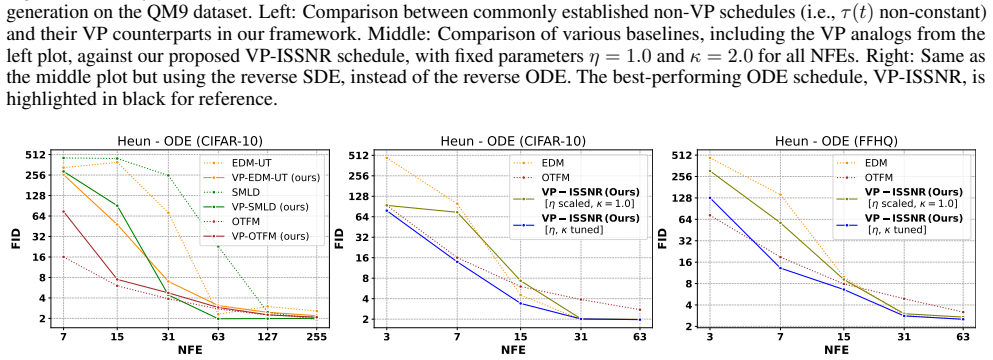
The paper's central claim is that the total variance (TV), $\tau^2(t) = a^2(t)+b^2(t)$, and the signal-to-noise ratio (SNR), $\gamma(t)=a(t)/b(t)$, of a diffusion perturbation kernel are separate design choices, and that treating them as such improves fast sampling. Reformulating the kernel as $p(x(t)|x(0))=\mathcal{N}\big(\sqrt{\tau^2\gamma^2/(1+\gamma^2)}\;x(0),\; \tau^2/(1+\gamma^2)\;I\big)$, the authors show that schedules whose TV explodes exponentially, such as SMLD and EDM with a uniform time grid, are dominated at equal SNR by their constant-TV (VP) counterparts in both molecular and image generation. They propose the VP-ISSNR schedule, $\tau^2(t)=1$ with $\gamma^2(t)=((1-t)/t)^{2\eta}e^{2\kappa}$, an inverse-sigmoid SNR law that contains optimal-transport flow matching as a special case. With this schedule, a model trained once under a cosine SNR schedule generates stable QM9 molecules in four Euler steps, reaches roughly 87 percent stability at 128 steps, and exceeds 95 percent with stochastic sampling at 64 steps; on images it matches or improves the highly optimized EDM sampler at low step counts when the two schedule parameters are scaled or tuned. The paper also offers a mechanistic explanation from a toy mixture-of-delta experiment: good schedules keep ODE trajectories straight near the data manifold and grow the marginal support early.
Load-bearing premise
The evaluation assumes that a score network trained under one SNR schedule (a cosine schedule for molecules, pretrained EDM models for images) can be sampled under a different SNR schedule without retraining, so that the observed differences in stability and FID are caused by the schedule rather than by the training run.
Editorial extensions
If this is right
- Schedules with exponentially exploding total variance (SMLD and uniform-time EDM) can be converted to constant-TV variants with the same SNR curve, improving or matching stability and FID at every tested number of function evaluations.
- The VP-ISSNR schedule produces stable QM9 molecules with a first-order Euler ODE in just four NFEs, about 74 percent stability at eight NFEs, and nearly 87 percent at 128 NFEs; with the reverse SDE it reaches 93.16 percent at 32 NFEs and 95.82 percent at 64 NFEs, which the authors report as state of the art for those budgets.
- The schedule benefit persists across Euler, Heun, DPM, and RK45 solvers, so noise-schedule optimization is orthogonal to solver improvements and can be combined with them.
- On image datasets (CIFAR-10, FFHQ, AFHQ, ImageNet), VP-ISSNR with an NFE-scaled or tuned schedule parameter matches or improves EDM and OTFM FID in the low-NFE regime while reusing the same pretrained EDM score networks.
- The toy trajectory analysis suggests a concrete design criterion for fast schedules: low ODE curvature near the data manifold at $t\approx 0$ and marginal support that saturates before $t=1$.
- Because the molecular model is trained once under a cosine SNR schedule and then sampled under many schedules, the reported gains do not require retraining per schedule, provided the SNR-conditioned score transfer holds.
Reading between the lines
- If the SNR-conditioned transfer is general, the TV/SNR split implies that existing pretrained diffusion checkpoints could be re-scheduled at inference time, per dataset or per NFE, without retraining; the paper demonstrates this capability for its own experiments but does not develop it into a general recipe for arbitrary checkpoints.
- The inverse-sigmoid SNR allocates many integration steps near both $t\approx 0$ and $t\approx 1$, not just near the data manifold; a testable extension is that the high-noise end matters for high-frequency detail, which could be checked by ablating the offset parameter $\kappa$ while holding the total number of steps fixed.
- The fact that VP-OTFM matches OTFM on molecules but underperforms on images hints that the optimal TV schedule is task-dependent; searching over $\tau(t)$ jointly with $\gamma(t)$ using the curvature and support diagnostics is a natural next step that the paper leaves open.
- The curvature and support hypothesis could be turned into a training-free schedule optimizer: parametrize $\tau$ and $\gamma$, and minimize integrated trajectory curvature subject to a support-growth constraint on a small calibration set; the paper supplies the diagnostics but not the optimization.
Signed reviews
Editorial analysis
A structured set of objections, weighed in public.
Referee Report
Summary. The paper proposes a total-variance/signal-to-noise-ratio (TV/SNR) disentangled framework for diffusion noise schedules, in which the perturbation kernel is reparameterized by a TV-controlling function τ(t) and an SNR-controlling function γ(t). The authors derive forward/reverse SDEs for this parameterization, introduce constant-TV (VP) variants of existing VE schedules, and propose a new VP-ISSNR schedule based on the exponential of an inverse sigmoid SNR. They report improved few-step molecular structure generation on QM9 (stability rate as a function of NFE) and improved/competitive FID on CIFAR-10 and FFHQ, and supplement this with a numerical analysis of ODE trajectory curvature and marginal-support growth. The central claims are that exploding-TV schedules can be improved by constant-TV counterparts and that the proposed ISSNR schedule enables state-of-the-art few-step generation, especially for molecules.
Significance. If the claims hold, the TV/SNR reformulation is a useful unifying perspective, and the empirical gains in few-step molecular generation are practically significant. The manuscript ships an open-source implementation, recovers several existing schedules in a single table (Table A1), and includes a toy experiment on trajectory curvature and marginal support that goes beyond pure benchmarking. The VP-vs-VE comparisons on images and molecules use shared pretrained models, which is a reasonable first-order protocol, and Figure A4 provides a partial check of schedule transfer for molecules. However, the correctness of the derived SDE drift is compromised by an algebraic error, and the tuned image hyperparameters are selected per NFE without a stated validation protocol. These issues are load-bearing for the empirical conclusions, so the paper requires major revision before the central claims can be accepted.
major comments (3)
- [Appendix B.3, Eq. (42)] The drift coefficient is derived incorrectly. For a^2 = τ^2γ^2/(1+γ^2), differentiating log a gives f(t) = d/dt log a = τ'(t)/τ(t) + γ'(t)/[γ(t)(1+γ^2(t))], not τ'(t)/τ(t) + γ'(t)/γ(t) * (1+γ^2(t)). The last algebraic step in the derivation inverts the factor (1+γ^2). Consequently, the forward SDE and the reverse ODE/SDE used in Sections 3 and 4 are not the SDEs that correspond to the perturbation kernel in Eq. (8). For the pure VE case τ=1, γ=1/σ, the correct drift is f=0, whereas the paper's formula gives f = -σ'/σ (1+1/σ^2), a spurious non-zero drift. Since all sampling experiments, including the VP-ISSNR results, use this ODE/SDE, the authors must correct the derivation and re-run the experiments with the correct drift, or demonstrate that the code implemented the correct drift despite the erroneous derivation.
- [Section 4.2 and Figure 4] The 'ISSNR[tuned]' results are obtained by Bayesian optimization of η and κ separately for each NFE (32 trials), but the manuscript does not specify the selection criterion or whether the FID used for selection is computed on the same test set used for the reported numbers. Tuning directly against the reported FID would make the low-NFE improvements optimistic and not directly comparable with fixed-schedule baselines such as EDM and OTFM, whose hyperparameters were set in prior work. Please state the selection protocol (e.g., a validation split), and present the fixed 'scaled' variant as the primary image claim, with the tuned variant clearly labeled as an upper-bound/exploratory result.
- [Section 4.1 and Appendix C] The headline molecular results are produced by a single model trained with the DDPM-cos (ν=1) schedule and then evaluated with other schedules, relying on the network being conditioned on SNR rather than time. Figure A4 shows that a model trained with the EDM SNR schedule also benefits from VP-ISSNR sampling relative to other schedules, which is reassuring partial evidence. However, the manuscript never trains with the proposed VP-ISSNR schedule itself. Since schedule transfer is only as good as the score approximation over the queried (x̂, csnr(γ^2)) pairs, a decisive experiment that trains with VP-ISSNR (or demonstrates schedule-ranking invariance across more than two training schedules) is needed to support the claim that VP-ISSNR is a state-of-the-art scheduling choice for few-step molecular generation.
minor comments (4)
- [Section 3.3, Eq. (10)] The displayed formula for γ^2(t) is inconsistent with Table A1 and with the boundary expressions in Eqs. (11) and (12): as written, the argument of the logarithm becomes negative for t close to tmax (e.g., with tmax=0.99). The intended schedule appears to be γ^2(t) = ((1-t)/t)^{2η} exp(2κ) with a truncation/renormalization to the interval [tmin, tmax]; please repair the formula so that a reader can implement it directly.
- [Section 5, Conclusion] The statement of an 'up to 30-fold' improvement in molecular generation is ambiguous; the authors should specify the comparison point, e.g., the NFE at which the best baseline reaches the same stability as VP-ISSNR at 4 or 8 NFEs.
- [Section 4.3] The curvature measure E[||(x(1)-x(0))-ẋ(t)||^2] is used to support the trajectory-straightness hypothesis, but the manuscript does not explain why this quantity controls the discretization error of the reverse ODE; a short derivation or a reference would make the argument easier to evaluate.
- [Appendix A, Eq. (7)] The definition of the EDM non-uniform time grid uses σ_{i<N} and then sets σ_N = 0, which is standard but can be confusing; adding an explicit note that σ_N = 0 corresponds to the data endpoint would improve readability.
Circularity Check
No circular derivation: the TV/SNR reparameterization is algebraic and the schedule improvements are empirical external-benchmark results; the reuse of a single trained network for schedule comparisons is a limitation but not a definitional reduction.
full rationale
The paper's core formalism, Eq. (8), is an exact algebraic reparameterization of the perturbation kernel in Eq. (1): comparing coefficients gives TV = a^2 + b^2 = tau^2 and SNR = a/b = gamma, so no performance claim is derived from the definition itself. The proposed VP variants are new schedules (tau=1 with unchanged gamma), and their reported superiority is an empirical result measured by QM9 stability rates and CIFAR-10/FFHQ FID scores against external baselines (EDM, OTFM, SMLD, DDPM variants). The VP-ISSNR schedule is explicitly defined in Eqs. (9)-(10), with fixed parameters eta=1.0, kappa=2.0 for molecules; the image-generation variants are transparently labeled as 'scaled' or 'tuned' (Bayesian optimization over 32 trials), so the tuned FID numbers are not disguised predictions. Self-citations to Kahouli et al. (2024) supply only the architecture and data split, not a uniqueness theorem or the schedule claim, so no load-bearing self-citation chain exists. The main weakness is experimental rather than circular: Appendix C states that all molecular models are trained with tau(t)=1 and DDPM-cos, and that this makes the model 'compatible with various TV and SNR schedules during sampling without retraining.' Thus the VP-vs-non-VP molecular comparisons use a single network trained under a constant-TV schedule, and Figure A4 retrains only with the EDM SNR schedule (still tau=1), never with VP-ISSNR itself. If score-network transfer across tau schedules is imperfect, the measured gains could partly reflect training-schedule alignment rather than the TV/SNR geometry. However, this is a train/sample mismatch confound, not a case where the conclusion equals its input by construction; the image experiments use pretrained EDM models trained under a non-constant-TV VE schedule and still show VP variants improving, providing independent evidence. The curvature-and-support analysis (Section 4.3) is explicitly presented as a post-hoc hypothesis, not a derivation of performance from the framework. Accordingly, no step satisfies the quoted-reduction test for circularity.
Assumptions & free parameters
free parameters (5)
- eta (steepness of ISSNR) =
1.0 for molecules; scaled with NFE or Bayesian-tuned per NFE for images
- kappa (offset of ISSNR) =
2.0 for molecules; 0 or Bayesian-tuned for images
- tmin =
0.01 for molecules; not stated for images
- tmax =
0.99 for molecules; tuned to approximate dataset maximum pairwise distance
- omega, xi (csnr linearization) =
0.35, -0.125
assumptions (4)
- domain assumption The denoising score-matching objective in Eq. (5) yields an accurate epsilon prediction for all schedules used at sampling.
- domain assumption Data are standardized to zero mean and unit variance.
- ad hoc to paper A model trained with DDPM-cos can be evaluated with other schedules, including VP-ISSNR, without retraining.
- standard math Standard Ito calculus and Tweedie's formula are valid for deriving the SDE and analyzing trajectories.
Cite this review
Pith. "Pith review of Disentangling Total-Variance and Signal-to-Noise-Ratio Improves Diffusion Models." pith.science (2026). https://pith.science/paper/BBF3RK6Z
@misc{pith2026250208598,
  author       = {Pith},
  title        = {Pith review of: Disentangling Total-Variance and Signal-to-Noise-Ratio Improves Diffusion Models},
  year         = {2026},
  howpublished = {\url{https://pith.science/paper/BBF3RK6Z}},
  note         = {Machine review of arXiv:2502.08598}
}
abstract
The long sampling time of diffusion models remains a significant bottleneck, which can be mitigated by reducing the number of diffusion time steps. However, the quality of samples with fewer steps is highly dependent on the noise schedule, i.e., the specific manner in which noise is introduced and the signal is reduced at each step. Although prior work has improved upon the original variance-preserving and variance-exploding schedules, these approaches $\textit{passively}$ adjust the total variance, without direct control over it. In this work, we propose a novel total-variance/signal-to-noise-ratio disentangled (TV/SNR) framework, where TV and SNR can be controlled independently. Our approach reveals that schedules where the TV explodes exponentially can often be improved by adopting a constant TV schedule while preserving the same SNR schedule. Furthermore, generalizing the SNR schedule of the optimal transport flow matching significantly improves the generation performance. Our findings hold across various reverse diffusion solvers and diverse applications, including molecular structure and image generation.
Figures


Figures from the paper (1 more)
Reference graph
Works this paper leans on
-
[1]
Deep unsupervised learning using nonequilibrium thermodynamics
Jascha Sohl-Dickstein, Eric Weiss, Niru Maheswaranathan, and Surya Ganguli. Deep unsupervised learning using nonequilibrium thermodynamics. In Francis Bach and David Blei, editors, Proceedings of the 32nd International Conference on Machine Learning, volume 37 of Proceedings of Machine Learning Research, pages 2256--2265, Lille, France, 07--09 Jul 2015. P...
2015
-
[2]
Denoising diffusion probabilistic models
Jonathan Ho, Ajay Jain, and Pieter Abbeel. Denoising diffusion probabilistic models. In H. Larochelle, M. Ranzato, R. Hadsell, M.F. Balcan, and H. Lin, editors, Advances in Neural Information Processing Systems, volume 33, pages 6840--6851. Curran Associates, Inc., 2020. URL https://proceedings.neurips.cc/paper_files/paper/2020/file/4c5bcfec8584af0d967f1a...
2020
-
[3]
Improved techniques for training score-based generative models
Yang Song and Stefano Ermon. Improved techniques for training score-based generative models. In H. Larochelle, M. Ranzato, R. Hadsell, M.F. Balcan, and H. Lin, editors, Advances in Neural Information Processing Systems, volume 33, pages 12438--12448. Curran Associates, Inc., 2020. URL https://proceedings.neurips.cc/paper_files/paper/2020/file/92c3b916311a...
work page 2020
-
[4]
Score-based generative modeling through stochastic differential equations
Yang Song, Jascha Sohl-Dickstein, Diederik P Kingma, Abhishek Kumar, Stefano Ermon, and Ben Poole. Score-based generative modeling through stochastic differential equations. In International Conference on Learning Representations, 2021 a . URL https://openreview.net/forum?id=PxTIG12RRHS
2021
-
[5]
Diffusion models beat GAN s on image synthesis
Prafulla Dhariwal and Alexander Quinn Nichol. Diffusion models beat GAN s on image synthesis. In A. Beygelzimer, Y. Dauphin, P. Liang, and J. Wortman Vaughan, editors, Advances in Neural Information Processing Systems, 2021. URL https://openreview.net/forum?id=AAWuCvzaVt
2021
-
[6]
GLIDE : Towards photorealistic image generation and editing with text-guided diffusion models
Alexander Quinn Nichol, Prafulla Dhariwal, Aditya Ramesh, Pranav Shyam, Pamela Mishkin, Bob Mcgrew, Ilya Sutskever, and Mark Chen. GLIDE : Towards photorealistic image generation and editing with text-guided diffusion models. In Kamalika Chaudhuri, Stefanie Jegelka, Le Song, Csaba Szepesvari, Gang Niu, and Sivan Sabato, editors, Proceedings of the 39th In...
work page 2022
-
[7]
High-resolution image synthesis with latent diffusion models
Robin Rombach, Andreas Blattmann, Dominik Lorenz, Patrick Esser, and Bj \"o rn Ommer. High-resolution image synthesis with latent diffusion models. In Proceedings of the IEEE/CVF conference on computer vision and pattern recognition (CVPR), pages 10684--10695, 2022
work page 2022
-
[8]
Scalable diffusion models with transformers
William Peebles and Saining Xie. Scalable diffusion models with transformers. In Proceedings of the IEEE/CVF International Conference on Computer Vision (ICCV), pages 4195--4205, October 2023
work page 2023
Show all 62 references
-
[9]
Albergo, Nicholas M
Nanye Ma, Mark Goldstein, Michael S. Albergo, Nicholas M. Boffi, Eric Vanden-Eijnden, and Saining Xie. Sit: Exploring flow and diffusion-based generative models with scalable interpolant transformers. In Ale s Leonardis, Elisa Ricci, Stefan Roth, Olga Russakovsky, Torsten Satt...
2024
-
[10]
Diffwave: A versatile diffusion model for audio synthesis
Zhifeng Kong, Wei Ping, Jiaji Huang, Kexin Zhao, and Bryan Catanzaro. Diffwave: A versatile diffusion model for audio synthesis. In International Conference on Learning Representations, 2021. URL https://openreview.net/forum?id=a-xFK8Ymz5J
2021
-
[11]
Wavegrad: Estimating gradients for waveform generation
Nanxin Chen, Yu Zhang, Heiga Zen, Ron J Weiss, Mohammad Norouzi, and William Chan. Wavegrad: Estimating gradients for waveform generation. In International Conference on Learning Representations, 2021. URL https://openreview.net/forum?id=NsMLjcFaO8O
2021
-
[12]
A udio LDM : Text-to-audio generation with latent diffusion models
Haohe Liu, Zehua Chen, Yi Yuan, Xinhao Mei, Xubo Liu, Danilo Mandic, Wenwu Wang, and Mark D Plumbley. A udio LDM : Text-to-audio generation with latent diffusion models. In Andreas Krause, Emma Brunskill, Kyunghyun Cho, Barbara Engelhardt, Sivan Sabato, and Jonathan Scarlett, ...
2023
-
[13]
u ller, and Kristof T Sch \
Niklas WA Gebauer, Michael Gastegger, Stefaan SP Hessmann, Klaus-Robert M \"u ller, and Kristof T Sch \"u tt. Inverse design of 3d molecular structures with conditional generative neural networks. Nature communications, 13: 0 973, 2022
2022
-
[14]
Equivariant diffusion for molecule generation in 3 D
Emiel Hoogeboom, V\' ctor Garcia Satorras, Cl \'e ment Vignac, and Max Welling. Equivariant diffusion for molecule generation in 3 D . In Kamalika Chaudhuri, Stefanie Jegelka, Le Song, Csaba Szepesvari, Gang Niu, and Sivan Sabato, editors, Proceedings of the 39th International...
2022
-
[15]
Diffusion-based molecule generation with informative prior bridges
Lemeng Wu, Chengyue Gong, Xingchao Liu, Mao Ye, and Qiang Liu. Diffusion-based molecule generation with informative prior bridges. In S. Koyejo, S. Mohamed, A. Agarwal, D. Belgrave, K. Cho, and A. Oh, editors, Advances in Neural Information Processing Systems, volume 35, pages...
2022
-
[16]
Mdm: Molecular diffusion model for 3d molecule generation
Lei Huang, Hengtong Zhang, Tingyang Xu, and Ka-Chun Wong. Mdm: Molecular diffusion model for 3d molecule generation. Proceedings of the AAAI Conference on Artificial Intelligence, 37 0 (4): 0 5105--5112, Jun. 2023. doi:10.1609/aaai.v37i4.25639. URL https://ojs.aaai.org/index.p...
2023 doi
-
[17]
Dror, Stefano Ermon, and Jure Leskovec
Minkai Xu, Alexander S Powers, Ron O. Dror, Stefano Ermon, and Jure Leskovec. Geometric latent diffusion models for 3 D molecule generation. In Andreas Krause, Emma Brunskill, Kyunghyun Cho, Barbara Engelhardt, Sivan Sabato, and Jonathan Scarlett, editors, Proceedings of the 4...
-
[18]
M ol D iff: Addressing the atom-bond inconsistency problem in 3 D molecule diffusion generation
Xingang Peng, Jiaqi Guan, Qiang Liu, and Jianzhu Ma. M ol D iff: Addressing the atom-bond inconsistency problem in 3 D molecule diffusion generation. In Andreas Krause, Emma Brunskill, Kyunghyun Cho, Barbara Engelhardt, Sivan Sabato, and Jonathan Scarlett, editors, Proceedings...
2023
-
[19]
Midi: Mixed graph and 3d denoising diffusion for molecule generation
Clement Vignac, Nagham Osman, Laura Toni, and Pascal Frossard. Midi: Mixed graph and 3d denoising diffusion for molecule generation. In ICLR 2023 - Machine Learning for Drug Discovery workshop, 2023. URL https://openreview.net/forum?id=M6Ifac3G4HK
2023
-
[20]
Navigating the design space of equivariant diffusion-based generative models for de novo 3d molecule generation
Tuan Le, Julian Cremer, Frank Noe, Djork-Arn \'e Clevert, and Kristof T Sch \"u tt. Navigating the design space of equivariant diffusion-based generative models for de novo 3d molecule generation. In The Twelfth International Conference on Learning Representations, 2024. URL h...
2024
-
[21]
Molecular relaxation by reverse diffusion with time step prediction
Khaled Kahouli, Stefaan Simon Pierre Hessmann, Klaus-Robert Müller, Shinichi Nakajima, Stefan Gugler, and Niklas Wolf Andreas Gebauer. Molecular relaxation by reverse diffusion with time step prediction. Machine Learning: Science and Technology, 5 0 (3): 0 035038, aug 2024. do...
2024 doi
-
[22]
GeoDiff : A geometric diffusion model for molecular conformation generation
Minkai Xu, Lantao Yu, Yang Song, Chence Shi, Stefano Ermon, and Jian Tang. GeoDiff : A geometric diffusion model for molecular conformation generation. In International Conference on Learning Representations, 2022. URL https://openreview.net/forum?id=PzcvxEMzvQC
2022
-
[23]
Improved denoising diffusion probabilistic models
Alexander Quinn Nichol and Prafulla Dhariwal. Improved denoising diffusion probabilistic models. In Marina Meila and Tong Zhang, editors, Proceedings of the 38th International Conference on Machine Learning, volume 139 of Proceedings of Machine Learning Research, pages 8162--8...
2021
-
[24]
Learning fast samplers for diffusion models by differentiating through sample quality
Daniel Watson, William Chan, Jonathan Ho, and Mohammad Norouzi. Learning fast samplers for diffusion models by differentiating through sample quality. In International Conference on Learning Representations, 2022. URL https://openreview.net/forum?id=VFBjuF8HEp
2022
-
[25]
Progressive distillation for fast sampling of diffusion models
Tim Salimans and Jonathan Ho. Progressive distillation for fast sampling of diffusion models. In International Conference on Learning Representations, 2022. URL https://openreview.net/forum?id=TIdIXIpzhoI
2022
-
[26]
Consistency models
Yang Song, Prafulla Dhariwal, Mark Chen, and Ilya Sutskever. Consistency models. In Andreas Krause, Emma Brunskill, Kyunghyun Cho, Barbara Engelhardt, Sivan Sabato, and Jonathan Scarlett, editors, Proceedings of the 40th International Conference on Machine Learning, volume 202...
2023
-
[27]
Simplifying, stabilizing and scaling continuous-time consistency models
Cheng Lu and Yang Song. Simplifying, stabilizing and scaling continuous-time consistency models. In The Thirteenth International Conference on Learning Representations, 2025. URL https://openreview.net/forum?id=LyJi5ugyJx
2025
-
[28]
Simple reflow: Improved techniques for fast flow models
Beomsu Kim, Yu-Guan Hsieh, Michal Klein, marco cuturi, Jong Chul Ye, Bahjat Kawar, and James Thornton. Simple reflow: Improved techniques for fast flow models. In The Thirteenth International Conference on Learning Representations, 2025. URL https://openreview.net/forum?id=fpvgSDKXGY
2025
-
[29]
DPM -solver: A fast ODE solver for diffusion probabilistic model sampling in around 10 steps
Cheng Lu, Yuhao Zhou, Fan Bao, Jianfei Chen, Chongxuan Li, and Jun Zhu. DPM -solver: A fast ODE solver for diffusion probabilistic model sampling in around 10 steps. In Alice H. Oh, Alekh Agarwal, Danielle Belgrave, and Kyunghyun Cho, editors, Advances in Neural Information Pr...
2022
-
[30]
Pseudo numerical methods for diffusion models on manifolds
Luping Liu, Yi Ren, Zhijie Lin, and Zhou Zhao. Pseudo numerical methods for diffusion models on manifolds. In International Conference on Learning Representations, 2022. URL https://openreview.net/forum?id=PlKWVd2yBkY
2022
-
[31]
GENIE : Higher-order denoising diffusion solvers
Tim Dockhorn, Arash Vahdat, and Karsten Kreis. GENIE : Higher-order denoising diffusion solvers. In Alice H. Oh, Alekh Agarwal, Danielle Belgrave, and Kyunghyun Cho, editors, Advances in Neural Information Processing Systems, 2022. URL https://openreview.net/forum?id=LKEYuYNOqx
2022
-
[32]
Gotta go fast when generating data with score-based models, 2022
Alexia Jolicoeur-Martineau, Ke Li, R \'e mi Pich \'e -Taillefer, Tal Kachman, and Ioannis Mitliagkas. Gotta go fast when generating data with score-based models, 2022. URL https://openreview.net/forum?id=YmONQIWli--
2022
-
[33]
DPM -solver-v3: Improved diffusion ODE solver with empirical model statistics
Kaiwen Zheng, Cheng Lu, Jianfei Chen, and Jun Zhu. DPM -solver-v3: Improved diffusion ODE solver with empirical model statistics. In Thirty-seventh Conference on Neural Information Processing Systems, 2023. URL https://openreview.net/forum?id=9fWKExmKa0
2023
-
[34]
Fast sampling of diffusion models with exponential integrator
Qinsheng Zhang and Yongxin Chen. Fast sampling of diffusion models with exponential integrator. In The Eleventh International Conference on Learning Representations, 2023. URL https://openreview.net/forum?id=Loek7hfb46P
2023
-
[35]
Uni PC : A unified predictor-corrector framework for fast sampling of diffusion models
Wenliang Zhao, Lujia Bai, Yongming Rao, Jie Zhou, and Jiwen Lu. Uni PC : A unified predictor-corrector framework for fast sampling of diffusion models. In Thirty-seventh Conference on Neural Information Processing Systems, 2023. URL https://openreview.net/forum?id=hrkmlPhp1u
2023
-
[36]
On the importance of noise scheduling for diffusion models
Ting Chen. On the importance of noise scheduling for diffusion models. arXiv preprint arXiv:2301.10972, 2023
2023 arXiv
-
[37]
Common diffusion noise schedules and sample steps are flawed
Shanchuan Lin, Bingchen Liu, Jiashi Li, and Xiao Yang. Common diffusion noise schedules and sample steps are flawed. In Proceedings of the IEEE/CVF winter conference on applications of computer vision, pages 5404--5411, 2024
2024
-
[38]
Elucidating the design space of diffusion-based generative models
Tero Karras, Miika Aittala, Timo Aila, and Samuli Laine. Elucidating the design space of diffusion-based generative models. In Alice H. Oh, Alekh Agarwal, Danielle Belgrave, and Kyunghyun Cho, editors, Advances in Neural Information Processing Systems, 2022. URL https://openre...
2022
-
[39]
Flow straight and fast: Learning to generate and transfer data with rectified flow
Xingchao Liu, Chengyue Gong, and qiang liu. Flow straight and fast: Learning to generate and transfer data with rectified flow. In The Eleventh International Conference on Learning Representations, 2023 b . URL https://openreview.net/forum?id=XVjTT1nw5z
2023
-
[40]
Yaron Lipman, Ricky T. Q. Chen, Heli Ben-Hamu, Maximilian Nickel, and Matthew Le. Flow matching for generative modeling. In The Eleventh International Conference on Learning Representations, 2023. URL https://openreview.net/forum?id=PqvMRDCJT9t
2023
-
[41]
Building normalizing flows with stochastic interpolants
Michael Samuel Albergo and Eric Vanden-Eijnden. Building normalizing flows with stochastic interpolants. In The Eleventh International Conference on Learning Representations, 2023. URL https://openreview.net/forum?id=li7qeBbCR1t
2023
-
[42]
Aram-Alexandre Pooladian, Heli Ben-Hamu, Carles Domingo-Enrich, Brandon Amos, Yaron Lipman, and Ricky T. Q. Chen. Multisample flow matching: Straightening flows with minibatch couplings. In Andreas Krause, Emma Brunskill, Kyunghyun Cho, Barbara Engelhardt, Sivan Sabato, and Jo...
2023
-
[43]
Improving and generalizing flow-based generative models with minibatch optimal transport
Alexander Tong, Kilian FATRAS, Nikolay Malkin, Guillaume Huguet, Yanlei Zhang, Jarrid Rector-Brooks, Guy Wolf, and Yoshua Bengio. Improving and generalizing flow-based generative models with minibatch optimal transport. Transactions on Machine Learning Research, 2024. ISSN 283...
2024
-
[44]
Equivariant flow matching
Leon Klein, Andreas Kr \"a mer, and Frank Noe. Equivariant flow matching. In Thirty-seventh Conference on Neural Information Processing Systems, 2023. URL https://openreview.net/forum?id=eLH2NFOO1B
2023
-
[45]
Equivariant flow matching with hybrid probability transport for 3d molecule generation
Yuxuan Song, Jingjing Gong, Minkai Xu, Ziyao Cao, Yanyan Lan, Stefano Ermon, Hao Zhou, and Wei-Ying Ma. Equivariant flow matching with hybrid probability transport for 3d molecule generation. In Thirty-seventh Conference on Neural Information Processing Systems, 2023 b . URL h...
2023
-
[46]
Efficient 3d molecular generation with flow matching and scale optimal transport
Ross Irwin, Alessandro Tibo, Jon Paul Janet, and Simon Olsson. Efficient 3d molecular generation with flow matching and scale optimal transport. In ICML 2024 AI for Science Workshop, 2024. URL https://openreview.net/forum?id=CxAjGjdkqu
2024
-
[47]
Generative modeling by estimating gradients of the data distribution
Yang Song and Stefano Ermon. Generative modeling by estimating gradients of the data distribution. In H. Wallach, H. Larochelle, A. Beygelzimer, F. d Alch\' e -Buc, E. Fox, and R. Garnett, editors, Advances in Neural Information Processing Systems, volume 32. Curran Associates...
2019
-
[48]
Variational diffusion models
Diederik P Kingma, Tim Salimans, Ben Poole, and Jonathan Ho. Variational diffusion models. In A. Beygelzimer, Y. Dauphin, P. Liang, and J. Wortman Vaughan, editors, Advances in Neural Information Processing Systems, 2021. URL https://openreview.net/forum?id=2LdBqxc1Yv
2021
-
[49]
Diffusion normalizing flow
Qinsheng Zhang and Yongxin Chen. Diffusion normalizing flow. In A. Beygelzimer, Y. Dauphin, P. Liang, and J. Wortman Vaughan, editors, Advances in Neural Information Processing Systems, 2021. URL https://openreview.net/forum?id=x1Lp2bOlVIo
2021
-
[50]
A connection between score matching and denoising autoencoders
Pascal Vincent. A connection between score matching and denoising autoencoders. Neural Computation, 23 0 (7): 0 1661--1674, 2011. doi:10.1162/NECO_a_00142
2011 doi
-
[51]
Denoising diffusion implicit models
Jiaming Song, Chenlin Meng, and Stefano Ermon. Denoising diffusion implicit models. In International Conference on Learning Representations, 2021 b . URL https://openreview.net/forum?id=St1giarCHLP
2021
-
[52]
DPM -solver: A fast ODE solver for diffusion probabilistic model sampling in around 10 steps
Cheng Lu, Yuhao Zhou, Fan Bao, Jianfei Chen, Chongxuan Li, and Jun Zhu. DPM -solver: A fast ODE solver for diffusion probabilistic model sampling in around 10 steps. Advances in Neural Information Processing Systems, 35: 0 5775--5787, 2022 b
2022
-
[53]
Equivariant flow matching for molecular conformer generation
Majdi Hassan, Nikhil Shenoy, Jungyoon Lee, Hannes Stark, Stephan Thaler, and Dominique Beaini. Equivariant flow matching for molecular conformer generation. In ICML'24 Workshop ML for Life and Material Science: From Theory to Industry Applications, 2024. URL https://openreview...
2024
-
[54]
Ramakrishnan, P
R. Ramakrishnan, P. O. Dral, M. Rupp, and O. A. von Lilienfeld. Quantum chemistry structures and properties of 134 kilo molecules. Scientific Data, 1 0 (1): 0 140022, 2014. doi:10.1038/sdata.2014.22
2014 doi
-
[55]
DPM - Solver ++: Fast Solver for Guided Sampling of Diffusion Probabilistic Models , May 2023
Cheng Lu, Yuhao Zhou, Fan Bao, Jianfei Chen, Chongxuan Li, and Jun Zhu. DPM - Solver ++: Fast Solver for Guided Sampling of Diffusion Probabilistic Models , May 2023. URL http://arxiv.org/abs/2211.01095. arXiv:2211.01095 [cs]
2023 arXiv
-
[56]
Gans trained by a two time-scale update rule converge to a local nash equilibrium
Martin Heusel, Hubert Ramsauer, Thomas Unterthiner, Bernhard Nessler, and Sepp Hochreiter. Gans trained by a two time-scale update rule converge to a local nash equilibrium. In I. Guyon, U. Von Luxburg, S. Bengio, H. Wallach, R. Fergus, S. Vishwanathan, and R. Garnett, editors...
2017
-
[57]
Learning multiple layers of features from tiny images
Alex Krizhevsky. Learning multiple layers of features from tiny images. Technical Report 0, University of Toronto, Toronto, Ontario, 2009. URL https://www.cs.toronto.edu/ kriz/learning-features-2009-TR.pdf
2009
-
[58]
A style-based generator architecture for generative adversarial networks
Tero Karras, Samuli Laine, and Timo Aila. A style-based generator architecture for generative adversarial networks. 2019 IEEE/CVF Conference on Computer Vision and Pattern Recognition (CVPR), pages 4396--4405, 2018. URL https://openaccess.thecvf.com/content_CVPR_2019/papers/Ka...
2019
-
[59]
Stargan v2: Diverse image synthesis for multiple domains
Yunjey Choi, Youngjung Uh, Jaejun Yoo, and Jung-Woo Ha. Stargan v2: Diverse image synthesis for multiple domains. In Proceedings of the IEEE/CVF Conference on Computer Vision and Pattern Recognition (CVPR), June 2020
2020
-
[60]
Imagenet: A large-scale hierarchical image database
Jia Deng, Wei Dong, Richard Socher, Li-Jia Li, Kai Li, and Li Fei-Fei. Imagenet: A large-scale hierarchical image database. In 2009 IEEE Conference on Computer Vision and Pattern Recognition, pages 248--255, 2009. doi:10.1109/CVPR.2009.5206848
2009
-
[61]
Tweedie’s formula and selection bias
Bradley Efron. Tweedie’s formula and selection bias. Journal of the American Statistical Association, 106 0 (496): 0 1602--1614, 2011. doi:10.1198/jasa.2011.tm11181. URL https://doi.org/10.1198/jasa.2011.tm11181. PMID: 22505788
2011 doi
-
[62]
Applied Stochastic Differential Equations
Simo Särkkä and Arno Solin. Applied Stochastic Differential Equations. Cambridge University Press, 1 edition, April 2019. ISBN 978-1-108-18673-5. doi:10.1017/9781108186735. URL https://www.cambridge.org/core/product/identifier/9781108186735/type/book
2019
Reviewed August 8, 2026 · model on record in the stance chip above.
Discussion (0). Continue with ORCID to comment.