REVIEW 3 major objections 5 minor 4 cited by
The AURORA Survey: The Evolution of Multi-phase Electron Densities at High Redshift
T0 review · 3 major / 5 minor · reviewed 2026-08-07 · deepseek-v4-flash
Pith's one-line read Low-ionization gas in star-forming galaxies is denser at earlier cosmic times, rising from 268 to 480 cm^-3 between z=2.3 and z=5.3, while high-ionization gas is about 30 times denser.
desk verdict A solid homogeneous JWST density survey whose headline (1+z)^1.5 evolution is shaky—two of the three bins overlap and the z~5 bin has four objects—but the multiphase CIII]/[SII] contrast and SPHINX comparison carry real value. read the letter →
The pith
A machine-rendered reading of the paper's core claim, the machinery that carries it, and where it could break.
The reading
What carries the argument
The argument runs on ratios of density-sensitive, collisionally excited emission-line doublets: [SII] $\lambda\lambda6717,6731$ for low-ionization gas and CIII] $\lambda\lambda1907,1909$ for high-ionization gas. These ratios are converted to electron densities with the PyNeb atomic-physics package assuming an electron temperature of $15{,}000$ K. Because the CIII] doublet is only marginally resolved by NIRSpec's $R\simeq1000$ gratings, the survey determines the effective resolution galaxy-by-galaxy from morphological modeling and retains only the eight galaxies for which CIII] is genuinely resolved. The two doublets together let the paper compare the densities of two distinct ISM phases, which is what carries the layered-structure claim.
What would settle it
A reader could test the claim by measuring low-ionization densities from [SII] (or a complementary rest-UV doublet) for a larger sample of $z\sim5$ to $6$ galaxies selected without requiring strong [SII] emission and comparing the median to the reported $480~\mathrm{cm^{-3}}$; a substantially lower median would rule out the $(1+z)^{1.5}$ evolution.
Extended reading notes
Core claim
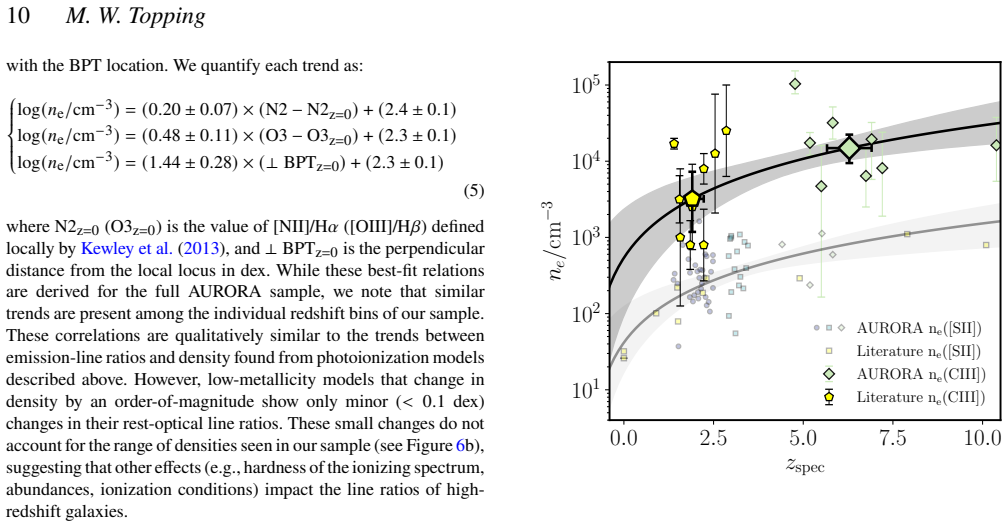
The central discovery is a coherent rise in the density of low-ionization interstellar gas with redshift: from the [SII] $\lambda\lambda6717,6731$ doublet the survey measures median electron densities of $268^{+45}_{-49}$, $350^{+140}_{-76}$, and $480^{+390}_{-310}~\mathrm{cm^{-3}}$ at median redshifts $z=2.3$, $3.2$, and $5.3$, with a best-fit power law $(1+z)^{1.5\pm0.6}$. The same galaxies show, through the CIII] $\lambda\lambda1907,1909$ doublet, a median density of $1.4^{+0.7}_{-0.5}\times10^4~\mathrm{cm^{-3}}$, roughly 30 times the [SII]-based value at $z>4$, which the paper interprets as a consistent two-phase structure of HII regions across cosmic time: compact, dense, high-ionization gas near the ionizing sources surrounded by more diffuse, low-ionization gas. The paper also finds that density correlates weakly with star-formation rate and star-formation surface density, and more strongly with offset from the local BPT (optical emission-line ratio) sequence, and that these trends match the behavior of simulated galaxies in which young systems retain the high pressure of their parent molecular clouds before feedback disperses it.
Load-bearing premise
The paper's redshift evolution is carried by three bins, and the $z>4$ bin contains only four [SII]-detected galaxies, so the load-bearing premise is that those four systems represent the typical star-forming population at that epoch rather than a systematically denser, line-bright subset.
Editorial extensions
If this is right
- If the $(1+z)^{1.5\pm0.6}$ trend holds, typical star-forming galaxies at $z\sim5$ have roughly twice the low-ionization gas density of those at $z\sim2$, which shifts the interpretation of line-ratio diagnostics at high redshift.
- The factor-of-30 contrast between CIII] and [SII] densities implies that constant-density single-phase models cannot reproduce high-redshift nebular spectra; density indicators must be chosen to match the ionization phase they trace.
- The weak positive correlations with SFR and SFR surface density, alongside the stronger correlation with BPT offset, imply that density tracks star-formation intensity and ionizing conditions rather than stellar mass or specific SFR.
- The similar evolution of [SII] and CIII] densities suggests the inner/outer density contrast of HII regions is roughly constant from $z\sim2$ to $z\sim6$, so the increase in density is a whole-ISM effect rather than a rearrangement of the structure.
- The match to simulated galaxies links the high densities of young, high-H$\beta$ EW galaxies to residual molecular-cloud pressure that feedback from stars and supernovae later dissipates.
Reading between the lines
- Beyond the paper: if the same slope persists above $z\sim6$, galaxies near $z\sim8$ should have [SII]-phase densities approaching $1000~\mathrm{cm^{-3}}$, which would make low-ionization optical doublets faint and push density work onto rest-UV lines; existing JWST surveys could test this by stacking CIII] and SiIII] ratios.
- Beyond the paper: the claim that dust scatter hides the O32-density trend could be tested by applying per-galaxy Balmer-decrement corrections with a flexible dust law; a recovered correlation would strengthen the ionization-parameter interpretation.
- Beyond the paper: the two-phase density contrast predicts that rest-UV high-ionization doublets such as SiIII] will yield systematically higher densities than optical low-ionization lines in the same galaxies, a prediction that can be checked with stacked spectra at $z\sim6$.
Editorial analysis
A structured set of objections, weighed in public.
Referee Report
Summary. This paper analyzes deep JWST/NIRSpec spectra from the AURORA survey to derive electron densities from [SII] and CIII] doublet ratios for 57 star-forming galaxies at z≈1.4–10. The authors report median [SII] densities of 268, 350, and 480 cm^-3 at z≈2.1, 3.2, and 5.3 and fit a redshift evolution ∝(1+z)^1.5±0.6. They further find a median CIII] density of 1.4×10^4 cm^-3, about 30 times larger than [SII], and identify weak correlations with SFR, ΣSFR, Ne3O2, and offset from the local BPT sequence. The data are compared with SPHINX cosmological radiation-hydrodynamic simulations.
Significance. If the redshift trend holds, the paper would provide one of the first homogeneous multi-phase electron-density measurements at z>2 with JWST, with a careful treatment of spectral resolution and bootstrap uncertainties. The paper also makes a useful empirical point that low- and high-ionization gas densities differ by an order of magnitude, and the comparison to simulations is a constructive step. However, the headline evolutionary law is not firmly established by the data presented.
major comments (3)
- [Section 3.1.1 and Table A2] The quoted z>4 median [SII] density of 480 cm^-3 cannot be reproduced from the four point estimates listed in Table A2 (808, 237, 1125, and 594 cm^-3; their median is ~700 cm^-3). Since the high-z bin is the only bin that drives a statistically significant increase over the lower-redshift medians, the authors must clarify how this median was computed (e.g., including lower/upper limits from non-detections) and report the bootstrap median distribution. Without this, the central evolutionary claim is not reproducible.
- [Section 3.1.1 and Fig. 3] The two lowest redshift bins (z≈2.1 and z≈3.2) have medians of 268 and 350 cm^-3, which are consistent within their quoted 1σ uncertainties, so the AURORA data alone do not demonstrate a monotonic rise. The fitted exponent 1.5±0.6 is therefore almost entirely determined by the four-object z>4 bin. Even taking the quoted medians at face value, a simple power-law fit in log space gives a slope closer to 0.9. The paper should either fit the individual densities with a proper censored regression or present the (1+z)^1.5 relation as a preliminary suggestion.
- [Section 2.4 and Fig. 1] The representativeness claim for the z>4 sample is based on only four galaxies. With N=4, requiring a >5σ [SII] detection at the red edge of the G395M coverage may systematically select systems with high line surface brightness or high density. The authors should test the sensitivity of the redshift slope to selection effects, e.g., by comparing the properties of [SII]-detected and non-detected galaxies at z>4 and by recomputing the fit without the z>4 bin.
minor comments (5)
- [Abstract and Section 3.1.1] The abstract gives the lowest-redshift bin as z=2.3 while Section 3.1.1 reports a median redshift of z≈2.1; please harmonize these values.
- [Abstract and Section 4.2] The phrase 'SPHINX galaxy formations' is incomplete; it should read 'SPHINX galaxy formation simulations'.
- [Figure 3 caption] The text refers to panels (a) and (b) of Figure 3, but the caption labels them only as 'Left' and 'Right'; please add explicit panel labels.
- [Section 4.1 and Fig. 7] The CIII] evolutionary slope ∝(1+z)^1.6 is derived from a heterogeneous sample (8 AURORA galaxies plus the Maseda et al. 2017 sample) and should be reported with a caveat about selection; consider softening the co-evolution claim.
- [Section 2.3.2] The statement that varying the assumed electron temperature between 10,000 K and 20,000 K has 'only a minimal effect' is vague; please quantify the effect on the inferred [SII] densities.
Circularity Check
No significant circularity: the electron densities are external observables derived from [SII]/CIII] doublet ratios, and the (1+z)^1.5 trend is an empirical fit to the measured medians, not a construction from the model.
full rationale
The derivation chain is self-contained in the relevant sense. Electron densities are inferred from measured [SII] and CIII] doublet ratios using PyNeb (Section 2.3.2), with a stated assumption of Te = 15,000 K; they are not defined by the evolutionary claim. The redshift trend is obtained by fitting a power law to the bootstrapped medians in three redshift bins (Section 3.1.1), which is standard empirical fitting rather than a prediction derived from the model. The extrapolations to z ~ 0 and z ~ 7.5 are explicitly described as extrapolations of this best-fit trend and are compared to, not substituted for, independent literature measurements. The CIII] analysis uses an external comparison sample (Maseda et al. 2017), and the SPHINX simulations provide an external theoretical comparison; neither is calibrated to force the AURORA densities. The paper contains self-citations to companion AURORA papers (Shapley et al. 2024; Sanders et al. 2024a) for survey design, data reduction, and SED fitting, but these do not enter the density measurement or the redshift-evolution fit in a load-bearing way. The small size of the z > 4 [SII] sample (N = 4) and the overlap of the two lower-redshift medians are statistical robustness concerns, not circularity. No equation reduces to its own input, and no fitted parameter is renamed as an independent prediction.
Assumptions & free parameters
free parameters (3)
- [SII] density redshift evolution exponent =
1.5 ± 0.6
- CIII] density redshift evolution exponent =
1.6 +0.8/-0.7
- SFR and SigmaSFR density relation slopes =
0.29 ± 0.16 and 0.15 ± 0.10
assumptions (7)
- standard math PyNeb atomic data and collisional excitation/de-excitation equilibrium convert doublet ratios to electron density.
- domain assumption A single electron temperature of 15,000 K is assumed for all density derivations.
- domain assumption Case B recombination with H-alpha/H-beta = 2.79 is used for Balmer decrement dust corrections.
- domain assumption SFR conversion factors come from BPASS models with a 100 solar mass upper cutoff and metallicity-dependent calibration.
- domain assumption The relation U proportional to n_e^(1/3) epsilon^(2/3) for an ionization-bounded nebula is used to interpret Ne3O2 trends.
- domain assumption msafit-derived spectral resolutions correctly determine which CIII] doublets are resolved.
- domain assumption The SPHINX z=4.64 simulation snapshot provides a physically meaningful comparison for the observed trends.
Cite this review
Pith. "Pith review of The AURORA Survey: The Evolution of Multi-phase Electron Densities at High Redshift." pith.science (2026). https://pith.science/paper/EOLWYWBI
@misc{pith2026250208712,
  author       = {Pith},
  title        = {Pith review of: The AURORA Survey: The Evolution of Multi-phase Electron Densities at High Redshift},
  year         = {2026},
  howpublished = {\url{https://pith.science/paper/EOLWYWBI}},
  note         = {Machine review of arXiv:2502.08712}
}
abstract
We present an analysis of deep $\textit{JWST}$/NIRSpec spectra of star-forming galaxies at $z\simeq1.4-10$, observed as part of the AURORA survey. We infer median low-ionization electron densities of $268_{-49}^{+45}~\rm cm^{-3}$, $350_{-76}^{+140}~\rm cm^{-3}$, and $480_{-310}^{+390}~\rm cm^{-3}$ at redshifts z$=2.3$, $z=3.2$, and $z=5.3$, respectively, revealing an evolutionary trend following $(1+z)^{1.5\pm0.6}$. We identify weak positive correlations between electron density and star formation rate (SFR) as well as SFR surface density, but no significant trends with stellar mass or specific SFR. Correlations with rest-optical emission line ratios show densities increasing with $\rm [NeIII]\lambda3869/[OII]\lambda3727$ and, potentially, $\rm [OIII]\lambda5007/[OII]\lambda3727$, although variations in dust attenuation complicate the latter. Additionally, electron density is more strongly correlated with distance from the local BPT sequence than can be explained by simple photoionization models. We further derive electron densities from the CIII] doublet probing higher-ionization gas, and find a median value of $1.4_{-0.5}^{+0.7}\times10^4~\rm cm^{-3}$, $\sim30$ times higher than densities inferred from [SII]. This comparison suggests a consistent HII region structure across cosmic time with dense, high-ionization interiors surrounded by less dense, low-ionization gas. We compare measurements of AURORA galaxies to predictions from the SPHINX galaxy formations, highlighting the interplay between residual molecular cloud pressure in young galaxies and feedback from stellar winds and supernovae as galaxies mature.
Figures


Figures from the paper (5 more)



Forward citations
Cited by 4 Pith papers
-
The AURORA Survey: Robust Helium Abundances at High Redshift Reveal A Subpopulation of Helium-Enhanced Galaxies in the Early Universe
JWST spectra of 20 high-redshift galaxies provide the first robust helium abundances at z=1.6-3.3 and reveal a subpopulation of four galaxies with elevated helium but normal nitrogen and alpha-element abundances.
-
Resolving stellar populations, star formation, and interstellar medium conditions with JWST in a large spiral galaxy at $z\approx2$
Resolved JWST and ERIS observations of the z≈2.2 spiral K20-ID7 reveal a heavily obscured, still star-forming bulge, low S/O abundance, and an inside-out stellar age gradient.
-
GA-NIFS: an extended [OIII] halo around the sub-Eddington quasar J1342+0928 at z=7.54
JWST spectra of the z=7.54 quasar ULAS J1342+0928 reveal a 7-kpc oxygen halo and a moderate accretion rate of about 40% of the Eddington limit.
-
Deep Spectroscopic Follow-Up of Maisie's Galaxy -- A Typical Galaxy in the Early Universe
Deep JWST spectroscopy of Maisie's Galaxy at z=11.4 reveals moderate star formation, metallicity, and ionization consistent with a typical galaxy on the early star-formation main sequence rather than an extreme source.
Reference graph
Works this paper leans on
-
[1]
Abdurro'uf et al., 2024, @doi [arXiv e-prints] 10.48550/arXiv.2404.16201 , https://ui.adsabs.harvard.edu/abs/2024arXiv240416201A p. arXiv:2404.16201
-
[2]
Andrews B. H., Martini P., 2013, @doi [ ] 10.1088/0004-637X/765/2/140 , https://ui.adsabs.harvard.edu/abs/2013ApJ...765..140A 765, 140
-
[3]
Asplund M., Grevesse N., Sauval A. J., Scott P., 2009, @doi [ ] 10.1146/annurev.astro.46.060407.145222 , https://ui.adsabs.harvard.edu/abs/2009ARA&A..47..481A 47, 481
arXiv 2009
-
[4]
Baldwin J. A., Phillips M. M., Terlevich R., 1981, @doi [ ] 10.1086/130766 , https://ui.adsabs.harvard.edu/abs/1981PASP...93....5B 93, 5
doi:10.1086/130766 1981
-
[5]
Berg D. A., et al., 2012, @doi [ ] 10.1088/0004-637X/754/2/98 , https://ui.adsabs.harvard.edu/abs/2012ApJ...754...98B 754, 98
-
[6]
Berg D. A., Chisholm J., Erb D. K., Skillman E. D., Pogge R. W., Olivier G. M., 2021, @doi [ ] 10.3847/1538-4357/ac141b , https://ui.adsabs.harvard.edu/abs/2021ApJ...922..170B 922, 170
-
[7]
Berg D. A., et al., 2022, @doi [ ] 10.3847/1538-4365/ac6c03 , https://ui.adsabs.harvard.edu/abs/2022ApJS..261...31B 261, 31
-
[8]
Bian F., et al., 2010, @doi [ ] 10.1088/0004-637X/725/2/1877 , https://ui.adsabs.harvard.edu/abs/2010ApJ...725.1877B 725, 1877
Show all 109 references
-
[9]
J., Dopita M
Bian F., Kewley L. J., Dopita M. A., Juneau S., 2016, @doi [ ] 10.3847/0004-637X/822/2/62 , https://ui.adsabs.harvard.edu/abs/2016ApJ...822...62B 822, 62
2016 doi
-
[10]
J., et al., 2015, @doi [ ] 10.1088/0004-637X/803/1/34 , https://ui.adsabs.harvard.edu/abs/2015ApJ...803...34B 803, 34
Bouwens R. J., et al., 2015, @doi [ ] 10.1088/0004-637X/803/1/34 , https://ui.adsabs.harvard.edu/abs/2015ApJ...803...34B 803, 34
2015 doi
-
[11]
Brinchmann J., Pettini M., Charlot S., 2008, @doi [ ] 10.1111/j.1365-2966.2008.12914.x , https://ui.adsabs.harvard.edu/abs/2008MNRAS.385..769B 385, 769
2008
-
[12]
J., et al., 2023, @doi [ ] 10.1051/0004-6361/202346159 , https://ui.adsabs.harvard.edu/abs/2023A&A...677A..88B 677, A88
Bunker A. J., et al., 2023, @doi [ ] 10.1051/0004-6361/202346159 , https://ui.adsabs.harvard.edu/abs/2023A&A...677A..88B 677, A88
2023 doi
-
[13]
J., Conroy C., Johnson B
Byler N., Dalcanton J. J., Conroy C., Johnson B. D., 2017, @doi [ ] 10.3847/1538-4357/aa6c66 , https://ui.adsabs.harvard.edu/abs/2017ApJ...840...44B 840, 44
2017 doi
-
[14]
C., Kinney A
Calzetti D., Armus L., Bohlin R. C., Kinney A. L., Koornneef J., Storchi-Bergmann T., 2000, @doi [ ] 10.1086/308692 , https://ui.adsabs.harvard.edu/abs/2000ApJ...533..682C 533, 682
2000 doi
-
[15]
J., Katz H., Witten C., Saxena A., Laporte N., Bunker A
Cameron A. J., Katz H., Witten C., Saxena A., Laporte N., Bunker A. J., 2024, @doi [ ] 10.1093/mnras/stae1547 , https://ui.adsabs.harvard.edu/abs/2024MNRAS.534..523C 534, 523
2024 doi
-
[16]
A., Clayton G
Cardelli J. A., Clayton G. C., Mathis J. S., 1989, @doi [ ] 10.1086/167900 , https://ui.adsabs.harvard.edu/abs/1989ApJ...345..245C 345, 245
1989 doi
-
[17]
Chabrier G., 2003, @doi [ ] 10.1086/376392 , https://ui.adsabs.harvard.edu/abs/2003PASP..115..763C 115, 763
2003 doi
-
[18]
E., 2010, @doi [ ] 10.1088/0004-637X/712/2/833 , https://ui.adsabs.harvard.edu/abs/2010ApJ...712..833C 712, 833
Conroy C., Gunn J. E., 2010, @doi [ ] 10.1088/0004-637X/712/2/833 , https://ui.adsabs.harvard.edu/abs/2010ApJ...712..833C 712, 833
2010 doi
-
[19]
E., White M., 2009, @doi [ ] 10.1088/0004-637X/699/1/486 , https://ui.adsabs.harvard.edu/abs/2009ApJ...699..486C 699, 486
Conroy C., Gunn J. E., White M., 2009, @doi [ ] 10.1088/0004-637X/699/1/486 , https://ui.adsabs.harvard.edu/abs/2009ApJ...699..486C 699, 486
2009 doi
-
[20]
Curti M., et al., 2024, @doi [ ] 10.1051/0004-6361/202346698 , https://ui.adsabs.harvard.edu/abs/2024A&A...684A..75C 684, A75
2024 doi
-
[21]
L., et al., 2021, @doi [ ] 10.3847/1538-4357/abd551 , https://ui.adsabs.harvard.edu/abs/2021ApJ...909...78D 909, 78
Davies R. L., et al., 2021, @doi [ ] 10.3847/1538-4357/abd551 , https://ui.adsabs.harvard.edu/abs/2021ApJ...909...78D 909, 78
2021 doi
-
[22]
S., et al., 2021, PRIMER: Public Release IMaging for Extragalactic Research , JWST Proposal
Dunlop J. S., et al., 2021, PRIMER: Public Release IMaging for Extragalactic Research , JWST Proposal. Cycle 1, ID. \#1837
2021
- [23]
-
[24]
Endsley R., et al., 2024, @doi [ ] 10.1093/mnras/stae1857 , https://ui.adsabs.harvard.edu/abs/2024MNRAS.533.1111E 533, 1111
2024 doi
-
[25]
K., Shapley A
Erb D. K., Shapley A. E., Pettini M., Steidel C. C., Reddy N. A., Adelberger K. L., 2006, @doi [ ] 10.1086/503623 , https://ui.adsabs.harvard.edu/abs/2006ApJ...644..813E 644, 813
2006 doi
-
[26]
L., et al., 2015, @doi [ ] 10.1088/0004-637X/810/1/71 , https://ui.adsabs.harvard.edu/abs/2015ApJ...810...71F 810, 71
Finkelstein S. L., et al., 2015, @doi [ ] 10.1088/0004-637X/810/1/71 , https://ui.adsabs.harvard.edu/abs/2015ApJ...810...71F 810, 71
2015 doi
-
[27]
Fujimoto S., et al., 2023, @doi [ ] 10.3847/2041-8213/acd2d9 , https://ui.adsabs.harvard.edu/abs/2023ApJ...949L..25F 949, L25
2023 doi
-
[28]
D., Clayton G
Gordon K. D., Clayton G. C., Misselt K. A., Landolt A. U., Wolff M. J., 2003, @doi [ ] 10.1086/376774 , https://ui.adsabs.harvard.edu/abs/2003ApJ...594..279G 594, 279
2003 doi
-
[29]
A., et al., 2011, @doi [ ] 10.1088/0067-0049/197/2/35 , https://ui.adsabs.harvard.edu/abs/2011ApJS..197...35G 197, 35
Grogin N. A., et al., 2011, @doi [ ] 10.1088/0067-0049/197/2/35 , https://ui.adsabs.harvard.edu/abs/2011ApJS..197...35G 197, 35
2011 doi
-
[30]
N., Shapley A
Hainline K. N., Shapley A. E., Kornei K. A., Pettini M., Buckley-Geer E., Allam S. S., Tucker D. L., 2009, @doi [ ] 10.1088/0004-637X/701/1/52 , https://ui.adsabs.harvard.edu/abs/2009ApJ...701...52H 701, 52
2009 doi
-
[31]
N., et al., 2024, @doi [ ] 10.3847/1538-4357/ad1ee4 , https://ui.adsabs.harvard.edu/abs/2024ApJ...964...71H 964, 71
Hainline K. N., et al., 2024, @doi [ ] 10.3847/1538-4357/ad1ee4 , https://ui.adsabs.harvard.edu/abs/2024ApJ...964...71H 964, 71
2024 doi
-
[32]
Harshan A., et al., 2020, @doi [ ] 10.3847/1538-4357/ab76cf , https://ui.adsabs.harvard.edu/abs/2020ApJ...892...77H 892, 77
2020 doi
- [33]
-
[34]
Herrera-Camus R., et al., 2016, @doi [ ] 10.3847/0004-637X/826/2/175 , https://ui.adsabs.harvard.edu/abs/2016ApJ...826..175H 826, 175
2016 doi
-
[35]
Horne K., 1986, @doi [ ] 10.1086/131801 , https://ui.adsabs.harvard.edu/abs/1986PASP...98..609H 98, 609
1986 doi
-
[36]
Hu W., et al., 2024, @doi [ ] 10.3847/1538-4357/ad5015 , https://ui.adsabs.harvard.edu/abs/2024ApJ...971...21H 971, 21
2024 doi
-
[37]
K., Hirashita H., 2009, @doi [ ] 10.1051/0004-6361/200912020 , https://ui.adsabs.harvard.edu/abs/2009A&A...507.1327H 507, 1327
Hunt L. K., Hirashita H., 2009, @doi [ ] 10.1051/0004-6361/200912020 , https://ui.adsabs.harvard.edu/abs/2009A&A...507.1327H 507, 1327
2009 doi
-
[38]
Isobe Y., Ouchi M., Nakajima K., Harikane Y., Ono Y., Xu Y., Zhang Y., Umeda H., 2023, @doi [ ] 10.3847/1538-4357/acf376 , https://ui.adsabs.harvard.edu/abs/2023ApJ...956..139I 956, 139
2023 doi
-
[39]
L., et al., 2014, @doi [ ] 10.1093/mnras/stu287 , https://ui.adsabs.harvard.edu/abs/2014MNRAS.440.1794J 440, 1794
James B. L., et al., 2014, @doi [ ] 10.1093/mnras/stu287 , https://ui.adsabs.harvard.edu/abs/2014MNRAS.440.1794J 440, 1794
2014 doi
-
[40]
J., Dutton A
Jiang F., Dekel A., Freundlich J., Romanowsky A. J., Dutton A. A., Macci \`o A. V., Di Cintio A., 2019, @doi [ ] 10.1093/mnras/stz1499 , https://ui.adsabs.harvard.edu/abs/2019MNRAS.487.5272J 487, 5272
2019 doi
-
[41]
D., Leja J., Conroy C., Speagle J
Johnson B. D., Leja J., Conroy C., Speagle J. S., 2021, @doi [ ] 10.3847/1538-4365/abef67 , https://ui.adsabs.harvard.edu/abs/2021ApJS..254...22J 254, 22
2021 doi
-
[42]
Jung I., et al., 2020, @doi [ ] 10.3847/1538-4357/abbd44 , https://ui.adsabs.harvard.edu/abs/2020ApJ...904..144J 904, 144
2020 doi
-
[43]
J., Gupta A., 2017, @doi [ ] 10.1093/mnras/stw2827 , https://ui.adsabs.harvard.edu/abs/2017MNRAS.465.3220K 465, 3220
Kaasinen M., Bian F., Groves B., Kewley L. J., Gupta A., 2017, @doi [ ] 10.1093/mnras/stw2827 , https://ui.adsabs.harvard.edu/abs/2017MNRAS.465.3220K 465, 3220
2017 doi
-
[44]
K., 2019, @doi [ ] 10.1093/mnras/stz881 , https://ui.adsabs.harvard.edu/abs/2019MNRAS.486.1053K 486, 1053
Kashino D., Inoue A. K., 2019, @doi [ ] 10.1093/mnras/stz881 , https://ui.adsabs.harvard.edu/abs/2019MNRAS.486.1053K 486, 1053
2019 doi
-
[45]
Kashino D., et al., 2017, @doi [ ] 10.3847/1538-4357/835/1/88 , https://ui.adsabs.harvard.edu/abs/2017ApJ...835...88K 835, 88
2017 doi
-
[46]
Katz H., et al., 2023, @doi [The Open Journal of Astrophysics] 10.21105/astro.2309.03269 , https://ui.adsabs.harvard.edu/abs/2023OJAp....6E..44K 6, 44
2023 arXiv
- [47]
-
[48]
C., 2007, @doi [ ] 10.1086/519947 , https://ui.adsabs.harvard.edu/abs/2007ApJ...665.1489K 665, 1489
Kelly B. C., 2007, @doi [ ] 10.1086/519947 , https://ui.adsabs.harvard.edu/abs/2007ApJ...665.1489K 665, 1489
2007 doi
-
[49]
J., Ellison S
Kewley L. J., Ellison S. L., 2008, @doi [ ] 10.1086/587500 , https://ui.adsabs.harvard.edu/abs/2008ApJ...681.1183K 681, 1183
2008 doi
-
[50]
J., Dopita M
Kewley L. J., Dopita M. A., Leitherer C., Dav \'e R., Yuan T., Allen M., Groves B., Sutherland R., 2013, @doi [ ] 10.1088/0004-637X/774/2/100 , https://ui.adsabs.harvard.edu/abs/2013ApJ...774..100K 774, 100
2013 doi
-
[51]
G., Labb \'e I., Franx M., Illingworth G
Kriek M., van Dokkum P. G., Labb \'e I., Franx M., Illingworth G. D., Marchesini D., Quadri R. F., 2009, @doi [ ] 10.1088/0004-637X/700/1/221 , https://ui.adsabs.harvard.edu/abs/2009ApJ...700..221K 700, 221
2009 doi
- [52]
-
[53]
H., et al., 2024, @doi [ ] 10.1051/0004-6361/202347133 , https://ui.adsabs.harvard.edu/abs/2024A&A...681A..70L 681, A70
Laseter I. H., et al., 2024, @doi [ ] 10.1051/0004-6361/202347133 , https://ui.adsabs.harvard.edu/abs/2024A&A...681A..70L 681, A70
2024 doi
-
[54]
D., Cannon J
Lee H., Skillman E. D., Cannon J. M., Jackson D. C., Gehrz R. D., Polomski E. F., Woodward C. E., 2006, @doi [ ] 10.1086/505573 , https://ui.adsabs.harvard.edu/abs/2006ApJ...647..970L 647, 970
2006 doi
-
[55]
D., Nesvadba N
Lehnert M. D., Nesvadba N. P. H., Le Tiran L., Di Matteo P., van Driel W., Douglas L. S., Chemin L., Bournaud F., 2009, @doi [ ] 10.1088/0004-637X/699/2/1660 , https://ui.adsabs.harvard.edu/abs/2009ApJ...699.1660L 699, 1660
2009 doi
-
[56]
F., Serrano A., Torres-Peimbert S., 1979, , https://ui.adsabs.harvard.edu/abs/1979A&A....80..155L 80, 155
Lequeux J., Peimbert M., Rayo J. F., Serrano A., Torres-Peimbert S., 1979, , https://ui.adsabs.harvard.edu/abs/1979A&A....80..155L 80, 155
1979
- [57]
-
[58]
A., 2015, @doi [ ] 10.1051/0004-6361/201323152 , https://ui.adsabs.harvard.edu/abs/2015A&A...573A..42L 573, A42
Luridiana V., Morisset C., Shaw R. A., 2015, @doi [ ] 10.1051/0004-6361/201323152 , https://ui.adsabs.harvard.edu/abs/2015A&A...573A..42L 573, A42
2015 doi
-
[59]
P., Jones T., Ellis R
Mainali R., Stark D. P., Jones T., Ellis R. S., Hezaveh Y. D., Rigby J. R., 2023, @doi [ ] 10.1093/mnras/stad387 , https://ui.adsabs.harvard.edu/abs/2023MNRAS.520.4037M 520, 4037
2023 doi
-
[60]
A., et al., 2013, @doi [ ] 10.1051/0004-6361/201321956 , https://ui.adsabs.harvard.edu/abs/2013A&A...559A.114M 559, A114
Marino R. A., et al., 2013, @doi [ ] 10.1051/0004-6361/201321956 , https://ui.adsabs.harvard.edu/abs/2013A&A...559A.114M 559, A114
2013 doi
-
[61]
F., Brammer G., Franx M., Nersesian A., 2024, @doi [ ] 10.3847/1538-4357/ad5c6a , https://ui.adsabs.harvard.edu/abs/2024ApJ...972..134M 972, 134
Martorano M., van der Wel A., Baes M., Bell E. F., Brammer G., Franx M., Nersesian A., 2024, @doi [ ] 10.3847/1538-4357/ad5c6a , https://ui.adsabs.harvard.edu/abs/2024ApJ...972..134M 972, 134
2024 doi
-
[62]
V., et al., 2017, @doi [ ] 10.1051/0004-6361/201730985 , https://ui.adsabs.harvard.edu/abs/2017A&A...608A...4M 608, A4
Maseda M. V., et al., 2017, @doi [ ] 10.1051/0004-6361/201730985 , https://ui.adsabs.harvard.edu/abs/2017A&A...608A...4M 608, A4
2017 doi
-
[63]
Mingozzi M., et al., 2022, @doi [ ] 10.3847/1538-4357/ac952c , https://ui.adsabs.harvard.edu/abs/2022ApJ...939..110M 939, 110
2022 doi
-
[64]
Nakajima K., Ouchi M., Isobe Y., Harikane Y., Zhang Y., Ono Y., Umeda H., Oguri M., 2023, @doi [ ] 10.3847/1538-4365/acd556 , https://ui.adsabs.harvard.edu/abs/2023ApJS..269...33N 269, 33
2023 doi
-
[65]
B., Das P., Oey M
Nath B. B., Das P., Oey M. S., 2020, @doi [ ] 10.1093/mnras/staa336 , https://ui.adsabs.harvard.edu/abs/2020MNRAS.493.1034N 493, 1034
2020 doi
-
[66]
A., et al., 2023, @doi [ ] 10.1093/mnras/stad2411 , https://ui.adsabs.harvard.edu/abs/2023MNRAS.525.2864O 525, 2864
Oesch P. A., et al., 2023, @doi [ ] 10.1093/mnras/stad2411 , https://ui.adsabs.harvard.edu/abs/2023MNRAS.525.2864O 525, 2864
2023 doi
-
[67]
S., Clarke C
Oey M. S., Clarke C. J., 1997, @doi [ ] 10.1093/mnras/289.3.570 , https://ui.adsabs.harvard.edu/abs/1997MNRAS.289..570O 289, 570
1997 doi
-
[68]
B., Gunn J
Oke J. B., Gunn J. E., 1983, @doi [ ] 10.1086/160817 , https://ui.adsabs.harvard.edu/abs/1983ApJ...266..713O 266, 713
1983 doi
-
[69]
E., 1989, Astrophysics of gaseous nebulae and active galactic nuclei
Osterbrock D. E., 1989, Astrophysics of gaseous nebulae and active galactic nuclei
1989
-
[70]
E., Ferland G
Osterbrock D. E., Ferland G. J., 2006, Astrophysics of gaseous nebulae and active galactic nuclei
2006
-
[71]
J., Shapley A., Steidel C
Pahl A. J., Shapley A., Steidel C. C., Reddy N. A., Chen Y., 2022, @doi [ ] 10.1093/mnras/stac1767 , https://ui.adsabs.harvard.edu/abs/2022MNRAS.516.2062P 516, 2062
2022 doi
-
[72]
Y., Ho L
Peng C. Y., Ho L. C., Impey C. D., Rix H.-W., 2002, @doi [ ] 10.1086/340952 , https://ui.adsabs.harvard.edu/abs/2002AJ....124..266P 124, 266
2002 doi
-
[73]
Y., Ho L
Peng C. Y., Ho L. C., Impey C. D., Rix H.-W., 2010, @doi [ ] 10.1088/0004-6256/139/6/2097 , https://ui.adsabs.harvard.edu/abs/2010AJ....139.2097P 139, 2097
2010 doi
-
[74]
Pettini M., Pagel B. E. J., 2004, @doi [ ] 10.1111/j.1365-2966.2004.07591.x , https://ui.adsabs.harvard.edu/abs/2004MNRAS.348L..59P 348, L59
2004
-
[75]
Popesso P., et al., 2023, @doi [ ] 10.1093/mnras/stac3214 , https://ui.adsabs.harvard.edu/abs/2023MNRAS.519.1526P 519, 1526
2023 doi
-
[76]
A., et al., 2022, @doi [ ] 10.3847/1538-4357/ac3b4c , https://ui.adsabs.harvard.edu/abs/2022ApJ...926...31R 926, 31
Reddy N. A., et al., 2022, @doi [ ] 10.3847/1538-4357/ac3b4c , https://ui.adsabs.harvard.edu/abs/2022ApJ...926...31R 926, 31
2022 doi
-
[77]
A., et al., 2023a, @doi [ ] 10.3847/1538-4357/acd0b1 , https://ui.adsabs.harvard.edu/abs/2023ApJ...951...56R 951, 56
Reddy N. A., et al., 2023a, @doi [ ] 10.3847/1538-4357/acd0b1 , https://ui.adsabs.harvard.edu/abs/2023ApJ...951...56R 951, 56
-
[78]
A., Topping M
Reddy N. A., Topping M. W., Sanders R. L., Shapley A. E., Brammer G., 2023b, @doi [ ] 10.3847/1538-4357/acd754 , https://ui.adsabs.harvard.edu/abs/2023ApJ...952..167R 952, 167
- [79]
-
[81]
L., et al., 2016b, @doi [ ] 10.3847/0004-637X/816/1/23 , https://ui.adsabs.harvard.edu/abs/2016ApJ...816...23S 816, 23
Sanders R. L., et al., 2016b, @doi [ ] 10.3847/0004-637X/816/1/23 , https://ui.adsabs.harvard.edu/abs/2016ApJ...816...23S 816, 23
-
[82]
L., et al., 2021, @doi [ ] 10.3847/1538-4357/abf4c1 , https://ui.adsabs.harvard.edu/abs/2021ApJ...914...19S 914, 19
Sanders R. L., et al., 2021, @doi [ ] 10.3847/1538-4357/abf4c1 , https://ui.adsabs.harvard.edu/abs/2021ApJ...914...19S 914, 19
2021 doi
- [83]
-
[84]
L., Shapley A
Sanders R. L., Shapley A. E., Topping M. W., Reddy N. A., Brammer G. B., 2024b, @doi [ ] 10.3847/1538-4357/ad15fc , https://ui.adsabs.harvard.edu/abs/2024ApJ...962...24S 962, 24
-
[85]
P., Rudie G
Senchyna P., Plat A., Stark D. P., Rudie G. C., Berg D., Charlot S., James B. L., Mingozzi M., 2024, @doi [ ] 10.3847/1538-4357/ad235e , https://ui.adsabs.harvard.edu/abs/2024ApJ...966...92S 966, 92
2024 doi
-
[86]
E., et al., 2017, @doi [ ] 10.3847/2041-8213/aa8815 , https://ui.adsabs.harvard.edu/abs/2017ApJ...846L..30S 846, L30
Shapley A. E., et al., 2017, @doi [ ] 10.3847/2041-8213/aa8815 , https://ui.adsabs.harvard.edu/abs/2017ApJ...846L..30S 846, L30
2017 doi
-
[87]
E., Reddy N
Shapley A. E., Reddy N. A., Sanders R. L., Topping M. W., Brammer G. B., 2023, @doi [ ] 10.3847/2041-8213/acd939 , https://ui.adsabs.harvard.edu/abs/2023ApJ...950L...1S 950, L1
2023 doi
- [88]
-
[89]
Shimakawa R., et al., 2015, @doi [ ] 10.1093/mnras/stv915 , https://ui.adsabs.harvard.edu/abs/2015MNRAS.451.1284S 451, 1284
2015 doi
-
[90]
Shirazi M., Brinchmann J., Rahmati A., 2014, @doi [ ] 10.1088/0004-637X/787/2/120 , https://ui.adsabs.harvard.edu/abs/2014ApJ...787..120S 787, 120
2014 doi
-
[91]
S., Steinhardt C
Speagle J. S., Steinhardt C. L., Capak P. L., Silverman J. D., 2014, @doi [ ] 10.1088/0067-0049/214/2/15 , https://ui.adsabs.harvard.edu/abs/2014ApJS..214...15S 214, 15
2014 doi
-
[92]
R., Eldridge J
Stanway E. R., Eldridge J. J., 2018, @doi [ ] 10.1093/mnras/sty1353 , https://ui.adsabs.harvard.edu/abs/2018MNRAS.479...75S 479, 75
2018 doi
-
[93]
C., et al., 2014, @doi [ ] 10.1088/0004-637X/795/2/165 , https://ui.adsabs.harvard.edu/abs/2014ApJ...795..165S 795, 165
Steidel C. C., et al., 2014, @doi [ ] 10.1088/0004-637X/795/2/165 , https://ui.adsabs.harvard.edu/abs/2014ApJ...795..165S 795, 165
2014 doi
-
[94]
C., Strom A
Steidel C. C., Strom A. L., Pettini M., Rudie G. C., Reddy N. A., Trainor R. F., 2016, @doi [ ] 10.3847/0004-637X/826/2/159 , https://ui.adsabs.harvard.edu/abs/2016ApJ...826..159S 826, 159
2016 doi
-
[95]
Tacchella S., et al., 2022, @doi [ ] 10.3847/1538-4357/ac4cad , https://ui.adsabs.harvard.edu/abs/2022ApJ...927..170T 927, 170
2022 doi
-
[96]
P., Chevallard J., Charlot S., 2019, @doi [ ] 10.1093/mnras/stz2236 , https://ui.adsabs.harvard.edu/abs/2019MNRAS.489.2572T 489, 2572
Tang M., Stark D. P., Chevallard J., Charlot S., 2019, @doi [ ] 10.1093/mnras/stz2236 , https://ui.adsabs.harvard.edu/abs/2019MNRAS.489.2572T 489, 2572
2019 doi
-
[97]
Tang M., et al., 2023, @doi [ ] 10.1093/mnras/stad2763 , https://ui.adsabs.harvard.edu/abs/2023MNRAS.526.1657T 526, 1657
2023 doi
-
[98]
W., et al., 2022a, @doi [ ] 10.1093/mnras/stac2291 , https://ui.adsabs.harvard.edu/abs/2022MNRAS.516..975T 516, 975
Topping M. W., et al., 2022a, @doi [ ] 10.1093/mnras/stac2291 , https://ui.adsabs.harvard.edu/abs/2022MNRAS.516..975T 516, 975
-
[99]
W., Stark D
Topping M. W., Stark D. P., Endsley R., Plat A., Whitler L., Chen Z., Charlot S., 2022b, @doi [ ] 10.3847/1538-4357/aca522 , https://ui.adsabs.harvard.edu/abs/2022ApJ...941..153T 941, 153
- [100]
-
[101]
W., et al., 2024b, @doi [ ] 10.1093/mnras/stae682 , https://ui.adsabs.harvard.edu/abs/2024MNRAS.529.3301T 529, 3301
Topping M. W., et al., 2024b, @doi [ ] 10.1093/mnras/stae682 , https://ui.adsabs.harvard.edu/abs/2024MNRAS.529.3301T 529, 3301
-
[102]
A., et al., 2004, @doi [ ] 10.1086/423264 , https://ui.adsabs.harvard.edu/abs/2004ApJ...613..898T 613, 898
Tremonti C. A., et al., 2004, @doi [ ] 10.1086/423264 , https://ui.adsabs.harvard.edu/abs/2004ApJ...613..898T 613, 898
2004 doi
-
[103]
P., Endsley R., Leja J., Charlot S., Chevallard J., 2023, @doi [ ] 10.1093/mnras/stad004 , https://ui.adsabs.harvard.edu/abs/2023MNRAS.519.5859W 519, 5859
Whitler L., Stark D. P., Endsley R., Leja J., Charlot S., Chevallard J., 2023, @doi [ ] 10.1093/mnras/stad004 , https://ui.adsabs.harvard.edu/abs/2023MNRAS.519.5859W 519, 5859
2023 doi
-
[104]
Witstok J., Smit R., Maiolino R., Curti M., Laporte N., Massey R., Richard J., Swinbank M., 2021, @doi [ ] 10.1093/mnras/stab2591 , https://ui.adsabs.harvard.edu/abs/2021MNRAS.508.1686W 508, 1686
2021 doi
-
[105]
Yanagisawa H., et al., 2024, @doi [ ] 10.3847/1538-4357/ad72ec , https://ui.adsabs.harvard.edu/abs/2024ApJ...974..266Y 974, 266
2024 doi
-
[106]
de Graaff A., et al., 2024, @doi [ ] 10.1051/0004-6361/202347755 , https://ui.adsabs.harvard.edu/abs/2024A&A...684A..87D 684, A87
2024 doi
-
[107]
write newline
" write newline "" before.all 'output.state := FUNCTION fin.entry write newline FUNCTION new.block output.state before.all = 'skip after.block 'output.state := if FUNCTION new.sentence output.state after.block = 'skip output.state before.all = 'skip after.sentence 'output.stat...
-
[108]
C., Jr., Vishniac, E., & Sneden, C.\ 2006, , 652, 847
Kennicutt, R. C., Jr., Vishniac, E., & Sneden, C.\ 2006, , 652, 847
2006
-
[109]
J., Eichhorn, G., Accomazzi, A., et al.\ 2000, , 143, 41
Kurtz, M. J., Eichhorn, G., Accomazzi, A., et al.\ 2000, , 143, 41
2000
-
[110]
T.\ 2012, American Astronomical Society Meeting Abstracts \#219, 219, 204.04
Vishniac, E. T.\ 2012, American Astronomical Society Meeting Abstracts \#219, 219, 204.04
2012
Reviewed August 7, 2026 · model on record in the stance chip above.
Discussion (0). Continue with ORCID to comment.