REVIEW 3 major objections 6 minor 37 references
$\nu$SpaceSim: An end-to-end simulation package to model the sensitivity of UHECR experiments to upward-moving extensive air showers sourced by cosmic neutrinos interacting in the Earth
T0 review · 3 major / 6 minor · reviewed 2026-08-07 · deepseek-v4-flash
Pith's one-line read νSpaceSim claims one modular pipeline can model the whole neutrino-to-detector chain and produce sensitivity estimates for any optical or radio instrument.
desk verdict A genuinely useful, openly released end-to-end simulation package for earth-skimming tau neutrinos; the paper is honest about its approximations, but the unvalidated Greisen shower model means the quoted sensitivity curves are indicative, not definitive. read the letter →
The pith
A machine-rendered reading of the paper's core claim, the machinery that carries it, and where it could break.
The reading
What carries the argument
The carrying mechanism is a sampled-library, modular pipeline: a vectorized Python wrapper that chains together pre-built lookup tables and external modules for the computationally expensive physical stages, then folds in a user-supplied detector configuration (altitude, effective area, frequency band, pointing) at the final stage. Lookup tables provide the probability that a tau exits the Earth and its emerging energy; a Monte-Carlo event generator produces the tau decay products; a radio-emission code computes the shower's radio signal; atmospheric reanalysis data supply cloud and weather conditions; and parameterized shower profiles are being integrated to replace the current Greisen parametrization. Because the wrapper is modular, a user can swap in alternative propagation tables or detector geometries through a TOML parameter file, and the same pipeline yields sensitivity curves for ground-based, balloon-borne, and space-based instruments.
What would settle it
Take a fixed tau-emergence geometry and energy, run νSpaceSim and an independent full air-shower Monte Carlo with the same atmosphere, and compare the predicted Cherenkov photon counts and radio pulse amplitudes at the detector; a disagreement beyond the quoted statistical uncertainties would show that the current sensitivity curves are not reliable.
Extended reading notes
Core claim
The paper claims that the relevant physics—neutrino charged- and neutral-current interactions inside the Earth, tau regeneration, tau decay, air-shower development, optical and radio emission, atmospheric attenuation, and instrument response—can be assembled into one modular, vectorized simulation, and that the result is fast enough to generate a million events in about five minutes on a laptop. The package's workflow is demonstrated with a simulated balloon mission at 33 km altitude pointing between the Earth's limb and 6.4 degrees below it, and with a target-of-opportunity comparison showing that the simulated 14-day sensitivity of a balloon detector to a binary-neutron-star merger would have been competitive with the sensitivities of the large observatories that actually observed it.
Load-bearing premise
The load-bearing premise is that the chained approximations (lookup-table Earth-exit probabilities, the Greisen shower parametrization, the radio-emission model, and the treatment of clouds as opaque to Cherenkov light) each stay accurate enough that their errors do not accumulate; the paper does not validate the full chain against a real detected event.
Editorial extensions
If this is right
- A detector team can obtain a first sensitivity estimate by editing a parameter file, without writing custom simulation code for each physical stage.
- Balloon- and space-mission designs can be optimized for neutrino-triggered upward showers while the package is still under active development.
- A large ground-based fluorescence observatory can use νSpaceSim output to estimate its exposure to neutrino-induced upward extensive air showers.
- Transient-source alerts can be paired with simulated 14-day sensitivities, giving a direct comparison of balloon and ground experiments for target-of-opportunity follow-up.
- Users can exchange the Earth-propagation lookup tables for alternative public codes to quantify how much the resulting sensitivity depends on that modeling choice.
Reading between the lines
- A natural next validation, not performed in the paper, would be to compare νSpaceSim's predicted Cherenkov and radio event rates with an independent full air-shower Monte Carlo for identical tau-emergence conditions; the paper's own note that the shower-shape parametrization is still being upgraded suggests this stage is the least settled.
- The treatment of clouds as fully opaque to Cherenkov light means the optical sensitivity estimates are conservative in cloudy conditions; modeling partial transmission and scattering would probably increase predicted photon counts on partially cloudy lines of sight.
- If the end-to-end chain is accurate, the same modular wrapper could be extended to the muon channel, which the paper mentions as possible but does not model in detail.
- The modular design invites a systematic-error study that the paper does not report: swapping the built-in Earth-propagation lookup tables for an alternative public code would show how much the final sensitivity curves move, and that spread could be quoted as a model uncertainty.
Editorial analysis
A structured set of objections, weighed in public.
Referee Report
Summary. The paper presents νSpaceSim, an open-source Python package that simulates the full chain from cosmic neutrinos interacting in the Earth, through tau-lepton production and propagation, tau decay and extensive air shower development, to optical Cherenkov and radio emission, atmospheric propagation, and detector response. The authors describe the modular architecture, the use of precomputed lookup tables from external packages (NuPyProp, NuTauSim/NuLeptonSim, Pythia8, ZHAireS, MERRA-2, CONEX), and the package's speed and public availability. The manuscript reports example outputs, including a simulated sensitivity curve for an SPB-2-like balloon instrument and a comparison with the GW170817 sensitivities of ANTARES, IceCube, and Auger. The stated goal is to provide a user-friendly, end-to-end tool for designing and estimating the sensitivity of balloon-borne, space-based, and ground-based detectors to Earth-emergent neutrino-induced showers.
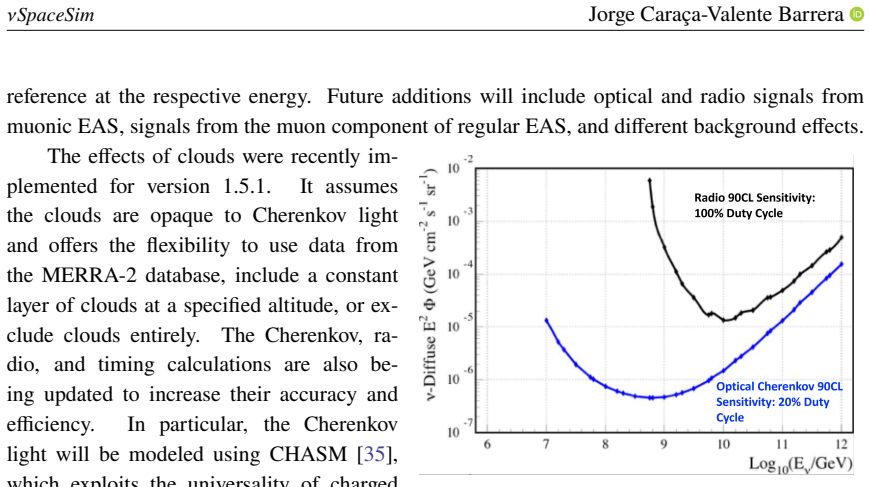
Significance. If the package performs as claimed, it would be a valuable community resource for the UHECR and high-energy neutrino community. The authors explicitly credit the package's public availability through pip, GitHub, and HEASARC, and the modular design with independently published physics packages is a genuine strength. The paper also demonstrates a fast workflow and a direct interface with experimental frameworks such as EUSO-Offline. However, the central claim of being a 'comprehensive' end-to-end simulation that can be used to calculate reliable sensitivity estimates is currently not supported by quantitative validation. The manuscript's own text acknowledges that the default shower model is the Greisen parametrization, that the improved composite-shower implementation is in beta, and that several atmospheric and detector effects are treated with simplifying assumptions. These limitations directly affect the quoted sensitivity projections, so the significance of the numerical results in Figures 7 and 8 is contingent on added validation.
major comments (3)
- [Section 3 and Figure 6] The default EAS module in the released version uses the Greisen parametrization, which the paper itself describes as approximate in comparison with the CONEX-parametrized composite-shower implementation currently in beta. The Greisen profile is a mean electromagnetic cascade function; it does not describe event-by-event fluctuations in Xmax and Nmax, the muon content, or the composite electromagnetic-plus-hadronic structure of tau-decay-initiated showers. Since the optical Cherenkov and radio signals that drive triggering depend directly on the longitudinal profile, this approximation propagates into the sensitivity curves in Figures 7 and 8. The manuscript does not provide a quantitative bound on this systematic error, and the end-to-end chain is not benchmarked against an independent full Monte Carlo or a real detected event. Please add a validation study comparing the Greisen-based default with a CONEX/ZHAireS-based chain for representative energies and emergence angles, or explicitly re-label the sensitivity curves as preliminary projections that do not yet incorporate the improved shower model.
- [Section 4 and Figure 8] The comparison of the simulated SPB-2 sensitivity with the measured 14-day 90% confidence sensitivities of ANTARES, IceCube, and Auger to GW170817 lacks the assumptions needed for reproducibility. The manuscript does not specify the input neutrino flux model and spectrum, the source time profile used for GW170817, the detector trigger and background models, or the exact definition of the 14-day window. Without these details, the SPB-2 curve in Figure 8 cannot be reproduced or interpreted quantitatively. Please provide the full configuration, ideally as a TOML file in the public repository, and state the assumed transient source model.
- [Section 3, cloud and atmospheric modeling] The treatment of clouds as opaque to Cherenkov light is a strong assumption that can bias the optical sensitivity in either direction, and the manuscript gives no estimate of the size of this effect. Since the MERRA-2 database option is available, the authors should quantify the impact of the opaque-cloud assumption on the projected sensitivity in Figures 7 and 8, or at minimum state clearly whether the curves assume no clouds, a constant cloud layer, or MERRA-2-derived clouds. A sensitivity test varying cloud altitude and opacity would make the limitation concrete.
minor comments (6)
- [Affiliation] The affiliation line contains a typo: 'Department of Phisics' should be 'Department of Physics'.
- [References] Reference [36] is listed with a garbled author string ('Antares, I., Auger, P., Scientific, L.I.G.O., ...') and should be corrected to the published collaboration author list; the reference style is also inconsistent with the rest of the bibliography.
- [Section 2] The performance claim '10^6 events in ~5 minutes using a MacBook Pro with an M2Max processor' should specify the software version, the number of threads used, and whether this runtime includes the full end-to-end pipeline or only a subset of modules, so that the claim can be reproduced.
- [Throughout] The capitalization of package and collaboration names is inconsistent: 'nuPyProp' and 'NuPyProp' are both used, as are 'nuspacesim' and 'NuSpaceSim', and 'Euso Offline' appears in place of 'EUSO-Offline'.
- [Section 2] The phrase 'counts with inherent multi-core processing via Dask' is awkward; 'includes inherent multi-core processing via Dask' or 'uses Dask for multi-core processing' would be clearer.
- [Figure 4] The title 'Nuspacesim Results Dashboard' in Figure 4 should be 'νSpaceSim Results Dashboard' for consistency with the paper's notation.
Circularity Check
No significant circularity: νSpaceSim's predictions are forward simulation outputs built from independent external physics libraries, not from fitted inputs or self-citation chains.
full rationale
νSpaceSim is a forward simulation package whose outputs are not recovered from fitted parameters. The physics chain is imported from independent, publicly released packages (NuPyProp and NuTauSim for tau propagation, Pythia8 for decay products, ZHAireS for radio emission, MERRA-2 for atmospheric data, and CONEX for composite EAS in the beta version), while the paper's own code provides vectorized sampling, event looping, and detector-response geometry. The key quantitative outputs, such as the Earth-emergence probabilities in Figure 3 and the simulated 90% CL sensitivity curves in Figures 7 and 8, are Monte Carlo estimates built from those forward models; they are not obtained by fitting a model to a subset of the same data and then presenting a closely related quantity as a prediction. The cited libraries are externally peer-reviewed and independently maintained, and the fact that some NuPyProp authors are also νSpaceSim collaboration members does not make the import circular, because the library is parameter-free with stated physics inputs and is validated outside this paper. The acknowledged use of the Greisen parametrization in the released version, as opposed to the beta CONEX implementation, is an approximation and a correctness risk, not a circular step: it is an input assumption, not a hidden restatement of the sensitivity result. No step in the claimed derivation chain reduces to its own inputs by construction or relies on a self-citation chain to forbid alternatives. Overall, the presentation is self-contained with respect to circularity, with only the normal degree of author self-citation in a simulation-package paper.
Assumptions & free parameters
free parameters (5)
- Detector optical aperture (Figure 7) =
1 m^2
- Balloon altitude (Figure 7) =
33 km
- Radio antenna band (Figure 7) =
30 to 300 MHz
- Pointing range (Figure 7) =
limb to 6.4 degrees below
- Cloud layer opacity =
opaque to Cherenkov light
assumptions (5)
- domain assumption Standard-model neutrino cross sections and tau decay branching ratios
- domain assumption Earth density profile used in NuPyProp lookup tables
- domain assumption MERRA-2 atmospheric data adequately represents clouds and atmospheric attenuation
- domain assumption Greisen parametrization approximates EAS longitudinal development
- domain assumption ZHAireS radio emission modeling is accurate for Earth-emergent showers
Cite this review
Pith. "Pith review of $\nu$SpaceSim: An end-to-end simulation package to model the sensitivity of UHECR experiments to upward-moving extensive air showers sourced by cosmic neutrinos interacting in the Earth." pith.science (2026). https://pith.science/paper/IVBBFUDF
@misc{pith2026250208890,
  author       = {Pith},
  title        = {Pith review of: $\nu$SpaceSim: An end-to-end simulation package to model the sensitivity of UHECR experiments to upward-moving extensive air showers sourced by cosmic neutrinos interacting in the Earth},
  year         = {2026},
  howpublished = {\url{https://pith.science/paper/IVBBFUDF}},
  note         = {Machine review of arXiv:2502.08890}
}
abstract
Neutrinos act as probes of hadronic processes and offer a distinctive view into their astrophysical origins at high energies. When reaching energies on the PeV scale, $\nu_\tau$ interactions within the Earth can produce a significant flux of $\tau$-leptons. These $\tau$-leptons subsequently decay, generating upward-moving extensive air showers (EAS). Using the Earth as a target for neutrinos and the atmosphere as a signal generator effectively creates a detector with a mass $\gg$ gigaton. $\nu$SpaceSim is a comprehensive simulation developed to model all the relevant physical processes that describe the neutrino-induced, Earth-emergent lepton chain. The simulation models neutrino interactions inside the Earth that produce leptons, the propagation of the leptons through the Earth into the atmosphere, and their decay, forming composite EAS. Next, it models the generation of air optical Cherenkov and radio signals from these showers, including the propagation and attenuation of these signals through the atmosphere, accounting for effects such as clouds and the ionosphere. Finally, the simulation models the detector response according to the parameters defined by the user (such as altitude, effective area, frequency band...). Through this end-to-end simulation, $\nu$SpaceSim aims to help design the next generation of balloon- and space-based experiments, to estimate the exposure of ground-based experiments to these showers, and to understand the data from recent experiments such as EUSO-SPB2 and ANITA.
Figures


Figures from the paper (5 more)



Reference graph
Works this paper leans on
-
[1]
Pathways to Discovery in Astron- omy and Astrophysics for the 2020s
NationalAcademiesofSciences,Engineering,andMedicine.(2021). Pathways to Discovery in Astron- omy and Astrophysics for the 2020s
work page 2021
-
[2]
Brandenburg, A., & Subramanian, K. (2005). Astrophysical magnetic fields and nonlinear dynamo theory. Physics Reports, 417(1-4), 1-209
work page 2005
-
[3]
Ackermann, M. et al. (2022). High-energy and ultra-high-energy neutrinos: A Snowmass white paper. Journal of high energy astrophysics, 36, 55-110
work page 2022
-
[4]
Spiering, C. (2012). Towards high-energy neutrino astronomy: a historical review. The European Physical Journal H, 37(3), 515-565
work page 2012
-
[5]
Reviews of Modern Physics, 84(3), 1307-1341
Formaggio,J.A.,&Zeller,G.P.(2012).FromeVtoEeV:Neutrinocrosssectionsacrossenergyscales. Reviews of Modern Physics, 84(3), 1307-1341
work page 2012
-
[6]
Aartsen, M. G. et al. (2017). The IceCube Neutrino Observatory: instrumentation and online systems. Journal of Instrumentation, 12(03), P03012
work page 2017
- [7]
-
[8]
DetectionofaparticleshowerattheGlashowresonancewithIceCube.Nature,2021,vol.591,no7849, p. 220-224
work page 2021
Show all 37 references
-
[9]
Abbasi et al., Science 378, 538 (2022), 2211.09972
IceCube Collaboration, R. Abbasi et al., Science 378, 538 (2022), 2211.09972
2022
-
[10]
Aartsen, M. G. et al. Science 361, eaat1378 (2018). arXiv preprint arXiv:1807.08816
2018 arXiv
-
[11]
Stein and other, Nature Astronomy 5, 510 (2021), 2005.05340
R. Stein and other, Nature Astronomy 5, 510 (2021), 2005.05340
2021 arXiv
-
[12]
Eser,J.,Olinto,A.V.,&Wiencke,L.(2023).OverviewandfirstresultsofEUSO-SPB2.arXivpreprint arXiv:2308.15693
2023 arXiv
-
[13]
Journal of Instrumentation, 16(08), P08035
Abarr,Q.etal.&PUEOcollaboration.(2021).Thepayloadforultrahighenergyobservations(PUEO): a white paper. Journal of Instrumentation, 16(08), P08035
2021
-
[14]
Battisti, M., Eser, J., Olinto, A., Osteria, G., & JEM-EUSO Collaboration. (2024). POEMMA-Balloon withRadio.NuclearInstrumentsandMethodsinPhysicsResearchSectionA:Accelerators,Spectrom- eters, Detectors and Associated Equipment, 1069, 169819
2024
-
[15]
Olinto,A.V.,Krizmanic,J.,...&PoemmaCollaboration.(2021).ThePOEMMAobservatory.Journal of Cosmology and Astroparticle Physics, 2021(06), 007
2021
-
[16]
Bustamante, M., & Ahlers, M. (2019). Inferring the flavor of high-energy astrophysical neutrinos at their sources. Physical Review Letters, 122(24), 241101
2019
-
[17]
Song, N. et al. (2021). Journal of Cosmology and Astroparticle Physics, 2021(04), 054
2021
-
[18]
Robitaille, T. et al. (2013). Astropy: A community Python package for astronomy. Astronomy & Astrophysics, 558, A33. 7 𝜈SpaceSim Jorge Caraça-Valente Barrera
2013
-
[19]
Journal of cosmology and astroparticle physics, 2023(01), 041
Garg,D.etal.(2023).NeutrinopropagationintheEarthandemergingchargedleptonswithnuPyProp. Journal of cosmology and astroparticle physics, 2023(01), 041
2023
-
[20]
H., Krizmanic, J
Reno, M. H., Krizmanic, J. F., & Venters, T. M. (2019). Cosmic tau neutrino detection via Cherenkov signals from air showers from Earth-emerging taus. Physical Review D, 100(6), 063010
2019
-
[21]
Garg et al., JCAP 2023, 041 (2023), 2209.15581
D. Garg et al., JCAP 2023, 041 (2023), 2209.15581
2023 arXiv
-
[22]
Alvarez-Muñiz, J. et al. (2018). Comprehensive approach to tau-lepton production by high-energy tau neutrinos propagating through the Earth. Physical Review D, 97(2), 023021
2018
-
[23]
Sjöstrand, T. (2020). The PYTHIA event generator. Computer Physics Communications, 246, 106910
2020
-
[24]
Gelaro, R., McCarty, W., Suárez, et al. (2017). The modern-era retrospective analysis for research and applications, version 2 (MERRA-2). Journal of climate, 30(14), 5419-5454
2017
-
[25]
R., & Zas, E
Alvarez-Muniz, J., Carvalho Jr, W. R., & Zas, E. (2012). Monte Carlo simulations of radio pulses in atmospheric showers using ZHAireS. Astroparticle Physics, 35(6), 325-341
2012
-
[26]
(2015, July)
Rocklin, M. (2015, July). Dask: Parallel computation with blocked... In SciPy (pp. 126-132)
2015
-
[27]
Reustle et al
A. Reustle et al. NuSpaceSim pypi (pip) webpage, https://pypi.org/project/ nuspacesim/ (2021)
2021
-
[28]
https://heasarc.gsfc.nasa.gov/docs/nuSpaceSim/
𝜈SpaceSim HEASARC web portal. https://heasarc.gsfc.nasa.gov/docs/nuSpaceSim/
-
[29]
Reustle et al
A. Reustle et al. NuSpaceSim github repository, https://github.com/NuSpaceSim/nuSpaceSim (2021)
2021
-
[30]
Pierog, T., Alekseeva, et al. (2004). First results of fast one-dimensional hybrid simulation of EAS using CONEX. arXiv preprint astro-ph/0411260
2004 arXiv
-
[31]
Argiro, S. et al. (2007). The offline software framework of the Pierre Auger Observatory. Nuclear Instruments and Methods in Physics Research Section A 580(3), 1485-1496
2007
-
[32]
Abe, S. et al. (2024). EUSO-Offline: A comprehensive simulation and analysis framework. Journal of Instrumentation, 19(01), P01007
2024
-
[33]
Safa, I. et al. (2020). Journal of Cosmology and Astroparticle Physics, 2020(01), 012
2020
-
[34]
Garcia, A. et al. (2020). Complete predictions for high-energy neutrino propagation in matter. Journal of Cosmology and Astroparticle Physics, 2020(09), 025
2020
-
[35]
J., & Bergman, D
Buckland, I. J., & Bergman, D. R. (2023). Universality of Cherenkov light in EAS. Astroparticle Physics, 150, 102832
2023
-
[36]
Antares,I.,Auger,P.,Scientific,L.I.G.O.,...,&Virgo.(2017).Searchforhigh-energyneutrinosfrom binary neutron star merger GW170817 with ANTARES, IceCube, and the Pierre Auger Observatory
2017
-
[37]
Hartley, W. (2017). Multi-messenger observations of a binary neutron star merger. The Astrophysical Journal Letters, 848(2), L12. 𝜈SpaceSim Collaboration John Krizmanic1, Yosui Akaike2, Luis Anchordoqui3, Douglas Bergman4, Isaac Buckland4, Jorge Caraça-Valente5, Austin Cumming...
2017
Reviewed August 7, 2026 · model on record in the stance chip above.
Discussion (0). Continue with ORCID to comment.