REVIEW 3 major objections 4 minor 3 cited by
RoSTE: An Efficient Quantization-Aware Supervised Fine-Tuning Approach for Large Language Models
T0 review · 3 major / 4 minor · reviewed 2026-08-07 · deepseek-v4-flash
Pith's one-line read RoSTE fine-tunes LLMs while quantizing weights, activations, and KV caches to 4 bits, outperforming post-training quantization baselines.
desk verdict New adaptive-rotation QA-SFT method with a believable ablation, but the headline numbers are single-run best-of-sweep and the 'consistently superior' claim needs multi-seed confirmation. read the letter →
The pith
A machine-rendered reading of the paper's core claim, the machinery that carries it, and where it could break.
The reading
What carries the argument
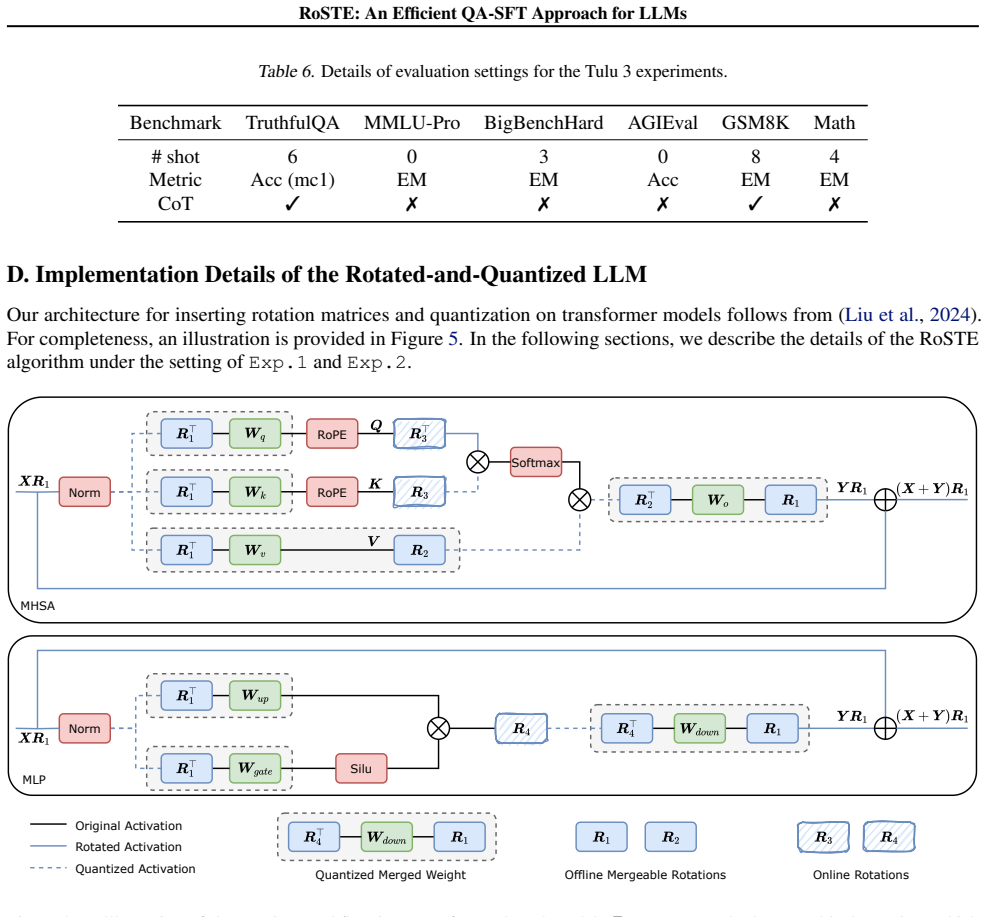
The load-bearing object is the bilevel formulation of Eq. (11): the upper level minimizes the SFT loss over quantized weights under straight-through estimation, while the lower level picks rotation matrices $\{R_i\}$ by minimizing the weight-activation quantization-error surrogate $E(W,R)$ of Eq. (12). The rotation family is restricted to identity or a random Walsh-Hadamard matrix $R(\zeta) = H\,\mathrm{Diag}(r(\zeta))$ (Eq. 19), whose fast CUDA kernel makes the search cheap. The theoretical engine is Theorem 4.3, which bounds the prediction error of a quantized linear model trained by STE by a discounted weighted sum of the weight-quantization errors, so reducing $E(W,R)$ directly reduces a bound on task loss. The per-layer decision rule, apply $H$ only where it lowers $E$, is what distinguishes RoSTE from rotating every module.
What would settle it
Pick a RoSTE-trained checkpoint and flip a single layer's rotation from the choice that minimizes $E(W,R)$ to the other; if held-out task accuracy improves, or stays equal while $E(W,R)$ rises, on enough layers, the surrogate-to-task link is falsified. A cheaper check is to recompute $E(W,R)$ on a disjoint calibration set and see whether the per-layer ordering of rotation benefits changes.
Extended reading notes
Core claim
RoSTE's discovery is that quantization-aware supervised fine-tuning works best when the model is allowed to decide, layer by layer, whether an incoherence rotation helps before each block of STE updates. Concretely, the method alternates between straight-through-estimator gradient steps on the supervised fine-tuning objective for the rotated, quantized network and a low-cost search over two candidates per layer, identity or a random Walsh-Hadamard matrix, selecting whichever minimizes the quantization error $E(W,R)$ of Eq. (12) on 128 calibration samples. The paper shows theoretically, on an overparameterized least-squares model with interpolating quantized features, that the STE-trained prediction error is bounded by a discounted sum of weight-quantization errors, and that a Hadamard rotation turns an outlier-sensitive error of order $d\,\max_i w_i^2$ into an $O(\|w\|^2)$ bound with high probability. Empirically, this adaptive rotation lets W4A4KV4 RoSTE models approach full-precision SFT accuracy while clearly outperforming SFT-then-PTQ pipelines such as RTN, GPTQ, QuaRot, and SpinQuant. The ablation with complete rotation shows the per-layer decision is load-bearing: rotating every module costs 9.98 average ROUGE on Pythia-1B.
Load-bearing premise
The load-bearing premise is that the quantization-error surrogate $E(W,R)$ computed on 128 calibration samples from the fine-tuning dataset faithfully tracks the final task objective, a link the paper proves only for a scalar-output quadratic interpolation model, not for transformer cross-entropy training.
Editorial extensions
If this is right
- A single QA-SFT run replaces the conventional two-stage SFT-then-PTQ pipeline, saving the extra quantization pass and avoiding its accuracy loss.
- At W4A4KV4, RoSTE recovers most of the full-precision SFT gap: on TL;DR, the remaining gap to FP16 SFT is about 1.06 average ROUGE for Pythia-6.9B and 0.77 for Qwen2.5-7B.
- Adaptive rotation, not rotation per se, is what succeeds: applying the Walsh-Hadamard rotation to every layer drops average ROUGE by 9.98 on Pythia-1B, while RoSTE's per-layer choice beats no rotation.
- The surrogate $E(W,R)$ is a practical guide for rotation search, and the theoretical bound says minimizing weight-quantization error is the mechanism, so the same principle can be reused in other quantization-aware training settings.
- The benefits concentrate at aggressive 4-bit weight-activation quantization, where activation outliers dominate the quantization error.
Reading between the lines
- Beyond the paper's K=1 implementation, one could re-select rotations several times during a longer fine-tuning run; the authors expect this to help on larger datasets, and it is a direct testable extension of the algorithm.
- The surrogate-plus-Hadamard-search recipe could be lifted out of SFT and applied to other post-training objectives, such as preference alignment or continued pretraining, where quantization-aware updates are currently done with LoRA.
- The theorem's bit-width remark suggests a trade-off: activation bit-width matters mainly for reaching an interpolation regime, while weight bit-width keeps improving the bound; if this transfers, QA-SFT budgets should spend bits on weights before activations.
- Because the complete-rotation ablation hurts badly, the method implicitly relies on the 128 calibration samples being representative; shrinking or reshuffling that subset and watching task accuracy degrade would reveal how much of RoSTE's gain depends on the surrogate's fidelity.
Editorial analysis
A structured set of objections, weighed in public.
Referee Report
Summary. The paper proposes RoSTE, a quantization-aware supervised fine-tuning (QA-SFT) algorithm that alternates between STE-based optimization of the SFT objective over quantized weights and a per-layer search over a Walsh-Hadamard rotation vs. identity that minimizes a weight-activation quantization-error surrogate. The authors report W4A4KV4 results on Pythia, Qwen, and Llama models, claim consistent superiority over post-SFT PTQ baselines (RTN, GPTQ, QuaRot, SpinQuant) and plain STE, and provide a stylized quadratic-model convergence bound (Theorem 4.3) together with a Walsh-Hadamard incoherence proposition. Code is released.
Significance. If the empirical claims are robust, the method is a practically useful single-pass alternative to fine-then-quantize pipelines for 4-bit weight-activation-KV quantization, and the adaptive per-layer rotation choice is well motivated by the ablation in Table 3 showing that applying rotation to all layers is harmful. The theoretical section is a reasonable first step: Proposition 4.4 gives a formal justification for Hadamard rotation for outlier-heavy weight vectors, and Theorem 4.3, despite its simplicity, makes explicit that the prediction error of STE training is tied to the weight quantization error. The paper also ships code and gives detailed implementation information. However, the central 'consistently superior' claim currently rests on single-run, best-of-sweep comparisons with undisclosed selected hyperparameters, so the practical significance is conditional on stronger experimental evidence.
major comments (3)
- [Section 5, Tables 1-2 and Table 5] Table 5 reports that every STE and RoSTE model is produced by sweeping the learning rate over three values and the clipping factor over three values, but Tables 1-2 report one number per condition without stating which configuration was selected or how many seeds (or checkpoints) were averaged. Since the PTQ baselines are evaluated with fixed settings, the reported margins of +3.01 ROUGE on Pythia-6.9B and +2.56 average accuracy on Llama-3.1-8B can in principle reflect best-of-nine selection for the QA-SFT methods against un-tuned baselines. The per-task pattern in Table 2 is also not uniformly favorable: RoSTE scores 26.44 on TruthfulQA versus 27.66 for QuaRot, so the average margin is not evidence of consistent per-task superiority. Please disclose the selected hyperparameters, run multiple seeds, and report the variability of the main comparisons so that 'consistently superior' is supported as stated.
- [Section 4, Eq. (18) and Assumption 4.2] Theorem 4.3 is proven only for a scalar-output linear model whose loss is squared prediction error (13)-(14), and Assumption 4.2 requires interpolation for every orthogonal matrix R, which is a strong condition that is not verified for transformer cross-entropy objectives. Moreover, the bound in Eq. (18) is expressed in the G-norm (weighted by the activation Gram matrix), whereas the lower-level objective E in Eq. (12) is an unweighted layer-wise sum of weight and activation quantization errors; the paper does not show that decreasing E decreases the G-norm terms or the SFT loss. Because the complete-rotation ablation in Table 3 shows that a poor rotation choice can cost -9.98 ROUGE, the reliability of this surrogate is load-bearing. I recommend adding a direct empirical check of the surrogate's correlation with the SFT objective (e.g., comparing E against held-out SFT loss across rotation configurations) and softening the abstract's claim that prediction error is 'directly proportional' to the quantization error.
- [Section 5, first paragraph and Algorithm 1] The paper states that K = 1 is used in all experiments, with the one-shot rotation configuration computed from the pre-trained model. With K = 1, the rotation configuration is never re-adapted after the QAT stage begins, so the implemented method is closer to 'fixed pre-selected rotations + STE-based QAT' than to the alternating adaptive-rotation procedure described in Section 3 and Figure 2. The sentence 'we anticipate the performance to further improve with larger K' is a conjecture and no experiments with K > 1 are reported. Please clarify whether any experiment used K > 1, and if not, revise the method description and the 'adaptive rotation strategy' claim so that the paper's claims match the implementation.
minor comments (4)
- [Throughout] There are several typos: 'appraoches' in Section 1, 'sceneario' in Section 2.2, and 'ROGUE score' in the discussion of Table 3.
- [Appendix F, text before Table 9] The sentence 'the results for Exp.2 on the Pythia models can be found in Table 9' should refer to Llama models; Table 9 reports Llama 3.1 8B results.
- [Algorithm 1, line 5 and Eq. (19)] Algorithm 1 says the Walsh-Hadamard matrix H is 'generated according to (19)', but Eq. (19) defines R(ζ) and does not specify the distribution of r(ζ); please state explicitly that r(ζ) is a uniformly random sign vector.
- [Figure 1] The full-precision SFT and Base entries appear as horizontal reference lines with no measured training-time point; please clarify in the caption that these are reference values, not training runs, to avoid an apples-to-oranges comparison in the time axis.
Circularity Check
No load-bearing circularity; one non-load-bearing self-citation keeps the score at 2.
full rationale
RoSTE's derivation chain is self-contained. The method selects rotation matrices by minimizing the quantization-error surrogate E in Eq. (12) on 128 calibration samples, runs STE-based QAT on the SFT objective, and then reports ROUGE and benchmark accuracies that are external to the optimization. The only bridge from E to final quality is Theorem 4.3, whose bound (18) is a genuine mathematical consequence under Assumptions 4.1-4.2, not a restatement of the conclusion; it bounds prediction error by an initial error term plus accumulated weight-quantization errors. This motivates the surrogate E but does not define it in terms of the final metrics, and E contains no ROUGE or accuracy term, so there is no fitted-input-called-prediction reduction. The Walsh-Hadamard incoherence bound in Proposition 4.4 is explicitly credited to Tseng et al. (2024), an external source, and no uniqueness theorem is imported from the authors' prior work. The only self-citation is footnote 2, which cites Li et al. (2024) merely as an example of other fine-tuning objectives; it is not load-bearing. Figure 4's lower quantization error for RoSTE is expected by construction because Algorithm 1 line 5 explicitly minimizes E, but the paper's central empirical claims rest on Tables 1-3, which use external evaluations rather than E itself. No circular step reaches the listing threshold; the score of 2 reflects the rubric's category for a single non-load-bearing self-citation.
Assumptions & free parameters
free parameters (4)
- Clipping factor c =
One of {1, 0.95, 0.9} per model, not reported
- Learning rate =
One of {3e-5, 6e-6, 3e-6} etc. per model, not reported
- Calibration set size n =
128
- Outer-loop count K =
1
assumptions (5)
- domain assumption Assumption 4.1: the Gram matrix of quantized-rotated features satisfies G^2 ⪰ λ_min G and ||Qx(Rx_t)||^2_G ≤ ρ.
- domain assumption Assumption 4.2: for every orthogonal R, there exists w*_R interpolating all training pairs through the quantized-rotated features.
- domain assumption STE approximation: the derivative of the quantizer is replaced by the identity in backprop (Eq. 6).
- ad hoc to paper The lower-level problem (12) is an appropriate surrogate for the SFT loss during QAT.
- standard math Random Walsh-Hadamard matrix R(ζ) has the incoherence property (Proposition 4.4, from Tseng et al. 2024).
Cite this review
Pith. "Pith review of RoSTE: An Efficient Quantization-Aware Supervised Fine-Tuning Approach for Large Language Models." pith.science (2026). https://pith.science/paper/KCPVXK3R
@misc{pith2026250209003,
  author       = {Pith},
  title        = {Pith review of: RoSTE: An Efficient Quantization-Aware Supervised Fine-Tuning Approach for Large Language Models},
  year         = {2026},
  howpublished = {\url{https://pith.science/paper/KCPVXK3R}},
  note         = {Machine review of arXiv:2502.09003}
}
read the original abstract
Supervised fine-tuning is a standard method for adapting pre-trained large language models (LLMs) to downstream tasks. Quantization has been recently studied as a post-training technique for efficient LLM deployment. To obtain quantized fine-tuned LLMs, conventional pipelines would first fine-tune the pre-trained models, followed by post-training quantization. This often yields suboptimal performance as it fails to leverage the synergy between fine-tuning and quantization. To effectively realize low-bit quantization of weights, activations and KV caches in LLMs, we propose an algorithm named Rotated Straight-Through-Estimator (RoSTE), which combines quantization-aware supervised fine-tuning (QA-SFT) with an adaptive rotation strategy that identifies an effective rotation configuration to reduce activation outliers. We provide theoretical insights on RoSTE by analyzing its prediction error when applied to an overparameterized least square quantized training problem. Our findings reveal that the prediction error is directly proportional to the quantization error of the converged weights, which can be effectively managed through an optimized rotation configuration. Experiments on Pythia, Qwen and Llama models of different sizes demonstrate the effectiveness of RoSTE. Compared to existing post-SFT quantization baselines, our method consistently achieves superior performances across various tasks and different LLM architectures. Our code is available at https://github.com/OptimAI-Lab/RoSTE.
Figures


Figures from the paper (4 more)



Forward citations
Cited by 3 Pith papers
-
Beyond Discreteness: Sample Complexity Analysis of Straight-Through Estimator for 1-bit Quantization
For a two-layer binary network with Gaussian inputs, O(n^2) samples guarantee ergodic convergence of STE training and O(n^4) guarantee that iterates revisit the optimal weights, even under label noise.
-
GaugeQuant: Online Learning of Quantization-Optimal Bases from LLM Symmetries
A training-time rotation loss learns quantization-friendly internal bases for LLMs, lowering LLaMA-2 7B W4A4 perplexity from 8.22 to 6.73.
-
Scalable Parameter and Memory Efficient Pretraining for LLM: Recent Algorithmic Advances and Benchmarking
A benchmark and two low-cost tricks (weight refactorization and momentum reset) that make low-rank LLM pre-training competitive with GaLore and Fira at about 25% lower memory.
Reference graph
Works this paper leans on
-
[1]
Anil, R., Dai, A. M., Firat, O., Johnson, M., Lepikhin, D., Passos, A., Shakeri, S., Taropa, E., Bailey, P., Chen, Z., et al. Palm 2 technical report. arXiv preprint arXiv:2305.10403,
-
[4]
Low- rank quantization-aware training for llms
Bondarenko, Y ., Del Chiaro, R., and Nagel, M. Low- rank quantization-aware training for llms. arXiv preprint arXiv:2406.06385,
-
[5]
Detailed training settings and hyper-parameters for QA-SFT in the TL;DR summarization and Tulu 3 experiments. Method QA-SFT (i.e., STE or RoSTE) Model Pythia 1B Pythia 6.9B Qwen2.5 0.5B Qwen2.5 7B Llama 3.1 8B Epoch 1 1 1 1 2 Batch Size (Per GPU) 16 1 16 1 1 Gradient Accumulation 1 16 1 16 16 Optimizer AdamW AdamW AdamW AdamW AdamW Learning Rate {3e-5, 6e...
work page 2004
-
[6]
Chen, M., Tworek, J., Jun, H., Yuan, Q., Pinto, H. P. D. O., Kaplan, J., Edwards, H., Burda, Y ., Joseph, N., Brockman, G., et al. Evaluating large language models trained on code. arXiv preprint arXiv:2107.03374,
-
[7]
Self-play fine-tuning converts weak language models to strong lan- guage models
Chen, Z., Deng, Y ., Yuan, H., Ji, K., and Gu, Q. Self-play fine-tuning converts weak language models to strong lan- guage models. arXiv preprint arXiv:2401.01335,
-
[8]
Training verifiers to solve math word problems
Cobbe, K., Kosaraju, V ., Bavarian, M., Chen, M., Jun, H., Kaiser, L., Plappert, M., Tworek, J., Hilton, J., Nakano, R., et al. Training verifiers to solve math word problems. arXiv preprint arXiv:2110.14168,
-
[9]
Bitdistiller: Unleashing the potential of sub-4-bit llms via self-distillation
Du, D., Zhang, Y ., Cao, S., Guo, J., Cao, T., Chu, X., and Xu, N. Bitdistiller: Unleashing the potential of sub-4-bit llms via self-distillation. arXiv preprint arXiv:2402.10631 ,
-
[10]
Dubey, A., Jauhri, A., Pandey, A., Kadian, A., Al-Dahle, A., Letman, A., Mathur, A., Schelten, A., Yang, A., Fan, A., et al. The llama 3 herd of models. arXiv preprint arXiv:2407.21783,
Show all 41 references
-
[11]
Extreme compression of large language models via additive quantization
Egiazarian, V ., Panferov, A., Kuznedelev, D., Frantar, E., Babenko, A., and Alistarh, D. Extreme compression of large language models via additive quantization. arXiv preprint arXiv:2401.06118,
-
[13]
Measuring mas- sive multitask language understanding
Hendrycks, D., Burns, C., Basart, S., Zou, A., Mazeika, M., Song, D., and Steinhardt, J. Measuring mas- sive multitask language understanding. arXiv preprint arXiv:2009.03300,
2009 arXiv
-
[16]
Owq: Outlier- aware weight quantization for efficient fine-tuning and inference of large language models
Lee, C., Jin, J., Kim, T., Kim, H., and Park, E. Owq: Outlier- aware weight quantization for efficient fine-tuning and inference of large language models. arXiv preprint arXiv:2306.02272,
-
[17]
Improving conversational abilities of quantized large language models via direct preference alignment
Lee, J., Park, S., Hong, S., Kim, M., Chang, D.-S., and Choi, J. Improving conversational abilities of quantized large language models via direct preference alignment. arXiv preprint arXiv:2407.03051,
-
[19]
Awq: Activation-aware weight quantization for llm compres- sion and acceleration
Lin, J., Tang, J., Tang, H., Yang, S., Chen, W.-M., Wang, W.-C., Xiao, G., Dang, X., Gan, C., and Han, S. Awq: Activation-aware weight quantization for llm compres- sion and acceleration. arXiv preprint arXiv:2306.00978,
-
[20]
Truthfulqa: Measuring how models mimic human falsehoods
Lin, S., Hilton, J., and Evans, O. Truthfulqa: Measuring how models mimic human falsehoods. arXiv preprint arXiv:2109.07958,
-
[21]
Llm-qat: Data-free quantization aware training for large language models
Liu, Z., Oguz, B., Zhao, C., Chang, E., Stock, P., Mehdad, Y ., Shi, Y ., Krishnamoorthi, R., and Chandra, V . Llm-qat: Data-free quantization aware training for large language models. arXiv preprint arXiv:2305.17888,
-
[22]
Spinquant–llm quantization with learned rotations
Liu, Z., Zhao, C., Fedorov, I., Soran, B., Choudhary, D., Kr- ishnamoorthi, R., Chandra, V ., Tian, Y ., and Blankevoort, T. Spinquant–llm quantization with learned rotations. arXiv preprint arXiv:2405.16406,
-
[25]
Sun, M., Liu, Z., Bair, A., and Kolter, J. Z. A simple and effective pruning approach for large language models. arXiv preprint arXiv:2306.11695,
-
[26]
W., Chowdhery, A., Le, Q
Suzgun, M., Scales, N., Sch ¨arli, N., Gehrmann, S., Tay, Y ., Chung, H. W., Chowdhery, A., Le, Q. V ., Chi, E. H., Zhou, D., et al. Challenging big-bench tasks and whether chain-of-thought can solve them. arXiv preprint arXiv:2210.09261,
-
[27]
Lamda: Language models for dialog appli- cations
Thoppilan, R., De Freitas, D., Hall, J., Shazeer, N., Kul- shreshtha, A., Cheng, H.-T., Jin, A., Bos, T., Baker, L., Du, Y ., et al. Lamda: Language models for dialog appli- cations. arXiv preprint arXiv:2201.08239,
-
[28]
Llama 2: Open foundation and fine- tuned chat models
Touvron, H., Martin, L., Stone, K., Albert, P., Almahairi, A., Babaei, Y ., Bashlykov, N., Batra, S., Bhargava, P., 11 RoSTE: An Efficient QA-SFT Approach for LLMs Bhosale, S., et al. Llama 2: Open foundation and fine- tuned chat models. arXiv preprint arXiv:2307.09288 ,
-
[29]
Quip#: Even better llm quantization with hadamard incoherence and lattice codebooks
Tseng, A., Chee, J., Sun, Q., Kuleshov, V ., and De Sa, C. Quip#: Even better llm quantization with hadamard incoherence and lattice codebooks. arXiv preprint arXiv:2402.04396,
-
[31]
Smoothquant: Accurate and efficient post-training quantization for large language models
Xiao, G., Lin, J., Seznec, M., Wu, H., Demouth, J., and Han, S. Smoothquant: Accurate and efficient post-training quantization for large language models. arXiv preprint arXiv:2211.10438,
-
[32]
A survey of resource- efficient llm and multimodal foundation models
Xu, M., Yin, W., Cai, D., Yi, R., Xu, D., Wang, Q., Wu, B., Zhao, Y ., Yang, C., Wang, S., et al. A survey of resource- efficient llm and multimodal foundation models. arXiv preprint arXiv:2401.08092, 2024a. Xu, X., Li, M., Tao, C., Shen, T., Cheng, R., Li, J., Xu, C., Tao, D....
-
[33]
Onebit: Towards extremely low-bit large language models
Xu, Y ., Han, X., Yang, Z., Wang, S., Zhu, Q., Liu, Z., Liu, W., and Che, W. Onebit: Towards extremely low-bit large language models. arXiv preprint arXiv:2402.11295, 2024c. Yang, A., Yang, B., Zhang, B., Hui, B., Zheng, B., Yu, B., Li, C., Liu, D., Huang, F., Wei, H., et al. ...
-
[34]
Understanding straight-through estimator in train- ing activation quantized neural nets
Yin, P., Lyu, J., Zhang, S., Osher, S., Qi, Y ., and Xin, J. Understanding straight-through estimator in train- ing activation quantized neural nets. arXiv preprint arXiv:1903.05662,
1903 arXiv
-
[35]
Asvd: Activation-aware singular value decomposition for compressing large language models
Yuan, Z., Shang, Y ., Song, Y ., Wu, Q., Yan, Y ., and Sun, G. Asvd: Activation-aware singular value decomposition for compressing large language models. arXiv preprint arXiv:2312.05821,
-
[36]
Agieval: A human-centric benchmark for evaluating foundation mod- els
Zhong, W., Cui, R., Guo, Y ., Liang, Y ., Lu, S., Wang, Y ., Saied, A., Chen, W., and Duan, N. Agieval: A human-centric benchmark for evaluating foundation mod- els. arXiv preprint arXiv:2304.06364,
-
[37]
Proof of Theorem 4.3 Proof
12 RoSTE: An Efficient QA-SFT Approach for LLMs A. Proof of Theorem 4.3 Proof. In this proof, we will use the following equality interchangeably: bL(mt Q,R) =E h Qx(Rxξ) Qw(Rwt) − yξ 2i = E ∥Qw(Rwt) − w⋆ R∥2 G (23) Consider the update rule of our algorithm as wt+1 = wt − η(⟨Qx...
2024
-
[38]
Detailed training settings for SFT in the TL;DR summarization and Tulu 3 experiments. Method SFT Model Pythia 1B Pythia 6.9B Qwen2.5 0.5B Qwen2.5 7B Llama 3.1 8B Epoch 1 1 1 1 2 Batch Size (Per GPU) 16 1 16 1 1 Gradient Accumulation 1 16 1 16 16 Optimizer AdamW AdamW AdamW Ada...
-
[40]
Benchmark TruthfulQA MMLU-Pro BigBenchHard AGIEval GSM8K Math # shot 6 0 3 0 8 4 Metric Acc (mc1) EM EM Acc EM EM CoT ✓ ✗ ✗ ✗ ✓ ✗ D
Details of evaluation settings for the Tulu 3 experiments. Benchmark TruthfulQA MMLU-Pro BigBenchHard AGIEval GSM8K Math # shot 6 0 3 0 8 4 Metric Acc (mc1) EM EM Acc EM EM CoT ✓ ✗ ✗ ✗ ✓ ✗ D. Implementation Details of the Rotated-and-Quantized LLM Our architecture for insertin...
2024
-
[41]
(Left) Relative reduction rates of quantization error, calculated as Error w/o rotation−Error w/ rotation Error w/o rotation × 100%
Effects of incoherence processing using rotation matrices on different layers of Pythia and Llama models using the pre-trained weights. (Left) Relative reduction rates of quantization error, calculated as Error w/o rotation−Error w/ rotation Error w/o rotation × 100%. Note tha...
2023
-
[1976]
Gptq: Accurate post-training quantization for generative pre- trained transformers
Frantar, E., Ashkboos, S., Hoefler, T., and Alistarh, D. Gptq: Accurate post-training quantization for generative pre- trained transformers. arXiv preprint arXiv:2210.17323,
-
[2017]
Getting more juice out of the sft data: Reward learning from human demonstration improves sft for llm align- ment
Li, J., Zeng, S., Wai, H.-T., Li, C., Garcia, A., and Hong, M. Getting more juice out of the sft data: Reward learning from human demonstration improves sft for llm align- ment. arXiv preprint arXiv:2405.17888,
-
[2018]
10 RoSTE: An Efficient QA-SFT Approach for LLMs Lambert, N., Morrison, J., Pyatkin, V ., Huang, S., Ivison, H., Brahman, F., Miranda, L. J. V ., Liu, A., Dziri, N., Lyu, S., et al. T \” ulu 3: Pushing frontiers in open language model post-training. arXiv preprint arXiv:2411.15124,
-
[2019]
Svd- llm: Truncation-aware singular value decomposition for large language model compression
Wang, X., Zheng, Y ., Wan, Z., and Zhang, M. Svd- llm: Truncation-aware singular value decomposition for large language model compression. arXiv preprint arXiv:2403.07378, 2024a. Wang, Y ., Ma, X., Zhang, G., Ni, Y ., Chandra, A., Guo, S., Ren, W., Arulraj, A., He, X., Jiang, ...
-
[2020]
The n+ implementation details of rlhf with ppo: A case study on tl; dr summarization
Huang, S., Noukhovitch, M., Hosseini, A., Rasul, K., Wang, W., and Tunstall, L. The n+ implementation details of rlhf with ppo: A case study on tl; dr summarization. arXiv preprint arXiv:2403.17031,
-
[2021]
Proxquant: Quantized neural networks via proximal operators
Bai, Y ., Wang, Y .-X., and Liberty, E. Proxquant: Quantized neural networks via proximal operators. arXiv preprint arXiv:1810.00861,
-
[2022]
L., Nikdan, M., and Alistarh, D
Panferov, A., Chen, J., Tabesh, S., Castro, R. L., Nikdan, M., and Alistarh, D. Quest: Stable training of llms with 1-bit weights and activations. arXiv preprint arXiv:2502.05003,
-
[2023]
L., Nascimento, M
9 RoSTE: An Efficient QA-SFT Approach for LLMs Ashkboos, S., Croci, M. L., Nascimento, M. G. d., Hoefler, T., and Hensman, J. Slicegpt: Compress large language models by deleting rows and columns. arXiv preprint arXiv:2401.15024, 2024a. Ashkboos, S., Mohtashami, A., Croci, M. ...
-
[2024]
T., Li, Y ., Lundberg, S., et al
Bubeck, S., Chandrasekaran, V ., Eldan, R., Gehrke, J., Horvitz, E., Kamar, E., Lee, P., Lee, Y . T., Li, Y ., Lundberg, S., et al. Sparks of artificial general intel- ligence: Early experiments with gpt-4. arXiv preprint arXiv:2303.12712,
-
[2025]
Omniquant: Omnidirectionally calibrated quantization for large lan- guage models
Shao, W., Chen, M., Zhang, Z., Xu, P., Zhao, L., Li, Z., Zhang, K., Gao, P., Qiao, Y ., and Luo, P. Omniquant: Omnidirectionally calibrated quantization for large lan- guage models. arXiv preprint arXiv:2308.13137,
Reviewed August 7, 2026 · model on record in the stance chip above.
Discussion (0). Continue with ORCID to comment.