REVIEW 4 major objections 4 minor 43 references
Vision-Language In-Context Learning Driven Few-Shot Visual Inspection Model
T0 review · 4 major / 4 minor · reviewed 2026-08-07 · deepseek-v4-flash
Pith's one-line read One labeled example plus a text criterion lets a vision-language model inspect new products and reach MCC 0.804 on MVTec AD without retraining.
desk verdict Promising combination, but the one-shot evaluation leaks test labels into the support set, so the headline numbers should not be trusted. read the letter →
The pith
A machine-rendered reading of the paper's core claim, the machinery that carries it, and where it could break.
The reading
What carries the argument
The key machinery is the in-context-learning prompt built from ViP-LLaVA's visual-prompt ability. ViP-LLaVA is a vision-language model derived from LLaVA-1.5 that has been trained to follow overlaid red circles or arrows, so it can attend to a marked region in the support image. The paper fine-tunes ViP-LLaVA on a unified VQA dataset whose answers are either \"None\" or a bounding box, teaching the model the inspection task itself. At inference, the support image and a short text criterion are placed together with the test image in one prompt, and the example is chosen by minimizing the squared Euclidean distance between ResNet50 features of the candidate and the test image, as in $\| f(x_i) - f(x_q) \|_2^2$ in Eq. (1), rather than by cosine similarity. This selection rule is what turns a generic fine-tuned inspector into a product-specific one without parameter updates.
What would settle it
Run the same one-shot experiment with the support pool restricted to an explicitly disjoint training split, or for defective supports to a separate held-out set, and compare MCC; if the score drops well below 0.804, the reported gain depends on test-set label leakage rather than on the model's inspection ability.
Extended reading notes
Core claim
The central claim is that in-context learning with a single support example makes a vision-language model a general visual inspector. The authors take ViP-LLaVA, a VLM that understands visual prompts like red circles and arrows, and fine-tune it on a small self-collected dataset of 941 web images covering 84 product categories, with answers formatted as coordinates of the defective region or \"None\". At test time, the model is given one example image marked with a visual prompt, an explanatory text saying what counts as a defect, and the test image; the example is selected as the nearest neighbor of the test image in a ResNet50 embedding space. This procedure reaches MCC 0.804 and F1-score 0.950 on MVTec AD in a one-shot manner, and the paper reports it also improves over giving no example and over the RICES cosine-similarity selection. The paper itself notes that defect-localization accuracy is still low, with pixel-level AUROC 0.730, and that multi-object scenes and some categories like Hazelnut remain difficult.
Load-bearing premise
The load-bearing premise is that the single example image comes from a labeled pool disjoint from the test image, which the paper never states explicitly; on MVTec AD defective images exist only in the test split, so a defective support example would necessarily be test data.
Editorial extensions
If this is right
- New product lines can be inspected by writing a text criterion and supplying one example image, removing the per-product data-collection and retraining step.
- The same checkpoint spans many categories: the method is evaluated on 15 MVTec AD and 12 VisA classes with a single model.
- Example choice is decisive: the Euclidean-nearest-neighbor rule beats RICES on MVTec AD (MCC 0.804 versus 0.665), and adding irrelevant examples can reduce accuracy.
- The model's answer format includes defect coordinates, so the binary judgment is at least human-auditable even if the localization is too coarse for pixel-level use.
Reading between the lines
- A direct next test is to hold the support image fixed and vary only the text criterion; if MCC changes substantially, the text is carrying inspection knowledge and not just class priors.
- Since the paper finds that more examples can hurt, a batch-selection rule with a diversity penalty may outperform single-nearest-neighbor selection, and this is testable on the same MVTec AD setup.
- In a real production line, the first defective exemplar must come from somewhere; a practical extension is to run the method with only a non-defective support plus text, because the random-support ablation shows 1-neg often beats 1-pos.
- Converting the predicted boxes into segmentation proposals, for example by feeding them to a patch-level anomaly scorer, would test whether the coarse localization can be sharpened without retraining.
Editorial analysis
A structured set of objections, weighed in public.
Referee Report
Summary. The paper proposes a general visual inspection model built on a vision-language model (ViP-LLaVA) that is fine-tuned on a web-collected dataset of non-defective and defective product images. For a new product, the method uses one-shot in-context learning (ICL): an example image (defective or non-defective) is selected by a Euclidean-distance criterion in a ResNet50 feature space, and this image plus an explanatory text prompt is fed to the VLM to classify a query image as defective or non-defective and to output a bounding box. The authors report MCC 0.804 and F1-score 0.950 on MVTec AD in the one-shot setting and also evaluate on VisA, and they provide an ablation comparing their selection algorithm with RICES and with random example selection.
Significance. If validated, the method would offer a practical path to rapid deployment of visual inspection for new products without per-product retraining, and the public release of code and the fine-tuning dataset would be a useful community resource. The use of MCC alongside F1 is a methodological strength, as is the explicit discussion of F1's sensitivity to class imbalance. However, the evaluation protocol as described is compromised by the support-set provenance, and the paper's own reported limitations (poor localization, sensitivity to multi-object scenes, and no benefit over RICES on VisA) substantially temper the claims. The significance of the contribution is therefore contingent on a clean re-evaluation.
major comments (4)
- [Section 3.4, Eq. (1); Section 4.1; Table 3] The support set for ICL is defined as 'all images except q' with no separate support split, so the one-shot examples are drawn from the same pool as the test queries. In MVTec AD, defective images exist only in the test split, so the '1-pos' entries in Table 3 must use test images as labeled demonstrations. This gives the model access to test-distribution images and their labels, which invalidates the claimed one-shot protocol for new products. The paper must re-run all experiments with a held-out support set that is disjoint from the query set (e.g., a partition of the test set into support and query, or a separate support collection) and report the results under that protocol.
- [Section 3.3; Section 4.2.1; Fig. 6] The fine-tuning dataset includes product categories that overlap with the evaluation benchmarks (e.g., bottle, tile, wood, capsules). The paper acknowledges this in Section 4.2.1, but the central claim is about inspecting 'new products' that the model has not been trained for. Evaluation on categories present in the fine-tuning data cannot support the generalization claim. The authors should evaluate on a set of categories that are entirely absent from the fine-tuning data, and report per-category results for those held-out classes.
- [Section 4.2.1; contribution 1] The paper lists 'detecting defective locations' as a main contribution, but reports a pixel-level AUROC of 0.730 and states that output coordinates 'deviate from the actual defective locations' for all products. This is far below the level expected for visual inspection localization, and the abstract's framing of the method as detecting defective locations is therefore misleading. The localization limitation should be stated explicitly in the abstract and conclusion, not only in the experimental discussion.
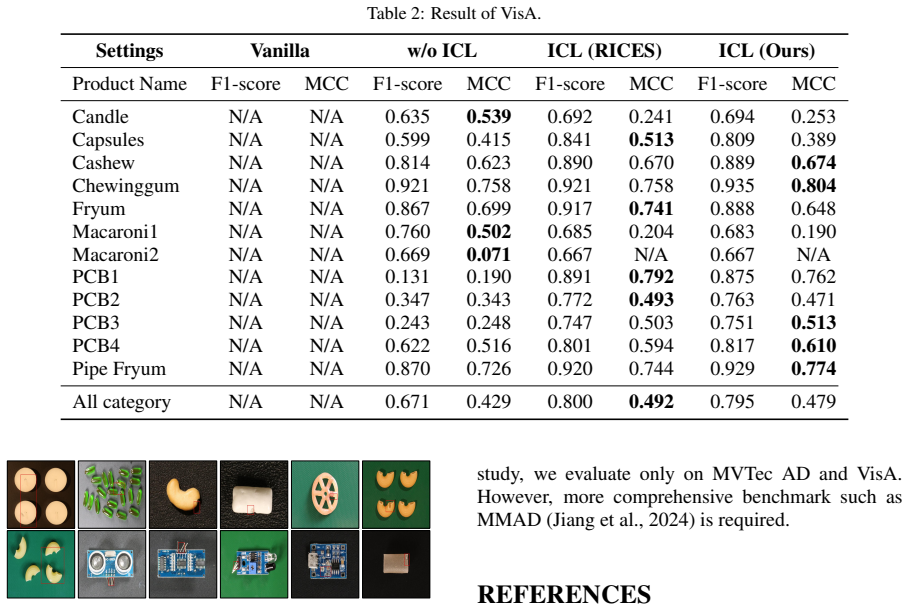
- [Section 4.2.2; Table 2] On VisA, the proposed selection algorithm does not improve over RICES: ICL (Ours) gives F1 0.795 and MCC 0.479, while ICL (RICES) gives F1 0.800 and MCC 0.492. The paper states that 'our selection algorithm does not show significant improvement,' but in fact it is slightly worse on both metrics. This weakens the generality of the claim that Eq. (1) is a better selection algorithm, and the paper should either present a corrected comparison under a clean protocol or temper the claim accordingly.
minor comments (4)
- [Section 4.1; Fig. 4] The explanatory texts used as inspection criteria are described only as 'explanatory texts' with no detail on how they are generated or whether they are hand-crafted per product for the evaluation benchmarks. If they are manually written for each MVTec/VisA category, that is important additional supervision that must be disclosed, and an ablation without these texts (or with automatically generated texts) would clarify the contribution.
- [Table 1; Table 3] Many entries are listed as 'N/A' for F1 or MCC. The caption says 'N/A means that zero division occurred,' but it would be useful to state explicitly which condition causes the denominator to be zero (e.g., all predictions in one class) and to confirm that the aggregate row excludes those categories rather than treating N/A as zero.
- [Appendix, Fig. 8] The product list contains typos: 'sadle' should be 'saddle' and 'wodden wheel' should be 'wooden wheel'. Also, the appendix says the training images 'will be publicly available' in future tense, which is inconsistent with the data-release claim in the abstract; please clarify the current availability status.
- [Throughout] Several references contain formatting errors or incomplete author names (e.g., 'Rosias, L.' in the Agarwal et al. entry, and the Gössgens et al. entry has an unusual volume/page field). Please proofread the reference list.
Circularity Check
Eq. (1) draws one-shot ICL examples from the test set itself, so the headline MVTec one-shot results leak test labels into the prompt.
-
self definitional
[Sec. 3.4, Eq. (1); Sec. 4.1; Table 3 caption (Appendix)]
"Where x denotes the image, f denotes the vision encoder (pre-trained ResNet50 (He et al., 2015)), and q denotes the index of the test image for inference, i denotes the index of the image except for q. Eq. (1) is an algorithm that selects neighboring image of the test image as example based on Euclidean distance. ... "1-pos" gives one defective example image."
Equation (1) defines the ICL support pool as all images except the query, with no separate support/train split; q is explicitly the test image. MVTec AD has defective images only in the test split, so a '1-pos' defective demonstration in Table 3 must be a test image. The reported one-shot MCC/F1 are therefore obtained by conditioning on a labeled defective image from the same test distribution before classifying another test image. The central claim—one example plus text suffices for a new product without collecting target samples—is not tested, because the 'example' is itself drawn from the target test set.
full rationale
The derivation chain for the proposed method is otherwise independent: the fine-tuning dataset is constructed from web images, ViP-LLaVA is an external base model, RICES is an external baseline, and the Euclidean example-selection rule in Eq. (1) is a new algorithmic contribution rather than a re-derived target. There is no load-bearing self-citation or imported uniqueness theorem; the one self-citation (Ueno et al. 2023) is confined to a future-work sentence. However, the central empirical claim is undermined by a self-referential evaluation setup: Eq. (1) pools candidates as 'all images except q', with q a test image, and no separate support set is defined. Because MVTec AD's only defective images are in the test split, Table 3's positive demonstrations must be test images, so the model is given labeled test-domain examples before predicting other test images. This does not invalidate the example-selection algorithm as a similarity method, but it means the headline one-shot accuracy cannot be read as evidence that one external labeled example suffices for a new product. The separate concern that fine-tuning categories overlap MVTec/VisA product names is noted but not counted as an additional circular step.
Assumptions & free parameters
free parameters (3)
- Fine-tuning learning rate =
1e-4
- Fine-tuning epochs =
300
- Global batch size =
32 (4 per GPU, 8 GPUs)
assumptions (4)
- domain assumption ViP-LLaVA's pretrained visual-linguistic knowledge, after fine-tuning on 941 web images, generalizes to industrial inspection datasets.
- ad hoc to paper The support example for in-context learning is selected without access to the test label, and the candidate pool is disjoint from the query.
- domain assumption ResNet50 feature Euclidean distance is a reliable proxy for selecting a useful in-context example.
- domain assumption Token coordinate outputs can be parsed and compared with ground-truth boxes for classification, and CrossEntropyLoss is adequate for training the coordinate branch.
Cite this review
Pith. "Pith review of Vision-Language In-Context Learning Driven Few-Shot Visual Inspection Model." pith.science (2026). https://pith.science/paper/TKGR3QRN
@misc{pith2026250209057,
  author       = {Pith},
  title        = {Pith review of: Vision-Language In-Context Learning Driven Few-Shot Visual Inspection Model},
  year         = {2026},
  howpublished = {\url{https://pith.science/paper/TKGR3QRN}},
  note         = {Machine review of arXiv:2502.09057}
}
read the original abstract
We propose general visual inspection model using Vision-Language Model~(VLM) with few-shot images of non-defective or defective products, along with explanatory texts that serve as inspection criteria. Although existing VLM exhibit high performance across various tasks, they are not trained on specific tasks such as visual inspection. Thus, we construct a dataset consisting of diverse images of non-defective and defective products collected from the web, along with unified formatted output text, and fine-tune VLM. For new products, our method employs In-Context Learning, which allows the model to perform inspections with an example of non-defective or defective image and the corresponding explanatory texts with visual prompts. This approach eliminates the need to collect a large number of training samples and re-train the model for each product. The experimental results show that our method achieves high performance, with MCC of 0.804 and F1-score of 0.950 on MVTec AD in a one-shot manner. Our code is available at~https://github.com/ia-gu/Vision-Language-In-Context-Learning-Driven-Few-Shot-Visual-Inspection-Model.
Figures


Figures from the paper (6 more)



Reference graph
Works this paper leans on
-
[1]
write newline
" write newline "" before.all 'output.state := FUNCTION fin.entry add.period write newline FUNCTION new.block output.state before.all = 'skip after.block 'output.state := if FUNCTION new.sentence output.state after.block = 'skip output.state before.all = 'skip after.sentence 'output.state := if if FUNCTION not #0 #1 if FUNCTION and 'skip pop #0 if FUNCTIO...
-
[2]
M., Bohnet, B., Rosias, L., Chan, S., Zhang, B., Anand, A., Abbas, Z., Nova, A., Co-Reyes , J
Agarwal, R., Singh, A., Zhang, L. M., Bohnet, B., Rosias, L., Chan, S., Zhang, B., Anand, A., Abbas, Z., Nova, A., Co-Reyes , J. D., Chu, E., Behbahani, F., Faust, A., and Larochelle, H. (2024). Many- Shot In-Context Learning
work page 2024
-
[3]
W., Ilharco, G., Wortsman, M., and Schmidt, L
Awadalla, A., Gao, I., Gardner, J., Hessel, J., Hanafy, Y., Zhu, W., Marathe, K., Bitton, Y., Gadre, S., Sagawa, S., Jitsev, J., Kornblith, S., Koh, P. W., Ilharco, G., Wortsman, M., and Schmidt, L. (2023). OpenFlamingo : An Open-Source Framework for Training Large Autoregressive Vision-Language Models
work page 2023
- [4]
-
[5]
B., Shukor, M., Cord, M., Soulier, L., and Piwowarski, B
Baldassini, F. B., Shukor, M., Cord, M., Soulier, L., and Piwowarski, B. (2024). What Makes Multimodal In-Context Learning Work ?
work page 2024
-
[6]
Bergmann, P., Fauser, M., Sattlegger, D., and Steger, C. (2019). MVTec AD --- A Comprehensive Real-World Dataset for Unsupervised Anomaly Detection . In IEEE / CVF Conference on Computer Vision and Pattern Recognition ( CVPR ) , pages 9584--9592. IEEE
work page 2019
-
[7]
Bertsch, A., Ivgi, M., Alon, U., Berant, J., Gormley, M. R., and Neubig, G. (2024). In- Context Learning with Long-Context Models : An In-Depth Exploration
work page 2024
-
[8]
Biderman, D., Ortiz, J. G., Portes, J., Paul, M., Greengard, P., Jennings, C., King, D., Havens, S., Chiley, V., Frankle, J., Blakeney, C., and Cunningham, J. P. (2024). LoRA Learns Less and Forgets Less
work page 2024
Show all 43 references
-
[9]
K., Meyer, G
Cai, M., Liu, H., Park, D., Mustikovela, S. K., Meyer, G. P., Chai, Y., and Lee, Y. J. (2024). ViP-LLaVA : Making Large Multimodal Models Understand Arbitrary Visual Prompts
2024
-
[10]
Chen, K., Zhang, Z., Zeng, W., Zhang, R., Zhu, F., and Zhao, R. (2023). Shikra: Unleashing Multimodal LLM 's Referential Dialogue Magic
2023
-
[11]
Chen, S., Han, Z., He, B., Buckley, M., Torr, P., Tresp, V., and Gu, J. (2024). Understanding and Improving In-Context Learning on Vision-language Models . arXiv
2024
-
[12]
The advantages of the Matthews correlation coefficient ( MCC ) over F1 score and accuracy in binary classification evaluation
Chicco Davide and Jurman Giuseppe (2020). The advantages of the Matthews correlation coefficient ( MCC ) over F1 score and accuracy in binary classification evaluation. BMC genomics , 21:1--13
2020
-
[13]
Defard, T., Setkov, A., Loesch, A., and Audigier, R. (2021). Padim: A patch distribution modeling framework for anomaly detection and localization. In International Conference on Pattern Recognition , pages 475--489. Springer
2021
-
[14]
Deng, J., Dong, W., Socher, R., Li, L.-J., Li, K., and Fei-Fei , L. (2009). Imagenet: A large-scale hierarchical image database. In IEEE / CVF Conference on Computer Vision and Pattern Recognition , pages 248--255
2009
-
[15]
Dong, Q., Li, L., Dai, D., Zheng, C., Wu, Z., Chang, B., Sun, X., Xu, J., Li, L., and Sui, Z. (2023). A Survey on In-context Learning
2023
-
[16]
G \"o sgens, M., Zhiyanov, A., Tikhonov, A., and Prokhorenkova, L. (2022). Good Classification Measures and How to Find Them . neural information processing systems , 34(17136-17147)
2022
-
[17]
Grandini, M., Bagli, E., and Visani, G. (2020). Metrics for Multi-Class Classification : An Overview
2020
-
[18]
Gu, Z., Zhu, B., Zhu, G., Chen, Y., Tang, M., and Wang, J. (2024). AnomalyGPT : Detecting Industrial Anomalies Using Large Vision-Language Models . In AAAI Conference on Artificial Intelligence , volume 38, pages 1932--1940. arXiv
2024
-
[19]
He, K., Zhang, X., Ren, S., and Sun, J. (2015). Deep Residual Learning for Image Recognition . In IEEE / CVF Conference on Computer Vision and Pattern Recognition , pages 770--778
2015
-
[20]
J., Shen, Y., Wallis, P., Allen-Zhu , Z., Li, Y., Wang, S., Wang, L., and Chen, W
Hu, E. J., Shen, Y., Wallis, P., Allen-Zhu , Z., Li, Y., Wang, S., Wang, L., and Chen, W. (2021). LoRA : Low-Rank Adaptation of Large Language Models
2021
-
[21]
Jeong, J., Zou, Y., Kim, T., Zhang, D., Ravichandran, A., and Dabeer, O. (2023). WinCLIP : Zero- / Few-Shot Anomaly Classification and Segmentation . In IEEE / CVF Conference on Computer Vision and Pattern Recognition , pages 19606--19616. arXiv
2023
-
[22]
Jiang, X., Li, J., Deng, H., Liu, Y., Gao, B.-B., Zhou, Y., Li, J., Wang, C., and Zheng, F. (2024). Mmad: The first-ever comprehensive benchmark for multimodal large language models in industrial anomaly detection. arXiv preprint arXiv:2410.09453
2024 arXiv
-
[23]
Li, B., Zhang, Y., Chen, L., Wang, J., Pu, F., Yang, J., Li, C., and Liu, Z. (2023a). MIMIC-IT : Multi-Modal In-Context Instruction Tuning
2023
-
[24]
Li, B., Zhang, Y., Chen, L., Wang, J., Yang, J., and Liu, Z. (2023b). Otter: A Multi-Modal Model with In-Context Instruction Tuning
2023
-
[25]
Liu, H., Li, C., Li, Y., and Lee, Y. J. (2024a). Improved Baselines with Visual Instruction Tuning
2024
-
[26]
Liu, H., Li, C., Wu, Q., and Lee, Y. J. (2023). Visual Instruction Tuning . In Advances in Neural Information Processing Systems , volume 36. arXiv
2023
-
[27]
Liu, Y., Duan, H., Zhang, Y., Li, B., Zhang, S., Zhao, W., Yuan, Y., Wang, J., He, C., Liu, Z., Chen, K., and Lin, D. (2024b). MMBench : Is Your Multi-modal Model an All-around Player ?
2024
-
[28]
and Hutter, F
Loshchilov, I. and Hutter, F. (2019). Decoupled Weight Decay Regularization
2019
-
[29]
Llama 2: Open Foundation and Fine-Tuned Chat Models
Meta (2023). Llama 2: Open Foundation and Fine-Tuned Chat Models
2023
-
[30]
GPT-4 Technical Report
OpenAI (2023). GPT-4 Technical Report
2023
-
[31]
B., Chen, X., and Wang, X
Pengzhen Ren , Xiao, Y., Chang, X., Huang, P.-Y., Li, Z., Gupta, B. B., Chen, X., and Wang, X. (2021). A Survey of Deep Active Learning . ACM computing surveys (CSUR) , 54(9):1--40
2021
-
[32]
W., Hallacy, C., Ramesh, A., Goh, G., Agarwal, S., Sastry, G., Askell, A., Mishkin, P., Clark, J., Krueger, G., and Sutskever, I
Radford, A., Kim, J. W., Hallacy, C., Ramesh, A., Goh, G., Agarwal, S., Sastry, G., Askell, A., Mishkin, P., Clark, J., Krueger, G., and Sutskever, I. (2021). Learning Transferable Visual Models From Natural Language Supervision . In International Conference on Machine Learnin...
2021
-
[33]
Roth, K., Pemula, L., Zepeda, J., Sch \"o lkopf, B., Brox, T., and Gehler, P. (2022). Towards total recall in industrial anomaly detection. In Proceedings of the IEEE / CVF Conference on Computer Vision and Pattern Recognition , pages 14318--14328
2022
-
[34]
Sokolova, M., Japkowicz, N., and Szpakowicz, S. (2006). Beyond Accuracy , F-Score and ROC : A Family of Discriminant Measures for Performance Evaluation . In AI 2006: Advances in Artificial Intelligence , Lecture Notes in Computer Science , volume 4304, pages 1015--1021
2006
-
[35]
Steck, H., Ekanadham, C., and Kallus, N. (2024). Is Cosine-Similarity of Embeddings Really About Similarity ? In Companion Proceedings of the ACM on Web Conference 2024 , pages 887--890
2024
-
[36]
Tai, Y., Fan, W., Zhang, Z., Zhu, F., Zhao, R., and Liu, Z. (2023). Link- Context Learning for Multimodal LLMs
2023
-
[37]
Ueno, S., Yamada, Y., Nakatsuka, S., and Kato, K. (2023). Benchmarking of Query Strategies : Towards Future Deep Active Learning
2023
-
[38]
XTuner : A Toolkit for Efficiently Fine-tuning LLM
XTuner Contributors (2023). XTuner : A Toolkit for Efficiently Fine-tuning LLM
2023
-
[39]
Yang, Z., Gan, Z., Wang, J., Hu, X., Lu, Y., Liu, Z., and Wang, L. (2022). An Empirical Study of GPT-3 for Few-Shot Knowledge-Based VQA . In AAAI Conference on Artificial Intelligence , volume 36 of 3 , pages 3081--3089. arXiv
2022
-
[40]
and Yoon, S
Yi, J. and Yoon, S. (2020). Patch SVDD : Patch-level SVDD for Anomaly Detection and Segmentation . In Asian Conference on Computer Vision ( ACCV ) . arXiv
2020
-
[41]
Yin, S., Fu, C., Zhao, S., Li, K., Sun, X., Xu, T., and Chen, E. (2024). A Survey on Multimodal Large Language Models
2024
-
[42]
Zong, Y., Bohdal, O., and Hospedales, T. (2024). VL-ICL Bench : The Devil in the Details of Benchmarking Multimodal In-Context Learning
2024
-
[43]
Zou, Y., Jeong, J., Pemula, L., Zhang, D., and Dabeer, O. (2022). SPot-the-Difference Self-Supervised Pre-training for Anomaly Detection and Segmentation . In European Conference on Computer Vision , pages 392--408. arXiv
2022
Reviewed August 7, 2026 · model on record in the stance chip above.
Discussion (0). Continue with ORCID to comment.