REVIEW 5 major objections 5 minor 26 references
A Novel Dialect-Aware Framework for the Classification of Arabic Dialects and Emotions
T0 review · 5 major / 5 minor · reviewed 2026-08-07 · deepseek-v4-flash
Pith's one-line read This paper claims that Arabic emotion detection is improved by first identifying the dialect, and that the clustering module can automatically generate a dialect-specific emotion lexicon from a dialect-labeled corpus.
desk verdict The lexicon-induction idea is genuinely new in a modest way, but the emotion-detection accuracies are measured against labels produced by the same pipeline, so the central claim is not yet supported. read the letter →
The pith
A machine-rendered reading of the paper's core claim, the machinery that carries it, and where it could break.
The reading
What carries the argument
The load-bearing mechanism is the five-step lexicon generator, run separately on each dialect's data. It embeds the dialect corpus with fastText; takes the Arabic Emotion Lexicon (AEL), a 3,207-word list covering six basic emotions (anger, disgust, fear, joy, sadness, surprise), as seed words; computes a centroid for each emotion's seeds; selects the top $n$ non-AEL words nearest each centroid; and then keeps only words lying in the same DBSCAN density cluster as those top-$n$ words. The output is a dialect-specific emotion lexicon, verified by native speakers and used to label training data for the dialect-aware emotion classifiers. Classification is carried out by fine-tuned AraBERT-large, an Arabic BERT transformer, first for dialect and then, conditioned on the predicted dialect, for emotion.
What would settle it
Give the generated Egyptian and Gulf lexicons to independent native speakers who have not seen the paper's labels for the words, and ask them to assign each word an emotion in isolation and in three naturally occurring example sentences; if their agreement with the paper's assignments is no better than chance for either dialect, the embedding-proximity-and-cluster assumption is falsified. A cheaper computational check is to rerun the five-step generator after randomly permuting the emotion labels of the AEL seed words; a pipeline whose output is nearly unchanged under that permutation is not actually extracting emotion-specific dialect words.
Extended reading notes
Core claim
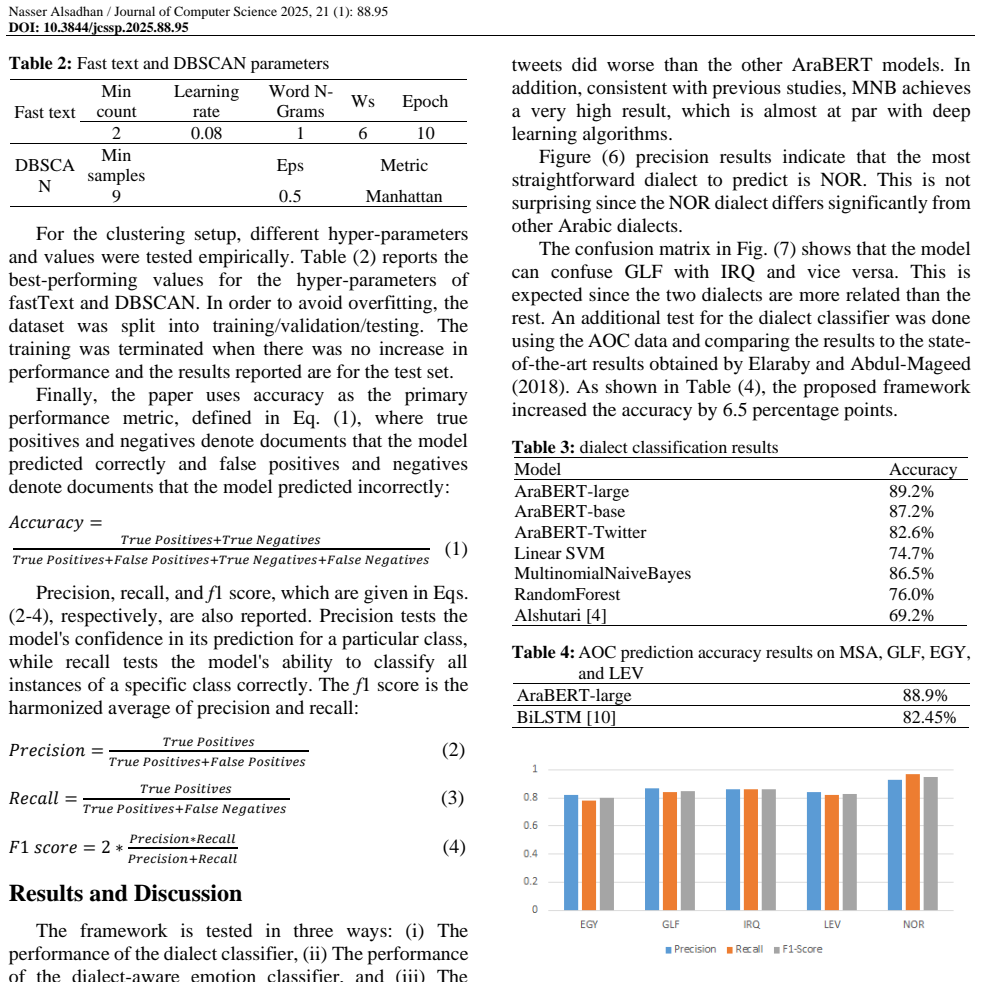
The paper's central claim is that the missing ingredient in Arabic emotion detection is dialect awareness, and that per-dialect emotion lexicons can be created automatically rather than hand-built. Its framework runs a dialect classifier (fine-tuned AraBERT-large), then a dialect-specific emotion classifier, and reports that the dialect-aware emotion classifiers outperform a dialect-agnostic classifier by 4–5 percentage points on Egyptian and Gulf Arabic (89.1% vs 84.2% and 79% vs 75.1%). The dialect classifier also reaches 88.9% on the AOC four-way MSA/EGY/GLF/LEV task, 6.45 points above the prior BiLSTM. The distinctive claim is that the clustering module, using fastText embeddings and DBSCAN seeded by the Arabic Emotion Lexicon, generates new dialect-specific emotion word lists that make these gains possible.
Load-bearing premise
The load-bearing premise is that words sitting close to established emotion seed words in a learned word-embedding space, and inside the same density cluster, express the same emotion in that dialect; if embedding proximity does not track emotional meaning across Arabic dialects, the generated lexicons and every emotion label derived from them are unreliable.
Editorial extensions
If this is right
- The same lexicon-generation pipeline can be pointed at any dialect-labeled Arabic corpus to produce an emotion lexicon for that dialect, needing only a native speaker to verify the output.
- Dialect-aware emotion classifiers beat a general classifier by 4–5 points for Egyptian and Gulf Arabic, so a single pan-Arab emotion model is leaving measurable accuracy on the table.
- On the AOC benchmark, fine-tuned AraBERT-large improves dialect classification from 82.45% to 88.9%, a 6.45-point gain over the leading BiLSTM.
- Applications that use the framework—regional review analysis, emotion-aware chatbots, and public-tone monitoring—can report results by dialect instead of by a generic 'Arabic' label.
Reading between the lines
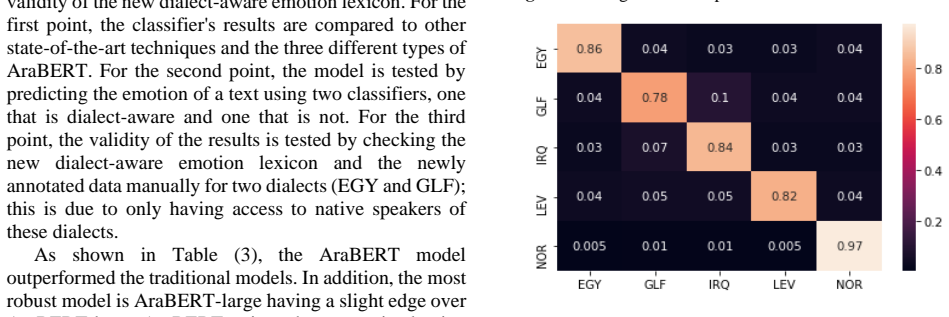
- A natural extension the paper leaves implicit is to soft-weight the dialect-specific emotion classifiers by the dialect classifier's confidence, which could reduce errors where Gulf and Iraqi dialects are confused.
- The dialect-first routing design should transfer to other author-state tasks in Arabic, such as sarcasm, stance, or personality, if those signals are also expressed differently by dialect.
- A sharper validation of the lexicon generator would measure precision per emotion against independent human labels for the same words, rather than only the downstream accuracy of classifiers trained on them.
- The pipeline is a candidate bootstrap for low-resource dialects: a few dozen seed emotion words plus fastText embeddings could produce an initial lexicon cheaply, with native-speaker review as the main remaining cost.
Editorial analysis
A structured set of objections, weighed in public.
Referee Report
Summary. The paper proposes a three-module framework for Arabic dialect and emotion classification: a preprocessing module, a clustering module that uses fastText embeddings and DBSCAN to generate dialect-aware emotion lexicons from the Arabic Emotion Lexicon (AEL), and a classification module based on AraBERT. The author reports 89.2% dialect classification accuracy on SMADC, 88.9% on AOC (compared to 82.45% for a 2018 BiLSTM), and 89.1% (Egyptian) and 79% (Gulf) accuracy for dialect-aware emotion detection. The main claimed contribution is the automatic generation of dialect-aware emotional lexicons from a dialect-labeled corpus, with a small manual sample verification for Egyptian and Gulf dialects.
Significance. If the emotion-lexicon generation and emotion-detection results were properly validated, the framework would be a useful contribution for under-resourced Arabic dialects, since it promises to bootstrap emotion lexicons from unlabeled dialect text. The paper has some strengths: it uses publicly available datasets (SMADC and AOC), reports the main hyperparameters of fastText and DBSCAN, and compares against a prior BiLSTM result on AOC. However, the emotion evaluation is circular because the emotion labels are generated by the same lexicon pipeline whose validity the paper claims to demonstrate, and the dialect classification results are reported without the experimental detail needed to assess their reliability. As it stands, the central emotion-detection claim is not supported by the evidence presented.
major comments (5)
- [Section 3.2 and Table 5] The emotion labels used to train and test the dialect-aware classifiers are produced by the same clustering/lexicon pipeline whose validity the paper claims to demonstrate, so the reported 89.1% (EGY) and 79% (GLF) accuracies quantify how consistently AraBERT reproduces the automatic labeler's decisions, not how well the system recognizes emotions as judged by humans. The manual verification in Table 7 covers only a small sample of lexicon words for two dialects, reports no inter-annotator agreement metric and no selection protocol, and does not validate sentence-level emotion labels. An independent human-annotated emotion test set is required before the emotion-detection claim can be accepted.
- [Section 4, Table 3] The SMADC dialect classification result is reported as a single accuracy figure without train/validation/test split proportions, random seed, error bars, or per-class statistics, despite the highly imbalanced class distribution shown in Fig. 5. In this setting the reported 89.2% cannot be compared reliably with the 69.2% baseline, and the claim of outperforming prior work needs a more complete experimental account.
- [Section 4, Table 4] The AOC comparison is against a single 2018 BiLSTM baseline and gives no information about the AOC subset used, the train/test split, preprocessing applied, class balance, or number of runs. The claimed 6.45 percentage-point improvement is therefore not established as statistically meaningful.
- [Section 3.2, clustering steps] Several load-bearing parameters and procedures are not specified, including the number n of top words per centroid, the distance threshold used to select words belonging to the centroid, the criterion for choosing dialect-specific words in step v, and the exact rule that converts lexicon membership into a text-level emotion label. Without these details the lexicon-generation pipeline is not reproducible and the emotion accuracies cannot be independently checked.
- [Conclusion] The paper itself acknowledges that a native speaker of each dialect must verify the output of the lexicon generator; this limitation directly affects the claimed automaticity of the framework and should be reflected in the evaluation rather than only in the conclusion. The manual verification in Table 7 is too limited to support the headline emotion accuracy numbers.
minor comments (5)
- [Abstract and Section 4] The accuracy values 88.9% and 89.2% appear for AOC and SMADC respectively; please state the dataset explicitly wherever an accuracy number is quoted.
- [Table 6] The label 'nger' in the first row should read 'Anger'.
- [Equation (1)] The prose describing accuracy should clarify that TP, TN, FP, and FN are counts and that the denominator is the total number of instances.
- [References] The bibliography is inconsistent: for example, 'Eslam., Mosa, M., & Ismail, N. (2019)' and 'Alshutayri, A. (2018)' lack full venue information, and Table 3 uses 'Alshutari' while the text uses 'Alshutayri'.
- [Figure 5] The x-axis label 'SMADAC dataset distribution' contains a typo and should be 'SMADC'.
Circularity Check
Emotion-detection accuracies are measured against labels generated by the same lexicon pipeline the paper introduces, so the reported 89.1% and 79% scores do not demonstrate real emotion recognition.
-
self definitional
[Proposed Approach (clustering component paragraph) and Results and Discussion, Table 5]
"The clustering component is responsible for building a new dialect-aware emotion lexicon, which is later used to label each piece of text with the appropriate emotion based on the dialect it exhibits."
The emotion labels used to train and test the dialect-aware classifiers (AraBERT-large_EGY and AraBERT-large_GLF) are produced by the very same clustering/lexicon-generation pipeline whose validity the paper claims to demonstrate. Table 5's 89.1% and 79% accuracies therefore measure how consistently the classifier reproduces the auto-generated lexicon's word-overlap and embedding-similarity decisions, not whether the texts genuinely express those emotions to human readers. The only external check, Table 7, manually verifies a small sample of lexicon words for two dialects, but reports no agreement metric, no selection protocol, and no full-lexicon precision, and does not validate sentence-level emotion labels.
full rationale
The dialect-classification claim (88.9% on AOC) is an external benchmark against a prior BiLSTM result and is therefore not circular. However, the emotion-classification claim is evaluated on labels generated by the paper's own clustering module, which builds the dialect-aware lexicon and then 'later used to label each piece of text with the appropriate emotion based on the dialect it exhibits.' The reported accuracies (89.1% EGY, 79% GLF) therefore measure agreement between the AraBERT classifier and the auto-labeled lexicon, not agreement with human emotion judgments. The manual check of a lexicon sample (Table 7) does not validate the sentence-level test labels. Thus the central contribution—dialect-aware emotion detection—reduces by construction to the lexicon-generation step. This is not a minor self-citation issue; it is an evaluation loop that makes the emotion-detection claim circular.
Assumptions & free parameters
free parameters (8)
- fastText min_count =
2
- fastText learning rate =
0.08
- fastText word N-grams =
1
- fastText context window (ws) =
6
- fastText epochs =
10
- DBSCAN min_samples =
9
- DBSCAN eps =
0.5
- top n words per centroid =
not reported
assumptions (3)
- domain assumption The Arabic Emotion Lexicon (AEL) of Saad (2015) provides an accurate seed for the six basic emotions.
- ad hoc to paper fastText embedding distance reflects emotional similarity between Arabic words across dialects.
- domain assumption The SMADC and AOC corpus dialect labels are sufficiently accurate for supervised training.
Cite this review
Pith. "Pith review of A Novel Dialect-Aware Framework for the Classification of Arabic Dialects and Emotions." pith.science (2026). https://pith.science/paper/AZ64VG63
@misc{pith2026250209128,
  author       = {Pith},
  title        = {Pith review of: A Novel Dialect-Aware Framework for the Classification of Arabic Dialects and Emotions},
  year         = {2026},
  howpublished = {\url{https://pith.science/paper/AZ64VG63}},
  note         = {Machine review of arXiv:2502.09128}
}
read the original abstract
Arabic is one of the oldest languages still in use today. As a result, several Arabic-speaking regions have developed dialects that are unique to them. Dialect and emotion recognition have various uses in Arabic text analysis, such as determining an online customer's origin based on their comments. Furthermore, intelligent chatbots that are aware of a user's emotions can respond appropriately to the user. Current research in emotion detection in the Arabic language lacks awareness of how emotions are exhibited in different dialects, which motivates the work found in this study. This research addresses the problems of dialect and emotion classification in Arabic. Specifically, this is achieved by building a novel framework that can identify and predict Arabic dialects and emotions from a given text. The framework consists of three modules: A text-preprocessing module, a classification module, and a clustering module with the novel capability of building new dialect-aware emotion lexicons. The proposed framework generated a new emotional lexicon for different dialects. It achieved an accuracy of 88.9% in classifying Arabic dialects, which outperforms the state-of-the-art results by 6.45 percentage points. Furthermore, the framework achieved 89.1-79% accuracy in detecting emotions in the Egyptian and Gulf dialects, respectively.
Figures


Figures from the paper (3 more)

Reference graph
Works this paper leans on
- [1]
-
[2]
H., Alshutayri, A., & Alahdal, S
Aljuhani, R. H., Alshutayri, A., & Alahdal, S. (2021). Arabic Speech Emotion Recognition from Saudi Dialect Corpus. IEEE Access , 9, 127081 –127085. https://doi.org/10.1109/access.2021.3110992
-
[3]
Al-Khatib, A., & El -Beltagy, S. R. (2018). Emotional Tone Detection in Arabic Tweets (Vol. 10762, pp. 105–114). Springer International Publishing. https://doi.org/10.1007/978-3-319-77116-8_8
-
[4]
Alsadhan, N., & Skillicorn, D. (2017). Estimating Personality from Social Media Posts. 2017 IEEE International Conference on Data Mining Workshops (ICDMW), 350–356. https://doi.org/10.1109/icdmw.2017.51
-
[5]
Alshutayri, A. (2018). Arabic Dialect Texts Classification
work page 2018
-
[6]
Alsarsour, I., Mohamed, E., Suwaileh , R., & Elsayed, T. (2018). Dart: A large Dataset of Dialectal Arabic Tweets. Proceedings of the Eleventh International Conference on Language Resources and Evaluation , 3666–3670
work page 2018
-
[7]
Alshutayri, A., & Atwell, E. (2019). Classifying Arbic Dialect Text in the Social Media Arabic Dialect Corpus (SMADC). Proceedings of the 3 rd Workshop on Arabic Corpus Linguistics, 51–59
work page 2019
- [8]
Show all 26 references
-
[9]
Antoun, W., Baly, F., & Hajj, H. (2020). Transformer - based Model for Arabic Language Understanding,”. ArXiv, arXiv:2003.00104
2020 arXiv
-
[10]
Biadsy, F. (2011). Automatic Dialect and Accent Recognition and its Application to Speech Recognition. https://doi.org/10.7916/D8M61S68
2011 doi
-
[11]
Bojanowski, P., Grave, E., Joulin, A., & Mikolov, T. (2017). Enriching Word Vectors with Subword Information. Transactions of the Association for Computational Linguistics, 5, 135–146. https://doi.org/10.1162/tacl_a_00051
2017 doi
-
[12]
Cotterell, R., & Callison -Burch, C. (2014). A Multi -
2014
-
[13]
Jokisch, O. (2019). Natural Arabic Language Resources for Emotion Recognition in Algerian Dialect (K. Smaïli, Ed.; Vol. 1108, pp. 18 –33). Springer International Publishing. https://doi.org/10.1007/978-3-030-32959-4_2
2019 doi
-
[14]
Elaraby, M., & Abdul -Mageed, M. (2018). Deep models for Arabic dialect identification on benchmarked data. Proceedings of the Fifth Workshop on NLP for Similar Languages, Varieties and Dialects, 263-274
2018
-
[15]
Ekman, P. (1992). An Argument for Basic Emotions. Cognition and Emotion, 6(3–4), 169–200. https://doi.org/10.1080/02699939208411068
1992 doi
-
[16]
P., Sander, J., & Xu, X
Ester, M., Kriegel, H. P., Sander, J., & Xu, X. (1996). A density-based algorithm for discovering clusters in large spatial databases with noise. KDD, 226–231
1996
-
[17]
El-Haj, M., Rayson, P., & Aboelezz, M. (2018). Arabic Dialect Identification in the Context of Bivalency and Code-Switching. European Language Resources Association, 3622–3627
2018
-
[18]
Habash, N. Y. (2010). Introduction to Arabic Natural Language Processing (1st ed., Vol. 3). Springer. https://doi.org/10.1007/978-3-031-02139-8
2010 doi
-
[19]
Lulu, L., & Elnagar, A. (2018). Automatic Arabic Dialect Classification Using Deep Learning Models. Procedia Computer Science, 142(Procedia Computer Science), 262–269. https://doi.org/10.1016/j.procs.2018.10.489
2018 doi
-
[20]
Moudjari, L., Akli-Astouati, K., & Benamara, F. (2020). An Algerian corpus and an annotation platform for opinion and emotion analysis. Proc. LREC, 1202-1210. Eslam., Mosa, M., & Ismail, N. (2019). Emotion Analysis in Arabic Language Applying Transfer Learning. 2019 15 th Inte...
2020
-
[21]
Kabi, M. N. (2016). Evaluating SentiStrength for Arabic Sentiment Analysis. 2016 7 th International Conference on Computer Science and Information Technology (CSIT), 1–6. https://doi.org/10.1109/csit.2016.7549458
2016
-
[22]
Saad, M. (2015). Mining Documents and Sentiments in Cross-Lingual Context. Université de Lorraine
2015
-
[23]
Sharmila, D., Kannimuthu, S., Ravikumar, G., & Anand, K. (2019). KCE DALab-APDA@ FIRE2019: Author Profiling and Deception Detection in Arabic Using Weighted Embedding. CEUR Workshop Proceedings, 12–15
2019
-
[24]
Vaswani, A., Shazeer, N., Parmar, N., Uszkoreit, J., & Jones, L. (2017). Attention is All you Need. Advances in Neural Information Processing Systems, 6000–6010
2017
-
[25]
Jernite, Y., Plu, J., Xu, C., Le Scao, T., Gugger, S., … Rush, A. (2020). Transformers: S tate-of-the-Art Natural Language Processing. Proceedings of the 2020 Conference on Empirical Methods in Natural Language Processing: System Demonstrations, 38–45. https://doi.org/10.18653...
2020 doi
-
[26]
Zaidan, O., & Callison -Burch, C. (2011). The Arabic Online Commentary Dataset: An Annotated Dataset of Informal Arabic with High Dialectal Content. Proceedings of the 49 th Annual Meeting of the Association for Computational Linguistics: Human Language Technologies, 37–41
2011
Reviewed August 7, 2026 · model on record in the stance chip above.
Discussion (0). Continue with ORCID to comment.