REVIEW 3 major objections 4 minor 41 references
Properties of Path-Independent Choice Correspondences and Their Applications to Efficient and Stable Matchings
T0 review · 3 major / 4 minor · reviewed 2026-08-07 · deepseek-v4-flash
Pith's one-line read The paper proves that under path-independent choice correspondences satisfying the law of aggregate demand, a stable matching is constrained efficient if and only if it is maximal and admits no potentially-stable improvement cycle, and a…
desk verdict New definition of PI for choice correspondences delivers a clean theory and restores the Erdil-Ergin cycle characterization; the flagged Lemma 9 gap dissolves under substitutability. read the letter →
The pith
A machine-rendered reading of the paper's core claim, the machinery that carries it, and where it could break.
The reading
What carries the argument
The central object is a choice correspondence $C:2^I\Rightarrow 2^I$ such that every consistent tie-breaking—choosing, for each available set, the subset in $C(X)$ of maximum weight under a unique-maximizing weight function—yields a path-independent choice function, where path-independence (PI) is the classical property that choices are unchanged by partitioning the available set. The proof machinery also uses the closure operator $\tau(X)=\bigcup\{Y\subseteq I : C(X)\cap C(Y)\neq\emptyset\}$, which is extensive, idempotent, and monotone; it supplies the rationalizing utility $u(X)=|\tau(X)|$ when $X\in C(X)$ and $|\tau(X)|-1$ otherwise, together with the interval lemma $S\in C(T)$ if and only if $S\subseteq T\subseteq \tau(S)$. A generalized matroid, also used here, is a family of subsets with an exchange property that makes all inclusion-maximal sets of the family have the same size. For the matching theorem, the named object is a potentially-stable improvement cycle (PSIC), a cycle of students in which each student moves to a preferred school and each receiving school still finds the resulting set acceptable; the proof shows that under PI plus the law of aggregate demand (LAD) a shortcut-free PSIC preserves stability and that any Pareto-improving stable matching generates one.
What would settle it
Exhaustively search all markets with at most five students and three schools in which every school's correspondence is path-independent but at least one violates the law of aggregate demand, using a PI-but-not-LAD rule such as the paper's C2 table example. If any market contains a stable matching that is maximal, admits no potentially-stable improvement cycle, and is nevertheless Pareto dominated by another stable matching, then Theorem 6 genuinely needs the LAD hypothesis.
Extended reading notes
Core claim
The paper introduces a path-independent choice correspondence: for every unique-maximizing weight function, the tie-broken choice function $C_w(X)=\arg\max_{Y\in C(X)} w(Y)$ is path-independent. It establishes four results. First, every such correspondence is rationalizable by an explicit utility built from a closure operator, extending a known property of path-independent choice functions. Second, for every available set $X$, the family $C(X)$ of chosen subsets is a generalized matroid, so tie-broken choices can be computed polynomially from a membership oracle. Third, any choice correspondence rationalized by an ordinally concave function is path-independent, and if the function also satisfies size-restricted concavity, the correspondence satisfies the law of aggregate demand. Fourth, in a matching market where each school's correspondence is path-independent and obeys the law of aggregate demand, a stable matching is constrained efficient if and only if it is maximal and admits no potentially-stable improvement cycle; moreover, a constrained efficient matching that Pareto dominates any given stable matching can be found in polynomial time.
Load-bearing premise
The load-bearing premise is that every school's choice correspondence satisfies the law of aggregate demand—for every consistent tie-breaking, shrinking the available set cannot increase the size of the chosen set—because the cycle argument uses this cardinality monotonicity to force shortcut-free cycles and to equate school sizes across Pareto-improving matchings.
Editorial extensions
If this is right
- Stable matchings exist whenever every school's choice correspondence is path-independent, and deferred acceptance with any fixed tie-breaking produces one such matching.
- Under PI plus LAD, the set of constrained efficient stable matchings is exactly the set of maximal stable matchings with no PSIC, giving a polynomial-time certificate for constrained efficiency.
- For any given stable matching, a constrained efficient stable matching that Pareto dominates it can be computed in polynomial time by repeatedly restoring maximality and then applying shortcut-free PSICs.
- Realistic school-choice correspondences—responsive with ties, type-specific quotas, reserves, overlapping reserves, evenly distributed and constrained responsive rules, and meritorious horizontal rules—all satisfy PI and LAD because they are rationalized by $M^\natural$-concave (in particular laminar concave) functions.
- For PI plus LAD correspondences, a tie-broken choice $C_w(X)$ can be computed in $O(|X|^2)$ time, making the improvement algorithm practical.
Reading between the lines
- The paper explicitly leaves open whether every PI choice correspondence is rationalizable by an ordinally concave function; a positive answer would make path independence exactly the correspondence-level counterpart of ordinal concavity, mirroring the known choice-function theorem.
- The proof uses LAD at two cardinality equalities; the paper's C2 example shows PI alone does not control selected-set sizes, so the cycle characterization is likely to need LAD or an extra cardinality assumption in applications, though the paper does not exhibit such a market.
- A concrete testable consequence for policy is that DA with arbitrary tie-breaking can be Pareto-dominated (the paper gives such a market); measuring this efficiency loss on real school-choice data would quantify the value of the polynomial-time improvement algorithm.
Signed reviews
Editorial analysis
A structured set of objections, weighed in public.
Referee Report
Summary. The paper introduces path-independence (PI) for choice correspondences by requiring that every consistent tie-breaking choice function is PI, and it studies the consequences for rationalizability, combinatorial structure, and stable matching. The main theoretical results are: (i) every PI choice correspondence is rationalizable (Theorem 2); (ii) for every available set X, the family C(X) of chosen sets forms a generalized matroid, yielding polynomial-time membership and computation results (Theorem 3, Theorem 4, Proposition 3); and (iii) choice correspondences rationalized by ordinally concave functions are PI, with size-restricted concavity additionally giving LAD (Theorem 5). The matching application defines an LAD extension for correspondences and proves that, under PI and LAD, a stable matching is constrained efficient if and only if it is maximal and admits no potentially-stable improvement cycle (PSIC), thereby restoring the Erdil-Ergin cycle characterization and providing a polynomial-time algorithm to compute a constrained efficient stable matching that Pareto dominates a given stable matching. The paper closes with applications to responsive choice, controlled school choice, evenly distributed and constrained responsive choice, and overlapping reserves.
Significance. This is a substantive theoretical contribution. The paper extends the well-developed PI/ordinal-concavity toolkit from choice functions to the more realistic setting of choice correspondences, where indifferences and ties are inherent. The rationalizability theorem and the g-matroid theorem are nontrivial and the connection to discrete convex analysis is convincing. The matching result, Theorem 6, is a genuine generalization of the Erdil-Ergin theorem: it replaces responsiveness with PI plus LAD and still obtains a cycle characterization, and the polynomial-time algorithm is an added strength. The paper is largely self-contained, with detailed proofs, consistent examples, and a clear statement of reliance on Yokote et al. (2024). There are no fitted parameters or circular reductions; the central claims are falsifiable mathematical statements. The main weaknesses are a load-bearing but undefined notion of 'shortcut' in the proof of Lemma 9 and several compressed or typo-laden passages in the proof of Theorem 5. These are fixable without changing the main results.
major comments (3)
- [Section 4.3.1, Lemma 9 and Definition 3] The term 'shortcut' is used repeatedly but never formally defined. Lemma 9 begins with 'Let (i0,...,i_{m-1}) be any PSIC for mu that does not contain a shortcut,' and the proof uses this property both to construct the weight function and to claim a contradiction when a shorter PSIC is produced. To make the sufficiency direction of Theorem 6 complete, the authors must give a formal definition of a shortcut (for example, a chord in the directed exchange graph that itself forms a PSIC) and prove that whenever a PSIC exists, a shortcut-free PSIC also exists (for example, by taking a shortest directed cycle in the graph G defined later in the proof). As written, the proof of Lemma 9 depends on an undefined property, and this is load-bearing for Theorem 6.
- [Section 3.3, proof of Theorem 5] The proof contains a clear typo in the ordinal concavity case analysis: in case (iii), the sentence 'either uw(X)<uw(X−i+j) or uw(X)<uw(X−i+j)' should read 'either uw(X)<uw(X−i+j) or uw(X′)<uw(X′+i−j).' In the size-restricted concavity paragraph, the sentence 'uw(X)>uw(X−i) if w(i)>0 and uw(X′)>uw(X′+i) if w(i)<0' is also not the correct way to state the verification; the correct observation is that condition (i) of size-restricted concavity holds for every sign of w(i). These are local errors, but they should be corrected because the theorem is central to the paper's applications.
- [Section 4.3.1, Lemma 9, aggregation step] The step from the individual PSIC inclusions to the simultaneous inclusion 'nu(s) = Y ∪ (mu(s)\X) ⊆ C^{w_s}_s({i:s≽_i mu(i)} \ X)' is compressed to the point of being hard to verify. The step is in fact valid: since PI implies substitutability, for each i_ℓ in Y we have i_ℓ ∈ C^{w_s}_s(A−i_{ℓ+1}) and i_ℓ ∉ X, so repeated application of substitutability gives i_ℓ ∈ C^{w_s}_s(A\X); moreover, mu(s)\X ⊆ C^{w_s}_s(A\X) follows from mu(s)=C^{w_s}_s(A). I recommend that the authors spell out this argument explicitly, because this inclusion is the crucial bridge that turns a PSIC into a stable Pareto-improving matching.
minor comments (4)
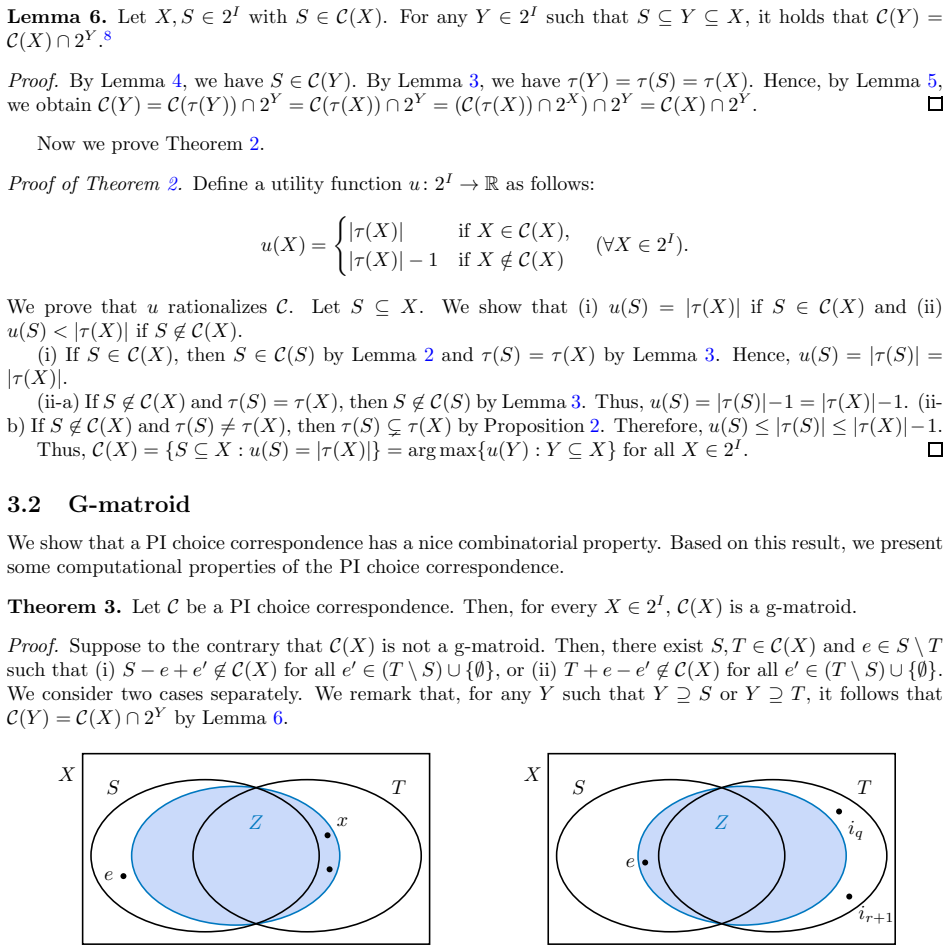
- [Section 3.2, proof of Theorem 3] The proof of Theorem 3 is extremely dense, especially the two case analyses with the auxiliary weight functions w and w′. Adding a short high-level explanation or moving some of the routine verifications to an appendix would significantly improve readability.
- [Appendix D.2, Example 6] The preference list for student i5 is written as '(s1 s4 ∅ s3 s4)', which appears to contain a typo and to list s4 twice. It should presumably be '(s1 s4 ∅ s2 s3)' or another complete strict preference order.
- [Section 5, Overlapping Reserves] The sentence 'In practice, each student can have multiple types. In practice, each student can have multiple types.' contains a duplicated phrase; one copy should be deleted.
- [Section 4.2, Definition 3] The PSIC definition would be clearer if the indexing conventions were stated more explicitly, in particular the treatment of im = i0 and sm = s0 in the third bullet. The current notation is understandable but easy to misread.
Circularity Check
No significant circularity: the main theorems are proved from the stated definitions and independent prior results; self-citations are contextual and not load-bearing.
full rationale
All load-bearing steps in the paper are self-contained derivations from the definitions of PI/LAD choice correspondences and from standard or independently cited results. Theorem 2 is proved from the closure-operator lemmas built directly on PI. Theorem 3 is proved from the g-matroid exchange axioms via a contradiction argument using tie-breaking weights. Theorem 5 follows from Theorem 1 of Yokote et al. (2024), an external result whose authors do not overlap with the present paper, plus a perturbation argument. Theorem 6 is proved through Lemmas 7–10, which use only PI, LAD, the g-matroid property, and the stability definitions. The self-citations to Imamura and Kawase (2024a,b) appear in Remark 3, Remark 4, the related-work discussion, and footnote 10; none of these is used to establish the main characterization, and they are not invoked as a uniqueness theorem or as a substitute for a proof. A skeptical reading identifies a possible proof gap in Lemma 9 (Section 4.3.1): the step 'since C^{w_s}_s satisfies PI, we obtain ν(s) = Y ∪ (μ(s)\X) ⊆ C^{w_s}_s({i : s ≽_i μ(i)} \ X)' aggregates one-element PSIC inclusions into a simultaneous removal of all students in X without an explicit argument, and the notion of 'shortcut' is not formally defined. This is a completeness or correctness concern, not a circular reduction: the claimed inclusion is not an input to any definition or theorem, and the proof does not assume Theorem 6 to prove Theorem 6. The paper contains no fitted parameters, no prediction that reduces by construction to an input, and no load-bearing premise justified solely by self-citation. The citations to previous work by the same authors are contextual remarks about applications and complexity, and the central derivation chain is independent of them. Score 0.
Assumptions & free parameters
assumptions (5)
- ad hoc to paper A choice correspondence is PI if, for any UM weight w, C_w satisfies PI (Definition 1).
- domain assumption Theorem 1 of Yokote et al. (2024): a choice function is PI iff rationalizable by an ordinally concave function.
- standard math Finite sets of students and schools.
- domain assumption Students have strict preferences over schools.
- domain assumption A choice correspondence is accessible via a membership oracle for computational results.
Cite this review
Pith. "Pith review of Properties of Path-Independent Choice Correspondences and Their Applications to Efficient and Stable Matchings." pith.science (2026). https://pith.science/paper/XB36YWJI
@misc{pith2026250209265,
  author       = {Pith},
  title        = {Pith review of: Properties of Path-Independent Choice Correspondences and Their Applications to Efficient and Stable Matchings},
  year         = {2026},
  howpublished = {\url{https://pith.science/paper/XB36YWJI}},
  note         = {Machine review of arXiv:2502.09265}
}
read the original abstract
Choice correspondences are crucial in decision-making, especially when faced with indifferences or ties. While tie-breaking can transform a choice correspondence into a choice function, it often introduces inefficiencies. This paper introduces a novel notion of path-independence (PI) for choice correspondences, extending the existing concept of PI for choice functions. Intuitively, a choice correspondence is PI if any consistent tie-breaking produces a PI choice function. This new notion yields several important properties. First, PI choice correspondences are rationalizabile, meaning they can be represented as the maximization of a utility function. This extends a core feature of PI in choice functions. Second, we demonstrate that the set of choices selected by a PI choice correspondence for any subset forms a generalized matroid. This property reveals that PI choice correspondences exhibit a nice structural property. Third, we establish that choice correspondences rationalized by ordinally concave functions inherently satisfy the PI condition. This aligns with recent findings that a choice function satisfies PI if and only if it can be rationalized by an ordinally concave function. Building on these theoretical foundations, we explore stable and efficient matchings under PI choice correspondences. Specifically, we investigate constrained efficient matchings, which are efficient (for one side of the market) within the set of stable matchings. Under responsive choice correspondences, such matchings are characterized by cycles. However, this cycle-based characterization fails in more general settings. We demonstrate that when the choice correspondence of each school satisfies both PI and monotonicity conditions, a similar cycle-based characterization is restored. These findings provide new insights into the matching theory and its practical applications.
Figures


Figures from the paper (2 more)


Reference graph
Works this paper leans on
-
[1]
Abdulkadiro g lu and T
A. Abdulkadiro g lu and T. S \"o nmez. School choice: A mechanism design approach. American Economic Review, 93 0 (3): 0 729--747, 2003
2003
-
[2]
M. Aizerman and A. Malishevski. General theory of best variants choice: Some aspects. IEEE Transactions on Automatic Control, 26 0 (5): 0 1030--1040, 1981
work page 1981
-
[3]
A. Alkan. A class of multipartner matching markets with a strong lattice structure. Economic Theory, 19 0 (4): 0 737--746, 2002
work page 2002
-
[4]
A. Alkan and D. Gale. Stable schedule matching under revealed preference. Journal of Economic Theory, 112 0 (2): 0 289--306, 2003
work page 2003
-
[5]
O. Ayg \"u n and I. B \'o . College admission with multidimensional privileges: The brazilian affirmative action case. American Economic Journal: Microeconomics, 13 0 (3): 0 1--28, 2021
work page 2021
-
[6]
O. Ayg \"u n and T. S \"o nmez. Matching with contracts: Comment. American Economic Review, 103 0 (5): 0 2050--51, 2013
work page 2013
-
[7]
C. Blair. The lattice structure of the set of stable matchings with multiple partners. Mathematics of Operations Research, 13 0 (4): 0 619--628, 1988
work page 1988
-
[8]
Y.-K. Che, J. Kim, and F. Kojima. Weak monotone comparative statics, 2019
work page 2019
Show all 41 references
-
[9]
Chen and M
X. Chen and M. Li. M - Convexity and Its Applications in Operations . Operations Research, 69 0 (5): 0 1396--1408, 2021
2021
-
[10]
P. H. Edelman and R. E. Jamison. The theory of convex geometries. Geometriae Dedicata, 19 0 (3): 0 247--270, 1985
1985
-
[11]
Ehlers, I
L. Ehlers, I. E. Hafalir, M. B. Yenmez, and M. A. Yildirim. School choice with controlled choice constraints: Hard bounds versus soft bounds. Journal of Economic Theory, 153: 0 648--683, 2014
2014
-
[12]
Erdil and H
A. Erdil and H. Ergin. What's the matter with tie-breaking? improving efficiency in school choice. American Economic Review, 98 0 (3): 0 669--689, 2008
2008
-
[13]
Erdil and T
A. Erdil and T. Kumano. Efficiency and stability under substitutable priorities with ties. Journal of Economic Theory, 184: 0 104950, 2019
2019
-
[14]
efficiency and stability under substitutable priorities with ties
A. Erdil, M. Kitahara, T. Kumano, and Y. Okumura. Corrigendum to “efficiency and stability under substitutable priorities with ties” [j. econ. theory 184 (2019) 104950]. Journal of Economic Theory, 203: 0 105470, 2022
2019
-
[15]
Farooq and A
R. Farooq and A. Shioura. A note on the equivalence between substitutability and m ^ -convexity. Pacific Journal of Optimization, 1: 0 243--252, 2005
2005
-
[16]
Farooq and A
R. Farooq and A. Tamura. A new characterization of m ^ -convex set functions by substitutability. Journal of the Operations Research Society of Japan, 47 0 (1): 0 18--24, 2004
2004
-
[17]
Fujishige and A
S. Fujishige and A. Tamura. A general two-sided matching market with discrete concave utility functions. Discrete Applied Mathematics, 154 0 (6): 0 950--970, 2006
2006
-
[18]
Fujishige, F
S. Fujishige, F. Kojima, and K. Yokote. A note on ordinally concave functions. arXiv preprint arXiv:2406.19697, 2024
2024 arXiv
-
[19]
Grätzer and F
G. Grätzer and F. Wehrung, editors. Lattice Theory: Special Topics and Applications, Volume 2. Birkhäuser, Cham, Switzerland, 2016
2016
-
[20]
I. E. Hafalir, M. B. Yenmez, and M. A. Yildirim. Effective affirmative action in school choice. Theoretical Economics, 8 0 (2): 0 325--363, 2013
2013
-
[21]
Imamura and Y
K. Imamura and Y. Kawase. Efficient matching under general constraints. Games and Economic Behavior, 145: 0 197--207, 2024 a
2024
-
[22]
Imamura and Y
K. Imamura and Y. Kawase. Efficient and strategy-proof mechanism under general constraints. Theoretical Economics, pages 1--28, 2024 b . Forthcoming
2024
-
[23]
M. R. Johnson and R. A. Dean. An algebraic characterization of path independent choice functions. In Third International Meeting of the Society for Social Choice and Welfare, Maastricht, The Netherlands, pages 1--37, Maastricht, The Netherlands, 1996
1996
-
[24]
Kojima, A
F. Kojima, A. Tamura, and M. Yokoo. Designing matching mechanisms under constraints: An approach from discrete convex analysis. Journal of Economic Theory, 176: 0 803--833, 2018
2018
-
[25]
G. A. Koshevoy. Choice functions and abstract convex geometries. Mathematical social sciences, 38 0 (1): 0 35--44, 1999
1999
-
[26]
Kurata, N
R. Kurata, N. Hamada, A. Iwasaki, and M. Yokoo. Controlled school choice with soft bounds and overlapping types. Journal of Artificial Intelligence Research, 58: 0 153--184, 2017
2017
-
[27]
Mas-Colell, M
A. Mas-Colell, M. Whinston, and J. Green. Microeconomic Theory. Oxford University Press, Oxford, England, 1995
1995
-
[28]
K. Murota. Discrete Convex Analysis. SIAM, Philadelphia, 2003
2003
-
[29]
K. Murota. Discrete convex analysis: A tool for economics and game theory. Journal of Mechanism and Institution Design, 1 0 (1): 0 151--273, 2016
2016
-
[30]
Murota and A
K. Murota and A. Shioura. M-convex function on generalized polymatroid. Mathematics of Operations Research, 24 0 (1): 0 95--105, 1999
1999
-
[31]
Murota and A
K. Murota and A. Shioura. Quasi M -convex and L -convex functions—quasiconvexity in discrete optimization. Discrete Applied Mathematics, 131 0 (2): 0 467--494, 2003
2003
-
[32]
Murota and Y
K. Murota and Y. Yokoi. On the Lattice Structure of Stable Allocations in a Two-Sided Discrete-Concave Market . Mathematics of Operations Research, 40 0 (2): 0 460--473, 2015
2015
-
[33]
C. R. Plott. Path independence, rationality, and social choice. Econometrica, 41: 0 1075--1091, 1973
1973
-
[34]
A. E. Roth. Stability and polarization of interests in job matching. Econometrica, 52 0 (1): 0 47--57, 1984
1984
-
[35]
S \"o nmez and M
T. S \"o nmez and M. B. Yenmez. Affirmative action in I ndia via vertical, horizontal, and overlapping reservations. Econometrica, 90 0 (3): 0 1143--1176, 2022
2022
-
[36]
Sotomayor
M. Sotomayor. Three remarks on the many-to-many stable matching problem. Mathematical social sciences, 38 0 (1): 0 55--70, 1999
1999
-
[37]
Suzuki, A
T. Suzuki, A. Tamura, and M. Yokoo. Efficient allocation mechanism with endowments and distributional constraints. In Proceedings of the 17th International Conference on Autonomous Agents and MultiAgent Systems, AAMAS '18, pages 50--58, Richland, SC, 2018. International Founda...
2018
-
[38]
Suzuki, A
T. Suzuki, A. Tamura, K. Yahiro, M. Yokoo, and Y. Zhang. Strategyproof allocation mechanisms with endowments and M -convex distributional constraints. Artificial Intelligence, 315: 0 103825, 2023
2023
-
[39]
E. Tardos. Generalized matroids and supermodular colourings. In A. Recski and L. Lov\' a sz, editors, Matroid Theory, pages 359--382. North-Holland Publishing, Amsterdam, 1985
1985
-
[40]
Y.-Y. Yang. Rationalizable choice functions. Games and Economic Behavior, 123: 0 120--126, 2020
2020
-
[41]
Yokote, I
K. Yokote, I. E. Hafalir, F. Kojima, and M. B. Yenmez. Rationalizing path-independent choice rules, 2024
2024
Reviewed August 7, 2026 · model on record in the stance chip above.
Discussion (0). Continue with ORCID to comment.