REVIEW 5 major objections 6 minor 2 cited by
MDCrow: Automating Molecular Dynamics Workflows with Large Language Models
T0 review · 5 major / 6 minor · reviewed 2026-08-07 · deepseek-v4-flash
Pith's one-line read This paper claims that a large language model equipped with a curated set of molecular-dynamics tools can automate most routine biomolecular simulation workflows, with gpt-4o completing 72% of a 25-task benchmark and an open-source model…
desk verdict MDCrow is a useful, open-source agentic MD toolkit with a new 25-task benchmark, but its headline accuracy numbers rest on single, hand-scored runs per model-prompt pair. read the letter →
The pith
A machine-rendered reading of the paper's core claim, the machinery that carries it, and where it could break.
The reading
What carries the argument
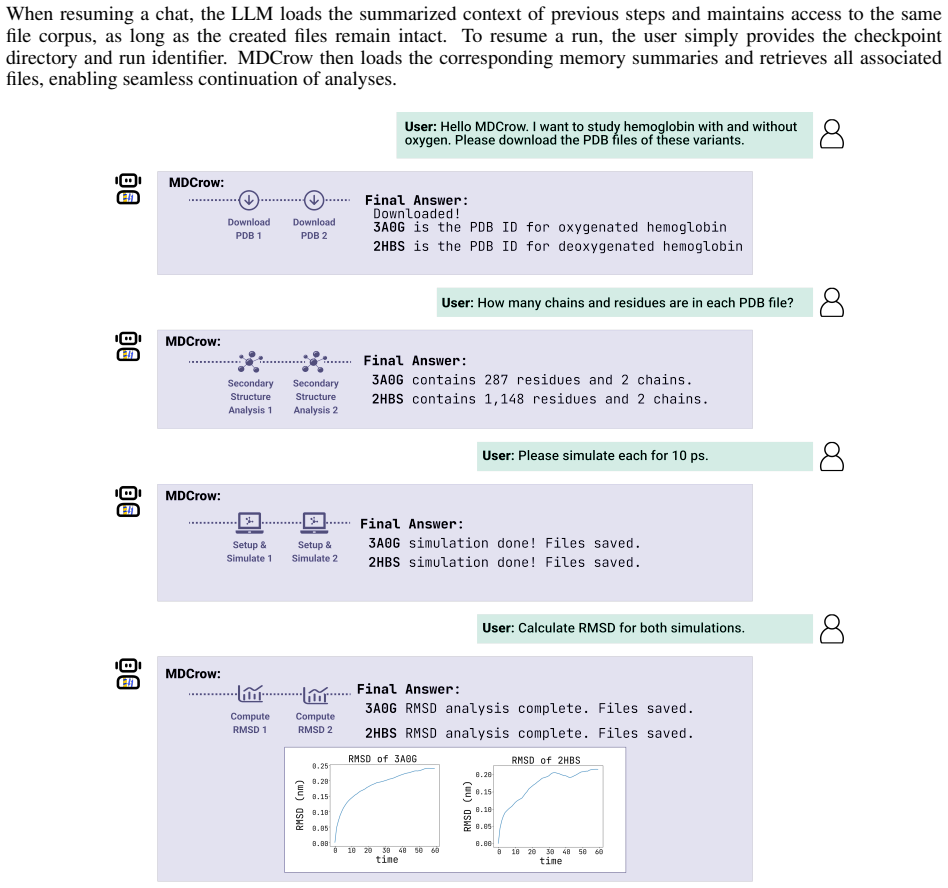
The carrying object is the MDCrow environment: forty-plus tools grouped into information retrieval (UniProt access and a PaperQA-based literature search), PDB and protein handling (cleaning, downloading, visualization), simulation (OpenMM with PackMol solvation and script output), and analysis (MDTraj-based RMSD, radius of gyration, secondary structure, SASA, PCA, RDF, and plotting). The agent runs a chain-of-thought ReAct loop in which the LLM emits a thought, an action, and action input, the tool emits an observation, and the loop repeats until a final answer. The tools emit informative error messages when simulation parameters are missing, letting the agent repair its own setup. A checkpoint-based chat feature saves each run's files and context so users can resume long simulations and guide the agent outside its predefined toolset.
What would settle it
Run the 25 prompts multiple times per model with the same settings and have independent experts grade each trajectory blindly; if per-model accuracy varies by more than a few points across repetitions, or if accuracy drops sharply when literature searches target an open corpus instead of the curated local PDFs, the central generalization fails. A simpler check is to score MDCrow's outputs automatically against a fixed reference trajectory and compare the result to the reported 72%.
Extended reading notes
Core claim
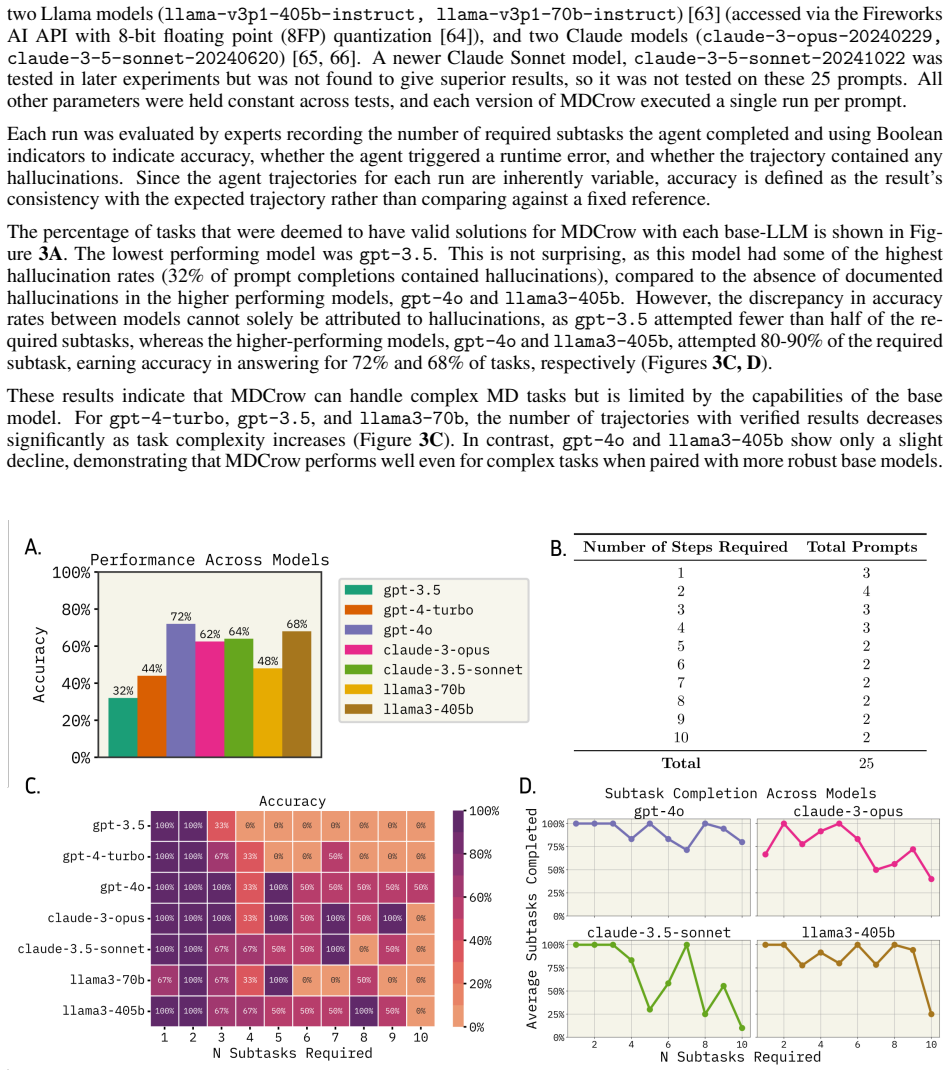
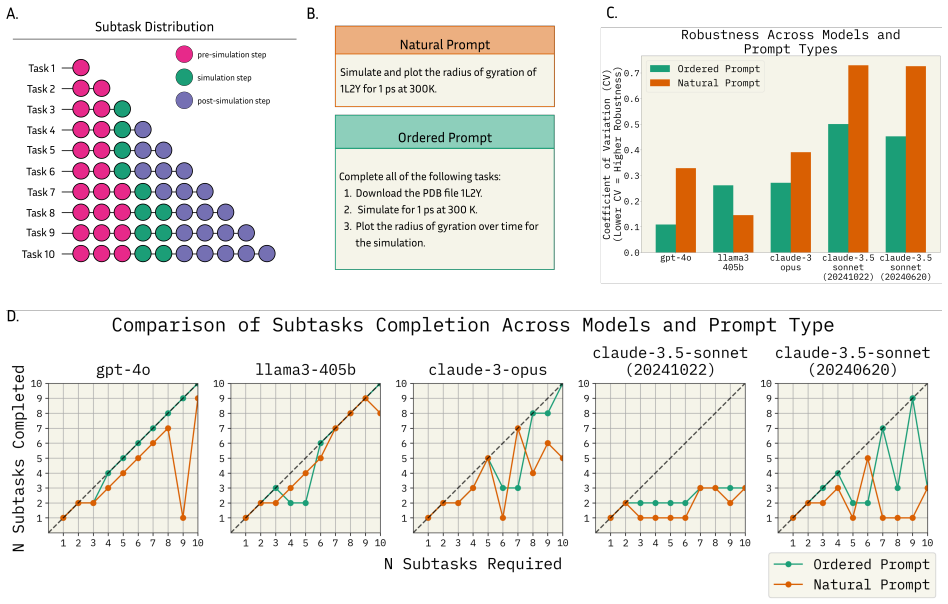
The central claim is that MDCrow, a ReAct-style agent with over 40 expert-designed tools, enables frontier LLMs to complete nearly all assessed molecular-dynamics tasks. The paper's headline result is quantitative: 72% of 25 tasks are judged accurate with gpt-4o and 68% with llama3-405b, compared with 28% for a plain LLM with a Python interpreter. The authors also report that the best models maintain 80-90% subtask completion even as task complexity rises and show low variance in performance when prompts are given in either a natural conversational style or an explicitly ordered style. They interpret the results as showing that MDCrow is limited by base-model capability rather than by the tool wrapper, with weaker models hallucinating or omitting steps as task length grows.
Load-bearing premise
The headline accuracy numbers rest on a single manually scored run per prompt, with accuracy defined as the result's consistency with an expected trajectory rather than a fixed reference, so the 72% versus 28% gap could shift if runs were repeated or graded blindly.
Editorial extensions
If this is right
- MDCrow can offload routine MD tasks such as solvation, equilibration, RMSD/RMSF/SASA analysis, and literature parameter lookup to an automated agent, freeing researchers for design and interpretation.
- Because the best open-source model, llama3-405b, trails the frontier model by only a few points, reproducible open toolchains can support this automation without proprietary APIs.
- Task accuracy degrades with complexity for weaker models, so the practical scope of automation depends on base-model capability; stronger models keep near-100% subtask completion up to 10-step prompts.
- The chat-and-resume design means long simulations can be started, revisited, and guided by a human, which is how the authors show the agent can perform an annealing simulation outside its original toolset.
Reading between the lines
- The toolset's action interface is generic: the same curated-tool pattern could wrap other simulation engines or experimental protocols, and the 25-prompt evaluation could serve as a template benchmark for those domains.
- Because the literature tool is tested against a corpus chosen for the prompts, the reported accuracy likely upper-bounds what the same agent would achieve searching uncurated literature; an open-search variant is the natural next test.
- The single-run hand-scoring protocol conflates agent variance with model capability; a repeated-run evaluation with inter-rater agreement statistics would sharpen the 72% estimate.
- Human-in-the-loop chatting, demonstrated on annealing, suggests the next capability milestone is measuring how much guidance a user must supply per task rather than binary success.
Editorial analysis
A structured set of objections, weighed in public.
Referee Report
Summary. MDCrow is an LLM-based agent for molecular dynamics workflows. It wraps more than 40 tools for PDB handling, OpenMM simulation setup/execution, MDTraj-based analysis, and information retrieval from UniProt and a local PaperQA literature corpus. The authors evaluate it on 25 self-authored prompts (1-10 required subtasks) with seven LLMs, compare it with a single-query LLM and a ReAct+Python-REPL baseline on gpt-4o, test robustness to natural vs. ordered prompt phrasing on 10 additional prompts, and demonstrate a chat-based annealing simulation outside the toolset. They report 72% task accuracy for gpt-4o, 68% for llama3-405b, and 28% for the baseline, concluding that MDCrow can complete nearly all assessed tasks and is relatively insensitive to instruction precision.
Significance. If the reported numbers were stable, this would be a useful contribution to AI-for-science: it shows that a ReAct agent with expert-curated domain tools can outperform code-writing baselines on routine protein MD tasks, and it provides an open-source toolset and task set for future work. The comparison across seven proprietary and open-weight models is informative, and the inclusion of the Llama 3 405B result is valuable for reproducibility. The main weakness is that the evaluation is currently single-run and hand-scored, with no inter-rater reliability reported, which makes the specific percentages and the 'nearly all' conclusion provisional; the internal benchmark also has several scoring-table inconsistencies. The conceptual direction is sound, but the quantitative claims need strengthening before they can be taken as established.
major comments (5)
- [Section 3.1] The headline accuracy figures rest on a single hand-scored run per (model, prompt) pair: the text states that 'each version of MDCrow executed a single run per prompt' and that accuracy is judged by the result's 'consistency with the expected trajectory' rather than a fixed reference. With 25 binary task outcomes, gpt-4o's 72% corresponds to a wide 95% confidence interval (roughly 51-88%), and no inter-rater reliability, scoring rubric, or number of annotators is reported. The abstract's 'low variance' claim is therefore not established, and the conclusion that MDCrow 'is able to perform nearly all of our assessed tasks' is stronger than the data support. The paper should either add repeated runs and an explicit scoring protocol with independent annotators, or substantially temper the headline claims.
- [Section 3.2] The robustness experiment uses only one trajectory per (model, prompt, style) condition: 'Each prompt was tested twice' means two total runs, one natural and one ordered. Thus 'relatively insensitive to how precise the instructions are given' is based on one observation per cell. Moreover, the coefficient of variation in Figure 4C is computed across the 10 tasks, not across repeated runs, so a low CV reflects consistency across task complexity rather than low stochastic variance; the abstract's 'low variance' wording conflates these. The claim that prompt style has 'significant effects on smaller models' is also not supported by any significance test reported in Section 3.2.
- [Section 3.1, Figure 3A caption] The t-tests and Spearman correlations are not corrected for multiple comparisons. With seven base models, multiple pairwise t-tests are reported (p-values 0.004-0.046), and Spearman p-values are given per model for the accuracy-complexity correlation; p-values near 0.046 or 0.011 would not survive a standard multiple-comparison correction. The qualitative conclusions may survive, but the paper should either apply a correction or explicitly label these as uncorrected exploratory tests.
- [Table 1 (SI section C)] The benchmark definition is internally inconsistent in several rows, which matters because the expert scoring is against the listed required subtasks. Prompt 7 asks for 'final secondary structure' but lists SASA (solvent accessible surface area) rather than a secondary-structure analysis; prompt 24 swaps the oxygenated/deoxygenated labels for 1A3N and 6BB5 compared with prompt 14; and prompt 25 asks for pH 5.0 and 8.8 but lists cleaning at pH 5.5 and 8.0. These mismatches should be corrected and the affected scores re-checked, because they can propagate directly into the hand-scored accuracy.
- [Section 2.1 and SI section C] The LiteratureSearch tool is tested against a local database 'selected specifically for the test prompts', so the literature subtasks measure retrieval from a known, pre-curated corpus rather than open literature search. This limits the external validity of the information-retrieval results. In addition, the SI reference list is not fully reproducible: it contains 28 entries while the benchmark has 25 prompts, there is no mapping from prompts to the relevant references, entry 27 lacks a DOI, and entry 28 is software documentation unrelated to the prompts. Please provide the exact corpus with DOIs and state clearly that the literature subtasks are closed-corpus retrieval.
minor comments (6)
- [Section 2.1 / SI B / Table 1] There are several typos and small errors: 'inpnut arguments' should be 'input arguments'; 'RSCB website' should be 'RCSB website'; 'TO preprocess' should be 'To preprocess'; 'eneRGy' in Table 1 should be 'energy'; and 'Medic al' in the Acknowledgments is a typo.
- [Section 3.3 / Conclusion] The Conclusion's statement that 'Simply using an LLM with a python interpreter and required packages installed had a 28% accuracy' does not specify which of the two baselines (single-query LLM or ReAct+REPL) this refers to; please state the exact condition and report both baseline numbers in the Conclusion.
- [Section 4] The sentence 'It performs 80% better than gpt-4o in ReAct workflows at completing subtasks' is ambiguous; it should be rephrased as a percentage-point or relative difference and tied explicitly to Figure 5.
- [Section 3.4 / Discussion] The annealing simulation is a single anecdotal example, and the Discussion correctly admits that no full evaluation of the chatting feature was performed; the abstract and conclusion should not imply that chat-based extrapolation is a measured capability.
- [Conclusion] The claim that MDCrow 'can scale-out to thousands of simultaneous tasks' is not supported by any experiment in the paper; either remove it or qualify it as an architectural capability rather than a demonstrated result.
- [Abstract / Section 2.1] The abstract says '40 expert-designed tools' while Section 2.1 says 'over 40'; please align the number and consider listing the complete tool inventory in the SI.
Circularity Check
No significant circularity: the accuracy claims are empirical measurements, not derived from the benchmark definitions or from self-citations.
full rationale
MDCrow's central claims are empirical: 72% / 68% task accuracy are measured outcomes of running LLM agents with tools against 25 prompts, scored by expert review. There is no fitted parameter that is later called a prediction, no quantity defined in terms of the target quantity, and no uniqueness theorem imported from the authors' prior work to force a choice. The LiteratureSearch tool's corpus is 'selected specifically for the test prompts' (Section 2.1), which is a benchmark-generalization limitation and a source of optimistic bias, but it is not circular: the agent's trajectories and tool calls are not constructed from the scoring rubric, and the base LLMs and OpenMM/MDTraj/PackMol engines are external anchors. The paper's self-citations (PaperQA, ChemCrow, LAB-Bench, Aviary, the authors' review) describe tools and related work; none is used to justify the headline result in place of the executed runs. The single-run-per-prompt protocol and subjective 'expected trajectory' rubric affect statistical reliability and reproducibility, but those are evaluation-quality concerns, not circularity. Under the definition of circularity as a derivation that reduces to its inputs, the paper contains no circular step.
Assumptions & free parameters
free parameters (1)
- Per-task difficulty label (number of required subtasks) =
1 to 10, assigned per prompt (SI Table 1)
assumptions (4)
- domain assumption Expert hand-scoring of 'accuracy' as consistency with an expected trajectory is consistent and unbiased.
- ad hoc to paper Single runs per (model, prompt) pair are representative of typical agent behavior.
- ad hoc to paper The pre-selected local literature database is a valid test of the LiteratureSearch tool.
- domain assumption The 25 authored prompts are representative of real-world MD workflow requests.
Cite this review
Pith. "Pith review of MDCrow: Automating Molecular Dynamics Workflows with Large Language Models." pith.science (2026). https://pith.science/paper/GROXPWRK
@misc{pith2026250209565,
  author       = {Pith},
  title        = {Pith review of: MDCrow: Automating Molecular Dynamics Workflows with Large Language Models},
  year         = {2026},
  howpublished = {\url{https://pith.science/paper/GROXPWRK}},
  note         = {Machine review of arXiv:2502.09565}
}
read the original abstract
Molecular dynamics (MD) simulations are essential for understanding biomolecular systems but remain challenging to automate. Recent advances in large language models (LLM) have demonstrated success in automating complex scientific tasks using LLM-based agents. In this paper, we introduce MDCrow, an agentic LLM assistant capable of automating MD workflows. MDCrow uses chain-of-thought over 40 expert-designed tools for handling and processing files, setting up simulations, analyzing the simulation outputs, and retrieving relevant information from literature and databases. We assess MDCrow's performance across 25 tasks of varying required subtasks and difficulty, and we evaluate the agent's robustness to both difficulty and prompt style. \texttt{gpt-4o} is able to complete complex tasks with low variance, followed closely by \texttt{llama3-405b}, a compelling open-source model. While prompt style does not influence the best models' performance, it has significant effects on smaller models.
Figures

Figures from the paper (4 more)


Forward citations
Cited by 2 Pith papers
-
Automating MD simulations for Proteins using Large language Models: NAMD-Agent
NAMD-Agent automates NAMD input file generation and simulation via a Gemini 2.0 Flash agent driving CHARMM-GUI with Selenium, succeeding in 5 of 7 test protein systems.
-
ChemGraph: An Agentic Framework for Computational Chemistry Workflows
A new LLM-driven framework, ChemGraph, automates molecular simulation workflows and shows that multi-agent task decomposition improves smaller models' accuracy on complex thermochemistry benchmarks.
Reference graph
Works this paper leans on
-
[1]
Applications of molecular dynamics simulation in protein study
Siddharth Sinha, Benjamin Tam, and San Ming Wang. Applications of molecular dynamics simulation in protein study. Membranes, 12(9):844, August 2022
2022
-
[2]
Molecular dynamics simulations of biomolecules
Martin Karplus and J Andrew McCammon. Molecular dynamics simulations of biomolecules. nature structural biology, 9(9), 2002
2002
-
[3]
Molecular dynamics simulation for all.Neuron, 99(6):1129–1143, 2018
Scott A Hollingsworth and Ron O Dror. Molecular dynamics simulation for all.Neuron, 99(6):1129–1143, 2018
2018
-
[4]
The protein data bank archive
Sameer Velankar, Stephen K Burley, Genji Kurisu, Jeffrey C Hoch, and John L Markley. The protein data bank archive. Structural Proteomics: High-Throughput Methods, pages 3–21, 2021
2021
-
[5]
CHARMM: the biomolecular simulation program
Bernard R Brooks, Charles L Brooks III, Alexander D Mackerell Jr, Lennart Nilsson, Robert J Petrella, Beno ˆıt Roux, Youngdo Won, Georgios Archontis, Christian Bartels, Stefan Boresch, et al. CHARMM: the biomolecular simulation program. Journal of computational chemistry, 30(10):1545–1614, 2009
2009
-
[6]
Force fields for protein simulations
Jay W Ponder and David A Case. Force fields for protein simulations. Advances in protein chemistry, 66:27–85, 2003
2003
-
[7]
Baumgartner and Hongzhou Zhang
Matthew P. Baumgartner and Hongzhou Zhang. Building admiral, an automated molecular dynamics and analysis platform. ACS Medicinal Chemistry Letters, 11(11):2331–2335, November 2020
2020
-
[8]
RadonPy: automated physical prop- erty calculation using all-atom classical molecular dynamics simulations for polymer informatics
Yoshihiro Hayashi, Junichiro Shiomi, Junko Morikawa, and Ryo Yoshida. RadonPy: automated physical prop- erty calculation using all-atom classical molecular dynamics simulations for polymer informatics. npj Computa- tional Materials, 8(1):222, November 2022
2022
Show all 100 references
-
[9]
Gmx qk: An automated protein protein- ligand complex simulation workflow bridged to MM PBSA, based on gromacs and zenity-dependent GUI for beginners in MD simulation study
Harvinder Singh, Anupam Raja, Ajay Prakash, and Bikash Medhi. Gmx qk: An automated protein protein- ligand complex simulation workflow bridged to MM PBSA, based on gromacs and zenity-dependent GUI for beginners in MD simulation study. Journal of Chemical Information and Modeli...
2023
-
[10]
Simulation foundry: Automated and F.A.I.R
Gudrun Gygli and Juergen Pleiss. Simulation foundry: Automated and F.A.I.R. molecular modeling. Journal of Chemical Information and Modeling, 60(4):1922–1927, April 2020
1922
-
[11]
CHAPERONg: A tool for automated GROMACS-based molecular dynamics simu- lations and trajectory analyses
Abeeb Abiodun Yekeen, Olanrewaju Ayodeji Durojaye, Mukhtar Oluwaseun Idris, Hamdalat Folake Muritala, and Rotimi Olusanya Arise. CHAPERONg: A tool for automated GROMACS-based molecular dynamics simu- lations and trajectory analyses. Computational and Structural Biotechnology J...
2023
-
[12]
Eduardo H. B. Maia, Lucas Rolim Medaglia, Alisson Marques Da Silva, and Alex G. Taranto. Molecular archi- tect: A user-friendly workflow for virtual screening. ACS Omega, 5(12):6628–6640, March 2020
2020
-
[13]
Giese, and Darrin M
Abir Ganguly, Hsu-Chun Tsai, Mario Fern ´andez-Pend´as, Tai-Sung Lee, Timothy J. Giese, and Darrin M. York. AMBER drug discovery boost tools: Automated workflow for production free-energy simulation setup and anal- ysis (professa). Journal of Chemical Information and Modeling,...
2022
-
[14]
Celso R. C. R ˆego, J ¨org Schaarschmidt, Tobias Schl ¨oder, Montserrat Penaloza-Amion, Saientan Bag, Tobias Neumann, Timo Strunk, and Wolfgang Wenzel. SimStack: An intuitive workflow framework. Frontiers in Materials, 9:877597, May 2022
2022
-
[15]
Bhati, James Suter, James Hetherington, Stefan J
Derek Groen, Agastya P. Bhati, James Suter, James Hetherington, Stefan J. Zasada, and Peter V . Coveney. FabSim: Facilitating computational research through automation on large-scale and distributed e-infrastructures. Computer Physics Communications, 207:375–385, October 2016
2016
-
[16]
Cino, and Rafaela Salgado Ferreira
Luan Carvalho Martins, Elio A. Cino, and Rafaela Salgado Ferreira. PyAutoFEP: An automated free energy perturbation workflow for GROMACS integrating enhanced sampling methods. Journal of Chemical Theory and Computation, 17(7):4262–4273, July 2021
2021
-
[17]
Bodnarchuk, Russell Viner, Ian D
Miroslav Suruzhon, Tharindu Senapathi, Michael S. Bodnarchuk, Russell Viner, Ian D. Wall, Christopher B. Barnett, Kevin J. Naidoo, and Jonathan W. Essex. ProtoCaller: Robust automation of binding free energy calcu- lations. Journal of Chemical Information and Modeling, 60(4):1...
1917
-
[18]
EasyAmber: A comprehensive toolbox to auto- mate the molecular dynamics simulation of proteins
Dmitry Suplatov, Yana Sharapova, and Vytas ˇSvedas. EasyAmber: A comprehensive toolbox to auto- mate the molecular dynamics simulation of proteins. Journal of Bioinformatics and Computational Biology , 18(06):2040011, 2020
2020
-
[19]
PACKMOL: A package for building initial configurations for molecular dynamics simulations
Leandro Mart ´ınez, Ricardo Andrade, Ernesto G Birgin, and Jos ´e Mario Mart ´ınez. PACKMOL: A package for building initial configurations for molecular dynamics simulations. Journal of computational chemistry , 30(13):2157–2164, 2009. 10
2009
-
[20]
MDAnalysis: a toolkit for the analysis of molecular dynamics simulations
Naveen Michaud-Agrawal, Elizabeth J Denning, Thomas B Woolf, and Oliver Beckstein. MDAnalysis: a toolkit for the analysis of molecular dynamics simulations. Journal of computational chemistry , 32(10):2319–2327, 2011
2011
-
[21]
McGibbon, Kyle A
Robert T. McGibbon, Kyle A. Beauchamp, Matthew P. Harrigan, Christoph Klein, Jason M. Swails, Carlos X. Hern´andez, Christian R. Schwantes, Lee-Ping Wang, Thomas J. Lane, and Vijay S. Pande. MDTraj: A modern open library for the analysis of molecular dynamics trajectories.Biop...
2015
-
[22]
OpenMM 7: Rapid development of high performance algorithms for molecular dynamics
Peter Eastman, Jason Swails, John D Chodera, Robert T McGibbon, Yutong Zhao, Kyle A Beauchamp, Lee-Ping Wang, Andrew C Simmonett, Matthew P Harrigan, Chaya D Stern, et al. OpenMM 7: Rapid development of high performance algorithms for molecular dynamics. PLoS computational bio...
2017
-
[23]
GROMACS: High performance molecular simulations through multi-level parallelism from laptops to supercomputers
Mark James Abraham, Teemu Murtola, Roland Schulz, Szil ´ard P ´all, Jeremy C Smith, Berk Hess, and Erik Lindahl. GROMACS: High performance molecular simulations through multi-level parallelism from laptops to supercomputers. SoftwareX, 1:19–25, 2015
2015
-
[24]
A. P. Thompson, H. M. Aktulga, R. Berger, D. S. Bolintineanu, W. M. Brown, P. S. Crozier, P. J. in ’t Veld, A. Kohlmeyer, S. G. Moore, T. D. Nguyen, R. Shan, M. J. Stevens, J. Tranchida, C. Trott, and S. J. Plimpton. LAMMPS - a flexible simulation tool for particle-based mater...
2022
-
[25]
MDANSE: An interactive analysis environment for molecular dynamics simulations
G Goret, B Aoun, and Eric Pellegrini. MDANSE: An interactive analysis environment for molecular dynamics simulations. Journal of chemical information and modeling, 57(1):1–5, 2017
2017
-
[26]
QwikMD - gateway for easy simulation with VMD and NAMD
Jo ˜ao Vieira Ribeiro, Rafael C Bernardi, Till Rudack, Klaus Schulten, and Emad Tajkhorshid. QwikMD - gateway for easy simulation with VMD and NAMD. Biophysical Journal, 114(3):673a–674a, 2018
2018
-
[27]
MDWiZ: a platform for the automated translation of molecular dynamics simulations
Victor H Rusu, Vitor AC Horta, Bruno AC Horta, Roberto D Lins, and Riccardo Baron. MDWiZ: a platform for the automated translation of molecular dynamics simulations. Journal of Molecular Graphics and Modelling , 48:80–86, 2014
2014
-
[28]
Bringing molecular dynamics simulation data into view
Peter W Hildebrand, Alexander S Rose, and Johanna KS Tiemann. Bringing molecular dynamics simulation data into view. Trends in Biochemical Sciences, 44(11):902–913, 2019
2019
-
[29]
Xevi Biarn ´es, Fabio Pietrucci, Fabrizio Marinelli, and Alessandro Laio. METAGUI. a VMD interface for analyz- ing metadynamics and molecular dynamics simulations. Computer Physics Communications, 183(1):203–211, 2012
2012
-
[30]
VMD: visual molecular dynamics.Journal of molecular graphics, 14(1):33–38, 1996
William Humphrey, Andrew Dalke, and Klaus Schulten. VMD: visual molecular dynamics.Journal of molecular graphics, 14(1):33–38, 1996
1996
-
[31]
Gromita: a fully integrated graphical user interface to gromacs 4
Diamantis Sellis, Dimitrios Vlachakis, and Metaxia Vlassi. Gromita: a fully integrated graphical user interface to gromacs 4. Bioinformatics and biology insights, 3:BBI–S3207, 2009
2009
-
[32]
PlayMolecule ProteinPrepare: a web applica- tion for protein preparation for molecular dynamics simulations
Gerard Mart ´ınez-Rosell, Toni Giorgino, and Gianni De Fabritiis. PlayMolecule ProteinPrepare: a web applica- tion for protein preparation for molecular dynamics simulations. Journal of chemical information and modeling, 57(7):1511–1516, 2017
2017
-
[33]
Toolformer: Language models can teach themselves to use tools.arXiv preprint arXiv:2302.04761, 2023
Timo Schick, Jane Dwivedi-Yu, Roberto Dess `ı, Roberta Raileanu, Maria Lomeli, Luke Zettlemoyer, Nicola Cancedda, and Thomas Scialom. Toolformer: Language models can teach themselves to use tools.arXiv preprint arXiv:2302.04761, 2023
2023 arXiv
-
[34]
MRKL systems: A modular, neuro-symbolic architecture that combines large language models, external knowledge sources and discrete reasoning
Ehud Karpas, Omri Abend, Yonatan Belinkov, Barak Lenz, Opher Lieber, Nir Ratner, Yoav Shoham, Hofit Bata, Yoav Levine, Kevin Leyton-Brown, et al. MRKL systems: A modular, neuro-symbolic architecture that combines large language models, external knowledge sources and discrete r...
2022 arXiv
-
[35]
ReAct: Synergizing reasoning and acting in language models
Shunyu Yao, Jeffrey Zhao, Dian Yu, Nan Du, Izhak Shafran, Karthik Narasimhan, and Yuan Cao. ReAct: Synergizing reasoning and acting in language models. arXiv preprint arXiv:2210.03629, 2022
2022 arXiv
-
[36]
Aviary: training language agents on challenging scientific tasks
Siddharth Narayanan, James D Braza, Ryan-Rhys Griffiths, Manu Ponnapati, Albert Bou, Jon Laurent, Ori Kabeli, Geemi Wellawatte, Sam Cox, Samuel G Rodriques, et al. Aviary: training language agents on challenging scientific tasks. arXiv preprint arXiv:2412.21154, 2024
2024 arXiv
-
[37]
BioGPT: generative pre-trained transformer for biomedical text generation and mining
Renqian Luo, Liai Sun, Yingce Xia, Tao Qin, Sheng Zhang, Hoifung Poon, and Tie-Yan Liu. BioGPT: generative pre-trained transformer for biomedical text generation and mining. Briefings in bioinformatics, 23(6):bbac409, 2022
2022
-
[38]
Large language models encode clinical knowledge
Karan Singhal, Shekoofeh Azizi, Tao Tu, S Sara Mahdavi, Jason Wei, Hyung Won Chung, Nathan Scales, Ajay Tanwani, Heather Cole-Lewis, Stephen Pfohl, et al. Large language models encode clinical knowledge. Nature, 620(7972):172–180, 2023. 11
2023
-
[39]
Empowering biomedical discovery with AI agents
Shanghua Gao, Ada Fang, Yepeng Huang, Valentina Giunchiglia, Ayush Noori, Jonathan Richard Schwarz, Yasha Ektefaie, Jovana Kondic, and Marinka Zitnik. Empowering biomedical discovery with AI agents. Cell, 187:6125–6151, Oct 2024
2024
-
[40]
Bran, Sam Cox, Oliver Schilter, Carlo Baldassari, Andrew D White, and Philippe Schwaller
Andres M. Bran, Sam Cox, Oliver Schilter, Carlo Baldassari, Andrew D White, and Philippe Schwaller. Aug- menting large language models with chemistry tools. Nature Machine Intelligence, pages 1–11, 2024
2024
-
[41]
Autonomous chemical research with large language models
Daniil A Boiko, Robert MacKnight, Ben Kline, and Gabe Gomes. Autonomous chemical research with large language models. Nature, 624(7992):570–578, 2023
2023
-
[42]
CACTUS: A computational framework for generating realistic white matter microstructure substrates, 2023
Juan Luis Villarreal-Haro, Remy Gardier, Erick J Canales-Rodriguez, Elda Fischi Gomez, Gabriel Girard, Jean- Philippe Thiran, and Jonathan Rafael-Patino. CACTUS: A computational framework for generating realistic white matter microstructure substrates, 2023
2023
-
[43]
14 examples of how LLMs can transform materials science and chemistry: a reflection on a large language model hackathon
Kevin Maik Jablonka, Qianxiang Ai, Alexander Al-Feghali, Shruti Badhwar, Joshua D Bocarsly, Andres M Bran, Stefan Bringuier, L Catherine Brinson, Kamal Choudhary, Defne Circi, et al. 14 examples of how LLMs can transform materials science and chemistry: a reflection on a large...
2023
-
[44]
Automation and machine learning augmented by large language models in catalysis study
Yuming Su, Xue Wang, Yuanxiang Ye, Yibo Xie, Yujing Xu, Yibing Jiang, and Cheng Wang. Automation and machine learning augmented by large language models in catalysis study. Chemical Science, 2024
2024
-
[45]
LLaMP: Large language model made powerful for high- fidelity materials knowledge retrieval and distillation
Yuan Chiang, Chia-Hong Chou, and Janosh Riebesell. LLaMP: Large language model made powerful for high- fidelity materials knowledge retrieval and distillation. arXiv preprint arXiv:2401.17244, 2024
2024 arXiv
-
[46]
Large language models for inorganic synthesis predictions
Seongmin Kim, Yousung Jung, and Joshua Schrier. Large language models for inorganic synthesis predictions. Journal of the American Chemical Society, 2024
2024
-
[47]
Harnessing large language model to collect and analyze metal-organic framework property dataset
Wonseok Lee, Yeonghun Kang, Taeun Bae, and Jihan Kim. Harnessing large language model to collect and analyze metal-organic framework property dataset. arXiv preprint arXiv:2404.13053, 2024
2024 arXiv
-
[48]
Language agents achieve superhuman synthesis of scientific knowledge
Michael D Skarlinski, Sam Cox, Jon M Laurent, James D Braza, Michaela Hinks, Michael J Hammerling, Manvitha Ponnapati, Samuel G Rodriques, and Andrew D White. Language agents achieve superhuman synthesis of scientific knowledge. arXiv preprint arXiv:2409.13740, 2024
2024 arXiv
-
[49]
Prince, Henry Chan, Aikaterini Vriza, Tao Zhou, Varuni K
Michael H. Prince, Henry Chan, Aikaterini Vriza, Tao Zhou, Varuni K. Sastry, Matthew T. Dearing, Ross J. Harder, Rama K. Vasudevan, and Mathew J. Cherukara. Opportunities for retrieval and tool augmented large language models in scientific facilities, 2023
2023
-
[50]
Bioplanner: Automatic evaluation of llms on protocol planning in biology, 2023
Odhran O’Donoghue, Aleksandar Shtedritski, John Ginger, Ralph Abboud, Ali Essa Ghareeb, Justin Booth, and Samuel G Rodriques. Bioplanner: Automatic evaluation of llms on protocol planning in biology, 2023
2023
-
[51]
Johnson, Di Yin, Mihir Shah, Denny Zhou, Russ Altman, Mengdi Wang, and Le Cong
Kaixuan Huang, Yuanhao Qu, Henry Cousins, William A. Johnson, Di Yin, Mihir Shah, Denny Zhou, Russ Altman, Mengdi Wang, and Le Cong. CRISPR-GPT: An LLM agent for automated design of gene-editing experiments, 2024
2024
-
[52]
Accelerated end-to-end chemical synthesis development with large language models
Yixiang Ruan, Chenyin Lu, Ning Xu, Jian Zhang, Jun Xuan, Jianzhang Pan, Qun Fang, Hanyu Gao, Xiaodong Shen, Ning Ye, and et al. Accelerated end-to-end chemical synthesis development with large language models. ChemRxiv, 2024
2024
-
[53]
ChatMOF: an artificial intelligence system for predicting and generating metal- organic frameworks using large language models
Yeonghun Kang and Jihan Kim. ChatMOF: an artificial intelligence system for predicting and generating metal- organic frameworks using large language models. Nature Communications, 15(1):4705, June 2024
2024
-
[54]
Anywhere: A multi-agent framework for reliable and diverse foreground-conditioned image inpainting, 2024
Tianyidan Xie, Rui Ma, Qian Wang, Xiaoqian Ye, Feixuan Liu, Ying Tai, Zhenyu Zhang, and Zili Yi. Anywhere: A multi-agent framework for reliable and diverse foreground-conditioned image inpainting, 2024
2024
-
[55]
Ghafarollahi and M
A. Ghafarollahi and M. J. Buehler. ProtAgents: Protein discovery via large language model multi-agent collab- orations combining physics and machine learning, 2024
2024
-
[56]
A review of large language models and autonomous agents in chemistry
Mayk Caldas Ramos, Christopher J Collison, and Andrew D White. A review of large language models and autonomous agents in chemistry. Chemical Science, 2025
2025
-
[57]
LangChain, 10 2022
Harrison Chase. LangChain, 10 2022
2022
-
[58]
UniProt: the Universal Protein Knowledgebase in 2023
The UniProt Consortium. UniProt: the Universal Protein Knowledgebase in 2023. Nucleic Acids Research , 51(D1):D523–D531, 11 2022
2023
-
[59]
molrender
Molstar Developers. molrender. https://github.com/molstar/molrender, 2019. Accessed: 2025-02-10
2019
-
[60]
NGLview–interactive molecular graphics for Jupyter note- books
Hai Nguyen, David A Case, and Alexander S Rose. NGLview–interactive molecular graphics for Jupyter note- books. Bioinformatics, 34(7):1241–1242, 2018. 12
2018
-
[61]
Training language models to follow instructions with human feedback
Long Ouyang, Jeffrey Wu, Xu Jiang, Diogo Almeida, Carroll Wainwright, Pamela Mishkin, Chong Zhang, Sandhini Agarwal, Katarina Slama, Alex Ray, et al. Training language models to follow instructions with human feedback. Advances in neural information processing systems, 35:2773...
2022
-
[62]
GPT-4 technical report
Josh Achiam, Steven Adler, Sandhini Agarwal, Lama Ahmad, Ilge Akkaya, Florencia Leoni Aleman, Diogo Almeida, Janko Altenschmidt, Sam Altman, Shyamal Anadkat, et al. GPT-4 technical report. arXiv preprint arXiv:2303.08774, 2023
2023 arXiv
-
[63]
The Llama 3 herd of models
Abhimanyu Dubey, Abhinav Jauhri, Abhinav Pandey, Abhishek Kadian, Ahmad Al-Dahle, Aiesha Letman, Akhil Mathur, Alan Schelten, Amy Yang, Angela Fan, et al. The Llama 3 herd of models. arXiv preprint arXiv:2407.21783, 2024
2024 arXiv
-
[64]
[Accessed 24-01-2025]
Fireworks AI, Inc. [Accessed 24-01-2025]
2025
-
[65]
https://www-cdn.anthropic.com/fed9cc193a14b84131812372d8d5857f8f304c52/ Model_Card_Claude_3_Addendum.pdf
www-cdn.anthropic.com. https://www-cdn.anthropic.com/fed9cc193a14b84131812372d8d5857f8f304c52/ Model_Card_Claude_3_Addendum.pdf. [Accessed 10-01-2025]
2025
-
[66]
The Claude 3 model family: Opus, Sonnet, Haiku, Mar 2024
Anthropic. The Claude 3 model family: Opus, Sonnet, Haiku, Mar 2024
2024
-
[67]
OpenAI o1 system card
Aaron Jaech, Adam Kalai, Adam Lerer, Adam Richardson, Ahmed El-Kishky, Aiden Low, Alec Helyar, Alek- sander Madry, Alex Beutel, Alex Carney, et al. OpenAI o1 system card. arXiv preprint arXiv:2412.16720 , 2024
2024 arXiv
-
[68]
GPT-4o system card
Aaron Hurst, Adam Lerer, Adam P Goucher, Adam Perelman, Aditya Ramesh, Aidan Clark, AJ Ostrow, Akila Welihinda, Alan Hayes, Alec Radford, et al. GPT-4o system card. arXiv preprint arXiv:2410.21276, 2024
2024 arXiv
-
[69]
LAB-Bench: Measuring capa- bilities of language models for biology research
Jon M Laurent, Joseph D Janizek, Michael Ruzo, Michaela M Hinks, Michael J Hammerling, Siddharth Narayanan, Manvitha Ponnapati, Andrew D White, and Samuel G Rodriques. LAB-Bench: Measuring capa- bilities of language models for biology research. arXiv preprint arXiv:2407.10362, 2024
2024 arXiv
-
[70]
MLLM-Tool: A multimodal large language model for tool agent learning, 2024
Chenyu Wang, Weixin Luo, Qianyu Chen, Haonan Mai, Jindi Guo, Sixun Dong, Xiaohua, Xuan, Zhengxin Li, Lin Ma, and Shenghua Gao. MLLM-Tool: A multimodal large language model for tool agent learning, 2024
2024
-
[71]
AssistGPT: A general multi-modal assistant that can plan, execute, inspect, and learn, 2023
Difei Gao, Lei Ji, Luowei Zhou, Kevin Qinghong Lin, Joya Chen, Zihan Fan, and Mike Zheng Shou. AssistGPT: A general multi-modal assistant that can plan, execute, inspect, and learn, 2023
2023
-
[72]
action": (the action name, it should be the name of a tool),
Guanzhi Wang, Yuqi Xie, Yunfan Jiang, Ajay Mandlekar, Chaowei Xiao, Yuke Zhu, Linxi Fan, and An- ima Anandkumar. V oyager: An open-ended embodied agent with large language models. arXiv preprint arXiv:2305.16291, 2023. 13 Supplemental Information A Claude-Specific Engineering ...
2023 arXiv
-
[73]
The folding space of protein β2-microglobulin is modulated by a single disulfide bridge, 10.1088/ 1478-3975/ac08ec
-
[74]
Molecular Dynamics Simulation of the Adsorption of a Fibronectin Module on a Graphite Surface,10.1021/ la0357716
-
[75]
Predicting stable binding modes from simulated dimers of the D76N mutant of β2-microglobulin, 10.1016/ j.csbj.2021.09.003
2021
-
[76]
Deciphering the Inhibition Mechanism of under Trial Hsp90 Inhibitors and Their Analogues: A Comparative Molecular Dynamics Simulation, 10.1021/acs.jcim.9b01134
-
[77]
3389/fbinf.2023.1125479
Molecular modeling, simulation and docking of Rv1250 protein from Mycobacterium tuberculosis, 10. 3389/fbinf.2023.1125479
2023
-
[78]
Molecular Dynamics Simulation of Rap1 Myb-type domain in Saccharomyces cerevisiae, 10.6026/ 97320630008881
-
[79]
A Giant Extracellular Matrix Binding Protein of Staphylococcus epidermidis Binds Surface-Immobilized Fibronectin via a Novel Mechanism, 10.1128/mbio.01612-20
-
[80]
High Affinity vs. Native Fibronectin in the Modulation of αvβ3 Integrin Conformational Dynamics: Insights from Computational Analyses and Implications for Molecular Design, 10.1371/journal.pcbi.1005334
-
[81]
Forced unfolding of fibronectin type 3 modules: an analysis by biased molecular dynamics simulations, 10.1006/jmbi.1999.2670
1999
-
[82]
Adsorption of Fibronectin Fragment on Surfaces Using Fully Atomistic Molecular Dynamics Simulations, 10.3390/ijms19113321
-
[83]
Fibronectin Unfolding Revisited: Modeling Cell Traction-Mediated Unfolding of the Tenth Type-III Repeat, 10.1371/journal.pone.0002373
-
[84]
Tertiary and quaternary structural basis of oxygen affinity in human hemoglobin as revealed by multiscale simulations, 10.1038/s41598-017-11259-0
-
[85]
Oxygen Delivery from Red Cells, 10.1016/s0006-3495(85)83890-x
-
[86]
Molecular Dynamics Simulations of Hemoglobin A in Different States and Bound to DPG: Effector-Linked Perturbation of Tertiary Conformations and HbA Concerted Dynamics, 10.1529/biophysj.107.114942
-
[87]
Theoretical Simulation of Red Cell Sickling Upon Deoxygenation Based on the Physical Chemistry of Sickle Hemoglobin Fiber Formation, 10.1021/acs.jpcb.8b07638
-
[88]
Adsorption of Heparin-Binding Fragments of Fibronectin onto Hydrophobic Surfaces, 10.3390/ biophysica3030027
-
[89]
Mechanistic insights into the adsorption and bioactivity of fibronectin on surfaces with varying chemistries by a combination of experimental strategies and molecular simulations,10.1016/j.bioactmat.2021.02.021
2021 doi
-
[90]
Anti-Inflammatory, Radical Scavenging Mechanism of New 4-Aryl-[1,3]-thiazol-2-yl-2-quinoline Carbohy- drazides and Quinolinyl[1,3]-thiazolo[3,2-b][1,2,4]triazoles, 10.1002/slct.201801398
-
[91]
Trypsin-Ligand binding affinities calculated using an effective interaction entropy method under polarized force field, 10.1038/s41598-017-17868-z
-
[92]
Ubiquitin: Molecular modeling and simulations, 10.1016/j.jmgm.2013.09.006
2013 doi
-
[93]
Valid molecular dynamics simulations of human hemoglobin require a surprisingly large box size,10.7554/ eLife.35560
-
[94]
1038/s41598-017-18328-4
Multiple Cryptic Binding Sites are Necessary for Robust Fibronectin Assembly: An In Silico Study, 10. 1038/s41598-017-18328-4
-
[95]
Computer simulations of fibronectin adsorption on hydroxyapatite surfaces, 10.1039/c3ra47381c
-
[96]
An Atomistic View on Human Hemoglobin Carbon Monoxide Migration Processes,10.1016/j.bpj.2012. 01.011
2012 doi
-
[97]
Best Practices for Foundations in Molecular Simulations [v1.0], 10.33011/livecoms.1.1.5957
-
[98]
Unfolding Dynamics of Ubiquitin from Constant Force MD Simulation: Entropy-Enthalpy Interplay Shapes the Free-Energy Landscape, 10.1021/acs.jpcb.8b09318
-
[99]
Dissecting Structural Aspects of Protein Stability
-
[100]
MACE Release 0.1.0 Documentation 19
Reviewed August 7, 2026 · model on record in the stance chip above.
Discussion (0). Continue with ORCID to comment.