REVIEW 5 major objections 5 minor 27 references
Volumetric Temporal Texture Synthesis for Smoke Stylization using Neural Cellular Automata
T0 review · 5 major / 5 minor · reviewed 2026-08-09 · deepseek-v4-flash
Pith's one-line read A volumetric neural cellular automaton trained on a single density frame stylizes entire 3D smoke sequences in real time with multi-view and temporal coherence, cutting training time by more than an order of magnitude.
desk verdict Promising 3D NCA for smoke stylization, but the real-time, order-of-magnitude speedup, and true 3D motion alignment claims are not backed by the reported evidence. read the letter →
The pith
A machine-rendered reading of the paper's core claim, the machinery that carries it, and where it could break.
The reading
What carries the argument
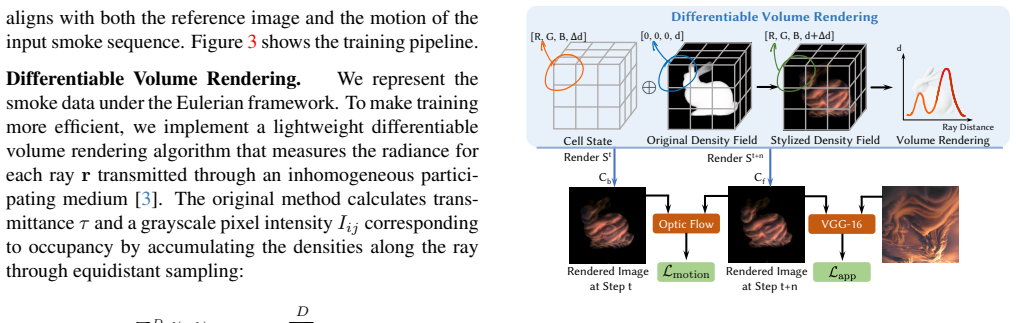
The central object is the Volumetric Neural Cellular Automaton (VNCA), a 3D voxel grid in which every cell carries a state vector (first three channels: RGB color; fourth: a density residual $\Delta d$; the rest hidden), updated by a shared two-layer MLP $f_\theta$ whose input is a perception vector built from the cell state, its 3D Sobel gradients, and a 27-point discrete Laplacian, concatenated with positional, density, and velocity encodings; each cell updates asynchronously through a randomized binary mask. The mechanism that carries the argument replaces explicit advection: the emergent motion of the trained automaton stands in for fluid transport, so no inter-frame smoothing loss or explicit transport solver is needed. That motion is steered by the flow-guided motion loss (Eqs. 12-14), which compares the optical flow between two rendered views of the evolving texture with the 2D projection of the input velocity field from the same camera pose, aligning direction first and then magnitude normalized by the number of update steps.
What would settle it
Train VNCA on a smoke sequence with strong depth-wise motion, then stylize held-out frames and render them from side and top views. If distinctive texture features visibly slide relative to the underlying smoke density, or if the paper's motion-loss terms computed from novel views grow well beyond their training-view values, then the 2D flow supervision does not pin down the 3D texture motion and the spatiotemporal-consistency claim fails.
Extended reading notes
Core claim
The paper's central claim is that volumetric style transfer for smoke can be reframed as dynamic volumetric texture synthesis: rather than optimizing or regressing stylized density fields frame by frame, one learns a single local update rule for a 3D neural cellular automaton whose repeated application grows a texture volume that matches the reference style image and moves with the smoke. The cell state carries RGB color plus a density residual, and the shared update rule reads neighboring cell states through fixed 3D Sobel and Laplacian filters, conditioned on positional, density, and velocity encodings, with stochastic asynchronous updates. Training uses a differentiable volume renderer: rendered views of the evolving texture are matched to the style image with a VGG-based appearance loss, and a flow-guided motion loss asks the optical flow between two rendered views to align in direction and magnitude with the 2D projection of the simulation's velocity field. The key asserted consequence is that the automaton's self-emerging motion replaces explicit fluid advection and inter-frame smoothing, so a model trained on a single density frame generalizes to the entire sequence and to unseen smoke datasets while cutting training time by over an order of magnitude.
Load-bearing premise
The load-bearing premise is that the 2D projection of the smoke's velocity, seen from whichever camera angle is used in training, carries enough information for the automaton to learn full 3D motion alignment; if the out-of-plane components of that motion are under-constrained, the stylized texture could drift in depth even on frames where the front view looks correct.
Editorial extensions
If this is right
- A converged VNCA stylizes the full smoke sequence without retraining, so artists get a single trained model that handles every frame of a simulation in real time (about 0.8 s per frame in the paper's measurements, versus 10 s and 463 s for the compared baselines).
- Because training uses a single density frame and a rotating camera, the resulting stylization is consistent across views and across frames by construction, eliminating the separate temporal-smoothing pass that slows optimization-based methods.
- The order-of-magnitude training speedup makes volumetric style transfer practical on a single GPU, which the paper argues is what previously blocked wider use of such tools.
- The same texture-volume formulation extends to mesh stylization, giving solid-texture-style results on meshes without UV maps.
- VNCA generalizes to smoke datasets unseen in training, so a model trained on one simulation can be applied to new simulations with the same style reference.
Reading between the lines
- Beyond the paper: the motion loss only sees a 2D projection of the motion, so smoke moving mostly toward or away from the camera is the natural stress test; rendering stylized frames from side or top views and tracking whether texture features stay locked to the smoke would directly probe whether the 2D supervision pins down the 3D alignment.
- Beyond the paper: the paper's stated limitation that the homogeneous update rule cannot produce clear foreground/background structure implies that styles with strong figure-ground organization will not stylize well, and a natural extension would be spatially conditioning the update rule on a segmentation or depth cue.
- Beyond the paper: because the motion loss aligns direction before magnitude (Eq. 14), the automaton's texture speed matches the fluid speed only on average; that is fine for artistic output, but the synthesized motion should not be treated as physical advection if the output were reused in a simulation loop.
- Beyond the paper: the demonstrated generalization to unseen datasets suggests a single VNCA could act as a reusable style capsule across simulations, and conditioning the appearance loss on the style image itself might let one model accept arbitrary reference images at inference without retraining.
Signed reviews
Editorial analysis
A structured set of objections, weighed in public.
Referee Report
Summary. The paper proposes Volumetric Neural Cellular Automata (VNCA), a 3D extension of neural cellular automata for stylizing volumetric smoke simulations from a single 2D reference image. VNCA maintains a per-voxel state with RGB and density-residual channels, updates it with a shared MLP acting on 3D Sobel/Laplacian perception vectors, and conditions the update on positional, density, and velocity encodings. A differentiable NeRF-style volume renderer turns the state into images, and training uses a VGG-based appearance loss together with an optical-flow motion loss that aligns rendered 2D motion with the projected input velocity field. The authors claim that, after training on a single density frame, VNCA stylizes the whole sequence in real-time, is multi-view consistent and temporally coherent, generalizes to unseen frames and datasets, and reduces training time by over an order of magnitude compared with prior volumetric style transfer methods. The paper also demonstrates an extension to solid mesh texturing.
Significance. The core idea is appealing: replacing explicit fluid advection and inter-frame smoothing with the emergent dynamics of a small recurrent neural cellular automaton is a genuinely different route to volumetric smoke stylization, and the paper contains several useful ablations (multi-view supervision, density encoding, velocity encoding, and motion-loss weighting) that support the existence of the proposed mechanism. If the claims were established, the practical value would be high, since training on one frame and generalizing to sequences and datasets would give artists a lightweight stylization tool. However, the paper does not currently support its strongest claims: 'real-time' is contradicted by Table 2's 0.8 s/frame, the training speedup is asserted without any training-time measurement, and the central temporal-coherence claim rests on 2D projected-flow supervision with no reported 3D motion correspondence. These gaps are substantial but appear fixable with additional measurement, reporting, and re-framing, so I recommend major revision rather than rejection.
major comments (5)
- [Abstract and Table 2] The abstract and Section 1 claim that VNCA synthesizes stylized smoke 'in real-time', but Table 2 reports 0.8 s/frame for VNCA on the Smoke Jet dataset, which is roughly 1.25 frames per second. This is not real-time in any standard sense. The authors should either report a runtime that meets a stated frame-rate target, provide a head-to-head comparison at a common resolution, or qualify the claim as near-real-time or as interactive per-frame processing with a clear operating definition.
- [Abstract, Sections 1 and 4.2] The abstract and Section 1 claim that VNCA reduces training time by 'over an order of magnitude', but no training-time measurement is reported anywhere in the paper. Section 4.2 reports only per-frame inference time in Table 2; the training times of prior works (20 hours, 70 hours, 18 hours) are quoted from the literature in Section 2.3 rather than measured on the same hardware. The training-speedup claim needs an end-to-end wall-clock comparison of VNCA and the baselines on the same GPU and dataset.
- [Section 3.4 (Eqs. 12-14) and Section 4] The temporal-coherence claim is not yet established. The motion loss in Eqs. 12-14 compares 2D optical flow of rendered views with a 2D projection of the input velocity field, while the update rule in Eqs. 2-3 uses only 3x3x3 Sobel/Laplacian stencils and an MLP writing to the center cell, so the texture can move at most one voxel per update step. The paper never reports N (the number of VNCA update steps applied between adjacent density frames at inference) or the velocity magnitudes in voxels/frame, so there is no check that the automaton can keep up with the smoke advection. The provided visual evidence does not close this gap: Figure 6 evaluates static multi-view consistency only, and Figure 10 is qualitative. A quantitative 3D motion metric (for example, comparing rendered optical flow against projected velocity from multiple camera angles, or measuring divergence of the synthesized texture from the advected density field) and a stated relation between N, voxel velocities, and the stencil size are needed to support the claim that VNCA dynamically aligns in 3D with the smoke motion.
- [Table 2] The user study that supports the inter-frame consistency and motion-preservation claims is reported as raw percentages with no confidence intervals, significance tests, or description of randomization and viewing conditions. With 44 to 50 responses per question, differences of 10 to 20 percentage points may or may not be statistically meaningful. As presented, the table cannot carry the quantitative weight of the coherence and motion-preservation claims; the authors should add statistical analysis or reframe the study as a small pilot preference report.
- [Section 4.4] The generalization claim (trained on one frame of Bunny, then applied to unseen Smoke Jet data) is demonstrated only qualitatively in Figure 10. It is also unclear in what sense Smoke Jet is 'unseen' given that Table 2 reports experiments on the same dataset name; if a different Smoke Jet sequence was used, that must be stated. Generalization should be quantified on held-out frames and datasets, for example by reporting the appearance and motion losses on the unseen data, so that the reader can distinguish true generalization from within-dataset interpolation.
minor comments (5)
- [Sections 3.2 and 3.4] The notation for update steps is inconsistent: Section 3.2 says N steps are mapped to adjacent density frames, while Section 3.4 and Eqs. 12-13 use a random n training steps and then refer to N without defining its value. These variables should be defined together and used consistently.
- [Section 4 and Appendix] Key hyperparameters are missing: the transmittance absorption constant γ, the loss weights λ_app and λ_motion, the number of VNCA update steps N and n, the exact MLP architecture, the number of training epochs, and the volume resolution at which the Table 2 runtime was measured. These are needed to reproduce the experiments and to interpret the ablation in Figure 9.
- [Section 3.3] Equation 3 writes the prior as zijk ∥ Pijk ∥ Dijk, but the text states that the perception vector also encodes velocity; the velocity encoding V is not visible in the equation. The authors should clarify where and how V is concatenated.
- [Throughout] There are several typographical and formatting errors: 'V olumetric' appears at the start of the title, the author email address 'alaa.abboud' does not match the author list, 'omni-view' and 'omniview' are used inconsistently, and the (i)/(ii) labels in the Figure 6 caption are not explained in the caption text.
- [Datasets] The Smoke Jet, Bunny, and Billowy datasets are not cited or described with generation parameters, which makes it difficult for readers to reproduce the experiments or to assess how challenging the test cases are.
Circularity Check
No significant circularity: motion supervision is a fitted training target, and the only self-citation (DynCA) is not load-bearing.
full rationale
VNCA's derivation chain is self-contained with respect to external targets: appearance is supervised using VGG16 features extracted from the reference style image (Eqs. 7-11), and motion is supervised by a pre-trained optical flow network comparing pre/post renders against the projected input velocity field (Eqs. 12-14). This motion loss is a direct supervised objective, not a fitted parameter renamed as a prediction; temporal alignment is the training target rather than a derived consequence. The self-citation to DynCA [21] is used only as inspiration and as the source of positional encoding; it is not invoked as a load-bearing theorem to exclude alternatives, so it does not make the 3D claims circular. The skeptical concerns about 2D optical flow under-constraining 3D motion, the one-voxel-per-update stencil, and the absence of a 3D motion metric are validation or robustness gaps rather than equivalence-by-construction. The paper's user study and comparisons with TNST and LNST provide external evidence. Overall, no significant circularity is present; the minor self-citation is not load-bearing.
Assumptions & free parameters
free parameters (3)
- Number of VNCA update steps N between adjacent density frames at inference =
not reported
- Motion loss weight ratio lambda_motion/lambda_app =
not explicitly stated
- Transmittance absorption constant gamma =
not reported
assumptions (4)
- domain assumption Pre-trained VGG16 features accurately capture style for 3D rendered smoke
- domain assumption Pre-trained optical flow network (FOF) provides reliable 2D motion estimates on stylized smoke renderings
- domain assumption Matching projected 2D optical flow of rendered views to the 2D projection of the input velocity field suffices to align 3D texture motion with smoke advection
- domain assumption A single NCA update rule trained on one frame can generalize to unseen frames and unseen smoke datasets
Cite this review
Pith. "Pith review of Volumetric Temporal Texture Synthesis for Smoke Stylization using Neural Cellular Automata." pith.science (2026). https://pith.science/paper/MES3GZIP
@misc{pith2026250209631,
  author       = {Pith},
  title        = {Pith review of: Volumetric Temporal Texture Synthesis for Smoke Stylization using Neural Cellular Automata},
  year         = {2026},
  howpublished = {\url{https://pith.science/paper/MES3GZIP}},
  note         = {Machine review of arXiv:2502.09631}
}
read the original abstract
Artistic stylization of 3D volumetric smoke data is still a challenge in computer graphics due to the difficulty of ensuring spatiotemporal consistency given a reference style image, and that within reasonable time and computational resources. In this work, we introduce Volumetric Neural Cellular Automata (VNCA), a novel model for efficient volumetric style transfer that synthesizes, in real-time, multi-view consistent stylizing features on the target smoke with temporally coherent transitions between stylized simulation frames. VNCA synthesizes a 3D texture volume with color and density stylization and dynamically aligns this volume with the intricate motion patterns of the smoke simulation under the Eulerian framework. Our approach replaces the explicit fluid advection modeling and the inter-frame smoothing terms with the self-emerging motion of the underlying cellular automaton, thus reducing the training time by over an order of magnitude. Beyond smoke simulations, we demonstrate the versatility of our approach by showcasing its applicability to mesh stylization.
Figures


Figures from the paper (7 more)


Reference graph
Works this paper leans on
-
[1]
Efficient neural style transfer for volumetric sim- ulations
Joshua Aurand, Raphael Ortiz, Silvia Nauer, and Vinicius C Azevedo. Efficient neural style transfer for volumetric sim- ulations. ACM Transactions on Graphics (Proceedings of SIGGRAPH), 41(6):1–10, 2022. 2, 3
work page 2022
-
[2]
Fluid Simulation for Computer Graphics
Robert Bridson. Fluid Simulation for Computer Graphics . CRC press, 2015. 1, 3
work page 2015
-
[3]
Production volume rendering: Siggraph 2017 course
Julian Fong, Magnus Wrenninge, Christopher Kulla, and Ralf Habel. Production volume rendering: Siggraph 2017 course. In ACM SIGGRAPH 2017 Courses , pages 1–79
work page 2017
-
[4]
Martin Gardner. The fantastic combinations of jhon con- way’s new solitaire game’life.Scientific American, 223:120– 123, 1970. 2
work page 1970
-
[5]
Tex- ture synthesis using convolutional neural networks
Leon Gatys, Alexander S Ecker, and Matthias Bethge. Tex- ture synthesis using convolutional neural networks. Ad- vances in Neural Information Processing Systems (NeurIPS), 28, 2015. 3
work page 2015
-
[6]
Image style transfer using convolutional neural networks
Leon A Gatys, Alexander S Ecker, and Matthias Bethge. Image style transfer using convolutional neural networks. In Proceedings of the IEEE/CVF Conference on Computer Vision and Pattern Recognition (CVPR) , pages 2414–2423,
-
[7]
Cellular automata as convolutional neural networks
William Gilpin. Cellular automata as convolutional neural networks. Physical Review E, 100(3):032402, 2019. 2
work page 2019
-
[8]
Jie Guo, Mengtian Li, Zijing Zong, Yuntao Liu, Jingwu He, Yanwen Guo, and Ling-Qi Yan. V olumetric appearance styl- ization with stylizing kernel prediction network.ACM Trans- actions on Graphics (Proceedings of SIGGRAPH) , 40(4): 162–1, 2021. 2, 3
work page 2021
Show all 27 references
-
[9]
On demand solid texture synthesis using deep 3d networks
Jorge Gutierrez, Julien Rabin, Bruno Galerne, and Thomas Hurtut. On demand solid texture synthesis using deep 3d networks. In Computer Graphics Forum , pages 511–530. Wiley Online Library, 2020. 2, 3, 9, 12 9
2020
-
[10]
Learn- ing a neural 3d texture space from 2d exemplars
Philipp Henzler, Niloy J Mitra, and Tobias Ritschel. Learn- ing a neural 3d texture space from 2d exemplars. InProceed- ings of the IEEE/CVF Conference on Computer Vision and Pattern Recognition (CVPR), pages 8356–8364, 2020. 3
2020
-
[11]
Singed silhouettes and feed forward flames: V olu- metric neural style transfer for expressive fire simulation
Paul Kanyuk, Vinicius Azevedo, Raphael Ortiz, and Jingwei Tang. Singed silhouettes and feed forward flames: V olu- metric neural style transfer for expressive fire simulation. In ACM SIGGRAPH 2023 Talks, pages 1–2. 2023. 2
2023
-
[12]
Azevedo, Markus Gross, and Barbara Solenthaler
Byungsoo Kim, Vinicius C. Azevedo, Markus Gross, and Barbara Solenthaler. Transport-Based Neural Style Trans- fer for Smoke Simulations. ACM Transactions on Graphics (Proceedings of SIGGRAPH), 38(6):188, 2019. 2, 3, 7
2019
-
[13]
Azevedo, Markus Gross, and Barbara Solenthaler
Byungsoo Kim, Vinicius C. Azevedo, Markus Gross, and Barbara Solenthaler. Lagrangian neural style transfer for flu- ids. ACM Transactions on Graphics (Proceedings of SIG- GRAPH), 39(4), 2020. 2, 3, 7, 8
2020
-
[14]
Style transfer by relaxed optimal transport and self-similarity
Nicholas Kolkin, Jason Salavon, and Gregory Shakhnarovich. Style transfer by relaxed optimal transport and self-similarity. In Proceedings of the IEEE/CVF Conference on Computer Vision and Pattern Recognition (CVPR), pages 10051–10060, 2019. 5
2019
-
[15]
Solid tex- ture synthesis from 2d exemplars
Johannes Kopf, Chi-Wing Fu, Daniel Cohen-Or, Oliver Deussen, Dani Lischinski, and Tien-Tsin Wong. Solid tex- ture synthesis from 2d exemplars. pages 2–es. 2007. 2, 3, 9, 12
2007
-
[16]
Geometric processes and replacement problem
Ye (Lam Yeh) Lin. Geometric processes and replacement problem. Acta Mathematicae Applicatae Sinica , 4(4):366– 377, 1988. 4
1988
-
[17]
Srinivasan, Matthew Tancik, Jonathan T
Ben Mildenhall, Pratul P. Srinivasan, Matthew Tancik, Jonathan T. Barron, Ravi Ramamoorthi, and Ren Ng. Nerf: Representing scenes as neural radiance fields for view syn- thesis. In The 16th European Conference on Computer Vi- sion ECCV 2020, 2020. 5
2020
-
[18]
Differentiable programming of reaction-diffusion patterns
Alexander Mordvintsev, Ettore Randazzo, and Eyvind Niklasson. Differentiable programming of reaction-diffusion patterns. In ALIFE 2022: The 2022 Conference on Artificial Life. MIT Press, 2021. 2
2022
-
[19]
Self-organising textures
Eyvind Niklasson, Alexander Mordvintsev, Ettore Ran- dazzo, and Michael Levin. Self-organising textures. Distill,
-
[20]
A family of large-stencil discrete laplacian approximations in three- dimensions
Randall C O’Reilly and Jeffrey M Beck. A family of large-stencil discrete laplacian approximations in three- dimensions. 2006. 4
2006
-
[21]
Dynca: Real-time dynamic texture synthe- sis using neural cellular automata
Ehsan Pajouheshgar, Yitao Xu, Tong Zhang, and Sabine S¨usstrunk. Dynca: Real-time dynamic texture synthe- sis using neural cellular automata. In Proceedings of the IEEE/CVF Conference on Computer Vision and Pattern Recognition (CVPR), pages 20742–20751, 2023. 2, 3, 4
2023
-
[22]
Solid texturing of complex surfaces
Darwyn R Peachey. Solid texturing of complex surfaces. In Proceedings of the 12th annual conference on Computer graphics and interactive techniques , pages 279–286, 1985. 2, 3
1985
-
[23]
An image synthesizer
Ken Perlin. An image synthesizer. ACM Transactions on Graphics (Proceedings of SIGGRAPH) , 19(3):287–296,
-
[24]
Gramgan: Deep 3d texture synthesis from 2d exem- plars
Tiziano Portenier, Siavash Arjomand Bigdeli, and Orcun Goksel. Gramgan: Deep 3d texture synthesis from 2d exem- plars. Advances in Neural Information Processing Systems (NeurIPS), 33:6994–7004, 2020. 3
2020
-
[25]
Very deep convo- lutional networks for large-scale image recognition
Karen Simonyan and Andrew Zisserman. Very deep convo- lutional networks for large-scale image recognition. InICLR,
-
[26]
Two-stream convolutional networks for dynamic texture synthesis
Matthew Tesfaldet, Marcus A Brubaker, and Konstantinos G Derpanis. Two-stream convolutional networks for dynamic texture synthesis. In Proceedings of the IEEE/CVF Confer- ence on Computer Vision and Pattern Recognition (CVPR) , pages 6703–6712, 2018. 2, 6 10 Figure 11. Styliza...
2018
-
[2021]
https://distill.pub/selforg/2021/textures. 2
2021
Reviewed August 9, 2026 · model on record in the stance chip above.
Discussion (0). Continue with ORCID to comment.