REVIEW 4 major objections 7 minor 22 references
Differential Adjusted Parity for Learning Fair Representations
T0 review · 4 major / 7 minor · reviewed 2026-08-07 · deepseek-v4-flash
Pith's one-line read A differentiable version of adjusted parity lets one loss train fair representations without an adversary.
desk verdict A plausible non-adversarial fairness loss with a correct multi-class normalization derivation, but the empirical claims rest on test-set hyperparameter selection and an unsupported key-element claim; needs revision before the numbers can be trusted. read the letter →
The pith
A machine-rendered reading of the paper's core claim, the machinery that carries it, and where it could break.
The reading
What carries the argument
The central object is the Differential Adjusted Parity (DAP) loss, built from soft balanced accuracy. Soft balanced accuracy is the differentiable per-class recall averaged over classes: $S = \frac{1}{C}\left\|\frac{TP}{TP+FN}\right\|_1$, with soft counts $TP=\sum_x P(x)\odot L_x$ and analogous expressions for $FP$, $TN$, and $FN$. Computing this quantity separately for each sensitive domain and plugging it into the adjusted parity formula makes $\Delta_{\mathrm{adj}}$ a smooth training target that rewards both high and consistent accuracy across groups. The loss combines $\Delta_{\mathrm{adj}}$ with the standard task cross-entropy via weights $\beta$ (on the deviation term) and $\Omega$ (on the cross-entropy), so no min-max game is needed.
What would settle it
Train the same DAP model on Adult and COMPAS with hyperparameters selected on a held-out validation split, then evaluate all fairness metrics on an untouched test split; if the demographic parity, equalized odds, and sensitive-feature accuracy improvements over adversarial baselines fall well below the reported double-digit margins, the central claim would fail.
Extended reading notes
Core claim
The paper's central claim is that a differentiable form of adjusted parity can act as the sole fairness mechanism in representation learning, with no adversary. The loss is defined by substituting per-domain soft balanced accuracy into $\Delta_{\mathrm{adj}} = \frac{\bar{S}-S_R}{1-S_R}\left(1-\frac{\sigma}{\gamma}\right)$, where $\bar{S}$ is mean balanced accuracy across sensitive domains, $\sigma$ is its standard deviation, $S_R$ is random-predictor accuracy, and $\gamma$ normalizes by the maximum possible deviation (for odd numbers of domains, $\gamma = \sqrt{\frac14(1-1/N^2)}$). Minimizing this loss jointly with task cross-entropy reduces mutual information between representations and sensitive features, improving demographic parity and equalized odds while keeping representations informative. The paper reports that DAP outperforms adversarial baselines on both datasets and extends to multi-class sensitive attributes.
Load-bearing premise
The load-bearing premise is that selecting hyperparameters with the test set's fairness metrics gives an unbiased estimate of DAP's performance; if a separate validation split is required, the reported gains may shrink or vanish.
Editorial extensions
If this is right
- Adversarial training is not required: a single cooperative loss can match or beat adversarial models on demographic parity, equalized odds, and sensitive-feature accuracy.
- Previous non-adversarial losses that could be gamed by uniformly poor performance no longer have that escape, because low mean accuracy directly lowers the adjusted parity term.
- With $\gamma$ normalizing for the number of domains, the metric and loss extend to multi-class sensitive attributes without forcing a binary reduction of the protected attribute.
- Fairness gains come at a controlled cost: less than 2.5% task-accuracy drop on Adult and less than 2% on COMPAS in the reported configurations.
- The hyperparameters $\beta$ and $\Omega$ let a user trade accuracy against fairness along a tunable axis.
Reading between the lines
- Because the loss is smooth and non-adversarial, it could be dropped into existing autoencoder or variational frameworks in place of maximum-mean-discrepancy penalties without changing the training dynamics; the paper does not test this extension.
- The $\gamma$ normalization implies a concrete prediction: for an odd number of sensitive domains, the maximum achievable adjusted parity is slightly lower than for even numbers, so fairness comparisons across datasets with different domain counts need this normalization to be comparable.
- A direct robustness test would be to select $\beta$ and $\Omega$ on a held-out validation split rather than the test set; if the reported double-digit margins persist, DAP's advantage is architectural rather than an artifact of test-set selection.
Editorial analysis
A structured set of objections, weighed in public.
Referee Report
Summary. The paper introduces a differentiable variant of the adjusted parity metric, called Differential Adjusted Parity (DAP), as a unified training objective for fair representation learning. The adjusted parity metric is generalized from binary to N sensitive domains through a normalization term γ, with a derivation for odd N in Appendix A. The authors define soft balanced accuracy (Eqs. 7–12) to make the metric differentiable and state that combining it with the standard cross-entropy loss yields the DAP loss, controlled by hyperparameters β and Ω. Experiments on Adult and COMPAS compare DAP with three adversarial debiasing methods (CFAIR, LAFTR, FAIR) and an unconstrained baseline (NODEBIAS), claiming improvements of up to 22.5% in demographic parity difference, 44.1% in equalized odds difference, and 40.1% in sensitive-feature classification accuracy, at a task-accuracy cost below 2.5%. A five-category sensitive-feature experiment on COMPAS is also reported. The paper argues that, unlike prior non-adversarial approaches, the DAP objective does not admit the degenerate solution of performing equally poorly across all sensitive domains.
Significance. If the empirical claims hold, DAP is a useful addition to non-adversarial fair representation learning: a single differentiable objective without a min-max game, with the adjusted parity metric extended to arbitrary numbers of sensitive domains. The derivation of the maximum standard deviation γ for odd N (Appendix A) is mathematically correct and is a genuine technical extension, and the paper ships code and full result tables (Appendix B). The core claims are falsifiable and are checked against independent standard fairness metrics (demographic parity, equalized odds), not only the proposed metric, which mitigates circularity. The significance is currently bounded by the protocol problems in the major comments: the exact loss is never written down, hyperparameters appear to be selected on the test set, and the authors' own Table 1 shows that the balance component has no measurable effect. If the claims survive a properly held-out protocol with matched baseline tuning, this would be a solid contribution to the fair-representation literature.
major comments (4)
- [Section 4; Eqs. (7)–(13); Section 5.4] The proposed loss function is never explicitly defined. Section 4 derives differentiable soft TP/FP/TN/FN quantities and the soft balanced accuracy S (Eqs. 7–12), and states that substituting S into Eq. (5) 'we can obtain a differential adjusted parity (DAP) loss', while Section 5 says the network is trained with 'a combination of our DAP metric and the standard task cross-entropy loss (Lce)' with weighting hyperparameters β and Ω. The actual expression for the training loss is never given, so the reader cannot determine how the mean-accuracy term, the standard-deviation term, and Lce are combined, nor verify the degeneracy-avoidance argument that is a central selling point (Sections 1 and 6). This omission is load-bearing for reproducibility; please state the loss explicitly, including the exact roles of β and Ω.
- [Sections 5.3–5.5] The empirical protocol appears to select hyperparameters on the test set, which biases the headline numbers. Section 5.3 describes only a train/test split (with the ambiguous '175:25 ratio'); Section 5.4 defines a 100-combination grid over Ω and β; and Section 5.5 states that an adjusted parity metric is computed 'for comparing models and selecting best performing hyperparameters', with no validation split described anywhere. In addition, the two balanced random-forest classifiers used for evaluation are trained on 'the encodings in the testing phase' (Section 5.5), so the test set is used both for probe fitting and for model selection. The abstract's quantified claims (22.5%, 44.1%, 40.1%) are therefore, under the protocol as described, the best grid point evaluated on the same test data used for selection rather than unbiased estimates of DAP's performance, and Section 6 even acknowledges that β and Ω require per-dataset calibration. Please add a held-out validation split for hyperparameter selection and for fitting the probes, and re-report the results with the selection-induced bias quantified.
- [Table 1; Abstract; Section 4] The paper's own ablation contradicts the claim that soft balanced accuracy is a key element of the method. The abstract calls it 'A key element in this approach', and Section 4 motivates balanced accuracy explicitly by class imbalance ('this measure can be misleading when classes are imbalanced'). Yet Table 1 compares balanced and unbalanced soft accuracies on the imbalanced Adult dataset (75.4% below $50k; 67.3% male) and states 'No significant difference is observed between Balanced and Unbalanced'. If the balance component is not load-bearing in the reported experiments, the claim of novelty should be narrowed to the differentiable soft accuracy, or the authors should demonstrate at least one setting in which balancing matters.
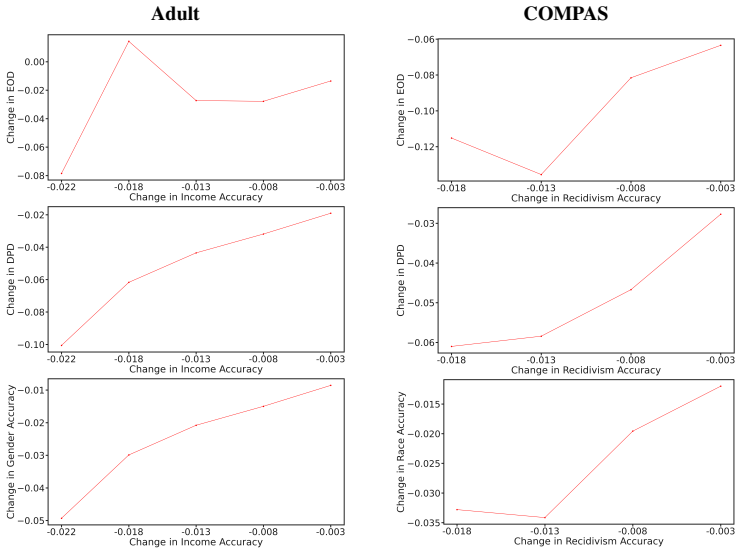
- [Section 5.5; Figures 1–3] The baseline comparison is not matched, and no significance tests are reported. The four baselines (CFAIR, LAFTR, FAIR, NODEBIAS) are 'adapted from [14]' with no disclosure of their hyperparameters or tuning budget, whereas DAP receives a 100-combination grid search; the paper reports medians and standard deviations over 5 runs for DAP but does not display uncertainty for the baselines in the figures and performs no statistical test for claims such as 'the lowest EOD and DPD are achieved with DAP' (Section 5.5). Furthermore, the non-adversarial methods discussed in Section 2.2 (VFAE, FBC, FRC, BFA) are never evaluated, even though the central motivation that DAP avoids the degenerate 'equally poor across all sensitive domains' solution is a comparative claim against that family. Please add a matched tuning protocol, significance tests or confidence intervals, and at least one non-adversarial baseline.
minor comments (7)
- [Section 5.3] The split 'in a 175:25 ratio' is unclear and likely a typo (perhaps 75:25); a 175:25 split sums to 200 parts and is not a standard notation.
- [Section 5.5; Figure 5] In the multi-class COMPAS experiment, the text says balanced race classification accuracy approaches 'the random chance level of 0.33', but the sensitive feature is one-hot encoded into five categories (Section 5.2), giving a chance-level balanced accuracy of 0.20; moreover, the extension of EOD and DPD (Eqs. 1–3), which are defined for binary sensitive attributes, to the five-category setting is never specified, and EOD staying at 0.5 across all β is not discussed as a failure to improve.
- [Appendix A; Section 5.4] The symbol Ω is used both for the task-loss weighting hyperparameter (Section 5.4) and for the upper bound of the soft accuracy range (Eq. 16 in Appendix A); please use a distinct symbol for the bound.
- [Section 5.5; Appendix B] The end of Section 5.5 tells the reader that the omitted COMPAS sensitivity results 'can be found in section Appendix A', but the relevant plot (Figure 7) appears in Appendix B, and Appendix B contains an unresolved 'Figure ??' cross-reference.
- [Throughout] There are numerous typos and misspelled affiliation names ('Unviersity', 'Lusanne', 'componenet', 'addititional', 'cirticised'), and the hyperparameter grid 'Ω ∈ {0...100} and β ∈ {0.1...100}' in Section 5.4 is ambiguous as stated (it should be clear that 10 log-spaced values per parameter are used to obtain 100 combinations).
- [Section 4] The claim that minimizing prediction inconsistency across sensitive domains 'would minimise the mutual information between the representations and the sensitive feature' is asserted without proof or citation; a formal statement (or a reference) would strengthen the link between the proposed objective and the reported fairness metrics.
- [Figures 1–3] The figures plot DAP metrics as functions of β, but the Ω value at which the sweep is performed is not stated in the captions or the text; given the strong Ω-dependence shown in Figure 2, this makes the curves difficult to interpret.
Circularity Check
Minor self-referential evaluation only; DAP's derivation is self-contained and independent DPD/EOD metrics support the central fairness claim.
-
other
[Section 4 and Section 5.5]
"By substituting the balanced soft accuracy into the adjusted parity metric, we can obtain a differential adjusted parity (DAP) loss which we can use to train a model. ... We also obtain an adjusted parity metric for comparing models and selecting best performing hyperparameters."
The adjusted parity metric is simultaneously the differentiable training objective (Section 4) and the test-set metric used to select the reported hyperparameters (Section 5.5). Consequently, reporting improved adjusted parity for the chosen configuration is partly a self-selection effect rather than independent confirmation, and the comparison baselines are not described as receiving the same grid-selection loop. This is a minor self-referentiality, not a definitional collapse: the loss is a fixed closed-form expression with no fitted constants, and the headline fairness gains are also measured with independent demographic-parity and equalised-odds metrics.
full rationale
The DAP derivation chain is essentially self-contained. Equation (5) extends the adjusted parity metric from prior work [19], one of whose authors is a co-author here, but the metric is restated in the paper and the gamma normalizer is derived from scratch in Appendix A without importing any uniqueness claim or fitted constant. The soft balanced accuracy in Eqs. (7)-(12) is a standard differentiable accuracy surrogate, and the claimed avoidance of the 'equally poorly across all domains' degeneracy follows directly from the accuracy factor in Eq. (5); it is a property of the definition, not a circular result. The central fairness evaluation also relies on independent, standard metrics (demographic parity difference and equalized odds difference), so the main empirical claim does not reduce to the training objective. The strongest validity caveat, noted by the paper's own sensitivity discussion in Section 6, is that hyperparameters beta and Omega are selected on the test set using adjusted parity (Section 5.5) without a held-out validation split or a matched tuning budget for baselines; this is a selection-bias/overfitting risk for the quantified gains, but it is an evaluation-protocol concern rather than a circular derivation. The self-citation to [19] is not load-bearing because the metric is re-derived here and is externally checkable against DPD/EOD.
Assumptions & free parameters
free parameters (6)
- beta (fairness weighting) =
Selected from {0.1...100}; reported best values include 1, 3, 5, 100
- Omega (task loss weighting) =
Selected from {0...100}; reported values include 1, 3, 5, 10, 15, 20
- Learning rate =
0.005 (Adult), 0.01 (COMPAS)
- Batch size =
64 (Adult), 32 (COMPAS)
- Training epochs =
20
- Network architecture =
Not disclosed in text
assumptions (6)
- domain assumption The adjusted parity metric from Vowels et al. 2020 is a valid measure of domain invariance and fairness.
- standard math Soft balanced accuracy values lie in [0,1], so the maximum standard deviation gamma can be computed from extremes 0 and 1.
- domain assumption Minimizing inconsistency of soft balanced accuracy across sensitive domains reduces mutual information between representations and sensitive features.
- domain assumption A balanced random forest probe trained on test embeddings accurately measures sensitive information and target accuracy.
- domain assumption The random predictor baseline S_R is known for each task and class count.
- domain assumption Every sensitive domain and every class appears in each training minibatch, so per-domain soft balanced accuracies are well-defined.
Cite this review
Pith. "Pith review of Differential Adjusted Parity for Learning Fair Representations." pith.science (2026). https://pith.science/paper/4DTC2ZNE
@misc{pith2026250209765,
  author       = {Pith},
  title        = {Pith review of: Differential Adjusted Parity for Learning Fair Representations},
  year         = {2026},
  howpublished = {\url{https://pith.science/paper/4DTC2ZNE}},
  note         = {Machine review of arXiv:2502.09765}
}
read the original abstract
The development of fair and unbiased machine learning models remains an ongoing objective for researchers in the field of artificial intelligence. We introduce the Differential Adjusted Parity (DAP) loss to produce unbiased informative representations. It utilises a differentiable variant of the adjusted parity metric to create a unified objective function. By combining downstream task classification accuracy and its inconsistency across sensitive feature domains, it provides a single tool to increase performance and mitigate bias. A key element in this approach is the use of soft balanced accuracies. In contrast to previous non-adversarial approaches, DAP does not suffer a degeneracy where the metric is satisfied by performing equally poorly across all sensitive domains. It outperforms several adversarial models on downstream task accuracy and fairness in our analysis. Specifically, it improves the demographic parity, equalized odds and sensitive feature accuracy by as much as 22.5\%, 44.1\% and 40.1\%, respectively, when compared to the best performing adversarial approaches on these metrics. Overall, the DAP loss and its associated metric can play a significant role in creating more fair machine learning models.
Figures


Figures from the paper (4 more)


Reference graph
Works this paper leans on
-
[14]
Transferlearning_verifyfairness
Taejun Kim. Transferlearning_verifyfairness. https://github.com/taejun13/TransferLearning_VerifyFairness,
-
[1]
Wasserstein generative adversarial networks
Martin Arjovsky, Soumith Chintala, and Léon Bottou. Wasserstein generative adversarial networks. In Doina Precup and Yee Whye Teh, editors, Proceedings of the 34th International Conference on Machine Learning, volume 70 of Proceedings of Machine Learning Research, pages 214–223. PMLR, 06–11 Aug 2017. URL https://proceedings.mlr.press/v70/ arjovsky17a.html
work page 2017
-
[2]
It’s compaslicated: The messy relationship between rai datasets and algorithmic fairness benchmarks
Michelle Bao, Angela Zhou, Samantha Zottola, Brian Brubach, Sarah Desmarais, Aaron Horowitz, Kristian Lum, and Suresh Venkatasubramanian. It’s compaslicated: The messy relationship between rai datasets and algorithmic fairness benchmarks. arXiv preprint arXiv:2106.05498, 2021
arXiv 2021
-
[3]
S. Barocas and A. D. Selbst. Big data’s disparate impact. California Law Review, 104, 2016
work page 2016
-
[4]
Y . Bengio, A. Courville, and P. Vincent. Representation learning: A review and new perspectives. IEEE Transactions on Pattern Analysis and Machine Intelligence, 35(8):1798–1828, 2013. doi: 10.1109/tpami.2013.50
-
[5]
A. Chouldechova. Fair prediction with disparate impact: A study of bias in recidivism prediction instruments. Big Data, 5(2):153–163, 2017
work page 2017
-
[6]
K. Crawford and R. Calo. There is a blind spot in ai research. Nature, 538(7625):311–313,
-
[7]
Compas risk scales: Demonstrating accuracy, equity, and predictive parity, 2016
William Dieterich, Christina Mendoza, and Tim Brennan. Compas risk scales: Demonstrating accuracy, equity, and predictive parity, 2016
work page 2016
Show all 22 references
-
[8]
Uci machine learning repository, 2017
Dheeru Dua and Casey Graff. Uci machine learning repository, 2017. URL http://archive. ics.uci.edu/ml
2017
-
[9]
Dwork, M
C. Dwork, M. Hardt, T. Pitassi, O. Reingold, and R. Zemel. Fairness through awareness. In Proceedings of the 3rd Innovations in Theoretical Computer Science Conference , pages 214–226, Cambridge, Massachusetts, 2012. ACM
2012
-
[10]
Fair representations by compression
Xavier Gitiaux and Huzefa Rangwala. Fair representations by compression. In Proceedings of the AAAI Conference on Artificial Intelligence, volume 35, pages 11506–11515, 2021. doi: https://doi.org/10.1609/aaai.v35i13.17370
2021 doi
-
[11]
Grgi´c-Hlaˇca, M
N. Grgi´c-Hlaˇca, M. B. Zafar, K. P. Gummadi, and A. Weller. Beyond distributive fairness in algorithmic decision making: Feature selection for procedurally fair learning. In AAAI, pages 51–60, 2018
2018
-
[12]
Hardt, E
M. Hardt, E. Price, and N. Srebro. Equality of opportunity in supervised learning. InProceedings of the 30th International Conference on Neural Information Processing Systems, pages 3315– 3323, Barcelona, Spain, 2016. Curran Associates Inc
2016
-
[13]
Equality of opportunity in supervised learning
Moritz Hardt, Eric Price, and Nati Srebro. Equality of opportunity in supervised learning. Advances in neural information processing systems, 29, 2016
2016
-
[15]
The variational fair autoencoder
Christos Louizos, Kevin Swersky, Yujia Li, Max Welling, and Richard Zemel. The variational fair autoencoder. In International Conference on Learning Representations (ICLR), 2016
2016
-
[16]
Learning adversarially fair and transferable representations
David Madras, Elliot Creager, Toniann Pitassi, and Richard Zemel. Learning adversarially fair and transferable representations. In International Conference on Machine Learning, pages 3381–3390, 2018. 10
2018
-
[17]
Learning fair representations by separating the relevance of potential information
Tangkun Quan, Fei Zhu, Xinghong Ling, and Quan Liu. Learning fair representations by separating the relevance of potential information. Information Processing & Management, 59 (6):103103, 2022. ISSN 0306-4573. doi: https://doi.org/10.1016/j.ipm.2022.103103. URL https://www.sci...
2022
-
[18]
Learning fair representations for accuracy parity
Tangkun Quan, Fei Zhu, Quan Liu, and Fanzhang Li. Learning fair representations for accuracy parity. Engineering Applications of Artificial Intelligence, 119:105819, 2023. ISSN 0952-1976. doi: https://doi.org/10.1016/j.engappai.2023.105819. URL https://www.sciencedirect. com/s...
2023
-
[19]
V owels, N
M.J. V owels, N. Cihan Camgoz, and R. Bowden. Nestedvae: Isolating common factors via weak supervision. In 2020 IEEE/CVF Conference on Computer Vision and Pattern Recognition (CVPR), 2020. doi: 10.1109/cvpr42600.2020.00922
2020
-
[20]
Zhang, B
B.H. Zhang, B. Lemoine, and M. Mitchell. Mitigating unwanted biases with adversarial learning. In Proceedings of the 2018 AAAI/ACM Conference on AI, Ethics, and Society, 2018. doi: 10.1145/3278721.3278779
2018
-
[21]
Han Zhao, Amanda Coston, Tameem Adel, and Geoffrey J. Gordon. Conditional learning of fair representations. In 8th International Conference on Learning Representations, pages 1–17, 2020. 11 A Derivation of maximum standard deviation. We define our Differential Adjusted Parity ...
2020
-
[2016]
doi: 10.1038/538311a
Reviewed August 7, 2026 · model on record in the stance chip above.
Discussion (0). Continue with ORCID to comment.