REVIEW 3 major objections 7 minor 1 cited by
INJONGO: A Multicultural Intent Detection and Slot-filling Dataset for 16 African Languages
T0 review · 3 major / 7 minor · reviewed 2026-08-07 · deepseek-v4-flash
Pith's one-line read Injongo, a native-speaker-built dataset for 16 African languages, shows that culturally grounded training data transfers better than Western-centric data at low shot counts and that fine-tuned African-language models beat prompted LLMs on…
desk verdict Injongo is a genuinely useful new dataset for African task-oriented dialogue, but its headline cross-lingual transfer claim is confounded and the abstract numbers don't match the tables. read the letter →
The pith
A machine-rendered reading of the paper's core claim, the machinery that carries it, and where it could break.
The reading
What carries the argument
The load-bearing object is the elicitation protocol that builds INJONGO. Annotators are shown a CLINC English utterance with an intent label, such as the paper's example of transferring ten dollars between two American banks, and are asked to generate a semantically similar utterance that fits their local context, such as transferring R200 from FNB to Absa in isiXhosa. The generated utterances then receive three-way slot annotation, with majority voting and Fleiss' kappa quality checks, and rare slot types are merged from 34 to 23 categories such as CITY_OR_PROVINCE and DISH_OR_FOOD. This protocol produces both the African-language test sets and an English practice split, and the comparison of that English split against CLINC is what carries the cross-lingual-transfer claim.
What would settle it
Have independent native speakers rate the naturalness of a random sample of utterances and re-annotate their slots without seeing the original guidelines' examples; if agreement falls below the reported post-review Fleiss kappa range (0.912-1.00) or utterances are judged stilted, the quality premise fails. For the transfer claim, replace the INJONGO English split with an English split elicited from independent writers who are given the same intent definitions but not CLINC sentences; if the 10-shot advantage over CLINC disappears, the effect is an artifact of shared annotation style rather than cultural relevance.
Extended reading notes
Core claim
INJONGO is, on the authors' account, the first large-scale multicultural intent-detection and slot-filling dataset for 16 African languages: 3,200 utterances per language, balanced across 40 intents in banking, home, travel, utility, and kitchen-and-dining, with 23 merged slot types. The central empirical discovery is that this kind of data separates the strong from the weak approaches: AfroXLMR-76L, an encoder pretrained on African languages, reaches 93.7% intent accuracy and 85.6 slot F1, whereas GPT-4o, the best prompting model, reaches 65.1% intent accuracy and 33.3 slot F1. Slot filling is particularly hard for prompted LLMs, and a few demonstrations (5 examples) recover much but not all of the gap. In cross-lingual transfer, the dataset's English split, produced by the same native-speaker annotators, outperforms the Western-centric CLINC English data when training examples are scarce.
Load-bearing premise
The dataset's value rests on the assumption that utterances elicited from CLINC prompts by three annotators per language are natural, culturally relevant, and consistently labeled, and that the English split written by those same annotators is a fair transfer source rather than a stylistically closer cousin of the African test sets.
Editorial extensions
If this is right
- Fine-tuned multilingual encoders remain the strongest option: AfroXLMR-76L reaches 93.7% average intent accuracy and 85.6 slot F1 on the 16 African test sets, and joint training across all 17 languages adds about 0.7 and 1.7 points over per-language training.
- Zero-shot LLM prompting lags substantially, especially on slot filling: GPT-4o reaches 65.1% intent accuracy and 33.3 slot F1, and even English slot filling is weak, so training data remains necessary for this task.
- A few demonstrations close part of the gap: with just 5 examples, GPT-4o and Gemini 1.5 Pro gain more than 19 F1 points on slot filling, and one example per intent lifts intent accuracy for several models.
- When transferring from English, African-context data beats Western-context data at low shot counts: at 10 shots INJONGO English reaches 16.1% accuracy versus 4.0% for CLINC in in-language transfer, with a larger gain in translate-test; beyond about 25 shots the two sources converge.
- The dataset extends the reach of intent-and-slot benchmarks from 3 African languages in MASSIVE to 16, with 3,200 utterances per language, 40 intents, and 23 slot types.
Reading between the lines
- Because the African and English splits share annotators, prompt sources, and slot guidelines, the 10-shot transfer gap over CLINC could partly measure pipeline similarity rather than cultural content; an English split written by independent authors is the clean test.
- The frequency-based slot trimming, which removes entity types appearing fewer than 500 times, means the 23-slot schema is optimised for common banking, travel, and home slots and may under-serve domain-specific applications that need rarer entity types.
- The same elicitation design should be portable to languages from other families, such as Nilo-Saharan, and to broader domains like health and education, where a similar low-shot transfer benefit is a testable prediction.
- The paper's few-shot results use fixed random examples; choosing examples by similarity or intent coverage may close more of the gap to supervised fine-tuning than simply adding more shots.
Editorial analysis
A structured set of objections, weighed in public.
Referee Report
Summary. The paper introduces INJONGO, a multilingual intent detection and slot-filling dataset for 16 African languages plus English, with 3,200 utterances per African language across 5 domains, 40 intents, and 23 slots. Utterances were elicited from native-speaker annotators using CLINC prompts but with culturally localized entities, and slots were annotated by three annotators per item with a review process. The paper benchmarks fine-tuned multilingual encoders and LLMs, and reports that AfroXLMR-76L achieves 93.7% intent accuracy and 85.6 slot F1, while zero-shot GPT-4o achieves 65.1% intent accuracy and 33.3 slot F1. A cross-lingual transfer experiment aims to show that fine-tuning on INJONGO English data outperforms fine-tuning on CLINC data for zero-shot transfer to African languages, with the effect most pronounced at 10 shots.
Significance. The dataset itself is a valuable contribution: it is, to my knowledge, the largest intent/slot-filling resource for African languages, with culturally localized entities, a documented multi-annotator protocol, Fleiss' kappa improvements after review, and a CC BY 4.0 release with open code. The fine-tuning results are reproducible and reported with five-seed averages. The observation that LLMs, including GPT-4o, lag far behind fine-tuned encoders on slot-filling in these languages is a useful benchmark finding. However, the paper's headline claim about the advantage of African-context utterances in cross-lingual transfer is not established by the current comparison, and several abstract numbers do not match the tables. If the transfer claim is either fixed with a proper control or appropriately weakened, the paper would be a solid benchmark contribution.
major comments (3)
- [Abstract] The abstract states that GPT-4o achieves an average slot-filling F1 of 26 and an average intent accuracy of 70.6%, but Table 6 (zero-shot, five templates, averaged over African languages) reports 33.3 F1 and 65.1 accuracy for GPT-4o, and Table 15's zero-shot rows report similar values (33.7 and 64.7). These are not minor rounding differences; the abstract numbers appear to be from a different experimental version. The abstract also says 'GPT-4o and fine-tuning baselines perform similarly on intent detection, achieving an accuracy of approximately 81%', which is not supported by the tables: GPT-4o English intent is 80.9 in Table 6, while the best fine-tuned English result is 84.5 in Table 5. The authors should correct the abstract or, if the abstract refers to a different setup, state that explicitly.
- [5.4] The central claim that 'leveraging African-cultural utterances' improves cross-lingual transfer from English is confounded. The INJONGO English split (Section 3.4) is composed of practice utterances written by the same three annotators per language, using the same CLINC prompts, with instructions to make entities African-relevant (Section 3.1). The African test utterances were produced by the same annotators under the same prompts. Thus the 10-shot advantage of INJONGO English over CLINC (16.1 vs. 4.0 in-language; 40.9 vs. 11.9 translate-test) could reflect shared annotator idiolect, word-choice patterns, and annotation conventions rather than cultural relevance. The paper does not state whether the sampled 4,000 CLINC examples were filtered to the same 40 intents (Table 4 shows 100 per intent, which implies 40, but this is not written in the text), and no significance testing is reported. Figure 4 shows near-identical performance at 5 shots and a sharp divergence at 10 shots, a pattern consistent with a coverage threshold effect. The authors should add a control condition, for example an English set elicited from independent speakers without African-context instructions, or a matched analysis that controls for utterance length, vocabulary, and label distribution. Without such a control, the cross-lingual transfer conclusion in the abstract and conclusion should be substantially weakened.
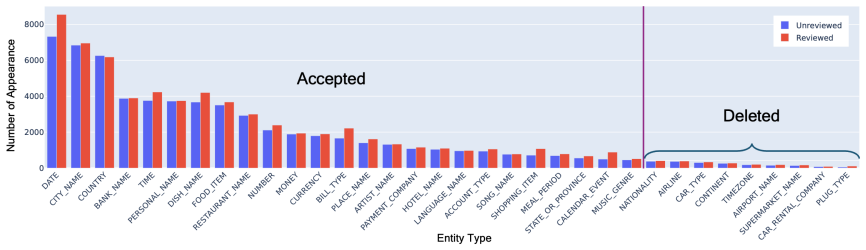
- [3.3] The final 23-slot schema is produced by post hoc pruning: slot types appearing fewer than 500 times are deleted, and two pairs are merged (CITY NAME with STATE OR PROVINCE, DISH NAME with FOOD ITEM). This means the evaluation ontology is defined after inspecting the data, not a priori. The paper does not state whether the frequency threshold was applied on the training split only or on the full dataset, and Appendix A.3 lists original slot types (e.g., TIMEZONE, PLUG_TYPE, NATIONALITY) that were later removed. Slot-filling F1 scores in Tables 5 and 6 are therefore computed on a schema that may have been selected to maximize annotation consistency. This is not necessarily fatal, but the authors should clarify the timeline of the pruning decisions relative to the train/dev/test split and, ideally, report results also on the full original 34-type schema as a robustness check.
minor comments (7)
- [3.1] The sentence 'Appendix A.3 contains all the 34 intent types selected' should read '34 slot types' (the 40 intents are in Appendix A.2).
- [3.2] Typo: 'Fless' Kappa' should be 'Fleiss' Kappa'.
- [Table 7] The Fleiss' kappa values in Table 7 (e.g., amh 0.836 unreviewed) do not match those in Table 3 (amh 0.850 unreviewed). Clarify whether these are different subsets or a reporting error.
- [Table 5] The table shows one 'Multi-lingual training' row (AfroXLMR-76L) but Section B.4 says 'the 4 top-performing models' were evaluated in multilingual training; make the table consistent with the text or update the text.
- [Figure 4] The caption should explicitly state that the task is intent detection (not slot-filling) and describe the error bars or variance.
- [C] The sentence 'The prompts' is incomplete; complete the description of how prompts are concatenated.
- [Abstract] The phrase 'approximately 81%' for English intent accuracy is vague; specify which model(s) and contrast with the table values.
Circularity Check
No derivation-level circularity; the only self-referential element is the Section 5.4 transfer comparison, where the INJONGO English source is produced by the same annotators and prompts as the African test data, partially confounding cultural relevance with same-pipeline similarity.
-
other
[Section 3.1, Section 3.4, Section 5.4 / Table 14]
"we conducted the tutorial on the utterance generation task and a practice session and asked every annotator to generate a sample English utterance per intent that culturally aligns with the African contexts ... We aggregated the practice data as the INJONGO English dataset. ... we sampled 4000 CLINC intent-only dataset to compare western-centric English dataset to our curated INJONGO dataset that captures the African contexts."
The claimed advantage of African-cultural utterances is measured by fine-tuning on INJONGO English versus CLINC English. The INJONGO English split is the practice output of the same three annotators who then produced the 3,200 African utterances per language from the same CLINC prompts, with instructions to use African-relevant entities. The source and target thus share annotator idiolect, wording style, entity choices, and annotation conventions, while CLINC differs on all those dimensions at once. The 10-shot gap (16.1 vs 4.0 in-language; 40.9 vs 11.9 translate-test) can therefore reflect same-pipeline similarity rather than cultural relevance. This is a self-referential comparison, though not a formal derivation-equivalence.
full rationale
The central contribution is an external dataset of native-speaker utterances, and the fine-tuning and prompting results are empirical measurements on held-out splits rather than derivations from the construction process. I found no self-definitional prediction, no fitted-input-called-prediction, and no load-bearing self-citation or imported uniqueness theorem. The in-language and multilingual results are self-contained comparisons across models and languages. The only self-referential element is the Section 5.4 cross-lingual transfer comparison: the INJONGO English source is the annotators' practice data, produced by the same three annotators and the same CLINC prompts as the African test utterances, so the 10-shot advantage over CLINC conflates cultural content with source-target annotator and entity overlap. This is a design confound and a partial self-reference in the evaluation, not a formal equivalence, so it is scored as a minor caveat rather than a full circularity.
Assumptions & free parameters
free parameters (2)
- Selected intent subset size =
40 intents from 5 CLINC domains
- Slot frequency threshold =
500 occurrences across all 16 languages
assumptions (4)
- domain assumption CLINC's intent taxonomy is a suitable seed for African task-oriented dialogue
- domain assumption Elicited native-speaker utterances are natural and culturally relevant rather than translationese
- domain assumption Majority voting with two review rounds yields consistent slot labels
- domain assumption The English practice split is comparable to CLINC as a transfer source
Cite this review
Pith. "Pith review of INJONGO: A Multicultural Intent Detection and Slot-filling Dataset for 16 African Languages." pith.science (2026). https://pith.science/paper/DZXW6Y7Z
@misc{pith2026250209814,
  author       = {Pith},
  title        = {Pith review of: INJONGO: A Multicultural Intent Detection and Slot-filling Dataset for 16 African Languages},
  year         = {2026},
  howpublished = {\url{https://pith.science/paper/DZXW6Y7Z}},
  note         = {Machine review of arXiv:2502.09814}
}
read the original abstract
Slot-filling and intent detection are well-established tasks in Conversational AI. However, current large-scale benchmarks for these tasks often exclude evaluations of low-resource languages and rely on translations from English benchmarks, thereby predominantly reflecting Western-centric concepts. In this paper, we introduce Injongo -- a multicultural, open-source benchmark dataset for 16 African languages with utterances generated by native speakers across diverse domains, including banking, travel, home, and dining. Through extensive experiments, we benchmark the fine-tuning multilingual transformer models and the prompting large language models (LLMs), and show the advantage of leveraging African-cultural utterances over Western-centric utterances for improving cross-lingual transfer from the English language. Experimental results reveal that current LLMs struggle with the slot-filling task, with GPT-4o achieving an average performance of 26 F1-score. In contrast, intent detection performance is notably better, with an average accuracy of 70.6%, though it still falls behind the fine-tuning baselines. Compared to the English language, GPT-4o and fine-tuning baselines perform similarly on intent detection, achieving an accuracy of approximately 81%. Our findings suggest that the performance of LLMs is still behind for many low-resource African languages, and more work is needed to further improve their downstream performance.
Figures


Figures from the paper (1 more)

Forward citations
Cited by 1 Pith paper
-
Deep Learning Approaches for Multimodal Intent Recognition: A Survey
A survey of deep learning methods for intent recognition, tracing the field from unimodal text, audio, vision, and EEG approaches to multimodal fusion, alignment, knowledge-augmented, and multi-task models.
Reference graph
Works this paper leans on
-
[1]
Analyze the sentence to understand its primary intention or purpose.,→
-
[2]
Compare the identified intention against the possible intent categories. ,→ ,→
-
[3]
Gemini 1.5: Unlocking multimodal under- standing across millions of tokens of context. ArXiv, abs/2403.05530. Sebastian Ruder, Jonathan Clark, Alexander Gutkin, Mi- hir Kale, Min Ma, Massimo Nicosia, Shruti Rijhwani, Parker Riley, Jean-Michel Sarr, Xinyi Wang, John Wi- eting, Nitish Gupta, Anna Katanova, Christo Kirov, Dana Dickinson, Brian Roark, Bidisha...
arXiv 2023
-
[4]
,→ ,→ ,→ ,→
**Reasoning**: Consider why you believe the text fits a certain category by assessing how the identified key elements align with the category's definition. ,→ ,→ ,→ ,→
-
[5]
,→ ,→ # Output Format - Provide the selected category as a plain text response.,→ - Don't include any justification
**Selection**: Select the category that most accurately represents the intent of the text. ,→ ,→ # Output Format - Provide the selected category as a plain text response.,→ - Don't include any justification. Prompt IV Identify the intent of the provided text by selecting the most suitable category from the list of available options. ,→ ,→ ,→ # Steps
-
[6]
,→ ,→ ,→ 10Jinjia: A fast, expressive, extensible templating engine
Select the category that best matches the sentence's intent.,→ # Output Format - Return the only one matching intent category from the list above.,→ - No additional text or punctuation should be included in the output.,→ Prompt II Identify the intent of the provided text by selecting the most suitable category from the list of available options. ,→ ,→ ,→ ...
-
[7]
Analyze the sentence to determine its primary purpose or intention.,→
-
[8]
Match the identified intention with the available intent categories.,→
Show all 127 references
-
[9]
,→ ,→ ,→ # Steps
Choose the category that best aligns with the sentence's intent.,→ # Output Format - Return the selected intent category from the list above.,→ - Do not include any additional text or punctuation in the response.,→ Prompt III Determine the intent of the provided text by select...
-
[10]
**Read the Text**: Carefully read the provided text to understand the context and main message. ,→ ,→
-
[11]
,→ ,→ ,→
**Identify Key Elements**: Identify the main action, subject, and any relevant details that indicate the overall purpose of the text. ,→ ,→ ,→
-
[12]
,→ ,→ ,→
**Consider Categories**: Review the list of available categories and consider which category best matches the text's intent. ,→ ,→ ,→
-
[15]
Analyze the text to understand its primary purpose and context.,→
-
[16]
,→ ,→ ,→
Consider the range of possible intents that the text might express, such as inquiry, statement, request, etc. ,→ ,→ ,→
-
[17]
,→ ,→ # Output Format Provide the resulting intent category as a short, concise phrase or word that best represents the text's purpose from the available options
Match the text with the most appropriate category based on its content and purpose. ,→ ,→ # Output Format Provide the resulting intent category as a short, concise phrase or word that best represents the text's purpose from the available options. ,→ ,→ ,→ # Notes - Carefully e...
-
[18]
,→ ,→ ,→
**Analyze the Text**: Thoroughly read and understand the text to grasp its primary purpose and context. ,→ ,→ ,→
-
[19]
,→ ,→ ,→ ,→
**Consider Possible Intents**: Reflect on the range of potential intents the text could express, such as inquiry, statement, or request. ,→ ,→ ,→ ,→
-
[20]
**Match with Category**: Align the text with the most appropriate category based on content, language subtleties, and dominant purpose. ,→ ,→ ,→ # Output Format Provide the resulting intent category as a short, concise phrase or word.,→ # Notes - Pay attention to context and s...
-
[21]
Analyze the sentence to identify named entities.,→
-
[22]
Extract each identified named entity and its content.,→
-
[23]
Concatenate the named entity type and its content with space as one pair. ,→ ,→
-
[24]
Ensure the output contains only the extracted entities and their labels, with no additional commentary or information
Join all pairs of named entities using "$$" as a delimiter.,→ Prompt III Extract named entities from the provided text and format the output by placing $$ between each entity type and its respective content. Ensure the output contains only the extracted entities and their labe...
-
[25]
Analyze the provided text and identify named entities.,→
-
[26]
,→ ,→ ,→
Categorize each identified entity by its correct type, careful to match the entity with the appropriate label. ,→ ,→ ,→
-
[27]
,→ ,→ Prompt IV Identify named entities from the provided text
Format the output by placing the entity type and its corresponding content, separated by $$. ,→ ,→ Prompt IV Identify named entities from the provided text. Format each entity and its content using $$ as a separator. ,→ ,→ ,→ # Steps
-
[28]
This includes proper nouns like names of people, places, organizations, dates, etc
Parse the input text to identify all named entities. This includes proper nouns like names of people, places, organizations, dates, etc. ,→ ,→ ,→
-
[29]
For each identified entity, extract the specific text corresponding to the entity. ,→ ,→
-
[30]
Concatenate the name of the entity type and the associated text using space. ,→ ,→
-
[31]
,→ ,→ ,→ Prompt V Detect named entities in the supplied sentence
Compile these formatted entries into a list with the $$ as a separator.,→ # Output Format - A string joined by a " $$ " for each pair of the entity type and content, formatted as `EntityType EntityContent`. ,→ ,→ ,→ Prompt V Detect named entities in the supplied sentence. Use ...
-
[32]
,→ ,→ ,→ ,→
Spanish: A Romance language that originated in the Iberian Peninsula and is now the primary language of Spain and most Latin American countries. ,→ ,→ ,→ ,→
-
[33]
Luganda: A Bantu language spoken primarily in Uganda, particularly by the Ganda people. ,→ ,→
-
[34]
,→ ,→ ,→ ### ACCOUNT_TYPE
French: A Romance language spoken as a first language in France, parts of Belgium, and Switzerland, and in various communities worldwide. ,→ ,→ ,→ ### ACCOUNT_TYPE
-
[35]
Savings Account: A bank account that earns interest over time, typically used for long-term savings. ,→ ,→
-
[36]
Checking Account: A bank account used for everyday transactions, such as deposits and withdrawals. ,→ ,→
-
[37]
,→ ,→ Not to be confused with payment company
Student Account: A bank account designed for students, often with no monthly fees and special benefits. ,→ ,→ Not to be confused with payment company. A credit card is NOT an account type. ### MONEY
-
[38]
$500: Five hundred dollars, often used to signify a substantial amount of money in various contexts. ,→ ,→
-
[39]
5 dollars: A small amount of money, typically used for minor purchases or expenses. ,→ ,→
-
[40]
,→ ,→ ,→ ### CURRENCY
$1,000: One thousand dollars, indicating a significant sum, commonly used in transactions or savings. ,→ ,→ ,→ ### CURRENCY
-
[41]
Dollar: The currency of several countries, including the United States, Canada, and Australia. ,→ ,→
-
[42]
Euro: The official currency of the Eurozone, used by 19 of the 27 European Union member states. ,→ ,→
-
[43]
### CITY_NAME
Yen: The official currency of Japan. ### CITY_NAME
-
[44]
,→ ,→ ,→
London: The capital city of the United Kingdom, known for its historical landmarks and cultural diversity. ,→ ,→ ,→
-
[45]
Kampala: The capital city of Uganda, known for its bustling markets and vibrant cultural scene. ,→ ,→
-
[46]
,→ ,→ ,→ If you are not sure if a place is a City name (Town name) State/Province or Village name, please refer to a search engine for clarification
New York: A major city in the United States, known for its skyscrapers and as a global financial and cultural center. ,→ ,→ ,→ If you are not sure if a place is a City name (Town name) State/Province or Village name, please refer to a search engine for clarification. ,→ ,→ ,→ ...
-
[47]
Sugar: A sweet substance commonly used in baking and cooking.,→
-
[48]
,→ ,→ Not to be confused with Shopping item or Dish name.,→ ### BANK_NAME
Orange: A citrus fruit known for its sweet and tangy flavor and high vitamin C content. ,→ ,→ Not to be confused with Shopping item or Dish name.,→ ### BANK_NAME
-
[49]
Ecobank: A pan-African banking conglomerate with operations in 36 African countries. ,→ ,→
-
[50]
,→ ,→ ,→
Wells Fargo: An American multinational financial services company headquartered in San Francisco, California. ,→ ,→ ,→
-
[51]
,→ ,→ When annotating Bank names, you do not need to include “bank” unless it is attached to the bank name, like seen above, with Ecobank
HSBC: A British multinational banking and financial services organization with global operations. ,→ ,→ When annotating Bank names, you do not need to include “bank” unless it is attached to the bank name, like seen above, with Ecobank. ,→ ,→ ,→ ### RESTAURANT_NAME
-
[52]
KFC: An American fast-food restaurant chain known for its fried chicken.,→
-
[53]
McDonald's: An American fast-food company famous for its hamburgers, fries, and other quick-serve meals. ,→ ,→
-
[54]
,→ ,→ ### DISH_NAME
Subway: An American fast-food franchise known for its submarine sandwiches (subs) and salads. ,→ ,→ ### DISH_NAME
-
[55]
Jollof Rice: A popular West African dish made with rice, tomatoes, onions, and various spices. ,→ ,→
-
[56]
,→ ,→ ,→
Paella: A Spanish rice dish originally from Valencia, featuring saffron, meat, seafood, and vegetables. ,→ ,→ ,→
-
[57]
,→ ,→ ,→ ### TIME
Sushi: A Japanese dish consisting of vinegared rice accompanied by various ingredients such as raw fish and vegetables. ,→ ,→ ,→ ### TIME
-
[58]
2pm: A specific time in the afternoon.,→
-
[59]
Morning: The period from sunrise until noon.,→
-
[60]
,→ ,→ Anything that is less than one day should be annotated as TIME and not DATE, as seen in the above examples
Evening: The period of the day from the end of the afternoon to the beginning of night. ,→ ,→ Anything that is less than one day should be annotated as TIME and not DATE, as seen in the above examples. ,→ ,→ ### TIMEZONE
-
[61]
,→ ,→ ,→
Pacific Time (PT): A time zone covering parts of western Canada, the western United States, and western Mexico. ,→ ,→ ,→
-
[62]
,→ ,→ ,→
West Africa Time (WAT): A time zone used by countries in West Africa, one hour ahead of Coordinated Universal Time (UTC+1). ,→ ,→ ,→
-
[63]
,→ ,→ ,→ ,→ ### DATE
Eastern Standard Time (EST): A time zone covering parts of the eastern United States and parts of Canada, five hours behind Coordinated Universal Time (UTC-5). ,→ ,→ ,→ ,→ ### DATE
-
[64]
January: The first month of the year in the Gregorian calendar.,→
-
[65]
2024: A specific year
2024
-
[66]
October: The tenth month of the year in the Gregorian calendar.,→ Anything that is more than one day must be annotated as DATE and not time, as seen above ,→ ,→ ### BILL_TYPE
-
[67]
Internet Fees: Charges for the provision of internet services.,→
-
[68]
School Fees: Costs associated with attending an educational institution. ,→ ,→
-
[69]
Electricity Bill: Charges for the consumption of electrical power.,→
-
[70]
Water Bill: You include “bill” as part of the annotation.,→ ### PLUG_TYPE
-
[71]
Type A: A two-pronged plug commonly used in North America and Japan.,→
-
[72]
Type C: A two-pin plug used in Europe, South America, and Asia.,→
-
[73]
,→ ,→ Internet cable, extension cord are NOT plug types.,→ ### COUNTRY
Type G: A three-pronged plug used in the United Kingdom and other countries. ,→ ,→ Internet cable, extension cord are NOT plug types.,→ ### COUNTRY
-
[74]
Germany: A country in Central Europe known for its rich history and economic strength. ,→ ,→
-
[75]
Nigeria: A country in West Africa, known for its diverse cultures and large population. ,→ ,→
-
[76]
,→ ,→ ### PERSONAL_NAME
Japan: An island nation in East Asia known for its technology and rich cultural heritage. ,→ ,→ ### PERSONAL_NAME
-
[77]
Dave: A common given name
-
[78]
Maria: A common given name, often used in Spanish and Portuguese-speaking countries. ,→ ,→
-
[79]
Akiko: A common Japanese given name
-
[80]
Don’t annotate titles as personal names e.g Mr., Dr., Mrs.,→ Mom, dad, aunt, sister is NOT a personal names,→ ### MUSIC_GENRE
-
[81]
Fuji: A popular Nigerian musical genre that originated from the Yoruba people. ,→ ,→
-
[82]
Gospel: A genre of Christian music
-
[83]
rock and roll
Rock: A broad genre of popular music that originated as "rock and roll" in the United States in the late 1940s and early 1950s. ,→ ,→ ,→ Old songs are not genres- Do not annotate them,→ ### ARTIST_NAME
-
[84]
Fela: Refers to Fela Kuti, a Nigerian multi-instrumentalist and pioneer of Afrobeat music. ,→ ,→
-
[85]
Beyoncé: An American singer, songwriter, and actress.,→
-
[86]
,→ ,→ ### HOTEL_NAME
Mozart: Wolfgang Amadeus Mozart, an influential classical composer from Austria. ,→ ,→ ### HOTEL_NAME
-
[87]
Radisson: A global hotel chain known for its upscale accommodations and services. ,→ ,→
-
[88]
Marriott: A worldwide hospitality company with a broad range of hotels and related services. ,→ ,→
-
[89]
Hilton: A global brand of full-service hotels and resorts.,→ You can annotate Radisson Hotel as a whole.,→ ### MEAL_PERIOD
-
[90]
Breakfast: The first meal of the day, typically eaten in the morning.,→
-
[91]
Lunch: A meal eaten around midday
-
[92]
Dinner: The main meal of the day, usually eaten in the evening.,→ ### PAYMENT_COMPANY
-
[93]
Paypal: An American company operating a worldwide online payments system.,→
-
[94]
Stripe: An Irish-American financial services and software as a service (SaaS) company. ,→ ,→
-
[95]
,→ ,→ Not to be confused with account type
Visa: A multinational financial services corporation known for its credit and debit cards. ,→ ,→ Not to be confused with account type. ### CONTINENT
-
[96]
Africa: The second-largest and second-most-populous continent on Earth. ,→ ,→
-
[97]
Europe: A continent located entirely in the Northern Hemisphere and mostly in the Eastern Hemisphere. ,→ ,→
-
[98]
,→ ,→ ### AIRPORT_NAME
Asia: The largest and most populous continent, located primarily in the Eastern and Northern Hemispheres. ,→ ,→ ### AIRPORT_NAME
-
[99]
Bole Addis Ababa International Airport: The main international gateway to Addis Ababa, Ethiopia. ,→ ,→
-
[100]
Heathrow Airport: A major international airport in London, United Kingdom. ,→ ,→
-
[101]
Kennedy International Airport: A major international airport in New York City, United States
John F. Kennedy International Airport: A major international airport in New York City, United States. ,→ ,→ ,→ ### SUPERMARKET
-
[102]
Shoprite: A leading food retailer in Africa with stores in several countries. ,→ ,→
-
[103]
Walmart: A large multinational retail corporation operating a chain of hypermarkets. ,→ ,→
-
[104]
,→ ,→ ### STATE/PROVINCE
Tesco: A British multinational groceries and general merchandise retailer. ,→ ,→ ### STATE/PROVINCE
-
[105]
Quebec Province: A province in eastern Canada, the largest in area and second-largest in population. ,→ ,→
-
[106]
Ogun State: A state in southwestern Nigeria.,→
-
[107]
,→ ,→ ### NUMBER
California: A state in the western United States, known for its diverse geography and large economy. ,→ ,→ ### NUMBER
-
[108]
10: A numerical value, often used to denote quantity or ranking.,→
-
[109]
20: A numerical value, commonly used to signify quantity or sequence.,→
-
[110]
Fifty-four: non-numeric should be annotated as a number.,→ ### NATIONALITY
-
[111]
Nigerian: Pertaining to Nigeria or its people.,→
-
[112]
Kenyan: Pertaining to Kenya or its people.,→
-
[113]
American: Pertaining to the United States of America or its people.,→ ### CALENDAR_EVENT
-
[114]
Football Match: A scheduled competitive game of football (soccer). ,→ ,→
-
[115]
Concert: A live music performance
-
[116]
Wedding: A ceremony where two people are united in marriage.,→ Christmas, Valentines day, birthdays, etc,→ ### SHOPPING_ITEM
-
[117]
,→ ,→ ,→
Shoe: A covering for the foot, typically made of leather, having a sturdy sole and not reaching above the ankle. ,→ ,→ ,→
-
[118]
Shirt: A piece of clothing worn on the upper body, typically with sleeves and a collar. ,→ ,→
-
[119]
,→ ,→ Not to be confused with Food items ### SONG_NAME
Laptop: A portable personal computer with a screen and alphanumeric keyboard. ,→ ,→ Not to be confused with Food items ### SONG_NAME
-
[120]
African Queen: A popular song by Nigerian artist 2Baba.,→
-
[121]
Thriller: A song by Michael Jackson from his album of the same name.,→
-
[122]
### CAR_TYPE
Shape of You: A song by Ed Sheeran. ### CAR_TYPE
-
[123]
BMW: A German multinational company that produces luxury vehicles and motorcycles. ,→ ,→
-
[124]
,→ ,→ ,→ 3.SUV: A sport utility vehicle, typically equipped with four-wheel drive for on- or off-road ability
Sedan: A passenger car in a three-box configuration with separate compartments for the engine, passenger, and cargo. ,→ ,→ ,→ 3.SUV: A sport utility vehicle, typically equipped with four-wheel drive for on- or off-road ability. ,→ ,→ Ambulance, Fire truck are not car types.,→ ...
-
[125]
Museums: Institutions that collect, preserve, and display objects of historical, cultural, artistic, or scientific importance. Examples include the Louvre Museum in Paris, which houses a vast collection of art, and the Smithsonian National Museum of Natural History in Washingt...
-
[126]
Mall: A large indoor shopping complex featuring a variety of retail stores, restaurants, and entertainment facilities. Examples include the Mall of America in Minnesota, which is one of the largest malls in the United States, and the Dubai Mall in the UAE, known for its luxury...
-
[127]
mall”, “airport
Park: A public area set aside for recreation and enjoyment, often featuring green spaces, playgrounds, and walking paths. Examples include Central Park in New York City, a vast urban park offering numerous recreational activities, and Hyde Park in London, known for its histori...
-
[2022]
No language left behind: Scaling human- centered machine translation. Odunayo Ogundepo, Tajuddeen Gwadabe, Clara Rivera, Jonathan Clark, Sebastian Ruder, David Adelani, Bonaventure Dossou, Abdou Diop, Claytone Sika- sote, Gilles Hacheme, Happy Buzaaba, Ignatius Ezeani, Rooweit...
2023 arXiv
-
[2024]
Sonal Gupta, Rushin Shah, Mrinal Mohit, Anuj Ku- mar, and Mike Lewis
The llama 3 herd of models. Sonal Gupta, Rushin Shah, Mrinal Mohit, Anuj Ku- mar, and Mike Lewis. 2018. Semantic parsing for task oriented dialog using hierarchical representa- tions. In Proceedings of the 2018 Conference on Empirical Methods in Natural Language Processing, pa...
2018 arXiv
Reviewed August 7, 2026 · model on record in the stance chip above.
Discussion (0). Continue with ORCID to comment.