REVIEW 4 major objections 5 minor 1 cited by
InteRecon: Towards Reconstructing Interactivity of Personal Memorable Items in Mixed Reality
T0 review · 4 major / 5 minor · reviewed 2026-08-07 · deepseek-v4-flash
Pith's one-line read A new AR prototype, InteRecon, aims to let non-experts turn cherished physical objects into Interactive Digital Items that preserve not just their look but their movement, controls, and stored content, making personal memory archives…
desk verdict Solid IDI concept and prototype, but the feasibility evidence is narrower than the 'as accessible as photo capturing' claim because content sync is researcher-run. read the letter →
The pith
A machine-rendered reading of the paper's core claim, the machinery that carries it, and where it could break.
The reading
What carries the argument
The load-bearing mechanism is an AR authoring pipeline with four functions: mobile 3D scanning to capture the item's shape; adding physical transforms by segmenting the scanned mesh (manually with cutting planes or automatically via spectral segmentation) and then mapping six pre-defined joint types — pivot, ball-and-socket, hinge, condyloid, plane, and saddle — that describe allowable motion between a movable part and a base; reconstructing the interface by attaching widget objects (knob, screen, slider, button) that trigger effects; and embedding content such as audio, video, and pictures. The mapping of a complex physics engine onto a small set of demonstrable joint templates is what makes the system usable by non-experts: users select the joint that feels right rather than specifying forces, materials, or boundary conditions.
What would settle it
A controlled experiment with a larger and more diverse group of non-expert users would settle the feasibility and memory-enrichment claims: if a substantial fraction cannot complete the IDI authoring workflow without experimenter assistance, or if interacting with an IDI does not evoke more story details than a static 3D scan or a photo in a randomized comparison, then the paper's central claims would be contradicted.
Extended reading notes
Core claim
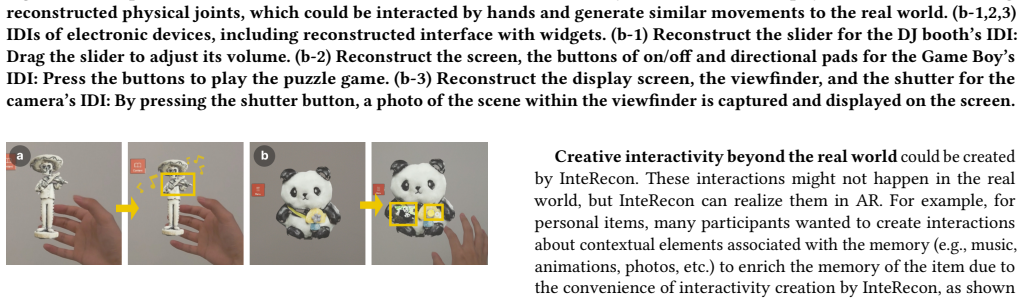
The paper claims that the interactivity of a memorable personal item — the way it moves, the widgets it offers, the content it holds — can be captured and rebuilt by an end-user in an augmented reality environment, and that this rebuilt interactivity makes the digital replica more meaningful for personal memory than a photo or static scan. The authors argue that IDI extends the notion of interactive 3D models by making the authoring process accessible to non-experts: scanning a physical item, segmenting its parts, assigning mechanical joints, attaching widgets, and embedding digital content. In the user study, participants created IDIs of their own items and reported realistic experiences, a stronger emotional connection, and opportunities for "creative interactivity beyond the real world" (e.g., adding a music button to a statue). The paper therefore concludes that InteRecon is feasible for IDI creation and that IDI enriches personal memory archives by recording how an item was used, not just what it looked like.
Load-bearing premise
The load-bearing premise is that the three interactivity attributes — geometry, interfaces, and embedded content — are the essential features of a memorable item's interactivity, a conclusion drawn from one semi-structured interview study with ten participants from a single local campus; if that attribute set is incomplete, the prototype and the study results only apply to a partial notion of interactivity.
Editorial extensions
If this is right
- Personal memory archives can include interactive copies of obsolete electronics, letting users keep operating vintage interfaces and accessing old media instead of losing them.
- Non-experts, not just 3D artists, can author interactive digital objects by scanning, segmenting, and attaching joints and widgets in AR.
- The three design goals of geometry, interface, and embedded content give future reconstruction systems a structured design space.
- IDIs can serve as digital keepsakes that preserve the feel of a toy's movement or a device's controls — not just its appearance.
- The study's examples of interactivity beyond the real world, such as adding a 'Play' button to a statue, show IDIs also enable creative augmentation of memory objects.
Reading between the lines
- If the IDI concept generalizes beyond the study, the three-attribute model (geometry, interface, embedded content) could serve as a design checklist for any future tool that reconstructs personal objects, including non-memory domains like education and museums.
- The audience's discomfort with segmenting cherished virtual objects suggests a design principle the paper does not fully develop: authoring tools may need an 'emotionally safe' editing mode, for example performing cuts in a less realistic 2D view, and this is a testable design choice.
- A natural next experiment would be to measure memory recall quantitatively — for instance, comparing the number of story details triggered by interacting with an IDI versus viewing a static 3D scan or photo — to see whether the reported 'enrichment' is an objective advantage.
Editorial analysis
A structured set of objections, weighed in public.
Referee Report
Summary. The paper introduces the Interactive Digital Item (IDI) concept: a digital reconstruction of a memorable personal item that preserves not only its appearance but also aspects of its physical interactivity. A formative interview study with ten participants identifies three interactivity attributes that become design goals: geometry, interface, and embedded content. The authors then present InteRecon, an AR prototype with four authoring functions corresponding to these goals: reconstructing 3D appearance, adding physical transforms, reconstructing interface widgets, and adding embedded content. A two-session exploratory user study with 16 participants measures task completion times and Likert ratings for the four functions and collects qualitative feedback, and an additional study with 10 professionals explores broader applications. The paper claims that InteRecon is feasible for end-user IDI creation and that IDIs can enrich personal memory archives.
Significance. If the central claims are supported, the paper makes a useful contribution to personal memory archiving and AR authoring: it proposes a concrete concept (IDI) and an end-user-oriented pipeline that goes beyond static 3D scanning by reconstructing interactive behavior. The paper has several strengths: a clearly articulated design space, a working prototype combining mobile scanning and HoloLens AR, objective task-completion time data for atomic interactions, and qualitative findings (e.g., the 'cruel' segmentation effect and creative beyond-real-world interactivity) that are plausible and potentially generative for future work. However, the evidence for the strongest claims is partial: the embedded-content authoring step includes an experimenter-in-the-loop synchronization step, the memory-enrichment conclusion rests on self-report without a baseline comparison, and the design-goal taxonomy is based on a small formative sample that the paper's own evaluation suggests is incomplete. The concept is promising, but the current manuscript overstates the strength of the feasibility and memory-enrichment evidence.
major comments (4)
- [Sec. 4.2.4 and Sec. 5.1, Table 2] The feasibility evaluation does not fully test the end-user authoring pipeline for embedded content. Section 4.2.4 states that user-uploaded content is 'synchronized to the Content category in the AR environment by our researcher,' and Section 5.1 records D1 ('Upload/edit the content with the application') as part of task T3. Since the synchronization step is performed by the research team rather than by the participant, the measured D1/D2 times and the subjective ratings for 'Adding Embedded Content' reflect attaching pre-loaded assets, not the complete authoring workflow. The feasibility claim should be narrowed accordingly, or the prototype should be extended so that end-users can perform the upload and synchronization themselves.
- [Sec. 5.2] The personalization evidence is weakened by the fact that three of the sixteen Session Two participants did not scan their own items: they downloaded similar 3D models 'with the assistance of our researcher.' The session is described as free exploration of reconstructing participants' own items, and several qualitative claims about emotional connection and memory enrichment depend on the item being personally meaningful. The paper should report how many of the Session Two IDIs were created from scanned personal items versus downloaded models, and it should qualify claims about reconstructing 'their own items' accordingly.
- [Sec. 5.4.2, Sec. 5.4.4, and Appendix Table 4] The memory-enrichment claim is based on qualitative self-report without any baseline or control condition. Participants state that IDIs are 'more memorable than photos, vlogs, or static 3D scanning items' (N=13), but no condition involves using a static 3D model or photo for comparison, and the questionnaire item for 'helpfulness' asks whether each function is 'helpful for realizing the IDI concept,' which embeds the concept's value in the measure. The paper should either add a comparative evaluation (e.g., static 3D model versus IDI) or explicitly label the memory-enrichment outcomes as exploratory impressions rather than demonstrated effects.
- [Sec. 3.2 and Sec. 4.1] The three design goals (geometry, interface, embedded content) are presented as the key physical interactivity attributes of memorable items, but this taxonomy is derived from a single semi-structured interview with ten participants from one local campus, and the paper's own evaluation identifies additional dimensions. In Section 5.4.2, participants mention that texture, softness, and opacity are missing from the reconstructed IDI, and Section 6.4 lists thermal properties and other physical effects as future work. This suggests that DG1-DG3 are an initial partial taxonomy rather than a comprehensive set of interactivity attributes. The paper should qualify the scope of the design goals accordingly, or expand the formative study to justify comprehensiveness.
minor comments (5)
- [Sec. 4.2.3] There is a typo: 'Fuction 2' should be 'Function 2'.
- [Sec. 5.4.1] The phrase 'within a reasonable time phrase' should be 'within a reasonable time frame'.
- [Sec. 5.1, Table 2] The notation '(D1-D2)^n' in task T3 is not explained until the following paragraph; it would be clearer to state in the table caption that n denotes the number of content items to be attached.
- [Sec. 5.3] The term 'appending study' is used repeatedly; 'additional study' or 'follow-up study' would be more standard.
- [Appendix Table 4] The metric label 'Easiness to use' should be 'Ease of use' to match the wording used in Section 5.4.1.
Circularity Check
No significant circularity: feasibility rests on measured task times; the only self-citation is a non-load-bearing implementation component.
full rationale
The paper's claimed derivation chain is a design process, not a mathematical or predictive derivation: a formative study identifies interactivity attributes, these inform design goals, a prototype is built, and an exploratory study evaluates feasibility. No step reduces by construction to its own inputs. The central feasibility claim is grounded in objective completion times for atomic interactions (Section 5.4.1, Figure 5), which are independent of the design goals and of the IDI concept. The memory-enrichment conclusion is supported by qualitative interview feedback; although self-report after introducing the IDI concept may be susceptible to demand characteristics, that is an internal-validity limitation, not circularity, because the interview responses are not used as inputs to the system's construction. The questionnaire item 'helpfulness for realizing the IDI concept' (Appendix Table 4) is conceptually close to the design goals, but it is only one of five metrics, and the overall pattern (ease of use, learnability, expressiveness, non-frustration) has independent content; the paper does not rest its central claim on that item alone. The only notable self-citation is Style2Fab [19], co-authored by two of the present authors, used for automatic mesh segmentation. That is an external published algorithm with a described spectral method, used as one of two segmentation options; no uniqueness theorem or prior-result dependency is imported, and the feasibility claim would stand without it. The expert-in-the-loop synchronization of embedded content (Section 4.2.4) and the researcher-assisted download of 3D models in Session Two (Section 5.2) narrow the scope of the full authoring-pipeline claim, but these are generalizability or implementation gaps rather than circular reductions. No circular step meeting the evidentiary standard was found.
Assumptions & free parameters
assumptions (3)
- domain assumption Preserving physical interactivity of memorable items is important for memory recall and personal memory archives.
- ad hoc to paper The three interactivity attributes (geometry, interfaces, embedded content) identified from the 10-participant formative study are comprehensive enough to serve as the design goals for IDI.
- domain assumption The predefined joint types and widget categories provided by InteRecon are sufficient to approximate the interactivity of a broad range of personal items.
invented entities (1)
-
Interactive Digital Item (IDI)
Cite this review
Pith. "Pith review of InteRecon: Towards Reconstructing Interactivity of Personal Memorable Items in Mixed Reality." pith.science (2026). https://pith.science/paper/GPILXH5Y
@misc{pith2026250209973,
  author       = {Pith},
  title        = {Pith review of: InteRecon: Towards Reconstructing Interactivity of Personal Memorable Items in Mixed Reality},
  year         = {2026},
  howpublished = {\url{https://pith.science/paper/GPILXH5Y}},
  note         = {Machine review of arXiv:2502.09973}
}
read the original abstract
Digital capturing of memorable personal items is a key way to archive personal memories. Although current digitization methods (e.g., photos, videos, 3D scanning) can replicate the physical appearance of an item, they often cannot preserve its real-world interactivity. We present Interactive Digital Item (IDI), a concept of reconstructing both the physical appearance and, more importantly, the interactivity of an item. We first conducted a formative study to understand users' expectations of IDI, identifying key physical interactivity features, including geometry, interfaces, and embedded content of items. Informed by these findings, we developed InteRecon, an AR prototype enabling personal reconstruction functions for IDI creation. An exploratory study was conducted to assess the feasibility of using InteRecon and explore the potential of IDI to enrich personal memory archives. Results show that InteRecon is feasible for IDI creation, and the concept of IDI brings new opportunities for augmenting personal memory archives.
Figures


Figures from the paper (5 more)


Forward citations
Cited by 1 Pith paper
-
ExplorAR: Assisting Older Adults to Learn Smartphone Apps through AR-powered Trial-and-Error with Interactive Guidance
An AR system that supports trial-and-error learning helped older adults complete smartphone tasks faster and with fewer mistakes than video or AR step-by-step tutorials.
Reference graph
Works this paper leans on
-
[1]
Matthew Addis, Walter Allasia, Werner Bailer, Laurent Boch, Francesco Gallo, and Richard Wright. 2010. 100 million hours of audiovisual content: digital preservation and access in the PrestoPRIME project. In Proceedings of the 1st International Digital Preservation Interoperability Framework Symposium . 1–8
2010
-
[2]
Tenglong Ao, Zeyi Zhang, and Libin Liu. 2023. Gesturediffuclip: Gesture diffu- sion model with clip latents. ACM Transactions on Graphics (TOG) 42, 4 (2023), 1–18
2023
-
[3]
Richard Banks and Abigail Sellen. 2009. Shoebox: mixing storage and display of digital images in the home. In Proceedings of the 3rd International Conference on Tangible and Embedded Interaction (Cambridge, United Kingdom) (TEI ’09). Association for Computing Machinery, New York, NY, USA, 35–40. https: //doi.org/10.1145/1517664.1517678
arXiv 2009
-
[4]
Michael Beigl, Hans-W Gellersen, and Albrecht Schmidt. 2001. Mediacups: experience with design and use of computer-augmented everyday artefacts. Computer Networks 35, 4 (2001), 401–409
2001
-
[5]
Alexander Blake. 1985. Design of mechanical joints . Vol. 42. CRC press
1985
-
[6]
Simon Bowen and Daniela Petrelli. 2011. Remembering today tomorrow: Ex- ploring the human-centred design of digital mementos. International Journal of Human-Computer Studies 69, 5 (2011), 324–337
2011
-
[7]
Margaret M Bradley. 2014. Emotional memory: A dimensional analysis. In Emotions. Psychology Press, 97–134
2014
-
[8]
Virginia Braun and Victoria Clarke. 2006. Using thematic analysis in psychology. Qualitative research in psychology 3, 2 (2006), 77–101
2006
Show all 109 references
-
[9]
Mendel Broekhuijsen, Elise van den Hoven, and Panos Markopoulos. 2017. Design Directions for Media-Supported Collocated Remembering Practices. In Proceedings of the Eleventh International Conference on Tangible, Embedded, and Embodied Interaction (Yokohama, Japan) (TEI ’17). A...
2017
-
[10]
Runze Cai, Nuwan Janaka, Yang Chen, Lucia Wang, Shengdong Zhao, and Can Liu. 2024. PANDALens: Towards AI-Assisted In-Context Writing on OHMD During Travels. In Proceedings of the CHI Conference on Human Fac- tors in Computing Systems (Honolulu, HI, USA) (CHI ’24) . Association...
2024
-
[11]
Amy Yo Sue Chen, William Odom, Ce Zhong, Henry Lin, and Tal Amram
-
[12]
Hsiao-yu Chen, Edith Tretschk, Tuur Stuyck, Petr Kadlecek, Ladislav Kavan, Etienne Vouga, and Christoph Lassner. 2022. Virtual Elastic Objects. In 2022 IEEE/CVF Conference on Computer Vision and Pattern Recognition (CVPR) . 15806– 15816. https://doi.org/10.1109/CVPR52688.2022.01537
2022
-
[13]
Andy Crabtree, Tom Rodden, and John Mariani. 2004. Collaborating around collections: informing the continued development of photoware. In Proceedings of the 2004 ACM Conference on Computer Supported Cooperative Work (Chicago, Illinois, USA) (CSCW ’04). Association for Computin...
2004
-
[14]
Masashi Crete-Nishihata, Ronald M Baecker, Michael Massimi, Deborah Ptak, Rachelle Campigotto, Liam D Kaufman, Adam M Brickman, Gary R Turner, Joshua R Steinerman, and Sandra E Black. 2012. Reconstructing the past: per- sonal memory technologies are not just personal and not j...
2012
-
[15]
Amber L Cushing. 2011. Self extension and the desire to preserve digital posses- sions. Proceedings of the American Society for Information Science and Technology 48, 1 (2011), 1–3
2011
-
[16]
Chelsea Dobbins, Madjid Merabti, Paul Fergus, and David Llewellyn-Jones. 2014. Creating human digital memories with the aid of pervasive mobile devices. Pervasive and Mobile Computing 12 (2014), 160–178
2014
-
[18]
Luciana Duranti and Elizabeth Shaffer. 2012. The memory of the world in the digital age: digitization and preservation. In An International Conference on Per- manent Access to Digital Documentary Heritage, UNESCO Conference Proceedings. Vancouver
2012
-
[19]
Faraz Faruqi, Ahmed Katary, Tarik Hasic, Amira Abdel-Rahman, Nayeemur Rahman, Leandra Tejedor, Mackenzie Leake, Megan Hofmann, and Stefanie Mueller. 2023. Style2Fab: Functionality-Aware Segmentation for Fabricating Personalized 3D Models with Generative AI. In Proceedings of t...
2023
-
[20]
Melanie Feinberg. 2013. Beyond Digital and Physical Objects: The Intellectual Work as a Concept of Interest for HCI. In Proceedings of the SIGCHI Conference on Human Factors in Computing Systems (Paris, France) (CHI ’13). Association for Computing Machinery, New York, NY, USA,...
2013
-
[21]
Andreas Rene Fender and Christian Holz. 2022. Causality-preserving Asyn- chronous Reality. In Proceedings of the 2022 CHI Conference on Human Factors in Computing Systems (<conf-loc>, <city>New Orleans</city>, <state>LA</state>, <country>USA</country>, </conf-loc>) (CHI ’22). ...
2022
-
[22]
J Garde-Hansen. 2011. Digital Memories: The Democratisation of Archives. Media and Memory (2011), 70–88
2011
-
[23]
James J Gibson. 1977. The theory of affordances. Hilldale, USA 1, 2 (1977), 67–82
1977
-
[24]
Connie Golsteijn, Elise van den Hoven, David Frohlich, and Abigail Sellen
-
[25]
Tilmann Habermas and Christine Paha. 2002. Souvenirs and other personal objects: Reminding of past events and significant others in the transition to university. Critical advances in reminiscence work (2002), 123–138
2002
-
[26]
Jonna Häkkilä, Petri Hannula, Elina Luiro, Emilia Launne, Sanni Mustonen, Toni Westerlund, and Ashley Colley. 2019. Visiting a virtual graveyard: designing virtual reality cultural heritage experiences. In Proceedings of the 18th Interna- tional Conference on Mobile and Ubiqui...
2019
-
[27]
Mohammed Hassanin, Salman Khan, and Murat Tahtali. 2021. Visual Affordance and Function Understanding: A Survey. ACM Comput. Surv. 54, 3, Article 47 (apr 2021), 35 pages. https://doi.org/10.1145/3446370
2021 doi
-
[28]
Daniel Hawkins, Carman Neustaedter, and Jason Procyk. 2015. Postulater: the design and evaluation of a time-delayed media sharing system. In Proceedings of the 41st Graphics Interface Conference . 249–256
2015
-
[29]
Fengming He, Xiyun Hu, Jingyu Shi, Xun Qian, Tianyi Wang, and Karthik Ramani. 2023. Ubi Edge: Authoring Edge-Based Opportunistic Tangible User Interfaces in Augmented Reality. In Proceedings of the 2023 CHI Conference on Human Factors in Computing Systems (Hamburg, Germany) (C...
2023
-
[30]
Otmar Hilliges and David Stanley Kirk. 2009. Getting sidetracked: display design and occasioning photo-talk with the photohelix. In Proceedings of the SIGCHI Conference on Human Factors in Computing Systems . 1733–1736
2009
-
[31]
Andrew Hoskins. 2017. The restless past: An introduction to digital memory and media. In Digital memory studies. Routledge, 1–24
2017
-
[32]
Erzhen Hu, Jens Emil Sloth Grønbæk, Wen Ying, Ruofei Du, and Seongkook Heo. 2023. ThingShare: Ad-Hoc Digital Copies of Physical Objects for Sharing Things in Video Meetings. In Proceedings of the 2023 CHI Conference on Human Factors in Computing Systems (Hamburg, Germany) (CHI...
2023
-
[33]
Erzhen Hu, Mingyi Li, Xun Qian, Alex Olwal, David Kim, Seongkook Heo, and Ruofei Du. 2024. Experiencing Thing2Reality: Transforming 2D Content into Conditioned Multiviews and 3D Gaussian Objects for XR Communication. In Adjunct Proceedings of the 37th Annual ACM Symposium on U...
2024
-
[34]
Jiawei Huang and Alexander Klippel. 2020. The Effects of Visual Realism on Spatial Memory and Exploration Patterns in Virtual Reality. In Proceedings of the 26th ACM Symposium on Virtual Reality Software and Technology (Virtual Event, Canada) (VRST ’20). Association for Comput...
2020
-
[35]
Tianyu Huang, Haoze Zhang, Yihan Zeng, Zhilu Zhang, Hui Li, Wangmeng Zuo, and Rynson W. H. Lau. 2024. DreamPhysics: Learning Physical Properties of Dynamic 3D Gaussians with Video Diffusion Priors. arXiv:2406.01476 [cs.CV] https://arxiv.org/abs/2406.01476
2024 arXiv
-
[36]
Xincheng Huang, Michael Yin, Ziyi Xia, and Robert Xiao. 2024. VirtualNexus: Enhancing 360-Degree Video AR/VR Collaboration with Environment Cutouts and Virtual Replicas. In Proceedings of the 37th Annual ACM Symposium on User Interface Software and Technology (Pittsburgh, PA, ...
2024
-
[37]
Heather Iriye and Peggy L St. Jacques. 2021. Memories for third-person experi- ences in immersive virtual reality. Scientific reports 11, 1 (2021), 4667
2021
-
[38]
Martijn Jansen, Elise van den Hoven, and David Frohlich. 2014. Pearl: living me- dia enabled by interactive photo projection. Personal and Ubiquitous Computing 18 (2014), 1259–1275
2014
-
[39]
Ying Jiang, Chang Yu, Tianyi Xie, Xuan Li, Yutao Feng, Huamin Wang, Minchen Li, Henry Lau, Feng Gao, Yin Yang, and Chenfanfu Jiang. 2024. VR-GS: A Physical Dynamics-Aware Interactive Gaussian Splatting System in Virtual Reality. In ACM SIGGRAPH 2024 Conference Papers (Denver, ...
2024
-
[40]
Jasmine Jones and Mark S Ackerman. 2018. Co-constructing family memory: Understanding the intergenerational practices of passing on family stories. In Proceedings of the 2018 chi conference on human factors in computing systems . 1–13
2018
-
[41]
Ackerman
Jasmine Jones and Mark S. Ackerman. 2018. Co-Constructing Family Memory: Understanding the Intergenerational Practices of Passing on Family Stories. In Proceedings of the 2018 CHI Conference on Human Factors in Computing Systems (Montreal QC, Canada) (CHI ’18). Association for...
2018
-
[42]
Vaiva Kalnikait˙e and Steve Whittaker. 2011. A saunter down memory lane: Digital reflection on personal mementos. International Journal of Human- Computer Studies 69, 5 (2011), 298–310. https://doi.org/10.1016/j.ijhcs.2010.12. 004 Designing for Reflection on Personal Experience
2011 doi
-
[43]
Yixiao Kang, Zhenglin Zhang, Meiqi Zhao, Xuanhui Yang, and Xubo Yang. 2022. Tie Memories to E-souvenirs: Hybrid Tangible AR Souvenirs in the Museum. In Adjunct Proceedings of the 35th Annual ACM Symposium on User Interface Software and Technology (Bend, OR, USA) (UIST ’22 Adju...
2022
-
[44]
Tatsuyuki Kawamura, Tomohiro Fukuhara, Hideaki Takeda, Yasuyuki Kono, and Masatsugu Kidode. 2007. Ubiquitous memories: a memory externalization system using physical objects. Personal and Ubiquitous Computing 11 (2007), 287–298
2007
-
[45]
Myung Jin Kim and Andrea Bianchi. 2022. SpinOcchietto: A Wearable Skin-Slip Haptic Device for Rendering Width and Motion of Objects Gripped Between the Fingertips. In Adjunct Proceedings of the 35th Annual ACM Symposium on User Interface Software and Technology . 1–3
2022
-
[46]
Kirk and Abigail Sellen
David S. Kirk and Abigail Sellen. 2010. On Human Remains: Values and Practice in the Home Archiving of Cherished Objects.ACM Trans. Comput.-Hum. Interact. 17, 3, Article 10 (jul 2010), 43 pages. https://doi.org/10.1145/1806923.1806924
2010
-
[47]
David S Kirk and Abigail Sellen. 2010. On human remains: Values and practice in the home archiving of cherished objects.ACM Transactions on Computer-Human Interaction (TOCHI) 17, 3 (2010), 1–43
2010
-
[48]
Rebecca Kleinberger, Alexandra Rieger, Janelle Sands, and Janet Baker. 2019. Supporting Elder Connectedness through Cognitively Sustainable Design Inter- actions with the Memory Music Box. In Proceedings of the 32nd Annual ACM Symposium on User Interface Software and Technolog...
2019
-
[49]
Eric Krokos, Catherine Plaisant, and Amitabh Varshney. 2019. Virtual memory palaces: immersion aids recall. Virtual reality 23, 1 (2019), 1–15
2019
-
[50]
Marc Erich Latoschik, Daniel Roth, Dominik Gall, Jascha Achenbach, Thomas Waltemate, and Mario Botsch. 2017. The effect of avatar realism in immersive social virtual realities. In Proceedings of the 23rd ACM Symposium on Virtual Reality Software and Technology (Gothenburg, Swe...
2017
-
[51]
Stephen Lekan. 2016. Virtual Environments, Rendered Realism and Their Effects on Spatial Memory. Ph. D. Dissertation
2016
-
[52]
Steve Lesser, Alexey Stomakhin, Gilles Daviet, Joel Wretborn, John Edholm, Noh-Hoon Lee, Eston Schweickart, Xiao Zhai, Sean Flynn, and Andrew Moffat
-
[53]
Cun Li, Jun Hu, Bart Hengeveld, and Caroline Hummels. 2020. Facilitating storytelling and preservation of mementos for the elderly through tangible interface. In Human Systems Engineering and Design II: Proceedings of the 2nd International Conference on Human Systems Engineeri...
2020
-
[54]
Xuan Li, Yi-Ling Qiao, Peter Yichen Chen, Krishna Murthy Jatavallabhula, Ming Lin, Chenfanfu Jiang, and Chuang Gan. 2023. PAC-NeRF: Physics Augmented Continuum Neural Radiance Fields for Geometry-Agnostic System Identification. arXiv:2303.05512 [cs.CV] https://arxiv.org/abs/2303.05512
2023 arXiv
-
[55]
Zisu Li, Li Feng, Chen Liang, Yuru Huang, and Mingming Fan. 2023. Exploring the Opportunities of AR for Enriching Storytelling with Family Photos between Grandparents and Grandchildren. Proc. ACM Interact. Mob. Wearable Ubiquitous Technol. 7, 3, Article 108 (sep 2023), 26 page...
2023 doi
-
[56]
Jian Liao, Adnan Karim, Shivesh Singh Jadon, Rubaiat Habib Kazi, and Ryo Suzuki. 2022. RealityTalk: Real-time speech-driven augmented presentation for AR live storytelling. In Proceedings of the 35th Annual ACM Symposium on User Interface Software and Technology. 1–12
2022
-
[57]
Smith, Andrés Monroy-Hernández, and Rajan Vaish
Yimeng Liu, Jacob Ritchie, Sven Kratz, Misha Sra, Brian A. Smith, Andrés Monroy-Hernández, and Rajan Vaish. 2023. Memento Player: Shared Multi- Perspective Playback of Volumetrically-Captured Moments in Augmented Reality. In Extended Abstracts of the 2023 CHI Conference on Hum...
2023
-
[58]
Yixin Liu, Kai Zhang, Yuan Li, Zhiling Yan, Chujie Gao, Ruoxi Chen, Zhengqing Yuan, Yue Huang, Hanchi Sun, Jianfeng Gao, et al . 2024. Sora: A Review on Background, Technology, Limitations, and Opportunities of Large Vision Models. arXiv preprint arXiv:2402.17177 (2024)
2024 arXiv
-
[59]
Hao Lü and Yang Li. 2013. Gesture studio: authoring multi-touch interactions through demonstration and declaration. In Proceedings of the SIGCHI Conference on Human Factors in Computing Systems . 257–266
2013
-
[60]
Hanuma Teja Maddali and Amanda Lazar. 2023. Understanding context to capture when reconstructing meaningful spaces for remote instruction and connecting in XR. In Proceedings of the 2023 CHI conference on Human Factors in Computing Systems. 1–18
2023
-
[61]
Sabine Marschall. 2019. ‘Memory objects’: Material objects and memories of home in the context of intra-African mobility. Journal of Material Culture 24, 3 (2019), 253–269
2019
-
[62]
Rudolf Mayer and Andreas Rauber. 2009. Establishing context of digital objects’ creation, content and usage. In Proc. Int. Workshop on Innovation in Digital Preservation
2009
-
[63]
Ryan P McMahan, Chengyuan Lai, and Swaroop K Pal. 2016. Interaction fidelity: the uncanny valley of virtual reality interactions. In Virtual, Augmented and Mixed Reality: 8th International Conference, V AMR 2016, Held as Part of HCI International 2016, Toronto, Canada, July 17...
2016
-
[64]
Vasileios Mezaris, Claudia Niederée, and Robert H Logie. 2018. Personal Multi- media Preservation: Remembering or forgetting images and video . Springer
2018
-
[65]
Ian Millington. 2010. Game physics engine development: how to build a robust commercial-grade physics engine for your game . CRC Press
2010
-
[66]
Stephanie Neumann, Richard Banks, and Marian Dörk. 2017. Memory Dialogue: Exploring Artefact-Based Memory Sharing. In Proceedings of the 2017 CHI Con- ference Extended Abstracts on Human Factors in Computing Systems (Denver, Colorado, USA) (CHI EA ’17). Association for Computi...
2017
-
[67]
Robert Neumayer, Thomas Lidy, and Andreas Rauber. 2005. Content-based organization of digital audio collections . na
2005
-
[69]
Michael Nunes, Saul Greenberg, and Carman Neustaedter. 2009. Using physical memorabilia as opportunities to move into collocated digital photo-sharing. International Journal of Human-Computer Studies 67, 12 (2009), 1087–1111
2009
-
[70]
William Odom, Mark Selby, Abigail Sellen, David Kirk, Richard Banks, and Tim Regan. 2012. Photobox: on the design of a slow technology. In Proceedings of the Designing Interactive Systems Conference (Newcastle Upon Tyne, United Kingdom) (DIS ’12). Association for Computing Mac...
2012
-
[71]
Tejaswi Peesapati, Victoria Schwanda, Johnathon Schultz, Matt Lepage, So- yae Jeong, and Dan Cosley
S. Tejaswi Peesapati, Victoria Schwanda, Johnathon Schultz, Matt Lepage, So- yae Jeong, and Dan Cosley. 2010. Pensieve: supporting everyday reminiscence. In Proceedings of the SIGCHI Conference on Human Factors in Computing Systems (Atlanta, Georgia, USA) (CHI ’10). Associatio...
2010
-
[72]
Daniela Petrelli, Simon Bowen, and Steve Whittaker. 2014. Photo mementos: Designing digital media to represent ourselves at home. International Journal of Human-Computer Studies 72, 3 (2014), 320–336
2014
-
[73]
Daniela Petrelli, Elise van den Hoven, and Steve Whittaker. 2009. Making History: Intentional Capture of Future Memories. In Proceedings of the SIGCHI Conference on Human Factors in Computing Systems (Boston, MA, USA) (CHI ’09). Association for Computing Machinery, New York, N...
2009
-
[74]
Daniela Petrelli and Steve Whittaker. 2010. Family memories in the home: contrasting physical and digital mementos. Personal and Ubiquitous Computing 14 (2010), 153–169
2010
-
[75]
Daniela Petrelli, Steve Whittaker, and Jens Brockmeier. 2008. AutoTopography: what can physical mementos tell us about digital memories?. In Proceedings of the SIGCHI conference on Human Factors in computing systems . 53–62
2008
-
[76]
Dustin Podell, Zion English, Kyle Lacey, Andreas Blattmann, Tim Dockhorn, Jonas Müller, Joe Penna, and Robin Rombach. 2023. Sdxl: Improving latent diffu- sion models for high-resolution image synthesis.arXiv preprint arXiv:2307.01952 (2023)
2023 arXiv
-
[77]
Howard R Pollio and Russell Foote. 1971. Memory as a reconstructive process. British Journal of Psychology 62, 1 (1971), 53–58
1971
-
[78]
John Potter. 2010. Embodied Memory and Curatorship in Children’s Digital Video Production. English Teaching: Practice and Critique 9, 1 (2010), 22–35
2010
-
[79]
Jiawei Ren, Liang Pan, Jiaxiang Tang, Chi Zhang, Ang Cao, Gang Zeng, and Ziwei Liu. 2024. DreamGaussian4D: Generative 4D Gaussian Splatting. arXiv:2312.17142 [cs.CV] https://arxiv.org/abs/2312.17142
2024 arXiv
-
[80]
2009.On organizing for digital preservation
Mari Runardotter. 2009.On organizing for digital preservation. Ph. D. Dissertation. Luleå tekniska universitet
2009
-
[81]
Corina Sas, Scott Challioner, Christopher Clarke, Ross Wilson, Alina Coman, Sarah Clinch, Mike Harding, and Nigel Davies. 2015. Self-Defining Memory Cues: Creative Expression and Emotional Meaning. In Proceedings of the 33rd Annual ACM Conference Extended Abstracts on Human Fa...
2015
-
[82]
Peter Scarfe and Andrew Glennerster. 2015. Using high-fidelity virtual reality to study perception in freely moving observers. Journal of vision 15, 9 (2015), 3–3
2015
-
[83]
Mike Seymour, Lingyao Ivy Yuan, Alan Dennis, Kai Riemer, et al. 2021. Have we crossed the uncanny valley? Understanding affinity, trustworthiness, and preference for realistic digital humans in immersive environments. Journal of the Association for Information Systems 22, 3 (2021), 9
2021
-
[84]
Mary M Somerville and Dana EchoHawk. 2011. Recuerdos hablados/memories spoken: Toward the co-creation of digital knowledge with community signifi- cance. Library Trends 59, 4 (2011), 650–662
2011
-
[85]
Yang Song, Prafulla Dhariwal, Mark Chen, and Ilya Sutskever. 2023. Consistency models. arXiv preprint arXiv:2303.01469 (2023)
2023 arXiv
-
[86]
Evgeny Stemasov, Tobias Wagner, Jan Gugenheimer, and Enrico Rukzio. 2020. Mix&Match: Towards omitting modelling through in-situ remixing of model repository artifacts in mixed reality. In Proceedings of the 2020 CHI Conference on Human Factors in Computing Systems . 1–12
2020
-
[87]
Beng-Kiang Tan and Hafizur Rahaman. 2009. Virtual heritage: Reality and criticism. In CAAD futures. Les Presses de l’Université de Montréal, 143–156
2009
-
[88]
Tan, Han Sha, Eda Celen, Phucanh Tran, Kelly Wang, Gifford Cheung, Philip Hinch, and Jeff Huang
Neille-Ann H. Tan, Han Sha, Eda Celen, Phucanh Tran, Kelly Wang, Gifford Cheung, Philip Hinch, and Jeff Huang. 2018. Rewind: Automatically Recon- structing Everyday Memories with First-Person Perspectives. Proc. ACM In- teract. Mob. Wearable Ubiquitous Technol. 2, 4, Article 1...
2018 doi
-
[89]
Markus Tatzgern, Michael Domhardt, Martin Wolf, Michael Cenger, Gerlinde Emsenhuber, Radomir Dinic, Nathalie Gerner, and Arnulf Hartl. 2022. Airres mask: A precise and robust virtual reality breathing interface utilizing breathing resistance as output modality. In Proceedings ...
2022
-
[90]
Wenn-Chieh Tsai, Po-Hao Wang, Hung-Chi Lee, Rung-Huei Liang, and Jane Hsu. 2014. The reflexive printer: toward making sense of perceived drawbacks in technology-mediated reminiscence. In Proceedings of the 2014 Conference on Designing Interactive Systems (Vancouver, BC, Canada...
2014
-
[91]
Stefano Valtolina, Stefano Franzoni, Pietro Mazzoleni, and Elisa Bertino. 2005. Dissemination of cultural heritage content through virtual reality and mul- timedia techniques: A case study. In 11th international multimedia modelling conference. IEEE, 214–221
2005
-
[92]
Maarten Van Someren, Yvonne F Barnard, and J Sandberg. 1994. The think aloud method: a practical approach to modelling cognitive. London: AcademicPress 11 (1994), 29–41
1994
-
[93]
Giuseppe Vecchio, Rosalie Martin, Arthur Roullier, Adrien Kaiser, Romain Rouf- fet, Valentin Deschaintre, and Tamy Boubekeur. 2024. ControlMat: A Controlled Generative Approach to Material Capture. ACM Trans. Graph. 43, 5, Article 164 (Sept. 2024), 17 pages. https://doi.org/10...
2024 doi
-
[94]
Giuseppe Vecchio, Renato Sortino, Simone Palazzo, and Concetto Spampinato
-
[95]
Cong Wang, Jiaxi Gu, Panwen Hu, Songcen Xu, Hang Xu, and Xiaodan Liang
-
[96]
Tianyi Wang, Xun Qian, Fengming He, Xiyun Hu, Yuanzhi Cao, and Karthik Ramani. 2021. GesturAR: An Authoring System for Creating Freehand In- teractive Augmented Reality Applications. In The 34th Annual ACM Sympo- sium on User Interface Software and Technology (Virtual Event, U...
2021
-
[97]
David West, Aaron Quigley, and Judy Kay. 2007. MEMENTO: a digital-physical scrapbook for memory sharing. Personal and Ubiquitous Computing 11 (2007), 313–328
2007
-
[98]
Matt Whitlock, Jake Mitchell, Nick Pfeufer, Brad Arnot, Ryan Craig, Bryce Wil- son, Brian Chung, and Danielle Albers Szafir. 2020. MRCAT: In situ prototyping of interactive AR environments. InInternational Conference on Human-Computer Interaction. Springer, 235–255
2020
-
[99]
John Williamson and Lorna M Brown. 2008. Flutter: directed random browsing of photo collections with a tangible interface. In Proceedings of the 7th ACM Conference on Designing Interactive Systems (Cape Town, South Africa) (DIS ’08). Association for Computing Machinery, New Yo...
2008
-
[100]
Tianyi Xie, Zeshun Zong, Yuxing Qiu, Xuan Li, Yutao Feng, Yin Yang, and Chenfanfu Jiang. 2024. PhysGaussian: Physics-Integrated 3D Gaussians for Generative Dynamics. arXiv:2311.12198 [cs.GR] https://arxiv.org/abs/2311. 12198
2024 arXiv
-
[101]
Cheng Yang, Dongmei Peng, and Shouqian Sun. 2006. Creating a virtual activity for the intangible culture heritage. In 16th International Conference on Artificial Reality and Telexistence–Workshops (ICAT’06). IEEE, 636–641
2006
-
[102]
Feng, Changxi Zheng, Noah Snavely, Jiajun Wu, and William T
Tianyuan Zhang, Hong-Xing Yu, Rundi Wu, Brandon Y. Feng, Changxi Zheng, Noah Snavely, Jiajun Wu, and William T. Freeman. 2024. PhysDreamer: Physics- Based Interaction with 3D Objects via Video Generation. arxiv (2024)
2024
-
[103]
Xueyao Zhang, Liumeng Xue, Yuancheng Wang, Yicheng Gu, Xi Chen, Zihao Fang, Haopeng Chen, Lexiao Zou, Chaoren Wang, Jun Han, et al. 2023. Amphion: An Open-Source Audio, Music and Speech Generation Toolkit. arXiv preprint arXiv:2312.09911 (2023)
2023 arXiv
-
[104]
Haoyu Zhao, Hao Wang, Xingyue Zhao, Hongqiu Wang, Zhiyu Wu, Chengjiang Long, and Hua Zou. 2024. Automated 3D Physical Simulation of Open-world Scene with Gaussian Splatting. arXiv:2411.12789 [cs.CV] https://arxiv.org/abs/ 2411.12789
2024 arXiv
-
[105]
Ce Zhong, Ron Wakkary, William Odom, Amy Yo Sue Chen, MinYoung Yoo, and Doenja Oogjes. 2022. On the Design of deformTable: Attending to Temporality and Materiality for Supporting Everyday Interactions with a Shape-Changing Artifact. In Proceedings of the 2022 ACM Designing Int...
2022
-
[106]
Xilong Zhou, Miloš Hašan, Valentin Deschaintre, Paul Guerrero, Kalyan Sunkavalli, and Nima Kalantari. 2022. TileGen: Tileable, Controllable Material Generation and Capture. arXiv:2206.05649 [cs.GR] https://arxiv.org/abs/2206. 05649
2022 arXiv
-
[107]
Deyao Zhu, Jun Chen, Xiaoqian Shen, Xiang Li, and Mohamed Elhoseiny. 2023. Minigpt-4: Enhancing vision-language understanding with advanced large lan- guage models. arXiv preprint arXiv:2304.10592 (2023). Interactive Digital Item CHI ’25, April 26-May 1, 2025, Yokohama, Japan ...
2023 arXiv
-
[2019]
In Proceedings of the 2019 on Designing Interactive Systems Conference (San Diego, CA, USA) (DIS ’19)
Chronoscope: Designing Temporally Diverse Interactions with Personal Digital Photo Collections. In Proceedings of the 2019 on Designing Interactive Systems Conference (San Diego, CA, USA) (DIS ’19). Association for Computing Machinery, New York, NY, USA, 799–812. https://doi.o...
2019 doi
-
[2022]
ACM Transactions on Graphics (TOG) 41, 4 (2022), 1–20
Loki: a unified multiphysics simulation framework for production. ACM Transactions on Graphics (TOG) 41, 4 (2022), 1–20
2022
-
[2023]
arXiv preprint arXiv:2312.03018 (2023)
DreamVideo: High-Fidelity Image-to-Video Generation with Image Re- tention and Text Guidance. arXiv preprint arXiv:2312.03018 (2023)
2023 arXiv
-
[2024]
In 2024 IEEE/CVF Conference on Computer Vision and Pattern Recognition (CVPR)
MatFuse: Controllable Material Generation with Diffusion Models. In 2024 IEEE/CVF Conference on Computer Vision and Pattern Recognition (CVPR) . IEEE, 4429–4438. https://doi.org/10.1109/cvpr52733.2024.00424
2024
Reviewed August 7, 2026 · model on record in the stance chip above.
Discussion (0). Sign in to comment.