REVIEW 3 major objections 6 minor 45 references
DiSciPLE: Learning Interpretable Programs for Scientific Visual Discovery
T0 review · 3 major / 6 minor · reviewed 2026-08-07 · deepseek-v4-flash
Pith's one-line read DiSciPLE claims that an LLM-guided evolutionary search can discover Python programs that predict scientific quantities from satellite imagery with lower error than deep neural networks, and that the programs are interpretable and…
desk verdict Promising method for interpretable scientific program discovery, but the headline accuracy claim rests on an input-parity assumption the paper does not document. read the letter →
The pith
A machine-rendered reading of the paper's core claim, the machinery that carries it, and where it could break.
The reading
What carries the argument
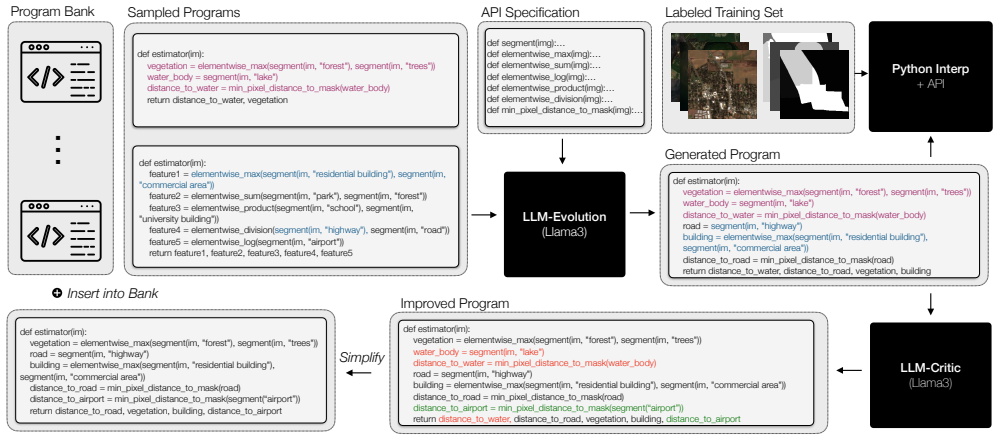
The central object is a Python program that interleaves calls to an open-vocabulary satellite-image segmenter (GRAFT) with arithmetic, logical, and distance-transform operations, and returns a list of features that a linear regressor maps to the target quantity. The search machinery is the evolutionary loop: an LLM (Llama-3-8B) writes the initial population, performs crossover and mutation given the parents' program texts and fitness scores, and the two proposed components — the critic and the simplifier — add fine-grained guidance. The critic partitions the data by land-use type and reports per-partition errors so the LLM can fix weak strata; the simplifier treats the program as an abstract syntax tree and repeatedly removes leaf nodes unreachable from the return statement, then cancels features whose regression weight is below 5% of the largest weight. Feature-set prediction is a third load-bearing design choice: the program outputs several features rather than a single number, so the linear layer, which is fitted conventionally, carries part of the model's expressiveness.
What would settle it
Take the published tasks and give the deep baselines the exact same auxiliary inputs that DiSciPLE programs receive — OpenStreetMaps land-use masks for population density, and the temperature, precipitation, nightlight, and elevation features for poverty and biomass — then compare errors. If the gap shrinks to near zero, the central claim that evolutionary program search beats black-box models on these tasks is refuted.
Extended reading notes
Core claim
The paper's claim is that LLM-guided evolutionary search can discover accurate, human-readable programs for scientific vision tasks that have no documented prior solution. DiSciPLE starts from zero-shot LLM programs, then over 15 generations applies LLM-based crossover and mutation, a critic that evaluates each program per land-use stratum and tells the LLM where it fails, and a simplifier that prunes dead code and low-weight features. The final program is a linear model over interpretable features computed by the program, such as distance to water, presence of residential or commercial buildings, and vegetation. On population density estimation, the best discovered program has 35% lower error than the closest non-interpretable baseline, and on out-of-distribution regions it outperforms all baselines, which the authors take as evidence that interpretable-by-design programs generalize better and overfit less.
Load-bearing premise
The reported accuracy comparisons assume the deep baselines saw the same auxiliary inputs (land-use masks for population density; temperature, precipitation, nightlight, and elevation for poverty and biomass) as the DiSciPLE programs, so the gap reflects the discovery method rather than an input advantage.
Editorial extensions
If this is right
- Population density can be estimated from satellite imagery with lower error using a readable program than using a large ResNet, both on held-out and out-of-distribution regions.
- A program for aboveground biomass learned from the northeastern United States predicts better in Washington state than every baseline tested, suggesting the discovered formulas capture mechanisms that transfer geographically.
- The method stays accurate when training data shrinks: with only a few hundred observations, DiSciPLE's error degrades much less than deep models, so it can be used where labels are scarce.
- Domain experts can read the discovered program, see which semantic concepts matter (for example, highway and residential building for population density), and edit or extend it, which enables a human-in-the-loop scientific workflow.
Reading between the lines
- One can test whether the core recipe transfers to other sensor modalities and scientific targets — crop yield, flood risk, or biodiversity from aerial or camera-trap imagery — since the domain-specific pieces are only the LLM prompt and the primitive library.
- A clean way to determine whether the reported advantage comes from discovery rather than from extra inputs is to give the deep baselines the same land-use masks, temperature, precipitation, nightlight, and elevation inputs that DiSciPLE programs receive; the paper does not report such an input-fair comparison.
- The critic's per-stratum feedback suggests a general principle for LLM-guided search: supplying the model with subgroup error signals instead of a single global fitness score may accelerate synthesis in any task with meaningful subgroups.
- Extending simplification beyond the final feature list could yield even more compact programs; the paper notes that only the last layer is optimized and that a fully differentiable pipeline did not help, so this remains a conjecture rather than a demonstrated result.
Editorial analysis
A structured set of objections, weighed in public.
Referee Report
Summary. The paper introduces DiSciPLE, an LLM-guided evolutionary search algorithm that synthesizes interpretable Python programs interleaving open-vocabulary segmentation with arithmetic and logical operations, for scientific visual tasks. The method is evaluated on population density estimation, poverty indicator prediction, and aboveground biomass (AGB) estimation from satellite imagery, reporting lower errors than deep baselines and better out-of-distribution generalization, together with a new benchmark and ablations of the proposed critic and simplifier components.
Significance. If the empirical claims hold, DiSciPLE is a meaningful contribution toward interpretable scientific discovery: it demonstrates that LLM-guided evolution can synthesize readable programs on high-dimensional visual tasks, and the critic and simplifier are plausible mechanisms for improving search efficiency. The release of a three-task benchmark for visual program discovery is also a useful community resource. However, the current evidence does not yet establish the headline claim of state-of-the-art accuracy because the evaluation may be confounded by input differences and lacks statistical confidence measures.
major comments (3)
- [Sec. 4.2.1-4.2.3 vs Sec. 4.3] The experimental protocol does not establish input parity between DiSciPLE and the deep baselines. Section 4.2.1 states that OpenStreetMaps masks are 'part of the input' for population density, and Sections 4.2.2 and 4.2.3 add temperature, precipitation, nightlight, and elevation as primitives for poverty and AGB. Section 4.3 lists the baselines but never states whether the deep models receive these same inputs. If the baselines see only raw Sentinel-2 imagery, the reported 35% error reduction and the OOD gains may reflect an information advantage rather than the program-search method. Please specify the exact input channels for every baseline, and run an ablation in which DiSciPLE is given the same inputs as the deep baselines.
- [Sec. 4.4, Tables 1-3] None of the reported scores include error bars or repeated-run statistics. DiSciPLE relies on stochastic LLM sampling and evolutionary operators, so the margin over Deep-Large on population density (0.2607 vs 0.3974 L2-Log) and the OOD gains may be within run-to-run variability. Please report mean and standard deviation over at least five seeds for DiSciPLE and for the stochastic baselines (Zero-shot, Random Search), and state the number of runs used for the deep baselines. This is essential for supporting the 'state-of-the-art' claim.
- [Abstract and Section 1] The claim that these are 'novel tasks with no prior literature' and 'no prior documented solutions in existing literature' is contradicted by the paper's own references, which include prior population-mapping works (Metzger et al. [30,31]), poverty prediction (Xie [41], Yong and Zhou [44]), and AGB estimation (Nathaniel et al. [32]). Please reframe the claim to something like 'no prior interpretable program-synthesis approach for these tasks' to avoid overstating novelty.
minor comments (6)
- [Sec. 4.3 / Figure 5] The 'Oracle' curve in Figure 5 is not defined in the experimental setup; please describe how this baseline is constructed.
- [Sec. 4.3] The Random Search baseline is described only as relying on the stochasticity of LLMs; please specify the number of LLM calls and the sampling procedure so that it is comparable to DiSciPLE.
- [Table 4] The header 'Perfomance' should be 'Performance'.
- [Figure 2 caption] The phrase 'withcritic' should be 'with critic'.
- [Conclusion] The sentence 'We shows its prowess' should be 'We show its prowess'.
- [Sec. 3.5] The simplification threshold of 5% is a free parameter; please state whether it is fixed across all tasks and how sensitive the results are to this value.
Circularity Check
No significant circularity: headline results are evaluated on held-out and OOD splits against external baselines, and the only same-author citations are non-load-bearing primitives.
full rationale
The central derivation is self-contained. Fitness is computed by Eq. (1) on training observations, while all reported accuracies (Tab. 1) are on unseen in-domain and OOD splits described in Sec. 4.1, so the headline '35% lower error' is not a refit of the training objective. The linear regressor of Sec. 3.3 is fit on the training portion and evaluated on held-out data, which is ordinary supervised evaluation rather than a renamed prediction. The only same-author citations are GRAFT [26] as an open-vocabulary segmentation primitive and the prior LLM-evolution method [4]; GRAFT is not trained on the target labels, and Sec. 4.2.1 replaces it with OpenStreetMaps masks in the population-density experiment, so the central claim does not reduce to a self-citation. The critic (Sec. 3.4) and simplifier (Sec. 3.5) use the same metric and regression weights, not the target labels as program inputs. The Sec. 5 limitation that only the last layer is differentiable is a performance caveat, not a circular step. The possible input-fairness confound (DiSciPLE receiving OSM masks and auxiliary geospatial primitives that deep baselines may not receive) is an experimental-design question, not a definitional equivalence, and therefore is outside circularity.
Assumptions & free parameters
free parameters (3)
- Linear regression weights over discovered features =
Estimated per program on training data
- Simplification feature-weight threshold =
5% of the largest regression weight
- Evolution hyperparameters: population size M, generations T, mutation probability rho_m =
M=100, T=15, rho_m unspecified
assumptions (4)
- domain assumption The provided primitive library F is sufficient to express the true relationship for each task.
- domain assumption GRAFT, a same-group remote-sensing foundation model, returns semantically correct segmentations for land-use concepts.
- domain assumption LLM mutations and crossovers guided by scalar fitness scores can improve programs enough for evolution to progress.
- domain assumption Ground-truth labels from ACS, SustainBench, and GEDI are accurate enough for training and evaluation.
Cite this review
Pith. "Pith review of DiSciPLE: Learning Interpretable Programs for Scientific Visual Discovery." pith.science (2026). https://pith.science/paper/WAD732DB
@misc{pith2026250210060,
  author       = {Pith},
  title        = {Pith review of: DiSciPLE: Learning Interpretable Programs for Scientific Visual Discovery},
  year         = {2026},
  howpublished = {\url{https://pith.science/paper/WAD732DB}},
  note         = {Machine review of arXiv:2502.10060}
}
read the original abstract
Visual data is used in numerous different scientific workflows ranging from remote sensing to ecology. As the amount of observation data increases, the challenge is not just to make accurate predictions but also to understand the underlying mechanisms for those predictions. Good interpretation is important in scientific workflows, as it allows for better decision-making by providing insights into the data. This paper introduces an automatic way of obtaining such interpretable-by-design models, by learning programs that interleave neural networks. We propose DiSciPLE (Discovering Scientific Programs using LLMs and Evolution) an evolutionary algorithm that leverages common sense and prior knowledge of large language models (LLMs) to create Python programs explaining visual data. Additionally, we propose two improvements: a program critic and a program simplifier to improve our method further to synthesize good programs. On three different real-world problems, DiSciPLE learns state-of-the-art programs on novel tasks with no prior literature. For example, we can learn programs with 35% lower error than the closest non-interpretable baseline for population density estimation.
Figures


Figures from the paper (2 more)


Reference graph
Works this paper leans on
-
[41]
MAPPING POVERTY WITH SATELLITE IM- AGERY
Michael Xie. MAPPING POVERTY WITH SATELLITE IM- AGERY. PhD thesis, STANFORD UNIVERSITY , 2017. 3
work page 2017
-
[44]
MuseCL: Predicting urban so- cioeconomic indicators via multi-semantic contrastive learn- ing
Xixian Yong and Xiao Zhou. MuseCL: Predicting urban so- cioeconomic indicators via multi-semantic contrastive learn- ing. CoRR, 2024. 3
work page 2024
-
[32]
Above ground car- bon biomass estimate with physics-informed deep network
Juan Nathaniel, Gabrielle Nyirjesy, Campbell D Watson, Conrad M Albrecht, and Levente J Klein. Above ground car- bon biomass estimate with physics-informed deep network. In IGARSS 2023-2023 IEEE International Geoscience and Remote Sensing Symposium, pages 1297–1300. IEEE, 2023. 3
work page 2023
-
[1]
Evaluation of output embeddings for fine- grained image classification
Zeynep Akata, Scott Reed, Daniel Walter, Honglak Lee, and Bernt Schiele. Evaluation of output embeddings for fine- grained image classification. In CVPR, 2015. 2
work page 2015
-
[2]
Aditya Chattopadhyay, Kwan Ho Ryan Chan, and Rene Vi- dal. Bootstrapping variational information pursuit with large language and vision models for interpretable image classifi- cation. In The Twelfth International Conference on Learning Representations, 2024. 2
work page 2024
-
[3]
Aditya Chattopadhyay, Ryan Pilgrim, and Rene Vidal. In- formation maximization perspective of orthogonal matching pursuit with applications to explainable ai. Advances in Neu- ral Information Processing Systems, 36, 2024. 2
work page 2024
-
[4]
Evolving interpretable visual classifiers with large language models
Mia Chiquier, Utkarsh Mall, and Carl V ondrick. Evolving interpretable visual classifiers with large language models. ECCV, 2024. 2
work page 2024
-
[5]
Interpretable machine learning for sci- ence with pysr and symbolicregression
Miles Cranmer. Interpretable machine learning for sci- ence with pysr and symbolicregression. jl. arXiv preprint arXiv:2305.01582, 2023. 2
arXiv 2023
Show all 45 references
-
[6]
Neural logic machines
Honghua Dong, Jiayuan Mao, Tian Lin, Chong Wang, Li- hong Li, and Denny Zhou. Neural logic machines. In In- ternational Conference on Learning Representations , 2019. 2
2019
-
[7]
Sentinel-2: Esa’s optical high-resolution mission for gmes operational services
Matthias Drusch, Umberto Del Bello, S ´ebastien Carlier, Olivier Colin, Veronica Fernandez, Ferran Gascon, Bianca Hoersch, Claudia Isola, Paolo Laberinti, Philippe Martimort, et al. Sentinel-2: Esa’s optical high-resolution mission for gmes operational services. Remote sensing...
2012
-
[8]
The global ecosystem dynamics investigation: High-resolution laser ranging of the earth’s forests and topography
Ralph Dubayah, James Bryan Blair, Scott Goetz, Lola Fa- toyinbo, Matthew Hansen, Sean Healey, Michelle Hofton, George Hurtt, James Kellner, Scott Luthcke, et al. The global ecosystem dynamics investigation: High-resolution laser ranging of the earth’s forests and topography. S...
2020
-
[9]
The llama 3 herd of models
Abhimanyu Dubey, Abhinav Jauhri, Abhinav Pandey, Ab- hishek Kadian, Ahmad Al-Dahle, Aiesha Letman, Akhil Mathur, Alan Schelten, Amy Yang, Angela Fan, et al. The llama 3 herd of models. arXiv preprint arXiv:2407.21783 ,
-
[10]
Dreamcoder: Bootstrapping inductive program synthesis with wake-sleep library learning
Kevin Ellis, Catherine Wong, Maxwell Nye, Mathias Sabl ´e- Meyer, Lucas Morales, Luke Hewitt, Luc Cary, Armando Solar-Lezama, and Joshua B Tenenbaum. Dreamcoder: Bootstrapping inductive program synthesis with wake-sleep library learning. In Proceedings of the 42nd acm sigplan ...
2021
-
[11]
Learning visual at- tributes
Vittorio Ferrari and Andrew Zisserman. Learning visual at- tributes. Advances in neural information processing systems, 20, 2007. 2
2007
-
[12]
Symbolic regression with a learned concept library
Arya Grayeli, Atharva Sehgal, Omar Costilla-Reyes, Miles Cranmer, and Swarat Chaudhuri. Symbolic regression with a learned concept library. arXiv preprint arXiv:2409.09359,
-
[13]
Visual pro- gramming: Compositional visual reasoning without training
Tanmay Gupta and Aniruddha Kembhavi. Visual pro- gramming: Compositional visual reasoning without training. 2023 ieee. In CVF Conference on Computer Vision and Pat- tern Recognition (CVPR), pages 14953–14962, 2022. 3
2023
-
[14]
Visual program- ming: Compositional visual reasoning without training
Tanmay Gupta and Aniruddha Kembhavi. Visual program- ming: Compositional visual reasoning without training. In Proceedings of the IEEE/CVF Conference on Computer Vi- sion and Pattern Recognition, pages 14953–14962, 2023. 1
2023
-
[15]
Llms as visual explainers: Advancing image classification with evolving vi- sual descriptions
Songhao Han, Le Zhuo, Yue Liao, and Si Liu. Llms as visual explainers: Advancing image classification with evolving vi- sual descriptions. arXiv preprint arXiv:2311.11904, 2023. 2
2023 arXiv
-
[16]
Deep residual learning for image recognition
Kaiming He, Xiangyu Zhang, Shaoqing Ren, and Jian Sun. Deep residual learning for image recognition. In Proceed- ings of the IEEE conference on computer vision and pattern recognition, pages 770–778, 2016. 6
2016
-
[17]
Part- stacked cnn for fine-grained visual categorization
Shaoli Huang, Zhe Xu, Dacheng Tao, and Ya Zhang. Part- stacked cnn for fine-grained visual categorization. In CVPR,
-
[18]
Inferring and executing programs for visual reasoning
Justin Johnson, Bharath Hariharan, Laurens Van Der Maaten, Judy Hoffman, Li Fei-Fei, C Lawrence Zitnick, and Ross Girshick. Inferring and executing programs for visual reasoning. In Proceedings of the IEEE international conference on computer vision, pages 2989–2998, 2017. 2
2017
-
[19]
Semantic autoencoder for zero-shot learning
Elyor Kodirov, Tao Xiang, and Shaogang Gong. Semantic autoencoder for zero-shot learning. In CVPR, 2017. 2
2017
-
[20]
Concept bottleneck models
Pang Wei Koh, Thao Nguyen, Yew Siang Tang, Stephen Mussmann, Emma Pierson, Been Kim, and Percy Liang. Concept bottleneck models. In ICML, 2020. 1, 2, 6
2020
-
[21]
Efficient memory management for large language model serving with pagedattention
Woosuk Kwon, Zhuohan Li, Siyuan Zhuang, Ying Sheng, Lianmin Zheng, Cody Hao Yu, Joseph Gonzalez, Hao Zhang, and Ion Stoica. Efficient memory management for large language model serving with pagedattention. In Pro- ceedings of the 29th Symposium on Operating Systems Prin- ciple...
2023
-
[22]
Attribute-based classification for zero-shot visual object categorization
Christoph H Lampert, Hannes Nickisch, and Stefan Harmel- ing. Attribute-based classification for zero-shot visual object categorization. CoRR, 2013. 2
2013
-
[23]
Au- tomated statistical model discovery with language models
Michael Y Li, Emily B Fox, and Noah D Goodman. Au- tomated statistical model discovery with language models. arXiv preprint arXiv:2402.17879, 2024. 2
2024 arXiv
-
[24]
Code as policies: Language model programs for embodied control
Jacky Liang, Wenlong Huang, Fei Xia, Peng Xu, Karol Hausman, Brian Ichter, Pete Florence, and Andy Zeng. Code as policies: Language model programs for embodied control. In 2023 IEEE International Conference on Robotics and Au- tomation (ICRA), pages 9493–9500. IEEE, 2023. 3
2023
-
[25]
Interpretable scientific dis- covery with symbolic regression: a review
Nour Makke and Sanjay Chawla. Interpretable scientific dis- covery with symbolic regression: a review. Artificial Intelli- gence Review, 57(1):2, 2024. 2
2024
-
[26]
Re- mote sensing vision-language foundation models without annotations via ground remote alignment
Utkarsh Mall, Cheng Perng Phoo, Meilin Kelsey Liu, Carl V ondrick, Bharath Hariharan, and Kavita Bala. Re- mote sensing vision-language foundation models without annotations via ground remote alignment. arXiv preprint arXiv:2312.06960, 2023. 3, 5
2023 arXiv
-
[27]
The neuro-symbolic concept learner: Interpreting scenes, words, and sentences from nat- ural supervision
Jiayuan Mao, Chuang Gan, Pushmeet Kohli, Joshua B Tenenbaum, and Jiajun Wu. The neuro-symbolic concept learner: Interpreting scenes, words, and sentences from nat- ural supervision. arXiv preprint arXiv:1904.12584, 2019. 2
1904 arXiv
-
[28]
Visual classification via description from large language models
Sachit Menon and Carl V ondrick. Visual classification via description from large language models. International Con- ference on Learning Representations, 2023. 1, 2 10
2023
-
[29]
In-context symbolic regression: Lever- aging large language models for function discovery
Matteo Merler, Katsiaryna Haitsiukevich, Nicola Dainese, and Pekka Marttinen. In-context symbolic regression: Lever- aging large language models for function discovery. In ACL,
-
[30]
Fine- grained population mapping from coarse census counts and open geodata
Nando Metzger, John E Vargas-Mu ˜noz, Rodrigo C Daudt, Benjamin Kellenberger, Thao Ton-That Whelan, Ferda Ofli, Muhammad Imran, Konrad Schindler, and Devis Tuia. Fine- grained population mapping from coarse census counts and open geodata. Scientific Reports, 12(1):20085, 2022. 3, 6
2022
-
[31]
High-resolution population maps derived from sentinel-1 and sentinel-2
Nando Metzger, Rodrigo Caye Daudt, Devis Tuia, and Kon- rad Schindler. High-resolution population maps derived from sentinel-1 and sentinel-2. Remote Sensing of Environment , 314:114383, 2024. 3, 6
2024
-
[33]
Label-free concept bottleneck models
Tuomas Oikarinen, Subhro Das, Lam M Nguyen, and Tsui- Wei Weng. Label-free concept bottleneck models. arXiv preprint arXiv:2304.06129, 2023. 2, 6
2023 arXiv
-
[34]
What does a platypus look like? generating customized prompts for zero-shot image classification
Sarah Pratt, Ian Covert, Rosanne Liu, and Ali Farhadi. What does a platypus look like? generating customized prompts for zero-shot image classification. In Proceedings of the IEEE/CVF International Conference on Computer Vision , pages 15691–15701, 2023. 2
2023
-
[35]
Llm-sr: Sci- entific equation discovery via programming with large lan- guage models
Parshin Shojaee, Kazem Meidani, Shashank Gupta, Amir Barati Farimani, and Chandan K Reddy. Llm-sr: Sci- entific equation discovery via programming with large lan- guage models. arXiv preprint arXiv:2404.18400, 2024. 2
2024 arXiv
-
[36]
Bioclip: A vision foundation model for the tree of life
Samuel Stevens, Jiaman Wu, Matthew J Thompson, Eliza- beth G Campolongo, Chan Hee Song, David Edward Carlyn, Li Dong, Wasila M Dahdul, Charles Stewart, Tanya Berger- Wolf, et al. Bioclip: A vision foundation model for the tree of life. In Proceedings of the IEEE/CVF Conference...
-
[37]
Vipergpt: Visual inference via python execution for reasoning
D ´ıdac Sur´ıs, Sachit Menon, and Carl V ondrick. Vipergpt: Visual inference via python execution for reasoning. ICCV,
-
[38]
Revisiting pose-normalization for fine-grained few-shot recognition
Luming Tang, Davis Wertheimer, and Bharath Hariha- ran. Revisiting pose-normalization for fine-grained few-shot recognition. In CVPR, 2020. 2
2020
-
[39]
American community sur- vey 5-year estimates
United States Census Bureau. American community sur- vey 5-year estimates. https://www.census.gov/ programs- surveys/acs, 2024. Accessed: 2024-10-
2024
-
[40]
Openstreetmap: Challenges and oppor- tunities in machine learning and remote sensing
John E Vargas-Munoz, Shivangi Srivastava, Devis Tuia, and Alexandre X Falcao. Openstreetmap: Challenges and oppor- tunities in machine learning and remote sensing. IEEE Geo- science and Remote Sensing Magazine, 9(1):184–199, 2020. 5, 6
2020
-
[42]
Language in a bottle: Language model guided concept bottlenecks for in- terpretable image classification
Yue Yang, Artemis Panagopoulou, Shenghao Zhou, Daniel Jin, Chris Callison-Burch, and Mark Yatskar. Language in a bottle: Language model guided concept bottlenecks for in- terpretable image classification. In CVPR, 2023. 2, 6
2023
-
[43]
Sustain- bench: Benchmarks for monitoring the sustainable de- velopment goals with machine learning
Christopher Yeh, Chenlin Meng, Sherrie Wang, Anne Driscoll, Erik Rozi, Patrick Liu, Jihyeon Lee, Marshall Burke, David B Lobell, and Stefano Ermon. Sustain- bench: Benchmarks for monitoring the sustainable de- velopment goals with machine learning. arXiv preprint arXiv:2111.04...
2021 arXiv
-
[45]
Interpretable basis decomposition for visual explanation
Bolei Zhou, Yiyou Sun, David Bau, and Antonio Torralba. Interpretable basis decomposition for visual explanation. In ECCV, 2018. 2 11
2018
Reviewed August 7, 2026 · model on record in the stance chip above.
Discussion (0). Continue with ORCID to comment.