REVIEW 4 major objections 6 minor 65 references
Variationally optimizing infinite projected entangled-pair states at large bond dimensions: A split corner transfer matrix renormalization group approach
T0 review · 4 major / 6 minor · reviewed 2026-08-07 · deepseek-v4-flash
Pith's one-line read Split-CTMRG contracts infinite PEPS at lower cost by keeping bra and ket layers separate.
desk verdict New split-CTMRG keeps bra/ket separate and shows real speedups, but gradient accuracy and asymptotic scaling need more evidence before the abstract's claims are fully earned. read the letter →
The pith
A machine-rendered reading of the paper's core claim, the machinery that carries it, and where it could break.
The reading
What carries the argument
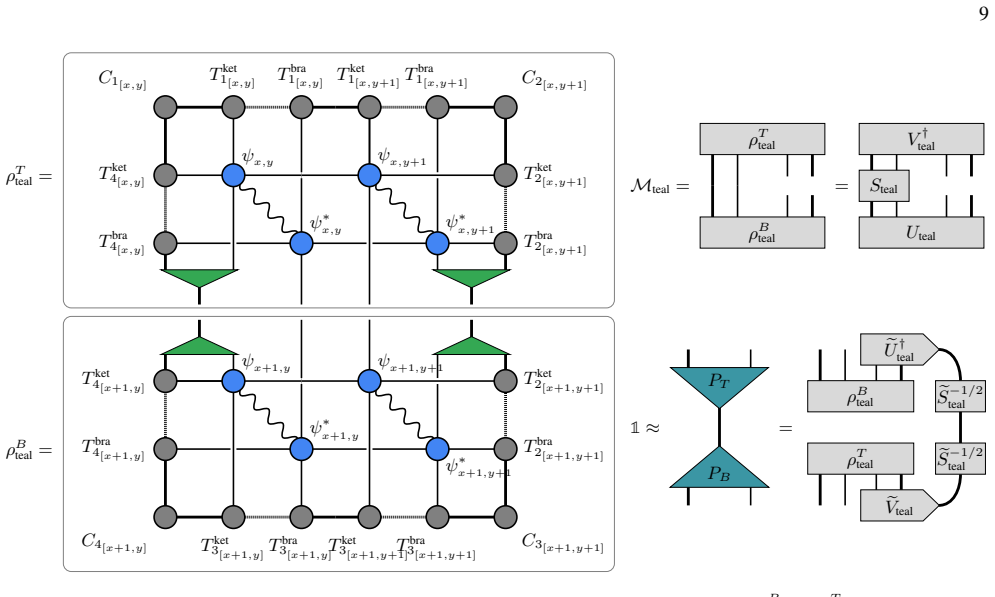
The central object is the split environment: two sets of transfer tensors $T^{\text{ket}}$ and $T^{\text{bra}}$ for each direction, linked by a new interlayer environment bond of dimension $\chi_I$, together with split corner tensors $C_i$. Renormalization is carried out by four projectors per move (green, teal, yellow, red), each defined from a patch network $\rho^B, \rho^T$ whose contraction approximates part of the double layer; a truncated SVD of $M=\rho^B \rho^T$ yields an approximate identity whose factors become the projectors. The green and yellow projectors truncate after ket absorption, the teal and red after bra absorption, and the red projector is notable because it truncates the physical index together with virtual legs into the interlayer bond $\chi_I$. The machine's job is to keep the layers separate during absorption and projection so that contractions never form the full double-layer tensor of dimension $\chi_B^2$, which is where the conventional cost $\mathcal{O}(\chi_E^3\chi_B^6)$ comes from.
What would settle it
A concrete test would be to run the split-CTMRG and conventional CTMRG on a model with strong interlayer correlations and non-trivial sign structure, such as the $J_1$–$J_2$ frustrated Heisenberg model or a fermionic PEPS with a doped hole, at $\chi_B=8$ and $\chi_I=\chi_E$, and compare the relative energy difference to the $10^{-8}$ level reported for honeycomb Heisenberg. If the difference grows by orders of magnitude, or if the variational gradient deviates from the conventional CTMRG gradient, the assumption that the split projectors preserve the relevant subspace would be falsified.
Extended reading notes
Core claim
The central claim is that the conventional double-layer CTMRG environment can be replaced by separate bra- and ket-layer transfer tensors connected by an interlayer bond of dimension $\chi_I$, with projectors built from truncated singular value decompositions of local patch networks. The projectors act through an approximate resolution of the identity, $1 \approx \rho^T \tilde{V} \tilde{S}^{-1} \tilde{U}^\dagger \rho^B$, so that the truncation removes the least relevant singular directions while keeping the layers distinct. This split structure lowers the leading contraction cost from $\mathcal{O}(\chi_E^3\chi_B^6)$ to $\mathcal{O}(\chi_E^3\chi_B^4)$ (and, with half projectors, further down). The paper demonstrates on the honeycomb-lattice antiferromagnetic Heisenberg model that expectation values match conventional CTMRG to relative differences around $10^{-8}$ when $\chi_I=\chi_E$, and that variational energy optimization at $\chi_B=10$ proceeds far more rapidly in wall-clock time than with conventional CTMRG.
Load-bearing premise
The method's accuracy rests on the assumption that the red projector, which truncates the physical index together with virtual legs, preserves the interlayer correlations that conventional CTMRG keeps exactly, so that setting the interlayer bond $\chi_I$ equal to the environment bond $\chi_E$ does not bias expectation values or gradients; this is benchmarked on a single model, the honeycomb Heisenberg antiferromagnet.
Editorial extensions
If this is right
- In variational PEPS optimization, every energy and gradient evaluation inherits the lower contraction cost, so wall-clock time per optimization step drops substantially at fixed $\chi_B$ and $\chi_E$.
- Bond dimensions beyond the usual $\chi_B \lesssim 8$ regime become accessible; the paper demonstrates $\chi_B=10$ optimization on the honeycomb Heisenberg model within a fixed ten-day budget.
- Post-optimization analyses that require large environment bond dimensions, such as finite-entanglement scaling, benefit from the cheaper environment construction.
- The split structure is compatible with global symmetries and with CTMRG-based calculations of excitations and structure factors, extending the speedup beyond ground-state energies.
- Choosing $\chi_I=\chi_E$ is a conservative setting that yields relative energy errors around $10^{-8}$; smaller $\chi_I$ may suffice in practice, offering an additional tunable speed-accuracy tradeoff.
Reading between the lines
- The accuracy of the split projectors rests on the red projector's simultaneous truncation of physical and virtual spaces; on models with strong interlayer (bra-ket) correlations, such as frustrated magnets or fermionic systems with signful wavefunctions, the optimal subspace may differ, so $\chi_I=\chi_E$ might need to be exceeded to maintain $10^{-8}$ accuracy. This is an extrapolation; the paper
- Because the physical index is truncated together with virtual legs, the method implicitly defines a state-dependent reduced basis for the local Hilbert space; tracking the retained singular weights could serve as a diagnostic for when the split contraction is losing relevant interlayer information.
- The same projector construction could be ported to three-dimensional CTMRG-style contractions, where the conventional double-layer cost is even more prohibitive; the paper mentions this as a possibility but does not implement it.
- A direct test of the method's robustness would be to run the same $\chi_I=\chi_E$ comparison on a model with chiral or fermionic PEPS, where the double-layer network has sign structure and the approximate identity in Eq. (10) may be less accurate.
Editorial analysis
A structured set of objections, weighed in public.
Referee Report
Summary. The paper introduces split-CTMRG, an alternative algorithm for contracting infinite PEPS tensor networks by keeping the bra and ket layers separate and connecting them through a new interlayer bond of dimension chi_I. The authors claim a reduction in computational complexity from O(chi_E^3 chi_B^6) to O(chi_E^3 chi_B^4) while preserving accuracy, and they demonstrate variational energy optimization on the honeycomb-lattice Heisenberg model at bulk bond dimension chi_B = 10. The algorithm is specified in detail through diagrammatic projector constructions, and an open-source implementation is provided.
Significance. If the central claims hold, the method directly addresses the dominant bottleneck in variational PEPS simulations, namely the cost of repeated CTMRG contractions during gradient-based optimization. The manuscript is clearly written, the algorithm is specified well enough to re-implement, and the open-source code is a substantial strength. The asymptotic complexity reduction is analytically plausible, and the energy benchmarks in Fig. 4 show that split-CTMRG reproduces conventional CTMRG energies to high accuracy for the tested state. However, the evidence for unbiased gradients and convergence to the same variational fixed point is incomplete, so the significance is conditional on additional benchmarks.
major comments (4)
- [Sec. II B, Eq. (10)] The projectors are constructed from an approximate resolution of the identity using a truncated SVD inverse, M_green^{-1} approx V_tilde S_tilde^{-1} U_tilde^dagger. This step requires the retained singular values to be sufficiently large that inverting them is numerically stable, and the paper provides no analysis or regularization for small singular values. Since every projector in the algorithm (green, teal, yellow, red) relies on this construction, this is load-bearing. Please report the singular value spectra for the benchmarks or introduce a regularization procedure and show that the results are insensitive to it.
- [Sec. II B, Eqs. (6)-(7) and App. A, Fig. 9] The red projectors truncate the physical index together with virtual legs into the interlayer bond dimension chi_I, which is a genuinely new approximation not present in conventional CTMRG. The accuracy evidence in Fig. 4 covers only energy expectation values for a single low-energy honeycomb Heisenberg state at chi_B = 8. Energy gradients are typically more sensitive to environment bias than expectation values, and the paper does not benchmark gradient accuracy against conventional CTMRG. Please provide comparisons of gradient components, or of optimization trajectories on a model with a reliable reference, to demonstrate that the gradient is unbiased.
- [Fig. 5b] The optimization comparison reports 44 split-CTMRG steps versus 3 conventional CTMRG steps over ten days, with the conventional run still far from convergence. This does not establish that both methods converge to the same variational fixed point. Please report converged energies from both methods at matched chi_B and chi_E, or run the conventional optimization to convergence, and compare the resulting states (e.g., via energy differences or overlaps) to support the claim of preserved accuracy during optimization.
- [Eqs. (11)-(12) and Fig. 5a] The central complexity claim is O(chi_E^3 chi_B^4) versus O(chi_E^3 chi_B^6), but Fig. 5a shows an empirical scaling of chi_B^3.0 +/- 0.2 for the split method in the range chi_B = 6-10, and the text notes that the leading term is only expected to dominate at larger chi_B. Thus the asymptotic complexity reduction is not verified in the tested regime. Either extend the scaling measurements to larger chi_B or clearly qualify the claim as an asymptotic prediction, with the demonstrated advantage currently being wall-clock time at moderate bond dimensions.
minor comments (6)
- [Sec. II A] There is a typo: "the the coefficient tensor" should read "the coefficient tensor".
- [App. B] The phrase "analog to of the half projectors" contains an extra "of" and should be corrected.
- [App. A] The sentence "The red projects then renormalize the enlarged space" should read "The red projectors then renormalize the enlarged space".
- [Acknowledgments] The name of the Studienstiftung des Deutschen Volkes is misspelled as "V olkes".
- [Fig. 5(a)] The linear fits use data points for chi_B >= 6, which is only four or five points; please state the number of points used and the fit uncertainty more explicitly.
- [Sec. III] The "state-of-the-art projectors introduced in Refs. [34,35]" are not described; a brief explanation of why they are considered state of the art would help readers assess the benchmark.
Circularity Check
No circularity: the split-CTMRG accuracy claim is benchmarked against conventional CTMRG, and no fitted parameter is renamed as a prediction.
full rationale
The derivation of the split-CTMRG algorithm is self-contained in the sense relevant to circularity. The new projectors are obtained from a truncated SVD of local patch networks (Eqs. (8)-(10)), an approximation that is explicit and whose accuracy is not assumed but tested: Fig. 4(a) compares split-CTMRG energies to conventional CTMRG energies with state-of-the-art projectors at chi_E = 280, and Fig. 4(b) measures the dependence on the freely chosen parameter chi_I. The improved scaling O(chi_E^3 chi_B^4) in Eq. (12) follows from tensor-network contraction counts, not from fitting observed runtimes; the measured exponents in Fig. 5(a) confirm, rather than define, the scaling. The optimization comparison in Fig. 5(b) uses the same preconverged initial state for both methods, and the fact that the conventional CTMRG baseline is only partially converged after ten days is an experimental-fairness limitation, not a circular identification of output with input. Self-citations (Refs. [11,61,62]) are background or code/data availability references and do not carry the accuracy or complexity claims. No fitted parameter is renamed as a prediction, and no uniqueness theorem is invoked to force the projector choice. Therefore no circular step meeting the quoted-evidence threshold can be identified.
Assumptions & free parameters
free parameters (1)
- Interlayer environment bond dimension chi_I =
chi_I = chi_E in all main benchmarks; Fig. 4b shows convergence as chi_I approaches chi_E
assumptions (4)
- domain assumption The CTMRG environment fixed point provides a sufficiently accurate approximation to the infinite PEPS contraction for energies and gradients.
- ad hoc to paper The truncated SVD-based approximate resolution of the identity (Eq. 10) produces projectors that preserve the relevant subspace at the chosen chi_E and chi_I.
- domain assumption The leading computational cost of split-CTMRG is the construction of the teal projectors, with all other steps subdominant at large chi_B.
- standard math For p < chi_B, the stated complexity counts O(chi_E^3 chi_B^6) and O(chi_E^3 chi_B^4) correctly capture the dominant tensor contractions.
Cite this review
Pith. "Pith review of Variationally optimizing infinite projected entangled-pair states at large bond dimensions: A split corner transfer matrix renormalization group approach." pith.science (2026). https://pith.science/paper/JPZ2FNET
@misc{pith2026250210298,
  author       = {Pith},
  title        = {Pith review of: Variationally optimizing infinite projected entangled-pair states at large bond dimensions: A split corner transfer matrix renormalization group approach},
  year         = {2026},
  howpublished = {\url{https://pith.science/paper/JPZ2FNET}},
  note         = {Machine review of arXiv:2502.10298}
}
read the original abstract
Projected entangled-pair states (PEPS) have become a powerful tool for studying quantum many-body systems in the condensed matter and quantum materials context, particularly with advances in variational energy optimization methods. A key challenge within this framework is the computational cost associated with the contraction of the two-dimensional lattice, crucial for calculating state vector norms and expectation values. The conventional approach, using the corner transfer matrix renormalization group (CTMRG), involves combining two tensor network layers, resulting in significant time and memory demands. In this work, we introduce an alternative "split-CTMRG" algorithm, which maintains separate PEPS layers and leverages new environment tensors, reducing computational complexity while preserving accuracy. Benchmarks on quantum lattice models demonstrate substantial speedups for variational energy optimization, rendering this method valuable for large-scale PEPS simulations.
Figures


Figures from the paper (9 more)




Reference graph
Works this paper leans on
-
[1]
R. Orús, A practical introduction to tensor networks: Matrix product states and projected entangled pair states, Annals of Physics 349, 117 (2014)
work page 2014
-
[2]
J. I. Cirac, D. Pérez-García, N. Schuch, and F. Verstraete, Ma- trix product states and projected entangled pair states: Con- cepts, symmetries, theorems, Rev. Mod. Phys. 93, 045003 (2021)
2021
- [3]
-
[4]
J. C. Bridgeman and C. T. Chubb, Hand-waving and interpretive dance: An introductory course on tensor networks, J. Phys. A 50, 223001 (2017)
work page 2017
-
[5]
S. R. White, Density matrix formulation for quantum renormal- ization groups, Phys. Rev. Lett. 69, 2863 (1992)
1992
-
[6]
Schollwöck, The density-matrix renormalization group in the age of matrix product states, Ann
U. Schollwöck, The density-matrix renormalization group in the age of matrix product states, Ann. Phys. 326, 96 (2011)
work page 2011
-
[7]
F. Verstraete and J. I. Cirac, Renormalization algorithms for quantum-many body systems in two and higher dimensions 11 ψx,y C1[x,y] T ket 1[x,y] T bra 1[x,y] C2[x,y] T ket 2[x,y]T ket 4[x,y] ρT yellow = ψ∗ x,y T bra 2[x,y] C3[x,y]T bra 3[x,y]T ket 3[x,y] C4[x,y] T bra 4[x,y] ρB yellow = Nyellow = ρT yellow ρB yellow = Uyellow Syellow V † yellow 1 ≈ PT PB...
arXiv 2004
-
[8]
Corboz, Variational optimization with infinite projected entangled-pair states, Phys
P. Corboz, Variational optimization with infinite projected entangled-pair states, Phys. Rev. B 94, 035133 (2016)
2016
Show all 65 references
-
[9]
Vanderstraeten, J
L. Vanderstraeten, J. Haegeman, P. Corboz, and F. Verstraete, Gradient methods for variational optimization of projected entangled-pair states, Phys. Rev. B 94, 155123 (2016)
2016
-
[10]
Liao, J.-G
H.-J. Liao, J.-G. Liu, L. Wang, and T. Xiang, Differentiable pro- gramming tensor networks, Phys. Rev. X 9, 031041 (2019)
2019
-
[11]
Naumann, E
J. Naumann, E. L. Weerda, M. Rizzi, J. Eisert, and P. Schmoll, An introduction to infinite projected entangled-pair state meth- ods for variational ground state simulations using automatic dif- ferentiation, SciPost Phys. Lect. Notes , 86 (2024)
2024
-
[12]
Francuz, N
A. Francuz, N. Schuch, and B. Vanhecke, Stable and efficient differentiation of tensor network algorithms, Phys. Rev. Res.7, 013237 (2025)
2025
-
[13]
Hasik, D
J. Hasik, D. Poilblanc, and F. Becca, Investigation of the Néel phase of the frustrated Heisenberg antiferromagnet by differen- tiable symmetric tensor networks, SciPost Phys.10, 012 (2021)
2021
-
[14]
Schmoll, A
P. Schmoll, A. Kshetrimayum, J. Naumann, J. Eisert, and Y . Iqbal, Tensor network study of the spin- 1 2 Heisenberg anti- ferromagnet on the Shuriken lattice, Phys. Rev. B 107, 064406 (2023)
2023
-
[15]
I. V . Lukin and A. G. Sotnikov, Variational optimization of tensor-network states with the honeycomb-lattice corner trans- fer matrix, Phys. Rev. B 107, 054424 (2023)
2023
-
[16]
Ferrari, S
F. Ferrari, S. Niu, J. Hasik, Y . Iqbal, D. Poilblanc, and F. Becca, Static and dynamical signatures of Dzyaloshinskii-Moriya in- teractions in the Heisenberg model on the Kagome lattice, Sci- Post Phys. 14, 139 (2023)
2023
-
[17]
Zhang, S
X.-Y . Zhang, S. Liang, H.-J. Liao, W. Li, and L. Wang, Dif- ferentiable programming tensor networks for Kitaev magnets, Phys. Rev. B 108, 085103 (2023)
2023
-
[18]
Schmoll, J
P. Schmoll, J. Naumann, J. Eisert, and Y . Iqbal, Bathing in a sea of candidate quantum spin liquids: From the gapless ruby to the gapped maple-leaf lattice (2024), arXiv:2407.07145 [cond- mat.str-el]
2024 arXiv
-
[19]
Hasik, M
J. Hasik, M. Van Damme, D. Poilblanc, and L. Vanderstraeten, Simulating chiral spin liquids with projected entangled-pair states, Phys. Rev. Lett. 129, 177201 (2022). 12
2022
-
[20]
Y . Xu, S. Capponi, J.-Y . Chen, L. Vanderstraeten, J. Hasik, A. H. Nevidomskyy, M. Mambrini, K. Penc, and D. Poil- blanc, Phase diagram of the chiral su(3) antiferromagnet on the kagome lattice, Phys. Rev. B 108, 195153 (2023)
2023
-
[21]
E. L. Weerda and M. Rizzi, Fractional quantum Hall states with variational projected entangled-pair states: A study of the bosonic Harper-Hofstadter model, Phys. Rev. B 109, L241117 (2024)
2024
-
[22]
Ponsioen, F
B. Ponsioen, F. F. Assaad, and P. Corboz, Automatic differenti- ation applied to excitations with projected entangled pair states, SciPost Phys. 12, 006 (2022)
2022
-
[23]
Ponsioen, S
B. Ponsioen, S. S. Chung, and P. Corboz, Superconducting stripes in the hole-doped three-band hubbard model, Phys. Rev. B 108, 205154 (2023)
2023
-
[24]
Jordan, R
J. Jordan, R. Orús, G. Vidal, F. Verstraete, and J. I. Cirac, Clas- sical simulation of infinite-size quantum lattice systems in two spatial dimensions, Phys. Rev. Lett. 101, 250602 (2008)
2008
-
[25]
Zauner-Stauber, L
V . Zauner-Stauber, L. Vanderstraeten, M. T. Fishman, F. Ver- straete, and J. Haegeman, Variational optimization algorithms for uniform matrix product states, Phys. Rev. B 97, 045145 (2018)
2018
-
[26]
Nietner, B
A. Nietner, B. Vanhecke, F. Verstraete, J. Eisert, and L. Vander- straeten, Efficient variational contraction of two-dimensional tensor networks with a non-trivial unit cell, Quantum 4, 328 (2020)
2020
-
[28]
Z. Y . Xie, H. C. Jiang, Q. N. Chen, Z. Y . Weng, and T. Xiang, Second renormalization of tensor-network states, Phys. Rev. Lett. 103, 160601 (2009)
2009
-
[29]
H. H. Zhao, Z. Y . Xie, Q. N. Chen, Z. C. Wei, J. W. Cai, and T. Xiang, Renormalization of tensor-network states, Phys. Rev. B 81, 174411 (2010)
2010
-
[30]
Z. Y . Xie, J. Chen, M. P. Qin, J. W. Zhu, L. P. Yang, and T. Xi- ang, Coarse-graining renormalization by higher-order singular value decomposition, Phys. Rev. B 86, 045139 (2012)
2012
-
[31]
Nishino and K
T. Nishino and K. Okunishi, Corner transfer matrix renormal- ization group method, J. Phys. Soci. Jap, 65, 891 (1996)
1996
-
[32]
Nishino and K
T. Nishino and K. Okunishi, Corner transfer matrix algorithm for classical renormalization group, J. Phys. Soc. Jap. 66, 3040 (1997)
1997
-
[33]
Orús and G
R. Orús and G. Vidal, Simulation of two-dimensional quantum systems on an infinite lattice revisited: Corner transfer matrix for tensor contraction, Phys. Rev. B 80, 094403 (2009)
2009
-
[34]
Corboz, J
P. Corboz, J. Jordan, and G. Vidal, Simulation of fermionic lat- tice models in two dimensions with projected entangled-pair states: Next-nearest neighbor hamiltonians, Phys. Rev. B 82, 245119 (2010)
2010
-
[35]
Corboz, T
P. Corboz, T. M. Rice, and M. Troyer, Competing states in the t-j model: Uniform d-wave state versus stripe state, Phys. Rev. Lett. 113, 046402 (2014)
2014
-
[36]
M. T. Fishman, L. Vanderstraeten, V . Zauner-Stauber, J. Haege- man, and F. Verstraete, Faster methods for contracting infi- nite two-dimensional tensor networks, Phys. Rev. B98, 235148 (2018)
2018
-
[37]
van Alphen, S
O. van Alphen, S. V . Kleijweg, J. Hasik, and P. Corboz, Ex- ploiting the Hermitian symmetry in tensor network algorithms, Phys. Rev. B 111, 045105 (2025)
2025
-
[38]
Z. Y . Xie, H. J. Liao, R. Z. Huang, H. D. Xie, J. Chen, Z. Y . Liu, and T. Xiang, Optimized contraction scheme for tensor-network states, Phys. Rev. B 96, 045128 (2017)
2017
-
[39]
Haghshenas, S.-S
R. Haghshenas, S.-S. Gong, and D. N. Sheng, Single-layer ten- sor network study of the Heisenberg model with chiral interac- tions on a Kagome lattice, Phys. Rev. B 99, 174423 (2019)
2019
-
[40]
Lan and G
W. Lan and G. Evenbly, Reduced contraction costs of corner- transfer methods for PEPS (2023), arXiv:2306.08212 [quant- ph]
2023 arXiv
-
[41]
H. N. Phien, J. A. Bengua, H. D. Tuan, P. Corboz, and R. Orús, Infinite projected entangled pair states algorithm improved: Fast full update and gauge fixing, Phys. Rev. B 92, 035142 (2015)
2015
-
[42]
Levin and C
M. Levin and C. P. Nave, Tensor renormalization group ap- proach to two-dimensional classical lattice models, Phys. Rev. Lett. 99, 120601 (2007)
2007
-
[43]
Evenbly and G
G. Evenbly and G. Vidal, Tensor network renormalization, Phys. Rev. Lett. 115, 180405 (2015)
2015
-
[44]
Bruognolo, J.-W
B. Bruognolo, J.-W. Li, J. von Delft, and A. Weichselbaum, A beginner’s guide to non-Abelian iPEPS for correlated fermions, SciPost Phys. Lect. Notes , 25 (2021)
2021
-
[45]
Rader and A
M. Rader and A. M. Läuchli, Finite correlation length scaling in Lorentz-invariant gapless iPEPS wave functions, Phys. Rev. X 8, 031030 (2018)
2018
-
[46]
Corboz, P
P. Corboz, P. Czarnik, G. Kapteijns, and L. Tagliacozzo, Finite correlation length scaling with infinite projected entangled-pair states, Phys. Rev. X 8, 031031 (2018)
2018
-
[47]
Vanhecke, J
B. Vanhecke, J. Hasik, F. Verstraete, and L. Vanderstraeten, Scaling hypothesis for projected entangled-pair states, Phys. Rev. Lett. 129, 200601 (2022)
2022
-
[48]
Singh, R
S. Singh, R. N. C. Pfeifer, and G. Vidal, Tensor network de- compositions in the presence of a global symmetry, Phys. Rev. A 82, 050301 (2010)
2010
-
[49]
Weichselbaum, Non-abelian symmetries in tensor networks: A quantum symmetry space approach, Ann
A. Weichselbaum, Non-abelian symmetries in tensor networks: A quantum symmetry space approach, Ann. Phys. 327, 2972 (2012)
2012
-
[50]
Silvi, F
P. Silvi, F. Tschirsich, M. Gerster, J. Jünemann, D. Jaschke, M. Rizzi, and S. Montangero, The Tensor Networks Anthology: Simulation techniques for many-body quantum lattice systems, SciPost Phys. Lect. Notes , 8 (2019)
2019
-
[51]
Schmoll, S
P. Schmoll, S. Singh, M. Rizzi, and R. Orús, A programming guide for tensor networks with global SU (2) symmetry, Ann. Phys. 419, 168232 (2020)
2020
-
[52]
Hasik and P
J. Hasik and P. Corboz, Incommensurate order with translation- ally invariant projected entangled-pair states: Spiral states and quantum spin liquid on the anisotropic triangular lattice, Phys. Rev. Lett. 133, 176502 (2024)
2024
-
[53]
Vanderstraeten, M
L. Vanderstraeten, M. Mariën, F. Verstraete, and J. Haegeman, Excitations and the tangent space of projected entangled-pair states, Phys. Rev. B 92, 201111 (2015)
2015
-
[54]
Vanderstraeten, J
L. Vanderstraeten, J. Haegeman, and F. Verstraete, Simulating excitation spectra with projected entangled-pair states, Phys. Rev. B 99, 165121 (2019)
2019
-
[55]
Ponsioen and P
B. Ponsioen and P. Corboz, Excitations with projected entan- gled pair states using the corner transfer matrix method, Phys. Rev. B 101, 195109 (2020)
2020
-
[56]
Vanderstraeten, L
L. Vanderstraeten, L. Burgelman, B. Ponsioen, M. Van Damme, B. Vanhecke, P. Corboz, J. Haegeman, and F. Verstraete, Vari- ational methods for contracting projected entangled-pair states, Phys. Rev. B 105, 195140 (2022)
2022
-
[57]
Ponsioen, J
B. Ponsioen, J. Hasik, and P. Corboz, Improved summations of n-point correlation functions of projected entangled-pair states (2023), arXiv:2306.13327 [cond-mat.str-el]
2023 arXiv
-
[58]
W.-L. Tu, L. Vanderstraeten, N. Schuch, H.-Y . Lee, N. Kawashima, and J.-Y . Chen, Generating function for pro- jected entangled-pair states, PRX Quantum 5, 010335 (2024)
2024
-
[59]
P. C. G. Vlaar and P. Corboz, Simulation of three-dimensional quantum systems with projected entangled-pair states, Phys. Rev. B 103, 205137 (2021). 13
2021
-
[60]
P. C. G. Vlaar and P. Corboz, Efficient tensor network algorithm for layered systems, Phys. Rev. Lett. 130, 130601 (2023)
2023
-
[61]
Naumann and E
J. Naumann and E. L. Weerda, variPEPS – a versatile tensor network library for variational ground state simulations in two spatial dimensions, GitHub, https://github.com/variPEPS
-
[62]
Naumann, P
J. Naumann, P. Schmoll, F. Wilde, and F. Krein, variPEPS (Python version), Zenodo
-
[63]
Vari- ationally optimizing infinite projected entangled-pair states at large bond dimensions: A split-CTMRG approach
J. Naumann, E. L. Weerda, and P. Schmoll, Data for work "Vari- ationally optimizing infinite projected entangled-pair states at large bond dimensions: A split-CTMRG approach", Zenodo (2025)
2025
-
[64]
Bennett, B
L. Bennett, B. Melchers, and B. Proppe, Curta: A General- purpose High-Performance Computer at ZEDAT, Freie Univer- sität Berlin (2020)
2020
-
[65]
Large-Scale Rec
Jülich Supercomputing Centre, JUWELS Cluster and Booster: Exascale pathfinder with modular supercomputing architecture at JSC, J. Large-Scale Rec. Fac. 7, A183 (2021)
2021
-
[66]
Large-Scale Res
Jülich Supercomputing Centre, JURECA: Data centric and booster modules implementing the modular supercomputing ar- chitecture at JSC, J. Large-Scale Res. Fac. 7, A182 (2021)
2021
Reviewed August 7, 2026 · model on record in the stance chip above.
Discussion (0). Continue with ORCID to comment.