REVIEW 3 major objections 6 minor 3 cited by
I Think, Therefore I Diffuse: Enabling Multimodal In-Context Reasoning in Diffusion Models
T0 review · 3 major / 6 minor · reviewed 2026-08-08 · deepseek-v4-flash
Pith's one-line read A captioning proxy lifts diffusion reasoning accuracy to 46%.
desk verdict Clever proxy alignment yields a big CoBSAT number, but the missing text-only control leaves the core attribution unproven. read the letter →
The pith
A machine-rendered reading of the paper's core claim, the machinery that carries it, and where it could break.
The reading
What carries the argument
The load-bearing mechanism is the shared input feature space of the T5 decoder and T5-prompted diffusion decoders. The named central objects are the aligner network, a two-layer linear MLP with GELU and an RMSNorm layer initialized from the LLM encoder's final RMSNorm; the proxy task of autoregressive caption prediction through the T5 decoder; and two source VLMs, Qwen2-VL for ThinkDiff-LVLM and EVA-CLIP for ThinkDiff-CLIP. The aligner maps VLM tokens into this shared space, and the cross-entropy caption loss teaches the aligner to produce features the decoder can interpret. Random masking breaks the one-to-one token correspondence that would otherwise let the aligner cheat by copying, and the trained features are then consumed by the diffusion decoder at inference time.
What would settle it
Take the trained ThinkDiff-LVLM aligner and feed an analogy prompt such as 'flying monkey, flying cat, zebra' into the T5 decoder and into the diffusion decoder separately; if the T5 decoder predicts 'zebra' but the diffusion decoder produces a flying monkey or an unrelated image, the shared-input-space assumption fails for generation. A more direct measurement is to compare the distributions of aligned VLM feature norms with T5 encoder feature norms on a large caption set: a large scale or covariance mismatch that changes cross-attention entropy would show the RMSNorm is only masking the incompatibility.
Extended reading notes
Core claim
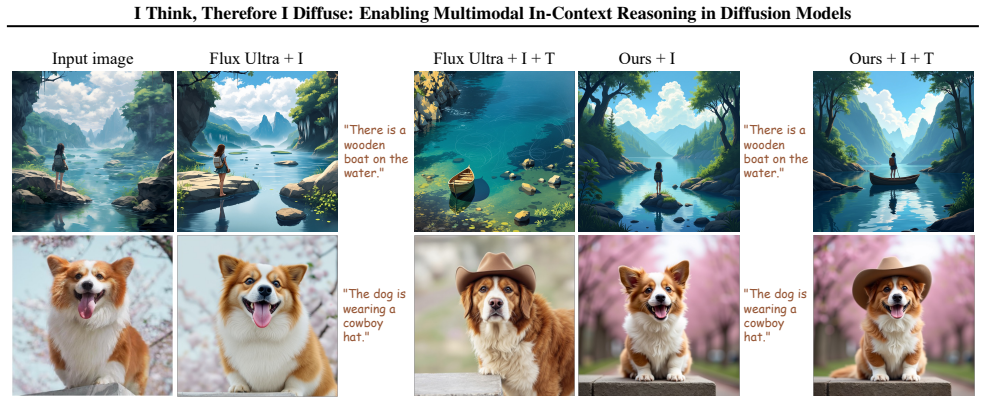
ThinkDiff claims that multimodal in-context reasoning can be transferred to a diffusion decoder without any reasoning-specific training data, by aligning a VLM to the LLM decoder through caption prediction. The central observation is architectural: T5-based diffusion models use the T5 encoder as their prompt encoder, and the T5 decoder reads from that same feature space, so a VLM aligned to the T5 decoder is, by construction, aligned to the diffusion decoder. During training, only the lightweight aligner network is updated; it maps VLM token features into decoder-ready features, and the T5 decoder is supervised to autoregressively predict captions. At inference, the aligner feeds the same features into the diffusion decoder, which generates a reasoned next image or a composed scene. The paper presents random masking of token features and initialization of the aligner's RMSNorm from the T5 encoder's final normalization layer as necessary to prevent shortcut mapping and training instability.
Load-bearing premise
The claim collapses if the feature space that the T5 decoder reads is not, in scale and semantics, the same feature space that the diffusion decoder reads, because then features aligned to the former would not be interpretable by the latter.
Editorial extensions
If this is right
- Any T5-encoder-based diffusion model can gain multimodal in-context reasoning by training only a small aligner on public image-caption pairs, with no curated reasoning dataset and no end-to-end diffusion finetuning.
- Reasoning accuracy should improve with a stronger source VLM or better image encoder, since the alignment recipe itself is agnostic to which VLM supplies the features.
- The same aligner can be plugged into different decoders, including a video diffusion decoder, so an image plus text prompt can be converted into a coherent video without additional reasoning-specific training.
- Using deep features of autoregressively generated tokens rather than input tokens is what carries reasoning, suggesting that generative token features are the right interface for transferring VLM reasoning into generation models.
- The reported reduction in cost—from hundreds of A100 GPU-hours to five hours on four GPUs—makes reasoning-capable generation accessible to teams without large-scale training infrastructure.
Reading between the lines
- The paper leaves unmeasured how far the shared-space assumption stretches: a direct ablation that perturbs feature scale or removes the RMSNorm initialization would quantify how much of the 46.3% accuracy depends on exact decoder compatibility rather than on the VLM's own reasoning.
- Because supervision is captions only, aligned features may be semantically rich but less faithful to pixel-level identity than reconstruction-based adapters; mixing a small reconstruction loss with the caption loss could improve composition fidelity without losing reasoning.
- The recipe suggests a general 'reasoning adapter' pattern: if an encoder-decoder LLM and a generative decoder share an encoder, any task signal expressible as text—instructions, analogies, or visual constraints—can be injected into the generative decoder through that shared space.
- A straightforward extension would evaluate ThinkDiff on held-out reasoning tasks beyond CoBSAT, or ablate the instruction prompt used during evaluation, to separate the VLM's inherent reasoning ability from the contribution of the alignment itself.
Editorial analysis
A structured set of objections, weighed in public.
Referee Report
Summary. The paper proposes ThinkDiff, an alignment paradigm that aims to give text-to-image diffusion models multimodal in-context reasoning. Instead of finetuning a diffusion decoder with a diffusion loss on reasoning data, ThinkDiff aligns a VLM's output features to a T5 decoder through a captioning/proxy cross-entropy loss on public image-caption data, relying on the premise that the T5 decoder and T5-based diffusion decoders such as FLUX consume a shared input feature space. Two variants are presented: ThinkDiff-LVLM, using Qwen2-VL as the VLM, and ThinkDiff-CLIP, using an EVA-CLIP vision encoder. On the CoBSAT benchmark, ThinkDiff-LVLM reports 2-shot and 4-shot accuracies, with a 4-shot average of 46.3% versus 19.2% for the previous state of the art, and qualitative results show composition of multiple images and text. The paper also reports ablations on random masked training and RMSNorm initialization, as well as a video extension through CogVideoX.
Significance. If the causal claim is upheld, this is a significant contribution: a lightweight, caption-only training recipe that transfers multimodal reasoning from a VLM to a frozen T5-based diffusion decoder, using only public image-caption data and roughly 5 GPU-hours on 4 A100s. The paper gives useful engineering insights, notably random masked training to avoid shortcut mapping and RMSNorm initialization for stable convergence, and it demonstrates qualitatively compelling image-text composition. However, the central attribution is not yet established because no control experiment feeds Qwen2-VL's generated text prompt through stock FLUX without the aligner. Until that control, along with a more rigorous evaluation protocol, is provided, the strong quantitative claims should be treated as provisional. The shared-feature-space premise is also asserted rather than directly verified.
major comments (3)
- [Section 3.3, Eq. (3), Appendix B] The inference pipeline first prompts Qwen2-VL to produce a detailed text prompt ("Create an image ...") and then maps Qwen2-VL token features through the aligner into the T5 decoder space for FLUX. Since stock FLUX already conditions on T5-encoded text, the paper must report the control that encodes Qwen2-VL's generated prompt as ordinary text with T5 and feeds it to unmodified FLUX, with no aligner. This control uses only the authors' existing components and requires no retraining. Without it, the CoBSAT improvement cannot be attributed to aligner-mediated feature transfer; it may be entirely explained by the VLM's text reasoning plus standard text-to-image rendering. Please report this baseline for both 2-shot and 4-shot CoBSAT settings and discuss how the results bear on the central claim in Section 3.1.
- [Section 4.1, Tables 2 and 3] CoBSAT is used both for model selection and for final reporting, and the reported numbers have no variance. The masking schedule, the choice of generated versus input tokens, the RMSNorm initialization, the LVLM token budget, and the evaluation instruction prompt in Appendix B were all selected by inspecting CoBSAT accuracy, yet the same benchmark supplies the final 46.3% figure. No held-out split or multiple-seed results are provided. This makes it difficult to rule out selection on the test benchmark. Please report results over at least three seeds with mean and standard deviation, or use a separate validation split for all ablation and hyperparameter choices and report the gap between validation-selected and final test numbers.
- [Section 3.1, Figure 3, Eq. (2)] The load-bearing architectural premise is that aligning VLM features to the T5 decoder input space transfers to the FLUX diffusion decoder. The paper states this as an observation, but the mechanism is not directly verified, and the phrase "decoder's input space" is ambiguous: in T5, the decoder receives target token embeddings as self-attention input and consumes encoder outputs through cross-attention. Please specify exactly which tensor is fed where in Eq. (2) and Eq. (3), and provide evidence that FLUX's conditioning layers consume the same feature representation. A direct test could compare the statistics of T5 encoder outputs with aligned VLM features, or feed the same aligned features to both the T5 decoder and the FLUX decoder and measure the quality of the decoded text and images. The missing text-only control is related but does not by itself establish that the two decoders share the feature space.
minor comments (6)
- [Figure 4(b) caption] The caption says "the LLM decoder is replaced by a diffusion encoder," but the text and the method consistently describe replacing the LLM decoder with a diffusion decoder; please correct this typo.
- [Section 4.2] The sentence "Results of SEED-LLaMA, Emu and GILL are token from the CoBSAT paper" should read "taken from the CoBSAT paper."
- [Section 4.3, Figure 6] The comparison with FLUX Ultra is described as "possibly finetuned by diffusion training and image reconstruction supervision," which is speculative and not a controlled comparison. Please specify the exact FLUX Ultra configuration, report the prompt set and any quantitative metrics, and clarify whether the qualitative differences are consistent across multiple runs.
- [Appendix B, Section 3.3] The random split in the masked training strategy is not fully specified: the masking ratio and the way the split is applied across the 64 generated tokens should be stated explicitly, along with the sensitivity of the final accuracy to this ratio.
- [Section 4.4, Table 3] The "using input tokens" row reports accuracies between 0.004 and 0.032 on every task, which is essentially chance; this row should be accompanied by the training loss curve and representative outputs so the reader can see whether this ablation failed to converge or reveals a brittle failure mode of the evaluation protocol.
- [Section 4.1 and project page] The paper does not state whether code, trained aligner weights, or evaluation scripts will be released; given the claim that ThinkDiff is a universal adapter for T5-based diffusion models, releasing the aligner and inference code would substantially aid reproducibility.
Circularity Check
No significant circularity: the CoBSAT result is not an input to the training objective, and no equation in the paper reduces to its own output by construction.
full rationale
ThinkDiff's derivation chain is a proxy-alignment recipe: an aligner is trained with a cross-entropy text loss so that VLM token features become interpretable by the T5 decoder, and at inference the T5 decoder is swapped for the FLUX diffusion decoder. The training data are public image-caption sets (CC3M, CC12M, SBU), and the CoBSAT benchmark is held out from parameter fitting, so the reported 46.3% accuracy is not statistically forced by the loss. The 'shared input feature space' between the T5 decoder and FLUX is an architectural assumption about compatibility, not a definitional equivalence, and the RMSNorm-initialization and random-masking designs are empirical stabilizers validated by ablations rather than hidden restatements of the benchmark. The paper's self-citations (Omni-ID, MoA, and X-ViLA) appear only as related work and do not carry the central claim. The main scientific weakness is attribution: because inference first lets Qwen2-VL generate a text prompt and FLUX then renders it, the paper lacks a text-only control that would establish that the aligner, rather than the stock text-to-image pipeline, causes the CoBSAT gain. That is a missing-control correctness issue, not a derivational circularity, since no equation in the paper is equivalent to its own input by construction.
Assumptions & free parameters
free parameters (4)
- masking ratio for random split =
not reported
- number of LVLM-generated tokens per image =
64
- CLIP image token downsampling factor =
2D pooling, size not specified
- evaluation instruction prompt for CoBSAT =
hand-written prompt in Appendix B
assumptions (4)
- domain assumption The LLM decoder and the diffusion decoder consume the same input feature space (outputs of the shared LLM encoder), so aligning a VLM to the LLM decoder transfers to the diffusion decoder.
- domain assumption Predicting image captions with a cross-entropy text loss is a sufficient proxy to align VLM features for downstream image generation.
- domain assumption The deep features of the LVLM's autoregressively generated tokens carry the reasoning about the input context and are the right features to align.
- domain assumption Random masking of the token and feature pairs prevents a trivial shortcut mapping and yields a more general alignment.
Cite this review
Pith. "Pith review of I Think, Therefore I Diffuse: Enabling Multimodal In-Context Reasoning in Diffusion Models." pith.science (2026). https://pith.science/paper/CYYK37H7
@misc{pith2026250210458,
  author       = {Pith},
  title        = {Pith review of: I Think, Therefore I Diffuse: Enabling Multimodal In-Context Reasoning in Diffusion Models},
  year         = {2026},
  howpublished = {\url{https://pith.science/paper/CYYK37H7}},
  note         = {Machine review of arXiv:2502.10458}
}
abstract
This paper presents ThinkDiff, a novel alignment paradigm that empowers text-to-image diffusion models with multimodal in-context understanding and reasoning capabilities by integrating the strengths of vision-language models (VLMs). Existing multimodal diffusion finetuning methods largely focus on pixel-level reconstruction rather than in-context reasoning, and are constrained by the complexity and limited availability of reasoning-based datasets. ThinkDiff addresses these challenges by leveraging vision-language training as a proxy task, aligning VLMs with the decoder of an encoder-decoder large language model (LLM) instead of a diffusion decoder. This proxy task builds on the observation that the $\textbf{LLM decoder}$ shares the same input feature space with $\textbf{diffusion decoders}$ that use the corresponding $\textbf{LLM encoder}$ for prompt embedding. As a result, aligning VLMs with diffusion decoders can be simplified through alignment with the LLM decoder. Without complex training and datasets, ThinkDiff effectively unleashes understanding, reasoning, and composing capabilities in diffusion models. Experiments demonstrate that ThinkDiff significantly improves accuracy from 19.2% to 46.3% on the challenging CoBSAT benchmark for multimodal in-context reasoning generation, with only 5 hours of training on 4 A100 GPUs. Additionally, ThinkDiff demonstrates exceptional performance in composing multiple images and texts into logically coherent images. Project page: https://mizhenxing.github.io/ThinkDiff.
Figures


Figures from the paper (11 more)




Forward citations
Cited by 3 Pith papers
-
MentisOculi: Revealing the Limits of Reasoning with Mental Imagery
Visual thoughts — latent tokens, interleaved images, or video rollouts — do not currently improve multi-step reasoning over text-only baselines in frontier models.
-
Canvas3D: Empowering Precise Spatial Control for Image Generation with Constraints from a 3D Virtual Canvas
Canvas3D lets users arrange objects in a 3D canvas generated from a text prompt, then feeds depth, skeleton, and lighting constraints to diffusion models to produce images that match the layout.
-
Fake it till You Make it: Reward Modeling as Discriminative Prediction
GAN-RM trains a CLIP-based discriminator to distinguish a few hundred preference proxy images from model outputs, then uses it for Best-of-N selection, SFT, and DPO.
Reference graph
Works this paper leans on
-
[1]
Achiam, J., Adler, S., and et. al., S. A. Gpt-4 technical report. arXiv preprint arXiv:2303.08774,
-
[3]
Playground v3: Improving text-to-image alignment with deep-fusion large language models
Liu, B., Akhgari, E., Visheratin, A., Kamko, A., Xu, L., Shrirao, S., Souza, J., Doshi, S., and Li, D. Playground v3: Improving text-to-image alignment with deep-fusion large language models. arXiv preprint arXiv:2409.10695,
-
[7]
Gen- erative pretraining in multimodality
Sun, Q., Yu, Q., Cui, Y ., Zhang, F., Zhang, X., Wang, Y ., Gao, H., Liu, J., Huang, T., and Wang, X. Gen- erative pretraining in multimodality. arXiv preprint arXiv:2307.05222,
-
[8]
Metamorph: Multimodal understanding and generation via instruction tuning
Tong, S., Fan, D., Zhu, J., Xiong, Y ., Chen, X., Sinha, K., Rabbat, M., LeCun, Y ., Xie, S., and Liu, Z. Metamorph: Multimodal understanding and generation via instruction tuning. arXiv preprint arXiv:2412.14164,
-
[9]
Moa: Mixture-of-attention for subject-context disentanglement in personalized image generation
Wang, K.-C., Ostashev, D., Fang, Y ., Tulyakov, S., and Aber- man, K. Moa: Mixture-of-attention for subject-context disentanglement in personalized image generation. In SIGGRAPH Asia, pp. 1–12, 2024a. Wang, P., Bai, S., Tan, S., Wang, S., Fan, Z., Bai, J., Chen, K., Liu, X., Wang, J., Ge, W., et al. Qwen2-vl: Enhancing vision-language model’s perception o...
-
[10]
Omnigen: Unified image generation
Xiao, S., Wang, Y ., Zhou, J., Yuan, H., Xing, X., Yan, R., Wang, S., Huang, T., and Liu, Z. Omnigen: Unified image generation. arXiv preprint arXiv:2409.11340,
-
[11]
Yang, A., Yang, B., Zhang, B., Hui, B., Zheng, et al
URL https://arxiv.org/ abs/2410.10629. Yang, A., Yang, B., Zhang, B., Hui, B., Zheng, et al. Qwen2.5 technical report. arXiv preprint arXiv:2412.15115, 2024a. Yang, Z., Teng, J., Zheng, W., Ding, M., Huang, S., Xu, J., Yang, Y ., Hong, W., Zhang, X., Feng, G., et al. Cogvideox: Text-to-video diffusion models with an expert transformer. arXiv preprint arXi...
-
[12]
X- vila: Cross-modality alignment for large language model
Ye, H., Huang, D.-A., Lu, Y ., Yu, Z., Ping, W., Tao, A., Kautz, J., Han, S., Xu, D., Molchanov, P., et al. X- vila: Cross-modality alignment for large language model. arXiv preprint arXiv:2405.19335,
Show all 15 references
-
[13]
Minigpt-4: Enhancing vision-language understanding with advanced large language models
Zhu, D., Chen, J., Shen, X., Li, X., and Elhoseiny, M. Minigpt-4: Enhancing vision-language understanding with advanced large language models. arXiv preprint arXiv:2304.10592,
-
[14]
Limitation Despite ThinkDiff’s strong performance in reasoning generation tasks, several limitations remain for future work
11 I Think, Therefore I Diffuse: Enabling Multimodal In-Context Reasoning in Diffusion Models APPENDIX A. Limitation Despite ThinkDiff’s strong performance in reasoning generation tasks, several limitations remain for future work. First, while it substantially outperforms exis...
2018
-
[15]
These images are preprocessed using Qwen2-VL, which generates detailed descriptions based on randomly selected text prompts from a predefined set
datasets. These images are preprocessed using Qwen2-VL, which generates detailed descriptions based on randomly selected text prompts from a predefined set. The generated text tokens and token features are stored for training the alignment. We generate 64 tokens for each data ...
2023
-
[2011]
Kosmos-g: Generating images in context with multimodal large language models
9 I Think, Therefore I Diffuse: Enabling Multimodal In-Context Reasoning in Diffusion Models Pan, X., Dong, L., Huang, S., Peng, Z., Chen, W., and Wei, F. Kosmos-g: Generating images in context with multimodal large language models. arXiv preprint arXiv:2310.02992,
-
[2018]
V ., Zettle- moyer, L., and Yu, L
Shi, W., Han, X., Zhou, C., Liang, W., Lin, X. V ., Zettle- moyer, L., and Yu, L. Llamafusion: Adapting pretrained language models for multimodal generation. arXiv preprint arXiv:2412.15188,
-
[2023]
Dreambench++: A human-aligned benchmark for personalized image gener- ation
Peng, Y ., Cui, Y ., Tang, H., Qi, Z., Dong, R., Bai, J., Han, C., Ge, Z., Zhang, X., and Xia, S.-T. Dreambench++: A human-aligned benchmark for personalized image gener- ation. arXiv preprint arXiv:2406.16855,
-
[2024]
Llama 3: Vision and edge ai for mo- bile devices
AI, M. Llama 3: Vision and edge ai for mo- bile devices. https://ai.meta.com/ blog/llama-3-2-connect-2024-vision\ -edge-mobile-devices/ , 2024a. AI, S. Deepfloyd if: Text-to-image model. https://stability.ai/news/ deepfloyd-if-text-to-image-model , 2024b. AI, S. Stable diffusi...
2024 arXiv
Reviewed August 8, 2026 · model on record in the stance chip above.
Discussion (0). Continue with ORCID to comment.