REVIEW 4 major objections 4 minor 1 cited by
Anisotropic power-law inflation for the S\'aez-Ballester theory non-minimally coupled to a vector field
T0 review · 4 major / 4 minor · reviewed 2026-08-08 · deepseek-v4-flash
Pith's one-line read The Sáez-Ballester theory non-minimally coupled to a vector field admits a stable, attractive Bianchi type I power-law inflationary solution, adding a new counterexample to the cosmic no-hair conjecture.
desk verdict A technically correct but low-novelty extension of KSW anisotropic inflation, whose stability proof contains a false lemma that is easily repaired. read the letter →
The pith
A machine-rendered reading of the paper's core claim, the machinery that carries it, and where it could break.
The reading
What carries the argument
Two objects carry the argument. The first is the gauge-kinetic coupling $f^2(\phi)F_{\mu\nu}F^{\mu\nu}$, which gives the vector field an effective coupling that keeps it from diluting during inflation and sources the anisotropy in $\sigma$. The second is the field redefinition $\varphi=\int\sqrt{\omega(\phi)}\,d\phi=\sqrt{w}\log\phi$, valid when $n=-2$, which maps the Sáez-Ballester action with $P(\phi,X)=w\phi^n X-V_0\phi^k$ to the canonical scalar-tensor action with exponential potential and exponential gauge coupling. This redefinition makes the anisotropic power-law solution identical to the known solution of the original anisotropic inflation model, while the autonomous system in $\bar X$, $Y$, $Z$, $U_1$, $U_2$ provides the stability proof that the fixed point is an attractor for $w>0$.
What would settle it
Compute the scalar and tensor perturbation spectra directly from the modified Sáez-Ballester action of Eq. (7.1) in a Bianchi I background. If the resulting speed of sound differs from $c_s^2=1/(2\bar m-1)$, or if the $n_s$–$r$ curve at $c_s=0.1$ leaves the Planck 2018 95 percent region, then the proposed route to observational viability fails.
Extended reading notes
Core claim
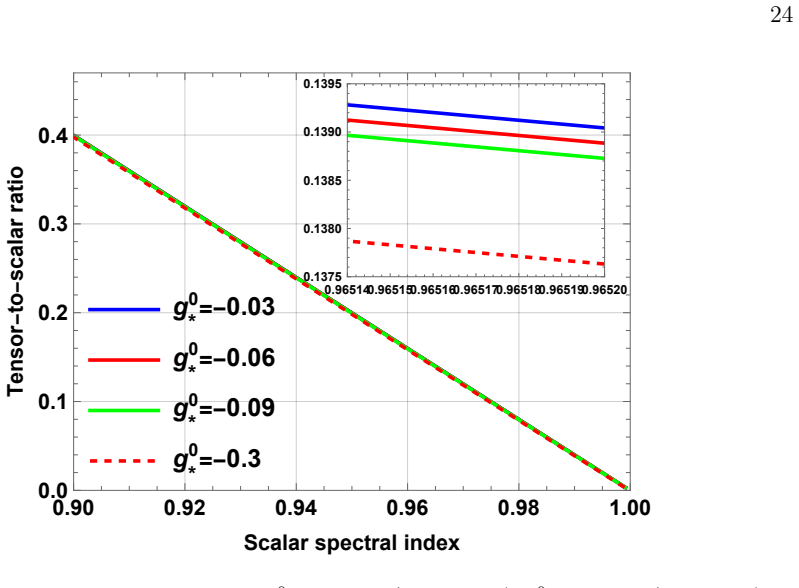
The paper's central claim is that the action $S=\int d^4x\sqrt{-g}[R/2 - \tfrac12 w\phi^n \partial_\mu\phi\partial^\mu\phi - V_0\phi^k - \tfrac14 f_0^2\phi^{2m}F_{\mu\nu}F^{\mu\nu}]$ has a Bianchi type I power-law solution $\alpha(t)=\zeta\log t$, $\sigma(t)=\eta\log t$, $\phi(t)=t^l$ with $n=-2$, $l=-2/k$, $\zeta=(k^2+8km+12m^2+8w)/[6k(k+2m)]$, and $\eta=1/3-4w/[3k(k+2m)]$. A dynamical-system analysis with variables $\bar X=\dot\sigma/\dot\alpha$, $Y=\phi^{n/2}\dot\phi/\dot\alpha$, and $Z=p_A f^{-1}e^{-2\alpha-2\sigma}/\dot\alpha$ identifies this solution as an anisotropic fixed point, and the characteristic equation for perturbations has only non-positive roots for $w>0$, so the solution is stable and attractive. Replacing $\phi$ by $\varphi=\sqrt{w}\log\phi$ turns the action into one with a canonical scalar and exponential potential and gauge-kinetic functions, which is exactly the original anisotropic inflation model. Because the speed of sound computed from this $P(\phi,X)$ is $c_s^2=1$, the resulting tensor-to-scalar ratio $r_{\rm SB}=16\epsilon(6-\epsilon g_*^0)/(6-4g_*^0)$ stays above the Planck 2018 limit.
Load-bearing premise
The cosmological-viability claim for the modified theory assumes that the noncanonical perturbation formulas for the scalar and tensor power spectra derived for other theories also hold for the modified Sáez-Ballester action of Eq. (7.1), and the paper does not verify that assumption.
Editorial extensions
If this is right
- The anisotropic fixed point is an attractor, so for a wide range of initial conditions the universe approaches a Bianchi type I state with small but nonvanishing anisotropy by the end of inflation.
- The Sáez-Ballester solution is physically the same as the original anisotropic inflation solution after field redefinition, so the known imprints of that model transfer to this theory.
- Because $c_s=1$, the tensor-to-scalar ratio of the Sáez-Ballester anisotropic solution lies above the Planck 2018 bound $r<0.056$; the model is not viable as it stands.
- If a modified Sáez-Ballester theory achieves $c_s\sim0.1$, the same formulas give $r$ in the observationally allowed region, so sound speed becomes the controlling parameter for viability.
Reading between the lines
- The equivalence in Section V suggests that the stability of the Sáez-Ballester attractor is inherited from the canonical model rather than a new dynamical effect; a full perturbation calculation would show whether the two theories share the same $c_s$, $n_s$, and $r$ at all orders.
- The modified theory of Eq. (7.1) is only treated at the background level, so its advertised $c_s\sim0.1$ compatibility with Planck 2018 is a heuristic extrapolation; computing its scalar and tensor spectra is the direct next step.
- If the modified model realizes $c_s\ll1$ in a k-inflation-like way, it would also predict enhanced non-Gaussianity proportional to $1/c_s^2$, giving an observable signature that could distinguish it from canonical anisotropic inflation.
Editorial analysis
A structured set of objections, weighed in public.
Referee Report
Summary. The paper investigates the Sáez-Ballester (SB) theory with a non-minimal scalar-vector coupling f^2(φ)F_μνF^μν, with P(φ,X)=wφ^n X - V(φ). It derives an exact Bianchi type I power-law inflationary solution for n=-2, V=V0φ^k, and f=f0φ^m, analyzes its stability through a five-dimensional dynamical system, proves an equivalence to the Kanno-Soda-Watanabe (KSW) model by a field redefinition, computes the tensor-to-scalar ratio, and proposes a modified SB model with P=wφ^n X^mbar - V in order to reduce the speed of sound. The central claims are that the SB solution is a stable and attractive counterexample to the cosmic no-hair conjecture and that modifications with c_s~0.1 could make the model consistent with Planck 2018 constraints.
Significance. If fully established, the paper would provide an exact anisotropic inflationary solution in the SB theory that is stable within the homogeneous dynamical system and that reduces to the known KSW solution via an invertible field redefinition. The exact solution algebra in Sec. III is straightforward and checks out, and the equivalence in Sec. V is cleanly demonstrated. However, the stability proof contains a logically invalid step, and the modified SB section is explicitly incomplete; the paper itself states that the stability of the modified model is postponed. The numerical figures showing an attractor are suggestive but not a substitute for the missing analytical criterion. The claim to have one more counterexample to cosmic no-hair is also weakened by the paper's own equivalence result, which shows that the SB solution is the KSW solution in different field variables. The result is therefore a useful reconfirmation of the KSW mechanism in the SB frame, with moderate novelty, rather than an independent new counterexample.
major comments (4)
- [§IV.B, Eqs. (4.38)–(4.42)] The stability argument uses the invalid implication that positive coefficients a_i in the cubic f(ω)=a3ω^3+a2ω^2+a1ω+a0 imply that all roots have non-positive real parts. This is false; for example, ω^3+ω^2+ω+10 has a negative real root and two complex roots with positive real part. The statement in the text that the cubic 'will only admit non-positive roots of ω' is therefore not established by positivity alone. The correct criterion is the Routh-Hurwitz condition a2 a1 > a3 a0 in addition to a_i>0. For the leading-order coefficients in Eqs. (4.39)–(4.42) this condition happens to hold, so the conclusion may be salvageable, but the paper must present the exact calculation with the full coefficients rather than only leading-order terms. Because the stable and attractive property is the load-bearing assertion for the central counterexample claim, this repair is essential.
- [§VII, Eqs. (7.1)–(7.8)] The modified action contains the term wφ^n X^mbar, with X=-1/2 ∂μφ∂^μφ. On the Bianchi I background X=-1/2 dotφ^2 is negative. The field equations in Eqs. (7.5)–(7.8) replace X^mbar by (1/2 dotφ^2)^mbar, dropping the sign. For non-integer mbar the original term is not well defined for negative X, and for odd integer mbar the sign changes the field equations. Consequently, the power-law solution in Eq. (7.25) is not shown to satisfy the action (7.1). The authors need to restrict mbar to an appropriate domain or otherwise specify how X^mbar is defined, and then rederive the background equations.
- [§VI–§VII, Eqs. (6.7)–(6.8), Eq. (7.1)] The abstract and Sec. VI claim that modifications of the SB theory with c_s~0.1 will have great potential to be consistent with Planck 2018. This claim rests on applying the noncanonical anisotropic perturbation formulas of Refs. [66,73] to the modified SB action. No perturbation calculation for the mSB model is given; Sec. VII derives only the background power-law solution and explicitly states that a detailed investigation of its stability will be published elsewhere. The applicability of Eqs. (6.7)–(6.8) to P=wφ^n X^mbar with the non-minimal vector coupling must be justified, or the mSB plots should be presented as heuristic and the unsupported Planck-viability statement should be removed from the abstract.
- [§V and §VIII] The field redefinition φ=√w log φ shown in Sec. V is invertible and maps the full SB action (2.5) with n=-2 onto the KSW action (5.7). The Bianchi I solution of Sec. III is therefore the KSW solution in different field variables, not an independent counterexample. This is in tension with the statement in Sec. VIII that the theory admits 'one more counterexample' to the cosmic no-hair conjecture. The paper should reconcile these statements and state clearly what is new beyond the field-redefinition equivalence, or explicitly present the result as a reconfirmation of KSW in the SB frame.
minor comments (4)
- [General] There are several typographical issues: 'S´aez' appears with inconsistent accents, and 'SKW' appears in Sec. IV.A where 'KSW' is meant.
- [§IV.B, Fig. 1] The axes of Fig. 1 are not labeled and the convergence time is not shown; labeling the axes and stating the parameters for each trajectory would make the attractor claim easier to verify.
- [§VI, Eq. (6.2)] The paper sets the reduced Planck mass to one in Sec. II, but Eq. (6.2) explicitly includes M_p^2; this is not an error in itself, but the convention should be stated consistently.
- [§IV.A, Eq. (4.24)] The text says that Eq. (4.24)–(4.26) are equivalent to the power-law solution of Sec. III, but it does not show the identification of the auxiliary variables with ζ, η, and l; a one-line verification would improve readability.
Circularity Check
No significant circularity: the SB power-law solution is derived from the field equations and later identified with KSW via an explicit field redefinition; the main unresolved issue is a correctness gap in the stability argument, not a circular one.
full rationale
The paper's central derivation is self-contained: the Bianchi I power-law solution in Sec. III is obtained by solving the field equations (2.11)-(2.14) under the ansatz (3.1) and the power-matching constraints (3.7)-(3.9), leading to independent algebraic expressions for zeta, eta, u, and v. The later identification with the KSW solution in Sec. V is an explicit field redefinition, not an assumption used to obtain the solution; the paper even states the result is a "non-trivial reconfirmation" of KSW. The stability analysis in Sec. IV is also internal to the paper's own dynamical system, with the KSW stability cited only as confirmation. The self-citations to Refs. [67, 102] for the "mathematical trick" and to Refs. [66, 73] for non-canonical perturbation formulas are real self-citations, but they are not the load-bearing derivation of the central counterexample claim, which stands or falls on the dynamical-system computation. No target result is plugged in as an assumption, and no fitted parameter is renamed as a prediction. Two flagged concerns are correctness or completeness issues rather than circularity: (i) the assertion after Eqs. (4.38)-(4.42) that positivity of all cubic coefficients implies only non-positive roots is mathematically false, so the stability proof needs repair; and (ii) the modified SB model's Planck-consistency claim relies on perturbation formulas whose applicability to Eq. (7.1) is not derived, with stability explicitly postponed in Sec. VII. These gaps do not make the derivation circular.
Assumptions & free parameters
free parameters (7)
- n =
-2
- k =
positive, free (0.1 in examples)
- m =
positive, large (50 in examples)
- w =
positive, less than km/2 (1 in examples)
- V0 =
fixed by Eq. (3.20) in terms of k, m, w
- p_A^2 / f0^2 =
fixed by Eq. (3.19) as 3 eta (3 zeta - 1)
- m_bar =
free; 1 for SB, larger values for slower sound speed
assumptions (5)
- domain assumption Bianchi type I metric with vector configuration A_mu = (0, A_x(t), 0, 0)
- domain assumption Power-law ansatz alpha = zeta log t, sigma = eta log t, phi = t^l
- domain assumption Stability analysis restricted to homogeneous perturbations in reduced variables
- domain assumption Noncanonical power-spectrum formulas from Refs [66,73] apply to SB and mSB
- ad hoc to paper Positive coefficients of the cubic imply non-positive roots
Cite this review
Pith. "Pith review of Anisotropic power-law inflation for the S\'aez-Ballester theory non-minimally coupled to a vector field." pith.science (2026). https://pith.science/paper/76BOFZBR
@misc{pith2026250210462,
  author       = {Pith},
  title        = {Pith review of: Anisotropic power-law inflation for the S\'aez-Ballester theory non-minimally coupled to a vector field},
  year         = {2026},
  howpublished = {\url{https://pith.science/paper/76BOFZBR}},
  note         = {Machine review of arXiv:2502.10462}
}
abstract
In this paper, we would like to examine whether the S\'aez-Ballester theory admits stable and attractive Bianchi type I inflationary solutions in the presence of a non-minimal coupling between scalar and vector fields such as $f^2(\phi)F_{\mu\nu}F^{\mu\nu}$. As a result, such a solution will be shown to exist within this theory for a suitable setup of fields. Interestingly, the considered S\'aez-Ballester theory can be shown to be equivalent to the standard scalar-vector theory via a suitable field redefinition. This means that the obtained solution can be reduced to that derived in an original anisotropic inflation model proposed by Kanno, Soda, and Watanabe. Consequently, the corresponding tensor-to-scalar ratio of this solution turns out to be higher than the latest observational value of the Planck satellite (Planck 2018) due to the fact that $c_s$, the corresponding speed of sound of scalar perturbations of the S\'aez-Ballester theory, turns out to be one. This result indicates an important hint that the speed of sound, $c_s$, could play an important role in making the corresponding non-canonical anisotropic inflation cosmologically viable in the light of the Planck 2018 data. To be more specific, we will point out that any modifications of the S\'aez-Ballester theory having $c_s \sim 0.1$ will have a great potential to be highly consistent with the Planck 2018 data. For heuristic reasons, a simple modified version of the S\'aez-Ballester theory will be proposed as a specific demonstration. As a result, we will show that this modified model admits an anisotropic power-law inflationary solution as expected.
Figures


Figures from the paper (1 more)

Forward citations
Cited by 1 Pith paper
-
Power-law Bianchi type I inflation with multiple vector fields
Exact power-law Bianchi type I inflationary solutions are found for one scalar field coupled to up to three vector fields, with stability governed by the relative sizes of the gauge-coupling exponents.
Reference graph
Works this paper leans on
-
[1]
D. J. Schwarz, C. J. Copi, D. Huterer, and G. D. Starkman, CMB anomalies after Planck, Class. Quant. Grav. 33, 184001 (2016) [arXiv:1510.07929]
arXiv 2016
-
[2]
T. Buchert, A. A. Coley, H. Kleinert, B. F. Roukema, and D. L. Wiltshire, Observa- tional challenges for the standard FLR W model, Int. J. Mod. Phys. D 25, 1630007 (2016) [arXiv:1512.03313]
arXiv 2016
-
[3]
L. Perivolaropoulos and F. Skara, Challenges for ΛCDM: An update, New Astron. Rev. 95, 101659 (2022) [arXiv:2105.05208]
arXiv 2022
-
[4]
E. Abdalla, G. Franco Abell´ an, A. Aboubrahim, A. Agnello, O. Akarsu, Y. Akrami, G. Alestas, D. Aloni, L. Amendola and L. A. Anchordoqui, et al. Cosmology intertwined: A review of the particle physics, astrophysics, and cosmology associated with the cosmological tensions and anomalies, JHEAp 34, 49 (2022) [arXiv:2203.06142]
arXiv 2022
-
[5]
P. K. Aluri, P. Cea, P. Chingangbam, M. C. Chu, R. G. Clowes, D. Hutsem´ ekers, J. P. Kochappan, A. M. Lopez, L. Liu, and N. C. M. Martens, et al., Is the observable Universe consistent with the cosmological principle?, Class. Quant. Grav. 40, 094001 (2023) [arXiv:2207.05765]
arXiv 2023
-
[6]
G. Hinshaw et al., Nine-Year Wilkinson Microwave Anisotropy Probe (WMAP) Observations: Cosmological Parameter Results, Astrophys. J. Suppl. 208, 19 (2013) [arXiv:1212.5226]. 31
arXiv 2013
-
[7]
Y. Akrami et al. [Planck], Planck 2018 results. VII. Isotropy and Statistics of the CMB, Astron. Astrophys. 641, A7 (2020) [arXiv:1906.02552]
arXiv 2020
-
[8]
C. E. Kester, A. Bernui, and W. S. Hip´ olito-Ricaldi, Probing the statistical isotropy of the universe with Planck data of the cosmic microwave background, Astron. Astrophys. 683, A176 (2024) [arXiv:2310.02928]
work page Pith review arXiv 2024
Show all 104 references
-
[9]
Jones, C
J. Jones, C. J. Copi, G. D. Starkman, and Y. Akrami, The Universe is not statistically isotropic, arXiv:2310.12859
-
[10]
Krishnan, R
C. Krishnan, R. Mohayaee, E. ´O. Colg´ ain, M. M. Sheikh-Jabbari, and L. Yin, Does Hubble tension signal a breakdown in FLR W cosmology?, Class. Quant. Grav. 38, 184001 (2021) [arXiv:2105.09790]
2021 arXiv
-
[11]
Krishnan, R
C. Krishnan, R. Mohayaee, E. ´O. Colg´ ain, M. M. Sheikh-Jabbari, and L. Yin, Hints of FLR W breakdown from supernovae, Phys. Rev. D 105, 063514 (2022) doi:10.1103/PhysRevD.105.063514 [arXiv:2106.02532]
2022 arXiv
-
[12]
Colin, R
J. Colin, R. Mohayaee, M. Rameez, and S. Sarkar, Evidence for anisotropy of cosmic accel- eration, Astron. Astrophys. 631, L13 (2019) [arXiv:1808.04597]
2019 arXiv
-
[13]
N. J. Secrest, S. von Hausegger, M. Rameez, R. Mohayaee, S. Sarkar, and J. Colin, A Test of the Cosmological Principle with Quasars, Astrophys. J. Lett. 908, L51 (2021) [arXiv:2009.14826]
2021 arXiv
-
[14]
Rameez, Anisotropy in the cosmic acceleration inferred from supernovae, arXiv:2411.14758
M. Rameez, Anisotropy in the cosmic acceleration inferred from supernovae, arXiv:2411.14758
-
[15]
Boubel, M
P. Boubel, M. Colless, K. Said, and L. Staveley-Smith, Testing anisotropic Hubble expansion, arXiv:2412.14607
-
[16]
G. W. Gibbons and S. W. Hawking, Cosmological event horizons, thermodynamics, and particle creation, Phys. Rev. D 15, 2738-2751 (1977)
1977
-
[17]
S. W. Hawking and I. G. Moss, Supercooled phase transitions in the very early universe, Phys. Lett. B 110, 35 (1982)
1982
-
[18]
R. M. Wald, Asymptotic behavior of homogeneous cosmological models in the presence of a positive cosmological constant, Phys. Rev. D 28, 2118 (1983)
1983
-
[19]
J. D. Barrow, Cosmic no hair theorems and inflation, Phys. Lett. B 187, 12 (1987)
1987
-
[20]
Mijic and J
M. Mijic and J. A. Stein-Schabes, A no-hair theorem for R2 models, Phys. Lett. B 203, 353 (1988). 32
1988
-
[21]
Kitada and K
Y. Kitada and K. i. Maeda, Cosmic no hair theorem in power law inflation, Phys. Rev. D 45, 1416 (1992)
1992
-
[22]
Maleknejad and M
A. Maleknejad and M. M. Sheikh-Jabbari, Revisiting cosmic no-hair theorem for inflationary settings, Phys. Rev. D 85, 123508 (2012) [arXiv:1203.0219]
2012 arXiv
-
[23]
Kleban and L
M. Kleban and L. Senatore, Inhomogeneous anisotropic cosmology, J. Cosmol. Astropart. Phys. 10 (2016) 022 [arXiv:1602.03520]
2016 arXiv
-
[24]
W. E. East, M. Kleban, A. Linde, and L. Senatore, Beginning inflation in an inhomogeneous universe, J. Cosmol. Astropart. Phys. 09 (2016) 010 [arXiv:1511.05143]
2016 arXiv
-
[25]
S. M. Carroll and A. Chatwin-Davies, Cosmic equilibration: A holographic no-hair theorem from the generalized second law, Phys. Rev. D 97, 046012 (2018) [arXiv:1703.09241]
2018 arXiv
-
[26]
Kaloper, Lorentz Chern-Simons terms in Bianchi cosmologies and the cosmic no hair conjecture, Phys
N. Kaloper, Lorentz Chern-Simons terms in Bianchi cosmologies and the cosmic no hair conjecture, Phys. Rev. D 44, 2380 (1991)
1991
-
[27]
J. D. Barrow and S. Hervik, Anisotropically inflating universes, Phys. Rev. D 73, 023007 (2006) [gr-qc/0511127]
2006 arXiv
-
[28]
M. a. Watanabe, S. Kanno, and J. Soda, Inflationary universe with anisotropic hair, Phys. Rev. Lett. 102, 191302 (2009) [arXiv:0902.2833]
2009 arXiv
-
[29]
Kanno, J
S. Kanno, J. Soda, and M. a. Watanabe, Anisotropic power-law inflation, J. Cosmol. As- tropart. Phys. 12, 024 (2010) [arXiv:1010.5307]
2010 arXiv
-
[30]
H. W. H. Tahara, S. Nishi, T. Kobayashi, and J. Yokoyama, Self-anisotropizing inflation- ary universe in Horndeski theory and beyond, J. Cosmol. Astropart. Phys. 07, 058 (2018) [arXiv:1805.00186]
2018 arXiv
-
[31]
A. A. Starobinsky, S. V. Sushkov, and M. S. Volkov, Anisotropy screening in Horndeski cosmologies, Phys. Rev. D 101, 064039 (2020) [arXiv:1912.12320]
2020 arXiv
-
[32]
Galeev, R
R. Galeev, R. Muharlyamov, A. A. Starobinsky, S. V. Sushkov, and M. S. Volkov, Anisotropic cosmological models in Horndeski gravity, Phys. Rev. D 103, 104015 (2021) [arXiv:2102.10981]
2021 arXiv
-
[33]
Nojiri, S
S. Nojiri, S. D. Odintsov, V. K. Oikonomou, and A. Constantini, Formalizing anisotropic inflation in modified gravity, Nucl. Phys. B 985, 116011 (2022) [arXiv:2210.16383]
2022 arXiv
-
[34]
A. A. Starobinsky, Isotropization of arbitrary cosmological expansion given an effective cos- mological constant, JETP Lett. 37, 66 (1983). 33
1983
-
[35]
Muller, H
V. Muller, H. J. Schmidt, and A. A. Starobinsky, Power law inflation as an attractor solution for inhomogeneous cosmological models, Class. Quant. Grav. 7, 1163 (1990)
1990
-
[36]
J. D. Barrow and J. Stein-Schabes, Inhomogeneous cosmologies with cosmological constant, Phys. Lett. A 103, 315 (1984)
1984
-
[37]
L. G. Jensen and J. A. Stein-Schabes, Is inflation natural?, Phys. Rev. D 35, 1146 (1987)
1987
-
[38]
J. A. Stein-Schabes, Inflation in spherically symmetric inhomogeneous models, Phys. Rev. D 35, 2345 (1987)
1987
-
[39]
G. F. R. Ellis and M. A. H. MacCallum, A Class of homogeneous cosmological models, Commun. Math. Phys. 12, 108 (1969)
1969
-
[40]
Pitrou, T
C. Pitrou, T. S. Pereira, and J. P. Uzan, Predictions from an anisotropic inflationary era, J. Cosmol. Astropart. Phys. 04, 004 (2008) [arXiv:0801.3596]
2008 arXiv
-
[41]
A. E. Gumrukcuoglu, C. R. Contaldi, and M. Peloso, Inflationary perturbations in anisotropic backgrounds and their imprint on the CMB, J. Cosmol. Astropart. Phys. 11, 005 (2007) [arXiv:0707.4179]
2007 arXiv
-
[42]
A. A. Starobinsky, A new type of isotropic cosmological models without singularity, Phys. Lett. B 91, 99 (1980)
1980
-
[43]
A. H. Guth, The inflationary universe: A possible solution to the horizon and flatness prob- lems, Phys. Rev. D 23, 347 (1981)
1981
-
[44]
A. D. Linde, A new inflationary universe scenario: A possible solution of the horizon, flatness, homogeneity, isotropy and primordial monopole problems, Phys. Lett. B 108, 389 (1982)
1982
-
[45]
D. H. Lyth and A. R. Liddle, The primordial density perturbation: Cosmology, inflation and the origin of structure, Cambridge University Press (2009)
2009
-
[46]
Aghanim et al., Planck 2018 results
N. Aghanim et al., Planck 2018 results. VI. Cosmological parameters, Astron. Astrophys. 641, A6 (2020) [arXiv:1807.06209]
2020 arXiv
-
[47]
Akrami et al., Planck 2018 results
Y. Akrami et al., Planck 2018 results. X. Constraints on inflation, Astron. Astrophys. 641, A10 (2020) [arXiv:1807.06211]
2020 arXiv
-
[48]
S. D. Odintsov, V. K. Oikonomou, I. Giannakoudi, F. P. Fronimos, and E. C. Lymperiadou, Recent advances on inflation, Symmetry 15, 1701 (2023) [arXiv:2307.16308]
2023 arXiv
-
[49]
Martin, C
J. Martin, C. Ringeval, and V. Vennin, Encyclopædia Inflationaris: Opiparous Edition, Phys.Dark Univ. 46, 101653 (2024); [arXiv:1303.3787]. 34
2024 arXiv
-
[50]
W. F. Kao and I. C. Lin, Anisotropically inflating universes in a scalar-tensor theory, Phys. Rev. D 79, 043001 (2009)
2009
-
[51]
Chang, W
C. Chang, W. F. Kao, and I. C. Lin, Stability analysis of the Lorentz Chern-Simons expanding solutions, Phys. Rev. D 84, 063014 (2011)
2011
-
[52]
M. a. Watanabe, S. Kanno, and J. Soda, The nature of primordial fluctuations from anisotropic inflation, Prog. Theor. Phys. 123, 1041 (2010) [arXiv:1003.0056]
2010 arXiv
-
[53]
T. R. Dulaney and M. I. Gresham, Primordial power spectra from anisotropic inflation, Phys. Rev. D 81, 103532 (2010) [arXiv:1001.2301]
2010 arXiv
-
[54]
A. E. Gumrukcuoglu, B. Himmetoglu, and M. Peloso, Scalar-scalar, scalar-tensor, and tensor-tensor correlators from anisotropic inflation, Phys. Rev. D 81, 063528 (2010) [arXiv:1001.4088]
2010 arXiv
-
[55]
M. a. Watanabe, S. Kanno, and J. Soda, Imprints of anisotropic inflation on the cosmic microwave background, Mon. Not. Roy. Astron. Soc. 412, L83 (2011) [arXiv:1011.3604]
2011 arXiv
-
[56]
Bartolo, S
N. Bartolo, S. Matarrese, M. Peloso, and A. Ricciardone, Anisotropic power spectrum and bispectrum in the f (ϕ)F 2 mechanism, Phys. Rev. D 87, 023504 (2013) [arXiv:1210.3257]
2013 arXiv
-
[57]
Ohashi, J
J. Ohashi, J. Soda, and S. Tsujikawa, Anisotropic non-Gaussianity from a two-form field, Phys. Rev. D 87, 083520 (2013) [arXiv:1303.7340]
2013 arXiv
-
[58]
Ohashi, J
J. Ohashi, J. Soda, and S. Tsujikawa, Observational signatures of anisotropic inflationary models, J. Cosmol. Astropart. Phys. 12, 009 (2013) [arXiv:1308.4488]
2013 arXiv
-
[59]
X. Chen, R. Emami, H. Firouzjahi, and Y. Wang, The TT, TB, EB and BB correlations in anisotropic inflation, J. Cosmol. Astropart. Phys. 08 (2014) 027 [arXiv:1404.4083]
2014 arXiv
-
[60]
Given these general results for non-canonical anisotropic inflation with undetermined cs, we now would like to discuss the SB theory with P (ϕ, X) = wϕnX − V0ϕk
Note again that these above formulas have been derived for an arbitrary P (ϕ, X). Given these general results for non-canonical anisotropic inflation with undetermined cs, we now would like to discuss the SB theory with P (ϕ, X) = wϕnX − V0ϕk. (6.10) 22 Surprisingly, the corre...
2018
-
[61]
Soda, Statistical anisotropy from anisotropic inflation, Class
J. Soda, Statistical anisotropy from anisotropic inflation, Class. Quant. Grav. 29, 083001 (2012) [arXiv:1201.6434]
2012 arXiv
-
[62]
Maleknejad, M
A. Maleknejad, M. M. Sheikh-Jabbari, and J. Soda, Gauge fields and inflation, Phys. Rept. 528, 161 (2013) [arXiv:1212.2921]
2013 arXiv
-
[63]
T. Q. Do and W. F. Kao, Anisotropic power-law inflation for the Dirac-Born-Infeld theory, Phys. Rev. D 84, 123009 (2011)
2011
-
[64]
Ohashi, J
J. Ohashi, J. Soda, and S. Tsujikawa, Anisotropic power-law k-inflation, Phys. Rev. D 88, 103517 (2013) [arXiv:1310.3053]
2013 arXiv
-
[65]
Holland, S
J. Holland, S. Kanno, and I. Zavala, Anisotropic inflation with derivative couplings, Phys. Rev. D 97, 103534 (2018) [arXiv:1711.07450]. 35
2018 arXiv
-
[66]
D. H. Nguyen, T. M. Pham, and T. Q. Do, Anisotropic constant-roll inflation for the Dirac–Born–Infeld model, Eur. Phys. J. C 81, 839 (2021) [arXiv:2107.14115]
2021 arXiv
-
[67]
T. Q. Do and W. F. Kao, Anisotropic power-law solutions for a supersymmetry Dirac–Born–Infeld theory, Class. Quant. Grav. 33, 085009 (2016)
2016
-
[68]
T. Q. Do, Stable small spatial hairs in a power-law k-inflation model, Eur. Phys. J. C 81, 77 (2021) [arXiv:2007.04867]
2021 arXiv
-
[69]
T. M. Pham, D. H. Nguyen, T. Q. Do, and W. F. Kao, Anisotropic power-law inflation for models of non-canonical scalar fields non-minimally coupled to a two-form field, Eur. Phys. J. C 84, 105 (2024) [arXiv:2309.02690]
2024 arXiv
-
[70]
Silverstein and D
E. Silverstein and D. Tong, Scalar speed limits and cosmology: Acceleration from D- cceleration, Phys. Rev. D 70, 103505 (2004) [hep-th/0310221]
2004 arXiv
-
[71]
Alishahiha, E
M. Alishahiha, E. Silverstein, and D. Tong, DBI in the sky: Non-Gaussianity from inflation with a speed limit, Phys. Rev. D 70, 123505 (2004) [hep-th/0404084]
2004 arXiv
-
[72]
Armendariz-Picon, T
C. Armendariz-Picon, T. Damour, and V. F. Mukhanov, k-inflation, Phys. Lett. B 458, 209 (1999) [hep-th/9904075]
1999 arXiv
-
[73]
Garriga and V
J. Garriga and V. F. Mukhanov, Perturbations in k-inflation, Phys. Lett. B 458, 219 (1999) [hep-th/9904176]
1999 arXiv
-
[74]
T. Q. Do, W. F. Kao, and I. C. Lin, CMB imprints of non-canonical anisotropic inflation, Eur. Phys. J. C 81, 390 (2021) [arXiv:2003.04266]
2021 arXiv
-
[75]
S´ aez and V
D. S´ aez and V. J. Ballester, A simple coupling with cosmological implications, Phys. Lett. A 113, 467 (1986)
1986
-
[76]
S´ aez, Simple coupling with cosmological implications
D. S´ aez, Simple coupling with cosmological implications. The initial singularity and the inflationary universe, Phys. Rev. D 35, 2027 (1987)
1987
-
[77]
Singh and A
T. Singh and A. K. Agrawal, Some Bianchi-type cosmological models in a new scalar-tensor theory, Astrophys. Space Sci. 182, 289 (1991)
1991
-
[78]
Ram and J
S. Ram and J. K. Singh, Cosmological models in certain scalar-tensor theories. Astrophys. Space Sci. 234, 325 (1995)
1995
-
[79]
Socorro, M
J. Socorro, M. Sabido, and L. A. Urena-Lopez, Classical and quantum Cosmology of the Saez-Ballester theory, Fizika B 19, 177 (2010) [arXiv:0904.0422]
2010 arXiv
-
[80]
S. M. M. Rasouli and P. Vargas Moniz, Modified Saez–Ballester scalar–tensor theory from 5D space-time, Class. Quant. Grav. 35, 025004 (2018) [arXiv:1712.01962]. 36
2018 arXiv
-
[81]
S. M. M. Rasouli, Noncommutativity, S´ aez–Ballester theory and kinetic inflation, Universe 8, 165 (2022) [arXiv:2203.00765]
2022 arXiv
-
[82]
Quiros and F
I. Quiros and F. A. Horta-Rangel, On the equivalence between S´ aez–Ballester theory and Einstein-scalar field system, Int. J. Mod. Phys. D 32, 2350033 (2023) [arXiv:2209.00157]
2023 arXiv
-
[83]
S. M. M. Rasouli, M. Sakellariadou, and P. Vargas Moniz, Geodesic deviation in S´ aez–Ballester theory, Phys. Dark Univ.37, 101112 (2022) [arXiv:2203.00766]
2022 arXiv
-
[84]
S. M. M. Rasouli, R. Pacheco, M. Sakellariadou, and P. V. Moniz, Late time cos- mic acceleration in modified S´ aez–Ballester theory, Phys. Dark Univ. 27, 100446 (2020) [arXiv:1911.03901]
2020 arXiv
-
[85]
J. K. Singh, H. Balhara, Shaily, T. Q. Do, and J. Jena, Observational constraints on Hubble parameter in S´ aez Ballester theory, Astron. Comput.47, 100800 (2024)
2024
-
[86]
M. S. Turner and L. M. Widrow, Inflation produced, large scale magnetic fields, Phys. Rev. D 37, 2743 (1988)
1988
-
[87]
Ratra, Cosmological ’seed’ magnetic field from inflation, Astrophys
B. Ratra, Cosmological ’seed’ magnetic field from inflation, Astrophys. J. Lett. 391, L1 (1992)
1992
-
[88]
Bamba and M
K. Bamba and M. Sasaki, Large-scale magnetic fields in the inflationary universe, J. Cosmol. Astropart. Phys. 02, 030 (2007) [astro-ph/0611701]
2007 arXiv
-
[89]
Martin and J
J. Martin and J. Yokoyama, Generation of large-scale magnetic fields in single-field inflation, J. Cosmol. Astropart. Phys. 01, 025 (2008) [arXiv:0711.4307]
2008 arXiv
-
[90]
Bamba and S
K. Bamba and S. D. Odintsov, Inflation and late-time cosmic acceleration in non-minimal Maxwell-F (R) gravity and the generation of large-scale magnetic fields, J. Cosmol. Astropart. Phys. 04, 024 (2008) [arXiv:0801.0954]
2008 arXiv
-
[91]
Adak, ¨O
M. Adak, ¨O. Akarsu, T. Dereli, and ¨O. Sert, Anisotropic inflation with a non-minimally coupled electromagnetic field to gravity, J. Cosmol. Astropart. Phys. 11, 026 (2017) [arXiv:1611.03393]
2017 arXiv
-
[92]
T. Q. Do and W. F. Kao, Anisotropic power-law inflation for a conformal-violating Maxwell model, Eur. Phys. J. C 78, 360 (2018) [arXiv:1712.03755]
2018 arXiv
-
[93]
Bamba, S
K. Bamba, S. Capozziello, S. Nojiri, and S. D. Odintsov, Dark energy cosmology: the equiv- alent description via different theoretical models and cosmography tests, Astrophys. Space Sci. 342, 155 (2012) [arXiv:1205.3421]. 37
2012 arXiv
-
[94]
Nojiri and S
S. Nojiri and S. D. Odintsov, Unifying phantom inflation with late-time acceleration: Scalar phantom-non-phantom transition model and generalized holographic dark energy, Gen. Rel. Grav. 38, 1285 (2006) [arXiv:hep-th/0506212]
2006 arXiv
-
[95]
Capozziello, S
S. Capozziello, S. Nojiri, and S. D. Odintsov, Unified phantom cosmology: Inflation, dark energy and dark matter under the same standard, Phys. Lett. B 632, 597 (2006) [arXiv:hep- th/0507182]
2006
-
[96]
Elizalde, S
E. Elizalde, S. Nojiri, S. D. Odintsov, D. Saez-Gomez, and V. Faraoni, Reconstructing the universe history, from inflation to acceleration, with phantom and canonical scalar fields, Phys. Rev. D 77, 106005 (2008) [arXiv:0803.1311]
2008 arXiv
-
[97]
Ackerman, S
L. Ackerman, S. M. Carroll, and M. B. Wise, Imprints of a primordial preferred direction on the microwave background, Phys. Rev. D 75, 083502 (2007) [astro-ph/0701357], [Erratum: Phys. Rev. D 80, 069901(E) (2009)]
2007 arXiv
-
[98]
N. E. Groeneboom, L. Ackerman, I. K. Wehus, and H. K. Eriksen, Bayesian analysis of an anisotropic universe model: systematics and polarization, Astrophys. J. 722, 452 (2010) [arXiv:0911.0150]
2010 arXiv
-
[99]
Kim and E
J. Kim and E. Komatsu, Limits on anisotropic inflation from the Planck data, Phys. Rev. D 88, 101301(R) (2013) [arXiv:1310.1605]
2013 arXiv
-
[100]
S. R. Ramazanov and G. Rubtsov, Constraining anisotropic models of the early Universe with WMAP9 data, Phys. Rev. D 89, 043517 (2014) [arXiv:1311.3272]
2014 arXiv
-
[101]
Ramazanov, G
S. Ramazanov, G. Rubtsov, M. Thorsrud, and F. R. Urban, General quadrupolar statistical anisotropy: Planck limits, J. Cosmol. Astropart. Phys. 03 (2017) 039 [arXiv:1612.02347]
2017 arXiv
-
[102]
N. S. Sugiyama, M. Shiraishi, and T. Okumura, Limits on statistical anisotropy from BOSS DR12 galaxies using bipolar spherical harmonics, Mon. Not. Roy. Astron. Soc. 473, 2737 (2018) [arXiv:1704.02868]
2018 arXiv
-
[103]
T. Q. Do and W. F. Kao, Anisotropic hyperbolic inflation for a model of two scalar and two vector fields, Eur. Phys. J. C 82, 123 (2022) [arXiv:2110.13516]
2022 arXiv
-
[104]
Bahamonde, C
S. Bahamonde, C. G. B¨ ohmer, S. Carloni, E. J. Copeland, W. Fang, and N. Tamanini, Dynamical systems applied to cosmology: dark energy and modified gravity, Phys. Rept. 775-777, 1 (2018) [arXiv:1712.03107]
2018 arXiv
Reviewed August 8, 2026 · model on record in the stance chip above.
Discussion (0). Continue with ORCID to comment.