REVIEW 4 major objections 5 minor 14 references
CacheMamba: Popularity Prediction for Mobile Edge Caching Networks via Selective State Spaces
T0 review · 4 major / 5 minor · reviewed 2026-08-08 · deepseek-v4-flash
Pith's one-line read CacheMamba, a Mamba-based selective state-space model, claims to outperform Transformer-based models on mobile edge caching popularity prediction, especially for long request sequences.
desk verdict CacheMamba is the first Mamba-for-MEC popularity prediction paper, but its own Table II contradicts the 'consistently outperforms' claim, so the empirical case collapses as written. read the letter →
The pith
A machine-rendered reading of the paper's core claim, the machinery that carries it, and where it could break.
The reading
What carries the argument
The carrying object is the Mamba block, a selective state-space model that processes sequences with input-dependent state transitions and linear-time computation. Around it, the pipeline normalizes the request matrix, discretizes time into update windows, compresses the input with a linear projection, adds sinusoidal positional encoding, applies several Mamba encoder layers, and finishes with a two-layer MLP and softmax to produce ranked probabilities. The softmax-normalized request-count vector in Eq. (4) serves as the training target, and cross-entropy in Eq. (10) is the loss that drives the ranking.
What would settle it
Train CacheMamba and a matched Transformer model on an independent streaming or CDN request trace using the same preprocessing, with look-back windows of 200 and 2000, and compare cache-hit rate at K=10 with equal parameter counts and training budgets; if the Mamba model does not match or beat the Transformer at L=2000, the paper's central long-sequence claim fails.
Extended reading notes
Core claim
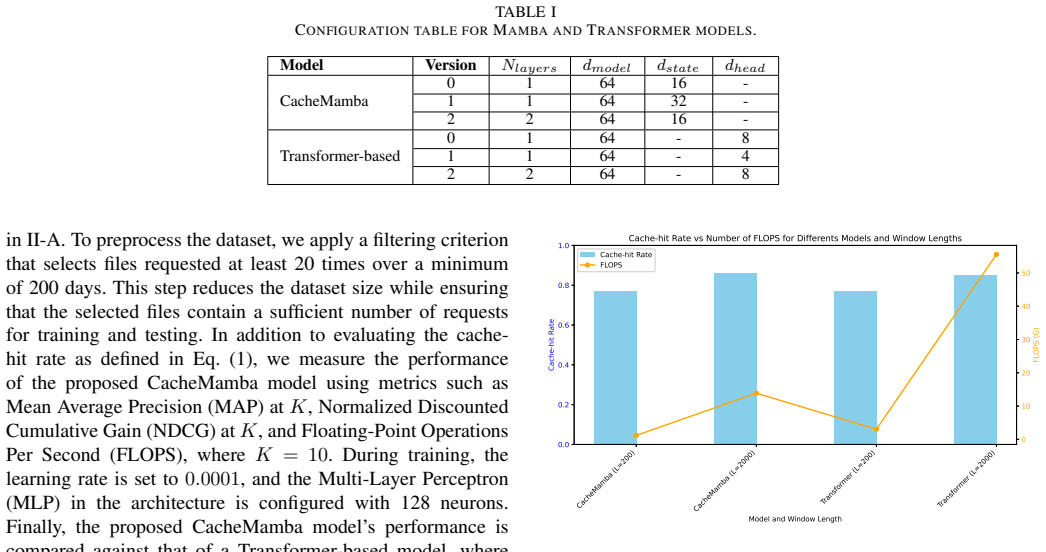
The central claim is that replacing the Transformer block with a Mamba block in a request-sequence ranking pipeline yields better top-K popularity prediction for mobile edge caching, and that the advantage grows with sequence length. On a MovieLens-derived request dataset, the paper shows CacheMamba reaching a MAP@10 of 0.1877 and a cache-hit rate of 0.8592 at a look-back window of 2000, versus 0.1696 and 0.8501 for the best Transformer version at the same window, while the Transformer's FLOPS grow 18.34-fold from L=200 to L=2000 compared to an 11.71-fold increase for CacheMamba. The paper also frames this as the first adoption of Mamba for popularity prediction in mobile edge caching.
Load-bearing premise
The load-bearing premise is that minimizing cross-entropy on the softmax-normalized request-count vector in Eq. (4) produces a ranking whose top-K set also maximizes the actual cache-hit rate in Eq. (1); if that surrogate is poorly calibrated, the reported ranking gains may not translate into real caching gains.
Editorial extensions
If this is right
- At a look-back window of 2000, CacheMamba reports a cache-hit rate about 0.01 higher than the Transformer baseline while using fewer FLOPS, suggesting that edge servers can afford longer request histories.
- The ranking formulation means that gains in MAP and NDCG should translate directly into better cache-hit rates under the definition in Eq. (1), so the reported metrics are not just ranking abstractions.
- Because Mamba is linear-time in sequence length, replacing attention with selective state spaces could make popularity prediction scalable to much larger look-back windows than current Transformer-based edge caches.
- Across three architectural versions, the paper reports consistent improvements in MAP, NDCG, and cache-hit rate, indicating the advantage is not tied to one specific hyperparameter configuration.
Reading between the lines
- The paper tests only MovieLens-32M, so the strongest test of the claimed long-sequence advantage would be to run the same architecture on a streaming video or CDN request trace, where popularity shifts are more pronounced and cache sizes are larger.
- The softmax target in Eq. (4) is one of several possible ranking surrogates; if Mamba's advantage is real, it should persist when the target is switched to pairwise ranking losses or sampled softmax for very large file catalogues.
- The fixed K=10 evaluation could be extended to dynamically sized cache budgets or multi-edge cooperative caching, where the ranking quality of the model would matter even more.
- Because the paper reports FLOPS rather than wall-clock latency, a natural follow-up would measure actual inference latency on edge-grade hardware; if linear-time complexity holds, the speedup should grow with sequence length.
Editorial analysis
A structured set of objections, weighed in public.
Referee Report
Summary. The paper proposes CacheMamba, a Mamba-based (state-space model) architecture for popularity prediction in mobile edge caching, framing the task as a top-K ranking problem. Historical request counts are arranged as sliding-window input matrices, the training target is a softmax-normalized request-count vector (Eq. 4), and the model is trained with cross-entropy loss. The authors benchmark three versions of CacheMamba against three versions of a Transformer-based model on the MovieLens-32M dataset, reporting MAP@K, NDCG@K, cache-hit rate, model size, and FLOPS at two look-back window lengths (L=200 and L=2000). The central claim is that CacheMamba consistently outperforms the Transformer-based models across all metrics, especially at longer sequence lengths, while requiring fewer FLOPS.
Significance. If the central claim were supported, the paper would provide a useful data point for applying Mamba-style selective state-space models to popularity prediction in edge caching, with potential practical benefit in reducing computational cost for long request histories. The study also formulates a reasonable ranking-based surrogate for cache-hit optimization and motivates the problem with relevant MEC applications. However, the paper's confirmatory value is currently undermined by the reported quantitative evidence: the central empirical claim is contradicted by the paper's own Table II, and no uncertainty quantification, repeated-seed experiments, or code release are provided to make the point estimates reproducible or assessable. The claimed improvements, as stated in the text, contain numerical errors that further weaken confidence. With the evidence as presented, the significance is not yet established.
major comments (4)
- [Section III, Table II] The claim that 'CacheMamba consistently outperforms the Transformer-based models across all metrics' is not supported by the table under a fixed comparison protocol. The paper defines three versions of each architecture, so the natural same-version comparison at L=2000 shows Transformer v2 beating CacheMamba v2 on MAP (0.1696 vs 0.1482), NDCG (0.6589 vs 0.6005), and cache-hit rate (0.8501 vs 0.8238). The headline advantage is obtained only by comparing the best CacheMamba version per metric (usually v1) with different Transformer versions (v2 or v0), which is not a consistent cross-architecture comparison. This directly contradicts the abstract's and Section III's central claim of 'superior performance' and 'consistently outperforms'.
- [Section III, paragraph after Table II] The numerical improvement figures cited in the text are incorrect. The text reports MAP improvements of 0.076 and 0.0181 for L=200 and L=2000, respectively, but the actual differences in Table II are 0.0076 (0.1769 vs 0.1693) and 0.0181 (0.1877 vs 0.1696). The 0.076 figure is off by a factor of ten, and the comparison basis is inconsistent because the Transformer value for L=200 (0.1693) corresponds to Transformer v2 while the CacheMamba value (0.1769) is CacheMamba v0. These errors affect load-bearing quantitative claims and must be corrected and recomputed under a fixed protocol.
- [Section III, experimental setup] No statistical assessment is provided: the paper reports single point estimates without error bars, confidence intervals, or repeated-seed runs. Given that the differences between architectures are often small (e.g., cache-hit rate 0.7729 vs 0.7511 at L=200, v0) and that model versions show high variance (e.g., Transformer v1 at L=2000 has cache-hit 0.5028 vs v2's 0.8501), the reported results cannot be distinguished from noise. The paper should include at least multiple random seeds with mean and standard deviation, or another statistically valid comparison, to support the claimed consistent outperformance.
- [Eq. (4) and cache-hit rate, Eq. (1)] The training target is a softmax-normalized request-count vector, and the model is trained with cross-entropy loss, while the evaluation metric is top-K cache-hit rate. The paper does not analyze or validate whether optimizing this surrogate reliably transfers to the cache-hit metric. For instance, a model that ranks popular items correctly at the top but with poorly calibrated probabilities could achieve high cache-hit yet poor cross-entropy, or vice versa. This mismatch may explain why model versions with higher MAP/NDCG do not always correspond to higher cache-hit rates (e.g., CacheMamba v0 at L=2000: NDCG 0.7261, cache-hit 0.8149; v1: NDCG 0.8027, cache-hit 0.8592; but at L=200, v0 has the highest cache-hit while v2 has the lowest). The authors should discuss this surrogate gap or evaluate with a metric directly tied to the caching objective.
minor comments (5)
- [Throughout] The manuscript contains numerous typographical errors, including 'Literiture Review', 'intorduciton', 'aformentioned', 'advancments', 'Cashing' in the index terms, and 'probabiities'. A careful copyedit is needed.
- [Fig. 2] The figure legend is garbled: 'T (an) o(me( (L=200)' should presumably read 'Transformer (L=200)', and similar artifacts appear for the other legend entries. The figure should be regenerated with a clear and correct legend.
- [Section III] The dataset split (train/validation/test split, temporal ordering, and preprocessing details) is not described. The paper mentions filtering files requested at least 20 times over 200 days but does not state how the data are divided or whether the test set respects temporal causality, which is important for time-series evaluation.
- [Table II] Model version selection is not described as a protocol: it appears that different versions are chosen post hoc for different metrics. The paper should specify which version (if any) is selected based on validation data before evaluating on the test set, and then report all metrics for that single selected model.
- [Section II-B, Eq. (8)-(9)] The positional encoding formula uses 'd' both as the feature index and in the numerator 'd / 10000^{2ℓ/d_model}'. This is ambiguous; the intended index range and the role of d in the exponent should be clarified.
Circularity Check
No circularity: CacheMamba is an empirical benchmark; the self-citations are contextual and no fitted quantity is renamed as a prediction.
full rationale
This paper is an empirical head-to-head benchmark of a Mamba-based encoder against a Transformer-based encoder for top-K popularity ranking. The training target (Eq. 4) is a softmax-normalized request-count vector, and the evaluation metrics (cache-hit rate in Eq. 1, MAP, NDCG, FLOPS) are computed from held-out test requests; no parameter fitted to a subset of test data is renamed as a prediction. The only self-citations ([2], [8], [9]) appear as related-work context and are not used to justify CacheMamba's architecture or performance; the core architecture is an application of externally introduced Mamba [11]. The claim that CacheMamba 'consistently outperforms' the Transformer is undermined by Table II's same-version comparisons (e.g., at L=2000, Transformer v2 exceeds CacheMamba v2 on MAP, NDCG, and cache-hit), but this is a correctness/selection-bias issue about which version is compared per metric, not a circularity in which a result is equivalent to its input by construction. No derivation chain reduces to its own assumptions.
Assumptions & free parameters
free parameters (6)
- Dataset filter thresholds =
min 20 requests and min 200 days
- Look-back window L =
200 and 2000
- Cache size K =
10
- Learning rate =
0.0001
- MLP hidden dimension =
128
- Mamba version selection =
N_layers in {1,2}, d_model=64, d_state in {16,32}
assumptions (4)
- domain assumption MovieLens-32M rating events are a valid proxy for MEC content request streams.
- domain assumption The softmax-normalized request-count vector in Eq. (4) is a valid training target for top-K cache-hit optimization.
- domain assumption The last output token of the Mamba encoder summarizes the entire input sequence.
- domain assumption Adjacent sliding-window samples can be treated as independent training examples.
Cite this review
Pith. "Pith review of CacheMamba: Popularity Prediction for Mobile Edge Caching Networks via Selective State Spaces." pith.science (2026). https://pith.science/paper/K7U6BJE5
@misc{pith2026250215746,
  author       = {Pith},
  title        = {Pith review of: CacheMamba: Popularity Prediction for Mobile Edge Caching Networks via Selective State Spaces},
  year         = {2026},
  howpublished = {\url{https://pith.science/paper/K7U6BJE5}},
  note         = {Machine review of arXiv:2502.15746}
}
read the original abstract
Mobile Edge Caching (MEC) plays a pivotal role in mitigating latency in data-intensive services by dynamically caching frequently requested content on edge servers. This capability is critical for applications such as Augmented Reality (AR), Virtual Reality (VR), and Autonomous Vehicles (AV), where efficient content caching and accurate popularity prediction are essential for optimizing performance. In this paper, we explore the problem of popularity prediction in MEC by utilizing historical time-series request data of intended files, formulating this problem as a ranking task. To this aim, we propose CacheMamba model by employing Mamba, a state-space model (SSM)-based architecture, to identify the top-K files with the highest likelihood of being requested. We then benchmark the proposed model against a Transformer-based approach, demonstrating its superior performance in terms of cache-hit rate, Mean Average Precision (MAP), Normalized Discounted Cumulative Gain (NDCG), and Floating-Point Operations Per Second (FLOPS), particularly when dealing with longer sequences.
Figures

Reference graph
Works this paper leans on
-
[13]
Uncovering selective state space model’s capabilities in lifelong sequential recommendation,
J. Yang, Y . Li, J. Zhao, H. Wang, M. Ma, J. Ma, Z. Ren, M. Zhang, X. Xin, Z. Chen et al. , “Uncovering selective state space model’s capabilities in lifelong sequential recommendation,” arXiv preprint arXiv:2403.16371, 2024
arXiv 2024
-
[1]
6g: A comprehensive survey on technologies, applications, challenges, and research problems,
H. H. H. Mahmoud, A. A. Amer, and T. Ismail, “6g: A comprehensive survey on technologies, applications, challenges, and research problems,” Transactions on Emerging Telecommunications Technologies , vol. 32, no. 4, p. e4233, Feb. 2021. TABLE II PERFORMANCE OF MAMBA AND TRANSFORMER MODELS ACROSS DIFFERENT WINDOW SIZES AND VERSIONS . Model Window Size Versi...
work page 2021
-
[2]
Digital aircomp-assisted federated edge learning with adaptive quantization,
G. Kianfar, S. J. S. Dmohammadi, J. Abouei, A. Mohammadi, and K. N. Plataniotis, “Digital aircomp-assisted federated edge learning with adaptive quantization,” in Proc. 2024 IEEE 4th International Conference on Human-Machine Systems (ICHMS) . IEEE, 2024, pp. 1–6
work page 2024
-
[3]
Ai-driven proactive content caching for 6g,
G. Cheng, C. Jiang, B. Yue, R. Wang, B. Alzahrani, and Y . Zhang, “Ai-driven proactive content caching for 6g,” IEEE Wireless Communi- cations, vol. 30, no. 3, pp. 180–188, June 2023
work page 2023
-
[4]
Joint caching and computing resource reservation for edge-assisted location-aware augmented reality,
Y . Pei, M. Li, H. Wu, Q. Ye, C. Zhou, S. Hu, and X. Shen, “Joint caching and computing resource reservation for edge-assisted location-aware augmented reality,” in Proc. ICC 2023-IEEE International Conference on Communications . IEEE, 2023, pp. 2547–2552
work page 2023
-
[5]
B. Mao, Y . Liu, J. Liu, and N. Kato, “Ai-assisted edge caching for metaverse of connected and automated vehicles: Proposal, challenges, and future perspectives,” IEEE V ehicular Technology Magazine, 2023
work page 2023
-
[6]
Content caching based on popularity and priority of content using seq2seq lstm in icn,
M. W. Kang and Y . W. Chung, “Content caching based on popularity and priority of content using seq2seq lstm in icn,” IEEE Access, vol. 11, pp. 16 831–16 842, Feb. 2023
work page 2023
-
[7]
Spatial-temporal content popularity prediction in cache enabled cellular networks,
L. Li, H. Tian, Y . Wang, and T. Zhang, “Spatial-temporal content popularity prediction in cache enabled cellular networks,” in Proc. 2022 21st International Symposium on Communications and Information Technologies (ISCIT). IEEE, 2022, pp. 111–116
work page 2022
Show all 14 references
-
[8]
Temporal dual-attention graph network for popularity prediction in mec networks,
G. Kianfar, Z. Hajiakhondi-Meybodi, and A. Mohammadi, “Temporal dual-attention graph network for popularity prediction in mec networks,” in Proc. 2024 IEEE 10th World F orum on Internet of Things (WF-IoT) . IEEE, 2024
2024
-
[9]
Multi-content time-series popularity prediction with multiple-model transformers in mec networks,
Z. H. Meybodi, A. Mohammadi, M. Hou, E. Rahimian, S. Heidarian, J. Abouei, and K. N. Plataniotis, “Multi-content time-series popularity prediction with multiple-model transformers in mec networks,” Ad Hoc Networks, vol. 157, p. 103436, April 2024
2024
-
[10]
Efficiently modeling long sequences with structured state spaces,
A. Gu, K. Goel, and C. R ´e, “Efficiently modeling long sequences with structured state spaces,” arXiv preprint arXiv:2111.00396 , 2021
2021 arXiv
-
[11]
Mamba: Linear-time sequence modeling with selective state spaces,
A. Gu and T. Dao, “Mamba: Linear-time sequence modeling with selective state spaces,” arXiv preprint arXiv:2312.00752 , 2023
2023 arXiv
-
[12]
Harmamba: Efficient and lightweight wearable sensor human activity recognition based on bidirectional mamba,
S. Li, T. Zhu, F. Duan, L. Chen, H. Ning, C. Nugent, and Y . Wan, “Harmamba: Efficient and lightweight wearable sensor human activity recognition based on bidirectional mamba,” IEEE Internet of Things Journal, 2024
2024
-
[14]
Attention is all you need,
A. Vaswani, “Attention is all you need,” Advances in Neural Information Processing Systems, 2017
2017
Reviewed August 8, 2026 · model on record in the stance chip above.
Discussion (0). Continue with ORCID to comment.