Harnessing Quantum Dynamics for Robust and Scalable Quantum Extreme Learning Machines
Pith reviewed 2026-05-23 01:01 UTC · model grok-4.3
The pith
Time evolution of MPS-modeled Rydberg chains generates high-quality embeddings for QELM without exact quantum simulation.
A machine-rendered reading of the paper's core claim, the machinery that carries it, and where it could break.
Core claim
Time-evolving an MPS system modeled as a chain of Rydberg atoms produces high-quality data embeddings with low classical computational overhead. Exact simulation of quantum dynamics is not necessary for strong machine learning performance; even approximate quantum embeddings can yield competitive results. Both increased disorder in the quantum state achieved by tuning Hamiltonian parameters and careful control of entanglement directly correlate with improved model accuracy.
What carries the argument
The Time Dependent Variational Principle (TDVP) with Matrix Product States (MPS) to simulate and control the quantum dynamics of a Rydberg atom chain for generating embeddings in QELM.
If this is right
- Approximate MPS-based simulations of quantum dynamics can replace exact quantum evolution while retaining competitive QELM accuracy.
- Tuning the Hamiltonian to increase state disorder improves classification accuracy in the QELM setting.
- Maintaining controlled levels of entanglement in the simulated system enhances model performance on image classification tasks.
- Low-overhead classical tensor-network methods enable scalable implementations of QELM frameworks.
Where Pith is reading between the lines
- The same controlled-dynamics approach could be tested on other image or sequence datasets to check whether the accuracy gains generalize beyond MNIST.
- Hybrid quantum-classical pipelines may benefit more from deliberate entanglement management than from maximizing entanglement.
- Tensor-network approximations might be applied to other quantum machine learning architectures that currently face expressivity limits from excessive entanglement.
Load-bearing premise
The chosen Rydberg atom chain Hamiltonian together with MPS truncation preserves the quantum features that actually drive classification gains on MNIST, rather than the gains arising mainly from classical post-processing steps.
What would settle it
If a classical embedding method with matched dimension and similar disorder statistics produces MNIST accuracy within a few percent of the TDVP-MPS embeddings, that would indicate the quantum dynamics are not required for the observed performance.
Figures




read the original abstract
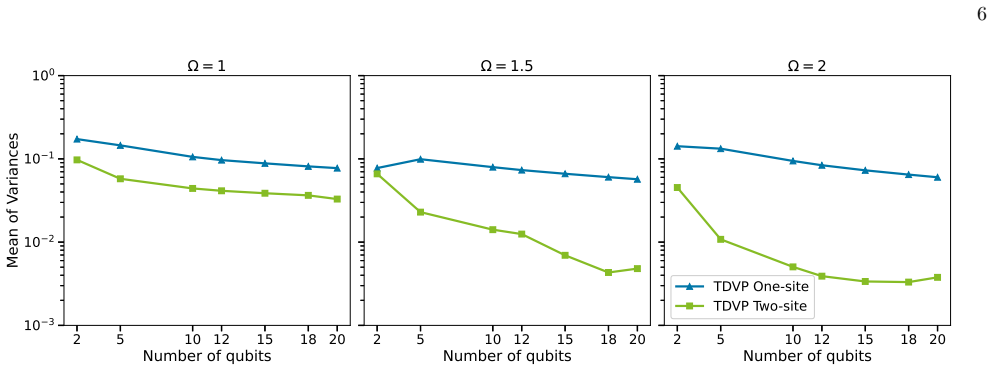
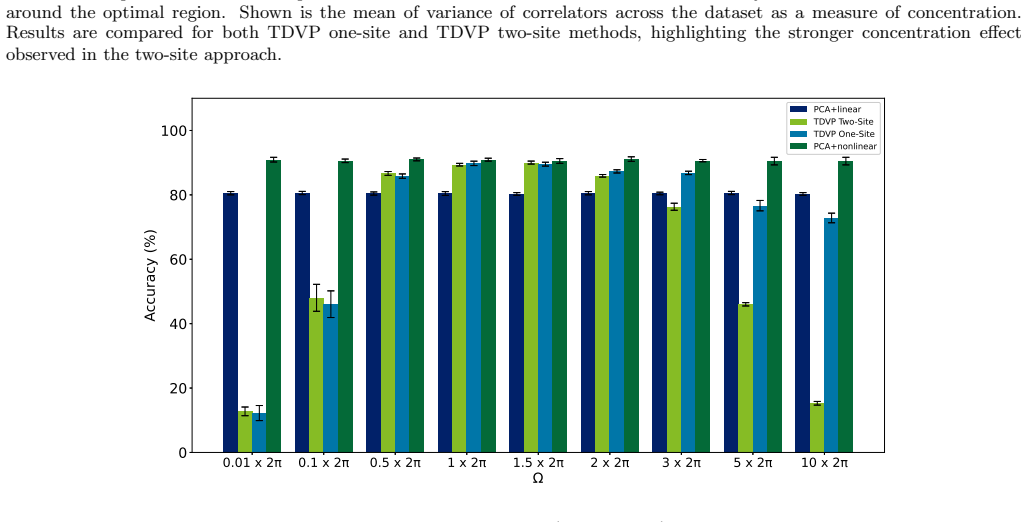
Quantum Extreme Learning Machine (QELM) is an emerging hybrid quantum machine learning framework that leverages quantum system dynamics to enhance classical models. However, QELM can suffer from the exponential concentration problem, where excessive entanglement reduces model expressivity. In this work, we gain insight into this challenge and demonstrate how tensor network methods specifically, the Time Dependent Variational Principle (TDVP) with Matrix Product States (MPS) can efficiently simulate quantum systems while controlling entanglement and mitigating exponential concentration. Using numerical experiments on the Modified National Institute of Standards and Technology (MNIST) dataset, we show that time-evolving an MPS system modeled as a chain of Rydberg atoms produces high-quality data embeddings with low classical computational overhead. Our findings indicate that exact simulation of quantum dynamics is not necessary for strong machine learning performance; even approximate quantum embeddings can yield competitive results. Furthermore, we observe that both increased disorder in the quantum state achieved by tuning Hamiltonian parameters and careful control of entanglement directly correlate with improved model accuracy, highlighting the importance of these factors in optimizing QELM performance.
Editorial analysis
A structured set of objections, weighed in public.
Referee Report
Summary. The paper claims that TDVP-MPS simulation of a Rydberg-atom chain Hamiltonian generates useful embeddings for QELM on MNIST. By tuning Hamiltonian disorder parameters and controlling entanglement via MPS bond dimension, the method mitigates exponential concentration; numerical results indicate that approximate (truncated) quantum dynamics suffice for competitive classification accuracy with low classical overhead.
Significance. If the experimental claims hold under proper controls, the work supplies a concrete, scalable classical route to QELM that avoids both full quantum simulation and the expressivity collapse associated with excessive entanglement. The explicit link between tunable disorder/entanglement and accuracy would be a useful design principle for hybrid quantum-classical models.
major comments (2)
- [Numerical experiments / MNIST results] The numerical MNIST experiments (abstract and § on results) report accuracy gains from disorder and entanglement control but supply no error bars, no classical or random-embedding baselines, no ablation isolating disorder versus bond-dimension effects, and no statistical significance tests. These omissions make it impossible to verify that the observed improvements arise from the controlled quantum dynamics rather than from classical post-processing or dataset artifacts.
- [Methods / TDVP-MPS setup] The central claim that MPS truncation preserves the quantum features relevant to classification rests on the untested assumption that the Rydberg Hamiltonian plus TDVP evolution with chosen bond dimension faithfully encodes the relevant correlations; without an ablation that varies the truncation while holding other factors fixed, it is unclear whether performance is independent of the simulation approximation or partly defined by it.
minor comments (2)
- [Hamiltonian definition] Notation for the Rydberg Hamiltonian parameters and the precise definition of the 'disorder' metric should be stated explicitly in the methods section rather than left implicit.
- [Abstract] The abstract states that 'exact simulation of quantum dynamics is not necessary'; this phrasing should be qualified to 'exact simulation of the full many-body wavefunction' to avoid implying that the MPS evolution itself is non-exact.
Simulated Author's Rebuttal
We thank the referee for the constructive comments on our manuscript. We address the two major concerns point-by-point below, agreeing that additional controls and ablations will strengthen the claims. We will incorporate the suggested revisions in the next version.
read point-by-point responses
-
Referee: [Numerical experiments / MNIST results] The numerical MNIST experiments (abstract and § on results) report accuracy gains from disorder and entanglement control but supply no error bars, no classical or random-embedding baselines, no ablation isolating disorder versus bond-dimension effects, and no statistical significance tests. These omissions make it impossible to verify that the observed improvements arise from the controlled quantum dynamics rather than from classical post-processing or dataset artifacts.
Authors: We agree that the absence of error bars, baselines, separate ablations, and statistical tests weakens the ability to attribute gains specifically to the controlled quantum dynamics. In the revised manuscript we will add: (i) error bars computed from multiple independent runs with different random seeds, (ii) explicit baselines including random embeddings and classical random-feature models, (iii) ablations that isolate the effects of disorder strength versus bond dimension, and (iv) paired statistical tests (e.g., Wilcoxon or t-tests) on the accuracy differences. These additions will be placed in the results section and will directly address the concern. revision: yes
-
Referee: [Methods / TDVP-MPS setup] The central claim that MPS truncation preserves the quantum features relevant to classification rests on the untested assumption that the Rydberg Hamiltonian plus TDVP evolution with chosen bond dimension faithfully encodes the relevant correlations; without an ablation that varies the truncation while holding other factors fixed, it is unclear whether performance is independent of the simulation approximation or partly defined by it.
Authors: The manuscript already demonstrates that accuracy correlates with bond dimension (i.e., entanglement level) under fixed Hamiltonian parameters, providing indirect support for the utility of controlled truncation. Nevertheless, we acknowledge that a dedicated ablation holding disorder and evolution time fixed while varying only the MPS bond dimension is missing. We will add this study in the revised version, reporting accuracy as a function of bond dimension under otherwise identical conditions, thereby testing whether the relevant classification features survive the truncation. revision: yes
Circularity Check
No significant circularity identified
full rationale
The provided abstract and context describe an empirical study using TDVP-MPS to evolve Rydberg atom chains for QELM embeddings on MNIST, with observations on disorder and entanglement correlating to accuracy. No load-bearing derivation step is shown that reduces by construction to its own inputs via self-definition, fitted parameters renamed as predictions, or self-citation chains. The claims rest on numerical experiments and standard tensor-network techniques without evident circular reduction; the derivation chain is self-contained against external benchmarks.
Axiom & Free-Parameter Ledger
free parameters (2)
- Hamiltonian disorder parameters
- MPS bond dimension / entanglement cutoff
axioms (1)
- domain assumption MPS representation with TDVP evolution sufficiently captures relevant quantum dynamics for the downstream ML task
Reference graph
Works this paper leans on
-
[1]
5 µ s up to a total time of 4 µ s. A detailed analysis of the effect of total evolution time on model performance is provided in [58]. Once the quantum embeddings were obtained, we per- formed classification using a simple linear fitting model with the quantum embeddings as input. In addition, we also compared the performance of our quantum-inspired QELM mod...
work page 2025
-
[2]
J. Biamonte, P. Wittek, N. Pancotti, P. Rebentrost, N. Wiebe, and S. Lloyd, Quantum machine learning, Na- ture 549, 195 (2017)
work page 2017
- [3]
-
[4]
Y. Liu, S. Arunachalam, and K. Temme, A rigorous and robust quantum speed-up in supervised machine learn- ing, Nature Physics 17, 1013 (2021)
work page 2021
-
[5]
E. R. Anschuetz, H.-Y. Hu, J.-L. Huang, and X. Gao, In- terpretable quantum advantage in neural sequence learn- ing, PRX Quantum 4, 020338 (2023)
work page 2023
- [6]
-
[7]
M. Kornjaˇ ca, H.-Y. Hu, C. Zhao, J. Wurtz, P. Weinberg, M. Hamdan, A. Zhdanov, S. H. Cantu, H. Zhou, R. A. Bravo, et al. , Large-scale quantum reservoir learning with an analog quan- tum computer, arXiv preprint arXiv:2407.02553 https://doi.org/10.48550/arXiv.2407.02553 (2024)
-
[8]
J. Garc ´ ıa-Beni, G. L. Giorgi, M. C. Soriano, and R. Zam- brini, Scalable photonic platform for real-time quantum reservoir computing, Physical Review Applied 20, 014051 (2023)
work page 2023
- [9]
-
[10]
R. Mart ´ ınez-Pe˜ na, J. Nokkala, G. L. Giorgi, R. Zambrini, and M. C. Soriano, Information processing capacity of spin-based quantum reservoir computing systems, Cog- nitive Computation , 1 (2023)
work page 2023
- [11]
- [12]
-
[13]
L. Innocenti, S. Lorenzo, I. Palmisano, A. Ferraro, M. Pa- ternostro, and G. M. Palma, Potential and limitations of quantum extreme learning machines, Communications Physics 6, 118 (2023)
work page 2023
- [14]
-
[15]
B. Schrauwen, D. Verstraeten, and J. Van Campenhout, An overview of reservoir computing: theory, applications and implementations, in Proceedings of the 15th european symposium on artificial neural networks. p. 471-482 2007 (2007) pp. 471–482
work page 2007
- [16]
-
[17]
M. Lukoˇ seviˇ cius and H. Jaeger, Reservoir computing ap- proaches to recurrent neural network training, Computer science review 3, 127 (2009)
work page 2009
-
[18]
J. B. Butcher, D. Verstraeten, B. Schrauwen, C. R. Day, and P. W. Haycock, Reservoir computing and extreme learning machines for non-linear time-series data analy- sis, Neural networks 38, 76 (2013)
work page 2013
-
[19]
G. Huang, G.-B. Huang, S. Song, and K. You, Trends in extreme learning machines: A review, Neural Networks 61, 32 (2015)
work page 2015
-
[20]
A. Bequ´ e and S. Lessmann, Extreme learning machines for credit scoring: An empirical evaluation, Expert Sys- tems with Applications 86, 42 (2017)
work page 2017
-
[21]
X. Wang, S. Ali, A. Arrieta, P. Arcaini, and M. Arrati- bel, Application of quantum extreme learning machines for qos prediction of elevators’ software in an industrial context, in Companion Proceedings of the 32nd ACM In- ternational Conference on the Foundations of Software Engineering (2024) pp. 399–410
work page 2024
- [22]
-
[23]
A. De Lorenzis, M. Casado, M. Estarellas, N. Lo Gullo, T. Lux, F. Plastina, A. Riera, and J. Settino, Harnessing quantum extreme learning machines for image classifi- cation, Physical Review Applied 23, 10.1103/physrevap- plied.23.044024 (2025)
-
[24]
A. Sakurai, A. Hayashi, W. J. Munro, and K. Nemoto, Simple hamiltonian dynamics as a powerful resource for image classification, Phys. Rev. A 111, 052432 (2025)
work page 2025
-
[25]
A. Hayashi, A. Sakurai, W. J. Munro, and K. Nemoto, Effective quantum feature maps in quantum extreme reservoir computation from the xy model, Phys. Rev. A 111, 022431 (2025)
work page 2025
-
[26]
K. Kobayashi, K. Fujii, and N. Yamamoto, Feedback- driven quantum reservoir computing for time-series anal- ysis, PRX Quantum 5, 040325 (2024)
work page 2024
-
[27]
M. Rader and A. M. L¨ auchli, Floating phases in one-di- mensional rydberg ising chains (2019), arXiv:1908.02068 [cond-mat.quant-gas]
-
[28]
C.-Y. Wang, Geometric phase and multipartite entangle- ment of rydberg atom chains (2025), arXiv:2407.14854 [cond-mat.quant-gas]
-
[29]
H. Bernien, S. Schwartz, A. Keesling, H. Levine, A. Om- ran, H. Pichler, S. Choi, A. S. Zibrov, M. Endres, M. Greiner, V. Vuleti´ c, and M. D. Lukin, Probing many- body dynamics on a 51-atom quantum simulator, Nature 551, 579 (2017)
work page 2017
-
[30]
A. Keesling, A. Omran, H. Levine, H. Bernien, H. Pich- ler, S. Choi, R. Samajdar, S. Schwartz, P. Silvi, S. Sachdev, P. Zoller, M. Endres, M. Greiner, V. Vuleti´ c, and M. D. Lukin, Quantum kibble–zurek mechanism and critical dynamics on a programmable rydberg simulator, Nature 568, 207 (2019)
work page 2019
-
[31]
I. Agarwal, T. L. Patti, R. A. Bravo, S. F. Yelin, and A. Anandkumar, Extending quantum perceptrons: Ry- dberg devices, multi-class classification, and error toler - ance (2024), arXiv:2411.09093 [quant-ph]
-
[32]
R. A. Bravo, K. Najafi, X. Gao, and S. F. Yelin, Quantum reservoir computing using arrays of rydberg atoms, PRX Quantum 3, 030325 (2022)
work page 2022
-
[33]
R. Or´ us, A practical introduction to tensor networks: Matrix product states and projected entangled pair states, Annals of physics 349, 117 (2014)
work page 2014
-
[34]
U. Schollw¨ ock, The density-matrix renormalization group in the age of matrix product states, Annals of physics 326, 96 (2011)
work page 2011
-
[35]
Schollw¨ ock, The density-matrix renormalization group, Reviews of modern physics 77, 259 (2005)
U. Schollw¨ ock, The density-matrix renormalization group, Reviews of modern physics 77, 259 (2005)
work page 2005
-
[36]
S.-J. Ran, E. Tirrito, C. Peng, X. Chen, L. Tagliacozzo, G. Su, and M. Lewenstein, Tensor network contractions: methods and applications to quantum many-body systems (Springer Nature, 2020)
work page 2020
-
[37]
F. Verstraete, V. Murg, and J. I. Cirac, Matrix prod- uct states, projected entangled pair states, and varia- tional renormalization group methods for quantum spin systems, Advances in physics 57, 143 (2008)
work page 2008
-
[38]
M. J. O’Rourke and G. K.-L. Chan, Entanglement in the quantum phases of an unfrustrated rydberg atom array, Nature Communications 14, 5397 (2023)
work page 2023
-
[39]
Y. Kharkov and K. Hyatt, High-performance simulation of Rydberg atom arrays with tensor networks, in APS March Meeting Abstracts , APS Meeting Abstracts, Vol. 2024 (2024) p. Z50.001
work page 2024
- [40]
-
[41]
G. Vidal, Efficient classical simulation of slightly entan- gled quantum computations, Physical review letters 91, 147902 (2003)
work page 2003
-
[42]
S. R. White, Density matrix formulation for quantum renormalization groups, Physical review letters 69, 2863 (1992)
work page 1992
-
[43]
K. Kechedzhi, S. Isakov, S. Mandr` a, B. Villalonga, X. Mi, S. Boixo, and V. Smelyanskiy, Effective quantum volume, fidelity and computational cost of noisy quantum pro- cessing experiments, Future Generation Computer Sys- tems 153, 431–441 (2024)
work page 2024
-
[44]
G. Vidal, Classical simulation of infinite-size quantum lattice systems in one spatial dimension, Physical review letters 98, 070201 (2007)
work page 2007
-
[45]
J. Haegeman, C. Lubich, I. Oseledets, B. Vandereycken, and F. Verstraete, Unifying time evolution and optimiza- tion with matrix product states, Physical Review B 94, 165116 (2016)
work page 2016
-
[46]
J. Haegeman, J. I. Cirac, T. J. Osborne, I. Piˇ zorn, H. Ver- schelde, and F. Verstraete, Time-dependent variational principle for quantum lattices, Physical review letters 107, 070601 (2011)
work page 2011
-
[47]
S. Paeckel, T. K¨ ohler, A. Swoboda, S. R. Manmana, 12 U. Schollw¨ ock, and C. Hubig, Time-evolution methods for matrix-product states, Annals of Physics 411, 167998 (2019)
work page 2019
- [49]
- [50]
-
[51]
P. Calabrese and J. Cardy, Evolution of entanglement entropy in one-dimensional systems, Journal of Statisti- cal Mechanics: Theory and Experiment 2005, P04010 (2005)
work page 2005
- [52]
-
[53]
L. Deng, The mnist database of handwritten digit images for machine learning research [best of the web], IEEE signal processing magazine 29, 141 (2012)
work page 2012
-
[54]
Aquila: Quera’s 256-qubit neutral-atom quantum computer,
J. Wurtz, A. Bylinskii, B. Braverman, J. Amato-Grill, S. H. Cantu, F. Huber, A. Lukin, F. Liu, P. Weinberg, J. Long, et al. , Aquila: Quera’s 256-qubit neutral-atom quantum computer, arXiv preprint arXiv:2306.11727 https://doi.org/10.48550/arXiv.2306.11727 (2023)
- [55]
- [56]
-
[57]
S. Goto and I. Danshita, Performance of the time- dependent variational principle for matrix product states in the long-time evolution of a pure state, Phys. Rev. B 99, 054307 (2019)
work page 2019
-
[58]
J. Hauschild and F. Pollmann, Efficient numerical sim- ulations with tensor networks: Tensor network python (tenpy), SciPost Physics Lecture Notes , 005 (2018)
work page 2018
-
[59]
See the supplemental material for details
-
[60]
K. P. F.R.S., Liii. on lines and planes of closest fit to systems of points in space, The London, Edinburgh, and Dublin Philosophical Magazine and Journal of Science 2, 559 (1901)
work page 1901
- [61]
-
[62]
M. M´ ezard, G. Parisi, and M. A. Virasoro,Spin glass the- ory and beyond: An Introduction to the Replica Method and Its Applications , Vol. 9 (World Scientific Publishing Company, 1987)
work page 1987
- [63]
-
[64]
Harnessing Physics-Inspired Dynamics for Robust and Scalable Quantum Extreme Learning Machines
A. M. L¨ auchli and C. Kollath, Spreading of correlations and entanglement after a quench in the one-dimensional bose–hubbard model, Journal of Statistical Mechanics: Theory and Experiment 2008, P05018 (2008) . 1 Supplementary Material for “Harnessing Physics-Inspired Dynamics for Robust and Scalable Quantum Extreme Learning Machines” I. DETAILS OF P ARAM...
work page 2008
discussion (0)
Sign in with ORCID, Apple, or X to comment. Anyone can read and Pith papers without signing in.