Nonlinear Tripartite Coupling of Trapped Electrons with Magnons in a Hybrid Quantum System
Pith reviewed 2026-05-23 00:07 UTC · model grok-4.3
The pith
A trapped electron near a micromagnet produces tunable nonlinear tripartite coupling between its motion, spin, and magnons at the single-quantum level.
A machine-rendered reading of the paper's core claim, the machinery that carries it, and where it could break.
Core claim
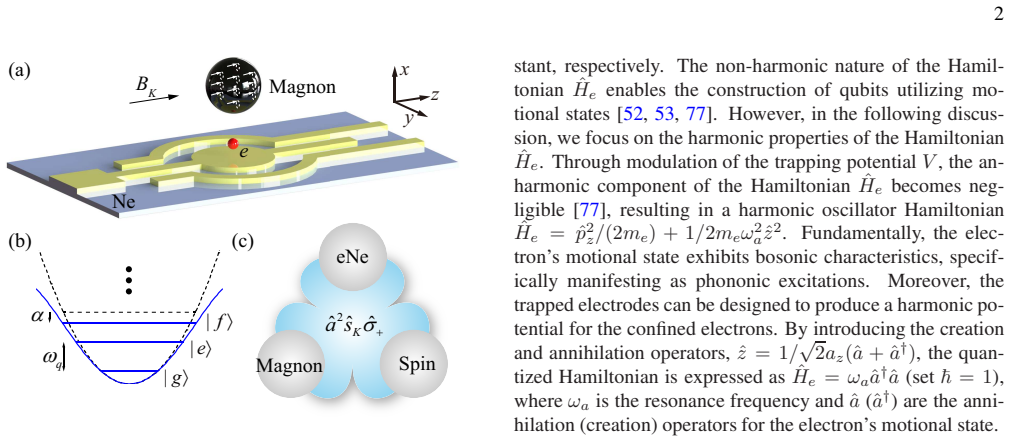
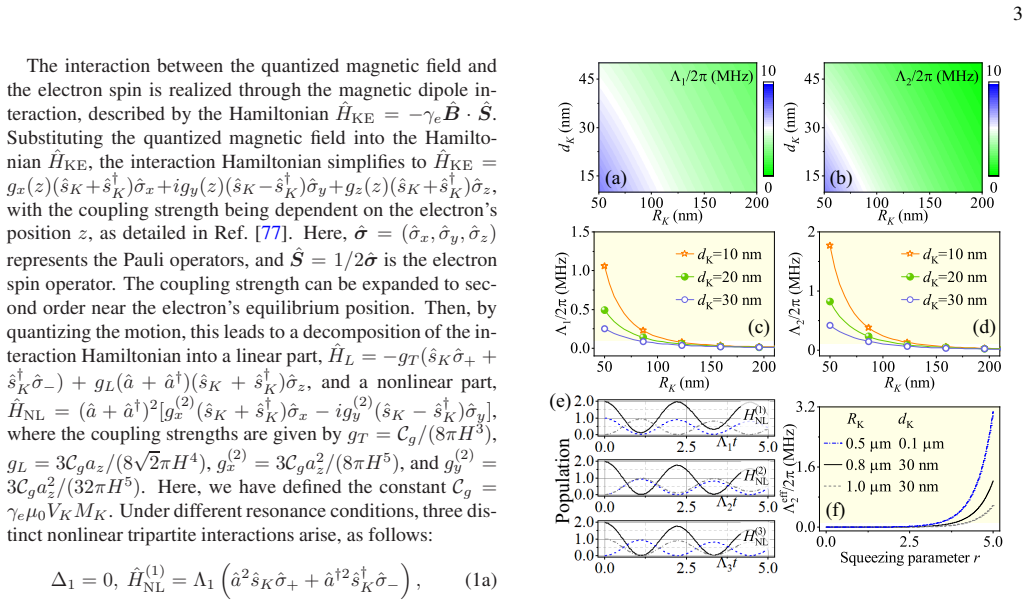
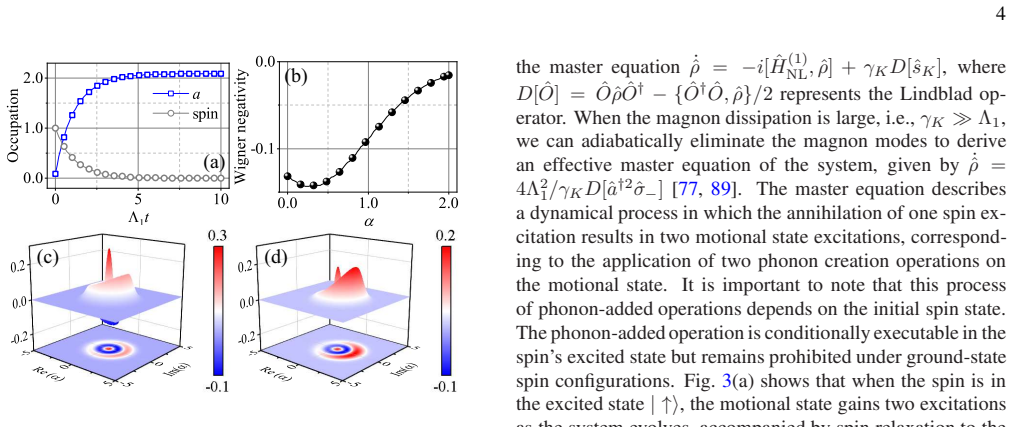
In a hybrid setup of one trapped electron and a nearby micromagnet, the electron charge and spin degrees of freedom couple to magnon modes such that the large zero-point motion yields a nonlinear tripartite interaction at the single-quantum level, with two phonons simultaneously interacting with a single spin and a single magnon excitation; this coupling is tunable and strong enough to let magnons mediate interactions among the distinct degrees of freedom of two electrons, enabling preparation of few-body entangled states.
What carries the argument
Nonlinear tripartite spin-magnon-motion coupling enabled by the electron zero-point motion, in which two phonons interact with one spin and one magnon excitation.
If this is right
- Magnons mediate coupling among distinct degrees of freedom of two electrons.
- Rapid preparation of few-body entangled states becomes feasible.
- The protocol can be implemented with existing electron-trap and magnonics techniques.
- The platform supports exploration of multipartite interactions and nonclassical state generation.
Where Pith is reading between the lines
- The same mechanism could be extended to generate entanglement across more than two electrons or additional magnon modes.
- The tripartite interaction might serve as a building block for hybrid quantum networks that combine electron traps with magnonic waveguides.
- Control over the tunable coupling could enable new protocols for quantum simulation of spin-phonon-magnon models.
Load-bearing premise
The hybrid electron-micromagnet setup permits the described nonlinear coupling to occur without decoherence or other losses dominating the interaction.
What would settle it
An experiment that measures the coupling rates between electron motion, spin, and magnons in the hybrid device and checks whether the nonlinear tripartite interaction appears at the single-excitation level with the predicted strength.
Figures
read the original abstract
Coherent nonlinear tripartite interactions are critical for advancing quantum simulation and information processing in hybrid quantum systems, yet they remain experimentally challenging and still evade comprehensive exploration. Here, we predict a nonlinear tripartite coupling mechanism in a hybrid setup comprising a single trapped electron and a nearby micromagnet. The tripartite coupling here leverages the electron's intrinsic charge (motional) and spin degrees of freedom interacting with the magnon modes of the micromagnet. Thanks to the large spatial extent of the electron zero-point motion, we show that it is possible to obtain a tunable and strong spin-magnon-motion coupling at the single quantum level, with two phonons simultaneously interacting with a single spin and magnon excitation. This enables, for example, magnons to mediate coupling among distinct degrees of freedom of two electrons, which can be used for the rapid preparation of few-body entangled states. This protocol can be readily implemented with the well-developed techniques in electron traps and quantum magnonics, and may open new avenues for quantum simulations and hybrid quantum information processing by introducing a versatile platform for exploring multipartite interactions and nonclassical state generation.
Editorial analysis
A structured set of objections, weighed in public.
Referee Report
Summary. The manuscript predicts a nonlinear tripartite spin-magnon-motion coupling in a hybrid system of a single trapped electron near a micromagnet. The electron's charge (motional) and spin degrees of freedom interact with magnon modes of the micromagnet, enabled by the large spatial extent of the electron zero-point motion. This is claimed to yield a tunable, strong coupling at the single-quantum level in which two phonons interact simultaneously with one spin and one magnon excitation, allowing magnons to mediate coupling between distinct degrees of freedom of two electrons for rapid preparation of few-body entangled states. The protocol is asserted to be realizable with existing electron-trap and magnonics techniques.
Significance. If the underlying model and parameter estimates hold, the work supplies a concrete, experimentally accessible platform for multipartite nonlinear interactions that have been difficult to realize. The use of established trap and magnonics methods, together with the explicit prediction of a two-phonon–one-spin–one-magnon process, constitutes a falsifiable advance that could be tested with current hardware and could open routes to magnon-mediated entanglement and hybrid quantum simulation.
major comments (2)
- [Abstract / model derivation] Abstract and model section: the central claim that the zero-point-motion-enabled tripartite coupling reaches the single-quantum level with two phonons interacting with one spin and one magnon rests on an explicit Hamiltonian and numerical evaluation of the effective coupling strength versus decoherence rates; neither the Hamiltonian nor any such calculation is supplied, rendering the feasibility assertion unverifiable.
- [Feasibility discussion] The weakest assumption identified—that the hybrid setup permits the interaction without dominant decoherence—is load-bearing for all claimed applications, yet no quantitative estimate comparing the predicted coupling rate to relevant loss channels (charge noise, magnon damping, spin relaxation) appears in the text.
Simulated Author's Rebuttal
We thank the referee for their careful reading, positive assessment of the significance, and constructive comments. The points raised highlight the need for greater explicitness in the model and feasibility analysis. We have revised the manuscript to include the requested details while preserving the original claims, which were based on the underlying derivations now made fully transparent.
read point-by-point responses
-
Referee: [Abstract / model derivation] Abstract and model section: the central claim that the zero-point-motion-enabled tripartite coupling reaches the single-quantum level with two phonons interacting with one spin and one magnon rests on an explicit Hamiltonian and numerical evaluation of the effective coupling strength versus decoherence rates; neither the Hamiltonian nor any such calculation is supplied, rendering the feasibility assertion unverifiable.
Authors: We agree that the explicit Hamiltonian and supporting calculations are essential for verifiability. The model derivation begins from the position-dependent magnetic field interaction with the electron's charge and spin degrees of freedom, leading to the tripartite term after a Schrieffer-Wolff transformation that isolates the two-phonon–one-spin–one-magnon process. In the revised manuscript we have added the full Hamiltonian (now Eq. (3) in Section II) together with the analytic expression for the effective coupling g_eff and a new numerical evaluation (new Figure 3) that plots g_eff against the relevant rates for realistic trap frequencies, micromagnet parameters, and zero-point motion amplitudes, confirming the single-quantum regime is accessible. revision: yes
-
Referee: [Feasibility discussion] The weakest assumption identified—that the hybrid setup permits the interaction without dominant decoherence—is load-bearing for all claimed applications, yet no quantitative estimate comparing the predicted coupling rate to relevant loss channels (charge noise, magnon damping, spin relaxation) appears in the text.
Authors: We concur that a direct comparison is required to substantiate feasibility. The revised manuscript now contains a dedicated feasibility subsection (Section IV.B) that supplies order-of-magnitude estimates: the tunable tripartite coupling reaches ~10–100 kHz for achievable gradients and trap parameters, while charge-noise-induced dephasing is kept below 1 kHz with existing surface-electrode traps, magnon damping is ~1–10 kHz in low-loss YIG films, and electron spin relaxation exceeds 1 s. These values demonstrate that the interaction can exceed the dominant loss channels, supporting the claimed applications. revision: yes
Circularity Check
No significant circularity detected
full rationale
The paper advances a theoretical prediction of tunable nonlinear tripartite spin-magnon-motion coupling arising from the electron's zero-point motion in a trap-micromagnet hybrid. No equations, Hamiltonians, or derivation steps are supplied that reduce any claimed result to a fitted input, self-citation chain, or definitional equivalence. The central claim is presented as a forward consequence of the physical setup rather than a re-derivation of prior quantities, satisfying the criteria for a self-contained prediction without circular reduction.
Axiom & Free-Parameter Ledger
axioms (1)
- domain assumption The electron possesses a large spatial extent of zero-point motion that enables strong coupling to magnon modes.
Reference graph
Works this paper leans on
- [1]
-
[2]
Y . Tabuchi, S. Ishino, A. Noguchi, T. Ishikawa, R. Ya- mazaki, K. Usami, and Y . Nakamura, Quantum magnon- ics: The magnon meets the superconducting qubit, C. R. Phys. 17, 729 (2016)
work page 2016
-
[3]
D. Lachance-Quirion, Y . Tabuchi, A. Gloppe, K. Usami, and Y . Nakamura, Hybrid quantum systems based on magnonics, Appl. Phys. Express 12, 070101 (2019)
work page 2019
-
[4]
G. Burkard, M. J. Gullans, X. Mi, and J. R. Petta, Superconductor-semiconductor hybrid-circuit quantum electro- dynamics, Nat. Rev. Phys. 2, 129 (2020)
work page 2020
-
[5]
A. A. Clerk, K. W. Lehnert, P . Bertet, J. R. Petta, and Y . Naka- mura, Hybrid quantum systems with circuit quantum electrod y- namics, Nat. Phys. 16, 257 (2020)
work page 2020
-
[6]
N. Maskara, S. Ostermann, J. Shee, M. Kalinowski, A. Mc- Clain Gomez, R. Araiza Bravo, D. S. Wang, A. I. Krylov, N. Y . Yao, M. Head-Gordon, M. D. Lukin, and S. F. Yelin, Pro- grammable simulations of molecules and materials with reco n- figurable quantum processors, Nat. Phys. 21, 289 (2025)
work page 2025
-
[7]
A. J. Daley, I. Bloch, C. Kokail, S. Flannigan, N. Pearson, M. Troyer, and P . Zoller, Practical quantum advantage in quan- tum simulation, Nature 607, 667 (2022)
work page 2022
-
[8]
I. M. Georgescu, S. Ashhab, and F. Nori, Quantum simulation, Rev. Mod. Phys. 86, 153 (2014)
work page 2014
- [9]
-
[10]
V . So, M. D. Suganthi, A. Menon, M. Zhu, R. Zhuravel, H. Pu, P . G. Wolynes, J. N. Onuchic, and G. Pagano, Trapped-ion quantum simulation of electron transfer models with tunabl e dissipation, Sci. Adv. 10, eads8011 (2024)
work page 2024
-
[11]
C. Gross and I. Bloch, Quantum simulations with ultracold atoms in optical lattices, Science 357, 995 (2017)
work page 2017
- [12]
-
[13]
X.-L. Hei, P .-B. Li, X.-F. Pan, and F. Nori, Enhanced tripar- tite interactions in spin-magnon-mechanical hybrid syste ms, Phys. Rev. Lett. 130, 073602 (2023)
work page 2023
- [14]
- [15]
-
[16]
F.-Z. Ji and J.-H. An, Kerr nonlinearity induced strong spin - magnon coupling, Phys. Rev. B 108, L180409 (2023)
work page 2023
- [17]
- [18]
-
[19]
¨O. O. Soykal and M. E. Flatt´ e, Strong field inter- actions between a nanomagnet and a photonic cavity, Phys. Rev. Lett. 104, 077202 (2010)
work page 2010
-
[20]
Y . Tabuchi, S. Ishino, T. Ishikawa, R. Yamazaki, K. Us- ami, and Y . Nakamura, Hybridizing ferromagnetic magnons and microwave photons in the quantum limit, Phys. Rev. Lett. 113, 083603 (2014)
work page 2014
-
[21]
X. Zhang, C.-L. Zou, L. Jiang, and H. X. Tang, Strongly coupled magnons and cavity microwave photons, Phys. Rev. Lett. 113, 156401 (2014)
work page 2014
-
[22]
D. Zhang, X.-M. Wang, T.-F. Li, X.-Q. Luo, W. Wu, F. Nori, and J. Q. Y ou, Cavity quantum electrodynamics with fer- romagnetic magnons in a small yttrium-iron-garnet sphere, npj Quantum Inf. 1, 15014 (2015)
work page 2015
-
[23]
Y .-P . Wang, G.-Q. Zhang, D. Zhang, X.-Q. Luo, W. Xiong, S.-P . Wang, T.-F. Li, C.-M. Hu, and J. Q. Y ou, Magnon Kerr effect in a strongly coupled cavity-magnon system, Phys. Rev. B 94, 224410 (2016)
work page 2016
- [24]
- [25]
-
[26]
C. Kong, H. Xiong, and Y . Wu, Magnon-induced nonreciprocity based on the magnon Kerr effect, Phys. Rev. Appl. 12, 034001 (2019)
work page 2019
-
[27]
Y .-P . Wang, J. W. Rao, Y . Yang, P .-C. Xu, Y . S. Gui, B. M. Yao, J. Q. Y ou, and C.-M. Hu, Nonre- ciprocity and unidirectional invisibility in cavity magno nics, Phys. Rev. Lett. 123, 127202 (2019)
work page 2019
-
[28]
Y .-P . Wang, G.-Q. Zhang, D. Zhang, T.-F. Li, C.-M. Hu, and J. Q. Y ou, Bistability of cavity magnon polaritons, Phys. Rev. Lett. 120, 057202 (2018)
work page 2018
-
[29]
Z. Shen, G.-T. Xu, M. Zhang, Y .-L. Zhang, Y . Wang, C.-Z. Chai, C.-L. Zou, G.-C. Guo, and C.-H. Dong, Co- herent coupling between phonons, magnons, and photons, Phys. Rev. Lett. 129, 243601 (2022)
work page 2022
-
[30]
Y . Wang, J.-L. Wu, Y .-F. Jiao, T.-X. Lu, H.-L. Zhang, L.-Y . Jiang, L.-M. Kuang, and H. Jing, Enhancing tripartite photo n- phonon-magnon entanglement by synergizing parametric am- plifications, Phys. Rev. A 111, 013709 (2025)
work page 2025
-
[31]
A. Kani, B. Sarma, and J. Twamley, Intensive cavity- magnomechanical cooling of a levitated macromagnet, Phys. Rev. Lett. 128, 013602 (2022) . 6
work page 2022
-
[32]
X. Zhang, C.-L. Zou, L. Jiang, and H. X. Tang, Cavity mag- nomechanics, Sci. Adv. 2, e1501286 (2016)
work page 2016
- [33]
-
[34]
C. Gonzalez-Ballestero, D. H¨ ummer, J. Gieseler, and O. Romero-Isart, Theory of quantum acoustom- agnonics and acoustomechanics with a micromagnet, Phys. Rev. B 101, 125404 (2020)
work page 2020
-
[35]
C. Gonzalez-Ballestero, J. Gieseler, and O. Romero- Isart, Quantum acoustomechanics with a micromagnet, Phys. Rev. Lett. 124, 093602 (2020)
work page 2020
-
[36]
M. F. Colombano, G. Arregui, F. Bonell, N. E. Capuj, E. Chavez-Angel, A. Pitanti, S. O. V alenzuela, C. M. Sotomayor-Torres, D. Navarro-Urrios, and M. V . Costache, Fer- romagnetic resonance assisted optomechanical magnetomet er, Phys. Rev. Lett. 125, 147201 (2020)
work page 2020
-
[37]
X.-F. Pan, P .-B. Li, X.-L. Hei, X. Zhang, M. Mochizuki, F.-L. Li, and F. Nori, Magnon-skyrmion hybrid quan- tum systems: Tailoring interactions via magnons, Phys. Rev. Lett. 132, 193601 (2024)
work page 2024
-
[38]
Y . Tabuchi, S. Ishino, A. Noguchi, T. Ishikawa, R. Ya- mazaki, K. Usami, and Y . Nakamura, Coherent coupling be- tween a ferromagnetic magnon and a superconducting qubit, Science 349, 405 (2015)
work page 2015
-
[39]
S. P . Wolski, D. Lachance-Quirion, Y . Tabuchi, S. Kono, A. Noguchi, K. Usami, and Y . Nakamura, Dissipation-based quantum sensing of magnons with a superconducting qubit, Phys. Rev. Lett. 125, 117701 (2020)
work page 2020
-
[40]
M. Kounalakis, G. E. W. Bauer, and Y . M. Blanter, Analog quantum control of magnonic cat states on a chip by a super- conducting qubit, Phys. Rev. Lett. 129, 037205 (2022)
work page 2022
- [41]
-
[42]
A. Jennings, X. Zhou, I. Grytsenko, and E. Kawakami, Quantum computing using floating electrons on cryogenic substrates: Potential and challenges, Appl. Phys. Lett. 124, 120501 (2024)
work page 2024
- [43]
-
[44]
M. Kjaergaard, M. E. Schwartz, J. Braumller, P . Krantz, J. I.-J. Wang, S. Gustavsson, and W. D. Oliver, Superconducting qubits: Current state of play, Annu. Rev. Condens. Matter Phys. 11, 369 (2020)
work page 2020
-
[45]
P . M. Platzman and M. I. Dykman, Quantum computing with electrons floating on liquid helium, Science 284, 1967 (1999)
work page 1967
-
[46]
M. M. Nieto, Electrons above a helium surface and the one- dimensional Rydberg atom, Phys. Rev. A 61, 034901 (2000)
work page 2000
-
[47]
M. I. Dykman, P . M. Platzman, and P . Seddighrad, Qubits with electrons on liquid helium, Phys. Rev. B 67, 155402 (2003)
work page 2003
-
[48]
Y . P . Monarkha, S. S. Sokolov, A. V . Smorodin, and N. Stu- dart, Decay of excited surface electron states in liquid hel ium and related relaxation phenomena induced by short-wavelen gth ripplons, Low Temp. Phys. 36, 565 (2010)
work page 2010
-
[49]
E. Kawakami, A. Elarabi, and D. Konstantinov, Image-charge detection of the Rydberg states of surface electrons on liqu id helium, Phys. Rev. Lett. 123, 086801 (2019)
work page 2019
-
[50]
E. Kawakami, A. Elarabi, and D. Konstantinov, Relaxation of the excited Rydberg states of surface electrons on liquid helium, Phys. Rev. Lett. 126, 106802 (2021)
work page 2021
- [51]
-
[52]
X. Zhou, G. Koolstra, X. Zhang, G. Yang, X. Han, B. Dizdar, X. Li, R. Divan, W. Guo, K. W. Murch, D. I. Schuster, and D. Jin, Single electrons on solid neon as a solid-state qubit plat- form, Nature 605, 46 (2022)
work page 2022
-
[53]
X. Zhou, X. Li, Q. Chen, G. Koolstra, G. Yang, B. Dizdar, Y . Huang, C. S. Wang, X. Han, X. Zhang, D. I. Schuster, and D. Jin, Electron charge qubit with 0.1 millisecond coherenc e time, Nat. Phys. 20, 116 (2024)
work page 2024
- [54]
- [55]
-
[56]
D. I. Schuster, A. Fragner, M. I. Dykman, S. A. Lyon, and R. J. Schoelkopf, Proposal for manipulating and detecting spin a nd orbital states of trapped electrons on helium using cavity q uan- tum electrodynamics, Phys. Rev. Lett. 105, 040503 (2010)
work page 2010
-
[57]
G. Yang, A. Fragner, G. Koolstra, L. Ocola, D. A. Czaplewski, R. J. Schoelkopf, and D. I. Schuster, Coupling an ensemble of electrons on superfluid helium to a superconducting circu it, Phys. Rev. X 6, 011031 (2016)
work page 2016
-
[58]
G. Koolstra, G. Yang, and D. I. Schuster, Coupling a single electron on superfluid helium to a superconducting resonato r, Nat. Commun. 10, 5323 (2019)
work page 2019
-
[59]
N. R. Beysengulov, Ø. S. Schøyen, S. D. Bilek, J. B. Flaten, O. Leinonen, M. Hjorth-Jensen, J. Pollanen, H. E. Kris- tiansen, Z. J. Stewart, J. D. Weidman, and A. K. Wilson, Coulomb interaction-driven entanglement of electrons on h e- lium, PRX Quantum 5, 030324 (2024)
work page 2024
-
[60]
S. A. Lyon, Spin-based quantum computing using electrons on liquid helium, Phys. Rev. A 74, 052338 (2006)
work page 2006
-
[61]
M. Zhang and L. F. Wei, Spin-orbit couplings between distant electrons trapped individually on liquid helium, Phys. Rev. B 86, 205408 (2012)
work page 2012
-
[62]
M. I. Dykman, O. Asban, Q. Chen, D. Jin, and S. A. Lyon, Spin dynamics in quantum dots on liquid helium, Phys. Rev. B 107, 035437 (2023)
work page 2023
-
[63]
Q. Chen, I. Martin, L. Jiang, and D. Jin, Elec- tron spin coherence on a solid neon surface, Quantum Sci. Technol. 7, 045016 (2022)
work page 2022
-
[64]
F. R. Bradbury, M. Takita, T. M. Gurrieri, K. J. Wilkel, K. Eng , M. S. Carroll, and S. A. Lyon, Efficient clocked electron tran s- fer on superfluid helium, Phys. Rev. Lett. 107, 266803 (2011)
work page 2011
-
[65]
E. Kawakami, J. Chen, M. Benito, and D. Konstantinov, Blueprint for quantum computing using electrons on helium, Phys. Rev. Appl. 20, 054022 (2023)
work page 2023
-
[66]
V . V . Zavyalov, I. I. Smolyaninov, E. A. Zotova, A. S. Borodin, and S. G. Bogomolov, Electron states above the surfaces of solid cryodielectrics for quantum-computing. , J. Low Temp. Phys. 138, 415 (2005)
work page 2005
-
[67]
Jin, Quantum electronics and optics at the interface of solid neon and superfluid helium, Quantum Sci
D. Jin, Quantum electronics and optics at the interface of solid neon and superfluid helium, Quantum Sci. Technol. 5, 035003 (2020)
work page 2020
- [68]
-
[69]
W. Qin, A. Miranowicz, P .-B. Li, X.-Y . L¨ u, J. Q. Y ou, and F. Nori, Exponentially enhanced light-matter interaction , coop- erativities, and steady-state entanglement using paramet ric am- plification, Phys. Rev. Lett. 120, 093601 (2018)
work page 2018
-
[70]
W. Ge, B. C. Sawyer, J. W. Britton, K. Jacobs, J. J. Bollinger, and M. Foss-Feig, Trapped ion quantum information processing 7 with squeezed phonons, Phys. Rev. Lett. 122, 030501 (2019)
work page 2019
-
[71]
P .-B. Li, Y . Zhou, W.-B. Gao, and F. Nori, Enhancing spin- phonon and spin-spin interactions using linear resources i n a hybrid quantum system, Phys. Rev. Lett. 125, 153602 (2020)
work page 2020
-
[72]
P . Groszkowski, H.-K. Lau, C. Leroux, L. C. G. Govia, and A. A. Clerk, Heisenberg-limited spin squeezing via bosonic parametric driving, Phys. Rev. Lett. 125, 203601 (2020)
work page 2020
-
[73]
Y .-H. Chen, W. Qin, X. Wang, A. Miranowicz, and F. Nori, Shortcuts to adiabaticity for the quantum Rabi model: Effici ent generation of giant entangled cat states via parametric amp lifi- cation, Phys. Rev. Lett. 126, 023602 (2021)
work page 2021
-
[74]
S. C. Burd, R. Srinivas, H. M. Knaack, W. Ge, A. C. Wilson, D. J. Wineland, D. Leibfried, J. J. Bollinger, D. T. C. Allcoc k, and D. H. Slichter, Quantum amplification of boson-mediated interactions, Nat. Phys. 17, 898 (2021)
work page 2021
-
[75]
X.-Y . L¨ u, Y . Wu, J. R. Johansson, H. Jing, J. Zhang, and F. Nori, Squeezed optomechanics with phase-matched ampli- fication and dissipation, Phys. Rev. Lett. 114, 093602 (2015)
work page 2015
-
[76]
M.-A. Lemonde, N. Didier, and A. A. Clerk, Enhanced non- linear interactions in quantum optomechanics via mechanic al amplification, Nat. Commun. 7, 11338 (2016)
work page 2016
-
[77]
See Supplementary Material at http://xxx for detailed derivations of our main results
-
[78]
J. Xu, C. Zhong, S. Zhuang, C. Qian, Y . Jiang, A. Pishe- hvar, X. Han, D. Jin, J. M. Jornet, B. Zhen, J. Hu, L. Jiang, and X. Zhang, Slow-wave hybrid magnonics, Phys. Rev. Lett. 132, 116701 (2024)
work page 2024
-
[79]
S. C. Burd, R. Srinivas, J. J. Bollinger, A. C. Wilson, D. J. Wineland, D. Leibfried, D. H. Slichter, and D. T. C. All- cock, Quantum amplification of mechanical oscillator motio n, Science 364, 1163 (2019)
work page 2019
- [80]
discussion (0)
Sign in with ORCID, Apple, or X to comment. Anyone can read and Pith papers without signing in.