FLUME-FNO: data-efficient and scalable prediction of 3D wind and temperature fields in unseen urban morphologies
Pith reviewed 2026-05-22 22:33 UTC · model grok-4.3
The pith
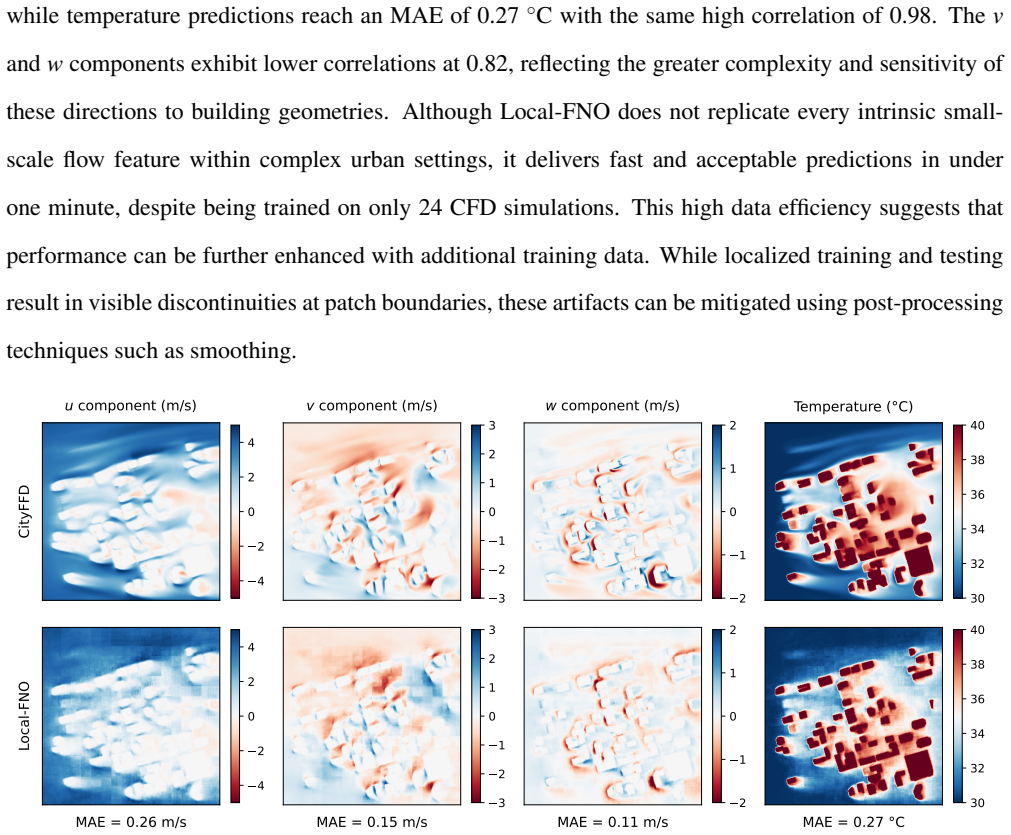
FLUME-FNO predicts 3D urban wind and temperature fields on unseen building layouts with mean absolute errors of 0.2 m/s and 0.19 °C after training on 23 CFD simulations.
A machine-rendered reading of the paper's core claim, the machinery that carries it, and where it could break.
Core claim
FLUME-FNO encodes building geometry through the Multi-Directional Distance Feature, which records directional distances to visible structures, then crops the encoded field into 3D patches for training a Fourier Neural Operator; this lets the model learn from only 23 CFD simulations and produce wind-speed and temperature fields on new morphologies at the stated error levels while supplying ensemble-based uncertainty estimates.
What carries the argument
Multi-Directional Distance Feature (MDDF) that records directional distances to surrounding buildings to capture visible open-space geometry, combined with patch cropping to augment training data inside the Fourier Neural Operator.
If this is right
- The model generalizes to entirely new building arrangements without retraining.
- Ensemble uncertainty ranges from 3 percent to 40 percent and can serve as a practical proxy for reliability in wind-engineering applications.
- Rapid microclimate evaluation becomes feasible for energy-consumption, pedestrian-comfort, and pollutant-dispersion studies.
- Training data requirements drop dramatically compared with conventional deep-learning approaches to the same task.
Where Pith is reading between the lines
- Patch-based geometric encoding of this type could be tested on other bounded fluid problems such as indoor airflow or coastal wave fields.
- Integration into iterative urban-design software would let users explore dozens of layouts in the time previously needed for one CFD run.
- The visible-geometry premise suggests a natural next test: adding time-dependent boundary conditions like shifting wind directions while keeping the same feature representation.
Load-bearing premise
The local urban microclimate is governed primarily by the building geometry that is directly visible from each location.
What would settle it
Apply the trained model to an urban configuration containing enclosed courtyards or deep canyons where flow is dominated by buildings not visible in line-of-sight from the measurement points, then check whether wind-speed or temperature errors exceed 0.2 m/s or 0.19 °C.
Figures


read the original abstract
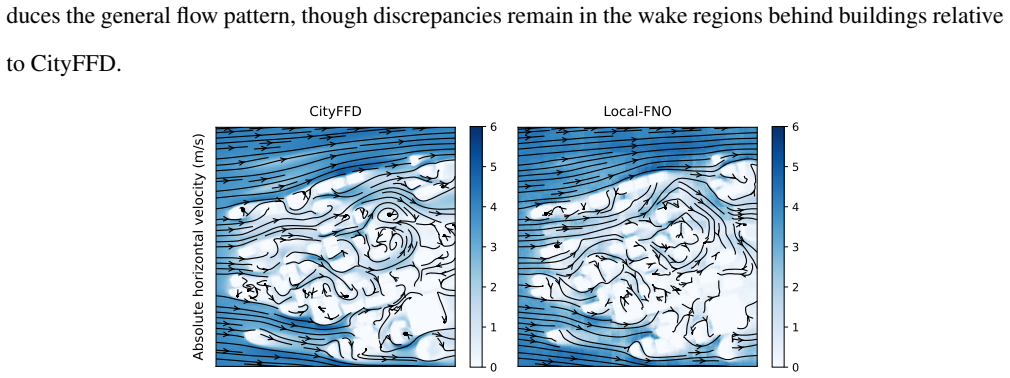
Urban microclimate, encompassing wind and temperature fields shaped by building geometry, significantly impacts energy consumption, pedestrian winds, pollutant dispersion, urban heat island, and public health. Accurately predicting microclimate is crucial yet challenging. Conventional Computational Fluid Dynamics (CFD) is computationally prohibitive for rapid assessments, while many deep learning approaches require extensive training data and struggle with generalization in unseen configurations. We present the Fast Localized Urban Microclimate Emulation Fourier Neural Operator (FLUME-FNO), a data-efficient and scalable framework for rapid prediction of 3D wind and temperature fields based solely on building geometry. FLUME-FNO assumes the local urban microclimate is primarily governed by surrounding geometry directly visible from a specific location. To encode this, the framework introduces a novel Multi-Directional Distance Feature (MDDF), representing visible open-space structures by measuring directional distances to surrounding buildings. By computing MDDF over the full domain and cropping encoded geometric features into smaller 3D patches, FLUME-FNO effectively augments limited CFD data, enabling robust learning from just 23 CFD simulations. The model achieves mean absolute errors of 0.2 m/s for wind speed and 0.19 {\deg}C for temperature on unseen configurations. Addressing the need for trustworthy fast microclimate prediction, the framework is further assessed using a deep ensemble as a practical proxy for FLUME-FNO uncertainty, ranging from 3% to 40% depending on location. The UQ framework demonstrates FLUME-FNO provides resilient, trustworthy predictions within acceptable accuracy thresholds for wind engineering and microclimate studies, highlighting its potential for real-world applications.
Editorial analysis
A structured set of objections, weighed in public.
Referee Report
Summary. The manuscript presents FLUME-FNO, a Fourier Neural Operator framework for predicting 3D wind and temperature fields in urban morphologies from building geometry alone. It introduces the Multi-Directional Distance Feature (MDDF) to encode visible open-space structures and employs patch-based cropping of encoded features to augment training data, enabling learning from only 23 CFD simulations. The central claim is that the model achieves mean absolute errors of 0.2 m/s (wind speed) and 0.19 °C (temperature) on unseen configurations, with an additional deep-ensemble uncertainty quantification step.
Significance. If the generalization claim holds, the data-efficiency (training on 23 simulations) and patch-augmentation strategy would represent a meaningful advance for rapid urban microclimate assessment where full CFD remains prohibitive. The inclusion of a practical UQ proxy via deep ensembles is a constructive element that directly addresses trustworthiness for wind-engineering applications.
major comments (2)
- [Abstract] Abstract and § on methods: the central generalization claim (MAE 0.2 m/s / 0.19 °C on unseen morphologies) rests on the premise that local microclimate is governed primarily by directly visible surrounding geometry; this premise directly motivates both the MDDF construction and the independent 3D-patch cropping. No quantitative test is reported that isolates the contribution of non-local effects (wake interference, channeling, or pressure gradients induced by buildings outside the visible line-of-sight or outside a given patch). If such effects are non-negligible, the learned operator will systematically under-represent them, undermining both the reported errors and the unseen-configuration statement.
- [Abstract] Abstract: specific error values and training size are reported, yet no information is supplied on data splits, cross-validation procedure, baseline comparisons, or the precise criterion used to designate configurations as “unseen.” Without these details the numerical claims cannot be assessed for soundness.
minor comments (1)
- [Abstract] Abstract: the temperature unit appears as “0.19 {deg}C”; standard notation °C should be used for readability.
Simulated Author's Rebuttal
We thank the referee for the constructive feedback on our manuscript. We address each major comment point by point below, proposing revisions where the comments identify gaps in the current presentation.
read point-by-point responses
-
Referee: [Abstract] Abstract and § on methods: the central generalization claim (MAE 0.2 m/s / 0.19 °C on unseen morphologies) rests on the premise that local microclimate is governed primarily by directly visible surrounding geometry; this premise directly motivates both the MDDF construction and the independent 3D-patch cropping. No quantitative test is reported that isolates the contribution of non-local effects (wake interference, channeling, or pressure gradients induced by buildings outside the visible line-of-sight or outside a given patch). If such effects are non-negligible, the learned operator will systematically under-represent them, undermining both the reported errors and the unseen-configuration statement.
Authors: The referee accurately notes that the framework is built on the stated assumption of local governance by visible geometry, which motivates the MDDF and patch-based approach. The manuscript does not contain a dedicated quantitative isolation of non-local effects such as wake interference from distant buildings. The reported errors on unseen morphologies provide empirical support for the approximation within the tested cases, but we agree this does not constitute a direct test. In revision we will expand the discussion to explicitly acknowledge this limitation, reference relevant urban fluid dynamics literature on non-local contributions, and outline a possible future experiment (e.g., controlled addition of distant obstacles) to quantify their impact. revision: partial
-
Referee: [Abstract] Abstract: specific error values and training size are reported, yet no information is supplied on data splits, cross-validation procedure, baseline comparisons, or the precise criterion used to designate configurations as “unseen.” Without these details the numerical claims cannot be assessed for soundness.
Authors: We agree that these details are necessary to evaluate the numerical claims. The current manuscript states the use of 23 CFD simulations and reports performance on unseen configurations, but does not supply the requested specifics in the abstract or methods. In the revised version we will add explicit statements: data split (18 simulations for training, 5 held-out morphologies for testing), cross-validation procedure (5-fold), baseline comparisons (standard FNO without MDDF and a 3D U-Net), and the definition of “unseen” (building morphologies whose geometric layouts do not appear in any training simulation). These additions will be placed in both the abstract and the methods section. revision: yes
Circularity Check
No significant circularity; derivation is self-contained against external CFD benchmarks
full rationale
The paper trains a Fourier Neural Operator on 23 independent CFD simulations as ground truth and evaluates generalization on unseen morphologies using standard supervised metrics (MAE). The MDDF feature and patch cropping are motivated by an explicit modeling assumption about visible geometry, but this assumption is not derived from the outputs or fitted parameters; performance is measured against external CFD data rather than by construction. No self-citation chains, uniqueness theorems, or fitted-input-as-prediction patterns appear in the provided text. The central claims reduce to empirical validation on held-out simulations, not to re-expression of the training inputs.
Axiom & Free-Parameter Ledger
free parameters (1)
- Neural network hyperparameters and training settings
axioms (1)
- domain assumption Local microclimate governed primarily by visible surrounding geometry
invented entities (1)
-
Multi-Directional Distance Feature (MDDF)
no independent evidence
Lean theorems connected to this paper
-
IndisputableMonolith/Foundation/AlexanderDuality.leanalexander_duality_circle_linking unclear?
unclearRelation between the paper passage and the cited Recognition theorem.
FLUME-FNO assumes the local urban microclimate is primarily governed by surrounding geometry directly visible from a specific location... Multi-Directional Distance Feature (MDDF)... cropping encoded geometric features into smaller 3D patches
-
IndisputableMonolith/Foundation/ArithmeticFromLogic.leanembed_strictMono_of_one_lt unclear?
unclearRelation between the paper passage and the cited Recognition theorem.
Trained on only 24 CFD simulations... mean absolute errors of 0.3 m/s for wind speed and 0.3 °C for temperature
What do these tags mean?
- matches
- The paper's claim is directly supported by a theorem in the formal canon.
- supports
- The theorem supports part of the paper's argument, but the paper may add assumptions or extra steps.
- extends
- The paper goes beyond the formal theorem; the theorem is a base layer rather than the whole result.
- uses
- The paper appears to rely on the theorem as machinery.
- contradicts
- The paper's claim conflicts with a theorem or certificate in the canon.
- unclear
- Pith found a possible connection, but the passage is too broad, indirect, or ambiguous to say the theorem truly supports the claim.
Reference graph
Works this paper leans on
-
[1]
W., Johansson, E., Thorsson, S., Lindberg, F
Yahia, M. W., Johansson, E., Thorsson, S., Lindberg, F. & Rasmussen, M. I. Effect of urban design on microclimate and thermal comfort outdoors in warm-humid dar es salaam, tanzania. Int. journal biometeorology 62, 373–385 (2018)
work page 2018
-
[2]
Hao, Z. et al. Gnot: A general neural operator transformer for operator learning. In International Conference on Machine Learning, 12556–12569 (PMLR, 2023). 9/10
work page 2023
-
[3]
Li, Z. et al. Geometry-informed neural operator for large-scale 3d pdes. Adv. Neural Inf. Process. Syst. 36, 35836–35854 (2023)
work page 2023
- [4]
-
[5]
Qin, S. et al. Modeling multivariable high-resolution 3d urban microclimate using localized fourier neural operator. Build. Environ. 112668 (2025)
work page 2025
-
[6]
Biljecki, F. & Chow, Y . S. Global building morphology indicators. Comput. Environ. Urban Syst. 95, 101809, DOI: https://doi.org/10.1016/j.compenvurbsys.2022.101809 (2022)
-
[7]
Hu, J., Fan, T., Tang, X., Yang, Z. & Ren, Y . Nonlinear relations of urban morphology to thermal anomalies: A cross-time comparative study based on grad-cam and shap. Ecol. Indic. 162, 112024, DOI: https://doi.org/10.1016/j.ecolind.2024.112024 (2024)
-
[8]
Kaseb, Z., Hafezi, M., Tahbaz, M. & Delfani, S. A framework for pedestrian-level wind conditions improvement in urban areas: Cfd simulation and optimization. Build. Environ. 184, 107191, DOI: https://doi.org/10.1016/j.buildenv.2020.107191 (2020)
-
[9]
Li, Z. et al. Fourier neural operator for parametric partial differential equations. In 9th Interna- tional Conference on Learning Representations, ICLR 2021, Virtual Event, Austria, May 3-7, 2021 (OpenReview.net, 2021)
work page 2021
-
[10]
Peng, W. et al. Fourier neural operator for real-time simulation of 3d dynamic urban microclimate. Build. Environ. 248, 111063 (2024)
work page 2024
-
[11]
Mortezazadeh, M., Wang, L. L., Albettar, M. & Yang, S. Cityffd – city fast fluid dynamics for urban microclimate simulations on graphics processing units. Urban Clim. 41, 101063, DOI: https: //doi.org/10.1016/j.uclim.2021.101063 (2022)
-
[12]
Yang, S. Assessment of Urban Microclimate and Its Impact on Outdoor Thermal Comfort and Building Energy Performance. Ph.D. thesis, Concordia University (2024)
work page 2024
-
[13]
Zhan, D., Sezer, N., Hou, D., Wang, L. & Hassan, I. G. Integrating urban heat island impact into building energy assessment in a hot-arid city. Buildings 13, 1818 (2023)
work page 2023
- [14]
discussion (0)
Sign in with ORCID, Apple, or X to comment. Anyone can read and Pith papers without signing in.