Global isotopic analysis of hyperfine-resolved rotational spectroscopic data for barium monofluoride, BaF
Pith reviewed 2026-05-22 23:01 UTC · model grok-4.3
The pith
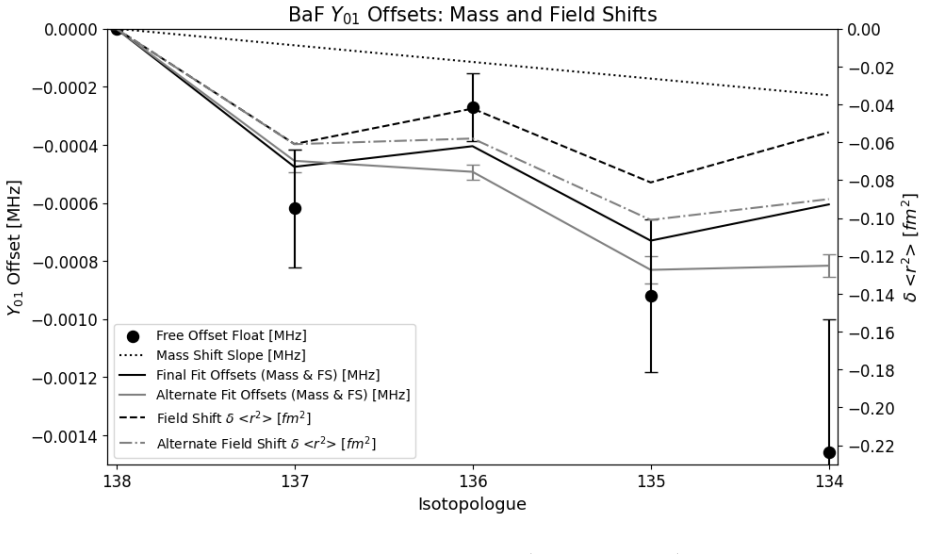
Nuclear field shifts from barium nuclear size variations explain the distinctive Born-Oppenheimer breakdown structure seen in BaF rotational constants.
A machine-rendered reading of the paper's core claim, the machinery that carries it, and where it could break.
Core claim
New spectroscopic data for the 138Ba19F, 137Ba19F, 136Ba19F, 135Ba19F, and 134Ba19F isotopologues are analyzed together with earlier data sets in a combined global fit. This produces significantly improved hyperfine parameters and reveals a distinctive structure in the Born-Oppenheimer breakdown of the primary rotational constant. The structure is accounted for by nuclear field shifts due to the known isotopic variation in barium nuclear sizes, in combination with the smaller linear mass-dependent Born-Oppenheimer breakdown terms.
What carries the argument
Born-Oppenheimer breakdown analysis of the primary rotational constant that incorporates nuclear field shifts from isotopic barium nuclear size variation
If this is right
- The refined hyperfine parameters increase the precision available for modeling BaF energy levels in electron electric dipole moment and nuclear anapole moment experiments.
- Separation of nuclear field shift contributions from mass-dependent terms improves the description of isotopic dependence across the measured isotopologues.
- The global fit supplies a more complete set of spectroscopic constants that can be used to predict transition frequencies for additional vibrational levels or isotopologues.
Where Pith is reading between the lines
- The same nuclear-field-shift correction could be applied to Born-Oppenheimer breakdown analyses of other heavy-metal monofluorides to test whether the pattern is general.
- If the nuclear size effect dominates the observed structure, reanalysis of older BaF data sets with explicit field-shift terms might reduce apparent discrepancies in the literature.
- Extension of the global fit to include vibrational dependence would show whether the nuclear field shift contribution remains constant or varies with vibrational quantum number.
Load-bearing premise
The global least-squares fit accounts for all relevant interactions and prior data sets for the three main isotopologues contain no unrecognized systematic offsets.
What would settle it
A new high-precision measurement of the rotational constant for one of the studied isotopologues that deviates from the nuclear-field-shift-predicted value after the mass-dependent terms are subtracted would falsify the proposed explanation.
Figures

read the original abstract
New high-precision microwave spectroscopic measurements and analysis of rotational energy level transitions in the ground vibronic state of the open-shell BaF molecule are reported with the purpose of contributing to studies of physics beyond the Standard Model. BaF is currently among the key candidate molecules being examined in the searches for a measurable electron electric dipole moment, eEDM, as well as the nuclear anapole moment. Employing Fourier-transform microwave spectroscopy, these new pure rotational transition frequencies for the 138Ba19F, 137Ba19F, 136Ba19F, 135Ba19F, and 134Ba19F isotopologues are analyzed here in a combined global fit with previous microwave data sets for 138Ba19F (v = 0 - 4), 137Ba19F, and 136Ba19F using the program SPFIT. As a result, hyperfine parameters are significantly improved, and we observe a distinctive structure in a Born-Oppenheimer breakdown (BOB) analysis of the primary rotational constant. This can be understood using the nuclear field shifts due to the known isotopic variation in the size of barium nuclei and in combination with the smaller linear mass-dependent BOB terms.
Editorial analysis
A structured set of objections, weighed in public.
Referee Report
Summary. The manuscript reports new Fourier-transform microwave (FTMW) measurements of pure rotational transitions in the ground vibronic state of BaF for the isotopologues 138Ba19F, 137Ba19F, 136Ba19F, 135Ba19F, and 134Ba19F. These data are merged in a single global least-squares fit using SPFIT with earlier microwave datasets for 138Ba19F (v=0–4), 137Ba19F, and 136Ba19F. The resulting parameters show improved hyperfine constants, and a Born-Oppenheimer breakdown (BOB) analysis of the leading rotational constant exhibits a distinctive isotopic dependence that the authors interpret as arising from nuclear field shifts (due to known variations in Ba nuclear charge radii) together with smaller linear mass-dependent BOB contributions.
Significance. If the reported BOB structure is shown to be robust, the work supplies a concrete example of how nuclear-size effects must be incorporated into high-precision spectroscopic models of open-shell molecules containing heavy atoms. This is directly relevant to ongoing eEDM and nuclear-anapole searches that rely on BaF. The global multi-isotopologue SPFIT treatment and the addition of new FTMW lines for the lighter Ba isotopes constitute a clear methodological strength; the analysis also supplies a falsifiable prediction that the same field-shift pattern should appear in other Ba-containing diatomics once comparable data become available.
major comments (1)
- [Results and discussion (BOB analysis paragraph)] The central claim that the observed structure in the BOB analysis of the primary rotational constant is attributable to nuclear field shifts (rather than an artifact of the merged dataset) rests on the untested assumption that the legacy microwave frequencies for 138Ba19F (v=0–4), 137Ba19F, and 136Ba19F contain no unrecognized systematic offsets at the level of the small field-shift correction. No leave-one-out test, subset-fit comparison, or explicit floating of a field-shift term inside SPFIT is described; without such a check the attribution cannot be regarded as load-bearing.
minor comments (2)
- [Abstract and § on experimental results] The abstract and main text should explicitly state the number of new transitions measured for each new isotopologue and the rms residual of the global fit so that readers can judge the internal consistency of the combined dataset.
- [Table of spectroscopic constants] Table of fitted constants should include the correlation matrix (or at least the largest off-diagonal elements) between the isotopologue-specific Y_01 values and the BOB/field-shift parameters to allow assessment of parameter trade-offs.
Simulated Author's Rebuttal
We thank the referee for the constructive review and for recognizing the value of the global multi-isotopologue fit and its relevance to eEDM searches. We respond to the major comment below.
read point-by-point responses
-
Referee: [Results and discussion (BOB analysis paragraph)] The central claim that the observed structure in the BOB analysis of the primary rotational constant is attributable to nuclear field shifts (rather than an artifact of the merged dataset) rests on the untested assumption that the legacy microwave frequencies for 138Ba19F (v=0–4), 137Ba19F, and 136Ba19F contain no unrecognized systematic offsets at the level of the small field-shift correction. No leave-one-out test, subset-fit comparison, or explicit floating of a field-shift term inside SPFIT is described; without such a check the attribution cannot be regarded as load-bearing.
Authors: We agree that the manuscript does not describe leave-one-out tests, subset-fit comparisons, or explicit floating of a field-shift term, and that such checks would strengthen the attribution. The observed isotopic dependence in the BOB term for the rotational constant matches the known variation in Ba nuclear charge radii, but we acknowledge that without the requested robustness tests the claim rests on the assumption of no unrecognized systematics in the legacy data. In revision we will add (i) a fit using only the new FTMW measurements for all five isotopologues and (ii) a comparison of BOB parameters obtained with and without the legacy 138Ba19F (v=0–4) lines, together with a brief discussion of the results. These additions will be placed in the Results and discussion section. revision: yes
Circularity Check
No circularity; BOB isotopic pattern interpreted via external nuclear radii data after global fit
full rationale
The paper reports a global SPFIT least-squares fit to combined FTMW and legacy microwave data for multiple BaF isotopologues, extracts effective rotational constants, and then notes an isotopic structure in the BOB analysis of those constants. The structure is attributed to known nuclear field shifts (from independent measurements of Ba nuclear charge radii) plus smaller mass-dependent BOB terms. No equation or step reduces the reported structure to a fitted parameter by construction, no self-citation chain is load-bearing for the central claim, and the interpretation relies on external physical data rather than re-deriving the fit inputs. This is a standard post-fit empirical interpretation against external benchmarks.
Axiom & Free-Parameter Ledger
Reference graph
Works this paper leans on
-
[1]
from the following studies: C. Ryzlewicz and T. T¨ orring (1980) [40], C. Ryzlewicz, H.- U. Sch¨ utze-Pahlmann, J. Hoeft, and T. T¨ orring (1982) [41], and W. E. Ernst, J. K¨ andler, and T. T¨ orring (1986) [42]. After successfully combining the data from all of these studies in a single fit, high-precision FTMW transition frequencies measured using the C...
work page 1980
-
[2]
BaF spectral data used to perform a global fit
136Ba19F 5 91→285 0.03 7-6→22-21 0 No Ryzlewicz et al.[41] 137Ba19F 24 104 and 285 0.06 8-7 and 22-21 0 Yes Ernst et al.[42] 138Ba19F 3 13 and 26 0.02 1-0 and 2-1 0 Yes Total Five Isotopologues95 13→285Varied1-0→22-21 0→4Partial TABLE I. BaF spectral data used to perform a global fit. This work introduces the first data for isotopologues 135Ba19F and 134B...
work page 1982
-
[3]
In 3 separate cases a fit was used to determineV X (setting ∆ X 01 = 0), ∆ X 01 (settingV X = 0), and the best combination of these using Equation 5 above following the general procedure outlined in Bizzocchi, et al. [55]. Here first the reference isotopologue dependent BOBδ X 01 parameter is determined and the corresponding equivalent unitless, reference...
work page 2060
-
[4]
T. C. Steimle, S. Frey, A. Le, D. DeMille, D. A. Rahmlow, and C. Linton,Phys. Rev. A84, 012508 (2011)
work page 2011
-
[5]
M. G. Kozlov, A. V. Titov, N. S. Mosyagin, and P. V. Souchko,Phys. Rev. A56, R3326 (1997)
work page 1997
-
[6]
A. V. Titov, N. S. Mosyagin, A. N. Petrov, and T. A. Isaev,Int. J. Quantum Chem.104, 223 (2005)
work page 2005
-
[7]
M. K. Nayak and R. K. Chaudhuri,J. Phys. B39, 1231 (2006)
work page 2006
-
[8]
A. V. Titov, N. S. Mosyagin, A. N. Petrov, T. A. Isaev, and D. P. DeMille,Prog. Theor. Chem. Phys.15, 253 (2006)
work page 2006
-
[9]
M. K. Nayak, R. K. Chaudhuri, and B. P. Das,Phys. Rev. A75, 022510 (2007)
work page 2007
-
[10]
M. K. Nayak and R. K. Chaudhuri,Phys. Rev. A78, 012506 (2008)
work page 2008
-
[11]
M. K. Nayak and B. P. Das,Phys. Rev. A79, 060502 (2009)
work page 2009
-
[12]
M. G. Kozlov and L. N. Labzowsky,J. Physics B28, 1933 (1995)
work page 1933
-
[13]
P. Aggarwal, H. L. Bethlem, A. Borschevsky, M. Denis, K. Esajas, P. A. B. Haase, Y. Hao, S. Hoekstra, K. Jungmann, T. B. Meijkneckt, M. C. Mooij, R. G. E. mermans, W. Ubachs, L. Willmann, and A. Zapara,Eur. Phys. J. D72, 197 (2018)
work page 2018
-
[14]
A. C. Vutha, M. Horbatsch, and E. A. Hessels,Phys. Rev. A98, 032513 (2018)
work page 2018
-
[15]
D. DeMille, S. B. Cahn, D. Murphree, D. A. Rahmlow, and M. G. Kozlov,Phys. Rev. Lett. 100, 023003 (2008)
work page 2008
-
[16]
E. Altunas, J. Ammon, S. B. Cahn, and D. DeMille,Phys. Rev. Lett.120, 142501 (2018)
work page 2018
-
[17]
M. S. Safronova, D. Budker, D. DeMille, D. F. J. Kimball, A. Derevianko, and C. W. Clark, Rev. Mod. Phys.90, 025008 (2018)
work page 2018
-
[18]
H. M. Pickett,J. Mol. Spectrosc.148, 371-377 (1991)
work page 1991
-
[19]
S. E. Novick,J. Mol. Spectrosc.329, 1-7 (2016)
work page 2016
-
[20]
B. J. Drouin,J. Mol. Spectrosc.340, 1-15 (2017)
work page 2017
-
[21]
B. J. Drouin, C. E. Miller, H. S. P. M¨ uller, and E. A. Cohen,J. Mol. Spectrosc.205, 128-138 (2001). 19
work page 2001
-
[22]
Mills and the International Union of Pure and Applied Chemistry
I. Mills and the International Union of Pure and Applied Chemistry. Physical and Biophysical Chemistry Division,Quantities, Units, and Symbols in Physical Chemistry, 3rd ed. (RSC Pub., Cambridge, UK, 2007)
work page 2007
- [23]
-
[24]
B.M. Giuliano, l. Bizzocchi, S, Cooke, D. Banser, M.Hess, J. Fritzsche, and J.-U. Grabow, Phys. Chem. Chem. Phys.10, 2078 (2008)
work page 2078
-
[25]
A. Almoukhalalati, A. Shee, and T. Saue,Phys. Chem. Chem. Phys.18, 15406 (2016)
work page 2016
- [26]
-
[27]
M. Athanasakis-Kaklamanakis, S. G. Wilkins, A. A. Breier and G. Neyens,Phys. Rev. X13, 011015 (2023)
work page 2023
-
[28]
M. Rockenh¨ auser, F. Kogel, E. Pultinevicius and T. LangenPhys. Rev. A108, 062812 (2023)
work page 2023
- [29]
-
[30]
L. V. Skripnikov,J. Chem. Phys.153, 114114 (2020)
work page 2020
-
[31]
T. J. Balle and W. H. Flygare,Rev. Sci. Instrum.52, 33 (1981)
work page 1981
-
[32]
Institut f¨ ur Physikalische Chemie und Elektrochemie, Gottfried Wilhelm Leibniz Universit¨ at, Hannover, Germany.https://www.pci.uni-hannover.de/
- [33]
-
[34]
U. Andresen, H. Dreizler, J.-U. Grabow, and W. Stahl,Rev. Sci. Instrum.61, 3694 (1990)
work page 1990
- [35]
-
[36]
Chapter 14 - Microwave Spectroscopy: Experimental Tech- niques
J.-U. Grabow and W. Caminati, “Chapter 14 - Microwave Spectroscopy: Experimental Tech- niques”, inFrontiers of Molecular Spectroscopy, edited by J. Laane (Elsevier, Amsterdam, 2009), pp. 383–454
work page 2009
-
[37]
Chapter 15 - Microwave Spectroscopy: Molecular Systems
W. Caminati and J.-U. Grabow, “Chapter 15 - Microwave Spectroscopy: Molecular Systems”, inFrontiers of Molecular Spectroscopy, edited by J. Laane (Elsevier, Amsterdam, 2009), pp. 455–552
work page 2009
- [38]
-
[39]
R. J. Mawhorter, B. S. Murphy, A. L. Baum, T. J. Sears, T. Yang, P. M Rupasinghe, C. P. McRaven, N. E. Shafer-Ray, L. D. Alphei, and J.-U. Grabow,Phys. Rev. A84, 022508 (2011). 20
work page 2011
-
[40]
Z. Glassman, R. J. Mawhorter, J.-U. Grabow, A. Le, and T. C. Steimle,J. Mol. Spectrosc. 300, 7-11 (2014)
work page 2014
-
[41]
R. Albrecht, M. Schwarwaechter, T. Sixt, L. Hofer, and T. Langen,Phys. Rev. A101, 013413 (2020)
work page 2020
-
[42]
NIST Diatomic Spectral Database,https://physics.nist.gov/cgi-bin/MolSpec/ dipeiodic.pl
- [43]
-
[44]
C. Ryzlewicz, H.-U. Sch¨ utze-Pahlmann, J. Hoeft, and T. T¨ orring,Chem. Phys.71, 389-399 (1982)
work page 1982
-
[45]
W. E. Ernst, J. K¨ andler, and T. T¨ orring,J. Chem. Phys.84, 4769 (1986)
work page 1986
-
[46]
C. Effantin, A. Bernard, J. d’Incan, G. Wannous, J. Verg` es, and R. F. Barrow,Mol. Phys. 70, 735-745 (1990)
work page 1990
-
[47]
B. Guo, Q. Zhang, and P. F. Bernath,J. Mol. Spectrosc.170, 59-74 (1995)
work page 1995
-
[48]
R. J. LeRoy,J. Mol. Spectrosc.194, 189-196 (1999)
work page 1999
-
[49]
K. C. Etchison, C. T. Dewberry and S. A. Cooke,Chem. Phys.342, 71-77 (2007)
work page 2007
- [50]
-
[51]
S. Jackson, L. Kim, A. Biekert, A. Nguyen, R. J. Mawhorter, T. J. Sears, L. V. Skripnikov, V. V. Baturo, A. N. Petrov, and J.-U. Grabow,Phys. Rev. A110, 042808 (2024)
work page 2024
- [52]
-
[53]
J. K. Watson,J. Mol. Spectrosc.80, 411 (1980)
work page 1980
-
[54]
M. Serafin, S. Peebles, C. Dewberry, K. Etchison, G. Grubbs, R. Powoski and S. Cooke,Chem. Phys. Lett.449, 33 (2007)
work page 2007
- [55]
- [56]
-
[57]
V. V. Baturo, P. M. Rupasinghe, T. J. Sears, R. J. Mawhorter, J.-U. Grabow and A. N. Petrov,Phys. Rev. A104, 012811 (2021)
work page 2021
-
[58]
L. Bizzocchi, B. M. Giuliano, M. Hess and J.-U. Grabow,J. Chem. Phys.126, 114305 (2007)
work page 2007
- [59]
-
[60]
W. Bu, Y. Zhang, Q. Liang, T. Chen and B. Yan,Front. Phys.1762502 (2022). 21
work page 2022
- [61]
-
[62]
A. Marsman, M Horbatsch and E. A. Hessels,Phys. Rev. A108, 012811 (2023)
work page 2023
-
[63]
T. Courageux, A. Cournol, D. Comparat, B. Viaris de Lesegno and H. Lignier,New J. Phys. 24, 025007 (2022)
work page 2022
-
[64]
Z. Zeng, S. Deng, S. Yang and B. Yan,Phys. Rev. Lett.133, 143404 (2024)
work page 2024
-
[65]
M. Rockenh¨ auser, F. Kogel, T. Garg, S.A. Morales-Ramirez and T. Langen,Phys. Rev. Re- search6, 043161 (2024)
work page 2024
- [66]
-
[67]
Athanasakis-Kaklamanakis, et al.,Phys
M. Athanasakis-Kaklamanakis, et al.,Phys. Rev. A110, L010802 (2024)
work page 2024
- [68]
-
[69]
Z. Glassman, R. Mawhorter, J.-U. Grabow, A. Le and T.C. Steimle,J. Mol. Spectrosc.300, 7-11 (2014)
work page 2014
-
[70]
P. A. B. Haase, E. Eliav, M. Ilias, and A. Borschevsky,J. Phys. Chem. A124, 3157-3169 (2020)
work page 2020
-
[71]
A. Lesarri, R. D. Suenram and D. Brugh,J. Chem. Phys.117, 9651-9662 (2002)
work page 2002
-
[72]
R. D. Suenram, F. J. Lovas, G. T. Fraser and K. Matsumura,J. Chem. Phys.92, 4724-4733 (1990)
work page 1990
-
[73]
W. Gordy and R. L. Cook, Microwave Molecular Spectra, (John Wiley and Sons, New York
-
[74]
3rd edition, ISBN 0-471-08681-9
- [75]
-
[76]
Z. Lasner, N. Albright, K. Rice, J. Doyle and B. Augenbraun, ”Spectroscopy of dysprosium monoxide for optical cycling, cooling, and trapping” Poster presented at DAMOP, 2025 Port- land, Oregon. APPENDIX A table of frequencies and SPFIT quantum numbers is shown in Table V. 22 N ′ J ′ F ′ 1 F ′ N ′′ J ′′ F ′′ 1 F ′′ Obs. (MHz) Obs.-Calc. (MHz) 138Ba19F 1 1/...
discussion (0)
Sign in with ORCID, Apple, or X to comment. Anyone can read and Pith papers without signing in.