Fast Reconfiguration of Liquid Crystal-RISs: Modeling and Algorithm Design
Pith reviewed 2026-05-22 20:55 UTC · model grok-4.3
The pith
A physics-based model of liquid crystal cell response plus location-based area coverage lets RIS phase shifts switch faster while meeting QoS.
A machine-rendered reading of the paper's core claim, the machinery that carries it, and where it could break.
Core claim
The authors establish a physics-based model of the LC unit cell's time response to applied voltage and use it to formulate an optimization problem that selects phase-shift configurations minimizing transition duration subject to QoS constraints. By exploiting the large aperture at millimeter-wave frequencies, the design uses only user location data and targets area coverage to reduce sensitivity to location errors. The resulting algorithm yields phase profiles that shorten the reconfiguration interval compared with conventional single-point focusing methods.
What carries the argument
Physics-based time-response model of the LC unit cell combined with location-driven area-coverage phase optimization.
If this is right
- Reconfiguration time becomes a smaller fraction of each TDMA slot, limiting throughput loss when intervals are short.
- Quality-of-service targets remain satisfied during the faster switching sequences.
- Channel estimation overhead is eliminated because only user locations are required.
- Area coverage reduces sensitivity to moderate errors in user location estimates.
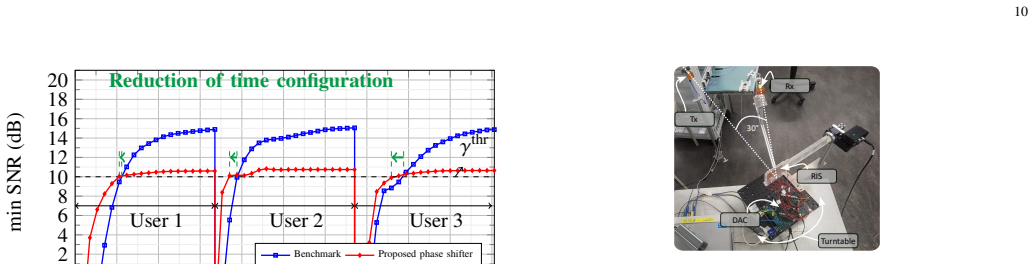
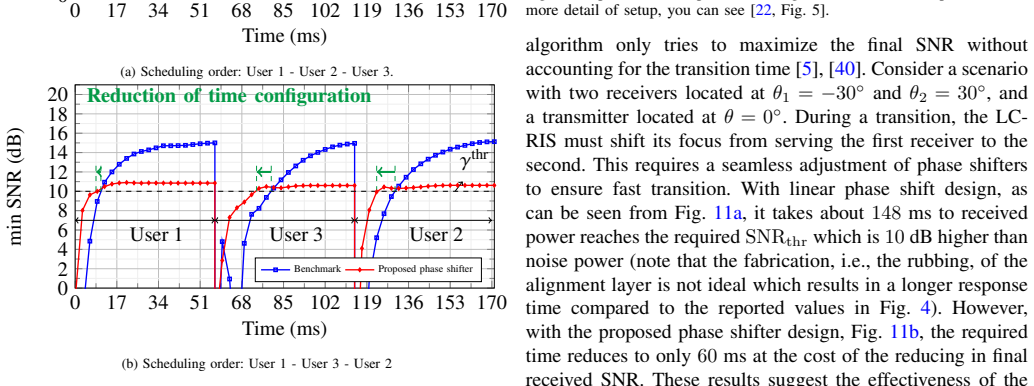
- Experimental hardware trials show the computed phase sequences achieve the predicted speed gains in practice.
Where Pith is reading between the lines
- The same modeling approach could be applied to other slow-response tunable surfaces if their cell dynamics can be captured by differential equations.
- Replacing instantaneous locations with short-term mobility predictions would test how well the area-coverage strategy handles movement during a slot.
- In networks with many users the location-only method may scale more readily than methods that require fresh channel estimates for each user.
- Repeating the experiments with different liquid crystal materials would show whether the speed gains depend on the specific cell parameters used in the model.
Load-bearing premise
The physics model of cell switching speed matches real hardware behavior and user locations are known well enough to stand in for full channel measurements.
What would settle it
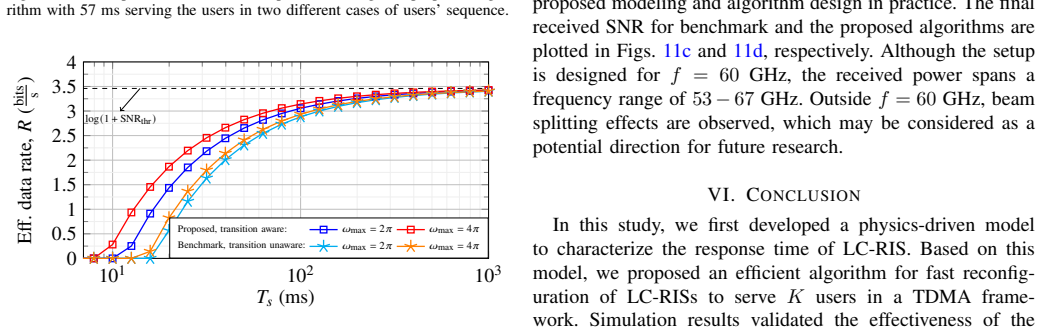
Measure actual transition times on an LC-RIS prototype under the optimized phase sequences and check whether they match the model's predictions; or compare measured TDMA throughput with and without the new designs when slot duration approaches reconfiguration time.
Figures




read the original abstract
LC technology is a promising hardware solution for realizing extremely large RISs due to its advantages in cost-effectiveness, scalability, energy efficiency, and continuous phase shift tunability. However, the slow response time of the LC cells, especially in comparison to the silicon-based alternatives like radio frequency switches and PIN diodes, limits the performance. This limitation becomes particularly relevant in TDMA applications where RIS must sequentially serve users in different locations, as the phase-shifting response time of LC cells can constrain system performance. This paper addresses the slow phase-shifting limitation of LC by developing a physics-based model for the time response of an LC unit cell and proposing a novel phase-shift design framework to reduce the transition time. Specifically, exploiting the fact that LC-RIS at milimeter wave bands have a large electric aperture, we optimize the LC phase shifts based on user locations, eliminating the need for full channel state information and minimizing reconfiguration overhead. Moreover, instead of focusing on a single point, the RIS phase shifters are designed to optimize coverage over an area. This enhances communication reliability for mobile users and mitigates performance degradation due to user location estimation errors. The proposed design minimizes the transition time between configurations, a critical requirement for TDMA schemes. Our analysis reveals that the impact of RIS reconfiguration time on system throughput becomes particularly significant when TDMA intervals are comparable to the reconfiguration time. In such scenarios, optimizing the phase-shift design helps mitigate performance degradation while ensuring specific QoS requirements. Moreover, the proposed algorithm has been tested through experimental evaluations, which demonstrate that it also performs effectively in practice.
Editorial analysis
A structured set of objections, weighed in public.
Referee Report
Summary. The paper develops a physics-based model of the time response of liquid crystal (LC) unit cells and a location-based phase-shift optimization framework for LC-RIS that minimizes reconfiguration transition time in TDMA settings while meeting QoS constraints. It replaces full CSI with user location information, optimizes coverage over an area rather than a single point, and reports experimental evaluations showing effective practical performance.
Significance. If the physics-based model accurately predicts voltage-to-phase trajectories and settling times, and if the location-based design maintains QoS without full CSI, the work would directly address the slow-response bottleneck of LC-RIS, enabling its deployment in dynamic multi-user millimeter-wave scenarios where TDMA intervals are comparable to reconfiguration time.
major comments (2)
- [Experimental evaluation section (and abstract)] The central claim that the physics-based model plus location-based optimization yields provably lower transition times rests on the model's fidelity to hardware. The abstract states that experiments 'demonstrate effective performance,' yet provides no indication that measured settling times for the optimized configurations were compared against model predictions (including any omitted effects such as temperature dependence or inter-cell coupling). This comparison is load-bearing for the throughput-gain claim in TDMA regimes.
- [Phase-shift design framework] The location-based design eliminates full CSI by exploiting the large electric aperture at mmWave. However, the manuscript must quantify the throughput degradation when location estimates contain realistic error (e.g., via the area-coverage formulation), because this directly determines whether the claimed QoS is preserved without CSI.
minor comments (1)
- [Abstract] Abstract: 'milimeter' should be 'millimeter'.
Simulated Author's Rebuttal
We thank the referee for the constructive feedback and positive overall assessment of the work. We address the two major comments point by point below, proposing targeted revisions where appropriate to strengthen the manuscript without altering its core contributions.
read point-by-point responses
-
Referee: [Experimental evaluation section (and abstract)] The central claim that the physics-based model plus location-based optimization yields provably lower transition times rests on the model's fidelity to hardware. The abstract states that experiments 'demonstrate effective performance,' yet provides no indication that measured settling times for the optimized configurations were compared against model predictions (including any omitted effects such as temperature dependence or inter-cell coupling). This comparison is load-bearing for the throughput-gain claim in TDMA regimes.
Authors: We agree that explicit validation of the physics-based model against hardware measurements for the optimized configurations would strengthen support for the reconfiguration-time claims. The existing experimental evaluations in the manuscript demonstrate practical performance through measured reconfiguration times and achieved coverage in a hardware testbed. To directly address the concern, we will add a new subsection in the experimental evaluation that compares measured settling times and phase trajectories for the location-based optimized configurations against the model predictions, with discussion of secondary effects such as temperature dependence where data permit. revision: yes
-
Referee: [Phase-shift design framework] The location-based design eliminates full CSI by exploiting the large electric aperture at mmWave. However, the manuscript must quantify the throughput degradation when location estimates contain realistic error (e.g., via the area-coverage formulation), because this directly determines whether the claimed QoS is preserved without CSI.
Authors: The area-coverage formulation was introduced precisely to improve robustness to location uncertainty by optimizing phase shifts over a spatial region rather than a single point. This design choice already mitigates degradation from location errors. We will augment the performance analysis section with additional numerical results that quantify throughput as a function of location-estimate error variance under the area-coverage approach, confirming that QoS constraints remain satisfied for realistic error levels typical of mmWave positioning. revision: yes
Circularity Check
No significant circularity; derivation is self-contained
full rationale
The paper derives a physics-based model of LC unit cell dynamics from first principles and applies it to a location-based phase-shift optimization that minimizes reconfiguration time subject to QoS constraints. This optimization is independent of the throughput metric used in later analysis, and experimental results are presented as separate validation rather than as inputs that define the claimed gains. No self-citation chain, fitted-parameter renaming, or definitional loop appears in the derivation; the central claims rest on the external validity of the physics model and the geometric assumptions about large-aperture mmWave RIS, both of which are falsifiable outside the paper's own fitted values.
Axiom & Free-Parameter Ledger
axioms (2)
- domain assumption The time response of an LC unit cell can be captured by a physics-based model derived from electric-field-driven molecular rotation.
- domain assumption At mmWave frequencies the electrically large aperture allows phase design from user locations alone without full CSI.
Lean theorems connected to this paper
-
IndisputableMonolith/Cost/FunctionalEquation.leanwashburn_uniqueness_aczel unclear?
unclearRelation between the paper passage and the cited Recognition theorem.
γ1 ∂φ/∂t = K̄ ∂²φ/∂z² + ε0Δε E² Φ(φ) ... ω(t) = ℓ_lc Σ D_p e^{-p t / τ_mol}
-
IndisputableMonolith/Foundation/RealityFromDistinction.leanreality_from_one_distinction unclear?
unclearRelation between the paper passage and the cited Recognition theorem.
min Σ max_n [t_k]_n s.t. SNR_min,k ≥ γ_thr,k (P1)
What do these tags mean?
- matches
- The paper's claim is directly supported by a theorem in the formal canon.
- supports
- The theorem supports part of the paper's argument, but the paper may add assumptions or extra steps.
- extends
- The paper goes beyond the formal theorem; the theorem is a base layer rather than the whole result.
- uses
- The paper appears to rely on the theorem as machinery.
- contradicts
- The paper's claim conflicts with a theorem or certificate in the canon.
- unclear
- Pith found a possible connection, but the passage is too broad, indirect, or ambiguous to say the theorem truly supports the claim.
Reference graph
Works this paper leans on
-
[1]
Fast transition-aware reconfiguration of liquid crystal-based RISs,
M. Delbari, R. Neuder, A. Jiménez-Sáez, A. Asadi, and V . Jamali, “Fast transition-aware reconfiguration of liquid crystal-based RISs,” in Proc. IEEE International Conf. on Commun. Workshops (ICC Workshops) , Denver, CO, USA, 2024, pp. 214–219
work page 2024
-
[2]
Intelligent reflecting surface enhanced wireless network via joint active and passive beamforming,
Q. Wu and R. Zhang, “Intelligent reflecting surface enhanced wireless network via joint active and passive beamforming,”IEEE Trans. Wireless Commun., vol. 18, no. 11, pp. 5394–5409, 2019
work page 2019
-
[3]
Smart radio environments empowered by AI reconfigurable meta-surfaces: An idea whose time has come,
M. Di Renzo et al. , “Smart radio environments empowered by AI reconfigurable meta-surfaces: An idea whose time has come,” EURASIP J. Wireless Commun. and Netw. , vol. 129, May 2019
work page 2019
-
[4]
Smart and reconfigurable wireless communications: From IRS modeling to algorithm design,
X. Yu, V . Jamali, D. Xu, D. W. K. Ng, and R. Schober, “Smart and reconfigurable wireless communications: From IRS modeling to algorithm design,” IEEE Wireless Commun. , vol. 28, no. 6, pp. 118– 125, 2021
work page 2021
-
[5]
Physics-based mod- eling and scalable optimization of large intelligent reflecting surfaces,
M. Najafi, V . Jamali, R. Schober, and H. V . Poor, “Physics-based mod- eling and scalable optimization of large intelligent reflecting surfaces,” IEEE Trans. Commun. , vol. 69, no. 4, pp. 2673–2691, 2020
work page 2020
-
[6]
Rayleigh fading modeling and channel hardening for reconfigurable intelligent surfaces,
E. Björnson and L. Sanguinetti, “Rayleigh fading modeling and channel hardening for reconfigurable intelligent surfaces,” Wireless Commun. Lett., vol. 10, no. 4, pp. 830–834, 2020
work page 2020
-
[7]
H. Kim, S. Oh, S. Bang, H. Yang, B. Kim, and J. Oh, “Independently polarization manipulable liquid- crystal -based reflective metasurface for 5G reflectarray and reconfigurable intelligent surface,” IEEE Trans. Antennas and Propag. , vol. 71, no. 8, pp. 6606–6616, 2023
work page 2023
-
[8]
A. Wolff, L. Franke, S. Klingel, J. Krieger, L. Mueller, R. Stemler, and M. Rahm, “Continuous beam steering with a varactor-based recon- figurable intelligent surface in the Ka-band at 31 GHz,” J. of Applied Physics, vol. 134, no. 11, 2023
work page 2023
-
[9]
A. Jiménez-Sáez, A. Asadi, R. Neuder, M. Delbari, and V . Jamali, “Reconfigurable intelligent surfaces with liquid crystal technology: A hardware design and communication perspective,” arXiv preprint arXiv:2308.03065, 2023
-
[10]
A varactor-based recon- figurable filtenna,
Y . Tawk, J. Costantine, and C. Christodoulou, “A varactor-based recon- figurable filtenna,” IEEE Antennas and Wireless Propag. lett. , vol. 11, pp. 716–719, 2012
work page 2012
-
[11]
W. Tang, M. Z. Chen, X. Chen, J. Y . Dai, Y . Han, M. Di Renzo, Y . Zeng, S. Jin, Q. Cheng, and T. J. Cui, “Wireless communications with reconfigurable intelligent surface: Path loss modeling and experimental measurement,” IEEE Trans. Wireless Commun., vol. 20, no. 1, pp. 421– 439, 2020
work page 2020
-
[12]
Ferrari, Reconfigurable circuits and technologies for smart millimeter- wave systems
P. Ferrari, Reconfigurable circuits and technologies for smart millimeter- wave systems. Cambridge University Press, 2022
work page 2022
-
[13]
L. Schmitt, P. Schmitt, and M. Hoffmann, “3-bit digital-to-analog converter with mechanical amplifier for binary encoded large displace- ments,” in Actuators, vol. 10, no. 8, 2021, p. 182
work page 2021
-
[14]
R. Neuder, D. Wang, R. Jakoby, and A. Jiménez-Sáez, “Compact liquid crystal-based defective ground structure phase shifter for reconfigurable intelligent surfaces,” in Proc. European Conf. Antennas and Propag. (EuCAP), Florence, Italy, 2023, pp. 1–5
work page 2023
-
[15]
R. Ghannam, Y . Xia, D. Shen, F. A. Fernandez, H. Heidari, and V . A. Roy, “Reconfigurable surfaces using fringing electric fields from nanostructured electrodes in nematic liquid crystals,” Advanced Theory and Simulations, vol. 4, no. 7, p. 2100058, 2021. 5This result can be derived by evaluating the integral over [0, 2π], ∀m ̸= p. However, due to space ...
work page 2021
-
[16]
R. Guirado, G. Perez-Palomino, M. Caño-García, M. A. Geday, and E. Carrasco, “mm-Wave metasurface unit cells achieving millisecond response through polymer network liquid crystals,”IEEE Access, vol. 10, pp. 127 928–127 938, 2022
work page 2022
-
[17]
Design and optimization of liquid crystal RIS-based visible light communication receivers,
S. Aboagye, A. R. Ndjiongue, T. M. Ngatched, and O. A. Dobre, “Design and optimization of liquid crystal RIS-based visible light communication receivers,” IEEE Photonics J. , vol. 14, no. 6, pp. 1–7, 2022
work page 2022
-
[18]
Re- configurable intelligent surface-based VLC receivers using tunable liquid-crystals: The concept,
A. R. Ndjiongue, T. M. Ngatched, O. A. Dobre, and H. Haas, “Re- configurable intelligent surface-based VLC receivers using tunable liquid-crystals: The concept,” J. of Lightwave Technol. , vol. 39, no. 10, pp. 3193–3200, 2021
work page 2021
-
[19]
H. Wang, T. X. Wu, X. Zhu, and S.-T. Wu, “Correlations between liquid crystal director reorientation and optical response time of a homeotropic cell,” J. of Applied Physics , vol. 95, no. 10, pp. 5502–5508, 2004
work page 2004
-
[20]
Studies of liquid crystal response time,
H. Wang, “Studies of liquid crystal response time,” Ph.D. dissertation, University of Central Florida, 2005. [Online]. Available: https: //stars.library.ucf.edu/etd/632
work page 2005
-
[21]
Temperature-aware phase-shift design of LC-RIS for secure communication,
M. Delbari, B. Wang, N. M. Gholian, A. Asadi, and V . Jamali, “Temperature-aware phase-shift design of LC-RIS for secure communication,” in Proc. IEEE International Conf. on Commun. (ICC), Montreal, Canada, 2025, accepted. [Online]. Available: arXivpreprint:2411.12342
-
[22]
R. Neuder, M. Späth, M. Schüßler, and A. Jiménez-Sáez, “Architecture for sub-100 ms liquid crystal reconfigurable intelligent surface based on defected delay lines,” Commun. Eng., vol. 3, no. 1, p. 70, 2024
work page 2024
-
[23]
J. Yang, S. Gao, P. Wang, Z. Yin, H. Lu, W. Lai, Y . Li, and G. Deng, “Design and experimental verification of a liquid crystal-based terahertz phase shifter for reconfigurable reflectarrays,” J. of Infrared, Millimeter, and Terahertz Waves, vol. 41, pp. 665–674, 2020
work page 2020
-
[24]
Near- field communications: A tutorial review,
Y . Liu, Z. Wang, J. Xu, C. Ouyang, X. Mu, and R. Schober, “Near- field communications: A tutorial review,”IEEE Open J. of the Commun. Society, vol. 4, pp. 1999–2049, 2023
work page 1999
-
[25]
Near-field multipath MIMO channel model for imperfect surface reflection,
M. Delbari, G. C. Alexandropoulos, R. Schober, H. V . Poor, and V . Jamali, “Near-field multipath MIMO channel model for imperfect surface reflection,” in Proc. IEEE Global Conf. Commun. Workshops (Globecom Workshops), Cape Town, South Africa, 2024, accepted for publication. [Online]. Available: https://arxiv.org/pdf/2409.17041
-
[26]
Far- versus near-field RIS modeling and beam design,
M. Delbari, G. C. Alexandropoulos, R. Schober, and V . Jamali, “Far- versus near-field RIS modeling and beam design,” arXiv preprint arXiv:2401.08237, 2024
-
[27]
A survey of wireless path loss prediction and coverage mapping methods,
C. Phillips, D. Sicker, and D. Grunwald, “A survey of wireless path loss prediction and coverage mapping methods,”IEEE Commun. Surveys and Tutorials, vol. 15, no. 1, pp. 255–270, 2013
work page 2013
-
[28]
Liquid crystal phase shifters at millimeter wave frequencies,
Garbovskiy et al. , “Liquid crystal phase shifters at millimeter wave frequencies,” J. of Applied Physics , vol. 111, no. 5, p. 054504, 2012
work page 2012
-
[29]
J. V . Selinger, Dynamics and Statistical Mechanics . Springer Nature Switzerland, 2024
work page 2024
-
[30]
I. liquid crystals. on the theory of liquid crystals,
F. C. Frank, “I. liquid crystals. on the theory of liquid crystals,” Discussions of the Faraday Society , vol. 25, pp. 19–28, 1958
work page 1958
-
[31]
Conservation laws for liquid crystals,
J. L. Ericksen, “Conservation laws for liquid crystals,” Trans. of the Society of Rheology , vol. 5, no. 1, pp. 23–34, 1961
work page 1961
-
[32]
Some constitutive equations for liquid crystals,
F. M. Leslie, “Some constitutive equations for liquid crystals,” Archive for Rational Mechanics and Analysis , vol. 28, pp. 265–283, 1968
work page 1968
-
[33]
Electro-optic response times in liquid crystals,
E. Jakeman and E. Raynes, “Electro-optic response times in liquid crystals,” Physics Lett. A , vol. 39, no. 1, pp. 69–70, 1972
work page 1972
-
[34]
L. M. Blinov and V . G. Chigrinov, Electrooptic effects in liquid crystal materials. Springer Science & Business Media, 2012
work page 2012
-
[35]
K. Sayyah, C.-S. Wu, S.-T. Wu, and U. Efron, “Anomalous liquid crystal undershoot effect resulting in a nematic liquid crystal-based spatial light modulator with one millisecond response time,” Applied physics letters, vol. 61, no. 8, pp. 883–885, 1992
work page 1992
-
[36]
Fundamentals of wireless communication,
D. Tse, “Fundamentals of wireless communication,” Cambridge Univer- sity Press, vol. 2, pp. 614–624, 2005
work page 2005
-
[37]
CVX: Matlab software for disciplined convex programming, version 2.1,
M. Grant and S. Boyd, “CVX: Matlab software for disciplined convex programming, version 2.1,” https://cvxr.com/cvx, Mar. 2014
work page 2014
-
[38]
Coordinate descent algorithms,
S. J. Wright, “Coordinate descent algorithms,” Mathematical program- ming, vol. 151, no. 1, pp. 3–34, 2015
work page 2015
-
[39]
Low-to- zero-overhead IRS reconfiguration: Decoupling illumination and channel estimation,
V . Jamali, G. C. Alexandropoulos, R. Schober, and H. V . Poor, “Low-to- zero-overhead IRS reconfiguration: Decoupling illumination and channel estimation,” IEEE Commun. Lett. , vol. 26, no. 4, pp. 932–936, 2022
work page 2022
-
[40]
Near- field hierarchical beam management for RIS-enabled millimeter wave multi-antenna systems,
G. C. Alexandropoulos, V . Jamali, R. Schober, and H. V . Poor, “Near- field hierarchical beam management for RIS-enabled millimeter wave multi-antenna systems,” in Proc. IEEE Sensor Array and Multichannel Signal Process. Workshop (SAM) , Trondheim, Norway, 2022, pp. 460– 464
work page 2022
-
[41]
E. Kreyszig, H. Kreyszig, and E. J. Norminton, Advanced engineering mathematics. John Wiley and Sons, Inc., 2011
work page 2011
discussion (0)
Sign in with ORCID, Apple, or X to comment. Anyone can read and Pith papers without signing in.