Magnetically modified double slit based x-ray interferometry
Pith reviewed 2026-05-22 19:26 UTC · model grok-4.3
The pith
Covering one slit with a magnetic thin film in an x-ray double-slit setup determines both real and imaginary parts of the complex refractive index from magnetization-induced fringe shifts.
A machine-rendered reading of the paper's core claim, the machinery that carries it, and where it could break.
Core claim
By covering one of two slits with a magnetic thin film and employing XMCD, fringe shifts that occur due to a change in the sample magnetization permit determination of both the real and the imaginary parts of the complex refractive index. The hybrid spectroscopic-interferometric methodology thereby provides a means to probe changes in the magnetic refractive index in terms of the electron spin moment.
What carries the argument
The magnetically modified Young's double slit, where one slit is covered by a magnetic thin film; it encodes magneto-optical modifications to the x-ray wave into measurable interference fringe shifts upon magnetization reversal.
If this is right
- Both real and imaginary refractive-index components become accessible from a single set of interference measurements.
- The method isolates spin-moment contributions to the refractive index through XMCD contrast.
- Magnetization reversal serves as an internal control to separate magnetic from non-magnetic signals.
- The technique supplies a combined spectroscopic and interferometric probe suited to magnetic thin films.
Where Pith is reading between the lines
- The setup could be extended to time-resolved x-ray sources to track dynamic magnetization processes.
- It may link to phase-contrast x-ray imaging methods already used for magnetic domain visualization.
- Systematic tests on films of varying thickness would help establish the range where non-magnetic artifacts remain negligible.
Load-bearing premise
The observed fringe shifts must arise solely from the magneto-optical modification of the refractive index in the magnetic film and not from mechanical, thermal, or non-magnetic optical changes when magnetization is reversed.
What would settle it
A control run with a non-magnetic film of identical thickness and material but no applied field or magnetization change that still produces identical fringe shifts would falsify the claim that the shifts originate from magnetic refractive-index effects.
Figures




read the original abstract
We demonstrate an experimental approach to determine magneto-optical effects which combines x-ray magnetic circular dichroism (XMCD) with x-ray interferometry, based on the concepts of Young's canonical double slit. By covering one of two slits with a magnetic thin film and employing XMCD, we show that it is possible to determine both the real and the imaginary parts of the complex refractive index by measuring the fringe shifts that occur due to a change in the sample magnetization. Our hybrid spectroscopic-interferometric methodology provides a means to probe changes in the magnetic refractive index in terms of the electron spin moment.
Editorial analysis
A structured set of objections, weighed in public.
Referee Report
Summary. The manuscript presents an experimental method combining x-ray magnetic circular dichroism (XMCD) with Young's double-slit interferometry. One slit is covered by a magnetic thin film; fringe shifts induced by reversing the sample magnetization are used to extract both the real and imaginary parts of the complex refractive index, thereby probing magneto-optical effects linked to the electron spin moment.
Significance. If the central experimental claim is validated with adequate controls, the hybrid interferometric-XMCD approach would supply a direct, phase-sensitive route to the magnetic contribution to the x-ray refractive index that is complementary to conventional absorption-based XMCD. This could be useful for quantifying spin-dependent optical constants in thin-film and nanostructured magnetic materials.
major comments (1)
- The central claim requires that measured fringe shifts upon magnetization reversal arise exclusively from the magneto-optical change in the complex refractive index of the film. The manuscript provides no quantitative upper bounds on possible non-magneto-optical contributions (e.g., magnetostrictive displacement of the slit or film, local heating, or geometric distortion) nor any control data that isolate these artifacts from the intended XMCD-induced shift. This assumption is load-bearing for the extraction of both real and imaginary index components.
minor comments (1)
- The abstract states the measurement principle clearly but does not report numerical values, error bars, or fringe-visibility data; these should be added to the results section with explicit comparison to the expected magneto-optical signal magnitude.
Simulated Author's Rebuttal
We thank the referee for their constructive review and for recognizing the potential of our hybrid XMCD-interferometry approach as a complementary probe of magnetic contributions to the x-ray refractive index. We address the single major comment below and will revise the manuscript to strengthen the validation of our central claim.
read point-by-point responses
-
Referee: The central claim requires that measured fringe shifts upon magnetization reversal arise exclusively from the magneto-optical change in the complex refractive index of the film. The manuscript provides no quantitative upper bounds on possible non-magneto-optical contributions (e.g., magnetostrictive displacement of the slit or film, local heating, or geometric distortion) nor any control data that isolate these artifacts from the intended XMCD-induced shift. This assumption is load-bearing for the extraction of both real and imaginary index components.
Authors: We agree that ruling out non-magneto-optical artifacts is essential for confidently attributing the observed fringe shifts to changes in the complex refractive index. The current manuscript does not include explicit quantitative upper bounds or dedicated control datasets for effects such as magnetostriction, local heating, or geometric distortions. In the revised manuscript we will add a new subsection (likely in the Methods or Supplementary Information) that provides order-of-magnitude estimates for these contributions based on the experimental parameters (magnetic field strength, film thickness, x-ray flux, and material properties from the literature). We will also describe control measurements performed with non-magnetic reference films and with the magnetic film held at fixed magnetization to demonstrate that fringe shifts are absent when the XMCD contrast is removed. These additions will directly support the exclusivity assumption and improve the robustness of the extracted real and imaginary index values. revision: yes
Circularity Check
No circularity: purely experimental measurement of fringe shifts
full rationale
The paper describes an experimental setup combining Young's double-slit interferometry with XMCD on a magnetic thin film covering one slit. Fringe shifts upon magnetization reversal are measured directly to extract real and imaginary parts of the refractive index. No derivation chain, fitted parameters renamed as predictions, or self-citation load-bearing steps appear in the provided abstract or described methodology. The central claim rests on observed optical-path changes in a physical apparatus rather than any equation that reduces to its inputs by construction, rendering the result self-contained against external benchmarks.
Axiom & Free-Parameter Ledger
axioms (1)
- domain assumption Fringe shifts observed upon magnetization reversal are caused solely by the magneto-optical change in the complex refractive index of the film covering one slit.
Lean theorems connected to this paper
-
IndisputableMonolith/Cost/FunctionalEquation.leanwashburn_uniqueness_aczel unclear?
unclearRelation between the paper passage and the cited Recognition theorem.
By covering one of two slits with a magnetic thin film and employing XMCD, it is possible to determine both the real and the imaginary parts of the complex refractive index by measuring the fringe shifts that occur due to a change in the sample magnetization.
What do these tags mean?
- matches
- The paper's claim is directly supported by a theorem in the formal canon.
- supports
- The theorem supports part of the paper's argument, but the paper may add assumptions or extra steps.
- extends
- The paper goes beyond the formal theorem; the theorem is a base layer rather than the whole result.
- uses
- The paper appears to rely on the theorem as machinery.
- contradicts
- The paper's claim conflicts with a theorem or certificate in the canon.
- unclear
- Pith found a possible connection, but the passage is too broad, indirect, or ambiguous to say the theorem truly supports the claim.
Reference graph
Works this paper leans on
-
[1]
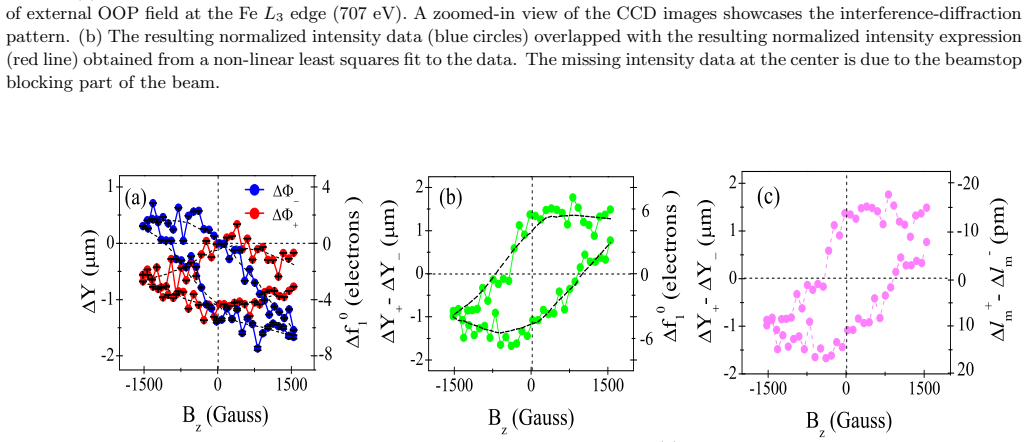
The two sharp peaks correspond to the Fe absorption edges and exhibit the XMCD ef- fect, appearing as a differential absorption between the two helical beams. The peaks in the β(ω) fits are consis- tent with the peaks seen in the total-electron-yield (TEY) data (shown in Fig. 3(inset)). We note that the differ- ential absorption is pronounced at the L3 edge,...
-
[2]
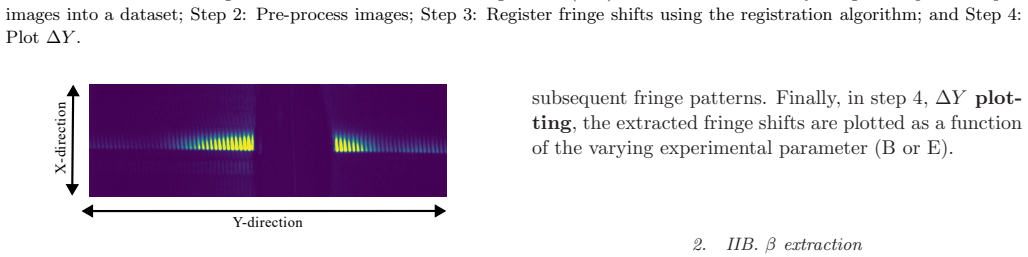
∆Y extraction The workflow for extracting the ∆ Y parameter is sum- marized in Fig
IIA. ∆Y extraction The workflow for extracting the ∆ Y parameter is sum- marized in Fig
-
[3]
In the first step, Image compilation , the CCD intensity images are systematically organized into a data set as a function of the varying experimen- tal parameters, such as the applied magnetic field ( B) or beamline energy ( E). In the next step, Image Pre- processing, we normalize by the beamline current to compensate for fluctuations in synchrotron intens...
-
[4]
IIB. β extraction To extract the β parameter from the intensity images, the images are organized into a data set in step 1, Im- age compilation , and pre-processed in step 2, Image pre-processing, following a method similar to that de- scribed earlier. The general procedure is described in the flow chart in Fig
-
[5]
For step 3, Data Fitting , we use the least-squares fitting analysis and focus on one half of the intensity pattern, specifically excluding the beamstop region to avoid distortions caused by the blocked beam. To simplify the analysis, the intensity data is averaged along the direction perpendicular to the fringe pattern (X-direction), collapsing the two-dim...
-
[6]
( 6) shown in the supplementary file [Eq.(2) of the main text]
The obtained intensity curve can now be fit to Eq. ( 6) shown in the supplementary file [Eq.(2) of the main text]. Finally, in step 4, β plotting, the obtained β parameter is plotted as a function of the beamline en- ergy
-
[7]
H. C. S. Joachim St¨ ohr, Magnetism: From Fundamen- tals to Nanoscale Dynamics (Springer Science & Business Media, 2007, London, 2007)
work page 2007
-
[8]
D. M. Jens Als-Nielsen, Elements of Modern X-ray Physics (John Wiley & Sons, Ltd, 2011, The Atrium, Southern Gate, Chichester, West Sussex, PO19 8SQ, United Kingdom, 2011)
work page 2011
-
[9]
P. Norman and A. Dreuw, Simulating x-ray spectro- scopies and calculating core-excited states of molecules, Chemical Reviews, Chemical Reviews 118, 7208 (2018)
work page 2018
-
[10]
A. Sakdinawat and D. Attwood, Nanoscale x-ray imag- ing, Nature Photonics 4, 840 (2010)
work page 2010
-
[11]
C. Sanchez-Cano, R. A. Alvarez-Puebla, J. M. Aben- droth, T. Beck, R. Blick, Y. Cao, F. Caruso, I. Chakraborty, H. N. Chapman, C. Chen, B. E. Co- hen, A. L. C. Concei¸ c˜ ao, D. P. Cormode, D. Cui, K. A. Dawson, G. Falkenberg, C. Fan, N. Feliu, M. Gao, E. Gargioni, C.-C. Gl¨ uer, F. Gr¨ uner, M. Hassan, Y. Hu, Y. Huang, S. Huber, N. Huse, Y. Kang, A. Khad...
-
[12]
Q. Saadeh, V. Philipsen, J. Meersschaut, V. S. K. Chan- nam, K.-A. Kantre, A. Sokolov, B. Kupper, T. Wiesner, D. Oca˜ na Garc ´ ıa, Z. Salami, C. Buchholz, F. Scholze, and V. Soltwisch, Optical constants of tin, amorphous sio2, and sin in the extreme ultraviolet range, Applied Optics , Applied Optics 63, 9210 (2024)
work page 2024
-
[13]
J. Kas, F. Vila, C. Pemmaraju, M. Prange, K. Pers- son, R. Yang, and J. Rehr, Full spectrum op- tical constant interface to the materials project, Computational Materials Science 201, 110904 (2022)
work page 2022
-
[14]
V. Lucarini, J. Saarinen, K. Peiponen, and E. Vartiainen, Kramers-kronig relations in optical materials research, Kramers-Kronig Relations in Optical Materials Research, by V. Lucarini, J. Saarinen, K. Peiponen, and E. Varti- ainen. X, 162 p. 37 illus. 3-540-23673-2. Berlin: Springer,
-
[15]
M. Blume and D. Gibbs, Polarization dependence of mag- netic x-ray scattering, Phys. Rev. B 37, 1779 (1988)
work page 1988
-
[16]
J. P. Hill and D. F. McMorrow, Resonant Exchange Scat- tering: Polarization Dependence and Correlation Func- tion, Acta Crystallographica Section A 52, 236 (1996)
work page 1996
-
[17]
B. T. Thole, P. Carra, F. Sette, and G. van der Laan, X-ray circular dichroism as a probe of orbital magnetiza- tion, Phys. Rev. Lett. 68, 1943 (1992)
work page 1943
-
[18]
C. Kao, J. B. Hastings, E. D. Johnson, D. P. Sid- dons, G. C. Smith, and G. A. Prinz, Magnetic-resonance exchange scattering at the iron lii and liii edges, Phys. Rev. Lett. 65, 373 (1990)
work page 1990
- [19]
-
[20]
J. W. Freeland, K. Bussmann, Y. U. Idzerda, and C.-C. Kao, Understanding correlations be- tween chemical and magnetic interfacial roughness, Phys. Rev. B 60, R9923 (1999)
work page 1999
-
[21]
S. Roy, M. R. Fitzsimmons, S. Park, M. Dorn, O. Pe- tracic, I. V. Roshchin, Z.-P. Li, X. Batlle, R. Morales, A. Misra, X. Zhang, K. Chesnel, J. B. Kortright, S. K. Sinha, and I. K. Schuller, Depth profile of uncompensated spins in an exchange bias system, Phys. Rev. Lett. 95, 047201 (2005)
work page 2005
-
[22]
H. Foroosh, J. Zerubia, and M. Berthod, Exten- sion of phase correlation to subpixel registration, IEEE Transactions on Image Processing 11, 188 (2002)
work page 2002
-
[23]
K. A. Goldberg and J. Bokor, Fourier- transform method of phase-shift determination, Appl. Opt. 40, 2886 (2001)
work page 2001
-
[24]
M. Born, E. Wolf, A. B. Bhatia, P. C. Clemmow, D. Ga- bor, A. R. Stokes, A. M. Taylor, P. A. Wayman, and W. L. Wilcock, Principles of Optics: Electromagnetic Theory of Propagation, Interference and Diffraction of Light, 7th ed. (Cambridge University Press, 1999)
work page 1999
-
[25]
D. P. Jackson, N. Ferris, R. Strauss, H. Li, and B. J. Pearson, Subtleties with Young’s double-slit experiment: Investigation of spatial coherence and fringe visibility, American Journal of Physics 86, 683 (2018)
work page 2018
-
[26]
A. Savitzky and M. J. E. Golay, Smoothing and differ- entiation of data by simplified least squares procedures., Analytical Chemistry 36, 1627 (1964)
work page 1964
-
[27]
D. Attwood, Soft X-Rays and Extreme Ultraviolet Radia- tion: Principles and Applications (Cambridge University Press, 1999)
work page 1999
-
[28]
J. B. Kortright and S.-K. Kim, Resonant magneto-optical properties of fe near its 2 p levels: Measurement and ap- plications, Phys. Rev. B 62, 12216 (2000)
work page 2000
- [29]
discussion (0)
Sign in with ORCID, Apple, or X to comment. Anyone can read and Pith papers without signing in.