Probe of Generic Quantum Contextuality and Nonlocal Resources for Qubits
Pith reviewed 2026-05-22 20:05 UTC · model grok-4.3
The pith
Entropic uncertainty relations with quantum memory connect local generic contextuality to entanglement and Bell nonlocality.
A machine-rendered reading of the paper's core claim, the machinery that carries it, and where it could break.
Core claim
The entropic uncertainty relation with a quantum memory intrinsically connects local generic contextuality, as addressed in the pioneering work by Spekkens, and nonlocal quantum resources such as entanglement and Bell nonlocality. Based on the constructed optimal set for any given single-qubit state, a rigorous faithful criterion is proved to witness the generic contextuality in the scenario of local quantum state preparation. Within the framework of quantum resource distribution, quantitative trade-off relations are proved between local preparation contextuality and bipartite entanglement or Bell nonlocality in a shared quantum system, captured by two inequalities where the local and nonlo
What carries the argument
The entropic uncertainty relation with a quantum memory, which intrinsically connects local generic contextuality witnesses to nonlocal resource trade-offs via inequalities.
If this is right
- A faithful criterion exists for witnessing generic contextuality using the optimal measurement set in local preparation scenarios for any qubit state.
- Quantitative trade-off inequalities bound the coexistence of local preparation contextuality and bipartite entanglement.
- Similar inequalities quantify trade-offs with Bell nonlocality in shared systems.
- The criterion and inequalities are all experimentally testable as verified on quantum hardware.
Where Pith is reading between the lines
- This link via uncertainty relations could extend to certify multiple resources simultaneously in quantum networks.
- The approach suggests testable extensions to higher-dimensional systems or other forms of uncertainty.
- It implies that contextuality and nonlocality may be hierarchically related through memory-assisted bounds.
Load-bearing premise
The constructed optimal set for any given single-qubit state yields a faithful criterion for witnessing generic contextuality without hidden assumptions about measurement compatibility or state preparation that would invalidate the trade-off inequalities.
What would settle it
An experiment on a prepared qubit state that measures the entropic uncertainty and finds it violates the derived trade-off inequality while entanglement or Bell nonlocality is observed, or where the optimal set fails to detect known generic contextuality.
Figures

read the original abstract
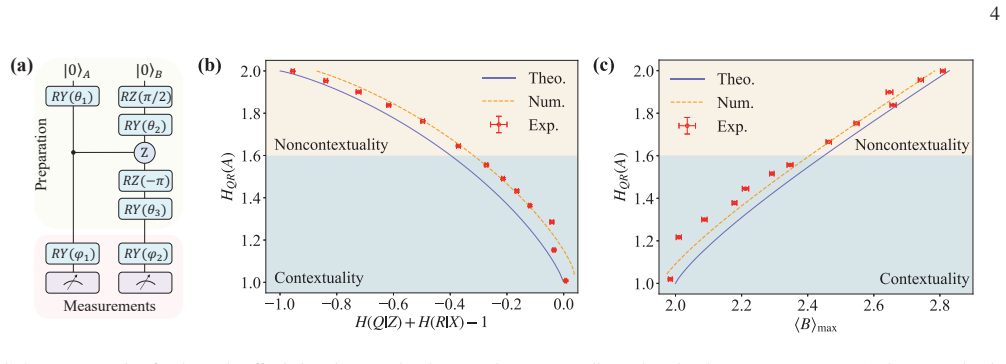
We reveal that the entropic uncertainty relation with a quantum memory is able to intrinsically connect local generic contextuality addressed in the pioneering work by Spekkens and nonlocal quantum resources such as entanglement and Bell nonlocality. Based on the constructed optimal set for any given single-qubit state, we prove rigorously a faithful criterion to witness the generic contextuality in the scenario of local quantum state preparation. Furthermore, within the framework of quantum resource distribution, it is proved that there exist quantitative trade-off relations between local preparation contextuality and bipartite entanglement or Bell nonlocality in a shared quantum system, which are captured by two inequalities where the local and nonlocal quantum resources can coexist. The faithful criterion and quantitative inequalities are all experimentally testable, which are verified through two independent well-designed experiments on the Quafu quantum cloud platform.
Editorial analysis
A structured set of objections, weighed in public.
Referee Report
Summary. The manuscript claims that the entropic uncertainty relation with a quantum memory intrinsically connects Spekkens-style local generic contextuality for single-qubit preparations to nonlocal resources including bipartite entanglement and Bell nonlocality. It constructs an optimal set for any given single-qubit state to prove a faithful criterion for witnessing contextuality, and within a resource-distribution framework derives two quantitative trade-off inequalities allowing coexistence of the local and nonlocal resources. Both the criterion and the inequalities are asserted to be parameter-free and are experimentally verified via two independent experiments on the Quafu quantum cloud platform.
Significance. If the derivations are independent and non-circular, the work would provide a useful entropic bridge between local contextuality and nonlocal correlations, extending Spekkens' framework with directly testable inequalities and cloud-based verification. The experimental component on Quafu adds concrete testability, though the absence of tabulated raw data or error budgets limits immediate reproducibility assessment.
major comments (2)
- [Proof of faithful criterion] The section deriving the faithful criterion via the optimal set for single-qubit states: the claim that this set yields a faithful witness without hidden assumptions on measurement compatibility or state preparation is load-bearing, yet the explicit mapping from the entropic uncertainty relation to the contextuality witness is not shown in sufficient detail to rule out post-hoc selection of the entropic quantities.
- [Quantitative trade-off relations] The section on quantitative trade-off relations (the two inequalities): it is unclear whether the inequalities are independently derived from the entropic relation or reduce by construction to identities involving the same entropic measures used to quantify both the local contextuality resource and the nonlocal resources, which would undermine the claimed trade-off.
minor comments (2)
- [Abstract] The abstract states that the results are 'all experimentally testable' and 'verified through two independent well-designed experiments,' but provides no numerical values, qubit numbers, or error analysis; adding a brief table of key measured quantities would improve clarity.
- [Introduction] Notation for the optimal set and the resource-distribution framework is introduced without an explicit comparison table to prior entropic contextuality witnesses (e.g., those based on Spekkens' original definitions), making it harder to assess novelty.
Simulated Author's Rebuttal
We thank the referee for the careful reading and constructive major comments. We address each point below with clarifications drawn directly from the derivations in the manuscript.
read point-by-point responses
-
Referee: [Proof of faithful criterion] The section deriving the faithful criterion via the optimal set for single-qubit states: the claim that this set yields a faithful witness without hidden assumptions on measurement compatibility or state preparation is load-bearing, yet the explicit mapping from the entropic uncertainty relation to the contextuality witness is not shown in sufficient detail to rule out post-hoc selection of the entropic quantities.
Authors: In Section III we first recall the entropic uncertainty relation with quantum memory for a single qubit prepared in state ρ and measured in an optimal set of three mutually unbiased bases (uniquely determined by maximizing the uncertainty bound for that ρ). We then prove that any non-contextual preparation (in the Spekkens sense) must satisfy the resulting entropic bound, with the witness obtained by subtracting the bound from the measured conditional entropy; violation certifies contextuality. The entropic quantities are fixed by the uncertainty relation and the optimality condition rather than chosen after the fact. We agree that inserting two additional intermediate equalities would make the mapping fully explicit and will do so in the revision. revision: yes
-
Referee: [Quantitative trade-off relations] The section on quantitative trade-off relations (the two inequalities): it is unclear whether the inequalities are independently derived from the entropic relation or reduce by construction to identities involving the same entropic measures used to quantify both the local contextuality resource and the nonlocal resources, which would undermine the claimed trade-off.
Authors: Section IV considers a bipartite state in which one qubit is used for local preparation contextuality (quantified by the memory-assisted entropic uncertainty) while the second qubit supplies the nonlocal resource (quantified by concurrence for entanglement or by the CHSH value for Bell nonlocality). The trade-off inequalities are obtained by applying the single-qubit entropic relation to the local subsystem and then invoking resource monotonicity on the nonlocal quantifier; the resulting bounds are of the form H_local + f(nonlocal) ≤ log 2, where f is a distinct function of concurrence or CHSH. These are not algebraic identities but genuine upper bounds on the coexistence of the two resources. We therefore maintain that the derivation is independent and does not require revision of the inequalities themselves. revision: no
Circularity Check
No significant circularity identified
full rationale
The paper derives a faithful criterion for Spekkens-style generic contextuality from an optimal set constructed for any single-qubit state using the entropic uncertainty relation with quantum memory, then establishes quantitative trade-off inequalities linking local contextuality to bipartite entanglement and Bell nonlocality within a resource-distribution framework. These are presented as independent rigorous proofs that are parameter-free and directly experimentally verifiable on Quafu, without reducing to self-definitions, fitted inputs renamed as predictions, or load-bearing self-citations. The central claims retain independent mathematical content beyond the input uncertainty relations and external Spekkens reference.
Axiom & Free-Parameter Ledger
Lean theorems connected to this paper
-
IndisputableMonolith/Cost/FunctionalEquation.leanwashburn_uniqueness_aczel unclear?
unclearRelation between the paper passage and the cited Recognition theorem.
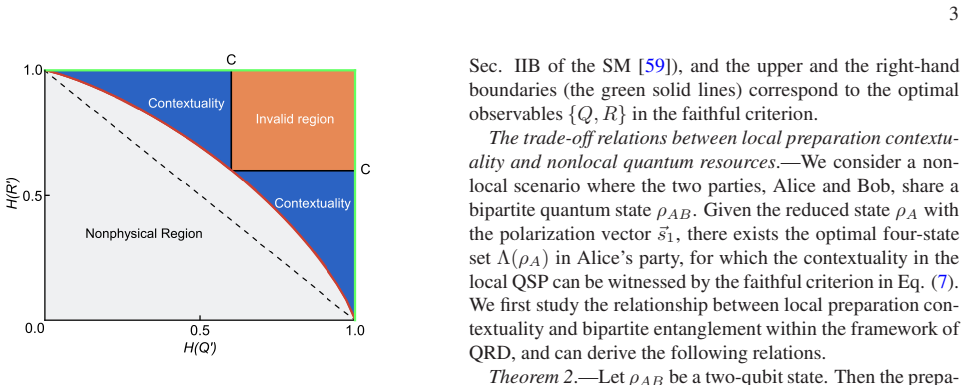
optimal four-state set Λ_s1 generated by B2-orbit realizability condition... H(Q)+H(R)<1+C
-
IndisputableMonolith/Foundation/AlexanderDuality.leanalexander_duality_circle_linking unclear?
unclearRelation between the paper passage and the cited Recognition theorem.
trade-off 1 ≤ H_QR(A)+S(A|B) ≤ 3
What do these tags mean?
- matches
- The paper's claim is directly supported by a theorem in the formal canon.
- supports
- The theorem supports part of the paper's argument, but the paper may add assumptions or extra steps.
- extends
- The paper goes beyond the formal theorem; the theorem is a base layer rather than the whole result.
- uses
- The paper appears to rely on the theorem as machinery.
- contradicts
- The paper's claim conflicts with a theorem or certificate in the canon.
- unclear
- Pith found a possible connection, but the passage is too broad, indirect, or ambiguous to say the theorem truly supports the claim.
Reference graph
Works this paper leans on
-
[1]
S. Storz, J. Sch¨ ar, A. Kulikov, P . Magnard, P . Kurpiers, J. L¨ utolf, T. Walter, A. Copetudo, K. Reuer, A. Akin et al., Loophole- free Bell inequality violation with superconducting circu its, Nature (London) 617, 265 (2023) . 1 SUPPLEMENTAL MATERIAL: Probe of Generic Quantum Contextuality and Nonlocal Resour ces for Qubits Wei Li,1, ∗ Min-Xuan Zhou, ...
work page 2023
-
[2]
(S28) According to the criterion in Eq. (S22) in Corollary 1, we have the result that the optimal four-state set Λ ⃗ s1(⃗ s1,⃗ s2,⃗ s3,⃗ s4) is noncontextual in the QSP and admits of a classical ontological model with preparation equivalence. Moreover, we investigate another four-state set of the same quantum state in Eq. ( S24), which has the A2 1 symmet...
-
[3]
(S29) Thus, in terms of the criterion in Eq. ( S18), the four-state set with the A2 1 symmetry Λ ′ ⃗ s1(⃗ s1,⃗ s2 ′,⃗ s3 ′,⃗ s4 ′) is preparation noncontextual and admits a classical ontological model. FIG. S3: Two four-state sets for the given quantum state in Eq. (S24). (a) The optimal four-state set Λ ⃗ s1 (⃗ s1,⃗ s2,⃗ s3,⃗ s4) generated by the B2-orbi...
-
[4]
(S63) Thus, according to the faithful criterion in Eq. ( S30), we have the EUR H(Q) +H(R) = 1 + h [ (5 − 3 √ 2)/ 10 ] ≈ 1. 3870 < 1 +C, (S64) which identifies the optimal four-state set Λ ⃗ s1 shown in Fig. S6(a) being preparation contextual. In order to further illustrate the “invalid region” in Fig. 2 of the main text, we consider another example where t...
-
[5]
with the A2 1 symmetry related to measurements X and Z. (b) The op- timal four-state set Λ ⃗ s1 (⃗ s1,⃗ s2,⃗ s3,⃗ s4) with the B2 symmetry with M1 = (Q − R)/ √ 2 andM2 = (Q +R)/ √ 2 with the optimal mea- surementsQ andR given in Eq. ( S74). ∆ X 2 + ∆ Z 2 ≥ 1, can be interpreted by a generalized non- contextual model. For qubit theory, they obtain that the...
-
[6]
can be generated as illustrated in Fig. S7(a), which is preparation noncontextual and has the form Λ ′ ⃗ s1 ={ 1 2 (I + 3 √ 2 16 X + 3 √ 6 16 Y + 3 √ 2 8 Z), 1 2 (I − 3 √ 2 16 X + 3 √ 6 16 Y + 3 √ 2 8 Z), 1 2 (I − 3 √ 2 16 X + 3 √ 6 16 Y − 3 √ 2 8 Z), 1 2 (I + 3 √ 2 16 X + 3 √ 6 16 Y − 3 √ 2 8 Z)}. (S72) The specificity of the four-state set Λ ′ ⃗ s1 lies ...
-
[7]
with the A2 1 symmetry related to measurements X and Z. (b) The op- timal four-state set Λ ⃗ v1 (⃗ v1,⃗ v2,⃗ v3,⃗ v4) with the B2 symmetry with M1 = (Q − R)/ √ 2 andM2 = (Q +R)/ √ 2 with the optimal mea- surementsQ andR given in Eq. ( S74). A2 1 symmetry associated with a pair of corresponding com- plementary measurements {M ′ 1,M ′ 2} is necessarily nonc...
-
[8]
(S81) In summary, the two criteria in Eqs
with theA2 1 symmetry is Λ ′ ⃗ v1 ={ 1 2 (I + √ 2 16X + √ 6 16Y + √ 2 8 Z), 1 2 (I − √ 2 16X + √ 6 16Y + √ 2 8 Z), 1 2 (I − √ 2 16X + √ 6 16Y − √ 2 8 Z), 1 2 (I + √ 2 16X + √ 6 16Y − √ 2 8 Z)}. (S81) In summary, the two criteria in Eqs. ( S68) and ( S69) serve for distinct tasks, and there exists the optimal set of the gi ven single-qubit state is prepara...
-
[9]
(S95) The proof of Theorem 3 in the main text is as follows. Proof.—In the Bloch representation, the two-qubit state can be expressed as [ 6] ρAB = 1 4 (IA ⊗ IB +⃗ a·⃗ σ⊗ IB +IA ⊗ ⃗b ·⃗ σ + 3∑ j,k =1 Tjkσj ⊗ σk), (S96) where⃗ σ= (σx,σ y,σ z) are Pauli matrices,⃗ a= (ax,a y,a z)⊤ is the polarization vector ofρA withai = Tr[ρAσi] (similarly, ⃗b is the polar...
work page 2075
-
[10]
The relation between ⟨B⟩max and Horodecki parameter M is given in Eq
These two local complementary mea- surementsQ andR are also the local observables for detecting the maximal Bell correlation ⟨B⟩max = |⟨A0B0⟩+⟨A0B1⟩+⟨A1B0⟩−⟨ A1B1⟩|, (S121) where the measurements for subsystem A are A0 =Q = X +Z√ 2 , A 1 =R = −X +Z√ 2 , (S122) and the generic forms of local measurements for subsystem B can be written as B0 =a0X +b0Y +c0Z,...
- [11]
-
[12]
J. E. Humphreys, Reflection Groups and Coxeter Groups (Ca m- bridge University Press, Cambridge, 1990)
work page 1990
-
[13]
R. W. Spekkens, Contextuality for prepara- tions, transformations and unsharp measurements, Phys. Rev. A 71, 052108 (2005)
work page 2005
-
[14]
R. W. Spekkens, Evidence for the epistemic view of quantu m states: A toy theory, Phys. Rev. A 75, 032110 (2007)
work page 2007
-
[15]
M. A. Nielsen and I. L. Chuang, Quantum Computation and Quantum Information (Cambridge University Press, Cam- bridge, England, 2010), p515-518
work page 2010
-
[16]
R. Horodecki, P . Horodecki, and M. Horodecki, Violating Bell inequality by mixed spin-1/2 states: necessary and sufficie nt condition, Phys. Lett. A 200, 340 (1995)
work page 1995
-
[17]
Peres, Quantum Theory: Concepts and Methods (Kluwer Academic Publishers, Dordrecht, 1993)
A. Peres, Quantum Theory: Concepts and Methods (Kluwer Academic Publishers, Dordrecht, 1993)
work page 1993
-
[18]
B. M. Terhal and P . Horodecki, Schmidt number for density matrices, Phys. Rev. A 61, 040301(R) (2000)
work page 2000
-
[19]
S. Cheng and M. J. W. Hall, Anisotropic Invari- ance and the Distribution of Quantum Correlations, Phys. Rev. Lett. 118, 010401 (2017)
work page 2017
-
[20]
B. Hensen, H. Bernien, A. E. Dr´ eau, A. Reiserer, N. Kalb , M. S. Blok, J. Ruitenberg, R. F. L. V ermeulen, R. N. Schouten, C. Abell´ an, W. Amaya, V . Pruneri, M. W. Mitchell, M. Markham, D. J. Twitchen, D. Elkouss, S. Wehner, T. H. Taminiau, and R. Hanson, Loophole-free Bell inequality violation using electron spins separated by 1.3 kilometres , Nature...
work page 2015
-
[21]
M. Giustina, M. A. M. V ersteegh, S. Wengerowsky, J. Handsteiner, A. Hochrainer, K. Phelan et al., Significant- Loophole-Free Test of Bell’s Theorem with Entangled Photon s, Phys. Rev. Lett. 115, 250401 (2015)
work page 2015
-
[22]
L. K. Shalm, E. Meyer-Scott, B. G. Christensen, P . Bierh orst, M. A. Wayne, M. J. Stevens, T. Gerrits, S. Glancy, D. R. Hamel, M. S. Allman et al., Strong Loophole-Free Test of Local Real- ism, Phys. Rev. Lett. 115, 250402 (2015) . 20
work page 2015
- [23]
-
[24]
Quafu quantum cloud computing cluster, https://quafu.baqis.ac.cn
discussion (0)
Sign in with ORCID, Apple, or X to comment. Anyone can read and Pith papers without signing in.