REVIEW 2 major objections 5 minor 57 references
NTIRE 2025 Challenge on Event-Based Image Deblurring: Methods and Results
T0 review · 2 major / 5 minor · reviewed 2026-08-16 · deepseek-v4-flash
Pith's one-line read The paper reports the first open challenge ranking of event-based image deblurring methods, with the winner at 42.79 dB PSNR on the HighREV test set.
desk verdict Useful first benchmark for event-based deblurring, but the 0.09 dB top-2 PSNR gap with inverted SSIM means the headline ranking is not statistically supported as stated. read the letter →
The pith
A machine-rendered reading of the paper's core claim, the machinery that carries it, and where it could break.
The reading
What carries the argument
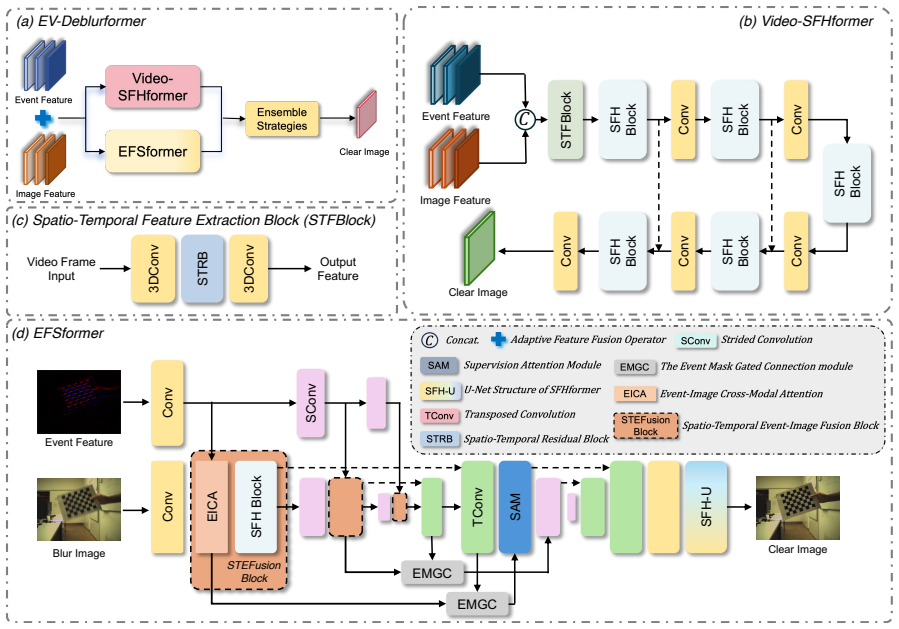
The load-bearing assessment machinery is the HighREV pairing of blurry images with asynchronous events and sharp ground truth, organized into fixed train/validation/test splits, plus the PSNR and SSIM metrics computed on 271 hidden test images. The mechanism that carries most solutions is cross-modal fusion: events are voxelized into a set of temporal bins and fed alongside the blurry image into an encoder-decoder whose attention blocks let image and event features guide each other, as in the EFNet and REFID baselines that many teams adapted. Supporting devices include triple-stream event voxelization at different temporal windows, sequence-level model ensembling, progressive enlargement of training patches, and pretrained initialization.
What would settle it
Run an independent audit of the released model weights: if any top finisher's predictions on validation or test images can only be explained by having seen the corresponding ground truth during training, the ranking collapses. More directly, retraining the top architecture from scratch on the official training split alone should reproduce its reported test PSNR to within a small tolerance.
Extended reading notes
Core claim
The paper's discovery is the benchmark outcome itself: under a shared protocol using the HighREV dataset, which contributes 1,771 training sets, 421 validation sets, and 271 hidden test sets of blurry images, event streams, and sharp references, the submitted event-based deblurring methods separate cleanly in quality. The first-place entry, an encoder-decoder that voxelizes events at three temporal scales and uses shift-window attention plus channel attention, scores 42.79 PSNR and 0.9196 SSIM; second and third place score 42.70 / 0.9281 and 42.09 / 0.9300, respectively. A supporting observation is architectural: all top-three teams combine transformers with convolutional networks, several build on the EFNet cross-modal fusion baseline, and the winning team initializes its backbone with ImageNet-pretrained weights. The paper also reports that the third-place team reached the highest SSIM by switching between a video-oriented and a single-image model depending on test-sequence type.
Load-bearing premise
The ranking stands on the trust-based rule that participants never trained on the HighREV validation or test data, since the report describes no enforcement or post-hoc verification of that rule.
Editorial extensions
If this is right
- The published code and pretrained weights for all 15 submissions make the top PSNR and SSIM numbers reproducible targets for future event-based deblurring methods.
- The top-three architecture pattern suggests that transformer-convolution hybrids with cross-modal attention are a strong default design for fusing events and images.
- Because the challenge imposed no limit on compute or model size, the scores represent an accuracy ceiling rather than a practical-efficiency trade-off.
- The observation that a 512-by-512 patch size was optimal for one team indicates resolution-dependent training behavior that later methods must tune explicitly.
- The scene-dependent ensemble that produced the best SSIM implies that no single model dominated all sequence types in the test set.
Reading between the lines
- If the data-use rules were ever violated by a leading team, the whole ranking would be suspect; an independent audit comparing models trained with and without the validation split would settle this.
- The assumption that event and image inputs are spatially aligned is baked into the challenge, so the rankings likely overstate performance on real event-camera deployments where calibration and synchronization are imperfect.
- A natural extension is to measure the same fifteen methods on misaligned or noisy event streams to see which architectural choices are robust to the gap between benchmark and deployment conditions.
- The wide PSNR spread from 42.79 down to 25.93 suggests that several submitted solutions are overfit to HighREV statistics; re-testing the released weights on a different event-deblurring dataset would reveal how much generalizes.
Signed reviews
Editorial analysis
A structured set of objections, weighed in public.
Referee Report
Summary. The paper reports the organization and outcomes of the NTIRE 2025 challenge on event-based image deblurring. Using the HighREV dataset, 199 participants registered and 15 teams submitted valid results; the paper presents the leaderboard (Table 1), summarizes the main architectural ideas of the top teams, and describes each method in Section 4. The central factual claim is that IVISLAB ranks first in PSNR (42.79 dB), followed by MiVideoDeblur (42.70 dB) and 404NotFound (42.09 dB), with additional observations in Section 3.2 about the benefits of hybrid transformer/convolutional architectures, pretrained initialization, cross-modal fusion, progressive training, and Mamba-based designs.
Significance. If the reported ranking is accepted as an accurate empirical comparison, the paper is a useful snapshot of the current state of event-based image deblurring and provides the community with public code and pretrained weights for all submitted solutions. The method descriptions are informative and the challenge itself is a valuable benchmark. However, the strength of the central claim is limited by the absence of any statistical analysis around the leaderboard numbers: the first- and second-place PSNR gap is only 0.09 dB, the SSIM order is reversed, and no per-image variance, confidence interval, paired test, or per-sequence breakdown is provided. The fairness premise, which is load-bearing for the ranking, is also stated but not verified. These issues are addressable and do not undermine the utility of the dataset or the reported methods, but they do weaken the paper's main empirical conclusions as currently written.
major comments (2)
- [Section 3, Table 1] The central claim that IVISLAB is the winner is not statistically supported as reported. The PSNR difference between IVISLAB (42.79) and MiVideoDeblur (42.70) is 0.09 dB, while MiVideoDeblur has the higher SSIM (0.9281 vs. 0.9196). The paper reports no per-image variance, confidence interval, paired significance test, or per-sequence breakdown, even though Section 4.3.3 states that the HighREV test set consists of four sequences. With such a small gap and a contradictory secondary metric, the first-place ranking, and the Section 3.2 attributions of that result to triple-stream event voxels, ImageNet pretraining, and 512x512 patches, could be properties of this particular 271-image test sample rather than stable method differences. Please add per-sequence results and a paired test or bootstrap confidence interval, or qualify the ranking accordingly.
- [Section 3.3] The integrity of the leaderboard rests on participants not using the HighREV validation set or the HighREV test blurry images during training, but the manuscript only states that these uses were 'strictly prohibited' and 'not allowed.' No enforcement mechanism, monitoring procedure, or post-hoc verification (for example, inspection of submitted code, model behavior checks, or data provenance analysis) is described. As written, one load-bearing premise of the ranking is unverified. The authors should either document how compliance was ensured or explicitly state that compliance was based on self-reporting, so that readers can calibrate the strength of the conclusions.
minor comments (5)
- [Section 4.1.3] The implementation details for TEIDNet specify Ts = 0, which makes the short-term event stream temporally degenerate (from frame t to frame t). Please clarify whether this is intentional or a typo, and explain how the short-term stream contributes in that case.
- [Section 4.3.2] The progressive training schedule for 404NotFound contains an apparent inconsistency: the text says training starts with patch size 152x152 for 250K iterations, then lists patch/batch pairs 'updated ... at iterations [250K, 200K, 150K].' This is confusing, and the initial patch size is likely a typo for 192x192 given the later mention of 'when patch size is 192.' Please rewrite the schedule to specify each stage's duration and patch size unambiguously.
- [Section 4.3.3] The sentence 'The results in Table 1 show that their approach yields the best performance' is ambiguous because 404NotFound ranks third in PSNR while achieving the highest SSIM. Please rephrase to say 'the highest SSIM score' or otherwise clarify which metric is meant.
- [Section 2.2 and Section 3.2] Since the challenge had no restrictions on computational complexity or model size, observations such as 'pretrained weights matters' and 'effective training strategies' are correlations, not controlled findings. I suggest softening 'demonstrating the advantages' to 'consistent with the advantages' and noting that the ranking reflects a joint algorithm/compute trade-off.
- [Section 2.2] The GitHub URL in the text appears with a space: 'https://github.com/AHupuJR/NTIRE2025 EventDeblur challenge'. Please ensure the link is correctly formatted and clickable.
Circularity Check
No significant circularity: the challenge ranking is a direct measurement of submitted outputs against hidden ground-truth images, with no fitted parameter, prediction-by-construction, or load-bearing self-citation loop.
full rationale
This paper is a challenge report rather than a derivation. Its central claims are the measured PSNR/SSIM values in Table 1 and the qualitative observations in Sec. 3.2. These are presented as empirical facts about submitted models evaluated on the held-out 271-image HighREV test set, with ground truth hidden from participants. There is no equation in the paper that defines an input in terms of the predicted quantity, no fitted parameter that is later renamed as a prediction, and no invocation of a uniqueness theorem or prior result that forces the ranking. The organizers' own prior works (EFNet [39], REFID [40], HighREV [40]) are used as baselines and as the dataset source, which may create a benchmark-design lineage favoring certain methods, but the paper does not claim to derive any result from those citations; the measured ranking could in principle favor any team. The integrity of the challenge relies on stated rules without independent enforcement, but that is a procedural concern, not a circularity in the logical sense. Accordingly, no circular step meeting the evidence threshold is present, and the appropriate score is 0.
Assumptions & free parameters
assumptions (4)
- domain assumption PSNR and SSIM are accepted as valid quantitative measures of deblurring quality.
- domain assumption HighREV provides spatially aligned event-image pairs.
- domain assumption The 271-image HighREV test set is representative of the event-based deblurring task.
- domain assumption Participants followed the rule not to train on HighREV validation or test data.
Cite this review
Pith. "Pith review of NTIRE 2025 Challenge on Event-Based Image Deblurring: Methods and Results." pith.science (2026). https://pith.science/paper/KMWRNRY6
@misc{pith2026250412401,
  author       = {Pith},
  title        = {Pith review of: NTIRE 2025 Challenge on Event-Based Image Deblurring: Methods and Results},
  year         = {2026},
  howpublished = {\url{https://pith.science/paper/KMWRNRY6}},
  note         = {Machine review of arXiv:2504.12401}
}
read the original abstract
This paper presents an overview of NTIRE 2025 the First Challenge on Event-Based Image Deblurring, detailing the proposed methodologies and corresponding results. The primary goal of the challenge is to design an event-based method that achieves high-quality image deblurring, with performance quantitatively assessed using Peak Signal-to-Noise Ratio (PSNR). Notably, there are no restrictions on computational complexity or model size. The task focuses on leveraging both events and images as inputs for single-image deblurring. A total of 199 participants registered, among whom 15 teams successfully submitted valid results, offering valuable insights into the current state of event-based image deblurring. We anticipate that this challenge will drive further advancements in event-based vision research.
Figures


Figures from the paper (10 more)


Reference graph
Works this paper leans on
-
[1]
Ev-segnet: Semantic segmentation for event-based cameras
Inigo Alonso and Ana C Murillo. Ev-segnet: Semantic segmentation for event-based cameras. In Proceedings of the IEEE/CVF Conference on Computer Vision and Pattern Recognition Workshops, pages 0–0, 2019. 1
work page 2019
-
[2]
Efficient human pose estimation via 3d event point cloud
Jiaan Chen, Hao Shi, Yaozu Ye, Kailun Yang, Lei Sun, and Kaiwei Wang. Efficient human pose estimation via 3d event point cloud. In 2022 International Conference on 3D Vision (3DV), pages 1–10. IEEE, 2022. 1
work page 2022
-
[3]
Simple baselines for image restoration
Liangyu Chen, Xiaojie Chu, Xiangyu Zhang, and Jian Sun. Simple baselines for image restoration. In European Con- ference on Computer Vision , pages 17–33. Springer, 2022. 5
work page 2022
-
[4]
NTIRE 2025 challenge on image super-resolution (×4): Methods and results
Zheng Chen, Kai Liu, Jue Gong, Jingkai Wang, Lei Sun, Zongwei Wu, Radu Timofte, Yulun Zhang, et al. NTIRE 2025 challenge on image super-resolution (×4): Methods and results. In Proceedings of the IEEE/CVF Conference on Computer Vision and Pattern Recognition (CVPR) Work- shops, 2025. 2
2025
-
[5]
NTIRE 2025 challenge on real-world face restoration: Methods and results
Zheng Chen, Jingkai Wang, Kai Liu, Jue Gong, Lei Sun, Zongwei Wu, Radu Timofte, Yulun Zhang, et al. NTIRE 2025 challenge on real-world face restoration: Methods and results. In Proceedings of the IEEE/CVF Conference on Computer Vision and Pattern Recognition (CVPR) Work- shops, 2025. 2
2025
-
[6]
Recovering Continuous Scene Dynamics from A Single Blurry Image with Events
Zhangyi Cheng, Xiang Zhang, Lei Yu, Jianzhuang Liu, Wen Yang, and Gui-Song Xia. Recovering continuous scene dynamics from a single blurry image with events. arXiv preprint arXiv:2304.02695, 2023. 8
work page Pith review arXiv 2023
-
[7]
NTIRE 2025 challenge on raw image restoration and super-resolution
Marcos Conde, Radu Timofte, et al. NTIRE 2025 challenge on raw image restoration and super-resolution. In Proceed- ings of the IEEE/CVF Conference on Computer Vision and Pattern Recognition (CVPR) Workshops, 2025. 2
2025
-
[8]
Raw image reconstruc- tion from RGB on smartphones
Marcos Conde, Radu Timofte, et al. Raw image reconstruc- tion from RGB on smartphones. NTIRE 2025 challenge re- port. In Proceedings of the IEEE/CVF Conference on Com- puter Vision and Pattern Recognition (CVPR) Workshops ,
2025
Show all 57 references
-
[9]
Selective frequency network for image restoration
Yuning Cui, Yi Tao, Zhenshan Bing, Wenqi Ren, Xinwei Gao, Xiaochun Cao, Kai Huang, and Alois Knoll. Selective frequency network for image restoration. In International Conference on Learning Representations, 2023. 10
2023
-
[10]
NTIRE 2025 challenge on night photography rendering
Egor Ershov, Sergey Korchagin, Alexei Khalin, Artyom Pan- shin, Arseniy Terekhin, Ekaterina Zaychenkova, Georgiy Lobarev, Vsevolod Plokhotnyuk, Denis Abramov, Elisey Zhdanov, Sofia Dorogova, Yasin Mamedov, Nikola Banic, Georgii Perevozchikov, Radu Timofte, et al. NTIRE 2025 ch...
2025
-
[11]
NTIRE 2025 challenge on cross-domain few-shot object detection: Methods and results
Yuqian Fu, Xingyu Qiu, Bin Ren Yanwei Fu, Radu Timofte, Nicu Sebe, Ming-Hsuan Yang, Luc Van Gool, et al. NTIRE 2025 challenge on cross-domain few-shot object detection: Methods and results. In Proceedings of the IEEE/CVF Con- ference on Computer Vision and Pattern Recognition ...
2025
-
[12]
Event-based vision: A survey
Guillermo Gallego, Tobi Delbruck, Garrick Orchard, Chiara Bartolozzi, Brian Taba, Andrea Censi, Stefan Leutenegger, Andrew Davison, J ¨org Conradt, Kostas Daniilidis, and Da- vide Scaramuzza. Event-based vision: A survey. IEEE Trans. Pattern Anal. Mach. Intell., 44(1):154–180, 2022. 1
2022
-
[13]
NTIRE 2025 challenge on text to image generation model quality assess- ment
Shuhao Han, Haotian Fan, Fangyuan Kong, Wenjie Liao, Chunle Guo, Chongyi Li, Radu Timofte, et al. NTIRE 2025 challenge on text to image generation model quality assess- ment. In Proceedings of the IEEE/CVF Conference on Com- puter Vision and Pattern Recognition (CVPR) Workshops ,
2025
-
[14]
Pan- mamba: Effective pan-sharpening with state space model
Xuanhua He, Ke Cao, Jie Zhang, Keyu Yan, Yingying Wang, Rui Li, Chengjun Xie, Danfeng Hong, and Man Zhou. Pan- mamba: Effective pan-sharpening with state space model. Information Fusion, 115:102779, 2025. 7
2025
-
[15]
v2e: From video frames to realistic dvs events
Yuhuang Hu, Shih-Chii Liu, and Tobi Delbruck. v2e: From video frames to realistic dvs events. In Proceedings of the IEEE/CVF Conference on Computer Vision and Pattern Recognition, pages 1312–1321, 2021. 8
2021
-
[16]
NTIRE 2025 challenge on video quality enhancement for video con- ferencing: Datasets, methods and results
Varun Jain, Zongwei Wu, Quan Zou, Louis Florentin, Hen- rik Turbell, Sandeep Siddhartha, Radu Timofte, et al. NTIRE 2025 challenge on video quality enhancement for video con- ferencing: Datasets, methods and results. In Proceedings of the IEEE/CVF Conference on Computer Vision...
2025
-
[17]
Event-based video deblur- ring based on image and event feature fusion.Expert Systems with Applications, 223:119917, 2023
J Kim, D K Ghosh, and Y J Jung. Event-based video deblur- ring based on image and event feature fusion.Expert Systems with Applications, 223:119917, 2023. 10
2023
-
[18]
Frequency- aware event-based video deblurring for real-world motion blur
Taewoo Kim, Hoonhee Cho, and Kuk-Jin Yoon. Frequency- aware event-based video deblurring for real-world motion blur. In Proceedings of the IEEE/CVF Conference on Com- puter Vision and Pattern Recognition , pages 24966–24976,
-
[19]
NTIRE 2025 challenge on efficient burst hdr and restoration: Datasets, methods, and results
Sangmin Lee, Eunpil Park, Angel Canelo, Hyunhee Park, Youngjo Kim, Hyungju Chun, Xin Jin, Chongyi Li, Chun-Le Guo, Radu Timofte, et al. NTIRE 2025 challenge on efficient burst hdr and restoration: Datasets, methods, and results. In Proceedings of the IEEE/CVF Conference on Com...
2025
-
[20]
A coarse-to-fine fusion network for event-based image deblurring
Huan Li, Hailong Shi, and Xingyu Gao. A coarse-to-fine fusion network for event-based image deblurring. In Pro- ceedings of the International Joint Conference on Artificial Intelligence, pages 974–982, 2024. 9, 10
2024
-
[21]
NTIRE 2025 challenge on day and night raindrop removal for dual-focused images: Methods and results
Xin Li, Yeying Jin, Xin Jin, Zongwei Wu, Bingchen Li, Yufei Wang, Wenhan Yang, Yu Li, Zhibo Chen, Bihan Wen, Robby Tan, Radu Timofte, et al. NTIRE 2025 challenge on day and night raindrop removal for dual-focused images: Methods and results. In Proceedings of the IEEE/CVF Conf...
2025
-
[22]
NTIRE 2025 challenge on short-form ugc video quality assessment and enhancement: Kwaisr dataset and study
Xin Li, Xijun Wang, Bingchen Li, Kun Yuan, Yizhen Shao, Suhang Yao, Ming Sun, Chao Zhou, Radu Timofte, and Zhibo Chen. NTIRE 2025 challenge on short-form ugc video quality assessment and enhancement: Kwaisr dataset and study. In Proceedings of the IEEE/CVF Conference on Com- p...
2025
-
[23]
NTIRE 2025 challenge on short-form ugc video quality assessment and enhancement: Methods and results
Xin Li, Kun Yuan, Bingchen Li, Fengbin Guan, Yizhen Shao, Zihao Yu, Xijun Wang, Yiting Lu, Wei Luo, Suhang Yao, Ming Sun, Chao Zhou, Zhibo Chen, Radu Timofte, et al. NTIRE 2025 challenge on short-form ugc video quality assessment and enhancement: Methods and results. In Pro- c...
2025
-
[24]
Swinir: Image restoration us- ing swin transformer
Jingyun Liang, Jiezhang Cao, Guolei Sun, Kai Zhang, Luc Van Gool, and Radu Timofte. Swinir: Image restoration us- ing swin transformer. InProceedings of the IEEE/CVF Inter- national Conference on Computer Vision, pages 1833–1844,
-
[25]
NTIRE 2025 the 2nd restore any image model (RAIM) in the wild challenge
Jie Liang, Radu Timofte, Qiaosi Yi, Zhengqiang Zhang, Shuaizheng Liu, Lingchen Sun, Rongyuan Wu, Xindong Zhang, Hui Zeng, Lei Zhang, et al. NTIRE 2025 the 2nd restore any image model (RAIM) in the wild challenge. In Proceedings of the IEEE/CVF Conference on Computer Vi- sion a...
2025
-
[26]
Event-conditioned dual-modal fusion for motion deblurring
Kean Liu, Mingchen Zhong, Senyan Xu, Zhijing Sun, Jiay- ing Zhu, Chengjie Ge, Xin Lu, Xingbo Wang, Xueyang Fu, and Zheng-Jun Zha. Event-conditioned dual-modal fusion for motion deblurring. InProceedings of the IEEE/CVF Con- ference on Computer Vision and Pattern Recognition (C...
2025
-
[27]
NTIRE 2025 XGC quality assessment chal- lenge: Methods and results
Xiaohong Liu, Xiongkuo Min, Qiang Hu, Xiaoyun Zhang, Jie Guo, et al. NTIRE 2025 XGC quality assessment chal- lenge: Methods and results. In Proceedings of the IEEE/CVF Conference on Computer Vision and Pattern Recognition (CVPR) Workshops, 2025. 2
2025
-
[28]
NTIRE 2025 challenge on low light image enhancement: Methods and results
Xiaoning Liu, Zongwei Wu, Florin-Alexandru Vasluianu, Hailong Yan, Bin Ren, Yulun Zhang, Shuhang Gu, Le Zhang, Ce Zhu, Radu Timofte, et al. NTIRE 2025 challenge on low light image enhancement: Methods and results. In Proceedings of the IEEE/CVF Conference on Computer Vi- sion ...
2025
-
[29]
Decoupled weight de- cay regularization
Ilya Loshchilov and Frank Hutter. Decoupled weight de- cay regularization. In International Conference on Learning Representations, 2019. 7, 10
2019
-
[30]
Sge: structured light system based on gray code with an event camera
Xingyu Lu, Lei Sun, Diyang Gu, and Kaiwei Wang. Sge: structured light system based on gray code with an event camera. Optics Express, 32(26):46044–46061, 2024. 1
2024
-
[31]
Adarevd: Adap- tive patch exiting reversible decoder pushes the limit of im- age deblurring
Xintian Mao, Qingli Li, and Yan Wang. Adarevd: Adap- tive patch exiting reversible decoder pushes the limit of im- age deblurring. In Proceedings of the IEEE/CVF Conference on Computer Vision and Pattern Recognition, pages 25681– 25690, 2024. 10
2024
-
[32]
Multi-bracket high dynamic range imaging with event cameras
Nico Messikommer, Stamatios Georgoulis, Daniel Gehrig, Stepan Tulyakov, Julius Erbach, Alfredo Bochicchio, Yuanyou Li, and Davide Scaramuzza. Multi-bracket high dynamic range imaging with event cameras. In Proceedings of the IEEE/CVF conference on computer vision and pattern r...
2022
-
[33]
Data-driven feature tracking for event cameras
Nico Messikommer, Carter Fang, Mathias Gehrig, and Da- vide Scaramuzza. Data-driven feature tracking for event cameras. In Proceedings of the IEEE/CVF Conference on Computer Vision and Pattern Recognition , pages 5642– 5651, 2023. 9
2023
-
[34]
Esl: Event-based structured light
Manasi Muglikar, Guillermo Gallego, and Davide Scara- muzza. Esl: Event-based structured light. In 2021 Inter- national Conference on 3D Vision (3DV), pages 1165–1174. IEEE, 2021. 1
2021
-
[35]
Ntire 2019 challenge on video deblurring and super- resolution: Dataset and study
Seungjun Nah, Sungyong Baik, Seokil Hong, Gyeongsik Moon, Sanghyun Son, Radu Timofte, and Kyoung Mu Lee. Ntire 2019 challenge on video deblurring and super- resolution: Dataset and study. In Proceedings of the IEEE/CVF Conference on Computer Vision and Pattern Recognition work...
2019
-
[36]
The tenth NTIRE 2025 efficient super- resolution challenge report
Bin Ren, Hang Guo, Lei Sun, Zongwei Wu, Radu Timo- fte, Yawei Li, et al. The tenth NTIRE 2025 efficient super- resolution challenge report. In Proceedings of the IEEE/CVF Conference on Computer Vision and Pattern Recognition (CVPR) Workshops, 2025. 2
2025
-
[37]
NTIRE 2025 challenge on UGC video enhancement: Meth- ods and results
Nickolay Safonov, Alexey Bryntsev, Andrey Moskalenko, Dmitry Kulikov, Dmitriy Vatolin, Radu Timofte, et al. NTIRE 2025 challenge on UGC video enhancement: Meth- ods and results. In Proceedings of the IEEE/CVF Conference on Computer Vision and Pattern Recognition (CVPR) Work- s...
2025
-
[38]
Reducing the sim-to-real gap for event cam- eras
Timo Stoffregen, Cedric Scheerlinck, Davide Scaramuzza, Tom Drummond, Nick Barnes, Lindsay Kleeman, and Robert Mahony. Reducing the sim-to-real gap for event cam- eras. In European Conference on Computer Vision , pages 534–549, 2020. 8
2020
-
[39]
Event-based fusion for motion deblurring with cross- modal attention
Lei Sun, Christos Sakaridis, Jingyun Liang, Qi Jiang, Kailun Yang, Peng Sun, Yaozu Ye, Kaiwei Wang, and Luc Van Gool. Event-based fusion for motion deblurring with cross- modal attention. In European Conference on Computer Vi- sion, pages 412–428. Springer, 2022. 1, 3, 4, 6, 7...
2022
-
[40]
Event-based frame interpolation with ad-hoc de- blurring
Lei Sun, Christos Sakaridis, Jingyun Liang, Peng Sun, Jiezhang Cao, Kai Zhang, Qi Jiang, Kaiwei Wang, and Luc Van Gool. Event-based frame interpolation with ad-hoc de- blurring. In Proceedings of the IEEE/CVF Conference on Computer Vision and Pattern Recognition , pages 18043–...
2023
-
[41]
A unified framework for event-based frame interpolation with ad-hoc deblurring in the wild
Lei Sun, Daniel Gehrig, Christos Sakaridis, Mathias Gehrig, Jingyun Liang, Peng Sun, Zhijie Xu, Kaiwei Wang, Luc Van Gool, and Davide Scaramuzza. A unified framework for event-based frame interpolation with ad-hoc deblurring in the wild. IEEE Transactions on Pattern Analysis a...
2024
-
[42]
NTIRE 2025 challenge on event-based image deblurring: Methods and results
Lei Sun, Andrea Alfarano, Peiqi Duan, Shaolin Su, Kaiwei Wang, Boxin Shi, Radu Timofte, Danda Pani Paudel, Luc Van Gool, et al. NTIRE 2025 challenge on event-based image deblurring: Methods and results. In Proceedings of the IEEE/CVF Conference on Computer Vision and Pattern R...
2025
-
[43]
Low-light image enhancement using event-based illumination estimation
Lei Sun, Yuhan Bao, Jiajun Zhai, Jingyun Liang, Yu- lun Zhang, Kaiwei Wang, Danda Pani Paudel, and Luc Van Gool. Low-light image enhancement using event-based illumination estimation. arXiv preprint arXiv:2504.09379 ,
-
[44]
The tenth ntire 2025 image denoising challenge report
Lei Sun, Hang Guo, Bin Ren, Luc Van Gool, Radu Timo- fte, Yawei Li, et al. The tenth ntire 2025 image denoising challenge report. In Proceedings of the IEEE/CVF Confer- ence on Computer Vision and Pattern Recognition (CVPR) Workshops, 2025. 2
2025
-
[45]
Motion aware event representation-driven image deblurring
Zhijing Sun, Xueyang Fu, Longzhuo Huang, Aiping Liu, and Zheng-Jun Zha. Motion aware event representation-driven image deblurring. In European Conference on Computer Vi- sion, pages 418–435. Springer, 2024. 4
2024
-
[46]
NTIRE 2025 image shadow removal challenge report
Florin-Alexandru Vasluianu, Tim Seizinger, Zhuyun Zhou, Cailian Chen, Zongwei Wu, Radu Timofte, et al. NTIRE 2025 image shadow removal challenge report. In Proceed- ings of the IEEE/CVF Conference on Computer Vision and Pattern Recognition (CVPR) Workshops, 2025. 2
2025
-
[47]
NTIRE 2025 ambi- ent lighting normalization challenge
Florin-Alexandru Vasluianu, Tim Seizinger, Zhuyun Zhou, Zongwei Wu, Radu Timofte, et al. NTIRE 2025 ambi- ent lighting normalization challenge. In Proceedings of the IEEE/CVF Conference on Computer Vision and Pattern Recognition (CVPR) Workshops, 2025. 2
2025
-
[48]
NTIRE 2025 challenge on light field image super-resolution: Methods and results
Yingqian Wang, Zhengyu Liang, Fengyuan Zhang, Lvli Tian, Longguang Wang, Juncheng Li, Jungang Yang, Radu Timofte, Yulan Guo, et al. NTIRE 2025 challenge on light field image super-resolution: Methods and results. In Pro- ceedings of the IEEE/CVF Conference on Computer Vision a...
2025
-
[49]
Image quality assessment: from error visibility to structural similarity
Zhou Wang, Alan C Bovik, Hamid R Sheikh, and Eero P Si- moncelli. Image quality assessment: from error visibility to structural similarity. IEEE Transactions on Image Process- ing, 13(4):600–612, 2004. 5
2004
-
[50]
Event- based blurry frame interpolation under blind exposure
Wenming Weng, Yueyi Zhang, and Zhiwei Xiong. Event- based blurry frame interpolation under blind exposure. In Proceedings of the IEEE/CVF Conference on Computer Vi- sion and Pattern Recognition, pages 1588–1598, 2023. 6
2023
-
[51]
NTIRE 2025 challenge on single image reflection removal in the wild: Datasets, methods and results
Kangning Yang, Jie Cai, Ling Ouyang, Florin-Alexandru Vasluianu, Radu Timofte, Jiaming Ding, Huiming Sun, Lan Fu, Jinlong Li, Chiu Man Ho, Zibo Meng, et al. NTIRE 2025 challenge on single image reflection removal in the wild: Datasets, methods and results. In Proceedings of th...
2025
-
[52]
Motion deblurring via spatial-temporal collaboration of frames and events
Wen Yang, Jinjian Wu, Jupo Ma, Leida Li, and Guangming Shi. Motion deblurring via spatial-temporal collaboration of frames and events. In Proceedings of the AAAI Conference on Artificial Intelligence, pages 6531–6539, 2024. 6
2024
-
[53]
NTIRE 2025 challenge on hr depth from images of specular and transparent surfaces
Pierluigi Zama Ramirez, Fabio Tosi, Luigi Di Stefano, Radu Timofte, Alex Costanzino, Matteo Poggi, Samuele Salti, Ste- fano Mattoccia, et al. NTIRE 2025 challenge on hr depth from images of specular and transparent surfaces. In Pro- ceedings of the IEEE/CVF Conference on Compu...
2025
-
[54]
Learning enriched features for real image restoration and enhancement
Syed Waqas Zamir, Aditya Arora, Salman Khan, Munawar Hayat, Fahad Shahbaz Khan, Ming-Hsuan Yang, and Ling Shao. Learning enriched features for real image restoration and enhancement. In European Conference on Computer Vi- sion, pages 492–511. Springer, 2020. 5
2020
-
[55]
Restormer: Efficient transformer for high-resolution image restoration
Syed Waqas Zamir, Aditya Arora, Salman Khan, Mu- nawar Hayat, Fahad Shahbaz Khan, and Ming-Hsuan Yang. Restormer: Efficient transformer for high-resolution image restoration. In Proceedings of the IEEE/CVF conference on computer vision and pattern recognition, pages 5728–5739,
-
[56]
A multi-scale re- current framework for motion segmentation with event cam- era
Shaobo Zhang, Lei Sun, and Kaiwei Wang. A multi-scale re- current framework for motion segmentation with event cam- era. IEEE Access, 11:80105–80114, 2023. 1
2023
-
[57]
Residual dense network for image super-resolution
Yulun Zhang, Yapeng Tian, Yu Kong, Bineng Zhong, and Yun Fu. Residual dense network for image super-resolution. In Proceedings of the IEEE/CVF Conference on Computer Vision and Pattern Recognition, pages 2472–2481, 2018. 7
2018
Reviewed August 16, 2026 · model on record in the stance chip above.
Discussion (0). Continue with ORCID to comment.