REVIEW 3 major objections 5 minor 1 cited by
Clump-fed black hole growth in the first billion years of the universe
T0 review · 3 major / 5 minor · reviewed 2026-08-16 · deepseek-v4-flash
Pith's one-line read Migrating star clumps can grow a 30-million-solar-mass black hole in the first billion years.
desk verdict A coherent single-object feasibility study that gives observed clumps in GSz5BH inspiral timescales near 0.1 Gyr, but the black hole growth conclusion rests on treating stellar clump mass as gas fuel and picking a 1% feeding efficiency. read the letter →
The pith
A machine-rendered reading of the paper's core claim, the machinery that carries it, and where it could break.
The reading
What carries the argument
The load-bearing object is the dynamical-friction inspiral timescale, Eq. 11, evaluated in a logarithmic dark-matter halo potential with core radius $R_c=6.85$ kpc and rotation velocity $V_0=62.8$ km s$^{-1}$. Clump stellar masses and positions come from PSF-matched, AGN-subtracted photometry and SED fitting of the resolved clumps, and the AGN-host clump K1 is treated as the fixed center. The equation assumes each clump is a bound, self-gravitating point mass that does not lose mass while spiraling in; for the observed clump masses and radii it yields the three inspiral timescales, and summing $M_{\rm clump}/T_{\rm inspiral}$ gives $\sim14\,M_\odot\,\mathrm{yr}^{-1}$. Equation 16 then converts this inflow into black hole growth through a constant feeding efficiency $\eta$, producing the hatched growth tracks shown against seed-mass constraints.
What would settle it
Track resolved clumps in a high-resolution hydrodynamical simulation of a $z\approx5.5$ galaxy with a $3\times10^7\,M_\odot$ central black hole, or measure clump mass loss across several orbital times in similar JWST-observed galaxies: if the clumps lose most of their mass before reaching the central kiloparsec, the claimed inflow rate and the 1%-efficiency growth curve are ruled out.
Extended reading notes
Core claim
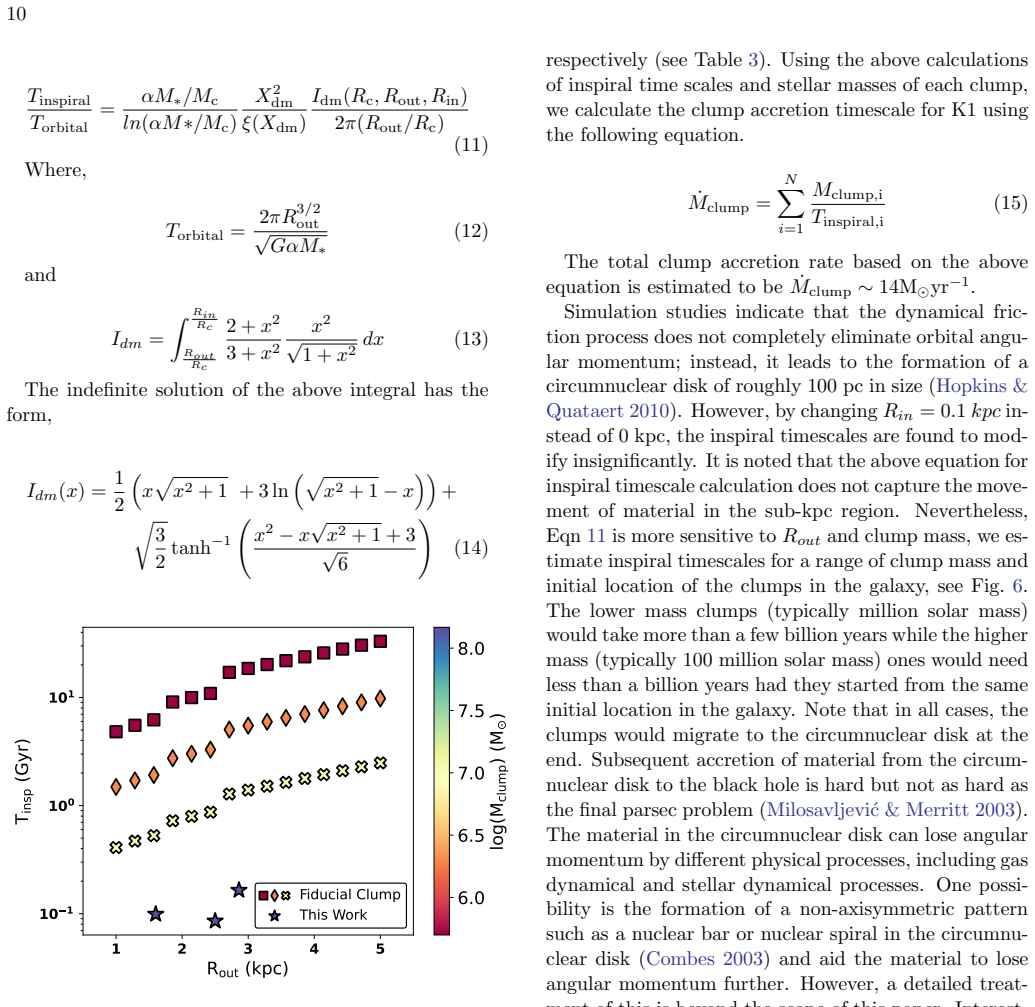
The central claim is that the bright clumps in GSz5BH spiral inward under dynamical friction from the dark-matter halo alone, on timescales of $0.09$, $0.10$ and $0.16$ Gyr for clumps C, K2 and K3 respectively, so that the total clump inflow rate is $\dot{M}_{\rm clump}\approx 14\,M_\odot\,\mathrm{yr}^{-1}$ (Eqs. 11 and 15). Inserting this rate into the linear growth law $M_{\rm BH}(t)=M_{\rm seed}+\eta\,\dot{M}_{\rm clump}\,t$ (Eq. 16), a feeding efficiency of $\eta=0.01$ is sufficient to grow the observed $3.09\times10^7\,M_\odot$ black hole. The paper argues this resolves a seed-mass problem for this galaxy: at its measured Eddington ratio $\lambda=0.14$, Eddington-limited growth from early epochs would require a seed above the direct-collapse ceiling, whereas clump-fed growth works from a much smaller seed and would also explain the galaxy's unusually high black-hole-to-stellar-mass ratio ($\sim2.1\%$).
Load-bearing premise
The calculation assumes the three clumps stay bound, self-gravitating point masses that lose no mass while spiraling to the center; if tidal shear, stellar feedback, or gas removal strips them before they arrive, the $14\,M_\odot\,\mathrm{yr}^{-1}$ inflow is too high and the clump-fed channel fails.
Editorial extensions
If this is right
- Given the observed clump masses and positions, roughly $14\,M_\odot\,\mathrm{yr}^{-1}$ will reach the central region of GSz5BH within about 0.1 Gyr, so the black hole's past growth does not require sustained super-Eddington accretion.
- Adding gas dynamical friction and clump-clump interactions, which Eq. 11 omits, would only shorten the inspiral timescales, making clump-fed accretion more efficient than the paper's conservative estimate.
- Because high-redshift galaxies are generally clumpy, the mechanism should operate broadly, not only in GSz5BH, and would deliver both black hole fuel and bulge-building material in the same events.
- The inflowing matter first assembles a circumnuclear disk on roughly 100 pc scales; the final 1% feeding efficiency then depends on angular-momentum loss mechanisms such as nuclear bars or spirals.
- The model predicts episodic, not steady, black-hole growth, with each clump arrival producing a temporary rise in the effective Eddington ratio.
Reading between the lines
- Across a sample of clumpy $z\approx5$--$7$ galaxies, this model predicts a positive correlation between total clump mass within a few kiloparsecs and central black hole mass at fixed stellar mass; measuring that correlation would test whether clump-fed growth dominates.
- The 1% feeding efficiency is currently an input assumption; comparing independent accretion-rate estimates from AGN luminosities with measured clump inflow rates in a statistical sample would calibrate $\eta$ and turn Eq. 16 into a predictive relation.
- If tidal disruption wins in most real clumps, the dynamical-friction channel would still build a central bulge and a circumnuclear disk, resulting in a galaxy with a massive bulge but a relatively underweight black hole, an observable discriminator between this model and smooth accretion.
Signed reviews
Editorial analysis
A structured set of objections, weighed in public.
Referee Report
Summary. The manuscript proposes that the z=5.48 galaxy GSz5BH grows its central supermassive black hole of 3.09e7 Msun through the inward migration of massive star-forming clumps. Using HST, JWST, and MUSE observations, the authors subtract AGN light from the images, perform resolved SED fitting, measure clump stellar masses, and derive Ly-alpha kinematics. They then compute dynamical-friction inspiral timescales for clumps C, K2, and K3 in a logarithmic dark-matter halo potential (Eq. 11), obtaining 0.09, 0.10, and 0.16 Gyr respectively. Summing stellar masses divided by these timescales gives an inflow rate of about 14 Msun/yr (Eq. 15). With a feeding efficiency of 0.1-1 percent (Eq. 16), the paper argues that this inflow can grow the black hole from a seed of about 10^6.8 Msun to the observed mass within roughly 600 Myr, concluding that clump-fed accretion is a viable channel for early SMBH growth.
Significance. If the result holds, the paper provides an observationally grounded mechanism for rapid SMBH growth in the first billion years, complementing Eddington-limited accretion and merger-driven scenarios. Its strengths are the use of high-resolution HST/JWST/MUSE data, explicit AGN PSF subtraction, resolved SED fitting, and an analytic dynamical-friction calculation whose assumptions are stated. The estimate is useful as an order-of-magnitude framework and is falsifiable in the sense that a low gas fraction or substantial stripping would break the proposed channel. On the other hand, the central claim is an existence argument rather than a prediction: the parameters alpha, eta, Av, and Mseed are free, and the derived inflow rate is not connected to a measured gas reservoir. The conclusion is therefore contingent on assumptions about gas content and clump survival that the current data do not directly constrain.
major comments (3)
- [Sec. 5.1, Eq. 15] The quantity entering Eq. 15 is the stellar mass of each clump, but the mass that can feed the black hole is gas, not stars. The text states that clumps do not lose mass while they inspiral and later concedes that the calculated rate is inflow into the inner region rather than direct accretion onto the black hole. This distinction is load-bearing: growing the black hole by about 2.5e7 Msun over 0.6 Gyr at eta=0.01 requires only about 4 Msun/yr of gas actually reaching the accretion region. If the clump gas fraction is about 50 percent, the 14 Msun/yr estimate has a factor of roughly two margin, and removing more than about 40 percent of the gas by tidal stripping or feedback before 0.1 kpc leaves less than the required rate. The authors should either justify the gas fraction of the clumps or reframe Eq. 15 as an upper limit on stellar inflow and discuss what gas-phase constraints, such as SFR, HI, or CO limits, imply for the available fuel.
- [Table 2 and Eq. 15] The stellar masses in Table 2 are internally inconsistent: C, K2, and K3 sum to about 1.37e9 Msun, while the full galaxy excluding K1 is listed as 1.22e9 Msun. Since the clumps are part of the galaxy, their sum cannot exceed the total stellar mass, indicating that the clump photometry or the SED fitting is double-counting or systematically overestimating the clump masses. Because Eq. 15 sums exactly these masses, the reported 14 Msun/yr inflow may be inflated. The authors should resolve this mass-budget discrepancy before the inflow rate can be trusted.
- [Sec. 5.1, Eq. 11] The inspiral timescales use projected distances as Rout and assume alpha=3, no mass loss, and the Chandrasekhar formula. For clump C, alpha*M*/Mc is about 4-5, so the Coulomb logarithm in Eq. 11 is only about 1.5-1.7, which is at the edge of the test-particle approximation. If the true three-dimensional radii are larger by 1/sin i, Tinsp grows as Rout^(3/2); for a typical inclination of 30 degrees, K3's timescale increases from 0.16 Gyr to about 0.45 Gyr, comparable to the assumed 0.6 Gyr growth time. The quoted uncertainties on clump masses, roughly 30 percent, are not propagated into Tinsp or Mdot. A sensitivity table varying alpha, inclination, and clump mass would establish whether the conclusion is robust.
minor comments (5)
- [Sec. 3.1 and Sec. 3.4] There are typographical errors: 'Photultils' should be 'photutils' in Sec. 3.1, and 'Caleztti et al. (2000)' should be 'Calzetti et al. (2000)' in Sec. 3.4 and in the reference list.
- [Eq. 11] The symbols M*, Mc, and alpha are not all defined where Eq. 11 is introduced; the reader must infer from the surrounding text that M* is the galaxy stellar mass, Mc is the clump mass, and alpha is the dynamical-to-stellar mass ratio. Please define each symbol explicitly in the equation or immediately below it.
- [Sec. 4.4] The rotation velocity is reported as about 63 km/s from the aperture extraction and about 44 km/s from the SAMI scaling relation; the two estimates should be reconciled or explicitly presented as different measures so that the reader can assess the kinematics used for the galaxy.
- [Sec. 3.5] The derivation of stellar mass for clump K1 quotes M/L = 0.139 from Eq. 1 with a_k = -1.16 and b_k = 0.44, but the V-K color of 0.687 and the resulting mass of 2.39e8 Msun are given without an uncertainty; adding an error estimate would make the comparison with the other clump masses more meaningful.
- [Code availability] The code availability statement lists standard tools but no custom scripts; making available the GALFIT configuration files and the SED-fitting parameter grids would improve reproducibility.
Circularity Check
No significant circularity: the clump inspiral and mass-inflow calculations are independent of the target black-hole mass, and the feeding efficiency is an explicit free parameter rather than a fitted prediction.
full rationale
The central derivation chain is not circular. The inspiral timescales (Eqs. 11-14) are computed from observed clump positions and masses, an assumed logarithmic halo potential (Eqs. 8-10), and standard dynamical-friction theory; they do not use the target black-hole mass. The clump mass inflow (Eq. 15) is the sum of SED-derived clump masses divided by these timescales, again independent of M_BH. Eq. 16 introduces a free feeding efficiency eta, scanned over 0.001-0.01 and presented as a sufficiency band, not as a fitted prediction; the statement 'with only 1% of feeding efficiency' is an existence argument rather than a unique derivation. The paper explicitly notes that Eq. 15 represents inflow into the inner region rather than direct accretion onto the black hole, which weakens the physical claim but does not make it definitionally circular. The cited Borgohain et al. (2022) expression for the inspiral timescale rests on standard Chandrasekhar dynamical friction (Binney & Tremaine 2008; Elmegreen et al. 2012), so the overlapping-author citation is not load-bearing in the sense of importing an unverified premise. The main caveats, such as the assumed no-mass-loss clump inspiral and the free efficiency eta, are physical modeling limitations and not circular reductions of the derivation to its inputs.
Assumptions & free parameters
free parameters (5)
- alpha (ratio of dynamical to stellar mass) =
3 (assumed, no uncertainty)
- V0 (halo circular velocity) =
62.8 km/s
- eta (feeding efficiency) =
0.001 to 0.01 (scanned; 1% used for headline)
- Av (AGN dust attenuation) =
4 mag
- Mseed (initial seed mass) =
not fixed; scenario-dependent (Pop III ~100-200 Msun; DCBH up to 1e6 Msun)
assumptions (5)
- domain assumption The dark matter halo is described by a spherical logarithmic potential Phi(r) = V0^2 ln(Rc^2 + r^2) (Eq. 8).
- standard math Dynamical friction follows the Chandrasekhar formula with a Maxwellian velocity distribution (Eq. 11), applied to clumps in a finite halo.
- ad hoc to paper The clumps are bound, self-gravitating structures that do not lose mass during inspiral.
- domain assumption The black-hole-hosting clump K1 is at the dynamical center of the galaxy.
- domain assumption Projected distances from K1 are used as orbital radii Rout.
Cite this review
Pith. "Pith review of Clump-fed black hole growth in the first billion years of the universe." pith.science (2026). https://pith.science/paper/MVJRAGA2
@misc{pith2026250413664,
  author       = {Pith},
  title        = {Pith review of: Clump-fed black hole growth in the first billion years of the universe},
  year         = {2026},
  howpublished = {\url{https://pith.science/paper/MVJRAGA2}},
  note         = {Machine review of arXiv:2504.13664}
}
read the original abstract
Understanding how supermassive black holes (SMBHs) form in the early universe is one of the most challenging problems in astrophysics. Their high abundance in the first billion years, as observed by the James Webb Space Telescope, hints towards black hole seeds that accrete mass rapidly. The origin of this accreted mass is not known. Here, we consider a billion solar mass clumpy galaxy at z=5.48 with a 30 million solar mass black hole in the center. We show that the clumps should migrate to the central region because of torques from dynamical friction with the halo, funneling in at least 14 solar masses per year. This is fast enough to grow the observed SMBH, with only 1% of the accreted mass getting in and the rest going to a bulge. Clump-fed accretion could explain most young SMBHs because young galaxies are highly irregular with massive star-forming clumps.
Figures


Figures from the paper (6 more)




Forward citations
Cited by 1 Pith paper
-
The Physical Nature of the Off-centered Extended Emission Associated with the Little Red Dots
The off-centered extended emission near three little red dots is physically associated with the dots, and for two sources it is best explained as low-density, metal-poor nebular gas photoionized by the dot's ultraviol...
Reference graph
Works this paper leans on
-
[1]
Dunlop, J. S. 2013, MNRAS, 432, 3438, doi: 10.1093/mnras/stt696 Astropy Collaboration, Robitaille, T. P., Tollerud, E. J., et al. 2013, A&A, 558, A33, doi: 10.1051/0004-6361/201322068 Astropy Collaboration, Price-Whelan, A. M., Sip˝ ocz, B. M., et al. 2018, AJ, 156, 123, doi: 10.3847/1538-3881/aabc4f
-
[2]
2016, MPDAF: MUSE Python Data Analysis Framework, Astrophysics Source Code Library, record ascl:1611.003
Shepherd, M. 2016, MPDAF: MUSE Python Data Analysis Framework, Astrophysics Source Code Library, record ascl:1611.003
2016
-
[3]
2017, Astronomy & Astrophysics, 608, A1, doi: 10.1051/0004-6361/201730833
Bacon, R., Conseil, S., Mary, D., et al. 2017, Astronomy & Astrophysics, 608, A1, doi: 10.1051/0004-6361/201730833
-
[4]
2023, A&A, 670, A4, doi: 10.1051/0004-6361/202244187
Bacon, R., Brinchmann, J., Conseil, S., et al. 2023, A&A, 670, A4, doi: 10.1051/0004-6361/202244187
-
[5]
2019, MNRAS, 487, 2924, doi: 10.1093/mnras/stz1439
Barat, D., D’Eugenio, F., Colless, M., et al. 2019, MNRAS, 487, 2924, doi: 10.1093/mnras/stz1439
-
[6]
2016, Journal of Open Source Software, 1, 58, doi: 10.21105/joss.00058
Barbary, K. 2016, Journal of Open Source Software, 1, 58, doi: 10.21105/joss.00058
-
[7]
Beckwith, S. V. W., Stiavelli, M., Koekemoer, A. M., et al. 2006, AJ, 132, 1729, doi: 10.1086/507302
doi:10.1086/507302 2006
-
[8]
Begelman, M. C., Volonteri, M., & Rees, M. J. 2006, MNRAS, 370, 289, doi: 10.1111/j.1365-2966.2006.10467.x
arXiv 2006
Show all 89 references
- [9]
-
[10]
1996, A&AS, 117, 393, doi: 10.1051/aas:1996164
Bertin, E., & Arnouts, S. 1996, A&AS, 117, 393, doi: 10.1051/aas:1996164
1996 doi
-
[11]
2008, Galactic Dynamics: Second Edition (Princeton University Press) Bogd´ an,´A., Goulding, A
Binney, J., & Tremaine, S. 2008, Galactic Dynamics: Second Edition (Princeton University Press) Bogd´ an,´A., Goulding, A. D., Natarajan, P., et al. 2024, Nature Astronomy, 8, 126, doi: 10.1038/s41550-023-02111-9
2008 doi
-
[12]
2019, A&A, 622, A103, doi: 10.1051/0004-6361/201834156
Boquien, M., Burgarella, D., Roehlly, Y., et al. 2019, A&A, 622, A103, doi: 10.1051/0004-6361/201834156
2019 doi
-
[13]
2022, Nature, 607, 459, doi: 10.1038/s41586-022-04905-9
Borgohain, A., Saha, K., Elmegreen, B., et al. 2022, Nature, 607, 459, doi: 10.1038/s41586-022-04905-9
2022 doi
-
[14]
2016, A&A, 596, A63, doi: 10.1051/0004-6361/201629080
Boucaud, A., Bocchio, M., Abergel, A., et al. 2016, A&A, 596, A63, doi: 10.1051/0004-6361/201629080
2016 doi
-
[15]
2011, ApJL, 741, L33, doi: 10.1088/2041-8205/741/2/L33
Bournaud, F., Dekel, A., Teyssier, R., et al. 2011, ApJL, 741, L33, doi: 10.1088/2041-8205/741/2/L33
2011 doi
-
[16]
G., & Elmegreen, D
Bournaud, F., Elmegreen, B. G., & Elmegreen, D. M. 2007, ApJ, 670, 237, doi: 10.1086/522077
2007 doi
-
[17]
2023, astropy/photutils: 1.9.0, 1.9.0, Zenodo, doi: 10.5281/zenodo.8248020
Bradley, L., Sip˝ ocz, B., Robitaille, T., et al. 2023, astropy/photutils: 1.9.0, 1.9.0, Zenodo, doi: 10.5281/zenodo.8248020
2023 doi
-
[18]
Bromm, V., Yoshida, N., Hernquist, L., & McKee, C. F. 2009, Nature, 459, 49, doi: 10.1038/nature07990
2009 doi
-
[20]
2005, MNRAS, 360, 1413, doi: 10.1111/j.1365-2966.2005.09131.x
Burgarella, D., Buat, V., & Iglesias-P´ aramo, J. 2005, MNRAS, 360, 1413, doi: 10.1111/j.1365-2966.2005.09131.x
2005
-
[21]
C., et al
Caleztti, D., Armus, L., Bohlin, R. C., et al. 2000, ApJ, 533, 682, doi: 10.1086/308692
2000 doi
-
[22]
2003, MNRAS, 342, 345, doi: 10.1046/j.1365-8711.2003.06541.x
Cappellari, M., & Copin, Y. 2003, MNRAS, 342, 345, doi: 10.1046/j.1365-8711.2003.06541.x
2003
-
[23]
Ciambur, B. C. 2016, PASA, 33, e062, doi: 10.1017/pasa.2016.60
2016 doi
-
[24]
2011, ApJL, 741, L11, doi: 10.1088/2041-8205/741/1/L11
Cisternas, M., Jahnke, K., Bongiorno, A., et al. 2011, ApJL, 741, L11, doi: 10.1088/2041-8205/741/1/L11
2011 doi
-
[25]
2003, in Astronomical Society of the Pacific Conference Series, Vol
Combes, F. 2003, in Astronomical Society of the Pacific Conference Series, Vol. 290, Active Galactic Nuclei: From Central Engine to Host Galaxy, ed. S. Collin, F. Combes, & I. Shlosman, 411, doi: 10.48550/arXiv.astro-ph/0210232
-
[26]
J., Grogin, N
Conselice, C. J., Grogin, N. A., Jogee, S., et al. 2004, ApJL, 600, L139, doi: 10.1086/378556
2004 doi
- [27]
-
[28]
B., Miller, M
Davies, M. B., Miller, M. C., & Bellovary, J. M. 2011, ApJL, 740, L42, doi: 10.1088/2041-8205/740/2/L42
2011 doi
-
[29]
DeForest, C. E. 2004, SoPh, 219, 3, doi: 10.1023/B:SOLA.0000021743.24248.b0
2004
-
[30]
2017, MNRAS, 466, 1462, doi: 10.1093/mnras/stw2777
DeGraf, C., Dekel, A., Gabor, J., & Bournaud, F. 2017, MNRAS, 466, 1462, doi: 10.1093/mnras/stw2777
2017 doi
-
[31]
2009, ApJ, 703, 785, doi: 10.1088/0004-637X/703/1/785
Dekel, A., Sari, R., & Ceverino, D. 2009, ApJ, 703, 785, doi: 10.1088/0004-637X/703/1/785
2009 doi
-
[32]
2009, ApJ, 694, 302, doi: 10.1088/0004-637X/694/1/302
Devecchi, B., & Volonteri, M. 2009, ApJ, 694, 302, doi: 10.1088/0004-637X/694/1/302
2009 doi
-
[34]
B., Guiderdoni, B., Blaizot, J., et al
Drake, A. B., Guiderdoni, B., Blaizot, J., et al. 2017, MNRAS, 471, 267, doi: 10.1093/mnras/stx1515
2017 doi
-
[35]
G., Bournaud, F., & Elmegreen, D
Elmegreen, B. G., Bournaud, F., & Elmegreen, D. M. 2008, ApJ, 684, 829, doi: 10.1086/590361
2008 doi
-
[36]
G., Zhang, H.-X., & Hunter, D
Elmegreen, B. G., Zhang, H.-X., & Hunter, D. A. 2012, ApJ, 747, 105, doi: 10.1088/0004-637X/747/2/105
2012 doi
-
[37]
M., Elmegreen, B
Elmegreen, D. M., Elmegreen, B. G., Marcus, M. T., et al. 2009, ApJ, 701, 306, doi: 10.1088/0004-637X/701/1/306
2009 doi
-
[38]
Schaffer, M. A. 2005, ApJ, 631, 85, doi: 10.1086/432502
2005 doi
- [39]
-
[40]
J., Eisenhauer, F., et al
Genzel, R., Tacconi, L. J., Eisenhauer, F., et al. 2006, Nature, 442, 786, doi: 10.1038/nature05052 16
2006 doi
-
[41]
M., Salim, S., Hornstein, S
Ghez, A. M., Salim, S., Hornstein, S. D., et al. 2005, ApJ, 620, 744, doi: 10.1086/427175
2005 doi
- [42]
-
[43]
F., et al
Guo, Y., Rafelski, M., Bell, E. F., et al. 2018, ApJ, 853, 108, doi: 10.3847/1538-4357/aaa018
2018 doi
-
[44]
2023, ApJ, 959, 39, doi: 10.3847/1538-4357/ad029e
Harikane, Y., Zhang, Y., Nakajima, K., et al. 2023, ApJ, 959, 39, doi: 10.3847/1538-4357/ad029e
2023 doi
-
[45]
2017, A&A, 608, A10, doi: 10.1051/0004-6361/201731579
Hashimoto, T., Garel, T., Guiderdoni, B., et al. 2017, A&A, 608, A10, doi: 10.1051/0004-6361/201731579
2017 doi
-
[46]
M., & Best, P
Heckman, T. M., & Best, P. N. 2014, ARA&A, 52, 589, doi: 10.1146/annurev-astro-081913-035722
2014 doi
-
[47]
F., Hernquist, L., Cox, T
Hopkins, P. F., Hernquist, L., Cox, T. J., et al. 2006, ApJS, 163, 1, doi: 10.1086/499298
2006 doi
-
[49]
M., Cowie, L
Hu, E. M., Cowie, L. L., & McMahon, R. G. 1998, ApJL, 502, L99, doi: 10.1086/311506
1998 doi
-
[50]
2015, Hubble Legacy Fields (”HLF”), STScI/MAST, doi: 10.17909/T91019
Illingworth, G. 2015, Hubble Legacy Fields (”HLF”), STScI/MAST, doi: 10.17909/T91019
2015 doi
-
[52]
A., & Mandel, E
Joye, W. A., & Mandel, E. 2003, in Astronomical Society of the Pacific Conference Series, Vol. 295, Astronomical Data Analysis Software and Systems XII, ed. H. E
2003
-
[53]
S., Silverman, J
Kalita, B. S., Silverman, J. D., Daddi, E., et al. 2025a, MNRAS, doi: 10.1093/mnras/staf031
-
[54]
S., Suzuki, T
Kalita, B. S., Suzuki, T. L., Kashino, D., et al. 2025b, MNRAS, 536, 3090, doi: 10.1093/mnras/stae2781
-
[55]
D., Faber, S
Kocevski, D. D., Faber, S. M., Mozena, M., et al. 2012, ApJ, 744, 148, doi: 10.1088/0004-637X/744/2/148
2012 doi
-
[56]
Kormendy, J., & Ho, L. C. 2013, ARA&A, 51, 511, doi: 10.1146/annurev-astro-082708-101811 Kov´ acs, O. E., Bogd´ an,´A., Natarajan, P., et al. 2024, ApJL, 965, L21, doi: 10.3847/2041-8213/ad391f
2013 doi
-
[57]
H., Calzetti, D., & Heckman, T
Leitherer, C., Li, I. H., Calzetti, D., & Heckman, T. M. 2002, ApJS, 140, 303, doi: 10.1086/342486
2002 doi
- [58]
-
[59]
2014, ApJL, 784, L38, doi: 10.1088/2041-8205/784/2/L38
Madau, P., Haardt, F., & Dotti, M. 2014, ApJL, 784, L38, doi: 10.1088/2041-8205/784/2/L38
2014 doi
-
[60]
Madau, P., & Rees, M. J. 2001, ApJL, 551, L27, doi: 10.1086/319848
2001 doi
-
[61]
2024, Nature, 627, 59, doi: 10.1038/s41586-024-07052-5
Maiolino, R., Scholtz, J., Witstok, J., et al. 2024, Nature, 627, 59, doi: 10.1038/s41586-024-07052-5
2024 doi
-
[62]
2014, MNRAS, 443, 3675, doi: 10.1093/mnras/stu1340
Mandelker, N., Dekel, A., Ceverino, D., et al. 2014, MNRAS, 443, 3675, doi: 10.1093/mnras/stu1340
2014 doi
-
[63]
P., Brammer, G., et al
Matthee, J., Naidu, R. P., Brammer, G., et al. 2024, ApJ, 963, 129, doi: 10.3847/1538-4357/ad2345
2024 doi
-
[64]
2001, in Astronomical Society of the Pacific Conference Series, Vol
Merritt, D., & Ferrarese, L. 2001, in Astronomical Society of the Pacific Conference Series, Vol. 249, The Central Kiloparsec of Starbursts and AGN: The La Palma Connection, ed. J. H. Knapen, J. E. Beckman, I. Shlosman, & T. J. Mahoney, 335, doi: 10.48550/arXiv.astro-ph/0107134
-
[65]
2007, MNRAS, 380, 1533, doi: 10.1111/j.1365-2966.2007.12162.x Milosavljevi´ c, M., & Merritt, D
Micic, M., Holley-Bockelmann, K., Sigurdsson, S., & Abel, T. 2007, MNRAS, 380, 1533, doi: 10.1111/j.1365-2966.2007.12162.x Milosavljevi´ c, M., & Merritt, D. 2003, in American Institute of Physics Conference Series, Vol. 686, The Astrophysics of Gravitational Wave Sources, ed....
2007
-
[66]
Moffat, A. F. J. 1969, A&A, 3, 455
1969
-
[67]
2019, MNRAS, 488, 5185, doi: 10.1093/mnras/stz2016
Netzer, H. 2019, MNRAS, 488, 5185, doi: 10.1093/mnras/stz2016
2019 doi
-
[68]
2009, A&A, 507, 1793, doi: 10.1051/0004-6361/200912497
Noll, S., Burgarella, D., Giovannoli, E., et al. 2009, A&A, 507, 1793, doi: 10.1051/0004-6361/200912497
2009 doi
- [69]
-
[70]
2023, ApJL, 957, L3, doi: 10.3847/2041-8213/ad0158
Pacucci, F., Nguyen, B., Carniani, S., Maiolino, R., & Fan, X. 2023, ApJL, 957, L3, doi: 10.3847/2041-8213/ad0158
2023 doi
-
[71]
Pei, Y. C. 1992, ApJ, 395, 130, doi: 10.1086/171637
1992 doi
-
[72]
Y., Ho, L
Peng, C. Y., Ho, L. C., Impey, C. D., & Rix, H.-W. 2002, AJ, 124, 266, doi: 10.1086/340952
2002 doi
-
[73]
2019, in Astronomical Society of the Pacific Conference Series, Vol
Piqueras, L., Conseil, S., Shepherd, M., et al. 2019, in Astronomical Society of the Pacific Conference Series, Vol. 521, Astronomical Data Analysis Software and Systems XXVI, ed. M. Molinaro, K. Shortridge, & F. Pasian, 545
2019
-
[75]
E., Panagia, N., Windhorst, R
Rhoads, J. E., Panagia, N., Windhorst, R. A., et al. 2005, ApJ, 621, 582, doi: 10.1086/427622
2005 doi
-
[76]
2018, MNRAS, 481, 3278, doi: 10.1093/mnras/sty2448
Ricarte, A., & Natarajan, P. 2018, MNRAS, 481, 3278, doi: 10.1093/mnras/sty2448
2018 doi
-
[77]
T., Lacy, M., Storrie-Lombardi, L
Richards, G. T., Lacy, M., Storrie-Lombardi, L. J., et al. 2006, ApJS, 166, 470, doi: 10.1086/506525
2006 doi
-
[78]
2023, Data from the JWST Advanced Deep Extragalactic Survey (JADES), STScI/MAST, doi: 10.17909/8TDJ-8N28
Rieke, Marcia, Robertson, Brant, Tacchella, Sandro, et al. 2023, Data from the JWST Advanced Deep Extragalactic Survey (JADES), STScI/MAST, doi: 10.17909/8TDJ-8N28
2023 doi
-
[79]
Salim, S., Boquien, M., & Lee, J. C. 2018, ApJ, 859, 11, doi: 10.3847/1538-4357/aabf3c
2018 doi
-
[80]
Salpeter, E. E. 1955, ApJ, 121, 161, doi: 10.1086/145971
1955 doi
-
[81]
F., & Finkbeiner, D
Schlafly, E. F., & Finkbeiner, D. P. 2011, ApJ, 737, 103, doi: 10.1088/0004-637X/737/2/103 17
2011 doi
-
[82]
L., & Haiman, Z
Shang, C., Bryan, G. L., & Haiman, Z. 2010, MNRAS, 402, 1249, doi: 10.1111/j.1365-2966.2009.15960.x
2010
-
[83]
C., Kassin, S
Simons, R. C., Kassin, S. A., Weiner, B. J., et al. 2017, ApJ, 843, 46, doi: 10.3847/1538-4357/aa740c
2017 doi
-
[84]
J., Beckmann, R
Smethurst, R. J., Beckmann, R. S., Simmons, B. D., et al. 2022, arXiv e-prints, arXiv:2211.13677, doi: 10.48550/arXiv.2211.13677 Smithsonian Astrophysical Observatory. 2000, SAOImage DS9: A utility for displaying astronomical images in the X11 window environment, Astrophysics ...
-
[85]
2019, A&A, 623, A157, doi: 10.1051/0004-6361/201833075
Sobral, D., & Matthee, J. 2019, A&A, 623, A157, doi: 10.1051/0004-6361/201833075
2019 doi
-
[86]
N., Cohen, S
Straughn, A. N., Cohen, S. H., Ryan, R. E., et al. 2006, ApJ, 639, 724, doi: 10.1086/499576
2006 doi
-
[87]
2024, arXiv e-prints, arXiv:2412.14248, doi: 10.48550/arXiv.2412.14248 vandenbergh, S., Abraham, R
Trinca, A., Valiante, R., Schneider, R., et al. 2024, arXiv e-prints, arXiv:2412.14248, doi: 10.48550/arXiv.2412.14248 vandenbergh, S., Abraham, R. G., Ellis, R. S., et al. 1996, AJ, 112, 359, doi: 10.1086/118020
-
[88]
2018, ApJL, 865, L9, doi: 10.3847/2041-8213/aadf3a
Visbal, E., & Haiman, Z. 2018, ApJL, 865, L9, doi: 10.3847/2041-8213/aadf3a
2018 doi
-
[89]
Volonteri, M., & Begelman, M. C. 2010, MNRAS, 409, 1022, doi: 10.1111/j.1365-2966.2010.17359.x
2010
-
[90]
Volonteri, M., & Rees, M. J. 2005, ApJ, 633, 624, doi: 10.1086/466521
2005 doi
-
[91]
2018, Royal Statistical Society
Wiener, N. 2018, Royal Statistical Society. Journal. Series A: General, 113, 413, doi: 10.2307/2981007
2018 doi
-
[92]
H., Turk, M
Wise, J. H., Turk, M. J., & Abel, T. 2008, ApJ, 682, 745, doi: 10.1086/588209 Wolfram Research, I. 2024, Mathematica, Version 14.0, Wolfram Research, Inc. https://www.wolfram.com/mathematica
2008 doi
-
[93]
Wright, E. L. 2006, PASP, 118, 1711, doi: 10.1086/510102
2006 doi
-
[94]
N., Alexander, D
Yang, G., Brandt, W. N., Alexander, D. M., et al. 2019, MNRAS, 485, 3721, doi: 10.1093/mnras/stz611
2019 doi
Reviewed August 16, 2026 · model on record in the stance chip above.
Discussion (0). Continue with ORCID to comment.