REVIEW 3 major objections 6 minor 24 references
Sensitivity-aware rock physics enhanced digital shadow for underground-energy storage monitoring
T0 review · 3 major / 6 minor · reviewed 2026-08-16 · deepseek-v4-flash
Pith's one-line read A single trained Digital Shadow can be conditioned on any assumed rock physics model at inference time, enabling real-time what-if testing for CO2 storage monitoring.
desk verdict A clean but under-tested extension: conditioning the Digital Shadow on the Brie exponent is a real idea, but the current experiments only show self-consistency on seen contexts, not the advertised what-if generalization. read the letter →
The pith
A machine-rendered reading of the paper's core claim, the machinery that carries it, and where it could break.
The reading
What carries the argument
The carrying mechanism is a conditional normalizing flow whose conditioning variable is not just the seismic image but also an embedded encoding of the rock physics context. The Brie saturation exponent e, which interpolates between uniform and patchy fluid mixing, is drawn from a uniform distribution, passed through a sinusoidal embedding followed by a dense layer, and added to the intermediate activations of the conditional arm of the network. Training minimizes a context-averaged negative log-posterior objective across e, so a single set of network weights is amortized over rock physics contexts. At inference the same weights are evaluated with a fixed e, which is what turns the posterior into a context-aware conditional distribution rather than a marginal one. The surrounding machinery is the Digital Shadow pipeline: multiphase flow simulation with random permeability fields produces an ensemble of CO2 saturation states, seismic simulation converts them to time-lapse images under each context, and the network is trained on those state, seismic, and context tuples.
What would settle it
Generate a test seismic image with an untrained Brie exponent, for example e=6.5 or e=2, condition the trained Digital Shadow on that same exponent, and compare the posterior mean and spread against a reference network retrained specifically at that exponent; if the context-conditioned result is no closer to the ground-truth plume than a wrong-context run, or if its uncertainty is not calibrated, the generalization claim fails.
Extended reading notes
Core claim
The central claim is that a Digital Shadow trained with a rock physics model as a context variable learns an explicit mapping between time-lapse seismic data, CO2 saturation, and the rock physics model, so that at inference time the network can be conditioned on a specific rock physics model and produce a context-aware posterior. The paper contrasts this with earlier augmentation that mixed multiple rock physics models into the training set, which produces a posterior marginalized over all models and thereby hides the source of uncertainty. Using the Brie saturation model family, with exponent e drawn uniformly from (1,10) and six discrete contexts used to augment 128 flow-simulation ensemble members, the network is trained as a conditional normalizing flow with a sinusoidal embedding of e added into the conditional arm. In the synthetic two-dimensional test, when the observed seismic data are generated with e=4, conditioning the trained network on e=4 yields a higher Structural Similarity Index, a lower root-mean-square error, and tighter posterior samples than conditioning on e=9. The paper reads this as evidence that the Digital Shadow can adapt to different rock physics assumptions dynamically and answer what-if questions without retraining.
Load-bearing premise
The Digital Shadow is trained on only six discrete values of the Brie exponent, the rock-physics parameter that links CO2 saturation to seismic response, and is trusted to work for any value in the claimed range (1,10), even though only two values are demonstrated.
Editorial extensions
If this is right
- A single trained Digital Shadow can be evaluated under any supplied Brie exponent at inference time, giving operators a posterior for CO2 saturation that reflects that specific rock physics assumption.
- The demonstrated gap between conditioning on e=4 and e=9 shows that the context variable materially changes the forecast, so using the wrong rock physics model remains detectable as poorer agreement instead of being silently absorbed into the posterior.
- What-if scenario testing for rock physics assumptions can be run without training a new network, reducing the cost of sensitivity analysis relative to per-model refitting.
- The method extends to any reservoir state estimated by the Digital Shadow framework, such as pressure perturbations, not only CO2 saturation.
- Because the posterior is context-aware, uncertainty from rock physics choice can be separated from uncertainty due to permeability and seismic noise, aiding interpretation of monitoring results.
Reading between the lines
- The same context-embedding design could be inverted at inference time: instead of conditioning on a known exponent, one could treat e as an unknown and infer it jointly with saturation, turning the network into a tool for identifying which rock physics model the seismic data actually support.
- Generalization beyond the six training contexts is the central open risk; a natural stress test would be to train on the same six contexts but evaluate on several intermediate exponents and on values near the endpoints of (1,10) to map where the context encoding stops interpolating.
- If the method holds up on field-like data, an operator could maintain one model plus a scalar context rather than a family of separate models, and the question of which rock physics model is right becomes an empirical test on the observed seismic response.
Signed reviews
Editorial analysis
A structured set of objections, weighed in public.
Referee Report
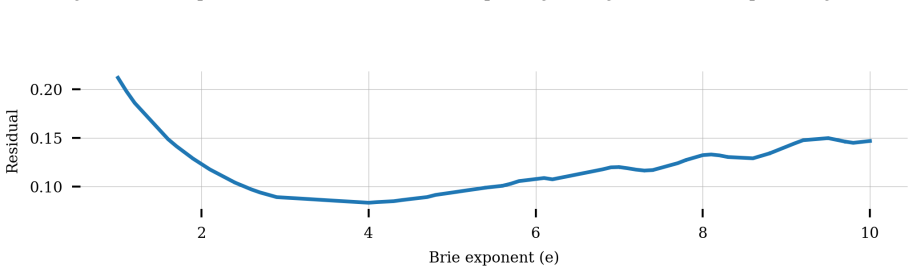
Summary. The paper proposes a context-aware Digital Shadow (DS) for monitoring underground energy storage, specifically tracking CO2 saturation from time-lapse seismic data. The key idea, borrowed from sensitivity-aware amortized Bayesian inference, is to train a conditional normalizing flow (CNF) that takes the rock-physics model as an additional conditioning variable, represented by the Brie saturation exponent e. The network is trained on a synthetic 2D Compass-based reservoir model with 128 flow realizations and six different rock-physics contexts, yielding 768 augmented training samples. At inference time the network can be conditioned on a specific e, enabling 'what if' sensitivity analysis without retraining. Results on synthetic data show that conditioning on the correct exponent e=4 gives higher SSIM, lower RMSE, and lower posterior standard deviation than conditioning on the incorrect exponent e=9, and the data-residual curve has a minimum at e=4.
Significance. If the central claim is validated, the paper would make a useful practical contribution: it would allow real-time sensitivity analysis of CO2 plume forecasts with respect to rock-physics assumptions, avoiding both the averaging effect of a marginal posterior and the cost of retraining a network for each rock-physics model. The authors correctly identify a real limitation of the earlier marginalizing DS approach and connect it to a principled amortized-inference framework. The synthetic experiments use open-source simulation tools (JutulDarcy.jl, JUDI.jl, InvertibleNetworks.jl), which is a strength for reproducibility. The main weakness is that the evaluation only tests the two training contexts e=4 and e=9, so the advertised 'what if' capability for arbitrary rock-physics models is not actually demonstrated. The paper would be strengthened substantially by held-out-context experiments and a baseline comparison with the marginalizing DS from prior work.
major comments (3)
- [§3.2–3.3] The manuscript repeatedly refers to '6 different contexts' but never reports the six Brie exponent values or how they were chosen. Since the outer expectation in Eq. (3) is over e ~ U(1,10) but is implemented with only these six samples, the effective training distribution is a six-point discrete distribution, not a continuous uniform range. The authors should report the six values and justify that they adequately cover [1,10]; otherwise the claim of amortization over a continuous range is unsupported.
- [§4, Figures 3–6] The evaluation only considers e=4 and e=9, and both appear to be among the six training contexts. The paper's central promise is 'what if' sensitivity testing at inference time for arbitrary rock-physics assumptions 'without requiring retraining'. To substantiate this, the authors need to evaluate held-out exponents (for example, e=2.5, e=6, or e=8) and report the resulting SSIM, RMSE, and posterior standard deviation. If performance degrades sharply for interpolated values, the method reduces to a lookup table over six discrete contexts rather than a continuous sensitivity tool.
- [§4, Figure 3] The observed time-lapse data are generated with e=4 using the same simulation family that produced the training contexts, so the finding that the residual minimum occurs at e=4 is partly a self-consistency check. The authors should also test with observed data generated under a held-out rock-physics model or with an exponent not included in the six training contexts. In addition, a direct comparison with the marginalizing DS of Gahlot and Herrmann (2025) is needed to show that conditioning on the correct context yields systematically better predictive performance rather than merely a different posterior mean.
minor comments (6)
- [§3.2] The Brie saturation model is not defined; since the exponent e is the central context variable, the authors should include the Brie mixing formula or provide the exact equations used to convert CO2 saturation and pressure to elastic properties, with a specific reference to the equation numbers in Avseth et al. (2010).
- [§3.3, Eq. (3)] The loss expression in Eq. (3) has typographical issues (triple vertical bars around the flow mapping) and ambiguous notation; please define f_phi explicitly as the forward or inverse transformation and write the standard change-of-variables negative log-likelihood in a cleaner form, stating which network outputs form the affine coupling layers.
- [§4] The text says that 'the captions of Figure 5 and figure 6 show' the RMSE and standard deviation values, but the corresponding numerical values are not given in the text; please report the exact SSIM, RMSE, and mean standard deviation values for both the correct and incorrect exponent cases in the main text.
- [§1] The discussion of Figure 1 and Figure 2 is confusing: the text refers to 'the right plot of figure 2' when describing the ground-truth plume and to the left/right in Figure 1; please clarify the figure references and ensure the captions explicitly identify which panel corresponds to the uniform and patchy rock-physics models.
- [§3.2] The phrase '28 dB SNR colored Gaussian noise' should be rephrased as 'additive colored Gaussian noise with 28 dB SNR', and the coloring (e.g., correlation length or frequency content) should be specified for reproducibility.
- [Acknowledgments] The statement 'The overall readability is enhanced using ChatGPT 4' is unconventional; if the journal requires generative-AI disclosure, please format it as a standard AI-use statement and place it in the appropriate section according to the journal's policy.
Circularity Check
No significant circularity found: the central claim is a conditional density estimator validated on synthetic data, and the main weakness is an untested generalization gap rather than a self-referential derivation.
full rationale
The paper derives no closed-form prediction from fitted constants; its method is a Conditional Normalizing Flow (CNF) trained with the standard maximum-likelihood objective in Eq. (3) on simulated pairs of reservoir states, seismic observations, and Brie-exponent contexts. At inference, conditioning on a context e is the standard amortized Bayesian inference computation, and the posterior for e=4 or e=9 is evaluated against synthetic ground truth generated with the same forward-model family. The statement in Section 4 that the data residual reaches its minimum at e=4 'as this is the exponent used to generate the observed data' is an explicit sanity check on synthetic data, not a fitted parameter being relabeled as a prediction. Self-citations to prior Digital Shadow work (Gahlot et al. 2023, 2024; Gahlot and Herrmann 2025) provide the base framework and training recipe, but the context-conditioning contribution is built on the external amortized-Bayesian-inference framework of Elsemüller et al. (2024), so the self-citations are not load-bearing in a circular sense. The paper's genuine weakness is that training uses only six discrete Brie exponents while the concluding what-if claim implies arbitrary continuous e in (1,10), and the evaluation tests only two seen contexts (e=4 and e=9). That is an untested generalization claim and a correctness/evidence concern, not a circular reduction of the derivation to its inputs. Accordingly, no circular step can be exhibited under the required standard.
Assumptions & free parameters
free parameters (2)
- Brie saturation exponent e at test time =
e=4 (correct) and e=9 (incorrect) in the demonstration
- Six discrete training contexts for e =
not specified
assumptions (5)
- domain assumption The Brie saturation model family with exponent e in [1,10] adequately spans the plausible rock physics uncertainty for CO2 storage monitoring.
- domain assumption The synthetic Compass model subset and its flow and seismic simulations faithfully represent a North Sea storage reservoir.
- domain assumption The empirical velocity-to-permeability transformation from Gahlot et al. (2024) is valid for this reservoir.
- domain assumption The seismic acquisition design (8 receivers, 200 sources, 15 Hz, 28 dB SNR colored noise) is sufficient for the monitoring task.
- standard math Conditional normalizing flows can approximate the posterior p(x_k | y_k, e) for this problem.
Cite this review
Pith. "Pith review of Sensitivity-aware rock physics enhanced digital shadow for underground-energy storage monitoring." pith.science (2026). https://pith.science/paper/JB52GEMX
@misc{pith2026250414405,
  author       = {Pith},
  title        = {Pith review of: Sensitivity-aware rock physics enhanced digital shadow for underground-energy storage monitoring},
  year         = {2026},
  howpublished = {\url{https://pith.science/paper/JB52GEMX}},
  note         = {Machine review of arXiv:2504.14405}
}
read the original abstract
Underground energy storage, which includes storage of hydrogen, compressed air, and CO2, requires careful monitoring to track potential leakage pathways, a situation where time-lapse seismic imaging alone may be inadequate. A recently developed Digital Shadow (DS) enhances forecasting using machine learning and Bayesian inference, yet their accuracy depends on assumed rock physics models, the mismatch of which can lead to unreliable predictions for the reservoir's state (saturation/pressure). Augmenting DS training with multiple rock physics models mitigates errors but averages over uncertainties, obscuring their sources. To address this challenge, we introduce context-aware sensitivity analysis inspired by amortized Bayesian inference, allowing the DS to learn explicit dependencies between seismic data, the reservoir state, e.g., CO2 saturation, and rock physics models. At inference time, this approach allows for real-time ''what if'' scenario testing rather than relying on costly retraining, thereby enhancing interpretability and decision-making for safer, more reliable underground storage.
Figures


Figures from the paper (3 more)


Reference graph
Works this paper leans on
-
[1]
Avseth, Per, Tapan Mukerji, and Gary Mavko. 2010. Quantitative Seismic Interpretation: Applying Rock Physics Tools to Reduce Interpretation Risk. Cambridge university press
2010
-
[2]
E. Jones, C., J. A. Edgar, J. I. Selvage, and H. Crook. 2012. ``Building Complex Synthetic Models to Evaluate Acquisition Geometries and Velocity Inversion Technologies.'' In 74th EAGE Conference and Exhibition Incorporating EUROPEC 2012, cp--293. https://doi.org/https://doi.org/10.3997/2214-4609.20148575
arXiv 2012
-
[3]
Elsemüller, Lasse, Hans Olischläger, Marvin Schmitt, Paul-Christian Bürkner, Ullrich Koethe, and Stefan T. Radev. 2024. ``Sensitivity-Aware Amortized Bayesian Inference.'' Transactions on Machine Learning Research. https://openreview.net/forum?id=Kxtpa9rvM0
work page 2024
-
[4]
Gahlot, Abhinav Prakash, Huseyin Tuna Erdinc, Rafael Orozco, Ziyi Yin, and Felix J. Herrmann. 2023. ``Inference of CO2 Flow Patterns a Feasibility Study.'' https://doi.org/10.48550/arXiv.2311.00290
-
[5]
Gahlot, Abhinav Prakash, and Felix J. Herrmann. 2025. ``Enhancing Robustness of Digital Shadow for CO2 Storage Monitoring with Augmented Rock Physics Modeling.'' https://arxiv.org/abs/2502.07171
work page Pith review arXiv 2025
-
[6]
Gahlot, Abhinav Prakash, Rafael Orozco, Ziyi Yin, and Felix J. Herrmann. 2024. ``An Uncertainty-Aware Digital Shadow for Underground Multimodal CO2 Storage Monitoring,'' October. https://doi.org/10.48550/arXiv.2410.01218
-
[7]
Global CCS Institute (GCCSI). 2019. ``GCCSI CO 2 RE Database: 2019.'' 2019. https://co2re.co
work page 2019
-
[8]
Herrmann, Felix J. 2023. ``President's Page: Digital Twins in the Era of Generative AI.'' The Leading Edge 42 (11): 730--32
2023
Show all 24 references
-
[9]
International Energy Agency (IEA). 2016. ``20 Years of Carbon Capture and Storage: Accelerating Future Deployment.'' https://www.iea.org/publications
2016
-
[10]
IPCC special report. 2018. ``Global Warming of 1.5 c.'' An IPCC Special Report on the Impacts of Global Warming of 1 (5): 43--50
2018
-
[11]
Kingma, Diederik P., and Jimmy Ba. 2014. ``Adam: A Method for Stochastic Optimization.'' CoRR abs/1412.6980. https://api.semanticscholar.org/CorpusID:6628106
2014 arXiv
-
[12]
Louboutin, Mathias, Philipp Witte, Ziyi Yin, Henryk Modzelewski, Kerim, Carlos da Costa, and Peterson Nogueira. 2023. ``Slimgroup/JUDI.jl: V3.2.3.'' Zenodo. https://doi.org/10.5281/zenodo.7785440
2023 doi
-
[13]
Lumley, David. 2010. ``4D Seismic Monitoring of CO 2 Sequestration.'' The Leading Edge 29 (2): 150--55
2010
-
[14]
Møyner, Olav, Grant Bruer, and Ziyi Yin. 2023. ``Sintefmath/JutulDarcy.jl: V0.2.3.'' Zenodo. https://doi.org/10.5281/zenodo.7855628
2023 doi
-
[15]
Herrmann
Orozco, Rafael, Philipp Witte, Mathias Louboutin, Ali Siahkoohi, Gabrio Rizzuti, Bas Peters, and Felix J. Herrmann. 2024. ``InvertibleNetworks.jl: A Julia Package for Scalable Normalizing Flows.'' Journal of Open Source Software 9 (99): 6554. https://doi.org/10.21105/joss.06554
2024 doi
-
[16]
Papamakarios, George, Eric Nalisnick, Danilo Jimenez Rezende, Shakir Mohamed, and Balaji Lakshminarayanan. 2021. ``Normalizing Flows for Probabilistic Modeling and Inference.'' J. Mach. Learn. Res. 22 (1)
2021
-
[17]
Radev, Stefan T, Ulf K Mertens, Andreas Voss, Lynton Ardizzone, and Ullrich Köthe. 2020. ``BayesFlow: Learning Complex Stochastic Models with Invertible Neural Networks.'' IEEE Transactions on Neural Networks and Learning Systems 33 (4): 1452--66
2020
-
[18]
Ringrose, Philip. 2020. How to Store CO\(_ 2 \) Underground: Insights from Early-Mover CCS Projects . Vol. 129. Springer
2020
-
[19]
---------. 2023. Storage of Carbon Dioxide in Saline Aquifers: Building Confidence by Forecasting and Monitoring. Society of Exploration Geophysicists
2023
-
[20]
Song, Yang, Jascha Sohl-Dickstein, Diederik P Kingma, Abhishek Kumar, Stefano Ermon, and Ben Poole. 2020. ``Score-Based Generative Modeling Through Stochastic Differential Equations.'' arXiv Preprint arXiv:2011.13456
2020 arXiv
-
[21]
Spantini, Alessio, Ricardo Baptista, and Youssef Marzouk. 2022. ``Coupling Techniques for Nonlinear Ensemble Filtering.'' SIAM Review 64 (4): 921--53
2022
-
[22]
Tancik, Matthew, Pratul Srinivasan, Ben Mildenhall, Sara Fridovich-Keil, Nithin Raghavan, Utkarsh Singhal, Ravi Ramamoorthi, Jonathan Barron, and Ren Ng. 2020. ``Fourier Features Let Networks Learn High Frequency Functions in Low Dimensional Domains.'' Advances in Neural Infor...
2020
-
[23]
Gorman, and Felix J
Witte, Philipp A., Mathias Louboutin, Navjot Kukreja, Fabio Luporini, Michael Lange, Gerard J. Gorman, and Felix J. Herrmann. 2019. ``A Large-Scale Framework for Symbolic Implementations of Seismic Inversion Algorithms in Julia.'' Geophysics 84 (3): F57--71. https://doi.org/10...
2019 doi
-
[24]
4i SN_?m9眸 of1uԴšzq饗&ڭ[_ =vqǔϘ1#? _|kѢE ] o twx K7lxwC E W#H E Gǎ 5 '暸k lٲ8C.4 grzW .TS!CĹ[uEj賈 jg] 1
Yin, Ziyi, Rafael Orozco, Mathias Louboutin, and Felix J Herrmann. 2024. ``WISE: Full-Waveform Variational Inference via Subsurface Extensions.'' Geophysics 89 (4): 1--31. CSLReferences document arxiv.sty0000664000000000000000000001615015001006246011445 0ustar rootroot LaTeX2e...
2024
Reviewed August 16, 2026 · model on record in the stance chip above.
Discussion (0). Continue with ORCID to comment.