REVIEW 4 major objections 4 minor 1 cited by
Talk is Not Always Cheap: Promoting Wireless Sensing Models with Text Prompts
T0 review · 4 major / 4 minor · reviewed 2026-08-16 · deepseek-v4-flash
Pith's one-line read WiTalk claims that a text branch with LLM-generated hierarchical prompts improves wireless sensing accuracy and temporal action localization with no architectural changes or new data collection.
desk verdict Useful idea, but the test-time text retrieval is never specified, so the headline gains may be label leakage; needs clarification before the results can be trusted. read the letter →
The pith
A machine-rendered reading of the paper's core claim, the machinery that carries it, and where it could break.
The reading
What carries the argument
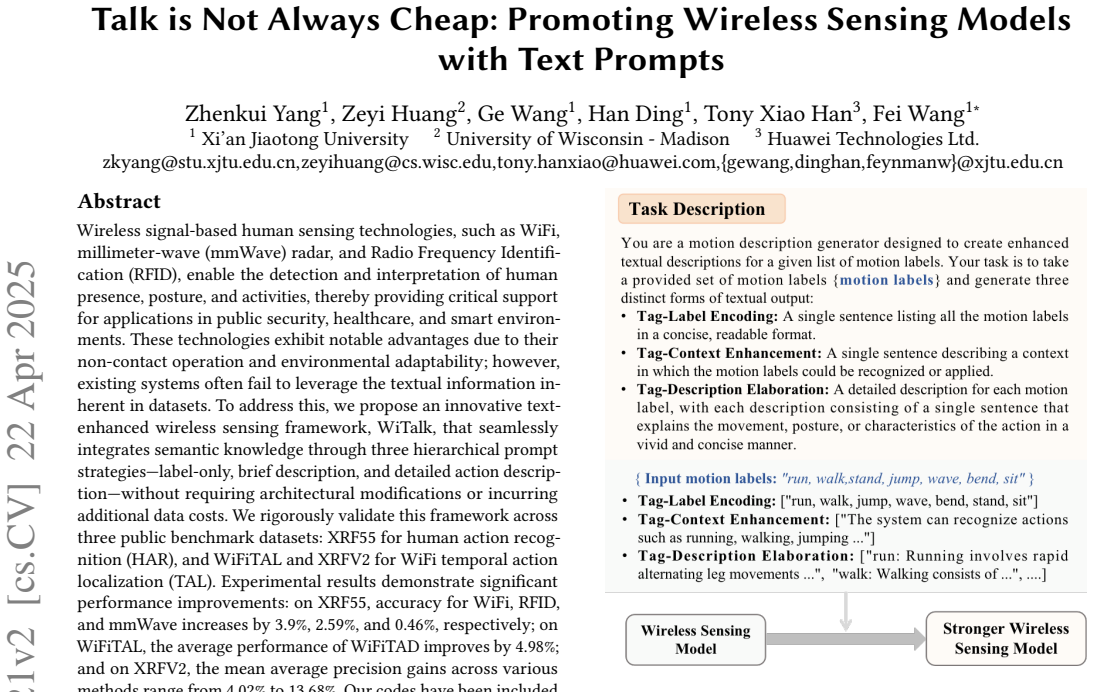
The load-bearing mechanism is the text branch: a contextual template plus LLM-generated hierarchical prompts (label-only, brief context, and detailed description), a text encoder producing fixed embeddings cached in JSON, a multi-head self-attention layer, and weighted fusion of text features with wireless features at a 0.1 text weight. This branch carries the argument because it is the only change between the W and W+T runs; all sensing encoders, losses, and hyperparameters stay fixed.
What would settle it
Run the full WiTalk pipeline but at inference replace the ground-truth label's text embedding with one derived from the model's own predicted label or from a fixed neutral description; if the W+T gains largely disappear, label leakage explains them.
Extended reading notes
Core claim
We claim that the latent text already present in wireless sensing datasets—the action labels—can be turned into a cheap performance booster. WiTalk enriches each label with a large language model under three prompt strategies of increasing semantic richness, encodes the enriched text with a frozen text encoder, refines it with multi-head self-attention, and fuses it with the wireless feature vector at a text weight of 0.1. Across XRF55, WiFiTAL, and XRFV2, this addition raises accuracy or mAP by the reported margins without changing the sensing model's architecture or collecting any new signal data.
Load-bearing premise
At test time, the text feature for each sample must be obtained without peeking at the sample's ground-truth action label, but the paper does not specify how that retrieval is done.
Editorial extensions
If this is right
- Any existing wireless sensing model can be upgraded with text semantics by adding the text branch, with no architectural changes.
- The improvement transfers across modalities (Wi-Fi, RFID, mmWave) and across tasks (human action recognition and temporal action localization), so the effect is not specific to one signal type.
- Because labels already exist in every dataset, the method promises a zero-data-collection accuracy gain for deployed systems.
- Text encoders trained only on images and text—not on wireless signals—still provide useful semantic guidance for wireless features.
Reading between the lines
- If the text feature at inference is chosen using the model's own predicted label rather than the ground-truth class name, the reported gains may shrink; a class-agnostic retrieval test would separate genuine semantic regularisation from label leakage.
- The prompt strategy that works best appears to depend on modality: RFID benefits more from detailed descriptions, while Wi-Fi prefers the brief-context prompt, suggesting prompt design should be tuned per signal type.
- The same branch could be applied to other RF tasks such as gesture recognition or pose estimation, where text labels are equally available and the fusion cost would be the same.
Signed reviews
Editorial analysis
A structured set of objections, weighed in public.
Referee Report
Summary. The paper proposes WiTalk, a text-enhanced wireless sensing framework that augments CSI, mmWave, and RFID based action recognition and temporal action localization models with text embeddings derived from LLM-generated prompts. The method encodes action labels using hierarchical prompts (label-only, brief description, detailed description), embeds them with CLIP (or other text encoders), refines them with multi-head self-attention, and fuses the text features with wireless signal features at a fixed weight. The authors report accuracy gains on XRF55 (WiFi +3.9%, RFID +2.59%, mmWave +0.46%), average mAP gains on WiFiTAL (+4.98%), and average mAP gains on XRFV2 (+4.02% to +13.68%) across multiple TAL backbones, and include an ablation over text encoders and prompt strategies. The central empirical claim is that adding a text branch improves wireless sensing performance without architectural changes or extra data collection.
Significance. If validated, the idea that semantic text prompts can cheaply boost wireless sensing models is practically attractive, and the paper's scope across three datasets, multiple wireless modalities, and several TAL backbones is appropriate. The authors also provide a code repository and include ablations over prompt strategies and encoders. However, the paper's empirical evidence is currently compromised by the absence of a specified inference-time retrieval protocol, the post-hoc selection of the best configuration on the test set, and the lack of variance estimates. These issues affect every headline result, so the significance of the claimed gains cannot be assessed from the manuscript as written.
major comments (4)
- [§4.1, §4.2.3, Figure 3] The paper never specifies how a text feature is obtained for a test sample without using its ground-truth action label. Section 4.1 states that text labels are encoded once and stored as key-value pairs in JSON files for efficient retrieval, and Section 4.2.3 describes fusing the retrieved text embedding with wireless features, but the retrieval key for a test sample is not defined. If the key is the ground-truth label, the reported gains in Tables 1–3 are inflated by label leakage; if the key is a predicted label, the method is a two-stage pipeline that is not described and would require a matched baseline for the W+T comparison. Since every headline result depends on this protocol, the central claim is unsupported as written.
- [§5.5, Tables 4–6] The best encoder-prompt configuration (CLIP with TCE) is selected using the same test set on which the final gains are reported. Several alternative configurations perform substantially worse than baseline, e.g., Qwen TCE on XRFV2 drops average mAP from 52.61 to 9.36, and LLaMA TCE drops to 13.74. Without a validation split, a pre-registered selection rule, or multiple seeds, the reported gains are optimistic and not properly controlled.
- [§4.2.3] The fusion weight of 0.9 for wireless features and 0.1 for text features is introduced as a fixed choice without justification or sensitivity analysis. This weight directly controls the contribution of the text branch, and the reported improvements could depend heavily on this single hand-picked hyperparameter. The paper should present a sweep over the fusion weight or a principled tuning procedure.
- [§5.3, §5.4, Tables 1–3] No error bars, standard deviations, or multiple seeded runs are reported. For improvements as small as 0.46% on XRF55 mmWave and differences of a few mAP points in Tables 2 and 3, the absence of variance estimates makes it impossible to assess whether the observed gains are statistically meaningful or due to run-to-run variation.
minor comments (4)
- [§3, 'Principle of WiFi-Based Human Motion Sensing'] The phrase 'capturing each subcarrier’s frequency response of each subcarrier' contains a redundant repetition of 'each subcarrier'.
- [Table 5] The entry '84.23 81.9275.04' in the CLIP TDE row appears to be missing a space (likely '84.23 81.92 75.04').
- [§6] The limitation paragraph correctly notes that improvements are inconsistent across signal types and that the mechanism is unclear; this honesty is appreciated, but the limitations should also explicitly address the need to specify the inference-time retrieval protocol.
- [References] Several references contain incomplete or malformed bibliographic metadata (e.g., reference [8] begins with 'Student Member Ieee'), which should be cleaned up.
Circularity Check
The text branch is built from ground-truth motion labels that Figure 1 says are used 'for training and inference,' so the W+T gains are label injection, not semantic transfer.
-
self definitional
[Figure 1 caption; Section 4.1; Section 4.2.3]
"WiTalk transforms raw motion labels into hierarchical semantic representations. By leveraging large language models (LLMs), these enriched annotations enhance the performance of wireless sensing models for training and inference, enabling robust action recognition through integrated contextual semantics. ... Notably, text labels are encoded once and stored as key-value pairs in JSON files for efficient retrieval."
The text feature is a function of the ground-truth action label, and the paper states this enriched annotation is used for inference, not only training. Because the task is to predict exactly that label, fusing the retrieved label-derived text feature into the wireless feature (Section 4.2.3) gives the classifier a feature that by construction contains the test label. The reported gains on XRF55 (3.9%, 2.59%, 0.46%), WiFiTAL (4.98%), and XRFV2 (4.02% to 13.68%) are therefore the expected result of label leakage; no inference-time protocol is provided for obtaining the text feature without the true label. The claim that text prompts improve wireless sensing is not independent of the target it is supposed to predict.
full rationale
The paper's other components (LLM prompt generation, CLIP encoding, MHSA, weighted fusion) are not circular; they are standard machinery. Self-citations to XRF55, XRFV2, and WiFiTAL datasets are not load-bearing. However, the central empirical claim rests on the W+T inference protocol. The figure caption's 'for training and inference' plus the key-value JSON retrieval means the only complete specification of the text branch at test time is label-keyed lookup. This makes the comparison circular: the model receives a feature derived from the correct action label while being evaluated on predicting that same label. The additional post-hoc selection of CLIP/TCE from Tables 4-6 is a validity concern (selection on the test set), but it is not needed for the circularity finding. Overall score 8: the central claim reduces to feeding the answer into the model as a 0.1-weighted auxiliary feature.
Assumptions & free parameters
free parameters (2)
- Fusion weight alpha =
0.1 text, 0.9 wireless
- Text encoder and prompt strategy =
CLIP with TCE
assumptions (3)
- domain assumption Baseline models (DML, WiFiTAD, XRFMamba) are correctly re-implemented via the original code.
- domain assumption CLIP text embeddings provide semantically useful features for wireless action labels despite no wireless pretraining.
- ad hoc to paper An inference-time text feature can be computed without the ground-truth label.
Cite this review
Pith. "Pith review of Talk is Not Always Cheap: Promoting Wireless Sensing Models with Text Prompts." pith.science (2026). https://pith.science/paper/EJT7HPTI
@misc{pith2026250414621,
  author       = {Pith},
  title        = {Pith review of: Talk is Not Always Cheap: Promoting Wireless Sensing Models with Text Prompts},
  year         = {2026},
  howpublished = {\url{https://pith.science/paper/EJT7HPTI}},
  note         = {Machine review of arXiv:2504.14621}
}
read the original abstract
Wireless signal-based human sensing technologies, such as WiFi, millimeter-wave (mmWave) radar, and Radio Frequency Identification (RFID), enable the detection and interpretation of human presence, posture, and activities, thereby providing critical support for applications in public security, healthcare, and smart environments. These technologies exhibit notable advantages due to their non-contact operation and environmental adaptability; however, existing systems often fail to leverage the textual information inherent in datasets. To address this, we propose an innovative text-enhanced wireless sensing framework, WiTalk, that seamlessly integrates semantic knowledge through three hierarchical prompt strategies-label-only, brief description, and detailed action description-without requiring architectural modifications or incurring additional data costs. We rigorously validate this framework across three public benchmark datasets: XRF55 for human action recognition (HAR), and WiFiTAL and XRFV2 for WiFi temporal action localization (TAL). Experimental results demonstrate significant performance improvements: on XRF55, accuracy for WiFi, RFID, and mmWave increases by 3.9%, 2.59%, and 0.46%, respectively; on WiFiTAL, the average performance of WiFiTAD improves by 4.98%; and on XRFV2, the mean average precision gains across various methods range from 4.02% to 13.68%. Our codes have been included in https://github.com/yangzhenkui/WiTalk.
Figures


Figures from the paper (1 more)

Forward citations
Cited by 1 Pith paper
-
FSTC-Encoder: Feature--Spatial--Temporal Correlation Learning for Generalizable RF Sensing
FSTC-Encoder factorizes RF sensing into feature, spatial, and temporal correlation stages and reports the best mean cross-domain accuracy on Widar3.0 (92.15%) and strong results on CSI-Bench and XRF55 with a single sh...
Reference graph
Works this paper leans on
-
[1]
Adib, Zachary Kabelac, Dina Katabi, and Rob Miller
Fadel M. Adib, Zachary Kabelac, Dina Katabi, and Rob Miller. 2014. 3D Tracking via Body Radio Reflections. In Symposium on Networked Systems Design and Implementation
work page 2014
-
[2]
Mohammad Arif Ul Alam, Md. Mahmudur Rahman, and Jared Q. Widberg. 2021. PALMAR: Towards Adaptive Multi-inhabitant Activity Recognition in Point- Cloud Technology. IEEE INFOCOM 2021 - IEEE Conference on Computer Commu- nications (2021), 1–10
work page 2021
-
[3]
Liu, Wen Wang, and Muhammad Shahzad
Kamran Ali, Alex X. Liu, Wen Wang, and Muhammad Shahzad. 2015. Keystroke Recognition Using WiFi Signals. Proceedings of the 21st Annual International Conference on Mobile Computing and Networking (2015)
work page 2015
-
[4]
Qiming Cao, Hongfei Xue, Tianci Liu, Xingchen Wang, Haoyu Wang, Xincheng Zhang, and Lu Su. 2024. mmCLIP: Boosting mmWave-based Zero-shot HAR via Signal-Text Alignment. In ACM International Conference on Embedded Networked Sensor Systems
work page 2024
-
[5]
Guo Chen, Yifei Huang, Jilan Xu, Baoqi Pei, Zhe Chen, Zhiqi Li, Jiahao Wang, Kun- chang Li, Tong Lu, and Limin Wang. 2024. Video mamba suite: State space model as a versatile alternative for video understanding. arXiv preprint arXiv:2403.09626 (2024)
arXiv 2024
-
[6]
Han Ding, Lei Guo, Cui Zhao, Fei Wang, Ge Wang, Zhiping Jiang, Wei Xi, and Jizhong Zhao. 2020. RFnet: Automatic gesture recognition and human identifica- tion using time series RFID signals. Mobile Networks and Applications 25 (2020), 2240–2253
work page 2020
-
[7]
Han Ding, Chen Qian, Jinsong Han, Ge Wang, Wei Xi, Kun Zhao, and Jizhong Zhao. 2017. RFIPad: Enabling Cost-Efficient and Device-Free In-air Handwrit- ing Using Passive Tags. 2017 IEEE 37th International Conference on Distributed Computing Systems (ICDCS) (2017), 447–457
work page 2017
-
[8]
Student Member Ieee Yuqian Hu, Senior Member Ieee Beibei Wang, Senior Member Ieee Chenshu Wu, and Fellow Ieee K. J. Ray Liu. 2021. mmKey: Universal Virtual Keyboard Using A Single Millimeter-Wave Radio. IEEE Internet of Things Journal 9 (2021), 510–524
work page 2021
Show all 54 references
-
[9]
Dr. V. Ilango and Anupama P Jose. 2018. Soli (Omnipresent Gesture Sensing with Millimeter Wave Radar)
2018
-
[10]
Wenjun Jiang, Chenglin Miao, Fenglong Ma, Shuochao Yao, Yaqing Wang, Ye Yuan, Hongfei Xue, Chen Song, Xin Ma, Dimitrios Koutsonikolas, Wenyao Xu, and Lu Su. 2018. Towards Environment Independent Device Free Human Activity Recognition. Proceedings of the 24th Annual Internation...
2018
-
[11]
Xuejing Jiang, Ye Liu, and Xiaolei Wang. 2009. An Enhanced Approach of Indoor Location Sensing Using Active RFID. 2009 W ASE International Conference on Information Engineering 1 (2009), 169–172
2009
-
[12]
Sai Shashank Kalakonda, Shubh Maheshwari, and Ravi Kiran Sarvadevabhatla
-
[13]
Abdelwahed Khamis, Branislav Kusy, Chun Tung Chou, Mary-Louise McLaws, and Wen Hu. 2020. RFWash: a weakly supervised tracking of hand hygiene technique. Proceedings of the 18th Conference on Embedded Networked Sensor Systems (2020)
2020
-
[14]
Bo Lan, Pei Li, Jiaxi Yin, Yunpeng Song, Ge Wang, Han Ding, Jinsong Han, and Fei Wang. 2025. XRF V2: A Dataset for Action Summarization with Wi-Fi Signals, and IMUs in Phones, Watches, Earbuds, and Glasses. arXiv preprint arXiv:2501.19034 (2025)
2025 arXiv
-
[15]
Zehan Li, Xin Zhang, Yanzhao Zhang, Dingkun Long, Pengjun Xie, and Meishan Zhang. 2023. Towards general text embeddings with multi-stage contrastive learning. arXiv preprint arXiv:2308.03281 (2023)
2023 arXiv
-
[16]
Zhendong Liu, Le Zhang, Bing Li, Yingjie Zhou, Zhenghua Chen, and Ce Zhu
-
[17]
Yizhe Lv, Tingting Zhang, Yunpeng Song, Han Ding, Jinsong Han, and Fei Wang
-
[18]
Seungwhan Moon, Andrea Madotto, Zhaojiang Lin, Aparajita Saraf, Amy Bear- man, and Babak Damavandi. 2023. IMU2CLIP: Language-grounded Motion Sensor Translation with Multimodal Contrastive Learning. In Conference on Empirical Methods in Natural Language Processing
2023
-
[19]
Sauradip Nag, Xiatian Zhu, Yi-Zhe Song, and Tao Xiang. 2022. Zero-shot tempo- ral action detection via vision-language prompting. In European conference on computer vision. Springer, 681–697
2022
-
[20]
arXiv preprint arXiv:2501.13805 (2025)
EgoHand: Ego-centric Hand Pose Estimation and Gesture Recognition with Head-mounted Millimeter-wave Radar and IMUs. arXiv preprint arXiv:2501.13805 (2025)
2025 arXiv
-
[21]
Alec Radford, Jong Wook Kim, Chris Hallacy, Aditya Ramesh, Gabriel Goh, Sandhini Agarwal, Girish Sastry, Amanda Askell, Pamela Mishkin, Jack Clark, et al. 2021. Learning transferable visual models from natural language supervision. In International conference on machine learni...
2021
-
[22]
Sai Deepika Regani, Chenshu Wu, Beibei Wang, Min Wu, and K. J. Ray Liu. 2021. mmWrite: Passive Handwriting Tracking Using a Single Millimeter-Wave Radio. IEEE Internet of Things Journal 8 (2021), 13291–13305
2021
-
[23]
Jacopo Pegoraro, Jesús Omar Lacruz, Michele Rossi, and Joerg Widmer. 2022. SPARCS: A Sparse Recovery Approach for Integrated Communication and Human Sensing in mmWave Systems. 2022 21st ACM/IEEE International Conference on Information Processing in Sensor Networks (IPSN) (2022), 79–91
2022
-
[24]
Srivastava
Akash Deep Singh, Sandeep Singh Sandha, Luis Garcia, and Mani B. Srivastava
-
[25]
Xiaoqi Sun, Yanwen Wang, Chenwei Zhang, Zheng Wang, Xiaokang Shi, and Yuanqing Zheng. 2024. LoDiHAR: A Low-Cost Distributed Human Activity Recognition System Based on RFID. In 2024 21st Annual IEEE International Con- ference on Sensing, Communication, and Networking (SECON) . ...
2024
-
[26]
Dingfeng Shi, Yujie Zhong, Qiong Cao, Lin Ma, Jia Li, and Dacheng Tao. 2023. Tridet: Temporal action detection with relative boundary modeling. InProceedings of the IEEE/CVF Conference on Computer Vision and Pattern Recognition . 18857– 18866
2023
-
[27]
Christian C. J. M. Tiberius and Edward Verbree. 2004. GNSS positioning accuracy and availability within Location Based Services: The advantages of combined GPS-Galileo positioning
2004
-
[28]
Hugo Touvron, Louis Martin, Kevin Stone, Peter Albert, Amjad Almahairi, Yas- mine Babaei, Nikolay Bashlykov, Soumya Batra, Prajjwal Bhargava, Shruti Bhos- ale, et al. 2023. Llama 2: Open foundation and fine-tuned chat models. arXiv preprint arXiv:2307.09288 (2023)
2023 arXiv
-
[29]
Kindt, Alejandro Masrur, and Graziano Pravadelli
Cristian Turetta, Florenc Demrozi, Philipp H. Kindt, Alejandro Masrur, and Graziano Pravadelli. 2022. Practical identity recognition using WiFi’s Chan- nel State Information. 2022 Design, Automation & Test in Europe Conference & Exhibition (DATE) (2022), 76–79
2022
-
[30]
Tuan N Tang, Kwonyoung Kim, and Kwanghoon Sohn. 2023. Temporalmaxer: Maximize temporal context with only max pooling for temporal action localiza- tion. arXiv preprint arXiv:2303.09055 (2023)
2023 arXiv
-
[31]
Fei Wang, Yizhe Lv, Mengdie Zhu, Han Ding, and Jinsong Han. 2024. XRF55: A Radio Frequency Dataset for Human Indoor Action Analysis. Proceedings of the ACM on Interactive, Mobile, Wearable and Ubiquitous Technologies 8, 1 (2024), 1–34
2024
-
[32]
Fei Wang, Tingting Zhang, Bintong Zhao, Libao Xing, Tiantian Wang, Han Ding, and Tony Xiao Han. 2025. A Survey on Wi-Fi Sensing Generalizability: Taxonomy, Techniques, Datasets, and Future Research Prospects. arXiv preprint arXiv:2503.08008 (2025)
2025
-
[33]
Fei Wang, Sanping Zhou, Stanislav Panev, Jinsong Han, and Dong Huang. 2019. Person-in-WiFi: Fine-Grained Person Perception Using WiFi. 2019 IEEE/CVF International Conference on Computer Vision (ICCV) (2019), 5451–5460
2019
-
[34]
Fei Wang, Yiao Gao, Bo Lan, Han Ding, Jingang Shi, and Jinsong Han. 2023. U-Shape Networks Are Unified Backbones for Human Action Understanding From Wi-Fi Signals. IEEE Internet of Things Journal 11, 6 (2023), 10020–10030
2023
-
[35]
Yuheng Wang, Haipeng Liu, Kening Cui, Anfu Zhou, Wensheng Li, and Huadong Ma. 2021. m-Activity: Accurate and Real-Time Human Activity Recognition Via Millimeter Wave Radar. ICASSP 2021 - 2021 IEEE International Conference on Acoustics, Speech and Signal Processing (ICASSP) (20...
2021
-
[36]
Teng Wei and Xinyu Zhang. 2015. mTrack: High-Precision Passive Tracking Using Millimeter Wave Radios. Proceedings of the 21st Annual International Conference on Mobile Computing and Networking (2015)
2015
-
[37]
Yuxuan Weng, Guoquan Wu, Tianyue Zheng, Yanbing Yang, and Jun Luo. 2024. Large Model for Small Data: Foundation Model for Cross-Modal RF Human Activity Recognition. ArXiv abs/2410.19766 (2024)
2024 arXiv
-
[38]
Xijun Wang, Ruiqi Xian, Tianrui Guan, and Dinesh Manocha. 2023. PLAR: Prompt Learning for Action Recognition. arXiv e-prints (2023), arXiv–2305
2023
-
[39]
Hongfei Xue, Yan Ju, Chenglin Miao, Yijiang Wang, Shiyang Wang, Aidong Zhang, and Lu Su. 2021. mmMesh: towards 3D real-time dynamic human mesh construction using millimeter-wave. Proceedings of the 19th Annual International Conference on Mobile Systems, Applications, and Servi...
2021
-
[40]
Kangwei Yan, Fei Wang, Bo Qian, Han Ding, Jinsong Han, and Xing Wei. 2024. Person-in-wifi 3d: End-to-end multi-person 3d pose estimation with wi-fi. In Proceedings of the IEEE/CVF Conference on Computer Vision and Pattern Recognition. 969–978
2024
-
[41]
Jianfei Yang, He Huang, Yunjiao Zhou, Xinyan Chen, Yuecong Xu, Shenghai Yuan, Han Zou, Chris Xiaoxuan Lu, and Lihua Xie. 2023. MM-Fi: Multi-Modal Non- Intrusive 4D Human Dataset for Versatile Wireless Sensing.ArXiv abs/2305.10345 (2023)
2023 arXiv
-
[42]
Kang Xia, Wenzhong Li, Shiwei Gan, and Sanglu Lu. 2023. TS2ACT: Few-Shot Human Activity Sensing with Cross-Modal Co-Learning. Proc. ACM Interact. Mob. Wearable Ubiquitous Technol. 7 (2023), 188:1–188:22
2023
-
[43]
Zheng Yang, Yi Zhang, and Qian Zhang. 2023. Rethinking Fall Detection With Wi-Fi. IEEE Transactions on Mobile Computing 22 (2023), 6126–6143. ACM XX 2025, June 03–05, 2025, Woodstock, NY Yang et al
2023
-
[44]
Chen-Lin Zhang, Jianxin Wu, and Yin Li. 2022. Actionformer: Localizing moments of actions with transformers. InEuropean Conference on Computer Vision. Springer, 492–510
2022
-
[45]
Haopeng Zhang, Yili Ren, Haohan Yuan, Jingzhe Zhang, and Yitong Shen. 2025. Wi-Chat: Large Language Model Powered Wi-Fi Sensing. ArXiv abs/2502.12421 (2025)
2025 arXiv
-
[46]
Lei Yang, Yekui Chen, Xiangyang Li, Chaowei Xiao, Mo Li, and Yunhao Liu
-
[47]
Hongwei Zheng, Han Li, Bowen Shi, Wenrui Dai, Botao Wang, Yu Sun, Min Guo, and Hongkai Xiong. 2023. Actionprompt: Action-guided 3d human pose estimation with text and pose prompting. In 2023 IEEE International Conference on Multimedia and Expo (ICME) . IEEE, 2657–2662
2023
-
[48]
Yunjiao Zhou, He Huang, Shenghai Yuan, Han Zou, Lihua Xie, and Jianfei Yang
-
[51]
Yi Zhang, Yue Zheng, Kun Qian, Guidong Zhang, Yunhao Liu, Chenshu Wu, and Zheng Yang. 2021. Widar3.0: Zero-Effort Cross-Domain Gesture Recognition With Wi-Fi. IEEE Transactions on Pattern Analysis and Machine Intelligence 44 (2021), 8671–8688
2021
-
[54]
IEEE Internet of Things Journal 10 (2023), 14128– 14136
MetaFi++: WiFi-Enabled Transformer-Based Human Pose Estimation for Metaverse Avatar Simulation. IEEE Internet of Things Journal 10 (2023), 14128– 14136
2023
-
[2014]
Proceedings of the 20th annual international conference on Mobile computing and networking (2014)
Tagoram: real-time tracking of mobile RFID tags to high precision using COTS devices. Proceedings of the 20th annual international conference on Mobile computing and networking (2014)
2014
-
[2019]
Proceedings of the 3rd ACM Workshop on Millimeter-wave Networks and Sensing Systems (2019)
RadHAR: Human Activity Recognition from Point Clouds Generated through a Millimeter-wave Radar. Proceedings of the 3rd ACM Workshop on Millimeter-wave Networks and Sensing Systems (2019)
2019
-
[2023]
In 2023 IEEE International Conference on Multimedia and Expo (ICME)
Action-gpt: Leveraging large-scale language models for improved and gen- eralized action generation. In 2023 IEEE International Conference on Multimedia and Expo (ICME). IEEE, 31–36
2023
-
[2025]
In Proceedings of the AAAI Conference on Artificial Intelligence , Vol
WiFi CSI Based Temporal Activity Detection via Dual Pyramid Network. In Proceedings of the AAAI Conference on Artificial Intelligence , Vol. 39. 550–558
Reviewed August 16, 2026 · model on record in the stance chip above.
Discussion (0). Continue with ORCID to comment.