REVIEW 3 major objections 5 minor 1 cited by
Simultaneously Modelling Dusty Star Forming Galaxies and Massive Quiescents: A Calibration Framework for Galaxy Formation Models
T0 review · 3 major / 5 minor · reviewed 2026-08-16 · deepseek-v4-flash
Pith's one-line read One calibrated galaxy-formation model now fits both dusty starbursts and massive quiescent galaxies.
desk verdict A serious calibration framework worth refereeing, but the dust-to-metal assumption is load-bearing and the abstract's physical claims should be softened. read the letter →
The pith
A machine-rendered reading of the paper's core claim, the machinery that carries it, and where it could break.
The reading
What carries the argument
The carrying object is the MCMC calibration mode of the L-Galaxies semi-analytic model, which explores 15 free parameters against chosen observables using a representative sample of dark-matter merger trees. Two new pieces are added: a merger-tree sampling procedure that keeps the rare SMG population representative, and a direct SMG number-density constraint built by converting simulated galaxies to 870-micron flux densities with the Cochrane et al. (2023a) scaling relations. The diagnostic that carries the physical interpretation is a set of fitted scaling laws — the merger starburst efficiency $M_{\star,\mathrm{burst}}/M_{\mathrm{cold}}$ vs mass ratio, the SN feedback efficiencies vs $V_{\mathrm{max}}$, and the SMBH cold-gas accretion fraction $\Delta M_{\mathrm{BH,Q}}/M_{\mathrm{cold}}$ vs $V_{\mathrm{200c}}$. The 'no HIMF' configuration's signature is a nearly flat SMBH accretion fraction combined with steep merger-starburst efficiency, which together let galaxies build stars and black holes rapidly and then quench.
What would settle it
Run the identical calibration with sub-mm fluxes computed from a dust-tracking version of L-Galaxies or from radiative-transfer post-processing; if the resulting SMG number-density target moves significantly, the 'no HIMF' parameters are an artifact of the scaling relations. A sharper observational test would be an MQ number-density measurement at z~3-4 whose central value sits clearly above the lower limits used here, since that would rule out the 'no HIMF' compromise.
Extended reading notes
Core claim
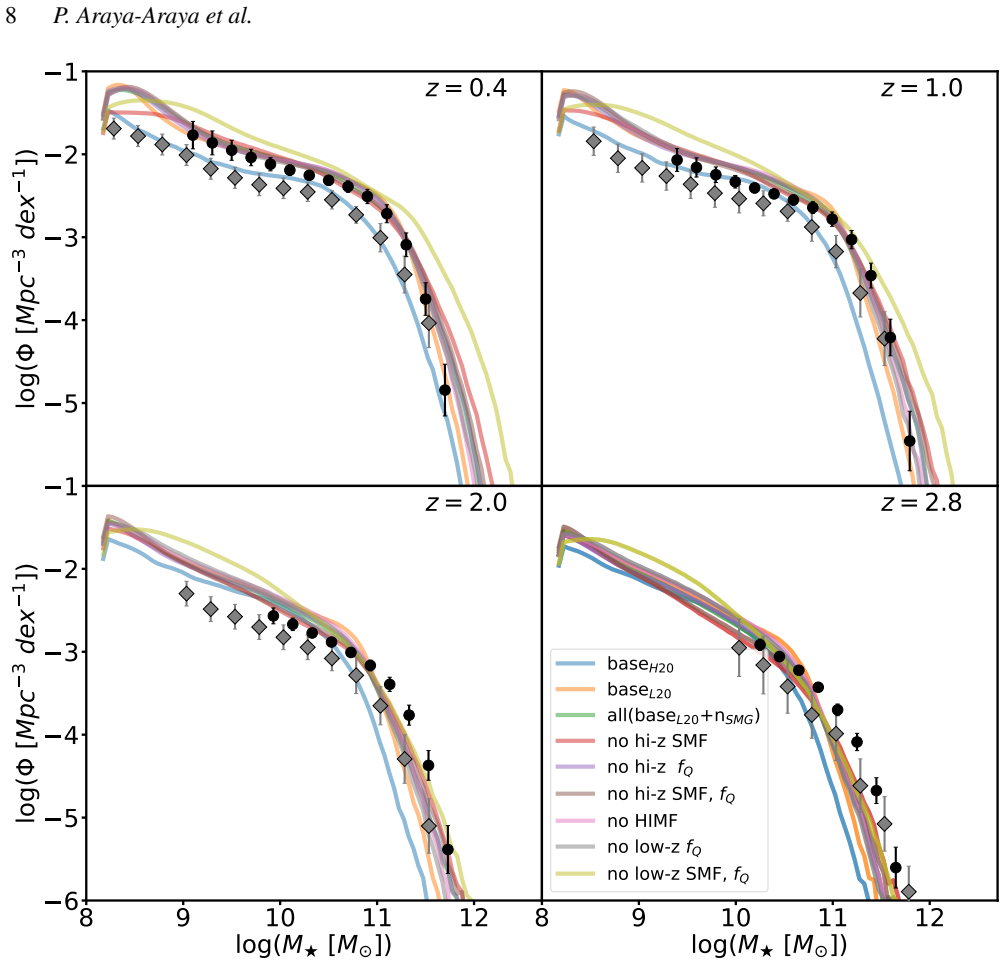
The central claim is that the L-Galaxies SAM contains a parameter combination that simultaneously reproduces the observed number density of DSFGs and the observationally-derived lower limits for high-redshift massive quiescent galaxies. This is configuration 'no HIMF', calibrated against the Leja et al. (2020) stellar mass functions and Leja et al. (2022) quiescent fractions at $z=0.4$ and $z=2.8$, plus the AS2UDS SMG number density at $z\sim2.8$. Its best-fit parameters imply that merger-induced starbursts convert a large fraction of cold gas into stars even in minor mergers, and that the fraction of cold gas accreted by SMBHs during mergers is nearly flat with halo virial velocity, so massive black holes can grow quickly. The paper also claims this fit produces an SMBH mass function at $z=0$ in better agreement with observations than the other configurations, while the fitted models that instead match DSFGs best fail on the quiescent population, and vice versa. The authors frame the result as a step toward resolving the tension, not a unique solution: nearly equally good fits span about two dex in feedback efficiencies.
Load-bearing premise
The fit's load-bearing premise is that the 870-micron scaling relations used here (plus a fixed 40% dust-to-metal ratio for cold-gas metals) correctly translate simulated galaxies into sub-mm brightness; if that translation is biased, the best-fit parameters — including the claimed merger efficiencies and SMBH accretion behavior — would shift.
Editorial extensions
If this is right
- Adding a single SMG number-density constraint at $z\sim2.8$ lifts predicted 870-micron number counts from more than two orders of magnitude below observation to within a factor of a few across an order of magnitude in flux density.
- When the SMG constraint is included, the model that also matches the massive quiescent lower limits is 'no HIMF'; dropping the $z=0$ HI mass function does not break its HI predictions, so the HIMF appears to be a less critical constraint than previously assumed.
- The best-fit physics of the 'no HIMF' model — high merger-driven starburst efficiencies and halo-mass-independent SMBH cold-gas accretion — provides a concrete, testable alternative to top-heavy IMF modifications for producing bright SMGs.
- The $z=0$ SMBH mass function is not used in calibration, yet it discriminates between the two SMBH growth modes (peaked vs Schechter-like), so future calibrations that include it should break some of the degeneracies shown in Figure 15.
Reading between the lines
- The same calibration recipe could be transferred to other semi-analytic and cosmological simulation pipelines, offering a route to the SMG-MQ compromise without changing the IMF.
- The fitted halo-mass-independence of SMBH cold-gas accretion is probably a stand-in for a more physical trigger: the MCMC finds that rapid black-hole growth must accompany rapid merger starbursts, so an explicit coupling between starburst-driven turbulence and black-hole feeding could reproduce the same observable.
- Because the 40% dust-to-metal assumption is fixed rather than fitted, repeating the calibration with a dust-evolution model would directly test whether the claimed parameters are an artifact of the dust recipe rather than a required property of galaxy formation.
- The representative merger-tree selection method should work for any rare tracer with a defined number density, so similar one-point constraints could bring other rare populations — for example high-redshift quasars or bright Lyman-alpha emitters — into MCMC calibration loops.
Signed reviews
Editorial analysis
A structured set of objections, weighed in public.
Referee Report
Summary. The paper uses the MCMC mode of the L-Galaxies semi-analytic model to calibrate 15 free parameters against nine combinations of observational constraints, including a newly implemented constraint on the number density of bright sub-mm galaxies (S870 >= 5.2 mJy at z ~ 2.8), computed from the Cochrane et al. (2023a) scaling relations with an assumed dust-to-metal ratio of 40%. After calibrating each configuration, the authors run the full Millennium volume and compare predictions for stellar mass functions, quiescent fractions, the HIMF, sub-mm number counts, redshift distributions, massive quiescent number densities, cosmic star formation rate density, and SMBH mass functions. They find that configurations including the nSMG constraint reproduce the cumulative S870 number counts within a factor of a few but underpredict the adopted nSMG at z = 2.8 by at least a factor of 2.5; none of the models matches the median high-redshift MQ number density, though some (notably 'no HIMF') reach the observational lower limits. The 'no HIMF' configuration is presented as the best compromise, and the paper argues that it requires high merger-induced star-formation efficiencies and a nearly halo-mass-independent SMBH cold-gas accretion rate. A degeneracy analysis (Section 4.3) shows that models within 1 dex of the best-fit likelihood span a wide range of physical scaling relations.
Significance. The paper's contribution is methodological and empirical: it systematically explores nine constraint configurations within the L-Galaxies MCMC framework and introduces, for the first time in this framework, a sub-mm number density as a direct calibration constraint. The resulting mock catalogues and number-count predictions are falsifiable, and the comparison to observations is transparent. If the central result holds, the 'no HIMF' configuration is a viable L-Galaxies variant that improves the long-standing SMG-MQ tension, and the paper demonstrates the value of robust calibration in exposing degeneracies. The explicit analysis of model degeneracy (Section 4.3) is a strength, as it quantifies how little the current observables constrain the underlying physical scalings. However, the claimed physical requirements are not yet robust because of the sensitivity to the dust-to-metal assumption and the degeneracy among equally good fits.
major comments (3)
- [3.3.3, 5.4] The nSMG constraint is computed from S870 estimated with the Cochrane et al. (2023a) scaling relations applied to L-Galaxies galaxies, with the dust mass set to 40% of cold-gas metals (Section 3.3.3 and Section 5.4). Because L-Galaxies does not track dust, the likelihood for the only DSFG-related constraint depends directly on this single scalar assumption. The paper asserts that this is unlikely to affect the results, citing Remy-Ruyer et al. (2014), but provides no sensitivity test or error propagation. A factor-of-two change in the dust-to-metal ratio - within the scatter of the cited relation - would shift the predicted S870 and the number of galaxies above 5.2 mJy, and the MCMC would compensate with different best-fit parameters (e.g., alpha_SF,burst and the SMBH growth parameters f_BH and V_BH in Appendix B). The claim that the model 'requires' high merger star-formation efficiencies and halo-mass-independent SMBH accretion is therefore contingent on an unquantified calibration choice. Please add a sensitivity run or explicitly propagate the uncertainty in the dust-to-metal ratio.
- [4.1.4, Figure 6] The abstract states that the model 'reasonably matches the number density of DSFGs,' but the calibration target itself - nSMG at z=2.8 with S870>=5.2 mJy - is not reproduced: all configurations except 'no low-z SMF, fQ' underpredict this number density by at least a factor of 2.5, and the highlighted 'no HIMF' configuration is among those. The support for the abstract claim comes from the cumulative number counts across flux density (Figure 7), which is a different, weaker statistic, and from the z=2.0 point. Please either soften the abstract and conclusions to state that the model approaches or is within a factor of a few of the observed nSMG, or provide a justification for why a factor-2.5 miss at the adopted calibration point is acceptable.
- [4.3, Figure 15; Abstract] The abstract's causal claim that the identified model 'requires high star formation efficiencies in mergers and a null dependency of SMBH cold gas accretion on halo mass' is not supported by the paper's own degeneracy analysis. Figure 15 shows that parameter sets within 1 dex of the best-fit likelihood produce scaling relations spanning roughly two orders of magnitude, and for three of the four scalings the best-fit model does not occupy the most densely populated region. Thus the quoted physical properties are properties of a single best-fit point, not robust features of the acceptable model ensemble. The paper should either demonstrate that these physical scalings are common to the high-likelihood region or explicitly restrict the abstract and conclusions to the best-fit model.
minor comments (5)
- [3.5] The convergence criterion ('no new accepted point with a higher likelihood within the final ~1000 steps') is not a standard convergence diagnostic; please report a quantitative measure such as the Gelman-Rubin statistic or split-chain acceptance diagnostics.
- [3.2, Appendix A] The average relative errors quoted in Section 3.2 (~10%, ~25%, ~5%, ~20% for SMFs, f_Q, nSMG, and HIMF) are not consistent with the values in Appendix A, where the f_Q error at z=2.8 is reported as 35% and the nSMG error as ~2%. Please harmonize the numbers.
- [Figure 6] The x-axis of Figure 6 is labelled only 'Configuration' with numbers 0-8; please add tick labels matching Table 1 (e.g., 'baseH20', 'baseL20', etc.) to make the figure self-contained.
- [2] The text says 'To date, five more recent modifications of L-Galaxies have been published' but then lists six references (Yates et al. 2021; Ayromlou et al. 2021; Izquierdo-Villalba et al. 2022; Murphy et al. 2022; Spinoso et al. 2023; Yates et al. 2024). Please correct the count or the reference list.
- [3.3.3] The phrase 'we further modified L-Galaxies to include this factor in the SfrInst parameter' is vague; please specify exactly how the merger-induced starburst SFR is added to the instantaneous SFR, as this directly affects the S870 estimates.
Circularity Check
The z=2.8, S870>5.2 mJy normalization of the predicted number counts is the fitted constraint itself, but the rest of the calibration and the physical claims rest on independent external inputs.
-
fitted input called prediction
[Section 3.3.3 (nSMG constraint) vs Section 4.1.4 / Fig. 7 (predicted S870 counts)]
"we adopted S870 = 5.2 mJy (where completeness exceeds 90 per cent) as the flux density threshold for our calibration. ... the number density of galaxies with S870 ≥ 5.2 mJy at z ∼ 2.8 is nSMG = (2.48 ± 0.3) × 10−5 h3 Mpc−3. ... The first notable result is that including the number density of galaxies with S870 ≥ 5.2 mJy at z = 2.8 as an observational constraint (a single data point) improves the consistency of the predicted S870 number counts with observational results."
The nSMG calibration value is, by definition, the cumulative integral of the same predicted dN/dS counts above S870 = 5.2 mJy at z = 2.8. Thus the improvement at that specific point in Figure 7 is a restatement of the fitted constraint, not an independent prediction. However, Figure 7 also compares counts across an order of magnitude in S870 and Figure 8 covers the full redshift distribution, neither of which is fixed by the single nSMG point, so the circularity is partial and confined to the normalization at the calibration threshold.
full rationale
The central calibration target is external: the observed SMG number density is taken from Dudzeviciute et al. (2020), and the model S870 values are computed with the Cochrane et al. (2023a) scaling relations, which were calibrated from radiative-transfer post-processing and are not fitted to the present MCMC target. The 'no HIMF' model's massive-quiescent agreement is an out-of-sample comparison at z ~ 3.5 and uses a different quiescent definition (Carnall et al. 2020) than the fQ constraint, so it is not forced by the fit. The abstract's statements about high merger star-formation efficiencies and halo-mass-independent SMBH accretion are direct readings of best-fit parameters rather than predictions; the paper's own Section 4.3 explicitly shows large degeneracies among equal-likelihood models, which is an interpretation risk but not a circular reduction. The only mild circular element is that the z = 2.8, S870 > 5.2 mJy normalization of the 'predicted' counts is the fitted constraint itself; the shape of the counts and their redshift dependence remain genuine out-of-sample predictions. Overall, the paper's main calibration claim is self-contained against external data, and the identified issue is a limited, partial self-consistency effect rather than load-bearing circularity.
Assumptions & free parameters
free parameters (15)
- alpha_SF =
See Figure B1 (not tabulated in text)
- alpha_SF,burst =
See Figure B1 (not tabulated in text)
- beta_SF,burst =
See Figure B1 (not tabulated in text)
- k_AGN =
See Figure B1 (not tabulated in text)
- f_BH =
See Figure B1 (not tabulated in text)
- V_BH =
See Figure B1 (not tabulated in text)
- eta_reheat =
See Figure B1 (not tabulated in text)
- V_reheat =
See Figure B1 (not tabulated in text)
- beta_reheat =
See Figure B1 (not tabulated in text)
- eta_eject =
See Figure B1 (not tabulated in text)
- V_eject =
See Figure B1 (not tabulated in text)
- beta_eject =
See Figure B1 (not tabulated in text)
- gamma_reinc =
See Figure B1 (not tabulated in text)
- alpha_friction =
See Figure B1 (not tabulated in text)
- M_RP =
See Figure B1 (not tabulated in text)
assumptions (5)
- domain assumption The Planck 2014 cosmology and the Millennium dark-matter-only simulation merger trees provide a correct backbone for galaxy formation.
- domain assumption The Cochrane et al. (2023a) S870 scaling relations convert galaxy SFR, stellar mass, dust mass, and redshift into 870 micron flux densities accurately for the entire simulated population.
- ad hoc to paper 40% of the metals in cold gas are in the form of dust.
- domain assumption The sample of 430 merger trees selected by the new method represents full-volume predictions for the calibrated observables.
- domain assumption The observational constraints (Leja et al. 2020 SMFs, Leja et al. 2022 quiescent fractions, HIMF compilations, Dudzeviciute et al. 2020 nSMG) are unbiased estimates of the true galaxy population.
Cite this review
Pith. "Pith review of Simultaneously Modelling Dusty Star Forming Galaxies and Massive Quiescents: A Calibration Framework for Galaxy Formation Models." pith.science (2026). https://pith.science/paper/RRP6X26O
@misc{pith2026250415283,
  author       = {Pith},
  title        = {Pith review of: Simultaneously Modelling Dusty Star Forming Galaxies and Massive Quiescents: A Calibration Framework for Galaxy Formation Models},
  year         = {2026},
  howpublished = {\url{https://pith.science/paper/RRP6X26O}},
  note         = {Machine review of arXiv:2504.15283}
}
read the original abstract
Galaxy formation models, particularly semi-analytic models (SAMs), rely on differential equations with free parameters to describe the physical mechanisms governing galaxy formation and evolution. Traditionally, most SAMs calibrate these parameters manually to match observational data. However, this approach fails to fully explore the multidimensional parameter space, resulting in limited robustness and inconsistency with some observations. In contrast, the L-Galaxies SAM features a unique Markov Chain Monte Carlo (MCMC) mode, enabling robust model calibration. Using this functionality, we address a long-standing tension in galaxy formation models: simultaneously reproducing the number densities of dusty star-forming galaxies (DSFGs) and high-redshift massive quiescent galaxies (MQs). We test nine combinations of observational constraints - including stellar mass functions, quiescent fractions, neutral hydrogen mass functions, and DSFG number densities - across different redshifts. We then analyze the resulting galaxy property predictions and discuss the underlying physical mechanisms. Our results identify a model that reasonably matches the number density of DSFGs while remaining consistent with observationally-derived lower limits on the number density of high-redshift MQs. This model requires high star formation efficiencies in mergers and a null dependency of supermassive black hole (SMBH) cold gas accretion on halo mass, facilitating rapid stellar mass and SMBH growth. Additionally, our findings highlight the importance of robust calibration procedures to address the significant degeneracies inherent to multidimensional galaxy formation models.
Figures


Figures from the paper (8 more)


Forward citations
Cited by 1 Pith paper
-
Hierarchical assembly impedes the inference of stellar mass growth histories for individual galaxies
An archaeological reconstruction of galaxy growth from stellar ages systematically overestimates the mass of the most massive progenitor at early times, easing claimed tensions between early massive galaxies and LCDM.
Reference graph
Works this paper leans on
-
[1]
write newline
" write newline "" before.all 'output.state := FUNCTION fin.entry write newline FUNCTION new.block output.state before.all = 'skip after.block 'output.state := if FUNCTION new.sentence output.state after.block = 'skip output.state before.all = 'skip after.sentence 'output.state := if if FUNCTION not #0 #1 if FUNCTION and 'skip pop #0 if FUNCTION or pop #1...
-
[2]
write newline
" write newline "" before.all 'output.state := FUNCTION fin.entry write newline FUNCTION new.block output.state before.all = 'skip after.block 'output.state := if FUNCTION new.sentence output.state after.block = 'skip output.state before.all = 'skip after.sentence 'output.state := if if FUNCTION not #0 #1 if FUNCTION and 'skip pop #0 if FUNCTION or pop #1...
-
[3]
Alberts S., et al., 2024, @doi [ ] 10.3847/1538-4357/ad66cc , https://ui.adsabs.harvard.edu/abs/2024ApJ...975...85A 975, 85
-
[4]
Angulo R. E., Hilbert S., 2015, @doi [ ] 10.1093/mnras/stv050 , https://ui.adsabs.harvard.edu/abs/2015MNRAS.448..364A 448, 364
-
[5]
Angulo R. E., White S. D. M., 2010, @doi [ ] 10.1111/j.1365-2966.2010.16459.x , https://ui.adsabs.harvard.edu/abs/2010MNRAS.405..143A 405, 143
arXiv 2010
-
[6]
C., Sodr \'e Laerte J., Overzier R
Araya-Araya P., Vicentin M. C., Sodr \'e Laerte J., Overzier R. A., Cuevas H., 2021, @doi [ ] 10.1093/mnras/stab1133 , https://ui.adsabs.harvard.edu/abs/2021MNRAS.504.5054A 504, 5054
-
[7]
Araya-Araya P., et al., 2024, @doi [ ] 10.3847/1538-4357/ad90ae , https://ui.adsabs.harvard.edu/abs/2024ApJ...977..204A 977, 204
-
[8]
Ayromlou M., Kauffmann G., Yates R. M., Nelson D., White S. D. M., 2021, @doi [ ] 10.1093/mnras/stab1245 , https://ui.adsabs.harvard.edu/abs/2021MNRAS.505..492A 505, 492
Show all 160 references
-
[9]
K., Glazebrook K., Brinkmann J., Ivezi \'c Z ., Lupton R
Baldry I. K., Glazebrook K., Brinkmann J., Ivezi \'c Z ., Lupton R. H., Nichol R. C., Szalay A. S., 2004, @doi [ ] 10.1086/380092 , https://ui.adsabs.harvard.edu/abs/2004ApJ...600..681B 600, 681
2004 doi
-
[10]
K., Glazebrook K., Driver S
Baldry I. K., Glazebrook K., Driver S. P., 2008, @doi [ ] 10.1111/j.1365-2966.2008.13348.x , https://ui.adsabs.harvard.edu/abs/2008MNRAS.388..945B 388, 945
2008
-
[12]
J., Cowie L
Barger A. J., Cowie L. L., Sanders D. B., Fulton E., Taniguchi Y., Sato Y., Kawara K., Okuda H., 1998, @doi [ ] 10.1038/28338 , https://ui.adsabs.harvard.edu/abs/1998Natur.394..248B 394, 248
1998 doi
-
[14]
S., Wechsler R
Behroozi P. S., Wechsler R. H., Conroy C., 2013, @doi [ ] 10.1088/0004-637X/770/1/57 , https://ui.adsabs.harvard.edu/abs/2013ApJ...770...57B 770, 57
2013 doi
-
[15]
Binney J., Tremaine S., 1987, Galactic dynamics
1987
-
[16]
W., Chapman S
Blain A. W., Chapman S. C., Smail I., Ivison R., 2004, @doi [ ] 10.1086/422353 , https://ui.adsabs.harvard.edu/abs/2004ApJ...611..725B 611, 725
2004 doi
-
[18]
Bruzual G., Charlot S., 2003, @doi [ ] 10.1046/j.1365-8711.2003.06897.x , https://ui.adsabs.harvard.edu/abs/2003MNRAS.344.1000B 344, 1000
2003
-
[19]
Calvi R., Castignani G., Dannerbauer H., 2023, @doi [ ] 10.1051/0004-6361/202346200 , https://ui.adsabs.harvard.edu/abs/2023A&A...678A..15C 678, A15
2023 doi
-
[20]
C., et al., 2020, @doi [ ] 10.1093/mnras/staa1535 , https://ui.adsabs.harvard.edu/abs/2020MNRAS.496..695C 496, 695
Carnall A. C., et al., 2020, @doi [ ] 10.1093/mnras/staa1535 , https://ui.adsabs.harvard.edu/abs/2020MNRAS.496..695C 496, 695
2020 doi
-
[21]
C., et al., 2023, @doi [ ] 10.1093/mnras/stad369 , https://ui.adsabs.harvard.edu/abs/2023MNRAS.520.3974C 520, 3974
Carnall A. C., et al., 2023, @doi [ ] 10.1093/mnras/stad369 , https://ui.adsabs.harvard.edu/abs/2023MNRAS.520.3974C 520, 3974
2023 doi
-
[22]
M., 2016, @doi [ ] 10.3847/0004-637X/824/1/36 , https://ui.adsabs.harvard.edu/abs/2016ApJ...824...36C 824, 36
Casey C. M., 2016, @doi [ ] 10.3847/0004-637X/824/1/36 , https://ui.adsabs.harvard.edu/abs/2016ApJ...824...36C 824, 36
2016 doi
-
[23]
M., Narayanan D., Cooray A., 2014, @doi [ ] 10.1016/j.physrep.2014.02.009 , https://ui.adsabs.harvard.edu/abs/2014PhR...541...45C 541, 45
Casey C. M., Narayanan D., Cooray A., 2014, @doi [ ] 10.1016/j.physrep.2014.02.009 , https://ui.adsabs.harvard.edu/abs/2014PhR...541...45C 541, 45
2014 doi
-
[24]
Cecchi R., Bolzonella M., Cimatti A., Girelli G., 2019, @doi [ ] 10.3847/2041-8213/ab2c80 , https://ui.adsabs.harvard.edu/abs/2019ApJ...880L..14C 880, L14
2019 doi
-
[25]
Chabrier G., 2003, @doi [ ] 10.1086/376392 , https://ui.adsabs.harvard.edu/abs/2003PASP..115..763C 115, 763
2003 doi
-
[26]
C., Lewis G
Chapman S. C., Lewis G. F., Scott D., Richards E., Borys C., Steidel C. C., Adelberger K. L., Shapley A. E., 2001, @doi [ ] 10.1086/318919 , https://ui.adsabs.harvard.edu/abs/2001ApJ...548L..17C 548, L17
2001 doi
-
[27]
C., Blain A
Chapman S. C., Blain A. W., Smail I., Ivison R. J., 2005, @doi [ ] 10.1086/428082 , https://ui.adsabs.harvard.edu/abs/2005ApJ...622..772C 622, 772
2005 doi
-
[28]
Charlot S., Bruzual G., 2007, in press
2007
-
[29]
Chen C.-C., et al., 2016, @doi [ ] 10.3847/0004-637X/831/1/91 , https://ui.adsabs.harvard.edu/abs/2016ApJ...831...91C 831, 91
2016 doi
-
[30]
K., et al., 2021, @doi [ ] 10.1093/mnras/stab467 , https://ui.adsabs.harvard.edu/abs/2021MNRAS.503.2622C 503, 2622
Cochrane R. K., et al., 2021, @doi [ ] 10.1093/mnras/stab467 , https://ui.adsabs.harvard.edu/abs/2021MNRAS.503.2622C 503, 2622
2021 doi
-
[31]
K., Hayward C
Cochrane R. K., Hayward C. C., Angl \'e s-Alc \'a zar D., Somerville R. S., 2023a, @doi [ ] 10.1093/mnras/stac3451 , https://ui.adsabs.harvard.edu/abs/2023MNRAS.518.5522C 518, 5522
-
[32]
K., et al., 2023b, @doi [ ] 10.1093/mnras/stad1602 , https://ui.adsabs.harvard.edu/abs/2023MNRAS.523.6082C 523, 6082
Cochrane R. K., et al., 2023b, @doi [ ] 10.1093/mnras/stad1602 , https://ui.adsabs.harvard.edu/abs/2023MNRAS.523.6082C 523, 6082
-
[33]
K., Angl \'e s-Alc \'a zar D., Cullen F., Hayward C
Cochrane R. K., Angl \'e s-Alc \'a zar D., Cullen F., Hayward C. C., 2024, @doi [ ] 10.3847/1538-4357/ad02f8 , https://ui.adsabs.harvard.edu/abs/2024ApJ...961...37C 961, 37
2024 doi
-
[34]
G., Baugh C
Cole S., Lacey C. G., Baugh C. M., Frenk C. S., 2000, @doi [ ] 10.1046/j.1365-8711.2000.03879.x , https://ui.adsabs.harvard.edu/abs/2000MNRAS.319..168C 319, 168
2000
-
[35]
E., White M., 2009, @doi [ ] 10.1088/0004-637X/699/1/486 , https://ui.adsabs.harvard.edu/abs/2009ApJ...699..486C 699, 486
Conroy C., Gunn J. E., White M., 2009, @doi [ ] 10.1088/0004-637X/699/1/486 , https://ui.adsabs.harvard.edu/abs/2009ApJ...699..486C 699, 486
2009 doi
-
[36]
R., Casey C
Cooper O. R., Casey C. M., Zavala J. A., Champagne J. B., da Cunha E., Long A. S., Spilker J. S., Staguhn J., 2022, @doi [ ] 10.3847/1538-4357/ac616d , https://ui.adsabs.harvard.edu/abs/2022ApJ...930...32C 930, 32
2022 doi
-
[37]
L., Barger A
Cowie L. L., Barger A. J., Wang W. H., Williams J. P., 2009, @doi [ ] 10.1088/0004-637X/697/2/L122 , https://ui.adsabs.harvard.edu/abs/2009ApJ...697L.122C 697, L122
2009 doi
-
[38]
I., Lacey C
Cowley W. I., Lacey C. G., Baugh C. M., Cole S., Frenk C. S., Lagos C. d. P., 2019, @doi [ ] 10.1093/mnras/stz1398 , https://ui.adsabs.harvard.edu/abs/2019MNRAS.487.3082C 487, 3082
2019 doi
-
[40]
Daddi E., et al., 2009, @doi [ ] 10.1088/0004-637X/694/2/1517 , https://ui.adsabs.harvard.edu/abs/2009ApJ...694.1517D 694, 1517
2009 doi
-
[41]
Daddi E., et al., 2010, @doi [ ] 10.1088/0004-637X/713/1/686 , https://ui.adsabs.harvard.edu/abs/2010ApJ...713..686D 713, 686
2010 doi
-
[42]
Dannerbauer H., et al., 2014, @doi [ ] 10.1051/0004-6361/201423771 , https://ui.adsabs.harvard.edu/abs/2014A&A...570A..55D 570, A55
2014 doi
-
[43]
H., Appleby S., 2019, @doi [ ] 10.1093/mnras/stz937 , https://ui.adsabs.harvard.edu/abs/2019MNRAS.486.2827D 486, 2827
Dav \'e R., Angl \'e s-Alc \'a zar D., Narayanan D., Li Q., Rafieferantsoa M. H., Appleby S., 2019, @doi [ ] 10.1093/mnras/stz937 , https://ui.adsabs.harvard.edu/abs/2019MNRAS.486.2827D 486, 2827
2019 doi
-
[44]
Davidzon I., et al., 2017, @doi [ ] 10.1051/0004-6361/201730419 , https://ui.adsabs.harvard.edu/abs/2017A&A...605A..70D 605, A70
2017 doi
-
[45]
De Lucia G., Fontanot F., Xie L., Hirschmann M., 2024, @doi [ ] 10.1051/0004-6361/202349045 , https://ui.adsabs.harvard.edu/abs/2024A&A...687A..68D 687, A68
2024 doi
- [46]
-
[47]
e U., et al., 2020, @doi [ ] 10.1093/mnras/staa769 , https://ui.adsabs.harvard.edu/abs/2020MNRAS.494.3828D 494, 3828
Dudzevi c i \= u t \. e U., et al., 2020, @doi [ ] 10.1093/mnras/staa769 , https://ui.adsabs.harvard.edu/abs/2020MNRAS.494.3828D 494, 3828
2020 doi
-
[48]
S., et al., 2004, @doi [ ] 10.1111/j.1365-2966.2004.07700.x , https://ui.adsabs.harvard.edu/abs/2004MNRAS.350..769D 350, 769
Dunlop J. S., et al., 2004, @doi [ ] 10.1111/j.1365-2966.2004.07700.x , https://ui.adsabs.harvard.edu/abs/2004MNRAS.350..769D 350, 769
2004
-
[49]
S., et al., 2017, @doi [ ] 10.1093/mnras/stw3088 , https://ui.adsabs.harvard.edu/abs/2017MNRAS.466..861D 466, 861
Dunlop J. S., et al., 2017, @doi [ ] 10.1093/mnras/stw3088 , https://ui.adsabs.harvard.edu/abs/2017MNRAS.466..861D 466, 861
2017 doi
-
[50]
R., Hammer F., Le F \`e vre O., Crampton D., 1999, @doi [ ] 10.1086/307069 , https://ui.adsabs.harvard.edu/abs/1999ApJ...515..518E 515, 518
Eales S., Lilly S., Gear W., Dunne L., Bond J. R., Hammer F., Le F \`e vre O., Crampton D., 1999, @doi [ ] 10.1086/307069 , https://ui.adsabs.harvard.edu/abs/1999ApJ...515..518E 515, 518
1999 doi
-
[51]
Fontanot F., Monaco P., Silva L., Grazian A., 2007, @doi [ ] 10.1111/j.1365-2966.2007.12449.x , https://ui.adsabs.harvard.edu/abs/2007MNRAS.382..903F 382, 903
2007
-
[52]
Fu J., et al., 2013, @doi [ ] 10.1093/mnras/stt1117 , https://ui.adsabs.harvard.edu/abs/2013MNRAS.434.1531F 434, 1531
2013 doi
-
[53]
F., Weiss A., Wardlow J., Myers A
Garc \' a-Vergara C., Hodge J., Hennawi J. F., Weiss A., Wardlow J., Myers A. D., Hickox R., 2020, @doi [ ] 10.3847/1538-4357/abbdfe , https://ui.adsabs.harvard.edu/abs/2020ApJ...904....2G 904, 2
2020 doi
-
[54]
E., et al., 2017, @doi [ ] 10.1093/mnras/stw2721 , https://ui.adsabs.harvard.edu/abs/2017MNRAS.465.1789G 465, 1789
Geach J. E., et al., 2017, @doi [ ] 10.1093/mnras/stw2721 , https://ui.adsabs.harvard.edu/abs/2017MNRAS.465.1789G 465, 1789
2017 doi
-
[55]
Genel S., et al., 2014, @doi [ ] 10.1093/mnras/stu1654 , https://ui.adsabs.harvard.edu/abs/2014MNRAS.445..175G 445, 175
2014 doi
-
[56]
Girelli G., Bolzonella M., Cimatti A., 2019, @doi [ ] 10.1051/0004-6361/201834547 , https://ui.adsabs.harvard.edu/abs/2019A&A...632A..80G 632, A80
2019 doi
-
[57]
Gouin C., Aghanim N., Dole H., Polletta M., Park C., 2022, @doi [ ] 10.1051/0004-6361/202243677 , https://ui.adsabs.harvard.edu/abs/2022A&A...664A.155G 664, A155
2022 doi
-
[58]
Gould K. M. L., et al., 2023, @doi [ ] 10.3847/1538-3881/accadc , https://ui.adsabs.harvard.edu/abs/2023AJ....165..248G 165, 248
2023 doi
-
[59]
L., Lacey C
Granato G. L., Lacey C. G., Silva L., Bressan A., Baugh C. M., Cole S., Frenk C. S., 2000, @doi [ ] 10.1086/317032 , https://ui.adsabs.harvard.edu/abs/2000ApJ...542..710G 542, 710
2000 doi
-
[60]
E., Almaini O., Pearce F
Harrold J. E., Almaini O., Pearce F. R., Yates R. M., 2024, @doi [ ] 10.1093/mnrasl/slae043 , https://ui.adsabs.harvard.edu/abs/2024MNRAS.532L..61H 532, L61
2024 doi
-
[61]
P., et al., 2011, @doi [ ] 10.1088/0004-6256/142/5/170 , https://ui.adsabs.harvard.edu/abs/2011AJ....142..170H 142, 170
Haynes M. P., et al., 2011, @doi [ ] 10.1088/0004-6256/142/5/170 , https://ui.adsabs.harvard.edu/abs/2011AJ....142..170H 142, 170
2011 doi
-
[62]
C., Kere s D., Jonsson P., Narayanan D., Cox T
Hayward C. C., Kere s D., Jonsson P., Narayanan D., Cox T. J., Hernquist L., 2011, @doi [ ] 10.1088/0004-637X/743/2/159 , https://ui.adsabs.harvard.edu/abs/2011ApJ...743..159H 743, 159
2011 doi
-
[63]
C., Narayanan D., Kere s D., Jonsson P., Hopkins P
Hayward C. C., Narayanan D., Kere s D., Jonsson P., Hopkins P. F., Cox T. J., Hernquist L., 2013, @doi [ ] 10.1093/mnras/sts222 , https://ui.adsabs.harvard.edu/abs/2013MNRAS.428.2529H 428, 2529
2013 doi
-
[64]
C., et al., 2021, @doi [ ] 10.1093/mnras/stab246 , https://ui.adsabs.harvard.edu/abs/2021MNRAS.502.2922H 502, 2922
Hayward C. C., et al., 2021, @doi [ ] 10.1093/mnras/stab246 , https://ui.adsabs.harvard.edu/abs/2021MNRAS.502.2922H 502, 2922
2021 doi
-
[67]
Henriques B. M. B., White S. D. M., Thomas P. A., Angulo R. E., Guo Q., Lemson G., Springel V., 2013, @doi [ ] 10.1093/mnras/stt415 , https://ui.adsabs.harvard.edu/abs/2013MNRAS.431.3373H 431, 3373
2013 doi
-
[68]
Henriques B. M. B., White S. D. M., Thomas P. A., Angulo R., Guo Q., Lemson G., Springel V., Overzier R., 2015, @doi [ ] 10.1093/mnras/stv705 , https://ui.adsabs.harvard.edu/abs/2015MNRAS.451.2663H 451, 2663
2015 doi
-
[69]
Henriques B. M. B., Yates R. M., Fu J., Guo Q., Kauffmann G., Srisawat C., Thomas P. A., White S. D. M., 2020, @doi [ ] 10.1093/mnras/stz3233 , https://ui.adsabs.harvard.edu/abs/2020MNRAS.491.5795H 491, 5795
2020 doi
-
[70]
Herard-Demanche T., et al., 2025, @doi [ ] 10.1093/mnras/staf030 , https://ui.adsabs.harvard.edu/abs/2025MNRAS.537..788H 537, 788
2025 doi
- [71]
-
[72]
Hirschmann M., Dolag K., Saro A., Bachmann L., Borgani S., Burkert A., 2014, @doi [ ] 10.1093/mnras/stu1023 , https://ui.adsabs.harvard.edu/abs/2014MNRAS.442.2304H 442, 2304
2014 doi
-
[73]
A., da Cunha E., 2020, @doi [Royal Society Open Science] 10.1098/rsos.200556 , https://ui.adsabs.harvard.edu/abs/2020RSOS....700556H 7, 200556
Hodge J. A., da Cunha E., 2020, @doi [Royal Society Open Science] 10.1098/rsos.200556 , https://ui.adsabs.harvard.edu/abs/2020RSOS....700556H 7, 200556
2020 doi
-
[74]
T., Rennehan D., Kobayashi C., Loubser S
Hough R. T., Rennehan D., Kobayashi C., Loubser S. I., Dav \'e R., Babul A., Cui W., 2023, @doi [ ] 10.1093/mnras/stad2394 , https://ui.adsabs.harvard.edu/abs/2023MNRAS.525.1061H 525, 1061
2023 doi
-
[75]
T., Shao Z., Cui W., Loubser S
Hough R. T., Shao Z., Cui W., Loubser S. I., Babul A., Dav \'e R., Rennehan D., Kobayashi C., 2024, @doi [ ] 10.1093/mnras/stae1435 , https://ui.adsabs.harvard.edu/abs/2024MNRAS.532..476H 532, 476
2024 doi
-
[76]
H., et al., 1998, @doi [ ] 10.1038/28328 , https://ui.adsabs.harvard.edu/abs/1998Natur.394..241H 394, 241
Hughes D. H., et al., 1998, @doi [ ] 10.1038/28328 , https://ui.adsabs.harvard.edu/abs/1998Natur.394..241H 394, 241
1998 doi
-
[77]
Ilbert O., et al., 2013, @doi [ ] 10.1051/0004-6361/201321100 , https://ui.adsabs.harvard.edu/abs/2013A&A...556A..55I 556, A55
2013 doi
-
[78]
Izquierdo-Villalba D., Bonoli S., Dotti M., Sesana A., Rosas-Guevara Y., Spinoso D., 2020, @doi [ ] 10.1093/mnras/staa1399 , https://ui.adsabs.harvard.edu/abs/2020MNRAS.495.4681I 495, 4681
2020 doi
-
[79]
Izquierdo-Villalba D., Sesana A., Bonoli S., Colpi M., 2022, @doi [ ] 10.1093/mnras/stab3239 , https://ui.adsabs.harvard.edu/abs/2022MNRAS.509.3488I 509, 3488
2022 doi
-
[80]
G., Haynes M
Jones M. G., Haynes M. P., Giovanelli R., Moorman C., 2018, @doi [ ] 10.1093/mnras/sty521 , https://ui.adsabs.harvard.edu/abs/2018MNRAS.477....2J 477, 2
2018 doi
-
[81]
C., Remus R.-S., Seidel B., Valenzuela L
Kimmig L. C., Remus R.-S., Seidel B., Valenzuela L. M., Dolag K., Burkert A., 2025, @doi [ ] 10.3847/1538-4357/ad9472 , https://ui.adsabs.harvard.edu/abs/2025ApJ...979...15K 979, 15
2025 doi
-
[82]
Kugel R., et al., 2023, @doi [ ] 10.1093/mnras/stad2540 , https://ui.adsabs.harvard.edu/abs/2023MNRAS.526.6103K 526, 6103
2023 doi
- [83]
-
[84]
G., et al., 2016, @doi [ ] 10.1093/mnras/stw1888 , https://ui.adsabs.harvard.edu/abs/2016MNRAS.462.3854L 462, 3854
Lacey C. G., et al., 2016, @doi [ ] 10.1093/mnras/stw1888 , https://ui.adsabs.harvard.edu/abs/2016MNRAS.462.3854L 462, 3854
2016 doi
-
[85]
Lagos C. d. P., Tobar R. J., Robotham A. S. G., Obreschkow D., Mitchell P. D., Power C., Elahi P. J., 2018, @doi [ ] 10.1093/mnras/sty2440 , https://ui.adsabs.harvard.edu/abs/2018MNRAS.481.3573L 481, 3573
2018 doi
-
[86]
Lagos C. d. P., et al., 2019, @doi [ ] 10.1093/mnras/stz2427 , https://ui.adsabs.harvard.edu/abs/2019MNRAS.489.4196L 489, 4196
2019 doi
-
[87]
Lagos C. d. P., et al., 2024, @doi [ ] 10.1093/mnras/stae1024 , https://ui.adsabs.harvard.edu/abs/2024MNRAS.531.3551L 531, 3551
2024 doi
-
[88]
Lagos C. d. P., et al., 2025, @doi [ ] 10.1093/mnras/stae2626 , https://ui.adsabs.harvard.edu/abs/2025MNRAS.536.2324L 536, 2324
2025 doi
-
[89]
Laigle C., et al., 2016, @doi [ ] 10.3847/0067-0049/224/2/24 , https://ui.adsabs.harvard.edu/abs/2016ApJS..224...24L 224, 24
2016 doi
-
[90]
G., Franx M., Whitaker K
Leja J., van Dokkum P. G., Franx M., Whitaker K. E., 2015, @doi [ ] 10.1088/0004-637X/798/2/115 , https://ui.adsabs.harvard.edu/abs/2015ApJ...798..115L 798, 115
2015 doi
-
[91]
D., Conroy C., van Dokkum P
Leja J., Johnson B. D., Conroy C., van Dokkum P. G., Byler N., 2017, @doi [ ] 10.3847/1538-4357/aa5ffe , https://ui.adsabs.harvard.edu/abs/2017ApJ...837..170L 837, 170
2017 doi
-
[92]
C., Johnson B
Leja J., Carnall A. C., Johnson B. D., Conroy C., Speagle J. S., 2019a, @doi [ ] 10.3847/1538-4357/ab133c , https://ui.adsabs.harvard.edu/abs/2019ApJ...876....3L 876, 3
-
[93]
Leja J., et al., 2019b, @doi [ ] 10.3847/1538-4357/ab1d5a , https://ui.adsabs.harvard.edu/abs/2019ApJ...877..140L 877, 140
-
[94]
S., Johnson B
Leja J., Speagle J. S., Johnson B. D., Conroy C., van Dokkum P., Franx M., 2020, @doi [ ] 10.3847/1538-4357/ab7e27 , https://ui.adsabs.harvard.edu/abs/2020ApJ...893..111L 893, 111
2020 doi
-
[95]
Leja J., et al., 2022, @doi [ ] 10.3847/1538-4357/ac887d , https://ui.adsabs.harvard.edu/abs/2022ApJ...936..165L 936, 165
2022 doi
-
[96]
K., et al., 2020, @doi [ ] 10.3847/1538-4357/aba044 , https://ui.adsabs.harvard.edu/abs/2020ApJ...899...58L 899, 58
Leslie S. K., et al., 2020, @doi [ ] 10.3847/1538-4357/aba044 , https://ui.adsabs.harvard.edu/abs/2020ApJ...899...58L 899, 58
2020 doi
-
[98]
Lim C.-F., et al., 2020, @doi [ ] 10.3847/1538-4357/ab8eaf , https://ui.adsabs.harvard.edu/abs/2020ApJ...895..104L 895, 104
2020 doi
- [99]
-
[100]
C., Geach J
Lovell C. C., Geach J. E., Dav \'e R., Narayanan D., Li Q., 2021, @doi [ ] 10.1093/mnras/staa4043 , https://ui.adsabs.harvard.edu/abs/2021MNRAS.502..772L 502, 772
2021 doi
-
[101]
J., Weinberg M
Lu Y., Mo H. J., Weinberg M. D., Katz N., 2011, @doi [ ] 10.1111/j.1365-2966.2011.19170.x , https://ui.adsabs.harvard.edu/abs/2011MNRAS.416.1949L 416, 1949
2011
-
[102]
Lu Y., et al., 2014, @doi [ ] 10.1088/0004-637X/795/2/123 , https://ui.adsabs.harvard.edu/abs/2014ApJ...795..123L 795, 123
2014 doi
-
[103]
Madau P., Dickinson M., 2014, @doi [ ] 10.1146/annurev-astro-081811-125615 , https://ui.adsabs.harvard.edu/abs/2014ARA&A..52..415M 52, 415
2014 doi
-
[104]
M., et al., 2022, @doi [ ] 10.3847/1538-4357/ac366a , https://ui.adsabs.harvard.edu/abs/2022ApJ...925...23M 925, 23
Manning S. M., et al., 2022, @doi [ ] 10.3847/1538-4357/ac366a , https://ui.adsabs.harvard.edu/abs/2022ApJ...925...23M 925, 23
2022 doi
-
[106]
Marinacci F., et al., 2018, @doi [MNRAS] 10.1093/mnras/sty2206 , 480, 5113
2018 doi
-
[107]
P., et al., 2018, @doi [ ] 10.1038/nature24629 , https://ui.adsabs.harvard.edu/abs/2018Natur.553...51M 553, 51
Marrone D. P., et al., 2018, @doi [ ] 10.1038/nature24629 , https://ui.adsabs.harvard.edu/abs/2018Natur.553...51M 553, 51
2018 doi
-
[108]
McAlpine S., et al., 2016, @doi [Astronomy and Computing] 10.1016/j.ascom.2016.02.004 , https://ui.adsabs.harvard.edu/abs/2016A&C....15...72M 15, 72
2016 doi
-
[109]
McAlpine S., et al., 2019, @doi [ ] 10.1093/mnras/stz1692 , https://ui.adsabs.harvard.edu/abs/2019MNRAS.488.2440M 488, 2440
2019 doi
-
[110]
Merlin E., et al., 2019, @doi [ ] 10.1093/mnras/stz2615 , https://ui.adsabs.harvard.edu/abs/2019MNRAS.490.3309M 490, 3309
2019 doi
-
[111]
J., et al., 2017, @doi [ ] 10.1093/mnras/stx861 , https://ui.adsabs.harvard.edu/abs/2017MNRAS.469..492M 469, 492
Micha owski M. J., et al., 2017, @doi [ ] 10.1093/mnras/stx861 , https://ui.adsabs.harvard.edu/abs/2017MNRAS.469..492M 469, 492
2017 doi
-
[112]
B., et al., 2018, @doi [ ] 10.1038/s41586-018-0025-2 , https://ui.adsabs.harvard.edu/abs/2018Natur.556..469M 556, 469
Miller T. B., et al., 2018, @doi [ ] 10.1038/s41586-018-0025-2 , https://ui.adsabs.harvard.edu/abs/2018Natur.556..469M 556, 469
2018 doi
-
[113]
G., Yates R
Murphy G. G., Yates R. M., Mohamed S. S., 2022, @doi [ ] 10.1093/mnras/stab3568 , https://ui.adsabs.harvard.edu/abs/2022MNRAS.510.1945M 510, 1945
2022 doi
-
[114]
Muzzin A., et al., 2013, @doi [ ] 10.1088/0004-637X/777/1/18 , https://ui.adsabs.harvard.edu/abs/2013ApJ...777...18M 777, 18
2013 doi
-
[115]
P., et al., 2018, @doi [MNRAS] 10.1093/mnras/sty618 , 477, 1206
Naiman J. P., et al., 2018, @doi [MNRAS] 10.1093/mnras/sty618 , 477, 1206
2018 doi
-
[116]
Nanayakkara T., et al., 2024, @doi [Scientific Reports] 10.1038/s41598-024-52585-4 , https://ui.adsabs.harvard.edu/abs/2024NatSR..14.3724N 14, 3724
2024 doi
-
[117]
Narayanan D., et al., 2021, @doi [ ] 10.3847/1538-4365/abc487 , https://ui.adsabs.harvard.edu/abs/2021ApJS..252...12N 252, 12
2021 doi
-
[118]
Nelson D., et al., 2018, @doi [MNRAS] 10.1093/mnras/stx3040 , 475, 624
2018 doi
-
[119]
Neri R., Downes D., Cox P., Walter F., 2014, @doi [ ] 10.1051/0004-6361/201322528 , https://ui.adsabs.harvard.edu/abs/2014A&A...562A..35N 562, A35
2014 doi
-
[120]
Oteo I., et al., 2018, @doi [ ] 10.3847/1538-4357/aaa1f1 , https://ui.adsabs.harvard.edu/abs/2018ApJ...856...72O 856, 72
2018 doi
-
[121]
Pillepich A., et al., 2018, @doi [ ] 10.1093/mnras/stx2656 , https://ui.adsabs.harvard.edu/abs/2018MNRAS.473.4077P 473, 4077
2018 doi
-
[122]
Planck Collaboration et al., 2014, @doi [ ] 10.1051/0004-6361/201321591 , https://ui.adsabs.harvard.edu/abs/2014A&A...571A..16P 571, A16
2014 doi
-
[123]
J., Krukau A., Petkova M., Steinborn D., 2017, @doi [Astronomy and Computing] 10.1016/j.ascom.2017.05.001 , https://ui.adsabs.harvard.edu/abs/2017A&C....20...52R 20, 52
Ragagnin A., Dolag K., Biffi V., Cadolle Bel M., Hammer N. J., Krukau A., Petkova M., Steinborn D., 2017, @doi [Astronomy and Computing] 10.1016/j.ascom.2017.05.001 , https://ui.adsabs.harvard.edu/abs/2017A&C....20...52R 20, 52
2017 doi
-
[124]
R \'e my-Ruyer A., et al., 2014, @doi [ ] 10.1051/0004-6361/201322803 , https://ui.adsabs.harvard.edu/abs/2014A&A...563A..31R 563, A31
2014 doi
-
[125]
A., 1999, @doi [ ] 10.1086/311905 , https://ui.adsabs.harvard.edu/abs/1999ApJ...513L...9R 513, L9
Richards E. A., 1999, @doi [ ] 10.1086/311905 , https://ui.adsabs.harvard.edu/abs/1999ApJ...513L...9R 513, L9
1999 doi
-
[126]
R., Avila-Reese V., Faber S
Rodr \' guez-Puebla A., Primack J. R., Avila-Reese V., Faber S. M., 2017, @doi [ ] 10.1093/mnras/stx1172 , https://ui.adsabs.harvard.edu/abs/2017MNRAS.470..651R 470, 651
2017 doi
-
[127]
C., 2017, @doi [ ] 10.1093/mnras/stx2172 , https://ui.adsabs.harvard.edu/abs/2017MNRAS.472.2462S 472, 2462
Safarzadeh M., Lu Y., Hayward C. C., 2017, @doi [ ] 10.1093/mnras/stx2172 , https://ui.adsabs.harvard.edu/abs/2017MNRAS.472.2462S 472, 2462
2017 doi
-
[128]
Schaye J., et al., 2023, @doi [ ] 10.1093/mnras/stad2419 , https://ui.adsabs.harvard.edu/abs/2023MNRAS.526.4978S 526, 4978
2023 doi
-
[129]
Schreiber C., et al., 2018, @doi [ ] 10.1051/0004-6361/201833070 , https://ui.adsabs.harvard.edu/abs/2018A&A...618A..85S 618, A85
2018 doi
-
[130]
Shahidi A., et al., 2020, @doi [ ] 10.3847/1538-4357/ab96c5 , https://ui.adsabs.harvard.edu/abs/2020ApJ...897...44S 897, 44
2020 doi
-
[131]
Shankar F., et al., 2020, @doi [Nature Astronomy] 10.1038/s41550-019-0949-y , https://ui.adsabs.harvard.edu/abs/2020NatAs...4..282S 4, 282
2020 doi
-
[132]
F., Nelson D., Hernquist L., 2015, @doi [ ] 10.1093/mnras/stv1340 , https://ui.adsabs.harvard.edu/abs/2015MNRAS.452..575S 452, 575
Sijacki D., Vogelsberger M., Genel S., Springel V., Torrey P., Snyder G. F., Nelson D., Hernquist L., 2015, @doi [ ] 10.1093/mnras/stv1340 , https://ui.adsabs.harvard.edu/abs/2015MNRAS.452..575S 452, 575
2015 doi
-
[133]
M., et al., 2014, @doi [ ] 10.1088/0004-637X/788/2/125 , https://ui.adsabs.harvard.edu/abs/2014ApJ...788..125S 788, 125
Simpson J. M., et al., 2014, @doi [ ] 10.1088/0004-637X/788/2/125 , https://ui.adsabs.harvard.edu/abs/2014ApJ...788..125S 788, 125
2014 doi
-
[134]
M., et al., 2017, @doi [ ] 10.3847/1538-4357/aa65d0 , https://ui.adsabs.harvard.edu/abs/2017ApJ...839...58S 839, 58
Simpson J. M., et al., 2017, @doi [ ] 10.3847/1538-4357/aa65d0 , https://ui.adsabs.harvard.edu/abs/2017ApJ...839...58S 839, 58
2017 doi
-
[135]
E., et al., 2014, @doi [ ] 10.1088/0067-0049/214/2/24 , https://ui.adsabs.harvard.edu/abs/2014ApJS..214...24S 214, 24
Skelton R. E., et al., 2014, @doi [ ] 10.1088/0067-0049/214/2/24 , https://ui.adsabs.harvard.edu/abs/2014ApJS..214...24S 214, 24
2014 doi
-
[136]
J., Blain A
Smail I., Ivison R. J., Blain A. W., 1997, @doi [ ] 10.1086/311017 , https://ui.adsabs.harvard.edu/abs/1997ApJ...490L...5S 490, L5
1997 doi
-
[137]
Smith D. J. B., Hayward C. C., Jarvis M. J., Simpson C., 2017, @doi [ ] 10.1093/mnras/stx1689 , https://ui.adsabs.harvard.edu/abs/2017MNRAS.471.2453S 471, 2453
2017 doi
-
[139]
S., Gilmore R
Somerville R. S., Gilmore R. C., Primack J. R., Dom \' nguez A., 2012, @doi [ ] 10.1111/j.1365-2966.2012.20490.x , https://ui.adsabs.harvard.edu/abs/2012MNRAS.423.1992S 423, 1992
2012
-
[140]
Spinoso D., Bonoli S., Valiante R., Schneider R., Izquierdo-Villalba D., 2023, @doi [ ] 10.1093/mnras/stac3169 , https://ui.adsabs.harvard.edu/abs/2023MNRAS.518.4672S 518, 4672
2023 doi
-
[141]
Springel V., 2005, @doi [ ] 10.1111/j.1365-2966.2005.09655.x , https://ui.adsabs.harvard.edu/abs/2005MNRAS.364.1105S 364, 1105
2005
-
[142]
Springel V., White S. D. M., Tormen G., Kauffmann G., 2001, @doi [ ] 10.1046/j.1365-8711.2001.04912.x , https://ui.adsabs.harvard.edu/abs/2001MNRAS.328..726S 328, 726
2001
-
[143]
Springel V., et al., 2018, @doi [MNRAS] 10.1093/mnras/stx3304 , 475, 676
2018 doi
-
[144]
M., et al., 2018, @doi [ ] 10.3847/1538-4357/aac5e5 , https://ui.adsabs.harvard.edu/abs/2018ApJ...860..161S 860, 161
Stach S. M., et al., 2018, @doi [ ] 10.3847/1538-4357/aac5e5 , https://ui.adsabs.harvard.edu/abs/2018ApJ...860..161S 860, 161
2018 doi
-
[145]
M., et al., 2019, @doi [ ] 10.1093/mnras/stz1536 , https://ui.adsabs.harvard.edu/abs/2019MNRAS.487.4648S 487, 4648
Stach S. M., et al., 2019, @doi [ ] 10.1093/mnras/stz1536 , https://ui.adsabs.harvard.edu/abs/2019MNRAS.487.4648S 487, 4648
2019 doi
-
[146]
M., et al., 2021, @doi [ ] 10.1093/mnras/stab714 , https://ui.adsabs.harvard.edu/abs/2021MNRAS.504..172S 504, 172
Stach S. M., et al., 2021, @doi [ ] 10.1093/mnras/stab714 , https://ui.adsabs.harvard.edu/abs/2021MNRAS.504..172S 504, 172
2021 doi
-
[147]
Straatman C. M. S., et al., 2014, @doi [ ] 10.1088/2041-8205/783/1/L14 , https://ui.adsabs.harvard.edu/abs/2014ApJ...783L..14S 783, L14
2014 doi
-
[148]
T., 2025, @doi [ ] 10.1093/mnras/staf132 , https://ui.adsabs.harvard.edu/abs/2025MNRAS.537.1849S 537, 1849
Szpila J., Dav \'e R., Rennehan D., Cui W., Hough R. T., 2025, @doi [ ] 10.1093/mnras/staf132 , https://ui.adsabs.harvard.edu/abs/2025MNRAS.537.1849S 537, 1849
2025 doi
-
[149]
J., et al., 2010, @doi [ ] 10.1038/nature08773 , https://ui.adsabs.harvard.edu/abs/2010Natur.463..781T 463, 781
Tacconi L. J., et al., 2010, @doi [ ] 10.1038/nature08773 , https://ui.adsabs.harvard.edu/abs/2010Natur.463..781T 463, 781
2010 doi
-
[150]
Toft S., et al., 2014, @doi [ ] 10.1088/0004-637X/782/2/68 , https://ui.adsabs.harvard.edu/abs/2014ApJ...782...68T 782, 68
2014 doi
-
[151]
R., et al., 2014, @doi [ ] 10.1088/0004-637X/783/2/85 , https://ui.adsabs.harvard.edu/abs/2014ApJ...783...85T 783, 85
Tomczak A. R., et al., 2014, @doi [ ] 10.1088/0004-637X/783/2/85 , https://ui.adsabs.harvard.edu/abs/2014ApJ...783...85T 783, 85
2014 doi
-
[152]
R., et al., 2016, @doi [ ] 10.3847/0004-637X/817/2/118 , https://ui.adsabs.harvard.edu/abs/2016ApJ...817..118T 817, 118
Tomczak A. R., et al., 2016, @doi [ ] 10.3847/0004-637X/817/2/118 , https://ui.adsabs.harvard.edu/abs/2016ApJ...817..118T 817, 118
2016 doi
-
[153]
W., et al., 2017, @doi [ ] 10.1093/mnras/stx1051 , https://ui.adsabs.harvard.edu/abs/2017MNRAS.470..771T 470, 771
Trayford J. W., et al., 2017, @doi [ ] 10.1093/mnras/stx1051 , https://ui.adsabs.harvard.edu/abs/2017MNRAS.470..771T 470, 771
2017 doi
-
[154]
Tucci M., Volonteri M., 2017, @doi [ ] 10.1051/0004-6361/201628419 , https://ui.adsabs.harvard.edu/abs/2017A&A...600A..64T 600, A64
2017 doi
-
[155]
Valentino F., et al., 2020, @doi [ ] 10.3847/1538-4357/ab64dc , https://ui.adsabs.harvard.edu/abs/2020ApJ...889...93V 889, 93
2020 doi
-
[156]
Valentino F., et al., 2023, @doi [ ] 10.3847/1538-4357/acbefa , https://ui.adsabs.harvard.edu/abs/2023ApJ...947...20V 947, 20
2023 doi
-
[157]
Vani A., Ayromlou M., Kauffmann G., Springel V., 2025, @doi [ ] 10.1093/mnras/stae2625 , https://ui.adsabs.harvard.edu/abs/2025MNRAS.536..777V 536, 777
2025 doi
-
[158]
P., Graham A
Vika M., Driver S. P., Graham A. W., Liske J., 2009, @doi [ ] 10.1111/j.1365-2966.2009.15544.x , https://ui.adsabs.harvard.edu/abs/2009MNRAS.400.1451V 400, 1451
2009
-
[159]
Vogelsberger M., et al., 2014, @doi [ ] 10.1093/mnras/stu1536 , https://ui.adsabs.harvard.edu/abs/2014MNRAS.444.1518V 444, 1518
2014 doi
-
[160]
H., Aretxaga I., Chapin E
Wagg J., Hughes D. H., Aretxaga I., Chapin E. L., Dunlop J. S., Gazta \ n aga E., Devlin M., 2007, @doi [ ] 10.1111/j.1365-2966.2006.11352.x , https://ui.adsabs.harvard.edu/abs/2007MNRAS.375..745W 375, 745
2007
-
[161]
Walter F., et al., 2012, @doi [ ] 10.1038/nature11073 , https://ui.adsabs.harvard.edu/abs/2012Natur.486..233W 486, 233
2012 doi
-
[162]
Wang G. C. P., et al., 2021, @doi [ ] 10.1093/mnras/stab2800 , https://ui.adsabs.harvard.edu/abs/2021MNRAS.508.3754W 508, 3754
2021 doi
-
[163]
R., et al., 2023, @doi [ ] 10.1051/0004-6361/202245581 , https://ui.adsabs.harvard.edu/abs/2023A&A...677A.184W 677, A184
Weaver J. R., et al., 2023, @doi [ ] 10.1051/0004-6361/202245581 , https://ui.adsabs.harvard.edu/abs/2023A&A...677A.184W 677, A184
2023 doi
-
[164]
M., Henriques B., Thomas P
Yates R. M., Henriques B., Thomas P. A., Kauffmann G., Johansson J., White S. D. M., 2013, @doi [ ] 10.1093/mnras/stt1542 , https://ui.adsabs.harvard.edu/abs/2013MNRAS.435.3500Y 435, 3500
2013 doi
-
[165]
M., Henriques B
Yates R. M., Henriques B. M. B., Fu J., Kauffmann G., Thomas P. A., Guo Q., White S. D. M., Schady P., 2021, @doi [ ] 10.1093/mnras/stab741 , https://ui.adsabs.harvard.edu/abs/2021MNRAS.503.4474Y 503, 4474
2021 doi
-
[166]
M., Hendriks D., Vijayan A
Yates R. M., Hendriks D., Vijayan A. P., Izzard R. G., Thomas P. A., Das P., 2024, @doi [ ] 10.1093/mnras/stad3419 , https://ui.adsabs.harvard.edu/abs/2024MNRAS.527.6292Y 527, 6292
2024 doi
-
[167]
A., et al., 2021, @doi [ ] 10.3847/1538-4357/abdb27 , https://ui.adsabs.harvard.edu/abs/2021ApJ...909..165Z 909, 165
Zavala J. A., et al., 2021, @doi [ ] 10.3847/1538-4357/abdb27 , https://ui.adsabs.harvard.edu/abs/2021ApJ...909..165Z 909, 165
2021 doi
-
[168]
A., Meyer M
Zwaan M. A., Meyer M. J., Staveley-Smith L., Webster R. L., 2005, @doi [ ] 10.1111/j.1745-3933.2005.00029.x , https://ui.adsabs.harvard.edu/abs/2005MNRAS.359L..30Z 359, L30
2005
-
[169]
da Cunha E., et al., 2015, @doi [ ] 10.1088/0004-637X/806/1/110 , https://ui.adsabs.harvard.edu/abs/2015ApJ...806..110D 806, 110
2015 doi
Reviewed August 16, 2026 · model on record in the stance chip above.
Discussion (0). Continue with ORCID to comment.