REVIEW 4 major objections 6 minor 2 cited by
Big, Dusty Galaxies in Blue Jay: Insights into the Relationship Between Morphology and Dust Attenuation at Cosmic Noon
T0 review · 4 major / 6 minor · reviewed 2026-08-16 · deepseek-v4-flash
Pith's one-line read Massive dusty galaxies at cosmic noon appear about 30 percent larger in rest-optical than rest-NIR light because central dust flattens their optical light profiles.
desk verdict A careful JWST study that makes a plausible case for dust-driven rest-optical size inflation at cosmic noon, but the load-bearing Av correlation in Fig. 11 lacks redshift control and is partly model-built. read the letter →
The pith
A machine-rendered reading of the paper's core claim, the machinery that carries it, and where it could break.
The reading
What carries the argument
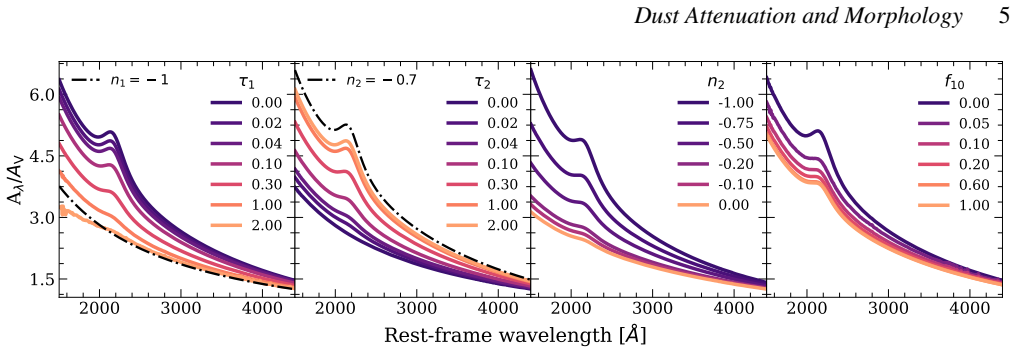
The load-bearing machinery is the two-component dust attenuation model combined with flexible attenuation laws and multi-band morphological fitting. A power-law 'birth cloud' component with fixed slope $n_1=-1$ attenuates light from stars younger than 10 Myr and from nebular regions, while an ISM component with a free slope $n_2$ and a 2175 Å UV bump whose strength is tied to $n_2$ attenuates all stars, built on a flexible curve anchored to the local starburst law. The effective attenuation law for each galaxy is recovered by comparing dust-on and dust-free model spectra from the SED fit, so stellar-population, dust, and morphological effects can be separated. Half-light radii come from one-component Sérsic profile fits to NIRCam images in F150W, F356W, and F444W; the flattening of the rest-optical light profile by the fitted central attenuation is what produces the ~30 percent size excess.
What would settle it
Dust-correct the rest-optical images for the most massive galaxies (for example by dividing the F150W image by the fitted attenuation map, or by using a Balmer-decrement-based attenuation map) and re-measure half-light radii; if the ~30 percent optical-versus-NIR size excess is caused by central dust, the corrected optical/NIR size ratio should become consistent with unity.
Extended reading notes
Core claim
The central discovery is a wavelength-dependent size gradient produced by dust. For the most massive star-forming galaxies in the sample ($M_\star \gtrsim 10^{10}\,M_\odot$), the half-light radius measured in F150W—which probes rest-optical light—is on average about 30 percent larger than the half-light radius measured in F444W, which probes rest-NIR light. The excess grows with the fitted optical attenuation $A_V$, and the authors interpret it as central dust attenuating the inner regions more strongly, flattening the optical surface-brightness profile and pushing the effective radius outward. Lower-mass galaxies show a wide range of optical-to-NIR size ratios, which the authors attribute to either inside-out growth or central starbursts rather than dust. The paper also establishes that the shape and strength of the attenuation law vary systematically with stellar mass, SFR, and $A_V$; that $A_V$ correlates more tightly with stellar-mass and SFR surface densities than with global quantities; and that nebular attenuation from the Balmer decrement tracks stellar-continuum attenuation among 67 star-forming galaxies.
Load-bearing premise
The load-bearing premise is that the adopted dust model—a fixed birth-cloud slope and a UV-bump strength tied to the ISM slope—describes real attenuation laws, since a different but plausible geometry would change the fitted optical attenuation and with it the size-gradient conclusion.
Editorial extensions
If this is right
- Size-mass relations in the rest-optical and rest-NIR differ: the rest-optical relation has a positive slope at $1.7<z<3$ that flattens at the massive end, while the rest-NIR relation is nearly flat across $1.7<z<3.5$.
- Dust attenuation correlates more strongly with stellar-mass and SFR surface densities than with the global stellar mass and SFR, implying that the concentration of mass and star formation sets the dust column.
- The 2175 Å UV-bump strength in the effective attenuation law is weaker than Milky Way/LMC values and cannot lie above the relation built into the model, because birth-cloud dust with no bump dilutes it; this is a modelling consequence, not a direct grain-composition measurement.
- Nebular attenuation measured from the Balmer decrement correlates with stellar-continuum $A_V$ (Spearman rank $r\simeq0.66$), supporting a common dust geometry for stars and gas in highly star-forming systems.
- No significant correlation is found between $A_V$ and axis ratio at $1.7<z<3.5$, consistent with clumpy star-dust geometry rather than inclination-driven attenuation at cosmic noon.
Reading between the lines
- If the size gradient is really produced by central dust, single-band rest-optical sizes systematically overestimate the effective radii of massive dusty galaxies; evolutionary size-mass relations built from such bands would then need dust corrections before being read as structural growth.
- Because the fitted attenuation law enforces a fixed birth-cloud slope and a tied bump-slope relation, part of the reported correlation between attenuation-law shape and star formation rate is imposed by the model; a testable next step is to fit steeper or decoupled dust laws and see whether the ~30% size excess survives.
- Spatially resolved dust maps (for example Balmer-decrement gradients) for a subset of these galaxies could directly confirm the central dust gradient: if it is real, the dust-corrected optical light profile should recover the flatter, more extended shape that the attenuation model predicts.
- The wide optical-to-NIR size ratios of lower-mass galaxies, interpreted as inside-out growth or central starbursts, could be separated by measuring rest-UV/optical colour gradients; this would distinguish dust-free structural differences from the dust-driven signal seen at high mass.
Signed reviews
Editorial analysis
A structured set of objections, weighed in public.
Referee Report
Summary. This paper presents a study of 141 Blue Jay galaxies at 1.7<z<3.5, combining JWST/NIRSpec R~1000 spectroscopy, NIRCam photometry, and HST photometry. Stellar populations and dust attenuation are modeled with Prospector using non-parametric SFHs and a two-component dust model: a birth-cloud power-law with fixed slope n1=-1 (Eq. 1) and an ISM attenuation law with a UV-bump strength tied to the ISM slope via Eb=0.85-1.9n2 (Eq. 4). The authors derive effective attenuation laws, report correlations between attenuation parameters and stellar mass, SFR, and surface densities, and compare stellar-continuum attenuation with Balmer-decrement nebular attenuation. Morphological fits with Pysersic in F150W, F356W, and F444W yield size-mass relations and a wavelength-dependent size ratio RF150W/RF444W; the central claim is that massive galaxies (M* >~1e10 Msun) appear about 30% larger in the rest-optical than in the rest-NIR because central dust flattens the optical light profile (Section 6.4, Figure 11).
Significance. If the size-gradient result holds, it is a valuable JWST-era measurement linking dust geometry to observed morphology at cosmic noon. The paper has real strengths: the size ratios are directly measured on 87-93 galaxies, the comparison with Balmer-decrement attenuation provides an independent dust tracer, and the authors are unusually candid about which trends are imposed by the model rather than required by the data (Section 5). The attenuation-law diversity and the mass-dust relation are interesting and well-contextualized with the literature. However, the headline causal claim that dust drives the 30% size excess is not yet backed by a controlled statistical analysis, and several quantitative statements rest on correlation coefficients reported without uncertainties.
major comments (4)
- [Section 6.4, Figure 11] The central size-gradient claim is not supported by a controlled statistical analysis. Figure 11 pools galaxies over the full range 1.7<z<3.5, while the rest-frame coverage of F150W and F444W shifts by a factor of about 1.7 across this range: F150W probes ~0.55 micron at z=1.7 but ~0.33 micron at z=3.5, and F444W probes ~1.6 micron at z=1.7 but ~1.0 micron at z=3.5. Because dust attenuation is stronger at bluer rest-frame wavelengths, and because stellar population gradients across the Balmer/4000 A break can also produce wavelength-dependent sizes, a trend of RF150W/RF444W with Av could arise partly from redshift-dependent wavelength sampling even with no change in central dust geometry. The paper reports no Spearman coefficient, fit, or significance for Figure 11, and the '~30%' statement is based on a visual trend. Please add redshift-binned versions of Figure 11 or a partial-correlation analysis controlling for redshift, quote correlation statistics with bootstrap uncertainties, check whether the massive high-Av galaxies preferentially lie at high z, and, if possible, use the Balmer-decrement attenuation as an independent dust indicator for the 67 galaxies with reliable measurements.
- [Section 5, Eqs. (1) and (4)] The paper explicitly states in Section 5 that the trends of attenuation-law slope and UV-bump strength with SFR are 'by construction': the birth-cloud slope is fixed at n1=-1, and the ISM bump strength is tied to the ISM slope by Eb=0.85-1.9n2. Nevertheless, the abstract and conclusions (item i) present these as empirical findings of diversity in the attenuation law. As written, this portion of the headline result is a property of the fitting assumptions rather than an independent measurement. Please state this model-imposed nature in the abstract and conclusions, and perform a robustness check, for example leaving n1 free in a subset of galaxies or fitting the bump strength independently, to show whether the data actually require the reported variation. This matters for the derived Av values that are used in the size-gradient interpretation.
- [Section 6.4] The causal attribution of the size ratio trend to central dust is not unique. Stellar population gradients (old centres with young outskirts) produce the same sign of wavelength-dependent size ratio without any dust, and the paper invokes exactly this mechanism for low-mass galaxies in the same section. Since high-Av massive galaxies likely have different SFHs from low-Av systems, the observed correlation could be partly due to stellar population gradients that correlate with Av. A quantitative test would be to compare rest-optical and rest-NIR Sersic indices or to use spatially resolved SED information to separate dust from stellar population effects; at minimum, the discussion should quantify how much of the 30% effect could be explained by stellar population gradients alone.
- [Sections 5, 6.1, and 7] Many Spearman rank coefficients are quoted without uncertainties (e.g., r=0.532 and r=0.667 in Figure 6; the r values in Figures 7, 12, and 13), and claims such as 'the surface densities correlate more strongly than the global quantities' are based on comparing coefficients from 16-36 galaxies per bin without error bars. Please provide bootstrap or posterior uncertainties for all quoted correlation coefficients and temper comparative statements unless the difference is statistically significant. This is partly a presentation issue, but it affects the quantitative conclusions about which galaxy properties best predict dust attenuation.
minor comments (6)
- [Section 3.2] In the description of the Drude profile, 'Delta lambda is is the FWHM' contains a duplicated 'is'.
- [Figure 1 caption] The caption appears to print 'n1 = 1' and 'n2 = 0.7' without the minus signs that the text and the panel labels use (n1=-1, n2=-0.7). Please correct the caption typography.
- [Abstract] The phrase 'star dust geometry' should be 'star-dust geometry' for consistency with the main text.
- [Section 7] The word 'anomolous' is a typo for 'anomalous'.
- [Figure 3] The SFR-bin labels in Figure 3 are garbled in the text version (e.g., '10 2.3<SFR [yr 1]<100.6'); please ensure the rendered labels display the intended powers of ten.
- [Sections 2 and 3.5] The sample-flow numbers (141 total, 137 with attenuation laws, 104/98 with morphological fits, 93/87 star-forming with morphology, 67 with Balmer decrements) are scattered across the text; a single sample-selection table or flowchart would make the analysis much easier to follow.
Circularity Check
Slope/bump vs SFR trends are model-imposed by construction; the size-gradient and Balmer-decrement results remain independent observational correlations.
-
self definitional
[Section 5, Figure 6 and accompanying text; Eqs. (1), (4), (5)]
"This relationship is by construction, since the birth cloud dust is modelled to have a fixed, shallow slope. When the birth cloud dust contributes significantly to the attenuation law (namely in highly star-forming galaxies), the overall attenuation law will have a shallow slope."
The effective attenuation law is defined by Eq. (5) as a luminosity-weighted sum of a birth-cloud law with fixed slope n1=-1 (Eq. 1) and an ISM law whose bump strength is locked to its slope by Eb=0.85-1.9n2 (Eq. 4). High-SFR galaxies have a large young-star flux fraction f_L(<10 Myr), so the algebra forces the combined law toward the fixed shallow, bump-free birth-cloud component. Hence the paper's 'finding' that high-SFR galaxies have shallower UV-optical slopes is a restatement of the model construction, not an independent empirical discovery. The paper is transparent about this, but the abstract and conclusions still present the SFR dependence of attenuation-law shape as a principal result.
-
self definitional
[Section 4.3, Figure 5 discussion; Eqs. (4) and (5)]
"Therefore, by construction, no galaxy can lie above the purple curve since the ISM dust would put it exactly on the purple curve, and the birth cloud dust will pull it down further to weaker bump strengths. Because of this, our dust attenuation laws are typically unable to reach bump strengths as strong as the MW or the LMC."
The observed weakness of the 2175 Å bump is a necessary consequence of the adopted parameterization: the ISM component is constrained to lie on the Kriek & Conroy (2013) bump-slope relation by Eq. (4), and the birth-cloud component is modelled with no bump at all. Therefore the distribution of measured bump strengths below the purple curve, and the statement that strong Milky-Way-like bumps are unattainable, follow from the model's definitions rather than from the data being able to explore alternative attenuation laws. This is an openly acknowledged model limitation, but it is still listed as an empirical property of the sample's attenuation laws.
full rationale
The paper is unusually explicit about two places where its headline attenuation-law trends are dictated by the model rather than measured independently. In Section 5 it states that the SFR-vs-slope relation is 'by construction' because the birth-cloud slope is fixed to n1=-1, and in Section 4.3 it states that no galaxy can lie above the Kriek & Conroy (2013) bump-slope relation 'by construction' because Eb is tied to n2 and the birth cloud has no bump. These are genuine self-definitional constraints: Eq. (5) combines a fixed-shape birth-cloud law with an ISM law whose bump is locked to its slope, so the SFR trends and the weak-bump distribution are algebraic consequences of the adopted dust model. The abstract and conclusions nevertheless present the SFR dependence of attenuation-law shape as a finding, so part of the central attenuation-law claim reduces by construction. The size-gradient result in Section 6.4 is not circular: the ratio R_F150W/R_F444W comes from imaging, Av comes from SED fitting, and no equation ties the two together; it is an empirical correlation, although the reviewer's redshift-wavelength concern is a legitimate confound for the causal attribution. The Balmer-decrement comparison provides an independent nebular check because the emission lines were marginalized during SED fitting, and the size-mass relations are compared with external literature. Self-citations (Park et al. 2024, Bugiani et al. 2024) are data provenance rather than load-bearing circular arguments. Overall, the partial circularity lies in the model-imposed attenuation-law-shape correlations, while the independent size-gradient core prevents a higher score.
Assumptions & free parameters
free parameters (3)
- Birth cloud attenuation law slope n1 =
-1 (fixed by hand)
- ISM UV-bump slope coupling coefficients (0.85, -1.9) =
0.85 and -1.9 (fixed from Kriek & Conroy 2013)
- Per-galaxy dust parameters tau_1, tau_2, n2 =
Per-galaxy posteriors (not tabulated in paper)
assumptions (6)
- domain assumption Two-component Charlot & Fall (2000) dust geometry: birth clouds attenuate stars younger than 10 Myr and nebular emission; diffuse ISM attenuates all stars.
- domain assumption Noll et al. (2009) parameterization of the ISM attenuation law, including the fixed Drude profile for the 2175 Angstrom bump and the Eb-n2 coupling (Eqs. 2-4).
- domain assumption Dust absorption and re-emission are in energy balance in Prospector.
- domain assumption Case B recombination with T = 10^4 K and ne = 10^2 cm^-3 gives the intrinsic Balmer decrement of 2.86.
- domain assumption A single Sersic profile describes the surface brightness of galaxies retained in the morphological sample.
- domain assumption Stellar population synthesis models (FSPS, MIST, C3K) and the Chabrier IMF describe the stellar emission.
Cite this review
Pith. "Pith review of Big, Dusty Galaxies in Blue Jay: Insights into the Relationship Between Morphology and Dust Attenuation at Cosmic Noon." pith.science (2026). https://pith.science/paper/C3QS3KCS
@misc{pith2026250415346,
  author       = {Pith},
  title        = {Pith review of: Big, Dusty Galaxies in Blue Jay: Insights into the Relationship Between Morphology and Dust Attenuation at Cosmic Noon},
  year         = {2026},
  howpublished = {\url{https://pith.science/paper/C3QS3KCS}},
  note         = {Machine review of arXiv:2504.15346}
}
abstract
The dust attenuation of galaxies is highly diverse and closely linked to stellar population properties and the star dust geometry, yet its relationship to galaxy morphology remains poorly understood. We present a study of 141 galaxies ($9<\log(\rm M_{\star}/\rm M_{\odot})<11.5$) at $1.7<z<3.5$ from the Blue Jay survey combining deep JWST/NIRCam imaging and $R\sim1000$ JWST/NIRSpec spectra. Using \texttt{Prospector} to perform a joint analysis of these data with non-parametric star-formation histories and a two-component dust model with flexible attenuation laws, we constrain stellar and nebular properties. We find that the shape and strength of the attenuation law vary systematically with optical dust attenuation ($A_V$), stellar mass, and star formation rate (SFR). $A_V$ correlates strongly with stellar mass for starbursts, star-forming galaxies and quiescent galaxies. The inclusion of morphological information tightens these correlations: attenuation correlates more strongly with stellar mass and SFR surface densities than with the global quantities. The Balmer decrement-derived nebular attenuation for 67 of these galaxies shows consistent trends with the stellar continuum attenuation. We detect a wavelength-dependent size gradient: massive galaxies ($\rm M_{\star}\gtrsim 10^{10}~M_{\odot}$) appear $\sim30\%$ larger in the rest-optical than in the rest-NIR, driven by central dust attenuation that flattens optical light profiles. Lower-mass systems exhibit more diverse size ratios, consistent with either inside-out growth or central starbursts. These results demonstrate that dust attenuation significantly alters observed galaxy structure and highlight the necessity of flexible attenuation models for accurate physical and morphological inference at cosmic noon.
Figures


Figures from the paper (9 more)


Forward citations
Cited by 2 Pith papers
-
The Thesan-Zoom project: bursty star formation is incompatible with prolonged dust survival
In Thesan-Zoom, bursty star formation prevents prolonged survival of large dust reservoirs (M_dust/M_star ≳ 10^{-3}), so it can explain z≳10 UV-bright galaxies only if it settles by z∼8.
-
Even redder than we knew: color and $A_{\mathrm{V}}$ evolution up to $z=2.5$ from JWST/NIRCam photometry
Massive star-forming galaxies at z~2 have dust attenuation A_V of 2-3 (sometimes 4), far higher than pre-JWST surveys found, because the new NIRCam photometry fixes the photometric redshifts of the reddest galaxies.
Reference graph
Works this paper leans on
-
[1]
Allen N., et al., 2024, Galaxy Size and Mass Build -up in the First 2 Gyrs of Cosmic History from Multi - Wavelength JWST NIRCam Imaging , @doi 10.48550/arXiv.2410.16354 , https://ui.adsabs.harvard.edu/abs/2024arXiv241016354A
-
[2]
Alsing J., Thorp S., Deger S., Peiris H. V., Leistedt B., Mortlock D., Leja J., 2024, @doi [The Astrophysical Journal Supplement Series] 10.3847/1538-4365/ad5c69 , 274, 12
-
[3]
Baker W. M., Maiolino R., Bluck A. F. L., Lin L., Ellison S. L., Belfiore F., Pan H.-A., Thorp M., 2022, @doi [Monthly Notices of the Royal Astronomical Society] 10.1093/mnras/stab3672 , 510, 3622
-
[4]
Belli S., et al., 2023, Massive and Multiphase Gas Outflow in a Quenching Galaxy at z=2.445, @doi 10.48550/arXiv.2308.05795 , https://ui.adsabs.harvard.edu/abs/2023arXiv230805795B
-
[5]
Belli S., et al., 2024, @doi [Nature] 10.1038/s41586-024-07412-1 , 630, 54
-
[6]
H., 1980, @doi [The Astrophysical Journal] 10.1086/157968 , 238, 148
Blitz L., Shu F. H., 1980, @doi [The Astrophysical Journal] 10.1086/157968 , 238, 148
doi:10.1086/157968 1980
-
[7]
Bluck A. F. L., Maiolino R., Sánchez S. F., Ellison S. L., Thorp M. D., Piotrowska J. M., Teimoorinia H., Bundy K. A., 2020, @doi [Monthly Notices of the Royal Astronomical Society] 10.1093/mnras/stz3264 , 492, 96
-
[8]
Bradley L., et al., 2024, astropy/photutils: 2.0.2, @doi 10.5281/zenodo.13989456 , https://zenodo.org/records/13989456
arXiv 2024
Show all 138 references
-
[9]
Brinchmann J., Charlot S., White S. D. M., Tremonti C., Kauffmann G., Heckman T., Brinkmann J., 2004, @doi [Monthly Notices of the Royal Astronomical Society] 10.1111/j.1365-2966.2004.07881.x , 351, 1151
2004
-
[10]
Bugiani L., et al., 2024, AGN Feedback in Quiescent Galaxies at Cosmic Noon Traced by Ionized Gas Emission , http://arxiv.org/abs/2406.08547
2024 arXiv
-
[11]
L., Storchi-Bergmann T., 1994, @doi [The Astrophysical Journal] 10.1086/174346 , 429, 582
Calzetti D., Kinney A. L., Storchi-Bergmann T., 1994, @doi [The Astrophysical Journal] 10.1086/174346 , 429, 582
1994 doi
-
[12]
C., Kinney A
Calzetti D., Armus L., Bohlin R. C., Kinney A. L., Koornneef J., Storchi-Bergmann T., 2000, @doi [The Astrophysical Journal] 10.1086/308692 , 533, 682
2000 doi
-
[13]
A., Clayton G
Cardelli J. A., Clayton G. C., Mathis J. S., 1989, @doi [The Astrophysical Journal] 10.1086/167900 , 345, 245
1989 doi
-
[14]
A., Conroy C., Johnson B
Cargile P. A., Conroy C., Johnson B. D., Ting Y.-S., Bonaca A., Dotter A., Speagle J. S., 2020, @doi [The Astrophysical Journal] 10.3847/1538-4357/aba43b , 900, 28
2020 doi
-
[15]
Cebrián M., Trujillo I., 2014, @doi [Monthly Notices of the Royal Astronomical Society] 10.1093/mnras/stu1375 , 444, 682
2014 doi
-
[16]
Chabrier G., 2003, @doi [Publications of the Astronomical Society of the Pacific] 10.1086/376392 , 115, 763
2003 doi
-
[17]
J., Chatzikos M., Guzmán F., Su Y., 2021, @doi [The Astrophysical Journal] 10.3847/1538-4357/abed4a , 912, 26
Chakraborty P., Ferland G. J., Chatzikos M., Guzmán F., Su Y., 2021, @doi [The Astrophysical Journal] 10.3847/1538-4357/abed4a , 912, 26
2021 doi
-
[18]
M., 2000, @doi [The Astrophysical Journal] 10.1086/309250 , 539, 718
Charlot S., Fall S. M., 2000, @doi [The Astrophysical Journal] 10.1086/309250 , 539, 718
2000 doi
-
[19]
Chevallard J., Charlot S., Wandelt B., Wild V., 2013, @doi [Monthly Notices of the Royal Astronomical Society] 10.1093/mnras/stt523 , 432, 2061
2013 doi
-
[20]
Chevance M., et al., 2020, @doi [Monthly Notices of the Royal Astronomical Society] 10.1093/mnras/stz3525 , 493, 2872
2020 doi
-
[21]
D., 2016, @doi [The Astrophysical Journal] 10.3847/0004-637X/823/2/102 , 823, 102
Choi J., Dotter A., Conroy C., Cantiello M., Paxton B., Johnson B. D., 2016, @doi [The Astrophysical Journal] 10.3847/0004-637X/823/2/102 , 823, 102
2016 doi
-
[22]
E., 2010, @doi [The Astrophysical Journal] 10.1088/0004-637X/712/2/833 , 712, 833
Conroy C., Gunn J. E., 2010, @doi [The Astrophysical Journal] 10.1088/0004-637X/712/2/833 , 712, 833
2010 doi
-
[23]
E., White M., 2009, @doi [The Astrophysical Journal] 10.1088/0004-637X/699/1/486 , 699, 486
Conroy C., Gunn J. E., White M., 2009, @doi [The Astrophysical Journal] 10.1088/0004-637X/699/1/486 , 699, 486
2009 doi
-
[24]
L., et al., 2024, @doi [Monthly Notices of the Royal Astronomical Society] 10.1093/mnras/stae327 , 528, 4976
Davies R. L., et al., 2024, @doi [Monthly Notices of the Royal Astronomical Society] 10.1093/mnras/stae327 , 528, 4976
2024 doi
-
[25]
T., 2003, @doi [Annual Review of Astronomy and Astrophysics] 10.1146/annurev.astro.41.011802.094840 , 41, 241
Draine B. T., 2003, @doi [Annual Review of Astronomy and Astrophysics] 10.1146/annurev.astro.41.011802.094840 , 41, 241
2003 arXiv
-
[26]
T., 2011, Physics of the Interstellar and Intergalactic Medium
Draine B. T., 2011, Physics of the Interstellar and Intergalactic Medium . https://ui.adsabs.harvard.edu/abs/2011piim.book.....D
2011
-
[27]
Dubois Y., Peirani S., Pichon C., Devriendt J., Gavazzi R., Welker C., Volonteri M., 2016, @doi [Monthly Notices of the Royal Astronomical Society] 10.1093/mnras/stw2265 , 463, 3948
2016 doi
-
[28]
N., O'Connell R
Fanelli M. N., O'Connell R. W., Thuan T. X., 1988, @doi [The Astrophysical Journal] 10.1086/166869 , 334, 665
1988 doi
-
[29]
Ferruit P., et al., 2022, @doi [Astronomy & Astrophysics] 10.1051/0004-6361/202142673 , 661, A81
2022 doi
-
[30]
W., Lang D., Goodman J., 2013, @doi [Publications of the Astronomical Society of the Pacific] 10.1086/670067 , 125, 306
Foreman-Mackey D., Hogg D. W., Lang D., Goodman J., 2013, @doi [Publications of the Astronomical Society of the Pacific] 10.1086/670067 , 125, 306
2013 doi
-
[31]
Frankel N., Sanders J., Rix H.-W., Ting Y.-S., Ness M., 2019, @doi [The Astrophysical Journal] 10.3847/1538-4357/ab4254 , 884, 99
2019 doi
-
[32]
M., et al., 2011, @doi [The Astrophysical Journal] 10.1088/0004-637X/739/1/45 , 739, 45
Förster Schreiber N. M., et al., 2011, @doi [The Astrophysical Journal] 10.1088/0004-637X/739/1/45 , 739, 45
2011 doi
-
[33]
C., 2011, @doi [The Astronomy and Astrophysics Review] 10.1007/s00159-011-0043-7 , 19, 43
Gall C., Hjorth J., Andersen A. C., 2011, @doi [The Astronomy and Astrophysics Review] 10.1007/s00159-011-0043-7 , 19, 43
2011 doi
-
[34]
Gallerani S., et al., 2010, @doi [Astronomy and Astrophysics] 10.1051/0004-6361/201014721 , 523, A85
2010 doi
-
[36]
C., Jones T
Gillett F. C., Jones T. W., Merrill K. M., Stein W. A., 1975, Astronomy and Astrophysics, 45, 77
1975
-
[37]
D., Calzetti D., Witt A
Gordon K. D., Calzetti D., Witt A. N., 1997, @doi [The Astrophysical Journal] 10.1086/304654 , 487, 625
1997 doi
-
[38]
D., Clayton G
Gordon K. D., Clayton G. C., Misselt K. A., Landolt A. U., Wolff M. J., 2003, @doi [The Astrophysical Journal] 10.1086/376774 , 594, 279
2003 doi
- [39]
-
[40]
Hayden-Pawson C., et al., 2022, @doi [Monthly Notices of the Royal Astronomical Society] 10.1093/mnras/stac584 , 512, 2867
2022 doi
-
[41]
Hou K.-C., Hirashita H., Nagamine K., Aoyama S., Shimizu I., 2017, @doi [Monthly Notices of the Royal Astronomical Society] 10.1093/mnras/stx877 , 469, 870
2017 doi
-
[42]
Inami H., et al., 2022, @doi [Monthly Notices of the Royal Astronomical Society] 10.1093/mnras/stac1779 , 515, 3126
2022 doi
-
[43]
A., Kaviraj S., Martin G., Devriendt J
Jackson R. A., Kaviraj S., Martin G., Devriendt J. E. G., Noakes-Kettel E. A., Silk J., Ogle P., Dubois Y., 2022, @doi [Monthly Notices of the Royal Astronomical Society] 10.1093/mnras/stac058 , 511, 607
2022 doi
- [44]
-
[45]
D., Leja J., Conroy C., Speagle J
Johnson B. D., Leja J., Conroy C., Speagle J. S., 2021, @doi [The Astrophysical Journal Supplement Series] 10.3847/1538-4365/abef67 , 254, 22
2021 doi
-
[46]
Kawinwanichakij L., et al., 2021, @doi [The Astrophysical Journal] 10.3847/1538-4357/ac1f21 , 921, 38
2021 doi
-
[47]
J., Tielens A
Kemper F., Vriend W. J., Tielens A. G. G. M., 2004, @doi [The Astrophysical Journal] 10.1086/421339 , 609, 826
2004 doi
-
[48]
Kriek M., Conroy C., 2013, @doi [The Astrophysical Journal] 10.1088/2041-8205/775/1/L16 , 775, L16
2013 doi
-
[49]
Laporte N., et al., 2017, @doi [The Astrophysical Journal Letters] 10.3847/2041-8213/aa62aa , 837, L21
2017 doi
-
[50]
C., Johnson B
Leja J., Carnall A. C., Johnson B. D., Conroy C., Speagle J. S., 2019a, @doi [The Astrophysical Journal] 10.3847/1538-4357/ab133c , 876, 3
-
[51]
Leja J., et al., 2019b, @doi [The Astrophysical Journal] 10.3847/1538-4357/ab1d5a , 877, 140
-
[52]
Leja J., et al., 2022, @doi [The Astrophysical Journal] 10.3847/1538-4357/ac887d , 936, 165
2022 doi
-
[53]
Lian J., Yan R., Blanton M., Kong X., 2017, @doi [Monthly Notices of the Royal Astronomical Society] 10.1093/mnras/stx2216 , 472, 4679
2017 doi
-
[54]
J., Carollo C
Lilly S. J., Carollo C. M., 2016, @doi [The Astrophysical Journal] 10.3847/0004-637X/833/1/1 , 833, 1
2016 doi
-
[55]
Lin L., et al., 2019, @doi [The Astrophysical Journal] 10.3847/2041-8213/ab4815 , 884, L33
2019 doi
-
[56]
Lin Q., Yang X., Li A., Witstok J., 2025, @doi [Astronomy and Astrophysics] 10.1051/0004-6361/202452372 , 694, A84
2025 doi
-
[57]
J., D'Eugenio F., Piotrowska J
Looser T. J., D'Eugenio F., Piotrowska J. M., Belfiore F., Maiolino R., Cappellari M., Baker W. M., Tacchella S., 2024, The stellar Fundamental Metallicity Relation : the correlation between stellar mass, star-formation rate and stellar metallicity, http://arxiv.org/abs/2401.08769
2024 arXiv
-
[58]
Lorenz B., et al., 2023, @doi [The Astrophysical Journal] 10.3847/1538-4357/accdd1 , 951, 29
2023 doi
-
[59]
Lyu Y., et al., 2025, @doi [Astronomy and Astrophysics] 10.1051/0004-6361/202451067 , 693, A313
2025 doi
-
[60]
Maheson G., Maiolino R., Curti M., Sanders R., Tacchella S., Sandles L., 2024, @doi [Monthly Notices of the Royal Astronomical Society] 10.1093/mnras/stad3685 , 527, 8213
2024 doi
-
[62]
D., 2023, @doi [Astronomy & Astrophysics] 10.1051/0004-6361/202346723 , 679, A12
Markov V., Gallerani S., Pallottini A., Sommovigo L., Carniani S., Ferrara A., Parlanti E., Mascia F. D., 2023, @doi [Astronomy & Astrophysics] 10.1051/0004-6361/202346723 , 679, A12
2023 doi
-
[63]
Markov V., Gallerani S., Ferrara A., Pallottini A., Parlanti E., Di Mascia F., Sommovigo L., Kohandel M., 2024, @doi [Nature Astronomy] 10.1038/s41550-024-02426-1
2024 doi
-
[64]
F., Brammer G., Franx M., Nersesian A., 2024, @doi [The Astrophysical Journal] 10.3847/1538-4357/ad5c6a , 972, 134
Martorano M., van der Wel A., Baes M., Bell E. F., Brammer G., Franx M., Nersesian A., 2024, @doi [The Astrophysical Journal] 10.3847/1538-4357/ad5c6a , 972, 134
2024 doi
-
[65]
Mascia F. D., Gallerani S., Ferrara A., Pallottini A., Maiolino R., Carniani S., D'Odorico V., 2021, @doi [Monthly Notices of the Royal Astronomical Society] 10.1093/mnras/stab1876 , 506, 3946
2021 doi
-
[66]
Matharu J., et al., 2023, @doi [The Astrophysical Journal] 10.3847/2041-8213/acd1db , 949, L11
2023 doi
-
[67]
McClymont W., et al., 2024, The density-bounded twilight of starbursts in the early Universe , @doi 10.48550/arXiv.2405.15859 , http://arxiv.org/abs/2405.15859
2024 doi
-
[68]
McClymont W., et al., 2025a, The THESAN - ZOOM project: Burst , quench, repeat -- unveiling the evolution of high-redshift galaxies along the star-forming main sequence, @doi 10.48550/arXiv.2503.00106 , https://ui.adsabs.harvard.edu/abs/2025arXiv250300106M
-
[69]
McClymont W., et al., 2025b, The THESAN - ZOOM project: central starbursts and inside-out quenching govern galaxy sizes in the early Universe , @doi 10.48550/arXiv.2503.04894 , http://arxiv.org/abs/2503.04894
-
[70]
R., Matsuura M., Sarangi A., 2018, @doi [Space Science Reviews] 10.1007/s11214-018-0484-7 , 214, 53
Micelotta E. R., Matsuura M., Sarangi A., 2018, @doi [Space Science Reviews] 10.1007/s11214-018-0484-7 , 214, 53
2018 doi
-
[71]
B., et al., 2024, JWST UNCOVERs the Optical Size - Stellar Mass Relation at \ 4, @doi 10.48550/arXiv.2412.06957 , https://ui.adsabs.harvard.edu/abs/2024arXiv241206957M
Miller T. B., et al., 2024, JWST UNCOVERs the Optical Size - Stellar Mass Relation at \ 4, @doi 10.48550/arXiv.2412.06957 , https://ui.adsabs.harvard.edu/abs/2024arXiv241206957M
-
[72]
G., et al., 2016, @doi [The Astrophysical Journal Supplement Series] 10.3847/0067-0049/225/2/27 , 225, 27
Momcheva I. G., et al., 2016, @doi [The Astrophysical Journal Supplement Series] 10.3847/0067-0049/225/2/27 , 225, 27
2016 doi
-
[73]
Z., Tacchella S., 2020, @doi [The Astrophysical Journal] 10.3847/1538-4357/abc7cc , 905, 170
Mosleh M., Hosseinnejad S., Hosseini-ShahiSavandi S. Z., Tacchella S., 2020, @doi [The Astrophysical Journal] 10.3847/1538-4357/abc7cc , 905, 170
2020 doi
-
[74]
A., et al., 2019, @doi [The Astrophysical Journal] 10.3847/1538-4357/ab290a , 880, 57
Mowla L. A., et al., 2019, @doi [The Astrophysical Journal] 10.3847/1538-4357/ab290a , 880, 57
2019 doi
-
[75]
C., Gil de Paz A., Boissier S., Zamorano J., Jarrett T., Gallego J., Madore B
Muñoz-Mateos J. C., Gil de Paz A., Boissier S., Zamorano J., Jarrett T., Gallego J., Madore B. F., 2007, @doi [The Astrophysical Journal] 10.1086/511812 , 658, 1006
2007 doi
-
[76]
H., Ostriker J
Naab T., Johansson P. H., Ostriker J. P., 2009, @doi [The Astrophysical Journal] 10.1088/0004-637X/699/2/L178 , 699, L178
2009 doi
-
[77]
C., Leja J., Foreman-Mackey D., Hayward C
Nagaraj G., Forbes J. C., Leja J., Foreman-Mackey D., Hayward C. C., 2022, @doi [The Astrophysical Journal] 10.3847/1538-4357/ac6c80 , 932, 54
2022 doi
-
[78]
D., Popping G., 2018, @doi [The Astrophysical Journal] 10.3847/1538-4357/aaed25 , 869, 70
Narayanan D., Conroy C., Davé R., Johnson B. D., Popping G., 2018, @doi [The Astrophysical Journal] 10.3847/1538-4357/aaed25 , 869, 70
2018 doi
-
[79]
V., et al., 2024, @doi [The Astrophysical Journal] 10.3847/1538-4357/ad4ede , 970, 188
Nedkova K. V., et al., 2024, @doi [The Astrophysical Journal] 10.3847/1538-4357/ad4ede , 970, 188
2024 doi
-
[80]
J., et al., 2016a, @doi [The Astrophysical Journal] 10.3847/2041-8205/817/1/L9 , 817, L9
Nelson E. J., et al., 2016a, @doi [The Astrophysical Journal] 10.3847/2041-8205/817/1/L9 , 817, L9
-
[81]
J., et al., 2016b, @doi [The Astrophysical Journal] 10.3847/0004-637X/828/1/27 , 828, 27
Nelson E. J., et al., 2016b, @doi [The Astrophysical Journal] 10.3847/0004-637X/828/1/27 , 828, 27
-
[82]
J., et al., 2021, @doi [Monthly Notices of the Royal Astronomical Society] 10.1093/mnras/stab2131 , 508, 219
Nelson E. J., et al., 2021, @doi [Monthly Notices of the Royal Astronomical Society] 10.1093/mnras/stab2131 , 508, 219
2021 doi
-
[83]
J., et al., 2023, @doi [The Astrophysical Journal] 10.3847/2041-8213/acc1e1 , 948, L18
Nelson E. J., et al., 2023, @doi [The Astrophysical Journal] 10.3847/2041-8213/acc1e1 , 948, L18
2023 doi
-
[84]
C., 2009, @doi [Astronomy and Astrophysics] 10.1051/0004-6361/200912497 , 507, 1793
Noll S., Burgarella D., Giovannoli E., Buat V., Marcillac D., Muñoz-Mateos J. C., 2009, @doi [Astronomy and Astrophysics] 10.1051/0004-6361/200912497 , 507, 1793
2009 doi
-
[85]
Orellana G., et al., 2017, @doi [Astronomy & Astrophysics] 10.1051/0004-6361/201629009 , 602, A68
2017 doi
-
[86]
D., Strauss M
Padilla N. D., Strauss M. A., 2008, @doi [Monthly Notices of the Royal Astronomical Society] 10.1111/j.1365-2966.2008.13480.x , 388, 1321
2008
-
[87]
J., Papoular R., 2009, @doi [Monthly Notices of the Royal Astronomical Society] 10.1111/j.1365-2966.2009.14484.x , 394, 2175
Papoular R. J., Papoular R., 2009, @doi [Monthly Notices of the Royal Astronomical Society] 10.1111/j.1365-2966.2009.14484.x , 394, 2175
2009
-
[88]
C., 2001, @doi [The Astrophysical Journal] 10.1086/322412 , 559, 620
Papovich C., Dickinson M., Ferguson H. C., 2001, @doi [The Astrophysical Journal] 10.1086/322412 , 559, 620
2001 doi
- [89]
- [90]
-
[91]
D., Sivaramakrishnan A., Lajoie C.-P., Elliott E., Pueyo L., Ravindranath S., Albert L., 2014
Perrin M. D., Sivaramakrishnan A., Lajoie C.-P., Elliott E., Pueyo L., Ravindranath S., Albert L., 2014. p. 91433X, @doi 10.1117/12.2056689 , https://ui.adsabs.harvard.edu/abs/2014SPIE.9143E..3XP
2014 doi
-
[92]
C., 2015, @doi [Monthly Notices of the Royal Astronomical Society] 10.1093/mnras/stv1077 , 451, 2324
Pezzulli G., Fraternali F., Boissier S., Muñoz-Mateos J. C., 2015, @doi [Monthly Notices of the Royal Astronomical Society] 10.1093/mnras/stv1077 , 451, 2324
2015 doi
-
[93]
S., Galametz M., 2017, @doi [Monthly Notices of the Royal Astronomical Society] 10.1093/mnras/stx1545 , 471, 3152
Popping G., Somerville R. S., Galametz M., 2017, @doi [Monthly Notices of the Royal Astronomical Society] 10.1093/mnras/stx1545 , 471, 3152
2017 doi
-
[94]
Popping G., et al., 2022, @doi [Monthly Notices of the Royal Astronomical Society] 10.1093/mnras/stab3312 , 510, 3321
2022 doi
-
[95]
H., et al., 2014, @doi [The Astrophysical Journal] 10.1088/0004-637X/788/1/86 , 788, 86
Price S. H., et al., 2014, @doi [The Astrophysical Journal] 10.1088/0004-637X/788/1/86 , 788, 86
2014 doi
-
[96]
Puglisi A., et al., 2016, @doi [Astronomy and Astrophysics] 10.1051/0004-6361/201526782 , 586, A83
2016 doi
-
[97]
D., et al., 2022, In-flight performance of the NIRSpec Micro Shutter Array , @doi 10.48550/arXiv.2208.04673 , http://arxiv.org/abs/2208.04673
Rawle T. D., et al., 2022, In-flight performance of the NIRSpec Micro Shutter Array , @doi 10.48550/arXiv.2208.04673 , http://arxiv.org/abs/2208.04673
2022 doi
-
[98]
A., Pettini M., Steidel C
Reddy N. A., Pettini M., Steidel C. C., Shapley A. E., Erb D. K., Law D. R., 2012, @doi [The Astrophysical Journal] 10.1088/0004-637X/754/1/25 , 754, 25
2012 doi
-
[99]
A., et al., 2015, @doi [The Astrophysical Journal] 10.1088/0004-637X/806/2/259 , 806, 259
Reddy N. A., et al., 2015, @doi [The Astrophysical Journal] 10.1088/0004-637X/806/2/259 , 806, 259
2015 doi
-
[100]
A., et al., 2020, @doi [The Astrophysical Journal] 10.3847/1538-4357/abb674 , 902, 123
Reddy N. A., et al., 2020, @doi [The Astrophysical Journal] 10.3847/1538-4357/abb674 , 902, 123
2020 doi
-
[101]
Salim S., Narayanan D., 2020, @doi [Annual Review of Astronomy and Astrophysics] 10.1146/annurev-astro-032620-021933 , 58, 529
2020 doi
-
[102]
C., 2018, @doi [The Astrophysical Journal] 10.3847/1538-4357/aabf3c , 859, 11
Salim S., Boquien M., Lee J. C., 2018, @doi [The Astrophysical Journal] 10.3847/1538-4357/aabf3c , 859, 11
2018 doi
-
[103]
Salmon B., et al., 2016, @doi [The Astrophysical Journal] 10.3847/0004-637X/827/1/20 , 827, 20
2016 doi
- [104]
-
[105]
Sandles L., et al., 2024, @doi [Astronomy and Astrophysics] 10.1051/0004-6361/202347119 , 691, A305
2024 doi
-
[106]
R., 2018, @doi [Space Science Reviews] 10.1007/s11214-018-0492-7 , 214, 63
Sarangi A., Matsuura M., Micelotta E. R., 2018, @doi [Space Science Reviews] 10.1007/s11214-018-0492-7 , 214, 63
2018 doi
-
[107]
Schneider R., Maiolino R., 2024, @doi [Astronomy and Astrophysics Review] 10.1007/s00159-024-00151-2 , 32, 2
2024 doi
-
[108]
T., 2016, @doi [The Astrophysical Journal] 10.3847/1538-4357/833/2/201 , 833, 201
Seon K.-I., Draine B. T., 2016, @doi [The Astrophysical Journal] 10.3847/1538-4357/833/2/201 , 833, 201
2016 doi
-
[109]
Shen X., Vogelsberger M., Nelson D., Tacchella S., Hernquist L., Springel V., Marinacci F., Torrey P., 2022, @doi [Monthly Notices of the Royal Astronomical Society] 10.1093/mnras/stab3794 , 510, 5560
2022 doi
-
[110]
A., Steidel C
Shivaei I., Reddy N. A., Steidel C. C., Shapley A. E., 2015, @doi [The Astrophysical Journal] 10.1088/0004-637X/804/2/149 , 804, 149
2015 doi
-
[111]
Shivaei I., et al., 2020, @doi [The Astrophysical Journal] 10.3847/1538-4357/aba35e , 899, 117
2020 doi
-
[112]
E., et al., 2014, @doi [The Astrophysical Journal Supplement Series] 10.1088/0067-0049/214/2/24 , 214, 24
Skelton R. E., et al., 2014, @doi [The Astrophysical Journal Supplement Series] 10.1088/0067-0049/214/2/24 , 214, 24
2014 doi
- [113]
-
[114]
P., Donn B., 1965, @doi [The Astrophysical Journal] 10.1086/148461 , 142, 1681
Stecher T. P., Donn B., 1965, @doi [The Astrophysical Journal] 10.1086/148461 , 142, 1681
1965 doi
-
[115]
Steglich M., Jäger C., Rouillé G., Huisken F., Mutschke H., Henning T., 2010, @doi [The Astrophysical Journal Letters] 10.1088/2041-8205/712/1/L16 , 712, L16
2010 doi
-
[116]
Stratta G., Gallerani S., Maiolino R., 2011, @doi [Astronomy and Astrophysics] 10.1051/0004-6361/201016414 , 532, A45
2011 doi
-
[117]
A., Kriek M., Price S
Suess K. A., Kriek M., Price S. H., Barro G., 2019, @doi [The Astrophysical Journal] 10.3847/1538-4357/ab1bda , 877, 103
2019 doi
-
[118]
A., et al., 2022, @doi [The Astrophysical Journal Letters] 10.3847/2041-8213/ac8e06 , 937, L33
Suess K. A., et al., 2022, @doi [The Astrophysical Journal Letters] 10.3847/2041-8213/ac8e06 , 937, L33
2022 doi
-
[119]
G., Trenti M., Illingworth G
Szomoru D., Franx M., van Dokkum P. G., Trenti M., Illingworth G. D., Labbé I., Oesch P., 2013, @doi [The Astrophysical Journal] 10.1088/0004-637X/763/2/73 , 763, 73
2013 doi
-
[120]
M., Ceverino D., DeGraf C., Lapiner S., Mandelker N., Primack Joel R., 2016a, @doi [Monthly Notices of the Royal Astronomical Society] 10.1093/mnras/stw131 , 457, 2790
Tacchella S., Dekel A., Carollo C. M., Ceverino D., DeGraf C., Lapiner S., Mandelker N., Primack Joel R., 2016a, @doi [Monthly Notices of the Royal Astronomical Society] 10.1093/mnras/stw131 , 457, 2790
-
[121]
M., Ceverino D., DeGraf C., Lapiner S., Mandelker N., Primack J
Tacchella S., Dekel A., Carollo C. M., Ceverino D., DeGraf C., Lapiner S., Mandelker N., Primack J. R., 2016b, @doi [Monthly Notices of the Royal Astronomical Society] 10.1093/mnras/stw303 , 458, 242
-
[122]
Tacchella S., et al., 2018, @doi [The Astrophysical Journal] 10.3847/1538-4357/aabf8b , 859, 56
2018 doi
-
[123]
Tacchella S., et al., 2022a, @doi [Monthly Notices of the Royal Astronomical Society] 10.1093/mnras/stac818 , 513, 2904
-
[124]
Tacchella S., et al., 2022b, @doi [The Astrophysical Journal] 10.3847/1538-4357/ac449b , 926, 134
-
[125]
Tacchella S., et al., 2022c, @doi [The Astrophysical Journal] 10.3847/1538-4357/ac4cad , 927, 170
-
[126]
W., Lagos C
Trayford J. W., Lagos C. d. P., Robotham A. S. G., Obreschkow D., 2020, @doi [Monthly Notices of the Royal Astronomical Society] 10.1093/mnras/stz3234 , 491, 3937
2020 doi
-
[127]
A., Ryden B
Vincent R. A., Ryden B. S., 2005, @doi [The Astrophysical Journal] 10.1086/428765 , 623, 137
2005 doi
-
[128]
Wang F., et al., 2021, @doi [The Astrophysical Journal Letters] 10.3847/2041-8213/abd8c6 , 907, L1
2021 doi
-
[129]
Ward E., et al., 2024, @doi [The Astrophysical Journal] 10.3847/1538-4357/ad20ed , 962, 176
2024 doi
-
[130]
C., Draine B
Weingartner J. C., Draine B. T., 2001, @doi [The Astrophysical Journal] 10.1086/318651 , 548, 296
2001 doi
-
[131]
Wild V., Charlot S., Brinchmann J., Heckman T., Vince O., Pacifici C., Chevallard J., 2011, @doi [Monthly Notices of the Royal Astronomical Society] 10.1111/j.1365-2966.2011.19367.x , 417, 1760
2011
-
[132]
Witstok J., et al., 2023, @doi [Nature] 10.1038/s41586-023-06413-w , 621, 267
2023 doi
-
[133]
Wuyts S., et al., 2012, @doi [The Astrophysical Journal] 10.1088/0004-637X/753/2/114 , 753, 114
2012 doi
-
[134]
Yang L., Roberts-Borsani G., Treu T., Birrer S., Morishita T., Bradač M., 2021, @doi [Monthly Notices of the Royal Astronomical Society] 10.1093/mnras/staa3713 , 501, 1028
2021 doi
- [135]
-
[136]
Zhang H., et al., 2019, @doi [Monthly Notices of the Royal Astronomical Society] 10.1093/mnras/stz339 , 484, 5170
2019 doi
-
[137]
Zhang J., et al., 2023, @doi [Monthly Notices of the Royal Astronomical Society] 10.1093/mnras/stad2066 , 524, 4128
2023 doi
-
[138]
D., Belli S., Leja J., Tacchella S., 2021, @doi [The Astrophysical Journal] 10.3847/2041-8213/ac3831 , 922, L32
Zuckerman L. D., Belli S., Leja J., Tacchella S., 2021, @doi [The Astrophysical Journal] 10.3847/2041-8213/ac3831 , 922, L32
2021 doi
-
[139]
da Cunha E., Eminian C., Charlot S., Blaizot J., 2010, @doi [Monthly Notices of the Royal Astronomical Society] 10.1111/j.1365-2966.2010.16344.x , 403, 1894
2010
-
[140]
van der Wel A., et al., 2014, @doi [The Astrophysical Journal] 10.1088/2041-8205/792/1/L6 , 792, L6
2014 doi
Reviewed August 16, 2026 · model on record in the stance chip above.
Discussion (0). Continue with ORCID to comment.