REVIEW 4 major objections 5 minor 1 cited by
A Novel Hybrid Approach Using an Attention-Based Transformer + GRU Model for Predicting Cryptocurrency Prices
T0 review · 4 major / 5 minor · reviewed 2026-08-16 · deepseek-v4-flash
Pith's one-line read A hybrid Transformer + GRU model predicts Bitcoin and Ethereum daily closing prices with lower error than four neural baselines.
desk verdict The hybrid's claimed consistent superiority is contradicted by the paper's own significance test, and the Ethereum comparison looks too good to be true without any training details or code. read the letter →
The pith
A machine-rendered reading of the paper's core claim, the machinery that carries it, and where it could break.
The reading
What carries the argument
The load-bearing object is the hybrid architecture itself: a Transformer encoder (embedding, sine/cosine positional encoding, L multi-head self-attention layers with residual connections and layer norm, feed-forward networks) whose output sequence is passed to a GRU decoder; the final GRU hidden state is linearly projected to the predicted price. The Transformer's self-attention is what the paper credits with capturing long-range dependencies across the sliding window, while the GRU's update and reset gates model short-term sequential dynamics; the min-max normalization and one-step lag framing set up the forecasting task. The claim's empirical weight rests on this specific encoder-decoder combination rather than on either component alone.
What would settle it
Run the exact same 80/20 split and one-step-ahead task with the four baselines given a standard hyperparameter search, with hidden sizes comparable to the GRU decoder, early stopping, and several seeds, and check whether the hybrid's test MSE and MAPE remain lowest; in particular, if a tuned BiLSTM or BiGRU on Ethereum drops from the reported MSEs of roughly 908,000 and 688,000 to the hybrid's ballpark of about 11,000, the central claim would be falsified.
Extended reading notes
Core claim
On the paper's own terms, the discovery is that combining a Transformer encoder, which uses multi-head self-attention to weigh all past observations simultaneously, with a GRU decoder, which compresses the encoded sequence into a gated hidden state, yields consistently lower one-day-ahead prediction error for Bitcoin and Ethereum than either feedforward baselines (RBFN, GRNN) or bidirectional recurrent baselines (BiLSTM, BiGRU). For Ethereum the reported margin is large: the hybrid's test MSE of about 11,345 is roughly 18 times smaller than RBFN's and 80 times smaller than BiLSTM's. For Bitcoin the hybrid's MSE of about 3.82 million is the smallest in the table, though the Wilcoxon post-hoc test finds its advantage over BiGRU is not significant at the Bonferroni-corrected level. The paper treats this as evidence that long-range pattern capture plus short-term sequential gating is a productive combination for volatile financial series.
Load-bearing premise
The load-bearing premise is that the four baseline models were implemented with reasonably competitive hyperparameters and training, because the paper reports no architecture details, hidden sizes, optimizers, learning rates, epochs, or random seeds for any model; if the baselines are handicapped by poor settings, the reported superiority is an artifact of the comparison.
Editorial extensions
If this is right
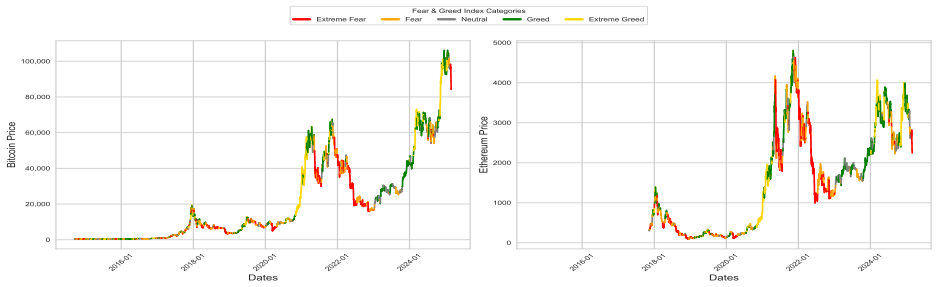
- If the hybrid's test-window errors hold up, one-day-ahead forecasts for Bitcoin and Ethereum can be produced from just price, volume, and the Fear and Greed Index with MAPE under 3 percent on these test periods.
- The architecture gives a concrete template for combining Transformer long-range attention with GRU short-term gating that can be carried to other financial time series.
- The statistical tests imply the hybrid's advantage over RBFN, GRNN, and BiLSTM is not a chance fluctuation on Bitcoin, and its advantage over all four baselines is significant for Ethereum.
- For Bitcoin, the honest reading of the post-hoc test is that the hybrid and BiGRU are statistically indistinguishable, so any claim of universal superiority must be qualified.
- The success of the hybrid suggests that bidirectional memory models are not always the best choice for one-day-ahead crypto closes; an encoder that sees the whole window at once can do at least as well.
Reading between the lines
- A natural extension the paper does not run is to match hidden sizes and training budgets across models; if the hybrid's edge persists under equalized capacity, the architectural argument is much stronger.
- The strong Ethereum result suggests testing the same encoder-decoder on other volatile, shorter-history assets, such as smaller-cap coins or commodity ETFs, to see whether the margin scales with volatility or with dataset length.
- Because the model uses only three features, the same architecture could be probed with added on-chain or macro indicators to test whether the Transformer+GRU combination extracts more benefit from richer inputs than the baselines do.
- If the authors' FGI proxy, an equally weighted blend of VADER social-media sentiment and Google Trends for dates before February 2018, is replaced with the official index throughout, the comparison could be re-run to check how sensitive the ranking is to the sentiment construction.
Signed reviews
Editorial analysis
A structured set of objections, weighed in public.
Referee Report
Summary. The paper proposes a hybrid deep learning architecture that stacks an attention-based Transformer encoder with a GRU decoder for one-day-ahead prediction of Bitcoin and Ethereum daily closing prices. Inputs are lagged price, trading volume, and a Fear and Greed Index (FGI), with a hand-built pre-2018 FGI proxy. The model is compared against RBFN, GRNN, BiLSTM, and BiGRU using MSE, RMSE, MAE, MAPE, and a Friedman test with Wilcoxon signed-rank post-hoc tests. The authors claim the hybrid consistently achieves superior accuracy, with especially large error reductions on Ethereum. The paper includes step-by-step descriptions of the proposed architecture and the statistical methodology.
Significance. If the empirical claims were reproducible, the paper would offer a modest architectural contribution: a Transformer encoder followed by a GRU decoder for cryptocurrency price prediction, with evidence of improved accuracy over four standard baselines on two major assets. The clear presentation of the model equations (Section 3.1) and the inclusion of statistical significance testing are strengths. However, the significance is heavily circumscribed by three factors: the absence of any training or architecture details for all models, the absence of a naive persistence baseline, and the contradiction between the abstract's 'consistently superior' claim and the paper's own Wilcoxon results for Bitcoin, where the hybrid is not significantly better than BiGRU. The Ethereum results are so extreme (Table 3) that they raise serious concerns about baseline configuration, making the central superiority claim unverifiable in the current form. The paper also introduces an unvalidated FGI proxy with equal weights, further limiting the reliability of the feature set.
major comments (4)
- [Section 5, Table 4, Abstract] The abstract and Section 5 state that the hybrid model 'consistently achieves superior accuracy,' but Table 4 shows that the hybrid is not statistically significantly better than BiGRU for Bitcoin (Bonferroni-corrected p = 0.0421 > alpha* = 0.005). The authors acknowledge this result in Section 5, yet the abstract and conclusion retain the unqualified 'consistently superior' wording. This is an internal inconsistency in the paper's central claim and must be corrected.
- [Section 4, Tables 2-3; Section 3] No architecture or training hyperparameters are reported for any of the five models. The hybrid's key dimensions (d, d_ffn, d_gru, L, h, and window length T) are unspecified, and the baselines' hidden sizes, number of layers, optimizers, learning rates, batch sizes, epochs, and random seeds are absent. Without these details, the Ethereum results in Table 3 are not credible: a BiLSTM with an MSE of 907,844 versus the hybrid's 11,344 (an 80-fold gap) strongly suggests a misconfigured or undertrained baseline. The claimed 8-9x RMSE/MAE/MAPE reductions in Section 5 cannot be verified or reproduced from the manuscript.
- [Section 4, Section 5] No persistence (naive random-walk) baseline is included, despite the fact that daily closing prices are highly autocorrelated and the task is one-step-ahead prediction. A simple lag-1 forecast is the standard lower bound for such a problem and is necessary to interpret the absolute error levels. For example, the Bitcoin RMSE of 1,954 USD in Table 2 corresponds to roughly 2-3% of the price level in the test period; reporting the persistence error would clarify whether the proposed model offers any real predictive gain or merely performs well because prices are smooth.
- [Section 4, Eq. (4.17)] The construction of the pre-2018 FGI proxy is not adequately validated. The equal weights w1=w2=0.5 are stated as a 'simplifying assumption,' and Eq. (4.17) is ambiguous: as typeset, 'FGI = 1/2 (Score from VADER+1)/2 x 100 + Score Google Trends' does not obviously map to the stated [0,100] range. No attempt is made to compare the proxy against the official FGI on the overlap period after February 2018. Since this proxy is used as a feature for all Bitcoin data before 2018, this is a load-bearing data-construction choice that needs clarification and a sensitivity check.
minor comments (5)
- [Section 2.1 (text before Eq. (2.2))] The sentence beginning 'Here, we consider x_{t-1} is a three dimensional vector' contains a typo: 'Her' should be 'Here.' Also, the phrasing would benefit from a comma or a 'where' clause.
- [Section 4, Table 3 surrounding text] In the paragraph preceding Table 3, 'RBNF' should be 'RBFN.'
- [Section 4, Eq. (4.22)] The Friedman test description states that n is the number of datasets (blocks), but the reported chi-square values (1419.34 and 747.76) are too large for n=2 datasets. Clarify whether the blocks are individual test observations or some other unit; otherwise the test statistics are not interpretable.
- [Section 1, 'To the best of our knowledge'] The claim of being 'the first study to introduce a deep learning model that combines a parallel self-attention-based Transformer architecture with a sequential memory-based GRU model' is overbroad. There are numerous existing Transformer-RNN hybrid time-series models in the literature (some cited by the authors themselves); suggest softening the novelty claim.
- [Section 4, Figures 8 and 9] The prediction curves for the hybrid and BiGRU appear nearly indistinguishable in Figure 8, making visual comparison difficult. A zoomed panel over a shorter test sub-period would help the reader see the differences claimed in the metrics.
Circularity Check
No circularity: the paper's claims are empirical comparisons, not derivations that assume their own conclusions.
full rationale
The paper makes no derivation from first principles that could reduce to its inputs. Its central claim is that the proposed Transformer+GRU hybrid achieves lower test-set errors than RBFN, GRNN, BiLSTM, and BiGRU on Bitcoin and Ethereum daily close prediction. This is supported by reported MSE/RMSE/MAE/MAPE values (Tables 2–3) and by Friedman/Wilcoxon tests (Tables 4–5). The model architecture is described as a standard composition of a Transformer encoder and GRU decoder; there is no fitted parameter, calibrated constant, or learned quantity that is later renamed as a prediction. The hand-built pre-2018 Fear and Greed Index proxy uses an equal-weight combination of VADER social-media sentiment and Google Trends, but that proxy is an input feature, not the target, and the target price is not used to define the proxy. The self-citations (Mahdi et al. 2021; Mahdi and Al-Abdulla 2022) appear only in a general literature review and are not load-bearing for the hybrid model's claimed performance. The main substantive weakness, noted in the skeptical commentary, is that baseline training details are absent, making the comparison hard to audit; however, missing hyperparameter reporting is a reproducibility or fairness concern, not a circularity concern, because nothing in the paper equates the outcome with the input by construction. Therefore no circular step can be exhibited, and the appropriate finding is no significant circularity.
Assumptions & free parameters
free parameters (5)
- FGI proxy weights =
w1=w2=0.5
- Transformer encoder hyperparameters (L, h, d, d_ffn) =
not reported
- GRU decoder hidden dimension (d_gru) =
not reported
- Sliding window size (T) =
not reported
- Training hyperparameters (optimizer, learning rate, epochs, batch size, dropout) =
not reported
assumptions (4)
- domain assumption Daily crypto prices follow y_t = f(x_{t-1}) + eps_t with x = [price, volume, FGI] and one-day lag.
- ad hoc to paper The hand-built pre-2018 FGI proxy equals the official FGI in information content.
- domain assumption The four baseline models were implemented and tuned fairly.
- standard math Standard backpropagation and attention math are valid.
invented entities (1)
-
Pre-2018 Fear and Greed Index proxy
Cite this review
Pith. "Pith review of A Novel Hybrid Approach Using an Attention-Based Transformer + GRU Model for Predicting Cryptocurrency Prices." pith.science (2026). https://pith.science/paper/T4VLUSTV
@misc{pith2026250417079,
  author       = {Pith},
  title        = {Pith review of: A Novel Hybrid Approach Using an Attention-Based Transformer + GRU Model for Predicting Cryptocurrency Prices},
  year         = {2026},
  howpublished = {\url{https://pith.science/paper/T4VLUSTV}},
  note         = {Machine review of arXiv:2504.17079}
}
read the original abstract
In this article, we introduce a novel deep learning hybrid model that integrates attention Transformer and Gated Recurrent Unit (GRU) architectures to improve the accuracy of cryptocurrency price predictions. By combining the Transformer's strength in capturing long-range patterns with the GRU's ability to model short-term and sequential trends, the hybrid model provides a well-rounded approach to time series forecasting. We apply the model to predict the daily closing prices of Bitcoin and Ethereum based on historical data that include past prices, trading volumes, and the Fear and Greed index. We evaluate the performance of our proposed model by comparing it with four other machine learning models: two are non-sequential feedforward models: Radial Basis Function Network (RBFN) and General Regression Neural Network (GRNN), and two are bidirectional sequential memory-based models: Bidirectional Long-Short-Term Memory (BiLSTM) and Bidirectional Gated Recurrent Unit (BiGRU). The performance of the model is assessed using several metrics, including Mean Squared Error (MSE), Root Mean Squared Error (RMSE), Mean Absolute Error (MAE), and Mean Absolute Percentage Error (MAPE), along with statistical validation through the nonparametric Friedman test followed by a post hoc Wilcoxon signed rank test. The results demonstrate that our hybrid model consistently achieves superior accuracy, highlighting its effectiveness for financial prediction tasks. These findings provide valuable insights for improving real-time decision making in cryptocurrency markets and support the growing use of hybrid deep learning models in financial analytics.
Figures


Figures from the paper (6 more)




Forward citations
Cited by 1 Pith paper
-
crypto price prediction using lstm+xgboost
An LSTM+XGBoost hybrid is reported to beat standalone models on crypto price forecasts, but the paper gives no reproducible protocol or data.
Reference graph
Works this paper leans on
-
[1]
Razi, M.A., Athappilly, K. (2005). A comparative predictive analysis of neural networks (NNS), nonlinear regression and classification and regression tree (CART) models. Expert Systems with Applications, 29, 65--74
work page 2005
-
[2]
\' S lepaczuk, R., Zenkova, M. (2018). Robustness of support vector machines in algorithmic trading on cryptocurrency market. Central European Economic Journal, 5, 186--205
work page 2018
-
[3]
Chen, Z., Li, C., Sun, W. (2020). Bitcoin price prediction using machine learning: An approach to sample dimension engineering. Journal of Computational and Applied Mathematics, 365, 112395
work page 2020
-
[4]
Mahdi, E., Leiva, V., Mara’Beh, S., Martin-Barreiro, C. (2021). A New Approach to Predicting Cryptocurrency Returns Based on the Gold Prices with Support Vector Machines during the COVID-19 Pandemic Using Sensor-Related Data. Sensors, 21, 6319. https://doi.org/10.3390/s21186319
-
[5]
Akyildirim, E., Goncu, A., Sensoy, A. (2021). Prediction of cryptocurrency returns using machine learning. Annals of Operations Research, 297, 3--36. https://doi.org/10.1007/s10479-020-03575-y
-
[6]
Makala, D., Li, Z. (2021). Prediction of gold price with ARIMA and SVM . Journal of Physics: Conference Series, 1767, 012022
work page 2021
-
[7]
Jaquart, P., K¨opke, S., Weinhardt, C. (2022). Machine learning for cryptocurrency market prediction and trading. The Journal of Finance and Data Science, 8: 331--352. https://doi.org/10.1016/j.jfds.2022.12.001
-
[8]
Mahdi, E., Al-Abdulla, A. (2022). Impact of COVID-19 Pandemic News on the Cryptocurrency Market and Gold Returns: A Quantile-on-Quantile Regression Analysis. Econometrics, 10, 26. https://doi.org/10.3390/econometrics10020026
Show all 52 references
-
[9]
C., Rehman, M
Qureshi, M., Iftikhar, H., Rodrigues, P. C., Rehman, M. Z., Salar, S. A. A. (2024). Statistical Modeling to Improve Time Series Forecasting Using Machine Learning, Time Series, and Hybrid Models: A Case Study of Bitcoin Price Forecasting. Mathematics, 12(23), 3666. https://doi...
2024 doi
-
[10]
S., Lowe, D
Broomhead, D. S., Lowe, D. (1988). Radial basis functions, multi-variable functional interpolation and adaptive networks (Technical report). Royal Signals and Radar Establishment (RSRE), Memorandum 4148
1988
-
[11]
S.; Lowe, D
Broomhead, D. S.; Lowe, D. (1988). Multivariable functional interpolation and adaptive networks. Complex Systems, 2: 321--355
1988
-
[12]
Predicting the Price of Cryptocurrency Using Support Vector Regression Methods
Alahmari, S., A., (2020). Predicting the Price of Cryptocurrency Using Support Vector Regression Methods. Journal of Mechanics of Continua and Mathematical Sciences, 15(4): 313--322. https://doi.org/10.26782/jmcms.2020.04.00023
2020 doi
-
[13]
Casillo, M., Lombardi, M., Lorusso, A., Marongiu, F., Santaniello, D., Valentino, C. (2022). Sentiment Analysis and Recurrent Radial Basis Function Network for Bitcoin Price Prediction. IEEE 21st Mediterranean Electrotechnical Conference (MELECON), Palermo, Italy, pp. 1189--11...
2022
-
[14]
Zhang, Y. (2025). Stock price behavior determination using an optimized radial basis function. Intelligent Decision Technologies, 1--18. doi:10.1177/18724981251315846
2025 doi
-
[15]
Specht, D. F. (1991). A general regression neural network. IEEE Transactions on Neural Networks, 2(6): 568--576. doi:10.1109/72.97934
1991 doi
-
[16]
Martínez, F., Charte, F., Rivera, A.J., Frías, M.P. (2019). Automatic Time Series Forecasting with GRNN: A Comparison with Other Models. In: Rojas, I., Joya, G., Catala, A. (eds) Advances in Computational Intelligence. IWANN 2019, Lecture Notes in Computer Science(), 11506. Sp...
2019 doi
-
[17]
Martínez, F., Charte, F., Frías, M., P., Martínez-Rodríguez, A. M. (2022). Strategies for time series forecasting with generalized regression neural networks. Neurocomputing, 49: 509-521 https://doi.org/10.1016/j.neucom.2021.12.028
2022 doi
-
[18]
Hochreiter, S., Schmidhuber, J. (1997). long-short-term memory. Neural Computation, 9(8): 1735--1780. https://doi.org/10.1162/neco.1997.9.8.1735
1997 doi
-
[19]
McNally, S., Roche, J., Caton, S. (2018). Predicting the Price of Bitcoin Using Machine Learning. 26th Euromicro International Conference on Parallel, Distributed and Network-based Processing (PDP), 339--343. https://api.semanticscholar.org/CorpusID:206505441
2018
-
[20]
Liu, Y., Gong, C., Yang, L., Chen, Y. (2020). DSTP-RNN: A dual-stage two-phase attention-based recurrent neural network for long-term and multivariate time series prediction. Expert Systems with Applications, 143, 113082
2020
-
[21]
Houstis, E., Vavalis, M
Zoumpekas, T. Houstis, E., Vavalis, M. (2020). ETH analysis and predictions utilizing deep learning. Expert Systems with Applications, 162: 113866. https://doi.org/10.1016/j.eswa.2020.113866
2020
-
[22]
Lahmiri, S., Bekiros, S. (2019). Cryptocurrency forecasting with deep learning chaotic neural networks. Chaos, Solitons & Fractals, 118, 35--40. https://doi.org/10.1016/j.chaos.2018.11.014
2019 doi
-
[23]
Ji, S., Kim, J., Im, H. (2019). A Comparative Study of Bitcoin Price Prediction Using Deep Learning. Mathematics, 7(10), 898. https://doi.org/10.3390/math7100898
2019 doi
-
[24]
Uras, N., Marchesi, L., Marchesi, M., Tonelli, R. (2020). Forecasting Bitcoin closing price series using linear regression and neural networks models. PeerJ Computer Science, 6: e279. https://doi.org/10.7717/peerj-cs.279
2020 doi
-
[25]
Lahmiri, S., and Bekiros, S. (2021). Deep learning forecasting in cryptocurrency high frequency trading. Cognitive Computation, 13: 485--487
2021
-
[26]
Cho, K., Merrienboer, B., Gulcehre, C., Bahdanau, D., Fethi, B., Holger, S., Bengio, Y. (2014). Learning phrase representations using RNN encoder- decoder for statistical machine translation. https://arxiv.org/abs/1406.1078
2014 arXiv
-
[27]
Jianwei, E., Ye, J., Jin, H. (2019). A novel hybrid model on the prediction of time series and its application for the gold price analysis and forecasting. Physica A: Statistical Mechanics and its Applications, 527, 121454. https://doi.org/10.1016/j.physa.2019.121454
2019
-
[28]
Dutta, A., Kumar, S., Basu, M. (2020). A gated recurrent unit approach to bitcoin price prediction. Journal of Risk and Financial Management, 13(2): 23. https://doi.org/10.3390/jrfm13020023
2020 doi
-
[29]
Tanwar, S., Patel, N. P. , Patel, S. N., Patel, J. R., Sharma, G., Davidson, I.E. Deep Learning-Based Cryptocurrency Price Prediction Scheme With Inter-Dependent Relations. IEEE Access, 9: 138633--138646. 10.1109/ACCESS.2021.3117848
2021
-
[30]
Ye, Z., Wu, Y., Chen, H., Pan, Y., Jiang, Q. (2022). A Stacking Ensemble Deep Learning Model for Bitcoin Price Prediction Using Twitter Comments on Bitcoin. Mathematics, 10(8), 1307. https://doi.org/10.3390/math10081307
2022 doi
-
[31]
Price Prediction of Cryptocurrency Using a Multi-Layer Gated Recurrent Unit Network with Multi Features
Patra1, G., R., Mohanty, M., N., (2023). Price Prediction of Cryptocurrency Using a Multi-Layer Gated Recurrent Unit Network with Multi Features. Computational Economics, 62: 1525--1544. https://doi.org/10.1007/s10614-022-10310-1
2023 doi
-
[32]
Hansun, S., Wicaksana, A ., Khaliq, A.Q.M. (2022). Multivariate cryptocurrency prediction: comparative analysis of three recurrent neural networks approaches. Journal of Big Data, 9, 50
2022
-
[33]
H., Radzi, R
Ferdiansyah, F., Othman, S. H., Radzi, R. Z., M., Stiawan, D., Sutikno T., (2023). Hybrid gated recurrent unit bidirectional-long-short-term memory model to improve cryptocurrency prediction accuracy. IAES International Journal of Artificial Intelligence (IJ-AI), 12 (1). http:...
2023 doi
-
[34]
N., Polosukhin, I
Vaswani, A., Shazeer, N., Parmar, N., Uszkoreit, J., Jones, L., Gomez, A. N., Polosukhin, I. (2017). Attention is all you need. Advances in Neural Information Processing Systems, 30
2017
-
[35]
W., Lee, K., Toutanova, K
Devlin, J., Chang, M. W., Lee, K., Toutanova, K. (2018). BERT: Pre-training of deep bidirectional transformers for language understanding. In Proceedings of the 2019 Conference of the North American Chapter of the Association for Computational Linguistics: Human Language Techn...
2018 doi
-
[36]
Dosovitskiy, A., Beyer, L., Kolesnikov, A., Weissenborn, D., Zhai, X., Unterthiner, T., Dehghani, M., Minderer, M., Heigold, G., Gelly, S., Uszkoreit, J., Houlsby, N. (2020). An Image is Worth 16x16 Words: Transformers for Image Recognition at Scale. ArXiv, abs/2010.11929
2020 arXiv
-
[37]
Zhou, H., Zhang, S., Peng, J., Zhang, S., Li, J., Xiong, H., Zhang, W. (2021). Informer: Beyond Efficient Transformer for Long Sequence Time-Series Forecasting. Proceedings of the AAAI Conference on Artificial Intelligence, 35(12), 11106--11115. https://doi.org/10.1609/aaai.v3...
2021 doi
-
[38]
Grigsby, J., Wang, Z., Qi, Y. (2021). Long-Range Transformers for Dynamic Spatiotemporal Forecasting. computer science bibliography. ArXiv, https://arxiv.org/abs/2109.12218
2021 arXiv
-
[39]
Lezmi, E., Xu, J. (2023). Time Series Forecasting with Transformer Models and Application to Asset Management. Available at SSRN: https://ssrn.com/abstract=4375798 or http://dx.doi.org/10.2139/ssrn.4375798. black
2023 doi
-
[40]
Wen, Q., Zhou, T., Zhang, C., Chen, W., Ma, Z., Yan, J., Sun, L. (2023). Transformers in Time Series: A Survey. Thirty-Second International Joint Conference on Artificial Intelligence, IJCAI-23, 6778--6786. https://doi.org/10.24963/ijcai.2023/759
2023 doi
- [41]
-
[42]
Zerveas, G., Jayaraman, S., Patel, D., Bhamidipaty, A., Eickhoff, C. (2021). A transformer-based framework for multivariate time series representation learning. In KDD '21: Proceedings of the 27th ACM SIGKDD Conference on Knowledge Discovery & Data Mining Pages 2114--2124 http...
2021
- [43]
-
[44]
Castangia, M., Grajales, L. M. M., Aliberti, A., Rossi, C., Macii, A., Macii, E., Patti, E. (2023). Transformer neural networks for interpretable flood forecasting. Environmental Modelling & Software, 160: 105581. https://doi.org/10.1016/j.envsoft.2022.105581
2023
-
[45]
Bahdanau, D., Cho, K., Bengio, Y. (2015). Neural Machine Translation by Jointly Learning to Align and Translate. In Proceedings of the International Conference on Learning Representations (ICLR)
2015
-
[46]
H, Alam, W., Avinash, G., Kumar, R.R., Ray, M., Barman, S., Singh, K.N., Naik, B.S., Alam, N.M., Pal, P., Rathod, S., Bisen, J
Nayak, G.H. H, Alam, W., Avinash, G., Kumar, R.R., Ray, M., Barman, S., Singh, K.N., Naik, B.S., Alam, N.M., Pal, P., Rathod, S., Bisen, J. (2024). Transformer-based deep learning architecture for time series forecasting. Software Impacts, 22, 100716. https://doi.org/10.1016/j...
2024
-
[47]
Kristoufek, L. (2013). BitCoin meets Google Trends and Wikipedia: Quantifying the relationship between phenomena of the Internet era. Scientific Reports, 3, 3415. https://doi.org/10.1038/srep03415
2013 doi
-
[48]
Urquhart, A. (2018). What causes the attention of Bitcoin?. Economics Letters, 166, 40--44, https://doi.org/10.1016/j.econlet.2018.02.017
2018 doi
-
[49]
Kao, Y.S., Day, M.Y., Chou, K.H. (2024). A comparison of bitcoin futures return and return volatility based on news sentiment contemporaneously or lead-lag. The North American Journal of Economics and Finance, 72, 102159. https://doi.org/10.1016/j.najef.2024.102159. black
2024
-
[50]
Mai, F., Shan, J., Bai, Q., Sahne, W. (2018). How does social media impact Bitcoin value? A test of the silent majority hypothesis. Journal of Management Information Systems, 35(1): 19--52. https://doi.org/10.1080/07421222.2018.1440774
2018
-
[51]
Garcia, D., Schweitzer, F. (2015). Social signals and algorithmic trading of Bitcoin. Royal Society Open Science, 2(9): 150288. http://doi.org/10.1098/rsos.150288
2015 doi
-
[52]
Yan, K., Li, Y. (2024). Machine learning-based analysis of volatility quantitative investment strategies for American financial stocks. Quantitative Finance and Economics, 2024, 8(2): 364-386. doi: 10.3934/QFE.2024014
2024 doi
Reviewed August 16, 2026 · model on record in the stance chip above.
Discussion (0). Continue with ORCID to comment.