REVIEW 4 major objections 7 minor 41 references
polyGen: A Learning Framework for Atomic-level Polymer Structure Generation
T0 review · 4 major / 7 minor · reviewed 2026-08-16 · deepseek-v4-flash
Pith's one-line read polyGen is a generative model that turns a repeat-unit SMILES string into an ensemble of realistic three-dimensional polymer conformations.
desk verdict A useful proof-of-concept for polymer structure generation, honest about its limits, but the 'low-energy' claim is not directly tested. read the letter →
The pith
A machine-rendered reading of the paper's core claim, the machinery that carries it, and where it could break.
The reading
What carries the argument
The load-bearing object is a latent diffusion transformer over an atom-wise variational latent space, conditioned by a graph-interaction-network encoding of the repeat unit and modified by a learnable relative-position attention bias. The bias is computed from a one-hot graph-distance tensor that classifies each atom pair as identical, bonded, angle-separated, dihedral-separated, or more than four bonds apart, and it is added directly to the attention logits so local interactions can dominate while global attention remains possible. The same network weights encode both polymers and small molecules, letting the much larger QM9 set share the latent space, and a post-generation filter keeps a sample only if its computed connectivity graph matches the input and every bond exceeds 0.8 Å.
What would settle it
Take a polymer with an independently known multi-conformer ensemble, for example from molecular-dynamics sampling or many DFT minima, generate 100 polyGen samples, and measure the KL divergence of bonds, angles, and dihedrals against that full ensemble. The central claim falls if a populated low-energy basin is systematically missed or if per-bond-type peaks stay displaced by more than about 0.1 Å while the connectivity filter still passes.
Extended reading notes
Core claim
polyGen's central claim is that polymer conformation generation can be posed as conditional latent diffusion: a molecular graph of the repeat unit is encoded into atom-wise conditioning vectors, a variational autoencoder learns a shared latent space for polymers and small molecules, and a diffusion transformer denoises that latent to decode back into fractional coordinates, Cartesian positions, and the chain-axis box height. Given only the repeat-unit connectivity, the model is claimed to generate a diverse ensemble of linear and branched conformations whose bond-length, angle, and dihedral distributions peak near the DFT-optimized references, rather than a single fixed geometry. The authors further claim that joint training with small-molecule conformers and a learnable relative-position attention bias are what make the approach viable on a dataset of only 3,855 polymers.
Load-bearing premise
The evaluation's load-bearing premise is that the single DFT-optimized conformation stored for each polymer stands in for that polymer's full ensemble of low-energy conformations, and that the combination of a matching connectivity pattern with a 0.8 Å bond cutoff certifies a physically useful structure.
Editorial extensions
If this is right
- Given only a repeat-unit SMILES string, the model can produce a pool of diverse polymer conformations suitable as starting points for DFT or molecular-dynamics simulation.
- Jointly training on QM9 small molecules cuts bond-length KL divergence by 41.0% and angle KL divergence by 29.0% relative to polymer-only training, showing that molecular local structure transfers to polymers.
- The relative-position attention bias is the main feasibility lever: it raises the graph-connectivity pass rate from 36.9% to 64.8%, and the vanilla transformer cannot generate any valid structure for polymers above roughly 150 atoms, whereas the biased version still can.
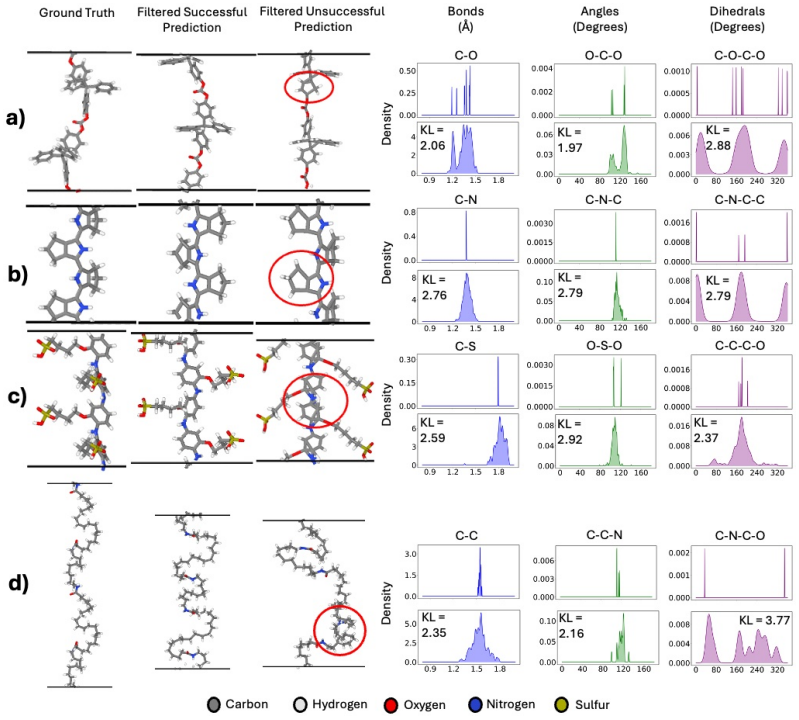
- Filter-passing ensembles are diverse rather than collapsed to one geometry, and the predicted chain-axis repeat length tracks the DFT reference with $r^2 = 0.854$, so the model distinguishes dense from sparse chains.
- Current precision is angstrom-scale rather than picometer-scale, so the generator cannot yet reliably separate bond types, and generation success falls off sharply for the largest repeat units.
Reading between the lines
- A stronger validation would compare polyGen ensembles against a genuinely multi-conformer ground truth, such as molecular-dynamics sampling or several DFT minima per polymer; if the distributional match survives that comparison, the realism claim is much firmer.
- The connectivity-match plus 0.8 Å filter is a crude physical-validity proxy, so re-ranking accepted samples by a fast force field or a single-point DFT energy could be a cheap way to improve the usable fraction.
- Because joint training with QM9 mainly improved local features (bonds and angles) rather than dihedrals and chain-axis heights, further gains in global conformation accuracy will likely require polymer-scale training data rather than more small-molecule data.
- The same conditioning and attention-bias recipe could extend to cross-linked or multi-chain amorphous polymer boxes, which share the same local-geometry constraints but also require handling non-bonded interactions that this single-chain proof-of-concept does not address.
Signed reviews
Editorial analysis
A structured set of objections, weighed in public.
Referee Report
Summary. The manuscript introduces polyGen, a latent diffusion framework that generates atomic-level 3D polymer structures conditioned only on the repeat-unit chemistry (SMILES). The model combines a graph-based conditioning module, a variational autoencoder that reconstructs fractional coordinates, Cartesian coordinates, and the periodic-box z-height, and a diffusion transformer with a relative-position attention bias. Training uses 3,855 DFT-optimized polymer chains from polyChainStructures, augmented with 100K QM9 small molecules. The paper evaluates generated structures by forward KL divergence between predicted and DFT bond-length, angle, and dihedral distributions (Eq. 1), and by a post-generation filter requiring graph isomorphism and a bond-length cutoff. The authors report that joint training with QM9 improves bond and angle KL divergences, that position-biased attention improves generation success and dihedral/angle metrics, and that the model produces diverse conformations and captures z-height trends. The stated contribution is the first generative model for synthetic polymer conformations, with the central claim that polyGen generates realistic and diverse low-energy polymer structures from minimal input.
Significance. If the central claim is established, polyGen would be a useful proof-of-concept for a genuinely under-addressed problem: generating diverse, physically reasonable polymer conformations without external relaxation. The paper has tangible strengths: it introduces a new evaluation protocol adapted to conformational diversity, it ablated the contribution of joint training and position-biased attention, and it reports limitations honestly, including low success rates for large systems and the concession that connectivity filtering does not certify 3D accuracy. However, the evidence as presented does not support the strong claim of generating 'realistic and diverse low-energy conformations.' The evaluation metrics overlap with the training objectives, the reference is a single DFT structure per polymer, no energy validation is reported, and no baselines are included. The paper would be strengthened substantially by adding energy-based validation, non-overlapping evaluation quantities, and comparisons to existing tools such as PSP, RDKit ETKDG, or PolyConf.
major comments (4)
- [§2.1, §2.3, §4.5] The headline claim that polyGen generates 'realistic and diverse low-energy conformations' (Abstract) is not directly tested. The evaluation in Eq. (1) compares bond/angle/dihedral histograms to a single DFT-optimized structure per polymer, and the Section 4.5 filter only checks graph isomorphism and a 0.8 Å bond-length cutoff. Section 4.5 itself states that 'a successful prediction of connectivity doesn't guarantee an accurate 3D structure.' No energies of generated structures are computed, no relaxation or re-optimization is reported, and no comparison to physics-based structure generators (PSP, ETKDG, PolyConf) is given. A generated structure with reference-like local geometry but severe nonbonded strain or incorrect global packing could pass all reported criteria. Please add energy-based validation (e.g., DFT or force-field single-point energies of generated versus relaxed structures) or explicitly narrow the claim to local-geometry distribution matching.
- [Eq. (8) and Eq. (1)] The evaluation quantities are not independent of the training objective. The VAE loss in Eq. (8) includes L_bond, L_angle, and L_dihedral, which directly supervise bond lengths, angles, and dihedrals; the evaluation metric in Eq. (1) measures exactly those quantities. Therefore, the reported distributional agreement partly reflects optimizing the same structural objectives during training, rather than an emergent ability to generate physically valid conformations. Please report at least one evaluation metric on quantities that are not directly optimized (e.g., nonbonded distances, density or z-height distributions, or energies), or ablate the structural losses and show how the KL metrics change.
- [§2.4 and §4.4.1] The quantitative claims lack baselines and uncertainty estimates. Improvements such as success rate increasing from 36.9% to 64.8% with position bias, and KL divergences decreasing by 41.0% (bonds), 29.0% (angles), and 16.1% (dihedrals) with joint training, are reported as point estimates with no standard deviations across seeds or per-polymer confidence intervals. There is also no quantitative comparison against existing polymer or conformer generators, even though PSP [13] and PolyConf [27] are cited in the introduction. Without baselines and error bars, the relative improvements and the claim of being 'the first' model for this task cannot be assessed.
- [§2.1 and §2.3] The dataset contains only one DFT-optimized conformation per polymer, as the paper acknowledges in Section 2.3. The forward KL divergence in Eq. (1) therefore measures agreement with a single point in what is acknowledged to be a broad conformational ensemble, not with the polymer's true low-energy distribution. The authors should justify that a single relaxed structure is representative of the ensemble, or evaluate against multiple conformers (e.g., from MD trajectories or repeated PSP/DFT relaxations) for at least a subset of test polymers. Without this, the distributional matching results do not establish that the model captures polymer flexibility.
minor comments (7)
- [§2.1, Eq. (1)] Please specify the binning scheme for the KL divergence computation. The text says the discrete buckets use dz=0.001 over ranges that imply ~1,100 (bond), 180,000 (angle), and 360,000 (dihedral) buckets; it is unclear whether such fine binning is actually used and how empty buckets are handled.
- [Figure 5] The caption and text do not state whether the reported KL divergences are means or medians over polymer test cases, or how the error bars in the figure are defined. Please clarify the aggregation and provide per-polymer distributions or boxplots.
- [§4.2, Eq. (2)] The symbol h_i^(0) is used both for the initial atom embedding and for the MLP output after concatenating positional encodings. Using a distinct symbol such as h_i^(0,raw) and h_i^(0) would remove ambiguity.
- [§4.4] The text mixes flow-matching and denoising-diffusion terminology. Equations (9)-(13) define a flow-matching objective, but Section 2 says 'latent diffusion transformer' and the abstract says 'latent diffusion.' Please state the exact formulation, noise schedule, and how the flow-matching ODE corresponds to the diffusion process.
- [§2.2] The qualitative statement 'Generation is precise to the order of Å, but not on the scale of picometers' would be more useful with numerical values, e.g., mean absolute errors or RMSDs for the bond-length distributions shown in Figure 3.
- [§5 and §6] The dataset link is present, but code and checkpoints are only promised 'upon publication.' Since the results are central to the paper and no code is available for review, please provide a link to an anonymous repository or describe how to reproduce the key numbers with the dataset alone.
- [§2.4, Figure 5d] Please clarify how the r²=0.854 for z-height is computed: is it a per-polymer mean of generated heights, or based on a single sample per polymer? The current text is ambiguous about which quantity is regressed.
Circularity Check
No significant circularity: held-out DFT test set, though evaluation metrics mirror training losses.
full rationale
polyGen's derivation is not circular. The model is trained on the polyChainStructures DFT set (with QM9 augmentation) and evaluated on a held-out test split; the reported KL divergences (Eq. 1) compare predicted bond, angle, and dihedral distributions to DFT ground truth for test polymers not used in training. The structural losses in Eq. 8 use the same local-geometry quantities, so the evaluation overlaps with the training objective; this is a standard reconstruction-benchmark setting and does not make the test-set numbers forced by construction. The paper also explicitly concedes in Sec. 4.5 that 'a successful prediction of connectivity doesn't guarantee an accurate 3D structure,' and no energy or relaxation validation is reported; those are evidence gaps, not circular reductions. Self-citations to the Ramprasad group's dataset (Ref 12) are data provenance rather than load-bearing mathematical premises. Thus no specific Eq. X = Eq. Y equivalence or renamed fit was identified. Score 1 reflects the mild self-referential flavor of the evaluation metrics, not a logical circularity.
Assumptions & free parameters
free parameters (8)
- VAE loss weights (wbbox, wfrac_coords, wpos, wkl, wbond, wangle, wdihedral) =
not stated in main text
- Bond-length filter cutoff =
0.8 Angstrom
- Graph-distance attention channels =
5 one-hot channels (identical, bonded, angle, dihedral, beyond four bonds)
- Polymer data upsampling ratio =
30x per epoch
- Positional encoding sizes =
random walk 16, Laplacian 2
- Fixed lateral box size =
55 Angstrom x 55 Angstrom
- Bounding box normalization =
bz/(10^3 sqrt(N))
- Graph interaction layers =
L = 4
assumptions (6)
- domain assumption DFT-optimized single-conformer structures are representative samples of polymer conformational ensembles.
- domain assumption A single polymer chain in a periodic orthorhombic box with x and y fixed at 55 Angstrom and only z height variable captures the relevant structure.
- domain assumption Small-molecule conformations from QM9 share a latent space with polymer repeat units such that joint training improves polymer generation.
- standard math Gaussian flow matching is equivalent to denoising diffusion and can be trained with the stated interpolation loss.
- domain assumption Random rotation and translation augmentation is sufficient for a non-equivariant transformer to learn equivariant structure generation.
- domain assumption Graph isomorphism plus the 0.8 Angstrom bond cutoff is a sufficient filter for chemically valid generated structures.
Cite this review
Pith. "Pith review of polyGen: A Learning Framework for Atomic-level Polymer Structure Generation." pith.science (2026). https://pith.science/paper/IJVOXPQC
@misc{pith2026250417656,
  author       = {Pith},
  title        = {Pith review of: polyGen: A Learning Framework for Atomic-level Polymer Structure Generation},
  year         = {2026},
  howpublished = {\url{https://pith.science/paper/IJVOXPQC}},
  note         = {Machine review of arXiv:2504.17656}
}
read the original abstract
Synthetic polymeric materials underpin fundamental technologies in the energy, electronics, consumer goods, and medical sectors, yet their development still suffers from prolonged design timelines. Although polymer informatics tools have supported speedup, polymer simulation protocols continue to face significant challenges in the on-demand generation of realistic 3D atomic structures that respect conformational diversity. Generative algorithms for 3D structures of inorganic crystals, bio-polymers, and small molecules exist, but have not addressed synthetic polymers because of challenges in representation and dataset constraints. In this work, we introduce polyGen, the first generative model designed specifically for polymer structures from minimal inputs such as the repeat unit chemistry alone. polyGen combines graph-based encodings with a latent diffusion transformer using positional biased attention for realistic conformation generation. Given the limited dataset of 3,855 DFT-optimized polymer structures, we incorporate joint training with small molecule data to enhance generation quality. We also establish structure matching criteria to benchmark our approach on this novel problem. polyGen overcomes the limitations of traditional crystal structure prediction methods for polymers, successfully generating realistic and diverse linear and branched conformations, with promising performance even on challenging large repeat units. As the first atomic-level proof-of-concept capturing intrinsic polymer flexibility, it marks a new capability in material structure generation.
Figures


Figures from the paper (2 more)


Reference graph
Works this paper leans on
-
[13]
Harikrishna Sahu, Kuan-Hsuan Shen, Joseph H Montoya, Huan Tran, and Rampi Ramprasad. Polymer structure predictor (psp): a python toolkit for predicting atomic-level structural models for a range of polymer geometries. Journal of Chemical Theory and Computation, 18(4):2737–2748, 2022
work page 2022
-
[27]
PolyConf: Unlocking Polymer Conformation Generation through Hierarchical Generative Models
Fanmeng Wang, Wentao Guo, Qi Ou, Hongshuai Wang, Haitao Lin, Hongteng Xu, and Zhifeng Gao. Polyconf: Unlocking polymer conformation generation through hierarchical generative models. arXiv preprint arXiv:2504.08859, 2025
work page Pith review arXiv 2025
-
[1]
Design of functional and sustainable polymers assisted by artificial intelligence
Huan Tran, Rishi Gurnani, Chiho Kim, Ghanshyam Pilania, Ha-Kyung Kwon, Ryan P Lively, and Rampi Ramprasad. Design of functional and sustainable polymers assisted by artificial intelligence. Nature Reviews Materials, pages 1–21, 2024
work page 2024
-
[2]
Emerging materials intelligence ecosystems propelled by machine learning
Rohit Batra, Le Song, and Rampi Ramprasad. Emerging materials intelligence ecosystems propelled by machine learning. Nature Reviews Materials, 6(8):655–678, 2021
work page 2021
-
[3]
Polymer Informatics Beyond Homopolymers
Shivank S Shukla, Christopher Kuenneth, and Rampi Ramprasad. Polymer informatics beyond homopoly- mers. arXiv preprint arXiv:2303.12938, 2023
work page Pith review arXiv 2023
-
[4]
Ai-assisted discovery of high-temperature dielectrics for energy storage
Rishi Gurnani, Stuti Shukla, Deepak Kamal, Chao Wu, Jing Hao, Christopher Kuenneth, Pritish Aklujkar, Ashish Khomane, Robert Daniels, Ajinkya A Deshmukh, et al. Ai-assisted discovery of high-temperature dielectrics for energy storage. Nature Communications, 15(1):6107, 2024
work page 2024
-
[5]
Brandon K Phan, Kuan-Hsuan Shen, Rishi Gurnani, Huan Tran, Ryan Lively, and Rampi Ramprasad. Gas permeability, diffusivity, and solubility in polymers: Simulation-experiment data fusion and multi-task machine learning. npj Computational Materials, 10(1):186, 2024
work page 2024
-
[6]
Polymer informatics: Current status and critical next steps
Lihua Chen, Ghanshyam Pilania, Rohit Batra, Tran Doan Huan, Chiho Kim, Christopher Kuenneth, and Rampi Ramprasad. Polymer informatics: Current status and critical next steps. Materials Science and Engineering: R: Reports, 144:100595, 2021
2021
Show all 41 references
-
[7]
Machine-learning predictions of polymer properties with polymer genome
Huan Doan Tran, Chiho Kim, Lihua Chen, Anand Chandrasekaran, Rohit Batra, Shruti Venkatram, Deepak Kamal, Jordan P Lightstone, Rishi Gurnani, Pranav Shetty, et al. Machine-learning predictions of polymer properties with polymer genome. Journal of Applied Physics, 128(17):171104, 2020
2020
-
[8]
Polymer informatics at scale with multitask graph neural networks
Rishi Gurnani, Christopher Kuenneth, Aubrey Toland, and Rampi Ramprasad. Polymer informatics at scale with multitask graph neural networks. Chemistry of Materials, 35(4):1560–1567, 2023
2023
-
[9]
An informatics framework for the design of sustainable, chemically recyclable, synthetically-accessible and durable polymers
Joseph Kern, Yongliang Su, Will Gutekunst, and Rampi Ramprasad. An informatics framework for the design of sustainable, chemically recyclable, synthetically-accessible and durable polymers. arXiv preprint arXiv:2409.15354, 2024
2024 arXiv
-
[10]
Design of polymers for energy storage capacitors using machine learning and evolutionary algorithms
Joseph Kern, Lihua Chen, Chiho Kim, and Rampi Ramprasad. Design of polymers for energy storage capacitors using machine learning and evolutionary algorithms. Journal of Materials Science, 56:19623– 19635, 2021
2021
-
[11]
Polymers for extreme conditions designed using syntax-directed variational autoencoders
Rohit Batra, Hanjun Dai, Tran Doan Huan, Lihua Chen, Chiho Kim, Will R Gutekunst, Le Song, and Rampi Ramprasad. Polymers for extreme conditions designed using syntax-directed variational autoencoders. Chemistry of Materials, 32(24):10489–10500, 2020
2020
-
[12]
Polymer structure prediction from first principles
Tran Doan Huan and Rampi Ramprasad. Polymer structure prediction from first principles. The Journal of Physical Chemistry Letters, 11(15):5823–5829, 2020
2020
-
[14]
Diffusion models: A comprehensive survey of methods and applications
Ling Yang, Zhilong Zhang, Yang Song, Shenda Hong, Runsheng Xu, Yue Zhao, Wentao Zhang, Bin Cui, and Ming-Hsuan Yang. Diffusion models: A comprehensive survey of methods and applications. ACM Computing Surveys, 56(4):1–39, 2023
2023
-
[15]
Flow matching for generative modeling
Yaron Lipman, Ricky TQ Chen, Heli Ben-Hamu, Maximilian Nickel, and Matt Le. Flow matching for generative modeling. arXiv preprint arXiv:2210.02747, 2022
2022 arXiv
-
[16]
The open catalyst 2022 (oc22) dataset and challenges for oxide electrocatalysts
Richard Tran, Janice Lan, Muhammed Shuaibi, Brandon M Wood, Siddharth Goyal, Abhishek Das, Javier Heras-Domingo, Adeesh Kolluru, Ammar Rizvi, Nima Shoghi, et al. The open catalyst 2022 (oc22) dataset and challenges for oxide electrocatalysts. ACS Catalysis, 13(5):3066–3084, 2023
2022
-
[17]
Highly accurate protein structure prediction with alphafold
John Jumper, Richard Evans, Alexander Pritzel, Tim Green, Michael Figurnov, Olaf Ronneberger, Kathryn Tunyasuvunakool, Russ Bates, Augustin Žídek, Anna Potapenko, et al. Highly accurate protein structure prediction with alphafold. nature, 596(7873):583–589, 2021
2021
-
[18]
Crystal structure prediction by joint equivariant diffusion
Rui Jiao, Wenbing Huang, Peijia Lin, Jiaqi Han, Pin Chen, Yutong Lu, and Yang Liu. Crystal structure prediction by joint equivariant diffusion. Advances in Neural Information Processing Systems, 36:17464– 17497, 2023
2023
-
[19]
Crystal diffusion variational autoencoder for periodic material generation
Tian Xie, Xiang Fu, Octavian-Eugen Ganea, Regina Barzilay, and Tommi Jaakkola. Crystal diffusion variational autoencoder for periodic material generation. arXiv preprint arXiv:2110.06197, 2021
2021 arXiv
-
[20]
Flowmm: Generating materials with riemannian flow matching
Benjamin Kurt Miller, Ricky TQ Chen, Anuroop Sriram, and Brandon M Wood. Flowmm: Generating materials with riemannian flow matching. In Forty-first International Conference on Machine Learning, 2024. 13
2024
-
[21]
Accurate structure prediction of biomolecular interactions with alphafold 3
Josh Abramson, Jonas Adler, Jack Dunger, Richard Evans, Tim Green, Alexander Pritzel, Olaf Ronneberger, Lindsay Willmore, Andrew J Ballard, Joshua Bambrick, et al. Accurate structure prediction of biomolecular interactions with alphafold 3. Nature, 630(8016):493–500, 2024
2024
-
[22]
Boltz-1: Democratizing biomolecular interaction modeling
Jeremy Wohlwend, Gabriele Corso, Saro Passaro, Mateo Reveiz, Ken Leidal, Wojtek Swiderski, Tally Portnoi, Itamar Chinn, Jacob Silterra, Tommi Jaakkola, et al. Boltz-1: Democratizing biomolecular interaction modeling. bioRxiv, pages 2024–11, 2024
2024
-
[23]
Et-flow: Equivariant flow-matching for molecular conformer generation
Majdi Hassan, Nikhil Shenoy, Jungyoon Lee, Hannes Stärk, Stephan Thaler, and Dominique Beaini. Et-flow: Equivariant flow-matching for molecular conformer generation. Advances in Neural Information Processing Systems, 37:128798–128824, 2024
2024
-
[24]
Geometric latent diffusion models for 3d molecule generation, 2023
Minkai Xu, Alexander Powers, Ron Dror, Stefano Ermon, and Jure Leskovec. Geometric latent diffusion models for 3d molecule generation, 2023. URL https://arxiv.org/abs/2305.01140
2023 arXiv
-
[25]
Moleculenet: a benchmark for molecular machine learning
Zhenqin Wu, Bharath Ramsundar, Evan N Feinberg, Joseph Gomes, Caleb Geniesse, Aneesh S Pappu, Karl Leswing, and Vijay Pande. Moleculenet: a benchmark for molecular machine learning. Chemical science, 9(2):513–530, 2018
2018
-
[26]
Diffdock: Diffusion steps, twists, and turns for molecular docking
Gabriele Corso, Hannes Stärk, Bowen Jing, Regina Barzilay, and Tommi Jaakkola. Diffdock: Diffusion steps, twists, and turns for molecular docking. arXiv preprint arXiv:2210.01776, 2022
2022 arXiv
-
[28]
High-throughput molecular dynamics simulations and validation of thermophysical properties of polymers for various applications
Mohammad Atif Faiz Afzal, Andrea R Browning, Alexander Goldberg, Mathew D Halls, Jacob L Gavartin, Tsuguo Morisato, Thomas F Hughes, David J Giesen, and Joseph E Goose. High-throughput molecular dynamics simulations and validation of thermophysical properties of polymers for v...
2020
-
[29]
Molecular simulations of thermomechanical properties of epoxy-amine resins
Mathilde Orselly, Julien Devemy, Agathe Bouvet-Marchand, Alain Dequidt, Cédric Loubat, and Patrice Malfreyt. Molecular simulations of thermomechanical properties of epoxy-amine resins. ACS omega, 7 (34):30040–30050, 2022
2022
-
[30]
All-atom diffusion transformers: Unified generative modelling of molecules and materials
Chaitanya K Joshi, Xiang Fu, Yi-Lun Liao, Vahe Gharakhanyan, Benjamin Kurt Miller, Anuroop Sriram, and Zachary W Ulissi. All-atom diffusion transformers: Unified generative modelling of molecules and materials. arXiv preprint arXiv:2503.03965, 2025
2025 arXiv
-
[31]
Geom, energy-annotated molecular conformations for property prediction and molecular generation
Simon Axelrod and Rafael Gomez-Bombarelli. Geom, energy-annotated molecular conformations for property prediction and molecular generation. Scientific Data, 9(1):185, 2022
2022
-
[32]
Python materials genomics (pymatgen): A robust, open-source python library for materials analysis
Shyue Ping Ong, William Davidson Richards, Anubhav Jain, Geoffroy Hautier, Michael Kocher, Shreyas Cholia, Dan Gunter, Vincent L Chevrier, Kristin A Persson, and Gerbrand Ceder. Python materials genomics (pymatgen): A robust, open-source python library for materials analysis. ...
2013
-
[33]
Torsional diffusion for molecular conformer generation
Bowen Jing, Gabriele Corso, Jeffrey Chang, Regina Barzilay, and Tommi Jaakkola. Torsional diffusion for molecular conformer generation. Advances in neural information processing systems, 35:24240–24253, 2022
2022
-
[34]
Interaction networks for learning about objects, relations and physics
Peter Battaglia, Razvan Pascanu, Matthew Lai, Danilo Jimenez Rezende, et al. Interaction networks for learning about objects, relations and physics. Advances in neural information processing systems , 29, 2016
2016
-
[35]
Graph neural networks with learnable structural and positional representations
Vijay Prakash Dwivedi, Anh Tuan Luu, Thomas Laurent, Yoshua Bengio, and Xavier Bresson. Graph neural networks with learnable structural and positional representations. arXiv preprint arXiv:2110.07875, 2021
2021 arXiv
-
[36]
Benchmarking graph neural networks
Vijay Prakash Dwivedi, Chaitanya K Joshi, Anh Tuan Luu, Thomas Laurent, Yoshua Bengio, and Xavier Bresson. Benchmarking graph neural networks. Journal of Machine Learning Research, 24(43):1–48, 2023
2023
-
[37]
Yuyang Wang, Ahmed A. A. Elhag, Navdeep Jaitly, Joshua M. Susskind, and Miguel Angel Bautista. Swallowing the bitter pill: Simplified scalable conformer generation. In International Conference on Machine Learning, 2023. URL https://api.semanticscholar.org/CorpusID:265506007
2023
-
[38]
Transformer for graphs: An overview from architecture perspective
Erxue Min, Runfa Chen, Yatao Bian, Tingyang Xu, Kangfei Zhao, Wenbing Huang, Peilin Zhao, Junzhou Huang, Sophia Ananiadou, and Yu Rong. Transformer for graphs: An overview from architecture perspective. arXiv preprint arXiv:2202.08455, 2022
2022 arXiv
-
[39]
lddt: a local superposition-free score for comparing protein structures and models using distance difference tests
Valerio Mariani, Marco Biasini, Alessandro Barbato, and Torsten Schwede. lddt: a local superposition-free score for comparing protein structures and models using distance difference tests. Bioinformatics, 29(21): 2722–2728, 2013. 14
2013
-
[40]
Murphy, and Tim Salimans
Ruiqi Gao, Emiel Hoogeboom, Jonathan Heek, Valentin De Bortoli, Kevin P. Murphy, and Tim Salimans. Diffusion meets flow matching: Two sides of the same coin. 2024. URL https://diffusionflow. github.io/
2024
-
[41]
Harmonic self-conditioned flow matching for multi-ligand docking and binding site design
Hannes Stärk, Bowen Jing, Regina Barzilay, and Tommi Jaakkola. Harmonic self-conditioned flow matching for multi-ligand docking and binding site design. arXiv preprint arXiv:2310.05764, 2023. 15
2023 arXiv
Reviewed August 16, 2026 · model on record in the stance chip above.
Discussion (0). Continue with ORCID to comment.