REVIEW 3 major objections 4 minor 72 references
The ALMA-CRISTAL survey: weak evidence for star-formation driven outflows in $z\sim5$ main-sequence galaxies
T0 review · 3 major / 4 minor · reviewed 2026-08-16 · deepseek-v4-flash
Pith's one-line read At z≈5, typical main-sequence galaxies drive at most weak, non-quenching gas outflows.
desk verdict Careful stacking paper whose only strong detection may come from a weighting bug in the method-4 normalization; outflow rates are provisional pending re-weighting. read the letter →
The pith
A machine-rendered reading of the paper's core claim, the machinery that carries it, and where it could break.
The reading
What carries the argument
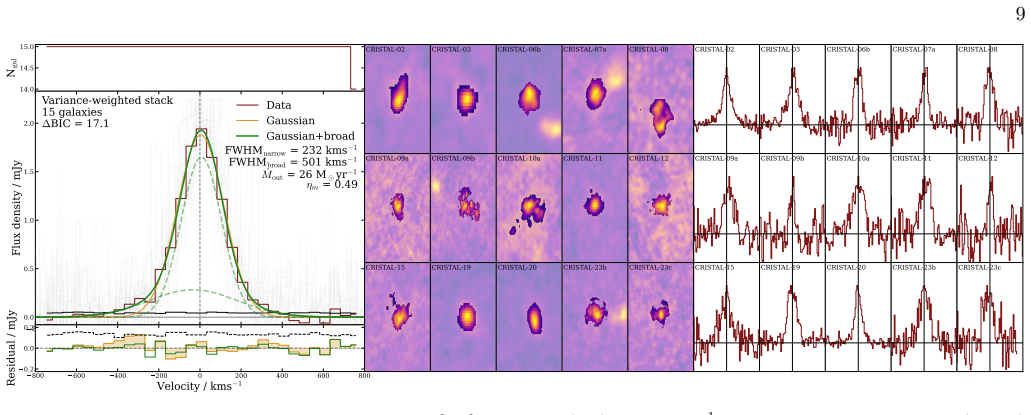
The load-bearing object is the variance-weighted composite [C II] line profile built from two-$\sigma$-masked spectral extractions, co-added in $50\,\mathrm{km}\,\mathrm{s}^{-1}$ bins. The analysis hinges on four stacking normalizations; only method 4, which stretches each line to the median FWHM of $260\,\mathrm{km}\,\mathrm{s}^{-1}$ and divides by peak flux, yields $\Delta{\rm BIC}=17$ in favour of adding a broad Gaussian of FWHM $\approx500\,\mathrm{km}\,\mathrm{s}^{-1}$. Model selection uses the Bayesian Information Criterion with priors on relative widths and amplitudes, and bootstrap resampling quantifies how strongly individual sources drive the preference.
What would settle it
Stack a sample of 50 or more kinematically relaxed $z\approx5$ disks using methods 2 and 3 (width normalization without peak normalization) at comparable depth; if no broad component appears with $\Delta{\rm BIC}>10$ after excluding known outflow sources, the claim that typical $z\approx5$ galaxies drive cold outflows fails. Equivalently, if a deep individual-spectrum survey finds no galaxy other than CRISTAL-02-like systems with a clear broad wing, the stack signal is a single-source artefact.
Extended reading notes
Core claim
The central claim is that the composite [C II] spectrum of fifteen kinematically relaxed $z\approx5$ main-sequence galaxies contains, at most, a weak broad component consistent with a star-formation-driven outflow, and that this component is not a general property of the population. The signal appears only under the stacking method that equalizes line width and peak flux ($\Delta{\rm BIC}=17$ for the full sample); methods that leave fluxes or widths unnormalized do not prefer a broad component ($\Delta{\rm BIC}=0.4$, $-2.3$, $-7.7$). Removing CRISTAL-02, already known to drive strong outflows, reduces $\Delta{\rm BIC}$ to $3.1$, and the high-$\Sigma_{\rm SFR}$ composite alone reaches $\Delta{\rm BIC}\approx9$ with similar derived outflow properties. The authors conclude that on average these galaxies drive outflows at a rate well below the star-formation rate, with $\eta_m\approx0.5$, so feedback regulates but does not quench.
Load-bearing premise
The whole outflow interpretation rests on the choice of how individual spectra are averaged: only method 4, which stretches every spectrum to the median line width and divides by peak flux, produces a statistically preferred broad component, while three equally plausible averaging schemes do not.
Editorial extensions
If this is right
- If the interpretation is right, typical $z\approx5$ main-sequence galaxies already host cold outflows, but with a mass-loading factor near $\eta_m\approx0.5$ they remove mass more slowly than they form stars; quenching does not come from this channel.
- The signal's confinement to the high-$\Sigma_{\rm SFR}$ composite and to central/inner regions implies feedback is localized where star formation is densest rather than uniformly distributed.
- The comparison with the earlier ALPINE stack suggests that lower-resolution stacks can overestimate outflow prevalence, partly through unresolved mergers and unnormalized line widths.
- Deeper, larger [C II] samples at comparable resolution are the direct next step; the paper's simulation shows its data could recover the earlier ALPINE broad component, so null results in larger samples would be informative.
Reading between the lines
- A testable consequence the authors leave implicit is that if equal-weight, width- and peak-normalized stacking becomes standard, previously published outflow rates from unnormalized stacks may need systematic downward revision.
- The near-threshold behaviour at $\Sigma_{\rm SFR}\approx2\,\mathrm{M}_\odot\,\mathrm{yr}^{-1}\,\mathrm{kpc}^{-2}$ suggests feedback may switch on above a surface-density threshold; a larger sample binned in $\Sigma_{\rm SFR}$ could map that threshold and connect it to the $z\approx2$ threshold of about $1\,\mathrm{M}_\odot\,\mathrm{yr}^{-1}\,\mathrm{kpc}^{-2}$.
- The dominance of a single source implies that any future detection claim from stacks should report bootstrap inclusion fractions and jackknife maps; without them, population-level statements are fragile.
- If outflows this weak are typical, extended [C II] halos around $z\sim5$-$7$ galaxies are more plausibly explained by extended gas disks or accretion than by outflow ejection.
Signed reviews
Editorial analysis
A structured set of objections, weighed in public.
Referee Report
Summary. The paper stacks [C II] 158 μm spectra of 15 main-sequence galaxies at z~5 from the ALMA-CRISTAL survey, excluding sources with kinematic evidence for mergers, and tests whether a broad Gaussian component is required to describe the composite line profile. The authors try four stacking normalizations and find that only method 4—normalizing each line to the median width and to its peak flux—yields ΔBIC=17.1 for the full sample, while the other methods give ΔBIC between -7.7 and 0.4. The detection is largely driven by CRISTAL-02: removing it drops ΔBIC to 3.1. A stack of high-Σ_SFR regions gives ΔBIC=8.5 and the low-Σ_SFR stack gives ΔBIC=-10.6. Interpreting the residual near v≈-300 km/s as an outflow, the authors derive Ṁ_out≈26±11 M_sun/yr and a mass-loading factor η_m≈0.49±0.20 for the full sample, and similar values for the high-Σ_SFR stack. They conclude that star-formation-driven feedback may be present in typical z~5 galaxies but is likely not strong enough to quench star formation.
Significance. The paper addresses a timely question in high-redshift galaxy evolution: whether stellar feedback drives outflows in typical, non-extreme galaxies at z~5. It leverages uniquely deep, high-resolution CRISTAL data, applies a careful kinematic exclusion of mergers, and conducts a commendably transparent set of robustness tests: four stacking normalizations, bootstrap resampling, a leave-one-out test for CRISTAL-02, and a re-analysis of the G20 composite. The explicit reporting of ΔBIC values for every stack, rather than only favorable cases, is a strength. The conclusion that any outflow signature is weak is honestly conveyed in the text. If the signal is confirmed, the derived outflow rate and mass-loading factor would provide rare observational constraints on feedback at z~5. However, the quantitative results currently rest on a single normalization choice and on a single source, and there appears to be an internal inconsistency in how the uncertainties are propagated in that normalization. The paper is therefore of interest to the field, but the central detection needs to be placed on firmer statistical and methodological footing.
major comments (3)
- [§3.3, Eq. (1)] The method-4 stack normalizes each spectrum by its peak flux density, but the text does not indicate that the per-channel uncertainties (computed in §3.2 from the original mJy data) are rescaled by the same factor. If the weights remain w_k=1/σ_k² with σ_k in mJy while the data are divided by peak_k, then Eq. (1) is not a minimum-variance weighted average of the normalized profiles. The correct weight for source k is peak_k²/σ_k²; the adopted weighting underweights high-peak sources by up to (5.4/0.5)² ≈ 117. Because Table 2 shows that method 4 is the only normalization yielding ΔBIC>10 for the full sample, this weighting inconsistency could artificially create (or suppress) the residual near v≈−300 km/s interpreted as an outflow. The authors should either explicitly state that σ_k was rescaled, or redo the method-4 stack with consistently scaled uncertainties and report whether ΔBIC=17.1 and the broad-component parameters survive.
- [§4.2 and Table 2] The high-Σ_SFR stack has ΔBIC=8.5, which is below the ΔBIC>10 threshold that the paper itself adopts in §3.4 to 'securely reject the null hypothesis.' Despite this, the Fig. 6 caption states that the composite 'requires' a broad component, and the abstract states that the result 'holds' for the high-Σ_SFR subsample. These statements overstate the statistical significance under the paper's own criterion. If ΔBIC=10 remains the threshold, the high-Σ_SFR stack should be described as marginal or tentative evidence; if the authors wish to claim a detection, they need to justify a lower ΔBIC threshold (e.g., by calibrating the BIC for this fitting problem, following Reichardt Chu et al. 2024) rather than applying the threshold inconsistently.
- [§4.1, §5.3] The full-sample broad-component detection is fragile: it appears only with method-4 normalization, and removing CRISTAL-02 reduces ΔBIC from 17.1 to 3.1. The bootstrap test further shows that only 8% of resampled composites reach ΔBIC>10. The paper acknowledges this fragility in §4.1, but the abstract and §5.3 present Ṁ_out=26±11 M_sun/yr and η_m=0.49±0.20 as headline numbers without making the conditional nature sufficiently prominent. Since these values are derived from a detection that is not robust to plausible analysis choices, the quantitative outflow rate and mass-loading factor should be explicitly presented as conditional on (a) the method-4 normalization and (b) the outflow interpretation, or the values from the CRISTAL-02-excluded stack should be reported alongside them in the abstract and conclusions.
minor comments (4)
- [§5.3, Eq. (4)] The critical density is written as ncrit = 3×10^3 cm^-2, but the units should be cm^-3 for a volume density; this is likely a typographical error.
- [§4.2] The sentence 'the higher significance of broad emission in the low-ΣSFR sample' appears to be a slip: the broad emission is found in the high-ΣSFR stack, not the low-ΣSFR stack. Please correct the wording.
- [§5.3] The text 'the mass outflow rates are Ṁout = 26±11 M_sun/yr for the full sample and Ṁout = 28±10 M_sun/yr for the low-ΣSFR sample' should refer to the high-ΣSFR sample for the second value, consistent with the results in §4.2 and Table 2.
- [Figure 3 caption] The caption states 'the BIC test described in §3.4 indicates that a broad component is necessary to model the composite emission line,' which is stronger than the cautious 'modest support' language used in §4.1. Please align the caption with the body text.
Circularity Check
No significant circularity: the stacked-spectrum analysis and outflow-rate derivation are not equivalent to their inputs by construction.
full rationale
The paper's derivation chain is: extract and stack [CII] spectra (Eq. 1), fit single- versus double-Gaussian models, compute Delta BIC, and, when a broad component is preferred, convert its fitted luminosity and width into Mdot_out and eta_m using external calibrations (Hailey-Dunsheath et al. 2010; Gallerani et al. 2018; Lutz et al. 2020). The broad component is a fitted output of the stack, not an input inserted into the stack; the outflow rate uses that fitted luminosity together with adopted inputs (X_C+, n, T, Rout) from the literature, so the rate is not identical to any input by construction. The method dependence of the detection is reported transparently in Section 4.3 and Table 2: only method 4 yields Delta BIC = 17.1 for the full sample, while methods 1-3 give 0.4, -2.3, and -7.7; the paper also shows that removing CRISTAL-02 lowers Delta BIC to 3.1 and that only 8% of bootstrap resamples have Delta BIC > 10. These are robustness caveats, not circular reductions. The reuse of Rout = 6 kpc and the G20 excitation assumptions is an adopted input from a paper with some overlapping authors; it does not presuppose the present detection or the measured broad-component luminosity. The possible inconsistency between peak-normalized spectra and unnormalized variance weights identified in the skeptical note is a statistical weighting concern, not a case where a prediction is definitionally equal to its input. No step satisfies the quote-and-reduction test for circularity.
Assumptions & free parameters
free parameters (4)
- Outflow radius Rout =
6 kpc (adopted from Ginolfi et al. 2020)
- Sigma_SFR threshold for high/low stacks =
1.93 M_sun/yr/kpc^2 (median of sample pixels)
- C+ abundance X_C+ =
1.4e-4
- Gas density and temperature in Eq. 4 =
n = ncrit = 3e3 cm^-3; T = 100 K
assumptions (5)
- domain assumption Flat Lambda-CDM cosmology with Omega_M=0.3, Omega_Lambda=0.7, H0=70 km/s/Mpc
- domain assumption The kinematic classification of Lee et al. (in prep.) correctly identifies all merging or disturbed systems
- domain assumption The L[CII]-SFR calibration of Lagache et al. (2018) is valid at z~5
- domain assumption [CII] line emission in the broad component traces outflowing cold atomic gas with the conversion factors of Hailey-Dunsheath et al. (2010)
- domain assumption The double-Gaussian fitting constraints from Carniani et al. (2024) are appropriate
Cite this review
Pith. "Pith review of The ALMA-CRISTAL survey: weak evidence for star-formation driven outflows in $z\sim5$ main-sequence galaxies." pith.science (2026). https://pith.science/paper/BBDBTMYL
@misc{pith2026250417877,
  author       = {Pith},
  title        = {Pith review of: The ALMA-CRISTAL survey: weak evidence for star-formation driven outflows in $z\sim5$ main-sequence galaxies},
  year         = {2026},
  howpublished = {\url{https://pith.science/paper/BBDBTMYL}},
  note         = {Machine review of arXiv:2504.17877}
}
abstract
There is a broad consensus from theory that stellar feedback in galaxies at high redshifts is essential to their evolution, alongside conflicting evidence in the observational literature about its prevalence and efficacy. To this end, we utilize deep, high-resolution [CII] emission line data taken as part of the [CII] resolved ISM in star-forming galaxies with ALMA (CRISTAL) survey. Excluding sources with kinematic evidence for gravitational interactions, we perform a rigorous stacking analysis of the remaining 15 galaxies to search for broad emission features that are too weak to detect in the individual spectra, finding only weak evidence that a broad component is needed to explain the composite spectrum. Additionally, such evidence is mostly driven by CRISTAL-02, which is already known to exhibit strong outflows in multiple ISM phases. Interpreting modest residuals in the stack at $v\sim300$kms$^{-1}$ as an outflow, we derive a mass outflow rate of $\dot{M}_{\rm out}=26\pm11$M$_\odot$yr$^{-1}$ and a cold outflow mass-loading factor of $\eta_m=0.49\pm0.20$. This result holds for the subsample with the highest star-formation rate surface density $(\Sigma_{\rm{SFR}}>1.93$M$_\odot$yr$^{-1}$kpc$^{-2}$) but no such broad component is present in the composite of the lower-star-formation rate density subsample. Our results imply that the process of star-formation-driven feedback may already be in place in typical galaxies at $z=5$, but on average not strong enough to completely quench ongoing star formation.
Figures


Figures from the paper (9 more)


Reference graph
Works this paper leans on
-
[1]
, " * write output.state after.block = add.period write newline
ENTRY address archivePrefix author booktitle chapter doi edition editor eprint howpublished institution journal key month number organization pages publisher school series title misctitle type volume year version url label extra.label sort.label short.list INTEGERS output.state before.all mid.sentence after.sentence after.block FUNCTION init.state.consts ...
-
[2]
write newline
" write newline "" before.all 'output.state := FUNCTION format.url url empty "" new.block "" url * "" * if FUNCTION format.eprint eprint empty "" archivePrefix empty "" archivePrefix "arXiv" = new.block " " eprint * " " * new.block " " eprint * " " * if if if FUNCTION format.doi doi empty "" " " doi * " " * if FUNCTION format.pid doi empty eprint empty ur...
-
[3]
thebibliography [1] 20pt to REFERENCES 6pt =0pt -12pt 10pt plus 3pt =0pt =0pt =1pt plus 1pt =0pt =0pt -12pt =13pt plus 1pt =20pt =13pt plus 1pt \@M =10000 =-1.0em =0pt =0pt 0pt =0pt =1.0em @enumiv\@empty 10000 10000 `\.\@m \@noitemerr \@latex@warning Empty `thebibliography' environment \@ifnextchar \@reference \@latexerr Missing key on reference command E...
-
[4]
2017, , 470, 4698, 10.1093/mnras/stx1517
Angl \'e s-Alc \'a zar , D., Faucher-Gigu \`e re , C.-A., Kere s , D., et al. 2017, , 470, 4698, 10.1093/mnras/stx1517
-
[5]
Astropy Collaboration , Price-Whelan , A. M., Sip o cz , B. M., et al. 2018, , 156, 123, 10.3847/1538-3881/aabc4f
-
[6]
R., Wuyts , S., F \"o rster Schreiber , N
Avery , C. R., Wuyts , S., F \"o rster Schreiber , N. M., et al. 2021, , 503, 5134, 10.1093/mnras/stab780
-
[7]
2020, , 643, A2, 10.1051/0004-6361/202037649
B \'e thermin , M., Fudamoto , Y., Ginolfi , M., et al. 2020, , 643, A2, 10.1051/0004-6361/202037649
-
[8]
Birkin , J. E., Weiss , A., Wardlow , J. L., et al. 2021, , 501, 3926, 10.1093/mnras/staa3862
Show all 72 references
-
[9]
2019, , 630, A59, 10.1051/0004-6361/201833557
Bischetti , M., Maiolino , R., Carniani , S., et al. 2019, , 630, A59, 10.1051/0004-6361/201833557
2019 doi
-
[10]
2024, , 685, A99, 10.1051/0004-6361/202347230
Carniani , S., Venturi , G., Parlanti , E., et al. 2024, , 685, A99, 10.1051/0004-6361/202347230
2024 doi
-
[11]
2015, , 574, A14, 10.1051/0004-6361/201424980
Cicone , C., Maiolino , R., Gallerani , S., et al. 2015, , 574, A14, 10.1051/0004-6361/201424980
2015 doi
-
[12]
2022, , 513, 2535, 10.1093/mnras/stac1026
Concas , A., Maiolino , R., Curti , M., et al. 2022, , 513, 2535, 10.1093/mnras/stac1026
2022 doi
-
[13]
P., Hony , S., et al
Cormier , D., Abel , N. P., Hony , S., et al. 2019, , 626, A23, 10.1051/0004-6361/201834457
2019 doi
-
[14]
V., Smith , J
Croxall , K. V., Smith , J. D., Pellegrini , E., et al. 2017, , 845, 96, 10.3847/1538-4357/aa8035
2017 doi
-
[15]
2020, , 491, 944, 10.1093/mnras/stz2910
Curti , M., Mannucci , F., Cresci , G., & Maiolino , R. 2020, , 491, 944, 10.1093/mnras/stz2910
2020 doi
-
[16]
Dalcanton , J. J. 2007, , 658, 941, 10.1086/508913
2007 doi
-
[17]
o rster Schreiber , N. M., \
Davies , R. L., F \"o rster Schreiber , N. M., \"U bler , H., et al. 2019, , 873, 122, 10.3847/1538-4357/ab06f1
2019 doi
-
[18]
P., et al
Decarli , R., Walter , F., Venemans , B. P., et al. 2018, , 854, 97, 10.3847/1538-4357/aaa5aa
2018 doi
- [19]
-
[20]
2017, , 846, 32, 10.3847/1538-4357/aa81d7
D \' az-Santos , T., Armus , L., Charmandaris , V., et al. 2017, , 846, 32, 10.3847/1538-4357/aa81d7
2017 doi
-
[21]
L., Patton , D
Ellison , S. L., Patton , D. R., Simard , L., & McConnachie , A. W. 2008, , 672, L107, 10.1086/527296
2008 doi
-
[22]
L., Schaerer , D., Lemaux , B
Faisst , A. L., Schaerer , D., Lemaux , B. C., et al. 2020, , 247, 61, 10.3847/1538-4365/ab7ccd
2020 doi
-
[23]
2008, , 385, 2181, 10.1111/j.1365-2966.2008.12991.x
Finlator , K., & Dav \'e , R. 2008, , 385, 2181, 10.1111/j.1365-2966.2008.12991.x
2008
-
[24]
2019, , 483, 4586, 10.1093/mnras/sty3449
Fluetsch , A., Maiolino , R., Carniani , S., et al. 2019, , 483, 4586, 10.1093/mnras/sty3449
2019 doi
-
[25]
W., Lang , D., & Goodman , J
Foreman-Mackey , D., Hogg , D. W., Lang , D., & Goodman , J. 2013, , 125, 306, 10.1086/670067
2013 doi
-
[26]
o rster Schreiber , N. M., \
F \"o rster Schreiber , N. M., \"U bler , H., Davies , R. L., et al. 2019, , 875, 21, 10.3847/1538-4357/ab0ca2
2019 doi
-
[27]
2019, , 887, 107, 10.3847/1538-4357/ab480f
Fujimoto , S., Ouchi , M., Ferrara , A., et al. 2019, , 887, 107, 10.3847/1538-4357/ab480f
2019 doi
-
[28]
2018, , 473, 1909, 10.1093/mnras/stx2458
Gallerani , S., Pallottini , A., Feruglio , C., et al. 2018, , 473, 1909, 10.1093/mnras/stx2458
2018 doi
-
[29]
2011, , 733, 101, 10.1088/0004-637X/733/2/101
Genzel , R., Newman , S., Jones , T., et al. 2011, , 733, 101, 10.1088/0004-637X/733/2/101
2011 doi
-
[30]
C., B \'e thermin , M., et al
Ginolfi , M., Jones , G. C., B \'e thermin , M., et al. 2020, , 633, A90, 10.1051/0004-6361/201936872
2020 doi
-
[31]
J., et al
Hailey-Dunsheath , S., Nikola , T., Stacey , G. J., et al. 2010, , 714, L162, 10.1088/2041-8205/714/1/L162
2010 doi
-
[32]
M., & Borthakur , S
Heckman , T. M., & Borthakur , S. 2016, , 822, 9, 10.3847/0004-637X/822/1/9
2016 doi
-
[33]
Henriques , B. M. B., White , S. D. M., Thomas , P. A., et al. 2013, , 431, 3373, 10.1093/mnras/stt415
2013 doi
-
[34]
2021, , 649, A31, 10.1051/0004-6361/202039704
Herrera-Camus , R., F \"o rster Schreiber , N., Genzel , R., et al. 2021, , 649, A31, 10.1051/0004-6361/202039704
2021 doi
- [35]
-
[36]
K., & Stanley , F
Jolly , J.-B., Knudsen , K. K., & Stanley , F. 2020, , 499, 3992, 10.1093/mnras/staa2908
2020 doi
-
[37]
K., Vlemmings , W., et al
Kade , K., Knudsen , K. K., Vlemmings , W., et al. 2023, , 673, A116, 10.1051/0004-6361/202141839
2023 doi
-
[38]
2018, , 609, A130, 10.1051/0004-6361/201732019
Lagache , G., Cousin , M., & Chatzikos , M. 2018, , 609, A130, 10.1051/0004-6361/201732019
2018 doi
-
[39]
2020, , 643, A1, 10.1051/0004-6361/201936965
Le F \`e vre , O., B \'e thermin , M., Faisst , A., et al. 2020, , 643, A1, 10.1051/0004-6361/201936965
2020 doi
-
[40]
F., Serrano , A., & Torres-Peimbert , S
Lequeux , J., Peimbert , M., Rayo , J. F., Serrano , A., & Torres-Peimbert , S. 1979, , 80, 155
1979
-
[41]
K., Walter , F., Martini , P., et al
Leroy , A. K., Walter , F., Martini , P., et al. 2015, , 814, 83, 10.1088/0004-637X/814/2/83
2015 doi
-
[42]
Leung , G. C. K., Coil , A. L., Aird , J., et al. 2019, , 886, 11, 10.3847/1538-4357/ab4a7c
2019 doi
-
[43]
C., Bolatto , A
Levy , R. C., Bolatto , A. D., Tarantino , E., et al. 2023, , 958, 109, 10.3847/1538-4357/acff6e
2023 doi
-
[44]
J., Carollo , C
Lilly , S. J., Carollo , C. M., Pipino , A., Renzini , A., & Peng , Y. 2013, , 772, 119, 10.1088/0004-637X/772/2/119
2013 doi
-
[45]
2020, , 633, A134, 10.1051/0004-6361/201936803
Lutz , D., Sturm , E., Janssen , A., et al. 2020, , 633, A134, 10.1051/0004-6361/201936803
2020 doi
-
[46]
2012, , 425, L66, 10.1111/j.1745-3933.2012.01303.x
Maiolino , R., Gallerani , S., Neri , R., et al. 2012, , 425, L66, 10.1111/j.1745-3933.2012.01303.x
2012
-
[48]
K., Mangum , J
Martini , P., Leroy , A. K., Mangum , J. G., et al. 2018, , 856, 61, 10.3847/1538-4357/aab08e
2018 doi
-
[49]
P., Waters , B., Schiebel , D., Young , W., & Golap , K
McMullin , J. P., Waters , B., Schiebel , D., Young , W., & Golap , K. 2007, in Astronomical Society of the Pacific Conference Series, Vol. 376, Astronomical Data Analysis Software and Systems XVI, ed. R. A. Shaw , F. Hill , & D. J. Bell , 127
2007
-
[50]
A., Walter , F., Cicone , C., et al
Meyer , R. A., Walter , F., Cicone , C., et al. 2022, , 927, 152, 10.3847/1538-4357/ac4e94
2022 doi
-
[51]
2024, , 690, A197, 10.1051/0004-6361/202348782
Mitsuhashi , I., Tadaki , K.-i., Ikeda , R., et al. 2024, , 690, A197, 10.1051/0004-6361/202348782
2024 doi
-
[52]
L., Kere s , D., Faucher-Gigu \`e re , C.-A., et al
Muratov , A. L., Kere s , D., Faucher-Gigu \`e re , C.-A., et al. 2015, , 454, 2691, 10.1093/mnras/stv2126
2015 doi
-
[53]
F., Genzel , R., F \"o rster-Schreiber , N
Newman , S. F., Genzel , R., F \"o rster-Schreiber , N. M., et al. 2012, , 761, 43, 10.1088/0004-637X/761/1/43
2012 doi
-
[54]
P., Walter , F., et al
Novak , M., Venemans , B. P., Walter , F., et al. 2020, , 904, 131, 10.3847/1538-4357/abc33f
2020 doi
-
[55]
D., Dav \'e , R., Kere s , D., et al
Oppenheimer , B. D., Dav \'e , R., Kere s , D., et al. 2010, , 406, 2325, 10.1111/j.1365-2966.2010.16872.x
2010
-
[56]
B., Angl \'e s-Alc \'a zar , D., et al
Pandya , V., Fielding , D. B., Angl \'e s-Alc \'a zar , D., et al. 2021, , 508, 2979, 10.1093/mnras/stab2714
2021 doi
-
[57]
2020, , 495, 160, 10.1093/mnras/staa1163
Pizzati , E., Ferrara , A., Pallottini , A., et al. 2020, , 495, 160, 10.1093/mnras/staa1163
2020 doi
- [58]
- [59]
- [60]
-
[61]
2023, , 677, A44, 10.1051/0004-6361/202346143
Romano , M., Nanni , A., Donevski , D., et al. 2023, , 677, A44, 10.1051/0004-6361/202346143
2023 doi
-
[62]
F., Zabl , J., et al
Schroetter , I., Bouch \'e , N. F., Zabl , J., et al. 2024, , 687, A39, 10.1051/0004-6361/202348725
2024 doi
-
[63]
S., Steinhardt , C
Speagle , J. S., Steinhardt , C. L., Capak , P. L., & Silverman , J. D. 2014, , 214, 15, 10.1088/0067-0049/214/2/15
2014 doi
-
[64]
S., Aravena , M., Phadke , K
Spilker , J. S., Aravena , M., Phadke , K. A., et al. 2020, , 905, 86, 10.3847/1538-4357/abc4e6
2020 doi
-
[65]
B., K \"o nig , S., & Knudsen , K
Stanley , F., Jolly , J. B., K \"o nig , S., & Knudsen , K. K. 2019, , 631, A78, 10.1051/0004-6361/201834530
2019 doi
-
[66]
2019, , 886, 29, 10.3847/1538-4357/ab49fe
Sugahara , Y., Ouchi , M., Harikane , Y., et al. 2019, , 886, 29, 10.3847/1538-4357/ab49fe
2019 doi
-
[67]
M., Harrison , C
Swinbank , A. M., Harrison , C. M., Tiley , A. L., et al. 2019, , 487, 381, 10.1093/mnras/stz1275
2019 doi
- [68]
-
[69]
2019, , 484, 5587, 10.1093/mnras/stz243
Torrey , P., Vogelsberger , M., Marinacci , F., et al. 2019, , 484, 5587, 10.1093/mnras/stz243
2019 doi
-
[70]
A., Heckman , T
Tremonti , C. A., Heckman , T. M., Kauffmann , G., et al. 2004, , 613, 898, 10.1086/423264
2004 doi
-
[71]
2022, , 665, A107, 10.1051/0004-6361/202243920
Tripodi , R., Feruglio , C., Fiore , F., et al. 2022, , 665, A107, 10.1051/0004-6361/202243920
2022 doi
-
[72]
D., & Aalto , S
Veilleux , S., Maiolino , R., Bolatto , A. D., & Aalto , S. 2020, , 28, 2, 10.1007/s00159-019-0121-9
2020 doi
- [73]
Reviewed August 16, 2026 · model on record in the stance chip above.
Discussion (0). Continue with ORCID to comment.