REVIEW 4 major objections 5 minor 43 references
From Mapping to Composing: A Two-Stage Framework for Zero-shot Composed Image Retrieval
T0 review · 4 major / 5 minor · reviewed 2026-08-16 · deepseek-v4-flash
Pith's one-line read This paper claims that decoupling zero-shot composed image retrieval into a visual-mapping stage and a composing stage, trained on only 32K synthetic triplets, beats prior methods on Fashion-IQ, CIRR, and CIRCO.
desk verdict A plausible two-stage idea with strong ablations, but the CIRCO numbers need a data hygiene audit before you trust the SOTA claim. read the letter →
The pith
A machine-rendered reading of the paper's core claim, the machinery that carries it, and where it could break.
The reading
What carries the argument
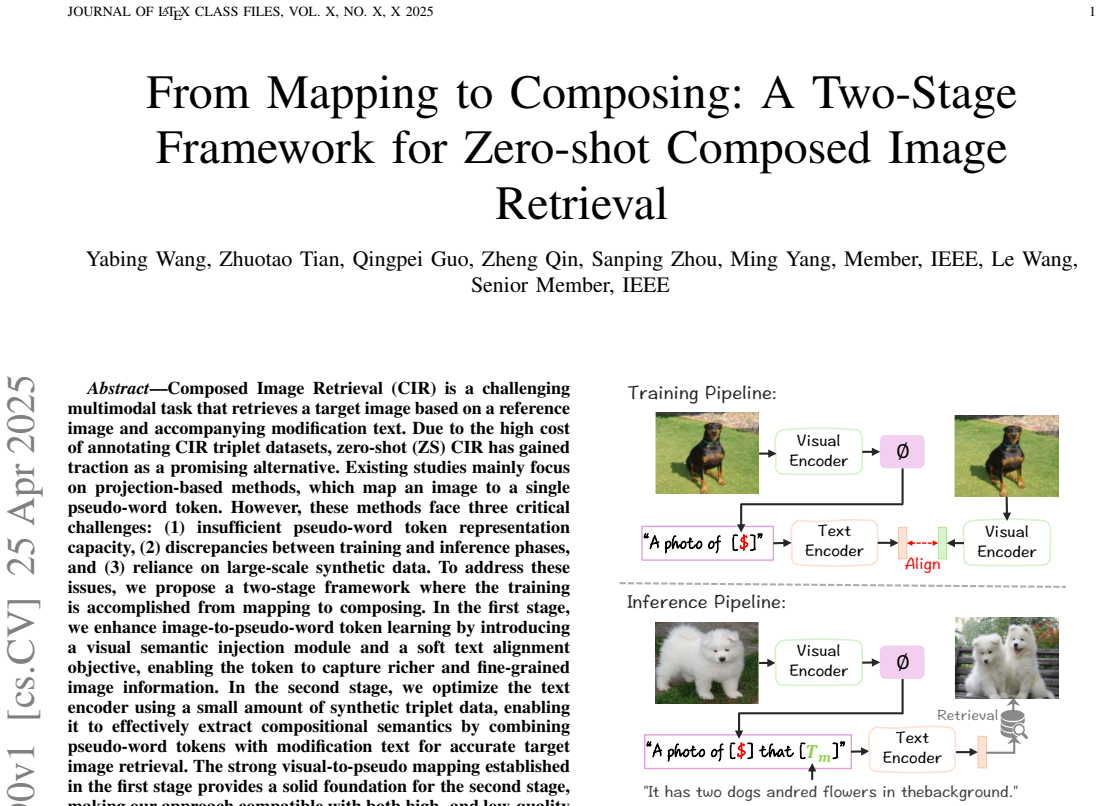
The load-bearing mechanism is the separation of mapping from composing. Stage I uses a Visual Semantic Injection (VSI) module—cross-attention layers that inject projected image patch features into the pseudo-word token inside the CLIP text encoder—plus a soft text alignment loss that pushes the pseudo-word's text features toward caption features according to a similarity distribution. Stage II freezes the backbone and adds lightweight composing adapters (two MLPs with residual connections, about 1M parameters) so the text encoder can combine the pseudo-word with modification text, trained with contrastive losses and a hard-negative strategy that interpolates target features with top-k distractors. The design keeps visual information concentrated in the pseudo-word token rather than flooding all words, which the ablations show is critical.
What would settle it
Run a near-duplicate or exact-duplicate image search between the Laion-CIR synthetic training set (and the sampled SynTriplets18M subset) and the CIRCO, CIRR, and Fashion-IQ evaluation images. If even a small percentage of training reference/target images match evaluation query/target images, the Stage-II margins—e.g., CIRCO mAP@5 rising from 15.05 to 18.37—can be explained by memorized identity; if no matching pairs are found, the compositional interpretation survives.
Extended reading notes
Core claim
The paper's central claim is that its two-stage framework, TSCIR, reaches state-of-the-art zero-shot composed image retrieval on Fashion-IQ, CIRR, and CIRCO, including CIRCO mAP@5 of 18.37 against 15.05 for the strongest prior method and Fashion-IQ average recall@10 of 31.88 against 30.61 for the fully fine-tuned TransAgg baseline. Even without Stage II, its Stage I mapping already outperforms all non-synthetic baselines and rivals methods trained on large synthetic sets. Using the same 32K synthetic triplets as TransAgg, TSCIR beats it by roughly 11.6% relative average recall on Fashion-IQ, and it stays competitive with methods using far larger synthetic corpora. The authors attribute this to a pseudo-word token that carries richer visual semantics plus a text encoder explicitly tuned to compose that token with real words.
Load-bearing premise
The central load-bearing premise is that the 32K synthetic Laion-CIR triplets used in Stage II do not materially overlap with the evaluation images; the paper verifies training/evaluation disjointness only for CC3M in Stage I, so if Laion-CIR contains near-duplicates of CIRCO/COCO images, the reported Stage-II gains could be identity retrieval rather than compositional understanding.
Editorial extensions
If this is right
- With the same 32K synthetic triplets as TransAgg, TSCIR reports about 11.6% relative improvement in average recall on Fashion-IQ, so synthetic-data efficiency is a direct corollary rather than a side effect.
- Stage I alone beats every non-synthetic baseline on all three benchmarks, implying the mapping stage is independently valuable even when no synthetic triplets are available.
- Adding Stage II to Stage I improves results on Fashion-IQ, CIRR, and CIRCO, so the two objectives are complementary rather than redundant.
- Because the same framework gains from both diffusion-generated SynTriplets18M and retrieval-based Laion-CIR, the approach does not depend on one particular synthetic-data quality level.
Reading between the lines
- A testable extension: if the two-stage separation is the operative factor, replacing CC3M with any domain-matched image-caption set in Stage I should transfer TSCIR to new retrieval domains with no triplet annotations.
- The hard-negative mixup strategy is not limited to CIR; it could be isolated and tested in other metric-learning settings where hard negatives are rare.
- The authors' implicit claim that pseudo-word quality, not composition machinery, drives most of the gain should be probed by scaling the backbone: ablations with ViT-H improve over ViT-L, so tests at larger scale would show whether composition learning grows with capacity.
- The CIRCO numbers deserve an overlap audit before use in leaderboards, since CIRCO is built from COCO while Laion-CIR is web-harvested from a large corpus that contains COCO-derived images.
Signed reviews
Editorial analysis
A structured set of objections, weighed in public.
Referee Report
Summary. The paper proposes TSCIR, a two-stage zero-shot composed image retrieval framework. Stage I trains an image-to-pseudo-word mapping on CC3M using a visual semantic injection (VSI) module and a soft text alignment loss; Stage II uses roughly 32K synthetic triplets (Laion-CIR from TransAgg) to train lightweight composing adapters and a hard-negative interpolation loss while freezing the backbone. The method reports state-of-the-art results on Fashion-IQ, CIRR, and CIRCO, with ablations showing that each component contributes and that Stage I alone is competitive with methods trained on large-scale synthetic data.
Significance. The central idea—decoupling mapping from composing and showing that Stage II needs only a small amount of synthetic data—is timely and, if the results are clean, would be a useful step for zero-shot CIR. The paper's strengths include systematic ablations (Tables IV–VIII) that support the incremental contribution of VSI, soft text alignment, adapters, and hard negatives, and the use of public benchmarks and public synthetic data, which aids reproducibility. However, the headline numbers depend on data hygiene and on a few technical statements that need correction; these issues must be resolved before the state-of-the-art claim can be accepted.
major comments (4)
- [Section IV-A / Table III] The paper states in Section IV-A that CC3M has 'no overlap with the evaluation datasets,' but it does not report a similar check for the Laion-CIR synthetic triplets used in Stage II. Because CIRCO is built from COCO images and LAION is a web-scale crawl likely to contain COCO images, the Stage II CIRCO gains (Table III: mAP@5 from 14.79 to 18.37, mAP@50 from 19.00 to 22.71) could partly reflect retrieval of training images by identity rather than compositional understanding. Please add exact/near-duplicate overlap statistics between the Laion-CIR training images and the CIRR/CIRCO/Fashion-IQ galleries, and either retrain on the non-overlapping subset or show that removing overlaps does not change the conclusions.
- [Section III-A, Eqs. (10)–(12)] The soft text alignment loss is not well defined as written. Equation (10) defines P as a negative batch-averaged scalar softmax value, and Eq. (11) similarly defines Q, so P and Q are negative scalars, not probability distributions; the KL divergence in Eq. (12) is therefore undefined. Please rewrite the loss as a per-sample KL between per-sample softmax distributions P_i and Q_i (presumably P_i = exp(τ vg_i^T cg_i)/Σ_j exp(τ vg_i^T cg_j) and Q_i = exp(τ sg_i^T cg_i)/Σ_j exp(τ sg_i^T cg_j), averaged over i), and verify that the reported implementation matches this corrected form.
- [Section IV-C / Table I] The text in Section IV-C says the method 'consistently achieves superior results across multiple benchmarks,' but Table I shows CompoDiff (18.8M synthetic triplets) reports FashionIQ Avg R@10 = 36.02, above TSCIR-32K's 31.88, even though TSCIR has higher R@50. Please report the missing per-category numbers for CompoDiff, or qualify the comparison to the specific metrics/categories where the claim holds. The abstract's 'superior performance compared to existing approaches' should be made precise.
- [Section III-B, Eqs. (21)–(22)] The hard-negative interpolation in Eqs. (21)–(22) does not state that the ground-truth target t_gt is excluded from the top-k candidate set T. If t_gt is among the top-k, then its similarity with itself yields β=1 by Eq. (22), so the generated 'negative' equals the positive target. Please state explicitly that t_gt is removed from T before computing the mixing weights, or revise the formula to guarantee that generated negatives are distinct from the positive.
minor comments (5)
- [Section IV-B / Table VIII] The text says the adapter configuration is placed at positions {2,4,6,8,10}, but Table VIII only reports {2,4,6,8,10,12}; the text and the table should be aligned.
- [Section IV-A / Table III caption] There are typos: 'FishionIQ' in Section IV-A and Figure 4 should be 'FashionIQ', and 'Synthetic daa' in the Table III caption should be 'Synthetic data'.
- [Section III-B, Eq. (19)] Equation (19) uses h_g without defining it; please clarify whether h_g is the final adapted composed text feature and how it relates to z_c^g in Eq. (14).
- [Section IV-B] The phrase 'text encoder with the V A' appears to be a typo for 'text encoder with VSI and CA'.
- [Figure 3 caption] The caption says 'visual semantic inject module'; this should be 'visual semantic injection module'.
Circularity Check
No circular construction found; the method is trained and evaluated against external benchmarks and public synthetic triplets.
full rationale
The paper's derivation chain is not circular. The central claim is that the two-stage TSCIR framework outperforms prior zero-shot CIR methods on Fashion-IQ, CIRR, and CIRCO; these are external benchmarks with public test annotations, so the reported numbers are not generated by the paper's own definitions. Stage I is trained on CC3M image-caption pairs with contrastive loss (Eq. 8) and a soft text-alignment KL objective (Eqs. 10-12); Stage II trains lightweight adapters using public synthetic triplets from TransAgg (Laion-CIR, 32K triplets) with contrastive loss (Eq. 19) and feature-interpolation hard negatives (Eqs. 21-22). No fitted parameter is renamed as a prediction, and no equation defines a purported output in terms of the benchmark metric being reported. Hyperparameters such as alpha and k are tuned on validation performance, which is normal empirical practice, not a circular reduction. Self-citations in the reference list are confined to related-work background and do not carry the load-bearing argument; there is no invoked uniqueness theorem and no ansatz smuggled in through a same-author citation. The one serious caveat is data hygiene rather than circularity: Section IV-A states that CC3M has 'no overlap with the evaluation datasets' but does not verify that the Laion-CIR synthetic triplets used in Stage II are disjoint from CIRCO's COCO-derived gallery. Since CIRCO is built from COCO images and LAION is a web-scale crawl, an undetected overlap could inflate the Stage II CIRCO gains (e.g., mAP@5 rising from 14.79 to 18.37) through image-identity leakage. That is a testable correctness and benchmark-integrity risk, but it is not a self-referential construction: the claimed improvement would still be an empirical result, flawed only if the training gallery contains test identities. The equations and training objectives are self-contained, and the predictions are compared against independent baselines. Therefore the circularity score is 0.
Assumptions & free parameters
free parameters (6)
- Temperature tau =
0.05 (Stage I), 0.07 (Stage II)
- Loss weight alpha =
0.2
- Top-k candidates k =
20
- VSI injection layers =
{5, 8, 11}
- Composing adapter positions =
{2, 4, 6, 8, 10, 12}
- Adapter dimensionality =
128
assumptions (4)
- domain assumption CLIP ViT-L/14 provides a shared embedding space in which a pseudo-word token can represent image semantics and combine with natural language.
- domain assumption CC3M has no overlap with the evaluation datasets Fashion-IQ, CIRR, and CIRCO.
- domain assumption The Laion-CIR synthetic triplets used in Stage II have no material overlap with the evaluation datasets.
- domain assumption Rank-based recall and mAP metrics are valid proxies for compositional retrieval quality.
invented entities (2)
-
Visual Semantic Injection (VSI) module
independent evidence
-
Composing Adapter (CA)
independent evidence
Cite this review
Pith. "Pith review of From Mapping to Composing: A Two-Stage Framework for Zero-shot Composed Image Retrieval." pith.science (2026). https://pith.science/paper/LKUKKTRC
@misc{pith2026250417990,
  author       = {Pith},
  title        = {Pith review of: From Mapping to Composing: A Two-Stage Framework for Zero-shot Composed Image Retrieval},
  year         = {2026},
  howpublished = {\url{https://pith.science/paper/LKUKKTRC}},
  note         = {Machine review of arXiv:2504.17990}
}
read the original abstract
Composed Image Retrieval (CIR) is a challenging multimodal task that retrieves a target image based on a reference image and accompanying modification text. Due to the high cost of annotating CIR triplet datasets, zero-shot (ZS) CIR has gained traction as a promising alternative. Existing studies mainly focus on projection-based methods, which map an image to a single pseudo-word token. However, these methods face three critical challenges: (1) insufficient pseudo-word token representation capacity, (2) discrepancies between training and inference phases, and (3) reliance on large-scale synthetic data. To address these issues, we propose a two-stage framework where the training is accomplished from mapping to composing. In the first stage, we enhance image-to-pseudo-word token learning by introducing a visual semantic injection module and a soft text alignment objective, enabling the token to capture richer and fine-grained image information. In the second stage, we optimize the text encoder using a small amount of synthetic triplet data, enabling it to effectively extract compositional semantics by combining pseudo-word tokens with modification text for accurate target image retrieval. The strong visual-to-pseudo mapping established in the first stage provides a solid foundation for the second stage, making our approach compatible with both high- and low-quality synthetic data, and capable of achieving significant performance gains with only a small amount of synthetic data. Extensive experiments were conducted on three public datasets, achieving superior performance compared to existing approaches.
Figures


Figures from the paper (2 more)


Reference graph
Works this paper leans on
-
[1]
Cross-domain diffusion with progressive alignment for efficient adaptive retrieval,
J. Luo, Y . Zhao, X. Luo, Z. Xiao, W. Ju, L. Shen, D. Tao, and M. Zhang, “Cross-domain diffusion with progressive alignment for efficient adaptive retrieval,” IEEE Transactions on Image Processing , 2025
work page 2025
-
[2]
Dual-view curricular optimal transport for cross-lingual cross-modal retrieval,
Y . Wang, S. Wang, H. Luo, J. Dong, F. Wang, M. Han, X. Wang, and M. Wang, “Dual-view curricular optimal transport for cross-lingual cross-modal retrieval,” IEEE Transactions on Image Processing, vol. 33, pp. 1522–1533, 2024
2024
-
[3]
Reading-strategy inspired visual representation learning for text-to- video retrieval,
J. Dong, Y . Wang, X. Chen, X. Qu, X. Li, Y . He, and X. Wang, “Reading-strategy inspired visual representation learning for text-to- video retrieval,” IEEE Transactions on Circuits and Systems for Video Technology, 2022
work page 2022
-
[4]
Semantics disentangling for cross-modal retrieval,
Z. Wang, X. Xu, J. Wei, N. Xie, Y . Yang, and H. T. Shen, “Semantics disentangling for cross-modal retrieval,” IEEE Transactions on image processing, vol. 33, pp. 2226–2237, 2024
work page 2024
-
[5]
Cross-modal retrieval with noisy correspondence via consistency refining and mining,
X. Ma, M. Yang, Y . Li, P. Hu, J. Lv, and X. Peng, “Cross-modal retrieval with noisy correspondence via consistency refining and mining,” IEEE transactions on image processing , 2024
work page 2024
-
[6]
Efficient token-guided image-text retrieval with consistent multimodal contrastive training,
C. Liu, Y . Zhang, H. Wang, W. Chen, F. Wang, Y . Huang, Y .-D. Shen, and L. Wang, “Efficient token-guided image-text retrieval with consistent multimodal contrastive training,”IEEE Transactions on Image Processing, vol. 32, pp. 3622–3633, 2023
work page 2023
-
[7]
Target-guided com- posed image retrieval,
H. Wen, X. Zhang, X. Song, Y . Wei, and L. Nie, “Target-guided com- posed image retrieval,” in Proceedings of the 31st ACM International Conference on Multimedia , 2023, pp. 915–923
work page 2023
-
[8]
Dynamic weighted combiner for mixed-modal image retrieval,
F. Huang, L. Zhang, X. Fu, and S. Song, “Dynamic weighted combiner for mixed-modal image retrieval,” in Proceedings of the AAAI Confer- ence on Artificial Intelligence , vol. 38, no. 3, 2024, pp. 2303–2311
work page 2024
Show all 43 references
-
[9]
Covr: Learning composed video retrieval from web video captions,
L. Ventura, A. Yang, C. Schmid, and G. Varol, “Covr: Learning composed video retrieval from web video captions,” in Proceedings of the AAAI Conference on Artificial Intelligence , vol. 38, no. 6, 2024, pp. 5270–5279
2024
-
[10]
Conceptual captions: A cleaned, hypernymed, image alt-text dataset for automatic image cap- tioning,
P. Sharma, N. Ding, S. Goodman, and R. Soricut, “Conceptual captions: A cleaned, hypernymed, image alt-text dataset for automatic image cap- tioning,” in Proceedings of the 56th Annual Meeting of the Association for Computational Linguistics (Volume 1: Long Papers), 2018, pp. ...
2018
-
[11]
Pic2word: Mapping pictures to words for zero-shot com- posed image retrieval,
K. Saito, K. Sohn, X. Zhang, C.-L. Li, C.-Y . Lee, K. Saenko, and T. Pfister, “Pic2word: Mapping pictures to words for zero-shot com- posed image retrieval,” in Proceedings of the IEEE/CVF Conference on Computer Vision and Pattern Recognition , 2023, pp. 19 305–19 314
2023
-
[12]
Context- i2w: Mapping images to context-dependent words for accurate zero-shot composed image retrieval,
Y . Tang, J. Yu, K. Gai, J. Zhuang, G. Xiong, Y . Hu, and Q. Wu, “Context- i2w: Mapping images to context-dependent words for accurate zero-shot composed image retrieval,” in Proceedings of the AAAI Conference on Artificial Intelligence, vol. 38, no. 6, 2024, pp. 5180–5188
2024
-
[13]
Language-only training of zero-shot composed image retrieval,
G. Gu, S. Chun, W. Kim, Y . Kang, and S. Yun, “Language-only training of zero-shot composed image retrieval,” inProceedings of the IEEE/CVF Conference on Computer Vision and Pattern Recognition , 2024, pp. 13 225–13 234
2024
-
[14]
Hycir: Boosting zero- shot composed image retrieval with synthetic labels,
Y . Jiang, H. Jia, X. Wang, and P. Hao, “Hycir: Boosting zero- shot composed image retrieval with synthetic labels,” arXiv preprint arXiv:2407.05795, 2024
2024 arXiv
-
[15]
Learning transferable visual models from natural language supervision,
A. Radford, J. W. Kim, C. Hallacy, A. Ramesh, G. Goh, S. Agarwal, G. Sastry, A. Askell, P. Mishkin, J. Clark et al., “Learning transferable visual models from natural language supervision,” in International conference on machine learning . PMLR, 2021, pp. 8748–8763
2021
-
[16]
Image2sentence based asymmetrical zero-shot composed image retrieval,
Y . Du, M. Wang, W. Zhou, S. Hui, and H. Li, “Image2sentence based asymmetrical zero-shot composed image retrieval,” arXiv preprint arXiv:2403.01431, 2024
2024 arXiv
-
[17]
Spherical linear interpolation and text-anchoring for zero-shot composed image retrieval,
Y . K. Jang, D. Huynh, A. Shah, W.-K. Chen, and S.-N. Lim, “Spherical linear interpolation and text-anchoring for zero-shot composed image retrieval,” in European Conference on Computer Vision. Springer, 2025, pp. 239–254
2025
-
[18]
Compodiff: Versatile composed image retrieval with latent diffusion,
G. Gu, S. Chun, W. Kim, H. Jun, Y . Kang, and S. Yun, “Compodiff: Versatile composed image retrieval with latent diffusion,” Transactions on Machine Learning Research , 2024, expert Certification. [Online]. Available: https://openreview.net/forum?id=mKtlzW0bWc
2024
-
[19]
Fine-grained textual inversion network for zero-shot composed image retrieval,
H. Lin, H. Wen, X. Song, M. Liu, Y . Hu, and L. Nie, “Fine-grained textual inversion network for zero-shot composed image retrieval,” in Proceedings of the 47th International ACM SIGIR Conference on Research and Development in Information Retrieval , 2024, pp. 240– 250
2024
-
[20]
Reducing task discrepancy of text encoders for zero-shot composed image retrieval,
J. Byun, S. Jeong, W. Kim, S. Chun, and T. Moon, “Reducing task discrepancy of text encoders for zero-shot composed image retrieval,” arXiv preprint arXiv:2406.09188 , 2024
2024 arXiv
-
[21]
Fashion iq: A new dataset towards retrieving images by natural language feedback,
H. Wu, Y . Gao, X. Guo, Z. Al-Halah, S. Rennie, K. Grauman, and R. Feris, “Fashion iq: A new dataset towards retrieving images by natural language feedback,” in Proceedings of the IEEE/CVF Conference on computer vision and pattern recognition , 2021, pp. 11 307–11 317
2021
-
[22]
Image retrieval on real-life images with pre-trained vision-and-language models,
Z. Liu, C. Rodriguez-Opazo, D. Teney, and S. Gould, “Image retrieval on real-life images with pre-trained vision-and-language models,” in Proceedings of the IEEE/CVF International Conference on Computer Vision, 2021, pp. 2125–2134
2021
-
[23]
Zero-shot composed image retrieval with textual inversion,
A. Baldrati, L. Agnolucci, M. Bertini, and A. Del Bimbo, “Zero-shot composed image retrieval with textual inversion,” in Proceedings of the IEEE/CVF International Conference on Computer Vision , 2023, pp. 15 338–15 347
2023
-
[24]
Cross- lingual cross-modal retrieval with noise-robust learning,
Y . Wang, J. Dong, T. Liang, M. Zhang, R. Cai, and X. Wang, “Cross- lingual cross-modal retrieval with noise-robust learning,” in Proceedings of the 30th ACM International Conference on Multimedia , 2022, pp. 422–433
2022
-
[25]
Cl2cm: Improving cross- lingual cross-modal retrieval via cross-lingual knowledge transfer,
Y . Wang, F. Wang, J. Dong, and H. Luo, “Cl2cm: Improving cross- lingual cross-modal retrieval via cross-lingual knowledge transfer,” in Proceedings of the AAAI Conference on Artificial Intelligence , vol. 38, no. 6, 2024, pp. 5651–5659
2024
-
[26]
Multimodal llm enhanced cross-lingual cross-modal retrieval,
Y . Wang, L. Wang, Q. Zhou, Z. Wang, H. Li, G. Hua, and W. Tang, “Multimodal llm enhanced cross-lingual cross-modal retrieval,” in Pro- ceedings of the 32nd ACM International Conference on Multimedia , 2024, pp. 8296–8305
2024
-
[27]
Cross-lingual cross-modal retrieval with noise-robust fine- tuning,
R. Cai, J. Dong, T. Liang, Y . Liang, Y . Wang, X. Yang, X. Wang, and M. Wang, “Cross-lingual cross-modal retrieval with noise-robust fine- tuning,” IEEE Transactions on Knowledge and Data Engineering , 2024
2024
-
[28]
Revealing security flaws in cross- modal retrieval models through video poisoning,
M. Jin, W. Hu, R. Hong, and L. Zhu, “Revealing security flaws in cross- modal retrieval models through video poisoning,” IEEE Transactions on Circuits and Systems for Video Technology , 2025
2025
-
[29]
Deep reversible consistency learning for cross-modal retrieval,
R. Pu, Y . Qin, D. Peng, X. Song, and H. Zheng, “Deep reversible consistency learning for cross-modal retrieval,” IEEE Transactions on Multimedia, 2025. JOURNAL OF LATEX CLASS FILES, VOL. X, NO. X, X 2025 10
2025
-
[30]
A large cross-modal video retrieval dataset with reading comprehension,
W. Wu, Y . Zhao, Z. Li, J. Li, H. Zhou, M. Z. Shou, and X. Bai, “A large cross-modal video retrieval dataset with reading comprehension,” Pattern Recognition, vol. 157, p. 110818, 2025
2025
-
[31]
Sda: Semantic discrepancy alignment for text-conditioned image retrieval,
Y . Yang, Y . Wang, and Y . Wang, “Sda: Semantic discrepancy alignment for text-conditioned image retrieval,” in Findings of the Association for Computational Linguistics ACL 2024 , 2024, pp. 5250–5261
2024
-
[32]
Improving composed image retrieval via contrastive learning with scaling positives and negatives,
Z. Feng, R. Zhang, and Z. Nie, “Improving composed image retrieval via contrastive learning with scaling positives and negatives,” inProceedings of the 32nd ACM International Conference on Multimedia , 2024, pp. 1632–1641
2024
-
[33]
Progressive learning for image retrieval with hybrid-modality queries,
Y . Zhao, Y . Song, and Q. Jin, “Progressive learning for image retrieval with hybrid-modality queries,” in Proceedings of the 45th International ACM SIGIR Conference on Research and Development in Information Retrieval, 2022, pp. 1012–1021
2022
-
[34]
Conditioned and composed image retrieval combining and partially fine-tuning clip- based features,
A. Baldrati, M. Bertini, T. Uricchio, and A. Del Bimbo, “Conditioned and composed image retrieval combining and partially fine-tuning clip- based features,” in Proceedings of the IEEE/CVF Conference on Com- puter Vision and Pattern Recognition , 2022, pp. 4959–4968
2022
-
[35]
Composing text and image for image retrieval - an empirical odyssey,
N. V o, L. Jiang, C. Sun, K. Murphy, L.-J. Li, L. Fei-Fei, and J. Hays, “Composing text and image for image retrieval - an empirical odyssey,” in 2019 IEEE/CVF Conference on Computer Vision and Pattern Recognition (CVPR) , Jun 2019. [Online]. Available: http://dx.doi.org/10.11...
2019
-
[36]
Cala: Complementary association learning for augmenting comoposed image retrieval,
X. Jiang, Y . Wang, M. Li, Y . Wu, B. Hu, and X. Qian, “Cala: Complementary association learning for augmenting comoposed image retrieval,” in Proceedings of the 47th International ACM SIGIR Confer- ence on Research and Development in Information Retrieval , 2024, pp. 2177–2187
2024
-
[37]
Ldre: Llm-based diver- gent reasoning and ensemble for zero-shot composed image retrieval,
Z. Yang, D. Xue, S. Qian, W. Dong, and C. Xu, “Ldre: Llm-based diver- gent reasoning and ensemble for zero-shot composed image retrieval,” in Proceedings of the 47th International ACM SIGIR Conference on Research and Development in Information Retrieval , 2024, pp. 80–90
2024
-
[38]
Training-free zero-shot composed image retrieval with local concept reranking,
S. Sun, F. Ye, and S. Gong, “Training-free zero-shot composed image retrieval with local concept reranking,”arXiv preprint arXiv:2312.08924, 2023
2023 arXiv
-
[39]
Seman- tic editing increment benefits zero-shot composed image retrieval,
Z. Yang, S. Qian, D. Xue, J. Wu, F. Yang, W. Dong, and C. Xu, “Seman- tic editing increment benefits zero-shot composed image retrieval,” in Proceedings of the 32nd ACM International Conference on Multimedia , 2024, pp. 1245–1254
2024
-
[40]
Zero-shot composed image retrieval considering query-target relationship leverag- ing masked image-text pairs,
H. Zhang, R. Yanagi, R. Togo, T. Ogawa, and M. Haseyama, “Zero-shot composed image retrieval considering query-target relationship leverag- ing masked image-text pairs,” in 2024 IEEE International Conference on Image Processing (ICIP) . IEEE, 2024, pp. 2431–2437
2024
-
[41]
Zero-shot composed text-image retrieval,
Y . Liu, J. Yao, Y . Zhang, Y . Wang, and W. Xie, “Zero-shot composed text-image retrieval,” arXiv preprint arXiv:2306.07272 , 2023
2023 arXiv
-
[42]
A corpus for reasoning about natural language grounded in photographs,
A. Suhr, S. Zhou, A. Zhang, I. Zhang, H. Bai, and Y . Artzi, “A corpus for reasoning about natural language grounded in photographs,” arXiv preprint arXiv:1811.00491, 2018
2018 arXiv
-
[43]
Knowledge-enhanced dual-stream zero-shot composed image retrieval,
Y . Suo, F. Ma, L. Zhu, and Y . Yang, “Knowledge-enhanced dual-stream zero-shot composed image retrieval,” in Proceedings of the IEEE/CVF Conference on Computer Vision and Pattern Recognition , 2024, pp. 26 951–26 962
2024
Reviewed August 16, 2026 · model on record in the stance chip above.
Discussion (0). Continue with ORCID to comment.