REVIEW 4 major objections 6 minor 27 references
Addressing Concept Mislabeling in Concept Bottleneck Models Through Preference Optimization
T0 review · 4 major / 6 minor · reviewed 2026-08-16 · deepseek-v4-flash
Pith's one-line read A preference-optimization training loss makes concept bottleneck models robust to mislabeled concepts.
desk verdict CPO is a genuinely new, DPO-style loss for concept bottleneck training with consistent empirical gains, but the proof that it is inherently noise-robust has a real gradient-derivation gap and the main comparison is confounded by RandInt. read the letter →
The pith
A machine-rendered reading of the paper's core claim, the machinery that carries it, and where it could break.
The reading
What carries the argument
The central object is the CPO loss (Eq. 5), an online Direct Preference Optimization objective in which the empirical concept $c$ is treated as preferred over a concept $c'\sim\pi_\theta$ sampled from the current policy, with the reward reparameterized as the log-ratio of the policy to a prior. Under a uniform prior this becomes a log-likelihood term that contributes a gradient only when $c'\neq c$, so the model updates only when it disagrees with the label, the mechanism that gives CPO its conservative, noise-attenuating updates. The supporting machinery is a control-as-inference identity: introducing an optimality variable $o$ with $p(o=1|x,c)=\exp(r^*(x,c))$ yields the posterior $\pi(c|o=1,x)\propto \pi_0(c|x)\exp(\beta^{-1}r^*(x,c))$, showing that optimizing Eq. 1 (and hence Eq. 5) directly approximates the concept posterior. This is what distinguishes CPO from BCE and from probabilistic CBM variants that amortize a latent variable's posterior instead.
What would settle it
Train a logistic concept predictor on a single binary concept with noisy labels and compute the exact expected update of the CPO loss, including the case where the sampled concept equals the empirical one. At model confidence 0.1, if this update has larger norm than the BCE update, the bound in Proposition 4.2 is violated.
Extended reading notes
Core claim
The paper's central claim is that the CPO objective, defined as $-E_{(x,c)\sim\mu,\,c'\sim\pi_\theta}[\log\sigma(\log(\pi_\theta(c|x)/\pi_0(c|x))-\log(\pi_\theta(c'|x)/\pi_0(c'|x)))]$, replaces the BCE concept loss in a CBM and directly optimizes the concept posterior rather than merely fitting noisy empirical labels. With a uniform prior, the loss is proportional to $-\log \pi_\theta(c|x)$ whenever the policy-sampled concept $c'$ differs from the empirical concept $c$, and a constant otherwise, so CPO's expected gradient is BCE's gradient weighted by the model's confidence $(1-\pi_\theta(c|x))$. The paper proves that this expected gradient norm is bounded by BCE's and that, under a fixed level of label noise, CPO's gradient stays closer to the noise-free gradient than BCE's does. It also shows, through a control-as-inference optimality variable, that optimizing this objective is equivalent to amortizing the posterior $\pi(c|o=1,x)$, which explains the improved uncertainty estimates and intervention behavior. The empirical section reports that CPO consistently improves task accuracy and concept AUC over BCE on CUB, AwA2, and CelebA with and without added noise, including at 40% concept-flip rates.
Load-bearing premise
The proof that CPO is always less sensitive to noise ignores part of the update from cases where the model's random choice matches the label; when the model is uncertain, the ignored part can make CPO's update larger than BCE's, so the guaranteed robustness bound does not always hold.
Editorial extensions
If this is right
- On clean data, CPO improves CBM task accuracy on CUB from 0.753 to 0.800 and concept AUC from 0.937 to 0.952, with no added parameters and roughly 0.05 extra minutes per epoch.
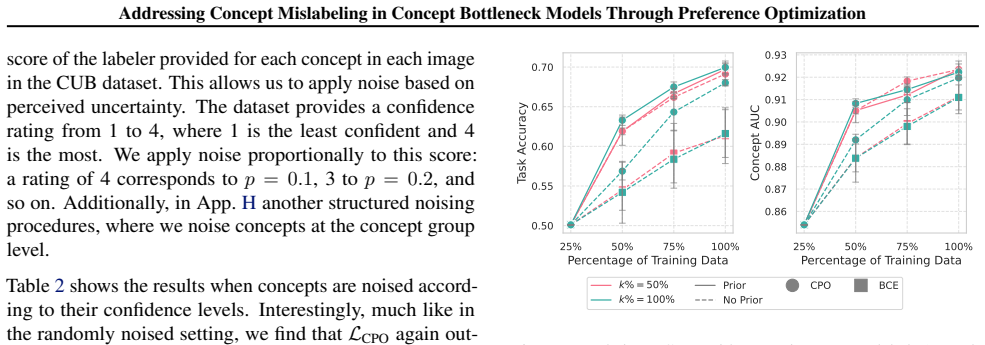
- Under random concept-label flips at rates up to 40%, CPO-trained CBMs are the least affected models on CUB, AwA2, and CelebA, and at 40% noise they can still outperform more complex BCE-trained baselines.
- CPO-trained models retain their intervenability under noise, with interventions ordered by CPO's uncertainty estimates improving task accuracy faster than BCE or ProbCBM interventions.
- CPO with a non-uniform prior can update a CBM from streaming concept labels without drifting from the joint-trained policy, outperforming BCE-based streaming updates.
- CPO's uncertainty estimates respond to occlusion: uncertainty rises when the target object is blocked, whereas BCE-trained models tend to stay overconfident.
Reading between the lines
- The confidence-weighted gradient suggests CPO should also dampen the effect of augmentation-induced concept corruption; a head-to-head comparison of no-augmentation versus random-crop training would isolate this mechanism from label-flip noise.
- Because the proof's robustness guarantee omits a parameter-dependent term, CPO's advantage may shrink precisely when the model is least confident; annealing the prior strength $\beta$ during training is a natural testable fix.
- The same preference-over-labels construction could extend to structured annotator disagreement in medical or clinical concept labeling, where noise is correlated rather than random flips.
- CPO's posterior-amortization view suggests it could replace the likelihood term in probabilistic CBM variants, yielding calibrated uncertainty without needing a latent variable bottleneck.
Signed reviews
Editorial analysis
A structured set of objections, weighed in public.
Referee Report
Summary. The paper introduces Concept Preference Optimization (CPO), a DPO-style loss for training Concept Bottleneck Models, and claims that CPO directly optimizes the concept posterior, is inherently less sensitive to concept-label noise than binary cross-entropy (BCE), and consistently outperforms BCE on CUB, AwA2, and CelebA with and without added noise. The theoretical component derives simplified forms of the CPO objective, a gradient bound relative to BCE, and a theorem about noise robustness; the empirical component compares CPO-trained CBMs and CEMs against BCE-trained baselines and ProbCBMs on task accuracy, concept AUC, intervention performance, uncertainty quantification, and noisy-label settings. The paper also includes a streaming-data experiment and releases code.
Significance. If the central claims were established, CPO would be a valuable, low-overhead drop-in loss for CBMs: it requires no extra parameters, adds modest compute, and appears to improve task accuracy and intervention behavior. The paper has concrete strengths: it ships code, evaluates across three datasets and several architectures, probes structured and uniform noise, includes an uncertainty study, and connects the loss to control-as-inference, which is a useful pedagogical framing. However, the central theoretical claim that CPO is 'inherently less sensitive' to concept noise rests on a gradient derivation that drops a theta-dependent term, and the headline empirical comparison is potentially confounded by the use of RandInt augmentation for CPO-trained models but not for the standard BCE baseline. The significance is therefore conditional on repairing the proof and deconfounding the experiments.
major comments (4)
- [Sec. 4.2 / App. C.1, Eqs. (25)-(26), Prop. 4.2] This comment is complete.
- [Prop. 4.1 / App. C.1, Eq. (6)] This comment is complete.
- [Sec. 4.2 / App. C.2, Theorem 4.3] This comment is complete.
- [App. A.1 / Table 1 / Figs. 5-6] This comment is complete.
minor comments (6)
- [App. C.1, Eq. (11)] This comment is complete.
- [App. H, first paragraph] This comment is complete.
- [App. F.1] This comment is complete.
- [Table 1] This comment is complete.
- [App. A / App. I] This comment is complete.
- [Throughout] This comment is complete.
Circularity Check
No circularity: CPO is a direct DPO adaptation, and the posterior and noise-robustness claims rest on external derivations and empirical benchmarks rather than on fitted inputs or self-citation chains.
full rationale
The paper's central derivation chain is: Eq. (5) defines L_CPO by instantiating DPO's Eq. (4) with empirical concepts as preferred and policy-sampled concepts as dispreferred; Proposition 4.1 is an algebraic identity under a uniform prior; the gradient bound in Proposition 4.2 follows from the paper's own gradient formula; Theorem 4.3 applies that bound to noise; and the posterior interpretation invokes standard control-as-inference equivalences from Levine (2018), Haarnoja et al. (2017), and Korbak et al. (2022), none of which are self-citations. No fitted parameter is renamed as a prediction, no benchmark number is constructed from the paper's own fitted constants, and no uniqueness theorem from the authors' prior work is used to forbid alternatives. The apparent weakness in App. C.1—the c'=c event's probability pi_theta(c|x) is theta-dependent, so the exact expected gradient of Eq. (5) contains an additional term that can break Proposition 4.2 as stated—is a mathematical correctness issue in the derivation, not circularity: the theorem is not true by construction, it is simply unproven as written. The RandInt augmentation asymmetry between CPO and BCE baselines is an experimental confound, not a circular reduction. Therefore no circular step is established, and the score is 0.
Assumptions & free parameters
free parameters (4)
- beta (KL regularization coefficient in CPO) =
1 (fixed, not tuned)
- lambda (concept loss weight) =
tuned in {1,5,10}
- RandInt intervention probability =
25% for CPO/CEM, 50% for ProbCBM; not used for CBM BCE
- learning rate =
tuned per dataset (e.g., {0.1,0.01} for CUB/AwA2)
assumptions (5)
- domain assumption The empirical concept label c is always preferred to a policy-sampled concept c' (c ≻ c'), even when c is noisy.
- domain assumption Uniform prior pi_0(c|x) over concepts.
- domain assumption Conditional independence of concepts: c_i ⊥ c_j | x for i ≠ j.
- domain assumption Optimality variable framing: p(o=1|x,c)=exp(r*(x,c)) with r* ∈ (-infinity, 0].
- domain assumption Task labels y are always correct; only concept labels may be noisy.
Cite this review
Pith. "Pith review of Addressing Concept Mislabeling in Concept Bottleneck Models Through Preference Optimization." pith.science (2026). https://pith.science/paper/FEXKLCAS
@misc{pith2026250418026,
  author       = {Pith},
  title        = {Pith review of: Addressing Concept Mislabeling in Concept Bottleneck Models Through Preference Optimization},
  year         = {2026},
  howpublished = {\url{https://pith.science/paper/FEXKLCAS}},
  note         = {Machine review of arXiv:2504.18026}
}
read the original abstract
Concept Bottleneck Models (CBMs) propose to enhance the trustworthiness of AI systems by constraining their decisions on a set of human-understandable concepts. However, CBMs typically assume that datasets contain accurate concept labels-an assumption often violated in practice, which we show can significantly degrade performance (by 25% in some cases). To address this, we introduce the Concept Preference Optimization (CPO) objective, a new loss function based on Direct Preference Optimization, which effectively mitigates the negative impact of concept mislabeling on CBM performance. We provide an analysis of key properties of the CPO objective, showing it directly optimizes for the concept's posterior distribution, and contrast it against Binary Cross Entropy (BCE), demonstrating that CPO is inherently less sensitive to concept noise. We empirically confirm our analysis by finding that CPO consistently outperforms BCE on three real-world datasets, both with and without added label noise. We make our code available on Github.
Figures


Figures from the paper (12 more)




Reference graph
Works this paper leans on
-
[4]
In our setup, the optimal values for γ were found to be γ= 5 for CUB,γ= 10 for AwA2, andγ= 0.01 for CelebA. We observed negligible differences between Coop-CBM and standard CBMs in terms of base and intervention performance (see Figure 8), except for in AwA2 where it improves intervention performance but outperforms ProbCBM at higher number of interventio...
work page 2022
-
[5]
Kaufmann, T., Weng, P., Bengs, V ., and H¨ullermeier, E
URL https: //arxiv.org/abs/1611.01144. Kaufmann, T., Weng, P., Bengs, V ., and H¨ullermeier, E. A survey of reinforcement learning from human feedback,
-
[7]
URL https://arxiv.org/ abs/1312.6114. Koh, P. W., Nguyen, T., Tang, Y . S., Mussmann, S., Pierson, E., Kim, B., and Liang, P. Concept bottleneck models. InInternational Conference on Machine Learning, pp. 5338–5348. PMLR,
- [9]
-
[10]
URL https://doi.org/ 10.1145/1458082.1458092
1145/1458082.1458092. URL https://doi.org/ 10.1145/1458082.1458092. Rafailov, R., Sharma, A., Mitchell, E., Ermon, S., Manning, C. D., and Finn, C. Direct preference optimization: Your language model is secretly a reward model,
-
[11]
Ouyang, L., Wu, J., Jiang, X., Almeida, D., Wainwright, C. L., Mishkin, P., Zhang, C., Agarwal, S., Slama, K., Ray, A., Schulman, J., Hilton, J., Kelton, F., Miller, L., Simens, M., Askell, A., Welinder, P., Christiano, P., Leike, J., and Lowe, R. Training language models to follow instructions with human feedback, 2022a. Ouyang, L., Wu, J., Jiang, X., Al...
-
[12]
Performance metrics for all tasks across varying degrees of label noise. We find that across all noise levels,LCPO ourperforms all other models, including both joint and sequential ProbCBMs 21 Addressing Concept Mislabeling in Concept Bottleneck Models Through Preference Optimization G. Additional Analysis on Uncertainty In this Appendix, we provide a mor...
work page 2023
-
[13]
cc/paper_files/paper/2021/file/ 60ce36723c17bbac504f2ef4c8a46995-Paper
URL https://proceedings.neurips. cc/paper_files/paper/2021/file/ 60ce36723c17bbac504f2ef4c8a46995-Paper. pdf. Russakovsky, O., Deng, J., Su, H., Krause, J., Satheesh, S., Ma, S., Huang, Z., Karpathy, A., Khosla, A., Bernstein, M., Berg, A. C., and Fei-Fei, L. Imagenet large scale visual recognition challenge,
work page 2021
Show all 27 references
-
[14]
11 Addressing Concept Mislabeling in Concept Bottleneck Models Through Preference Optimization Schulman, J., Wolski, F., Dhariwal, P., Radford, A., and Klimov, O
URL https:// arxiv.org/abs/1409.0575. 11 Addressing Concept Mislabeling in Concept Bottleneck Models Through Preference Optimization Schulman, J., Wolski, F., Dhariwal, P., Radford, A., and Klimov, O. Proximal policy optimization algo- rithms,
-
[15]
Sheth, I
URL https://arxiv.org/abs/ 1707.06347. Sheth, I. and Ebrahimi Kahou, S. Auxiliary losses for learn- ing generalizable concept-based models.Advances in Neural Information Processing Systems, 36,
-
[16]
A closer look at the intervention procedure of concept bottleneck models
Shin, S., Jo, Y ., Ahn, S., and Lee, N. A closer look at the intervention procedure of concept bottleneck models. arXiv preprint arXiv:2302.14260,
-
[18]
Sylolypavan, A., Sleeman, D., Wu, H., and Sim, M
URL https://arxiv.org/abs/2402.10893. Sylolypavan, A., Sleeman, D., Wu, H., and Sim, M. The impact of inconsistent human annotations on ai driven clinical decision making.NPJ Digital Medicine, 6(1):26,
-
[19]
Vandenhirtz, M., Laguna, S., Marcinkeviˇcs, R., and V ogt, J
URL https: //arxiv.org/abs/2407.21783. Vandenhirtz, M., Laguna, S., Marcinkeviˇcs, R., and V ogt, J. E. Stochastic concept bottleneck models.arXiv preprint arXiv:2406.19272,
-
[20]
Caltech ucsd birds
Wah, C., Branson, S., Welinder, P., Perona, P., and Belongie, S. Caltech ucsd birds. Technical Report CNS-TR-2011- 001, California Institute of Technology,
2011
-
[22]
URL https://doi.org/ 10.1145/1553374.1553527
1145/1553374.1553527. URL https://doi.org/ 10.1145/1553374.1553527. Yuksekgonul, M., Wang, M., and Zou, J. Post-hoc con- cept bottleneck models. InICLR 2022 Workshop on PAIR2Struct: Privacy, Accountability, Interpretability, Robustness, Reasoning on Structured Data,
2022
-
[23]
Following standard procedures, we apply random cropping and flipping to a portion of the images during training
as the backbone image encoder kθ, pretrained on ImageNet-1k (Russakovsky et al., 2015). Following standard procedures, we apply random cropping and flipping to a portion of the images during training. This augmentation process may introduce non-zero noise levels, as some conce...
2022
-
[25]
The final dataset is composed of∼ 6,000 RGB images of dimension (3,299,299) , and split into a standard 70%-10%-20% train-validation-test split
and by randomly flipping and cropping some images during training. The final dataset is composed of∼ 6,000 RGB images of dimension (3,299,299) , and split into a standard 70%-10%-20% train-validation-test split. AwA2 (Xian et al., 2019).For AwA2 we use the same data processing...
2024
-
[2009]
Korbak, T., Perez, E., and Buckley, C
ISBN 0262013193. Korbak, T., Perez, E., and Buckley, C. L. Rl with kl penalties is better viewed as bayesian inference.arXiv preprint arXiv:2205.11275,
-
[2012]
Steinmann, D., Stammer, W., Friedrich, F., and Kersting, K
URL https:// arxiv.org/abs/1205.4213. Steinmann, D., Stammer, W., Friedrich, F., and Kersting, K. Learning to intervene on concept bottlenecks.arXiv preprint arXiv:2308.13453,
-
[2015]
Jang, E., Gu, S., and Poole, B
URL https:// arxiv.org/abs/1512.03385. Jang, E., Gu, S., and Poole, B. Categorical reparame- terization with gumbel-softmax,
-
[2017]
Havasi, M., Parbhoo, S., and Doshi-Velez, F
URLhttps://arxiv.org/abs/1702.08165. Havasi, M., Parbhoo, S., and Doshi-Velez, F. Addressing leakage in concept bottleneck models. InAdvances in Neural Information Processing Systems,
-
[2019]
Xu, X., Qin, Y ., Mi, L., Wang, H., and Li, X
doi: 10.1109/TPAMI.2018.2857768. Xu, X., Qin, Y ., Mi, L., Wang, H., and Li, X. Energy-based concept bottleneck models: unifying prediction, con- cept intervention, and conditional interpretations.arXiv preprint arXiv:2401.14142,
2018
-
[2020]
Our only departure from Koh et al
madeup of k= 112 concept annotations representing bird attributes (e.g., beak type, wing color) and use the bird class (m= 200 ) as the downstream task. Our only departure from Koh et al. (2020) is that we group the concepts into 28 semantic concept groups, following Espinosa ...
2020
-
[2021]
org/abs/1807.11398
URL https://arxiv. org/abs/1807.11398. Chauhan, K., Tiwari, R., Freyberg, J., Shenoy, P., and Dvi- jotham, K. Interactive concept bottleneck models.arXiv preprint arXiv:2212.07430,
-
[2022]
Goodfellow, I., Bengio, Y ., and Courville, A.Deep Learning
URL https://arxiv.org/abs/2103.06257. Goodfellow, I., Bengio, Y ., and Courville, A.Deep Learning. MIT Press,
-
[2023]
doi: 10.1609/aaai.v37i12
ISBN 978-1-57735-880-0. doi: 10.1609/aaai.v37i12. 26682. URL https://doi.org/10.1609/aaai. v37i12.26682. Marcinkeviˇcs, R., Laguna, S., Vandenhirtz, M., and V ogt, J. E. Beyond concept bottleneck models: How to make black boxes intervenable?arXiv preprint arXiv:2401.13544,
-
[2024]
Kingma, D
URL https: //arxiv.org/abs/2409.14630. Kingma, D. P. and Welling, M. Auto-encoding varia- tional bayes,
Reviewed August 16, 2026 · model on record in the stance chip above.
Discussion (0). Continue with ORCID to comment.