REVIEW 4 major objections 5 minor 40 references
STP4D: Spatio-Temporal-Prompt Consistent Modeling for Text-to-4D Gaussian Splatting
T0 review · 4 major / 5 minor · reviewed 2026-08-16 · deepseek-v4-flash
Pith's one-line read The paper claims a single end-to-end diffusion model can generate 4D Gaussian Splatting content from text in 4.6 seconds while beating prior methods on consistency metrics.
desk verdict STP4D is a genuinely fast diffusion-based 4D generator, but its quality lead over baselines is inflated because it trains on the same CLIP and FVD metrics it reports. read the letter →
The pith
A machine-rendered reading of the paper's core claim, the machinery that carries it, and where it could break.
The reading
What carries the argument
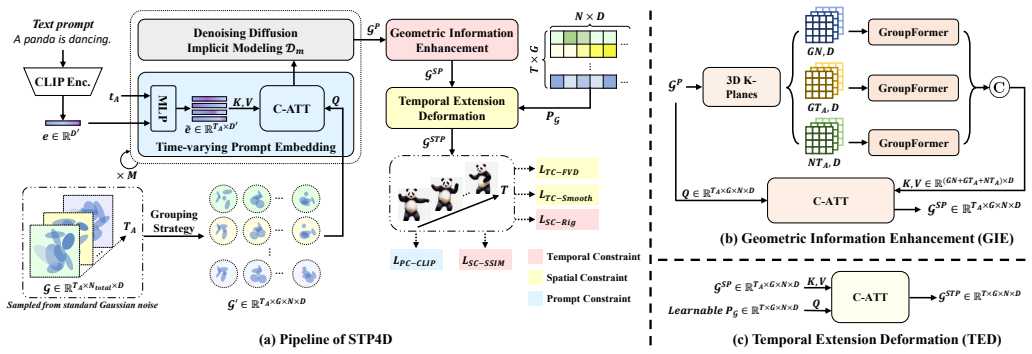
The load-bearing object is the 4D Gaussian splat itself, treated as a denoising target: 40,000 anisotropic Gaussians with attributes (position, rotation, scale, color, opacity) are sampled from standard Gaussian noise and iteratively denoised by a 50-step DDIM. Three mechanisms act on this object. Time-varying Prompt Embedding maps a CLIP text embedding into per-frame features injected by cross-attention; Geometric Information Enhancement uses K-Planes to factorize the Gaussian tensor into three low-rank planes and applies GroupFormer (window multi-head self-attention plus sparse convolution) to extract inter-group and intra-group features; Temporal Extension Deformation uses a learnable weight pool as the query and anchor-frame Gaussians as key and value to produce all actual frames. The losses $L_{\mathrm{SC-Rig}}$, $L_{\mathrm{TC-FVD}}$, $L_{\mathrm{TC-Smooth}}$, $L_{\mathrm{SC-SSIM}}$, and $L_{\mathrm{PC-CLIP}}$ jointly steer the representation.
What would settle it
Re-train the strongest baseline on the same Diffusion4D split with the STP4D loss terms $L_{\mathrm{PC-CLIP}}$ and $L_{\mathrm{TC-FVD}}$ added to its own objective, then compare CLIP-F, CLIP-O, and FVD. If its scores reach or exceed 0.841, 0.705, and 441.1, the claimed quality advantage is an artifact of uneven objectives rather than the architecture.
Extended reading notes
Core claim
The central claim is that the full spatio-temporal-prompt consistency needed for high-fidelity text-to-4D generation can be captured in a single end-to-end diffusion model over Gaussian splat parameters. STP4D treats 40,000 Gaussians across 12 anchor frames as tokens, embeds per-frame text features through cross-attention at each denoising step, enhances geometry via low-rank K-Planes decomposition and a GroupFormer attention block, and extends the anchor frames to 24 output frames with a learned weight pool in a further cross-attention stage. The paper reports that this setup produces higher CLIP-F and CLIP-O scores and a lower FVD score than prior text-to-4D methods, and that per-asset inference is roughly two orders of magnitude faster than the Diffusion4D baseline.
Load-bearing premise
The state-of-the-art quality claim rests on comparing methods under evaluation metrics that the proposed model is explicitly trained to optimize, while the baselines were not trained on those same objectives.
Editorial extensions
If this is right
- If the central claim is right, text-to-4D generation no longer needs a separate score-distillation stage; the diffusion model itself is the generator, so inference drops from hours to seconds.
- Removing Geometric Information Enhancement hurts all metrics most in the ablation, which suggests local and global geometric modeling, not just diffusion conditioning, is what keeps dynamic scenes coherent.
- Removing Time-varying Prompt Embedding reduces CLIP-F and CLIP-O, supporting the claim that frame-specific prompt features improve text alignment beyond a single global text embedding.
- The 2:1 anchor-to-actual temporal extension ratio is reported to generalize from 24-frame to 50-frame generation, implying the efficiency gain does not come at a quality cost at that ratio.
- Because the whole pipeline is end-to-end and runs in 4.6 seconds per asset, it is a direct candidate for interactive or real-time 4D content creation.
Reading between the lines
- Editorial inference: the reported margins likely overstate the architectural advantage, since STP4D is trained with the exact CLIP and FVD objectives used to score all methods; re-training baselines with the same losses would quantify the true gain.
- Editorial inference: the Temporal Extension Deformation module is a generic anchor-to-full-frame cross-attention mechanism that could be reused for temporal interpolation or frame-rate upsampling of any 4D Gaussian scene, independent of the diffusion front end.
- Editorial inference: the paper's own discussion predicts that scaling the Gaussian budget beyond 40,000 and training on richer multi-object datasets, without architecture changes, should extend the same consistency benefits to complex scenes; this is directly testable.
- Editorial inference: because DDIM sampling is deterministic given the initial noise, diversity across generated assets will come from the noise prior and the learned sampler; controlling or editing the noise seed is an unexplored handle for content variation.
Signed reviews
Editorial analysis
A structured set of objections, weighed in public.
Referee Report
Summary. The paper proposes STP4D, a text-to-4D generation method based on Gaussian splatting. The method initializes Gaussian attributes from noise and uses a DDIM denoiser conditioned on CLIP text embeddings, with a Time-varying Prompt Embedding (TPE) module, a Geometric Information Enhancement (GIE) module built on K-Planes and a GroupFormer, and a Temporal Extension Deformation (TED) module that extends anchor frames to full-length video via cross-attention. Training employs five losses: SSIM-based spatial loss, local rigidity, FVD-based temporal loss, Savitzky-Golay smoothness, and CLIP similarity. Experiments on the Diffusion4D dataset report CLIP-F 0.841, CLIP-O 0.705, FVD 441.1, and an inference time of about 4.6 seconds per asset, which is claimed to surpass existing methods in both quality and speed. Ablation studies are provided for each module and each proposed loss.
Significance. If the reported results are validated, the main contribution is a feed-forward text-to-4D pipeline that avoids per-asset test-time optimization, together with a coherent module design for spatio-temporal-prompt consistency. The speed advantage over optimization-based baselines is plausible and potentially practically important. The paper is also honest about its limitations, noting in Section VIII that training data and model capacity restrict complex-scene quality. However, the quantitative quality comparison is not currently established because the evaluation metrics coincide with the training objectives, baseline numbers are quoted from the literature without re-running, and no error bars or significance tests are reported. The central quality claim therefore needs additional evidence before the state-of-the-art conclusion can be accepted.
major comments (4)
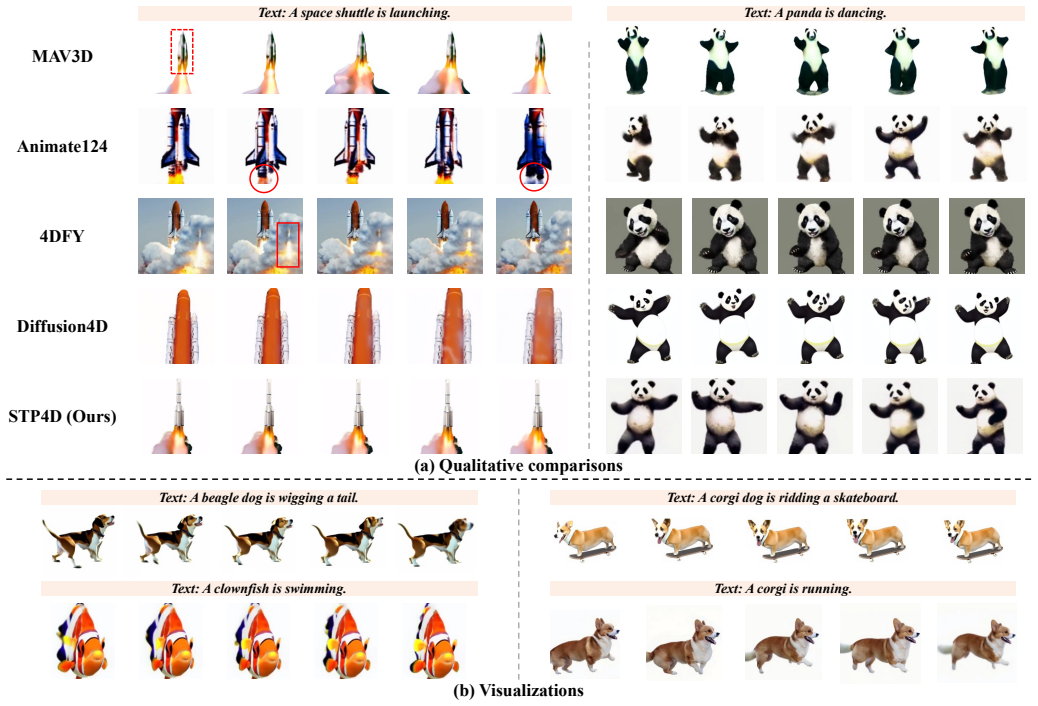
- [Section III-E, Section IV-A, Eqs. (14) and (16), Table I] The evaluation is asymmetric: STP4D is explicitly trained with L_TC-FVD (Eq. 14) and L_PC-CLIP (Eq. 16), which are the same quantities reported as FVD and CLIP-F/CLIP-O in Table I, while the baseline methods were not trained on these objectives. This gives STP4D a direct and undisclosed advantage when comparing against quoted baseline numbers. The reported margins are also small (0.031 in CLIP-F, 0.055 in CLIP-O, 41.5 in FVD) and are computed on only 20 test cases without error bars or significance testing. I therefore do not regard the claim that STP4D 'surpasses existing methods' in quality as supported. The authors should evaluate with metrics that are not part of the training objective, or re-run baselines under identical conditions, and report per-case results with confidence intervals or paired significance tests.
- [Table I and Section IV-B] The baseline numbers in Table I appear to be taken from prior publications rather than from re-running MAV3D, Animate124, 4DFY, and Diffusion4D on the same prompts, camera trajectories, rendering pipeline, and the same 20-case test split used for STP4D. Since CLIP-F, CLIP-O, and FVD all depend on the specific rendered sequences, cross-paper comparison of these numbers is unreliable. The authors should either run all methods under identical conditions or substantially weaken the quantitative comparison and explicitly state which numbers are quoted from the literature. Without this, the quantitative superiority claim is not established.
- [Table I, User Study] The user study is reported only as percentages in Table I, with no description of the experimental protocol: whether participants saw paired or unpaired videos, whether ratings were forced-choice or Likert-scale, how prompts and assets were sampled, and whether any significance test was applied. The percentages appear to sum to 100 per column, suggesting forced choice, but this is not stated. Given that the user study is a central piece of evidence for the subjective quality claim, the protocol and statistical significance must be reported.
- [Tables II and III, Section IV-C] The ablation studies also use CLIP-F, CLIP-O, and FVD as the evaluation metrics, which are the same quantities minimized by L_PC-CLIP and L_TC-FVD during training. This confounds the interpretation of the module and loss ablations: removing a module or loss may change the training dynamics in ways that affect the reported metrics, but the direction of the effect is biased by the fact that the metric itself is an objective. I recommend reporting at least one additional independent metric (for example, LPIPS, user study, or a no-reference video quality metric) for the ablations.
minor comments (5)
- [Section II] The statement that STP4D operates 'without the necessity of a prior guidance model' is slightly misleading because the method still uses a pretrained CLIP text encoder to obtain the conditioning signal; I suggest clarifying the distinction between a pretrained text encoder and the score-distillation guidance models used by prior work.
- [Section VI.A, Eq. (9)] The preliminary on Gaussian splatting in Eq. (7) is not written in standard form; the exponent should involve (x - x_i)^T Sigma_i^{-1} (x - x_i) rather than a quadratic form without the data point. This is a presentation issue in the supplementary material but should be corrected for readability.
- [Section VI.C, Eq. (14)] FVD is a distribution-level metric defined between two sets of videos, while Eq. (14) applies it to a single generated video and a single ground-truth video. The authors should explain how the I3D features and Frechet distance are computed in this per-sample setting, for example whether a batch of frames is used and how the statistics are estimated.
- [Table IV] The hyperparameter study on the temporal extension ratio reports CLIP-F and FVD but omits CLIP-O; adding CLIP-O would make the table consistent with the other comparisons.
- [General] The paper does not mention code or model release, which would be useful for reproducing the results and for the community to check the fairness of the baseline comparison.
Circularity Check
No derivational circularity; a minor training/evaluation overlap on the FVD and CLIP metrics mildly favors the reported quality comparison.
-
fitted input called prediction
[Section III.E (Eq. 14) and Section IV.A (Metrics); Table I]
"Temporal constraints. LT C−F V D minimizes the FVD [29] score of the rendered sequences, promoting smoother, higher-quality generation. ... LT C−F V D =F(I3D(V ),I 3D(Vgt)). ... Temporal consistency is assessed using the FVD [29] score to evaluate the quality and smoothness of the rendered sequences."
The network is explicitly optimized to minimize Eq. (14), the Frechet distance between I3D features of generated and ground-truth sequences, and Table I then reports FVD as evidence that STP4D surpasses baselines. The reported metric is the same scalar function as the training loss (same I3D features and same Frechet distance), while the baselines were not trained with that objective, so the comparison is partly by construction. CLIP is similar: LPC-CLIP (Eq. 16) is a frame-averaged CLIP text-image cosine similarity, the quantity underlying the reported CLIP-F/CLIP-O scores. Because the paper evaluates on a retained 20-case test set rather than on the training split, this is a training/evaluation overlap rather than a logical tautology, so it is only a mild circularity concern.
full rationale
STP4D is an empirical system paper rather than a derivational one: no architectural or loss equation is derived from the claim being tested, and the modules TPE, GIE, and TED are defined independently with supporting ablations. The only overlap between inputs and outputs is that quantities used as training losses (LTC-FVD, and in effect LPC-CLIP) reappear as the evaluation metrics (FVD, CLIP-F/CLIP-O). This gives the method an unacknowledged advantage in the reported comparison, but it is not a circular derivation because the metrics are computed on a held-out test set and because the speed claim is independent of that overlap. Citations to the authors' earlier GaussianDreamer and 4D-GS works are related-work context, not load-bearing uniqueness arguments. Overall, no significant circularity is present.
Assumptions & free parameters
free parameters (5)
- Loss weight vector theta =
[1, 0.01, 0.001, 0.1, 1]
- Temporal extension ratio eta =
2:1
- Number of Gaussian groups G =
400
- Number of anchor frames T_A =
12
- Total number of Gaussians N_total =
40000
assumptions (5)
- domain assumption The Diffusion4D dataset's rendered videos are valid ground truth for both training and evaluation.
- domain assumption SSIM, FVD, and CLIP cosine similarity capture the desired properties of geometric realism, temporal consistency, and prompt alignment.
- standard math The 3D Gaussian splatting renderer is accurate and differentiable for optimization.
- domain assumption K-Planes low-rank factorization loses acceptable information for the Gaussian tensor.
- domain assumption DDIM can be trained to map random Gaussian noise to plausible 4D Gaussian attributes in a single forward pass.
Cite this review
Pith. "Pith review of STP4D: Spatio-Temporal-Prompt Consistent Modeling for Text-to-4D Gaussian Splatting." pith.science (2026). https://pith.science/paper/AOFKWM6H
@misc{pith2026250418318,
  author       = {Pith},
  title        = {Pith review of: STP4D: Spatio-Temporal-Prompt Consistent Modeling for Text-to-4D Gaussian Splatting},
  year         = {2026},
  howpublished = {\url{https://pith.science/paper/AOFKWM6H}},
  note         = {Machine review of arXiv:2504.18318}
}
read the original abstract
Text-to-4D generation is rapidly developing and widely applied in various scenarios. However, existing methods often fail to incorporate adequate spatio-temporal modeling and prompt alignment within a unified framework, resulting in temporal inconsistencies, geometric distortions, or low-quality 4D content that deviates from the provided texts. Therefore, we propose STP4D, a novel approach that aims to integrate comprehensive spatio-temporal-prompt consistency modeling for high-quality text-to-4D generation. Specifically, STP4D employs three carefully designed modules: Time-varying Prompt Embedding, Geometric Information Enhancement, and Temporal Extension Deformation, which collaborate to accomplish this goal. Furthermore, STP4D is among the first methods to exploit the Diffusion model to generate 4D Gaussians, combining the fine-grained modeling capabilities and the real-time rendering process of 4DGS with the rapid inference speed of the Diffusion model. Extensive experiments demonstrate that STP4D excels in generating high-fidelity 4D content with exceptional efficiency (approximately 4.6s per asset), surpassing existing methods in both quality and speed.
Figures

Figures from the paper (2 more)


Reference graph
Works this paper leans on
-
[1]
A comprehensive survey on 3d content generation,
Jian Liu, Xiaoshui Huang, Tianyu Huang, Lu Chen, Yuenan Hou, Shixiang Tang, Ziwei Liu, Wanli Ouyang, Wangmeng Zuo, Junjun Jiang, et al., “A comprehensive survey on 3d content generation,” arXiv preprint arXiv:2402.01166, 2024
arXiv 2024
-
[2]
Deformable 3d gaussians for high-fidelity monocular dynamic scene reconstruction,
Ziyi Yang, Xinyu Gao, Wen Zhou, Shaohui Jiao, Yuqing Zhang, and Xiaogang Jin, “Deformable 3d gaussians for high-fidelity monocular dynamic scene reconstruction,” in Proceedings of the IEEE/CVF Conference on Computer Vision and Pattern Recognition , 2024, pp. 20331–20341
work page 2024
-
[3]
Sc-gs: Sparse-controlled gaussian splatting for editable dynamic scenes,
Yi-Hua Huang, Yang-Tian Sun, Ziyi Yang, Xiaoyang Lyu, Yan-Pei Cao, and Xiaojuan Qi, “Sc-gs: Sparse-controlled gaussian splatting for editable dynamic scenes,” in Proceedings of the IEEE/CVF Conference on Computer Vision and Pattern Recognition , 2024, pp. 4220–4230
work page 2024
-
[4]
Diffusion4d: Fast spatial-temporal consistent 4d generation via video diffusion mod- els,
Hanwen Liang, Yuyang Yin, Dejia Xu, Hanxue Liang, Zhangyang Wang, Konstantinos N Plataniotis, Yao Zhao, and Yunchao Wei, “Diffusion4d: Fast spatial-temporal consistent 4d generation via video diffusion mod- els,” arXiv preprint arXiv:2405.16645 , 2024
arXiv 2024
-
[5]
Guibiao Liao, Jiankun Li, Zhenyu Bao, Xiaoqing Ye, Jingdong Wang, Qing Li, and Kanglin Liu, “Clip-gs: Clip-informed gaussian splatting for real-time and view-consistent 3d semantic understanding,” arXiv preprint arXiv:2404.14249, 2024
arXiv 2024
-
[6]
Gaussiandreamer: Fast generation from text to 3d gaussian splatting with point cloud priors,
Taoran Yi, Jiemin Fang, Guanjun Wu, Lingxi Xie, Xiaopeng Zhang, Wenyu Liu, Qi Tian, and Xinggang Wang, “Gaussiandreamer: Fast generation from text to 3d gaussian splatting with point cloud priors,” arXiv preprint arXiv:2310.08529 , 2023
-
[7]
4d-fy: Text-to-4d gener- ation using hybrid score distillation sampling,
Sherwin Bahmani, Ivan Skorokhodov, Victor Rong, Gordon Wetzstein, Leonidas Guibas, Peter Wonka, Sergey Tulyakov, Jeong Joon Park, Andrea Tagliasacchi, and David B Lindell, “4d-fy: Text-to-4d gener- ation using hybrid score distillation sampling,” in Proceedings of the IEEE/CVF Conference on Computer Vision and Pattern Recognition , 2024, pp. 7996–8006
work page 2024
-
[8]
Zhengyi Wang, Cheng Lu, Yikai Wang, Fan Bao, Chongxuan Li, Hang Su, and Jun Zhu, “Prolificdreamer: High-fidelity and diverse text-to- 3d generation with variational score distillation,” Advances in Neural Information Processing Systems , vol. 36, 2024
work page 2024
Show all 40 references
-
[9]
Text-to-4d dynamic scene generation,
Uriel Singer, Shelly Sheynin, Adam Polyak, Oron Ashual, Iurii Makarov, Filippos Kokkinos, Naman Goyal, Andrea Vedaldi, Devi Parikh, Justin Johnson, et al., “Text-to-4d dynamic scene generation,” arXiv preprint arXiv:2301.11280, 2023
2023 arXiv
-
[10]
Hexplane: A fast representation for dynamic scenes,
Ang Cao and Justin Johnson, “Hexplane: A fast representation for dynamic scenes,” in Proceedings of the IEEE/CVF Conference on Computer Vision and Pattern Recognition , 2023, pp. 130–141
2023
-
[11]
Diffusion models in vision: A survey,
Florinel-Alin Croitoru, Vlad Hondru, Radu Tudor Ionescu, and Mubarak Shah, “Diffusion models in vision: A survey,” IEEE Transactions on Pattern Analysis and Machine Intelligence , vol. 45, no. 9, pp. 10850– 10869, 2023
2023
-
[12]
A survey on generative diffusion models,
Hanqun Cao, Cheng Tan, Zhangyang Gao, Yilun Xu, Guangyong Chen, Pheng-Ann Heng, and Stan Z Li, “A survey on generative diffusion models,” IEEE Transactions on Knowledge and Data Engineering, 2024
2024
-
[13]
Denoising diffusion implicit models,
Jiaming Song, Chenlin Meng, and Stefano Ermon, “Denoising diffusion implicit models,” arXiv preprint arXiv:2010.02502 , 2020
2010 arXiv
-
[14]
4d gaussian splatting for real-time dynamic scene rendering,
Guanjun Wu, Taoran Yi, Jiemin Fang, Lingxi Xie, Xiaopeng Zhang, Wei Wei, Wenyu Liu, Qi Tian, and Xinggang Wang, “4d gaussian splatting for real-time dynamic scene rendering,” in Proceedings of the IEEE/CVF Conference on Computer Vision and Pattern Recognition , 2024, pp. 20310–20320
2024
-
[15]
4d-rotor gaussian splatting: Towards efficient novel view synthesis for dynamic scenes,
Yuanxing Duan, Fangyin Wei, Qiyu Dai, Yuhang He, Wenzheng Chen, and Baoquan Chen, “4d-rotor gaussian splatting: Towards efficient novel view synthesis for dynamic scenes,” in ACM SIGGRAPH 2024 Conference Papers, 2024, pp. 1–11
2024
-
[16]
Nerf: Representing scenes as neural radiance fields for view synthesis,
Ben Mildenhall, Pratul P Srinivasan, Matthew Tancik, Jonathan T Barron, Ravi Ramamoorthi, and Ren Ng, “Nerf: Representing scenes as neural radiance fields for view synthesis,” Communications of the ACM, vol. 65, no. 1, pp. 99–106, 2021
2021
-
[17]
Probability distillation: A caveat and alternatives,
Chin-Wei Huang, Faruk Ahmed, Kundan Kumar, Alexandre Lacoste, and Aaron Courville, “Probability distillation: A caveat and alternatives,” in Uncertainty in Artificial Intelligence . PMLR, 2020, pp. 1212–1221
2020
-
[18]
Dream- fusion: Text-to-3d using 2d diffusion,
Ben Poole, Ajay Jain, Jonathan T Barron, and Ben Mildenhall, “Dream- fusion: Text-to-3d using 2d diffusion,” arXiv preprint arXiv:2209.14988, 2022
2022 arXiv
-
[19]
Animate124: Animating one image to 4d dynamic scene,
Yuyang Zhao, Zhiwen Yan, Enze Xie, Lanqing Hong, Zhenguo Li, and Gim Hee Lee, “Animate124: Animating one image to 4d dynamic scene,” arXiv preprint arXiv:2311.14603 , 2023
2023 arXiv
-
[20]
Align your gaussians: Text-to-4d with dynamic 3d gaussians and composed diffusion models,
Huan Ling, Seung Wook Kim, Antonio Torralba, Sanja Fidler, and Karsten Kreis, “Align your gaussians: Text-to-4d with dynamic 3d gaussians and composed diffusion models,” in Proceedings of the IEEE/CVF Conference on Computer Vision and Pattern Recognition , 2024, pp. 8576–8588
2024
-
[21]
A unified approach for text-and image-guided 4d scene generation,
Yufeng Zheng, Xueting Li, Koki Nagano, Sifei Liu, Otmar Hilliges, and Shalini De Mello, “A unified approach for text-and image-guided 4d scene generation,” in Proceedings of the IEEE/CVF Conference on Computer Vision and Pattern Recognition , 2024, pp. 7300–7309
2024
-
[22]
Stag4d: Spatial-temporal anchored generative 4d gaussians,
Yifei Zeng, Yanqin Jiang, Siyu Zhu, Yuanxun Lu, Youtian Lin, Hao Zhu, Weiming Hu, Xun Cao, and Yao Yao, “Stag4d: Spatial-temporal anchored generative 4d gaussians,” arXiv preprint arXiv:2403.14939 , 2024
2024 arXiv
-
[23]
Learning transferable visual models from natural language supervision,
Alec Radford, Jong Wook Kim, Chris Hallacy, Aditya Ramesh, Gabriel Goh, Sandhini Agarwal, Girish Sastry, Amanda Askell, Pamela Mishkin, Jack Clark, et al., “Learning transferable visual models from natural language supervision,” in International conference on machine learning....
2021
-
[24]
K-planes: Explicit radiance fields in space, time, and appearance,
Sara Fridovich-Keil, Giacomo Meanti, Frederik Rahbæk Warburg, Ben- jamin Recht, and Angjoo Kanazawa, “K-planes: Explicit radiance fields in space, time, and appearance,” in Proceedings of the IEEE/CVF Conference on Computer Vision and Pattern Recognition , 2023, pp. 12479–12488
2023
-
[25]
Condaformer: Disassembled transformer with local structure enhancement for 3d point cloud understanding,
Lunhao Duan, Shanshan Zhao, Nan Xue, Mingming Gong, Gui-Song Xia, and Dacheng Tao, “Condaformer: Disassembled transformer with local structure enhancement for 3d point cloud understanding,”Advances in Neural Information Processing Systems , vol. 36, 2024
2024
-
[26]
Make-a-video: Text-to-video generation without text-video data,
Uriel Singer, Adam Polyak, Thomas Hayes, Xi Yin, Jie An, Songyang Zhang, Qiyuan Hu, Harry Yang, Oron Ashual, Oran Gafni, et al., “Make-a-video: Text-to-video generation without text-video data,” arXiv preprint arXiv:2209.14792, 2022
2022 arXiv
-
[27]
Image quality assessment: from error visibility to structural similarity,
Zhou Wang, Alan C Bovik, Hamid R Sheikh, and Eero P Simoncelli, “Image quality assessment: from error visibility to structural similarity,” IEEE transactions on image processing , vol. 13, no. 4, pp. 600–612, 2004
2004
-
[28]
As-rigid-as-possible surface modeling,
Olga Sorkine and Marc Alexa, “As-rigid-as-possible surface modeling,” in Symposium on Geometry processing . Citeseer, 2007, vol. 4, pp. 109– 116
2007
-
[29]
Gans trained by a two time-scale update rule converge to a local nash equilibrium,
Martin Heusel, Hubert Ramsauer, Thomas Unterthiner, Bernhard Nessler, and Sepp Hochreiter, “Gans trained by a two time-scale update rule converge to a local nash equilibrium,” Advances in neural information processing systems , vol. 30, 2017
2017
-
[30]
Adaptive savitzky-golay filtering and its applications,
Jozsef Dombi and Adrienn Dineva, “Adaptive savitzky-golay filtering and its applications,” International Journal of Advanced Intelligence Paradigms, vol. 16, no. 2, pp. 145–156, 2020
2020
-
[31]
Neural point catacaustics for novel-view synthesis of reflections,
Georgios Kopanas, Thomas Leimk ¨uhler, Gilles Rainer, Cl ´ement Jam- bon, and George Drettakis, “Neural point catacaustics for novel-view synthesis of reflections,” ACM Transactions on Graphics (TOG) , vol. 41, no. 6, pp. 1–15, 2022
2022
-
[32]
3d gaussian splatting for real-time radiance field rendering.,
Bernhard Kerbl, Georgios Kopanas, Thomas Leimk ¨uhler, and George Drettakis, “3d gaussian splatting for real-time radiance field rendering.,” ACM Trans. Graph., vol. 42, no. 4, pp. 139–1, 2023
2023
-
[33]
Denoising diffusion prob- abilistic models,
Jonathan Ho, Ajay Jain, and Pieter Abbeel, “Denoising diffusion prob- abilistic models,” Advances in neural information processing systems , vol. 33, pp. 6840–6851, 2020
2020
-
[34]
Deep unsupervised learning using nonequilibrium thermody- namics,
Jascha Sohl-Dickstein, Eric Weiss, Niru Maheswaranathan, and Surya Ganguli, “Deep unsupervised learning using nonequilibrium thermody- namics,” in International conference on machine learning. PMLR, 2015, pp. 2256–2265
2015
-
[35]
Swin transformer: Hierarchical vision transformer using shifted windows,
Ze Liu, Yutong Lin, Yue Cao, Han Hu, Yixuan Wei, Zheng Zhang, Stephen Lin, and Baining Guo, “Swin transformer: Hierarchical vision transformer using shifted windows,” in Proceedings of the IEEE/CVF international conference on computer vision , 2021, pp. 10012–10022
2021
-
[36]
Adam: A method for stochastic optimization,
Diederik P Kingma and Jimmy Ba, “Adam: A method for stochastic optimization,” arXiv preprint arXiv:1412.6980 , 2014
2014 arXiv
-
[37]
Objaverse: A universe of annotated 3d objects,
Matt Deitke, Dustin Schwenk, Jordi Salvador, Luca Weihs, Oscar Michel, Eli VanderBilt, Ludwig Schmidt, Kiana Ehsani, Aniruddha Kembhavi, and Ali Farhadi, “Objaverse: A universe of annotated 3d objects,” in Proceedings of the IEEE/CVF Conference on Computer Vision and Pattern R...
2023
-
[38]
Objaverse-xl: A universe of 10m+ 3d objects,
Matt Deitke, Ruoshi Liu, Matthew Wallingford, Huong Ngo, Oscar Michel, Aditya Kusupati, Alan Fan, Christian Laforte, Vikram V oleti, Samir Yitzhak Gadre, et al., “Objaverse-xl: A universe of 10m+ 3d objects,” Advances in Neural Information Processing Systems , vol. 36, 2024
2024
-
[39]
Scal- able 3d captioning with pretrained models,
Tiange Luo, Chris Rockwell, Honglak Lee, and Justin Johnson, “Scal- able 3d captioning with pretrained models,” Advances in Neural Information Processing Systems , vol. 36, 2024
2024
-
[40]
View selection for 3d captioning via diffusion ranking,
Tiange Luo, Justin Johnson, and Honglak Lee, “View selection for 3d captioning via diffusion ranking,” arXiv preprint arXiv:2404.07984 , 2024
2024
Reviewed August 16, 2026 · model on record in the stance chip above.
Discussion (0). Continue with ORCID to comment.