REVIEW 3 major objections 6 minor 1 cited by
Probing Quantum Phenomena through Photoproduction in Relativistic Heavy-Ion Collisions
T0 review · 3 major / 6 minor · reviewed 2026-08-16 · deepseek-v4-flash
Pith's one-line read Photoproduction in heavy-ion collisions makes Fermi-scale double-slit interference visible.
desk verdict Useful review of a real experimental program, but the entanglement billing outruns what the paper itself supports; the E2I2-to-data link is explicitly deferred. read the letter →
The pith
A machine-rendered reading of the paper's core claim, the machinery that carries it, and where it could break.
The reading
What carries the argument
The carrying object is Entanglement Enabled Intensity Interferometry (E2I2), a formalism adapted from the study of two-photon intensity interferometry, in which interference can persist in the correlation of two distinguishable particles emitted from two sources because the particles are entangled. In this paper the two sources are the photoproduction amplitudes $\gamma_A + P_B \to \rho^0$ and $\gamma_B + P_A \to \rho^0$, and the detected pair is the $\pi^+\pi^-$ from the $\rho^0$ decay; retaining the phase terms of the two amplitudes yields extra cross terms, including a term analogous to the E2I2 correlation, that are absent for uncorrelated pion emission. The Vector Meson Dominance and color dipole models supply the production amplitudes that feed this interference, and their comparison with the STAR data determines how the modulation depends on the nuclear density profile.
What would settle it
Measure the $\cos(2\phi)$ modulation of $\rho^0 \to \pi^+\pi^-$ as a function of neutron-tagged impact parameter in a single collision system, and compare with a calculation that treats the two pions as independently emitted from the two sources: if the E2I2 entanglement claim is wrong, the extra phase terms carrying the $P_\perp \cdot B$ dependence should be absent and the modulation should not follow the predicted impact-parameter scaling.
Extended reading notes
Core claim
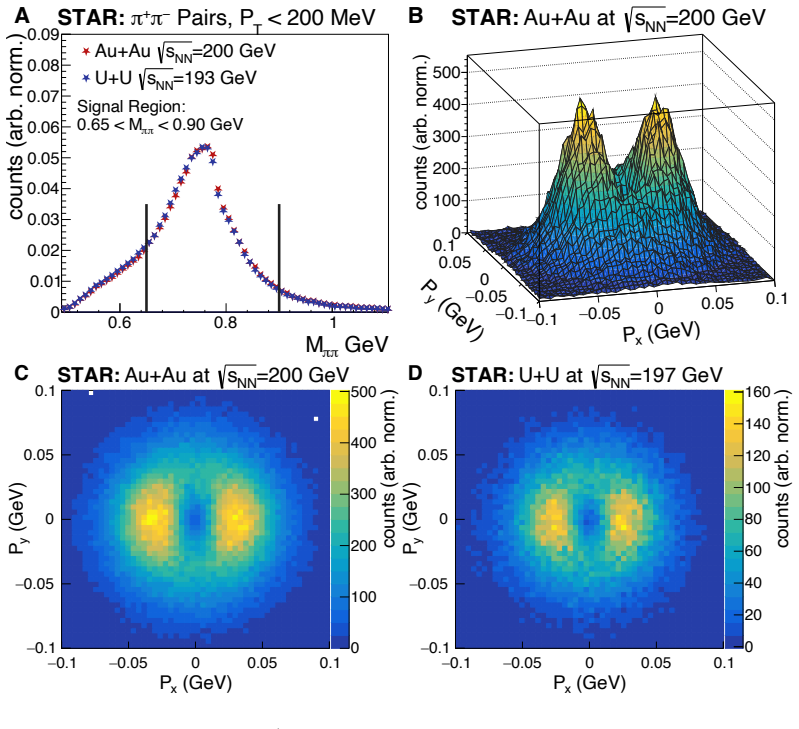
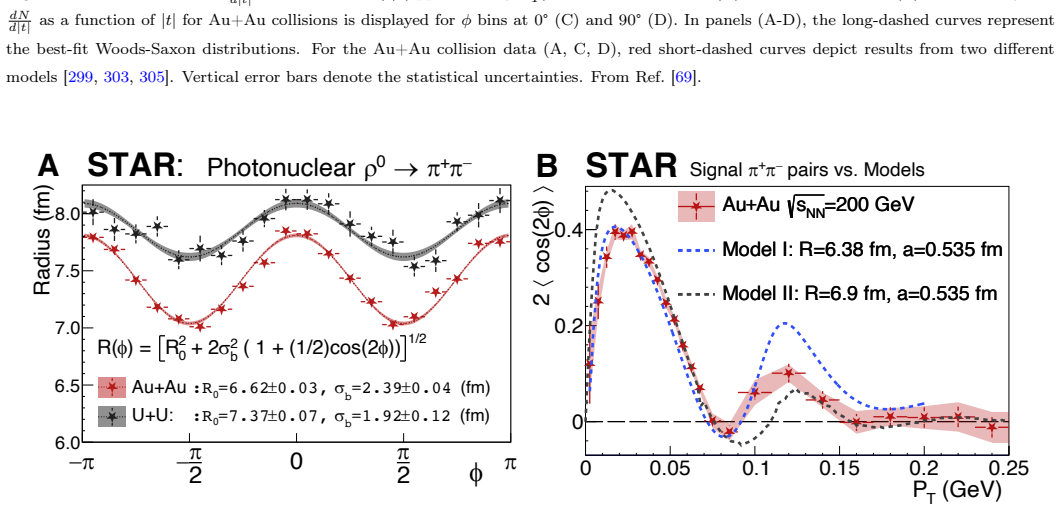
The paper's central claim is that diffractive photoproduction, especially $\rho^0$ photoproduction in ultra-peripheral heavy-ion collisions, shows genuine two-source quantum interference at a femtometer scale, with the two nuclei serving as the slits. In the $\rho^0 \to \pi^+\pi^-$ channel, the two amplitudes in which nucleus A emits the photon and nucleus B is the target, and vice versa, have opposite signs because the vector meson has negative parity, producing destructive interference at low transverse momentum and an azimuthal $\cos(2\phi)$ modulation in the decay distribution. The review presents the STAR and ALICE measurements of this spin-interference pattern, and argues through the E2I2 formalism that the interference survives in the simultaneous detection of two distinguishable decay daughters only if the $\pi^+$ and $\pi^-$ are treated as entangled, which in turn implies that particle decay does not collapse the wavefunction. The authors state that the quantitative relation between the E2I2 formalism and the measured $\cos(2\phi)$ modulation still requires further numerical investigation.
Load-bearing premise
The entanglement interpretation assumes that the two pions from the $\rho^0$ decay remain entangled and that particle decay does not collapse the wavefunction, so interference can appear in the pion pair even though the $\rho^0$ decays about 1.2 fm before the two nuclear sources are separated by 20 to 300 fm.
Editorial extensions
If this is right
- The observed $\cos(2\phi)$ modulation in $\rho^0$ photoproduction provides a quantitative handle on the gluon distribution and on the transverse size of the nucleus, as demonstrated by the extracted radii for gold and uranium.
- The E2I2 interpretation implies that the same entanglement-enabled interference should appear in other vector meson decay channels, including $\phi$ and $J/\psi$, allowing model-independent extraction of the effective Pomeron flux.
- The interference strength is expected to depend on the impact parameter, which can be selected experimentally through forward-neutron tagging; ALICE's neutron-class data show the modulation increasing by an order of magnitude from 0n0n to XnXn classes.
- If particle decay does not cause wavefunction collapse, the same formalism should apply to pseudoscalar production through Odderon exchange, where the azimuthal asymmetry order would differ according to the spin quantum numbers.
- Coherent photoproduction in hadronic heavy-ion collisions, where the overlap region partially 'observes' which slit was used, offers a test of decoherence and of which-way information in a femtometer-scale interferometer.
Reading between the lines
- A decisive extension would be to compare the $\cos(2\phi)$ modulation in Au+Au, U+U, and Pb+Pb collisions at matched impact parameter: if the E2I2 entanglement reading is correct, the modulation amplitude should track the slit separation, and models that treat the two pions as independently emitted should fail to reproduce the phase terms.
- The interpretation implies a sharp, testable contrast with classical coherence: the two-source interference should survive even when the $\rho^0$ decay length is far smaller than the nuclear separation, which is exactly the regime where a naive 'two decaying mesons' picture would predict no interference.
- A natural follow-up measurement would be the $\cos(4\phi)$ azimuthal asymmetry in $\rho^0$ photoproduction, which the paper connects to the elliptic gluon Wigner distribution; observing it with the predicted sign and magnitude would independently confirm that linearly polarized photons, not final-state interactions, drive the pattern.
Signed reviews
Editorial analysis
A structured set of objections, weighed in public.
Referee Report
Summary. The manuscript is a review of coherent photoproduction in relativistic heavy-ion collisions, organized around quantum-interference phenomena: two-source Young's double-slit interference in the transverse-momentum spectra, spin interference (the cos(2φ) modulation in ρ0→π+π− decays), and a proposed interpretation of the latter as evidence for quantum entanglement of the decay pions via the 'entanglement-enabled intensity interferometry' (E2I2) framework. It surveys RHIC and LHC measurements (STAR, ALICE, CMS, LHCb), theoretical models (VMD, color dipole/CGC), coherence requirements and the Good-Walker paradigm, applications to nuclear tomography and reaction-plane determination, and future facilities and opportunities.
Significance. If the E2I2 interpretation were quantitatively established, the review would identify a genuinely new quantum probe: Fermi-scale two-source interference with an entangled final state, offering access to non-perturbative dynamics and nuclear gluon structure. The review is useful as a compilation of experimental results and model comparisons, and it reports published data with uncertainties and gives the standard theoretical frameworks for the measurements. It also states several falsifiable expectations (e.g., universality across vector mesons, Odderon-exchange signatures) that could be tested at RHIC, the LHC, and the EIC. Its main deficit is that the central interpretive step is not derived quantitatively: the authors explicitly defer the E2I2-to-data connection to future work, and the same measurements are already described by standard two-source interference models without invoking entanglement.
major comments (3)
- [Sec. 1.4 and Sec. 3.3] There is an internal contradiction in the central claim. Section 1.4 calls the observed spin-interference patterns 'the first instances of Fermi-scale single-particle double-slit interference experiments,' but Section 3.3 states that, unlike the standard double-slit experiment, the measurement involves the simultaneous observation of two particles (the π+ and π− daughters) and is closer to intensity interferometry. Since the review itself concedes that the measurement is of a pair of particles, the 'single-particle' label is inaccurate and should be corrected consistently throughout the text.
- [Sec. 4.2] The load-bearing step for the entanglement interpretation is missing. The text states that the quantitative relation between the E2I2 illustration and the measured cos(2φ) modulation with a realistic ρ0→π+π− decay 'requires further numerical investigations [341].' Because the same data are already described by Model I (VMD) and Model II (dipole) in Sec. 3.5.2 as standard two-source interference of linearly polarized photons, the E2I2/entanglement conclusion is not yet an established result. The abstract's claim that these studies 'enrich our understanding of non-local realism' and the phrasing in Sec. 4.2 that 'particle decay does not cause wavefunction collapse' go beyond what is demonstrated. The review should either supply the quantitative E2I2 prediction or explicitly label the entanglement conclusion as a proposed interpretation awaiting validation.
- [Sec. 4.2, Eqs. (4.14)-(4.19)] The E2I2 derivation as presented does not by itself establish entanglement. The two-particle state written in Eq. (4.14) is a product of single-particle states, and the subsequent step imposes phase relations between the π+ and π− amplitudes rather than constructing a non-separable two-particle state. The text says 'we can consider the case where the π+ and π− daughters of a ρ0 decay are entangled,' but a product state with correlated phases is not an entangled state in the standard sense and does not, by itself, lead to a Bell-like or entanglement-certifying observable. Please clarify which notion of 'entangled' is intended and how the proposed interference measurement would certify it, or soften the terminology accordingly.
minor comments (6)
- [Sec. 2.1] The sentence 'and significant background of secondary particles scattered from the magnets' is an incomplete sentence and appears to be missing a main clause.
- [Sec. 4.2] The text contains several typographical errors, including 'Quicklyafterthefirstphotonuclearmeasurements' and 'the E2I2 framework provides a unified formalism1' with a stray footnote marker; a careful proofread is needed.
- [Sec. 5.5.1] The phrase 'complete complete reconstruction' is duplicated and should be corrected.
- [Fig. 5.2 caption] The caption refers to 'theoretical models []' without the actual citation numbers; the bracket appears to have been left empty.
- [Sec. 3.3 and Sec. 3.5.2] The explanation for the relative sign in Eq. (3.11) and for the positive sign in p+p collisions is presented in a compressed way; a more precise statement in terms of C-parity and, for p+p, identical-particle exchange would help readers not already familiar with the literature.
- [Sec. 5.3] The sentence 'By precisely adjusting these parameters, the complex quantum effects can be studied researchers' is ungrammatical; 'by' should be inserted before 'researchers' or the sentence should be rephrased.
Circularity Check
The spin-interference measurement is external and not fitted, but the entanglement interpretation is built into the E2I2 ansatz and the quantitative E2I2-to-data link is deferred to a companion paper.
-
self definitional
[Sec. 4.2, Eqs. (4.9)-(4.12), (4.17)-(4.18)]
"Another important note is that the above notation expresses the ρ wavefunction as transitioning to a π+ and a π− such that the π+ and π− cannot be written as a simple product of individual wavefunctions,i.e they are entangled."
The E2I2-inspired derivation starts by writing the ρ0→π+π− decay amplitude as the symmetrized two-particle state |π+,1⟩|π−,2⟩ + |π+,2⟩|π−,1⟩ (Eqs. 4.9-4.12). That state is entangled by construction. The later claim that the formalism provides a formal description of non-collapse by describing the daughter particles as an entangled state therefore restates the input ansatz rather than deriving entanglement from the measured cos(2φ). The same cos(2φ) modulation is already reproduced in Sec. 3.5.2 by ordinary two-source interference of linearly polarized photons (VMD and dipole models) without this entangled-state assumption, so the entanglement conclusion is an interpretation inserted via the notation, not a forced consequence of the data.
-
self citation load bearing
[Sec. 4.2, paragraph after Eq. (4.19)]
"However, how this illustration could be quantitatively related to the experimental measurements in Sec.5.1 and the formula discussed in Sec. 3.3 with a realistic decay ρ0→π+π− of JPC = 1−− requires further numerical investigations [341]."
The review's headline claim that the STAR/ALICE patterns are the first Fermi-scale double-slit experiments and that the π+π− pair is entangled depends on the quantitative connection between the E2I2 formalism and the measured cos(2φ) modulation. The text explicitly defers that connection to reference [341], the authors' own E2I2 companion program. Thus the central interpretive step is not derived in this paper; it is routed to a self-citation whose promised numerical link is not supplied. Because standard two-source interference models already describe the same observable, the E2I2/entanglement layer is not independently evidenced here.
full rationale
The observed cos(2φ) azimuthal modulation is external STAR/ALICE data, and the leading-order two-source interference prediction of Sec. 3.5.2 (Eqs. 3.13 and 3.15) is not fitted to that modulation; Model I and Model II are independent calculations. The core spin-interference effect is therefore not circular. The circularity that does exist is at the interpretive layer: the E2I2 formalism used to claim entanglement writes the ρ0→π+π− amplitude as a symmetrized two-particle state, which is entangled by definition, and then presents that as the formal description of why decay does not collapse the wavefunction. The paper also explicitly defers the quantitative E2I2-to-data connection for a realistic JPC=1−− decay to companion work [341], so the headline entanglement claim is not derived in this manuscript. The nuclear-tomography extraction in Sec. 5.1 uses measured |t| shapes and a correction parameter σ_b fitted from the interference pattern; this is a data-analysis model rather than a renamed prediction. Overall, the measurement and the standard interference interpretation stand independently; the entanglement-specific claims are ansatz-driven and self-citation-linked, but the paper is honest about the missing numerical link.
Assumptions & free parameters
free parameters (5)
- sigma_b (modulation strength) =
2.38 +/- 0.04 fm (Au+Au); 1.9 +/- 0.1 fm (U+U)
- R0 (minimum apparent radius) =
6.62 +/- 0.03 fm (Au+Au); 7.37 +/- 0.06 fm (U+U)
- epsilon_p (polarization resolution) =
0.5
- R_rho^T (transverse radius of rho wavefunction) =
1.03 fm
- Woods-Saxon radius and diffuseness =
e.g., R=7.47 fm, a=0.54 fm (Au) as used in Fig. 5.1
assumptions (6)
- standard math Linear superposition and Born rule of quantum mechanics hold for the full collision and decay process.
- domain assumption The Weizsacker-Williams equivalent photon approximation describes the photon flux and its 100% linear polarization at small x.
- domain assumption Vector meson photoproduction conserves s-channel helicity, so the rho0 inherits the photon's linear polarization.
- domain assumption The two production amplitudes interfere with a minus sign because vector mesons have negative parity and swapping emitter and target is a parity inversion.
- ad hoc to paper Coherent photoproduction can occur even when the target nucleus breaks up in hadronic collisions, and the Good-Walker definition of coherence is violated.
- ad hoc to paper The decay products of the rho0 remain entangled, so particle decay does not collapse the wavefunction and the pion pair can carry the two-source interference phase (E2I2 assumption).
Cite this review
Pith. "Pith review of Probing Quantum Phenomena through Photoproduction in Relativistic Heavy-Ion Collisions." pith.science (2026). https://pith.science/paper/IM2BJBIC
@misc{pith2026250418342,
  author       = {Pith},
  title        = {Pith review of: Probing Quantum Phenomena through Photoproduction in Relativistic Heavy-Ion Collisions},
  year         = {2026},
  howpublished = {\url{https://pith.science/paper/IM2BJBIC}},
  note         = {Machine review of arXiv:2504.18342}
}
read the original abstract
Photoproduction in ultra-peripheral relativistic heavy-ion collisions displays many unique features, often involving quantum mechanical coherence and two-source interference between photon emission from the two ions. We review the recent experimental results from RHIC and the LHC and theoretical studies of coherent vector meson photoproduction, emphasizing the quantum mechanical aspects of the interactions and the entanglement between the final state particles. These studies enrich our understanding of non-local realism, underscore the critical role of the polarization of the photon source, quantum interference and nuclear effect on the gluon distribution. It paves a way for quantitatively probing the quantum nature of these high-energy nuclear collisions.
Figures


Figures from the paper (26 more)






Forward citations
Cited by 1 Pith paper
-
Probing Quantum Numbers and Decay Branching Ratios of Exotic States via Entanglement-Enabled Spin Interference
Simulated spin-interference patterns in ρ(1450)→4π decays give a distinct azimuthal modulation for the π(1300)π channel, allowing its branching fraction to be extracted.
Reference graph
Works this paper leans on
-
[1]
Levine, Quantum Chemistry, Pearson advanced chemistry series, Pearson, 2014
I. Levine, Quantum Chemistry, Pearson advanced chemistry series, Pearson, 2014. URL https://books.google.com/books?id=ht6jMQEACAAJ
2014
-
[2]
G. S. Engel, T. R. Calhoun, E. L. Read, T.-K. Ahn, T. Mancal, T.-C. Cheng, R. E. Blankenship, G. R. Fleming, Evidence for wavelike energy transfer through quantum coherence in photosynthetic systems, Nature 446 (2007) 782–786. doi:10.1038/nature05678
-
[3]
Nielsen, I
M. Nielsen, I. Chuang, Quantum Computation and Quantum Information: 10th Anniversary Edition, Cambridge University Press, 2010. URL https://books.google.com/books?id=-s4DEy7o-a0C
2010
-
[4]
C. Y. Chao, Scattering of hardγ-rays, Phys. Rev. 36 (1930) 1519–1522.doi:10.1103/PhysRev.36.1519
-
[5]
Goworek, 80 years of positron annihilation radiation., Acta Phys
T. Goworek, 80 years of positron annihilation radiation., Acta Phys. Pol., A. 125 (3) (2014). doi:10.12693/ APhysPolA.125.685
2014
-
[6]
R. P. Feynman, Quantum Electrodynamics, Avalon Publishing, 1998
1998
-
[7]
Feynman, F
R. Feynman, F. Wilczek, The Character of Physical Law, with new foreword, MIT Press, 2017. URL https://books.google.com/books?id=SJNPDgAAQBAJ
2017
-
[8]
Penrose, The Road to Reality: A Complete Guide to the Laws of the Universe, Knopf Doubleday Publishing Group, 2021
R. Penrose, The Road to Reality: A Complete Guide to the Laws of the Universe, Knopf Doubleday Publishing Group, 2021. URL https://books.google.com/books?id=SkwiEAAAQBAJ
2021
Show all 298 references
-
[9]
Weinberg, Collapse of the state vector, Phys
S. Weinberg, Collapse of the state vector, Phys. Rev. A 85 (2012) 062116.doi:10.1103/PhysRevA.85.062116
2012 doi
-
[10]
Bassi, K
A. Bassi, K. Lochan, S. Satin, T. P. Singh, H. Ulbricht, Models of wave-function collapse, underlying theories, and experimental tests, Reviews of Modern Physics 85 (2) (2013) 471
2013
-
[11]
Tegmark, The interpretation of quantum mechanics: Many worlds or many words?, Fortschritte der Physik: Progress of Physics 46 (6-8) (1998) 855–862
M. Tegmark, The interpretation of quantum mechanics: Many worlds or many words?, Fortschritte der Physik: Progress of Physics 46 (6-8) (1998) 855–862
1998
-
[12]
L. E. Ballentine, The statistical interpretation of quantum mechanics, Reviews of modern physics 42 (4) (1970) 358
1970
-
[13]
Jammer, Philosophy of quantum mechanics
M. Jammer, Philosophy of quantum mechanics. the interpretations of quantum mechanics in historical perspective (1974)
1974
-
[14]
doi:10.1038/121580a0
N.Bohr, TheQuantumPostulateandtheRecentDevelopmentofAtomicTheory, Nature121(3050)(1928)580–590. doi:10.1038/121580a0
1928 doi
-
[15]
Bohr, Discussion with einstein on epistemological problems in atomic physics, in: P
N. Bohr, Discussion with einstein on epistemological problems in atomic physics, in: P. A. Schilpp (Ed.), The Library of Living Philosophers, Volume 7. Albert Einstein: Philosopher-Scientist, Open Court, 1949, pp. 199–241
1949
-
[16]
a Heisenberg, Uber den anschaulichen Inhalt der quantentheoretischen Kinematik und Mechanik, Z
W. a Heisenberg, Uber den anschaulichen Inhalt der quantentheoretischen Kinematik und Mechanik, Z. Phys. 43 (1927) 172–198. doi:10.1007/BF01397280. 60
1927 doi
-
[17]
Born, Quantenmechanik der Stoßvorgänge, Z
M. Born, Quantenmechanik der Stoßvorgänge, Z. Phys. 38 (11-12) (1926) 803–827.doi:10.1007/BF01397184
1926 doi
-
[18]
D. Dürr, S. Teufel, Bohmian Mechanics: The Physics and Mathematics of Quantum Theory, Springer Berlin Heidelberg, 2009. URL https://books.google.com/books?id=UWP2ZSs-UD0C
2009
-
[19]
Everett, Relative state formulation of quantum mechanics, Rev
H. Everett, Relative state formulation of quantum mechanics, Rev. Mod. Phys. 29 (1957) 454–462.doi:10.1103/ RevModPhys.29.454
1957
-
[20]
C. A. Fuchs, N. D. Mermin, R. Schack, An introduction to qbism with an application to the locality of quantum mechanics, Am. J. Phys. 82 (8) (2014) 749–754
2014
-
[21]
J. G. Cramer, The transactional interpretation of quantum mechanics, Rev. Mod. Phys. 58 (1986) 647–687.doi: 10.1103/RevModPhys.58.647
1986 doi
-
[22]
N. D. Mermin, Could feynman have said this?, Phys. Today 57 (5) (2004) 10–11
2004
-
[23]
Scheidl, et al., Violation of local realism with freedom of choice, Proc
T. Scheidl, et al., Violation of local realism with freedom of choice, Proc. Nat. Acad. Sci. 107 (46) (2010) 19708– 19713. arXiv:0811.3129, doi:10.1073/pnas.1002780107
2010 arXiv
-
[24]
Hensen, et al., Loophole-free Bell inequality violation using electron spins separated by 1.3 kilometres, Nature 526 (2015) 682–686
B. Hensen, et al., Loophole-free Bell inequality violation using electron spins separated by 1.3 kilometres, Nature 526 (2015) 682–686. arXiv:1508.05949, doi:10.1038/nature15759
2015 arXiv
-
[25]
Giustina, et al., Bell violation using entangled photons without the fair-sampling assumption, Nature 497 (7448) (2013) 227–230
M. Giustina, et al., Bell violation using entangled photons without the fair-sampling assumption, Nature 497 (7448) (2013) 227–230. doi:10.1038/nature12012
2013 doi
-
[26]
Rauch, et al., Cosmic Bell Test Using Random Measurement Settings from High-Redshift Quasars, Phys
D. Rauch, et al., Cosmic Bell Test Using Random Measurement Settings from High-Redshift Quasars, Phys. Rev. Lett. 121 (8) (2018) 080403.arXiv:1808.05966, doi:10.1103/PhysRevLett.121.080403
2018 arXiv
-
[27]
Ansmann, et al., Violation of Bell’s inequality in Josephson phase qubits, Nature 461 (7263) (2009) 504–506
M. Ansmann, et al., Violation of Bell’s inequality in Josephson phase qubits, Nature 461 (7263) (2009) 504–506. doi:10.1038/nature08363
2009 doi
-
[28]
M. A. Rowe, D. Kielpinski, V. Meyer, C. A. Sackett, W. M. Itano, C. Monroe, D. J. Wineland, Experimental violation of a Bell’s inequality with efficient detection, Nature 409 (6822) (2001) 791–794.doi:10.1038/35057215
2001 doi
-
[29]
R. P. Feynman, The Feynman lectures on physics, Vol. 1, 1963
1963
-
[30]
G. I. Taylor, Interference fringes with feeble light, Proc. Camb. Philos. Soc. 114–115 (1909) 46
1909
-
[31]
Jönsson, Elektroneninterferenzen an mehreren künstlich hergestellten feinspalten, Z
C. Jönsson, Elektroneninterferenzen an mehreren künstlich hergestellten feinspalten, Z. Phys. 161 (4) (1961) 454– 474
1961
-
[32]
P. G. Merli, G. F. Missiroli, G. Pozzi, On the statistical aspect of electron interference phenomena, Am. J. Phys. 44 (3) (1976) 306–307
1976
-
[33]
Frabboni, A
S. Frabboni, A. Gabrielli, G. Carlo Gazzadi, F. Giorgi, G. Matteucci, G. Pozzi, N. S. Cesari, M. Villa, A. Zoccoli, The young-feynman two-slits experiment with single electrons: Build-up of the interference pattern and arrival- time distribution using a fast-readout pixel dete...
2012 doi
-
[34]
Ariga, A
A. Ariga, A. Ereditato, R. Ferragut, M. Giammarchi, M. Leone, C. Pistillo, S. Sala, P. Scampoli, First demonstration of antimatter wave interferometry, Sci. Adv. 5 (5) (2019) eaav7610.arXiv:1808.08901, doi:10.1126/sciadv. aav7610
2019 arXiv
-
[35]
Zeilinger, R
A. Zeilinger, R. Gahler, C. G. Shull, W. Treimer, W. Mampe, Single- and double-slit diffraction of neutrons, Rev. Mod. Phys. 60 (1988) 1067–1073.doi:10.1103/RevModPhys.60.1067
1988 doi
-
[36]
Carnal, J
O. Carnal, J. Mlynek, Young’s double-slit experiment with atoms: A simple atom interferometer, Phys. Rev. Lett. 66 (1991) 2689–2692. doi:10.1103/PhysRevLett.66.2689
1991 doi
-
[37]
Arndt, O
M. Arndt, O. Nairz, J. Vos-Andreae, C. Keller, G. van der Zouw, A. Zeilinger, Wave–particle duality of C60 molecules, Nature 401 (6754) (1999) 680–682.doi:10.1038/44348
1999 doi
-
[38]
Andrews, C
M. Andrews, C. Townsend, H.-J. Miesner, D. Durfee, D. Kurn, W. Ketterle, Observation of interference between two bose condensates, Science 275 (5300) (1997) 637–641
1997
-
[39]
Hackermüller, S
L. Hackermüller, S. Uttenthaler, K. Hornberger, E. Reiger, B. Brezger, . f. A. Zeilinger, M. Arndt, Wave nature of biomolecules and fluorofullerenes, Phys. Rev. Lett. 91 (9) (2003) 090408
2003
-
[40]
Heimann, Reviews: The born-einstein letters
P. Heimann, Reviews: The born-einstein letters. correspondence between albert einstein and max and hedwig born from 1916 to 1955 with commentaries by max born. translated by irene born. london, macmillan, i970. 320 pp.£ 3.85, Eur. Stud. Rev. 3 (2) (1973) 198–199
1973
-
[41]
C. S. Wu, I. Shaknov, The angular correlation of scattered annihilation radiation, Phys. Rev. 77 (1950) 136–136. doi:10.1103/PhysRev.77.136. URL https://link.aps.org/doi/10.1103/PhysRev.77.136
1950 doi
-
[42]
Aspect, J
A. Aspect, J. Dalibard, G. Roger, Experimental test of Bell’s inequalities using time varying analyzers, Phys. Rev. Lett. 49 (1982) 1804–1807.doi:10.1103/PhysRevLett.49.1804
1982 doi
-
[43]
Wang, et al., Experimental Ten-Photon Entanglement, Phys
X.-L. Wang, et al., Experimental Ten-Photon Entanglement, Phys. Rev. Lett. 117 (21) (2016) 210502. doi: 10.1103/PhysRevLett.117.210502
2016 doi
-
[44]
L. M. Duan, M. D. Lukin, J. I. Cirac, P. Zoller, Long-distance quantum communication with atomic ensembles and linear optics, Nature 414 (2001) 413–418.doi:10.1038/35106500
2001 doi
-
[45]
S. Dürr, T. Nonn, G. Rempe, Origin of quantum-mechanical complementarity probed by a ‘which-way’experiment in an atom interferometer, Nature 395 (6697) (1998) 33–37
1998
-
[46]
Liu, L.-Y
L.-C. Liu, L.-Y. Qu, C. Wu, J. Cotler, F. Ma, M.-Y. Zheng, X.-P. Xie, Y.-A. Chen, Q. Zhang, F. Wilczek, J.- W. Pan, Improved spatial resolution achieved by chromatic intensity interferometry, Phys. Rev. Lett. 127 (2021) 103601. doi:10.1103/PhysRevLett.127.103601
2021 doi
-
[47]
M. W. Noel, C. R. Stroud, Jr., Young’s double-slit interferometry within an atom, Phys. Rev. Lett. 75 (1995) 1252–1255. doi:10.1103/PhysRevLett.75.1252
1995 doi
-
[48]
Cotler, F
J. Cotler, F. Wilczek, V. Borish, Entanglement enabled intensity interferometry of different wavelengths of light, Ann. Phys. (N. Y.) 424 (2021) 168346.doi:https://doi.org/10.1016/j.aop.2020.168346. 62
2021
-
[49]
Nogales, S
E. Nogales, S. H. Scheres, Cryo-em: a unique tool for the visualization of macromolecular complexity, Molecular cell 58 (4) (2015) 677–689
2015
-
[50]
E. H. T. Collaboration, K. Akiyama, A. Alberdi, W. Alef, K. Asada, R. Azuly, et al., First m87 event horizon telescope results. i. the shadow of the supermassive black hole, Astrophys. J. Lett 875 (1) (2019) L1
2019
-
[51]
Arneodo, Nuclear effects in structure functions, Phys
M. Arneodo, Nuclear effects in structure functions, Phys. Rept. 240 (1994) 301–393.doi:10.1016/0370-1573(94) 90048-5
1994 doi
-
[52]
A. W. Thomas, W. Weise, The structure of the nucleon, John Wiley & Sons, 2010
2010
-
[53]
Abramowicz, et al., Combination of measurements of inclusive deep inelastic e±p scattering cross sections and QCD analysis of HERA data, Eur
H. Abramowicz, et al., Combination of measurements of inclusive deep inelastic e±p scattering cross sections and QCD analysis of HERA data, Eur. Phys. J. C 75 (12) (2015) 580.arXiv:1506.06042, doi:10.1140/epjc/ s10052-015-3710-4
2015 arXiv
-
[54]
Max von Laue, The nobel prize in physics 1914, nobel Prize Outreach AB 2024. Sun. 30 Jun 2024 (1914). URL https://www.nobelprize.org/prizes/physics/1914/summary/
1914
-
[55]
William Henry Bragg and William Lawrence Bragg, The nobel prize in physics 1915, nobel Prize Outreach AB
1915
-
[56]
Max Ferdinand Perutz and John Cowdery Kendrew, The nobel prize in chemistry 1962, nobel Prize Outreach AB
1962
-
[57]
Francis Harry Compton Crick, James Dewey Watson and Maurice Hugh Frederick Wilkins, The nobel prize in physiology or medicine 1962, nobel Prize Outreach AB 2024. Sun. 30 Jun 2024 (1962). URL https://www.nobelprize.org/prizes/medicine/1962/summary/
1962
-
[58]
30 Jun 2024 (1962)
Sun. 30 Jun 2024 (1962). URL https://www.nobelprize.org/prizes/chemistry/1962/summary/
1962
-
[59]
Steitz and Ada E
Venkatraman Ramakrishnan, Thomas A. Steitz and Ada E. Yonath, The nobel prize in chemistry 2009, nobel Prize Outreach AB 2024. Sun. 30 Jun 2024 (2009). URL https://www.nobelprize.org/prizes/chemistry/2009/summary/
2009
-
[60]
Aaron Klug, The nobel prize in chemistry 1982, nobel Prize Outreach AB 2024. Sun. 30 Jun 2024 (1982). URL https://www.nobelprize.org/prizes/chemistry/1982/summary/
1982
-
[61]
C. E. Carlson, The Proton Radius Puzzle, Prog. Part. Nucl. Phys. 82 (2015) 59–77.arXiv:1502.05314, doi: 10.1016/j.ppnp.2015.01.002
2015 arXiv
-
[62]
Janssens, R
T. Janssens, R. Hofstadter, E. B. Hughes, M. R. Yearian, Proton form factors from elastic electron-proton scattering, Phys. Rev. 142 (1966) 922–931.doi:10.1103/PhysRev.142.922
1966 doi
-
[63]
Tanihata, H
I. Tanihata, H. Savajols, R. Kanungo, Recent experimental progress in nuclear halo structure studies, Prog. Part. Nucl. Phys. 68 (2013) 215–313.doi:10.1016/j.ppnp.2012.07.001. 63
2013 doi
-
[64]
Keeley, N
N. Keeley, N. Alamanos, K. Kemper, K. Rusek, Elastic scattering and reactions of light exotic beams, Prog. Part. Nucl. Phys. 63 (2) (2009) 396–447.doi:https://doi.org/10.1016/j.ppnp.2009.05.003
2009 doi
-
[65]
Hagino, N
K. Hagino, N. Takigawa, Subbarrier fusion reactions and many-particle quantum tunneling, Prog. Theor. Phys. 128 (2012) 1061–1106. arXiv:1209.6435, doi:10.1143/PTP.128.1061
2012 arXiv
-
[66]
F. Duan, Y. Yang, J. Lei, K. Wang, Z. Sun, D. Pang, J. Wang, X. Liu, S. Xu, J. Ma, et al., Elastic scattering and breakup reactions of neutron-rich nucleus be 11 on pb 208 at 210 mev, Phys. Rev. C 105 (3) (2022) 034602
2022
-
[67]
Braun-Munzinger, J
P. Braun-Munzinger, J. Stachel, The quest for the quark-gluon plasma, Nature 448 (2007) 302–309.doi:10.1038/ nature06080
2007
-
[68]
A. B. Balantekin, N. Takigawa, Quantum tunneling in nuclear fusion, Rev. Mod. Phys. 70 (1998) 77–100.arXiv: nucl-th/9708036, doi:10.1103/RevModPhys.70.77
1998 arXiv
-
[69]
Abdallah, et al., Tomography of ultrarelativistic nuclei with polarized photon-gluon collisions, Sci
M. Abdallah, et al., Tomography of ultrarelativistic nuclei with polarized photon-gluon collisions, Sci. Adv. 9 (1) (2023) eabq3903. arXiv:2204.01625, doi:10.1126/sciadv.abq3903
2023
-
[70]
C. A. Bertulani, S. R. Klein, J. Nystrand, Physics of ultra-peripheral nuclear collisions, Ann. Rev. Nucl. Part. Sci. 55 (2005) 271–310. arXiv:nucl-ex/0502005, doi:10.1146/annurev.nucl.55.090704.151526
2005 arXiv
-
[71]
Young, A course of lectures on natural philosophy and the mechanical arts, Vol
T. Young, A course of lectures on natural philosophy and the mechanical arts, Vol. 1, London, Printed for J. Johnson, 1807, 1807, https://www.biodiversitylibrary.org/bibliography/22458. URL https://www.biodiversitylibrary.org/item/63005
-
[72]
Acharya, et al., Measurement of the impact-parameter dependent azimuthal anisotropy in coherentρ0 pho- toproduction in Pb–Pb collisions at sNN=5.02 TeV, Phys
S. Acharya, et al., Measurement of the impact-parameter dependent azimuthal anisotropy in coherentρ0 pho- toproduction in Pb–Pb collisions at sNN=5.02 TeV, Phys. Lett. B 858 (2024) 139017. arXiv:2405.14525, doi:10.1016/j.physletb.2024.139017
2024 arXiv
-
[73]
Baym, The Physics of Hanbury Brown-Twiss intensity interferometry: From stars to nuclear collisions, Acta Phys
G. Baym, The Physics of Hanbury Brown-Twiss intensity interferometry: From stars to nuclear collisions, Acta Phys. Polon. B 29 (1998) 1839–1884.arXiv:nucl-th/9804026
1998 arXiv
-
[74]
Hanbury Brown, R
R. Hanbury Brown, R. Q. Twiss, A Test of a new type of stellar interferometer on Sirius, Nature 178 (1956) 1046–1048. doi:10.1038/1781046a0
1956 doi
-
[75]
C. F. von Weizsacker, Radiation emitted in collisions of very fast electrons, Z. Phys. 88 (1934) 612–625.doi: 10.1007/BF01333110
1934 doi
-
[76]
T. H. Bauer, R. D. Spital, D. R. Yennie, F. M. Pipkin, The Hadronic Properties of the Photon in High-Energy Interactions, Rev. Mod. Phys. 50 (1978) 261, [Erratum: Rev.Mod.Phys. 51, 407 (1979)].doi:10.1103/RevModPhys. 50.261
1978 doi
-
[77]
G. A. Schuler, T. Sjostrand, Towards a complete description of high-energy photoproduction, Nucl. Phys. B 407 (1993) 539–605. doi:10.1016/0550-3213(93)90091-3
1993 doi
-
[78]
E. J. Williams, Nature of the high-energy particles of penetrating radiation and status of ionization and radiation formulae, Phys. Rev. 45 (1934) 729–730.doi:10.1103/PhysRev.45.729
1934 doi
-
[79]
J.D.Kellie, etal., Theselectionandperformanceofdiamondradiatorsusedincoherentbremsstrahlungexperiments, Nucl. Instrum. Meth. A 545 (2005) 164–180.doi:10.1016/j.nima.2004.12.042
2005 doi
-
[80]
A. V. Belitsky, D. Mueller, A. Kirchner, Theory of deeply virtual Compton scattering on the nucleon, Nucl. Phys. B 629 (2002) 323–392.arXiv:hep-ph/0112108, doi:10.1016/S0550-3213(02)00144-X. 64
2002 arXiv
-
[81]
Criegee, et al., ρ production with polarized photons, Phys
L. Criegee, et al., ρ production with polarized photons, Phys. Lett. B 28 (1968) 282–286. doi:10.1016/ 0370-2693(68)90260-8
1968
-
[82]
Alvensleben, et al., Photoproduction of neutral rho mesons, Nucl
H. Alvensleben, et al., Photoproduction of neutral rho mesons, Nucl. Phys. B 18 (1970) 333–365.doi:10.1016/ 0550-3213(70)90123-9
1970
-
[83]
Ballam, et al., CONSERVATION OF S CHANNEL HELICITY IN rho0 PHOTOPRODUCTION, Phys
J. Ballam, et al., CONSERVATION OF S CHANNEL HELICITY IN rho0 PHOTOPRODUCTION, Phys. Rev. Lett. 24 (1970) 960–963.doi:10.1103/PhysRevLett.24.960
1970 doi
-
[84]
H. H. Bingham, et al., THE REACTION gamma p —> p rho0 WITH LINEARLY POLARIZED PHOTONS AT 2.8-GeV AND 4.7-GeV: CROSS-SECTIONS AND THE rho0 MASS SHIFT, Phys. Rev. Lett. 24 (1970) 955–959. doi:10.1103/PhysRevLett.24.955
1970 doi
-
[85]
J. M. Sellen, G. Cocconi, V. T. Cocconi, E. L. Hart, Multiple meson production by photons in hydrogen, Phys. Rev. 113 (1959) 1323–1329.doi:10.1103/PhysRev.113.1323. URL https://link.aps.org/doi/10.1103/PhysRev.113.1323
1959 doi
-
[86]
Ballam, G
J. Ballam, G. B. Chadwick, Z. G. T. Guiragossian, P. Klein, A. Levy, M. Menke, E. Pickup, T. H. Tan, P. Seyboth, G. E. Wolf, PARTIAL PHOTOPRODUCTION CROSS-SECTIONS UP TO 12-GeV, Phys. Rev. Lett. 21 (1968) 1541–1543. doi:10.1103/PhysRevLett.21.1541
1968 doi
-
[87]
Collaboration, U
A.-B.-B.-H.-H.-M. Collaboration, U. Brall, G. Reimann, W. Bothin, H. Böttcher, K. Lanius, A. Meyer, A. Pose, J. Moebes, B. Nellen, et al., Photoproduction of pion and nucleon resonances at energies up to 5.5 gev, Il Nuovo Cimento A (1965-1970) 41 (1966) 270–279
1966
-
[88]
Crouch Jr, R
H. Crouch Jr, R. Hargraves, B. Kendall, R. Lanou, A. Shapiro, M. Widgoff, G. Fischer, A. Brenner, M. Law, E. Ronat, et al., Gamma-ray proton interactions between 0.5 and 4.8 bev, Phys. Rev. Lett. 13 (21) (1964) 636
1964
-
[89]
Alexander, O
G. Alexander, O. Benary, B. Reuter, A. Shapira, E. Simopoulou, G. Yekutieli, Further Evidence for a Possible I=52 N* Resonance at 1580 MeV, Phys. Rev. Lett. 15 (1965) 207–210.doi:10.1103/PhysRevLett.15.207
1965 doi
-
[90]
Davier, I
M. Davier, I. Derado, D. J. Drickey, D. E. C. Fries, R. F. Mozley, A. Odian, F. Villa, D. Yount, R. Zdanis, rho PRODUCTION FROM HYDROGEN BY 16-GeV BREMSSTRAHLUNG, Phys. Rev. Lett. 21 (1968) 841–844. doi:10.1103/PhysRevLett.21.841
1968 doi
-
[91]
Breidenbach, J
M. Breidenbach, J. I. Friedman, H. W. Kendall, E. D. Bloom, D. H. Coward, H. C. DeStaebler, J. Drees, L. W. Mo, R. E. Taylor, Observed behavior of highly inelastic electron-proton scattering, Phys. Rev. Lett. 23 (1969) 935–939. doi:10.1103/PhysRevLett.23.935
1969 doi
-
[92]
E. D. Bloom, et al., High-Energy Inelastic e p Scattering at 6-Degrees and 10-Degrees, Phys. Rev. Lett. 23 (1969) 930–934. doi:10.1103/PhysRevLett.23.930
1969 doi
-
[93]
G. A. Voss, B. H. Wiik, The Electron proton collider HERA, Ann. Rev. Nucl. Part. Sci. 44 (1994) 413–452. doi:10.1146/annurev.ns.44.120194.002213
1994
-
[94]
Miller, et al., Inelastic electron-Proton Scattering at Large Momentum Transfers, Phys
G. Miller, et al., Inelastic electron-Proton Scattering at Large Momentum Transfers, Phys. Rev. D 5 (1972) 528. doi:10.1103/PhysRevD.5.528. 65
1972 doi
-
[95]
D. O. Caldwell, V. B. Elings, W. P. Hesse, R. J. Morrison, F. V. Murphy, B. W. Worster, D. E. Yount, Total hadronic (gamma, p) and (gamma, d) cross-sections from 4 to 18 gev/c, Phys. Rev. Lett. 25 (1970) 609–612. doi:10.1103/PhysRevLett.25.609
1970 doi
-
[96]
V. M. Budnev, I. F. Ginzburg, G. V. Meledin, V. G. Serbo, The Two photon particle production mechanism. Physical problems. Applications. Equivalent photon approximation, Phys. Rept. 15 (1975) 181–281.doi:10.1016/ 0370-1573(75)90009-5
1975
-
[97]
Alexander, J
G. Alexander, J. Gandsman, L. D. Jacobs, A. Levy, D. Lissauer, L. M. Rosenstein, Total and Partial gamma d, gamma n and gamma p Cross-Sections at 7.5-GeV, Nucl. Phys. B 68 (1974) 1–11.doi:10.1016/0550-3213(74) 90402-7
1974 doi
-
[98]
T. A. Armstrong, et al., Total hadronic cross-section of gamma rays in hydrogen in the energy range 0.265-GeV to 4.215-GeV, Phys. Rev. D 5 (1972) 1640–1652.doi:10.1103/PhysRevD.5.1640
1972 doi
-
[99]
T. A. Armstrong, et al., The total photon deuteron hadronic cross-section in the energy range 0.265-4.215 gev, Nucl. Phys. B 41 (1972) 445–473.doi:10.1016/0550-3213(72)90403-8
1972 doi
-
[100]
Michalowski, D
S. Michalowski, D. Andrews, J. Eickmeyer, T. Gentile, N. B. Mistry, R. Talman, K. Ueno, Experimental Study of Nuclear Shadowing in Photoproduction, Phys. Rev. Lett. 39 (1977) 737–740.doi:10.1103/PhysRevLett.39.737
1977 doi
-
[101]
Eisenberg, B
Y. Eisenberg, B. Haber, E. Kogan, U. Karshon, E. E. Ronat, A. Shapira, G. Yekutieli, Vector meson production by 4.3 GeV polarized photons on deuterium, Nucl. Phys. B 104 (1976) 61–97.doi:10.1016/0550-3213(76)90073-0
1976 doi
-
[102]
Joos, et al., Rho Production by Virtual Photons, Nucl
P. Joos, et al., Rho Production by Virtual Photons, Nucl. Phys. B 113 (1976) 53–92.doi:10.1016/0550-3213(76) 90455-7
1976 doi
-
[103]
D. O. Caldwell, et al., Measurements of the Photon Total Cross-Section on Protons from 18-GeV to 185-GeV, Phys. Rev. Lett. 40 (1978) 1222.doi:10.1103/PhysRevLett.40.1222
1978 doi
-
[104]
Ballam, et al., Bubble Chamber Study of Photoproduction by 2.8-GeV and 4.7-GeV Polarized Photons
J. Ballam, et al., Bubble Chamber Study of Photoproduction by 2.8-GeV and 4.7-GeV Polarized Photons. 1. Cross- Section Determinations and Production of rho0 and Delta++ in the Reaction gamma p –> p pi+ pi-, Phys. Rev. D 5 (1972) 545.doi:10.1103/PhysRevD.5.545
1972 doi
-
[105]
Aid, et al., Measurement of the total photon-proton cross-section and its decomposition at 200-GeV center-of-mass energy, Z
S. Aid, et al., Measurement of the total photon-proton cross-section and its decomposition at 200-GeV center-of-mass energy, Z. Phys. C 69 (1995) 27–38.arXiv:hep-ex/9509001, doi:10.1007/s002880050003
1995 arXiv
-
[106]
E. D. Bloom, et al., Determination of the total photon - proton cross-section from high-energy inelastic electron scattering, in: 4th Int. Symposium on Electron and Photon Interactions at High Energies, 1969
1969
-
[107]
H. H. Bingham, et al., TOTAL AND PARTIAL gamma p CROSS-SECTIONS AT 9.3-GeV, Phys. Rev. D 8 (1973)
1973
-
[108]
Ahmed, et al., Total photoproduction cross-section measurement at HERA energies, Phys
T. Ahmed, et al., Total photoproduction cross-section measurement at HERA energies, Phys. Lett. B 299 (1993) 374–384. doi:10.1016/0370-2693(93)90277-O
1993 doi
-
[109]
Abramowicz, et al., Measurement of the energy dependence of the total photon-proton cross section at HERA, Phys
H. Abramowicz, et al., Measurement of the energy dependence of the total photon-proton cross section at HERA, Phys. Lett. B 697 (2011) 184–193.arXiv:1011.1652, doi:10.1016/j.physletb.2011.01.051
2011 arXiv
-
[110]
Derrick, et al., Measurement of total and partial photon proton cross-sections at 180-GeV center-of-mass energy, Z
M. Derrick, et al., Measurement of total and partial photon proton cross-sections at 180-GeV center-of-mass energy, Z. Phys. C 63 (1994) 391–408.doi:10.1007/BF01580320
1994 doi
-
[111]
D. O. Caldwell, V. B. Elings, W. P. Hesse, R. J. Morrison, F. V. Murphy, D. E. Yount, Total Hadronic Photoab- sorption Cross-Sections on Hydrogen and Complex Nuclei from 4-GeV to 18-GeV, Phys. Rev. D 7 (1973) 1362. doi:10.1103/PhysRevD.7.1362
1973 doi
-
[112]
Chekanov, et al., Measurement of the photon proton total cross-section at a center-of-mass energy of 209-GeV at HERA, Nucl
S. Chekanov, et al., Measurement of the photon proton total cross-section at a center-of-mass energy of 209-GeV at HERA, Nucl. Phys. B 627 (2002) 3–28.arXiv:hep-ex/0202034, doi:10.1016/S0550-3213(02)00068-8
2002 arXiv
-
[113]
Struczinski, et al., Study of photoproduction on hydrogen in a streamer chamber with tagged photons for 1.6 GeV < Eγ < 6.3 GeV Topological and reaction cross sections, Nucl
W. Struczinski, et al., Study of photoproduction on hydrogen in a streamer chamber with tagged photons for 1.6 GeV < Eγ < 6.3 GeV Topological and reaction cross sections, Nucl. Phys. B 108 (1976) 45–74.doi:10.1016/ 0550-3213(76)90123-1
1976
-
[114]
Derrick, et al., A Measurement of sigma(tot) (gamma p) at s**(1/2) = 210-GeV, Phys
M. Derrick, et al., A Measurement of sigma(tot) (gamma p) at s**(1/2) = 210-GeV, Phys. Lett. B 293 (1992) 465–477. doi:10.1016/0370-2693(92)90914-P
1992 doi
-
[115]
Aston, et al., Photoproduction ofρ0 and ω on Hydrogen at Photon Energies of 20-GeV to 70-GeV, Nucl
D. Aston, et al., Photoproduction ofρ0 and ω on Hydrogen at Photon Energies of 20-GeV to 70-GeV, Nucl. Phys. B 209 (1982) 56–76.doi:10.1016/0550-3213(82)90102-X
1982 doi
-
[116]
H. R. Crouch, et al., Photoproduction on hydrogen ofρ0 mesons between threshold and 6 bev, Phys. Rev. 146 (1966) 994–1000. doi:10.1103/PhysRev.146.994
1966 doi
-
[117]
R. W. Clifft, J. B. Dainton, E. Gabathuler, L. S. Littenberg, R. Marshall, S. E. Rock, J. C. Thompson, D. L. Ward, G. R. Brookes, Backward Photoproduction of rho0 and f Between 2.8-GeV and 4.8-GeV, Phys. Lett. B 64 (1976) 213–216. doi:10.1016/0370-2693(76)90335-X
1976 doi
-
[119]
Berger, N
C. Berger, N. B. Mistry, L. Roberts, R. Talman, P. Walstrom, *elastic* photoproduction of rho0 and phi0 mesons from hydrogen, Phys. Lett. B 39 (1972) 659–662.doi:10.1016/0370-2693(72)90024-X
1972 doi
-
[120]
Crouch Jr, et al., Photoproduction of omega0 mesons, Phys
H. Crouch Jr, et al., Photoproduction of omega0 mesons, Phys. Rev 155 (1967) 1468
1967
-
[121]
W. R. Francis, et al., Diffractive Production of rho Mesons by 147-GeV Muons, Phys. Rev. Lett. 38 (1977) 633. doi:10.1103/PhysRevLett.38.633
1977 doi
-
[122]
R. M. Egloff, et al., Measurements of Elastic Rho and Phi Meson Photoproduction Cross-Sections on Protons from 30 GeV to 180 GeV, Phys. Rev. Lett. 43 (1979) 657.doi:10.1103/PhysRevLett.43.657. 67
1979 doi
-
[123]
Photoproduction of Meson and Baryon Resonances at Energies up to 5.8 GEV, Phys. Rev. 175 (1968) 1669–1696. doi:10.1103/PhysRev.175.1669
1968 doi
-
[124]
G. E. Gladding, J. J. Russell, M. J. Tannenbaum, J. M. Weiss, G. B. Thomson, Measurement of photoproduction of omega0 and rho0 mesons in hydrogen, Phys. Rev. D 8 (1973) 3721–3734.doi:10.1103/PhysRevD.8.3721
1973 doi
-
[125]
Adloff, et al., Elastic electroproduction of rho mesons at HERA, Eur
C. Adloff, et al., Elastic electroproduction of rho mesons at HERA, Eur. Phys. J. C 13 (2000) 371–396.arXiv: hep-ex/9902019, doi:10.1007/s100520050703
2000 arXiv
-
[126]
T. J. Chapin, R. L. Cool, K. A. Goulianos, K. A. Jenkins, J. P. Silverman, G. R. Snow, H. Sticker, S. N. White, Y.-H. Chou, Diffraction Dissociation of Photons on Hydrogen, Phys. Rev. D 31 (1985) 17–30.doi:10.1103/PhysRevD. 31.17
1985 doi
-
[127]
Andreev, et al., Measurement of Exclusiveπ+π− and ρ0 Meson Photoproduction at HERA, Eur
V. Andreev, et al., Measurement of Exclusiveπ+π− and ρ0 Meson Photoproduction at HERA, Eur. Phys. J. C 80 (12) (2020) 1189.arXiv:2005.14471, doi:10.1140/epjc/s10052-020-08587-3
2020 arXiv
-
[128]
Airapetian, et al., Exclusive leptoproduction of rho0 mesons from hydrogen at intermediate virtual photon energies, Eur
A. Airapetian, et al., Exclusive leptoproduction of rho0 mesons from hydrogen at intermediate virtual photon energies, Eur. Phys. J. C 17 (2000) 389–398.arXiv:hep-ex/0004023, doi:10.1007/s100520000483
2000 arXiv
-
[129]
Aid, et al., Elastic photoproduction of rho0 mesons at HERA, Nucl
S. Aid, et al., Elastic photoproduction of rho0 mesons at HERA, Nucl. Phys. B 463 (1996) 3–32.arXiv:hep-ex/ 9601004, doi:10.1016/0550-3213(96)00045-4
1996 doi
-
[130]
Wu, et al., Photoproduction of rho0 mesons and Delta-baryons in the reaction gamma p —> p pi+ pi- at energies up to s**(1/2) = 2.6-GeV, Eur
C. Wu, et al., Photoproduction of rho0 mesons and Delta-baryons in the reaction gamma p —> p pi+ pi- at energies up to s**(1/2) = 2.6-GeV, Eur. Phys. J. A 23 (2005) 317–344.doi:10.1140/epja/i2004-10093-9
2005 doi
-
[131]
Struczinski, et al., Photoproduction of rho0 on hydrogen with tagged photons between 4 and 6 gev, Nucl
W. Struczinski, et al., Photoproduction of rho0 on hydrogen with tagged photons between 4 and 6 gev, Nucl. Phys. B 47 (1972) 436–444.doi:10.1016/0550-3213(72)90444-0
1972 doi
-
[132]
Bodenkamp, D
J. Bodenkamp, D. C. Fries, A. Markou, E. Seitz, H. J. Behrend, W. P. Hesse, T. Miyachi, W. A. McNeely, Jr., V. Schroder, MEASUREMENT OF THE REACTION gamma p —> p anti-p p AT PHOTON ENERGIES 4.7-GeV <= E (gamma)<= 6.6-GeV, Nucl. Phys. B 255 (1985) 717–746.doi:10.1016/0550-3213(...
1985 doi
-
[133]
Davier, I
M. Davier, I. Derado, D. J. Drickey, D. E. C. Fries, R. F. Mozley, A. Odian, F. Villa, D. Yount, PHOTOPRODUC- TION OF VECTOR MESONS WITH A 16-GeV BREMSSTRAHLUNG BEAM, Phys. Lett. B 28 (1969) 619–622. doi:10.1016/0370-2693(69)90202-0
1969 doi
-
[134]
Ballam, et al., Vector Meson Production by Polarized Photons at 2.8-GeV, 4.7-GeV, and 9.3-GeV, Phys
J. Ballam, et al., Vector Meson Production by Polarized Photons at 2.8-GeV, 4.7-GeV, and 9.3-GeV, Phys. Rev. D 7 (1973) 3150. doi:10.1103/PhysRevD.7.3150
1973 doi
-
[135]
R. L. Anderson, D. Gustavson, J. R. Johnson, D. Ritson, B. H. Wiik, W. G. Jones, D. Kreinick, F. V. Murphy, R. Weinstein, Neutral Boson Photoproduction on Hydrogen at High-Energies, Phys. Rev. D 1 (1970) 27–47.doi: 10.1103/PhysRevD.1.27
1970 doi
-
[136]
Ballam, et al., STUDY OF HIGH-ENERGY PHOTOPRODUCTION WITH POSITRON ANNIHILATION RADIATION: I THREE PRONG EVENTS, Phys
J. Ballam, et al., STUDY OF HIGH-ENERGY PHOTOPRODUCTION WITH POSITRON ANNIHILATION RADIATION: I THREE PRONG EVENTS, Phys. Rev. D 5 (1972) 15.doi:10.1103/PhysRevD.5.15
1972 doi
-
[137]
Derrick, et al., Study of elasticρ0 photoproduction at HERA using the ZEUS leading proton spectrometer, Z
M. Derrick, et al., Study of elasticρ0 photoproduction at HERA using the ZEUS leading proton spectrometer, Z. Phys. C 73 (1997) 253–268.arXiv:hep-ex/9609003, doi:10.1007/s002880050314. 68
1997 arXiv
-
[138]
Eisenberg, B
Y. Eisenberg, B. Haber, E. Kogan, E. E. Ronat, A. Shapira, G. Yekutieli, Photoproduction ofϱ0 and ω in γd interactions at 4.3 GeV, Nucl. Phys. B 42 (1972) 349–368.doi:10.1016/0550-3213(72)90486-5
1972 doi
-
[139]
Breitweg, et al., Elastic and proton dissociativeρ0 photoproduction at HERA, Eur
J. Breitweg, et al., Elastic and proton dissociativeρ0 photoproduction at HERA, Eur. Phys. J. C 2 (1998) 247–267. arXiv:hep-ex/9712020, doi:10.1007/s100520050136
1998 arXiv
-
[140]
Breitweg, et al., Measurement of diffractive photoproduction of vector mesons at large momentum transfer at HERA, Eur
J. Breitweg, et al., Measurement of diffractive photoproduction of vector mesons at large momentum transfer at HERA, Eur. Phys. J. C 14 (2000) 213–238.arXiv:hep-ex/9910038, doi:10.1007/s100520000374
2000 arXiv
-
[141]
Breitweg, et al., Exclusive electroproduction ofρ0 andJ/ψ mesons at HERA, Eur
J. Breitweg, et al., Exclusive electroproduction ofρ0 andJ/ψ mesons at HERA, Eur. Phys. J. C 6 (1999) 603–627. arXiv:hep-ex/9808020, doi:10.1007/s100529901051
1999 arXiv
-
[142]
A. R. Clark, et al., Observation of J/ψ (3100) Production by 209-GeV Muons, Phys. Rev. Lett. 43 (1979) 187. doi:10.1103/PhysRevLett.43.187
1979 doi
-
[143]
Gittelman, K
B. Gittelman, K. M. Hanson, D. Larson, E. Loh, A. Silverman, G. Theodosiou, Photoproduction of the psi (3100) Meson at 11-GeV, Phys. Rev. Lett. 35 (1975) 1616.doi:10.1103/PhysRevLett.35.1616
1975 doi
-
[144]
Derrick, et al., Measurement of elasticρ0 photoproduction at HERA, Z
M. Derrick, et al., Measurement of elasticρ0 photoproduction at HERA, Z. Phys. C 69 (1995) 39–54. arXiv: hep-ex/9507011, doi:10.1007/s002880050004
1995 arXiv
-
[145]
Nash, et al., Measurement of J/ψ (3100) Photoproduction in Deuterium at 55-GeV, Phys
T. Nash, et al., Measurement of J/ψ (3100) Photoproduction in Deuterium at 55-GeV, Phys. Rev. Lett. 36 (1976)
1976
-
[146]
M. E. Binkley, et al.,J/ψ Photoproduction from 60-GeV/c to 300-GeV/c, Phys. Rev. Lett. 48 (1982) 73.doi: 10.1103/PhysRevLett.48.73
1982 doi
-
[147]
Breitweg, et al., Measurement of elasticJ/ψ photoproduction at HERA, Z
J. Breitweg, et al., Measurement of elasticJ/ψ photoproduction at HERA, Z. Phys. C 75 (1997) 215–228.arXiv: hep-ex/9704013, doi:10.1007/s002880050464
1997 arXiv
-
[148]
J. J. Aubert, et al., Measurement ofJ/ψ production in 280-GeV/cµ+ iron interactions, Phys. Lett. B 89 (1980) 267–270. doi:10.1016/0370-2693(80)90027-1
1980 doi
-
[149]
Adloff, et al., Elastic photoproduction of J / psi and Upsilon mesons at HERA, Phys
C. Adloff, et al., Elastic photoproduction of J / psi and Upsilon mesons at HERA, Phys. Lett. B 483 (2000) 23–35. arXiv:hep-ex/0003020, doi:10.1016/S0370-2693(00)00530-X
2000 arXiv
-
[150]
Aid, et al., Elastic and inelastic photoproduction ofJ/ψ mesons at HERA, Nucl
S. Aid, et al., Elastic and inelastic photoproduction ofJ/ψ mesons at HERA, Nucl. Phys. B 472 (1996) 3–31. arXiv:hep-ex/9603005, doi:10.1016/0550-3213(96)00274-X
1996 arXiv
-
[151]
B. H. Denby, et al., Inelastic and Elastic Photoproduction of J/ψ (3097), Phys. Rev. Lett. 52 (1984) 795–798. doi:10.1103/PhysRevLett.52.795
1984 doi
-
[152]
Aid, et al., Elastic electroproduction ofρ0 andJ/ψ mesons at large Q2 at HERA, Nucl
S. Aid, et al., Elastic electroproduction ofρ0 andJ/ψ mesons at large Q2 at HERA, Nucl. Phys. B 468 (1996) 3–36, [Erratum: Nucl.Phys.B 548, 639–639 (1999)].arXiv:hep-ex/9602007, doi:10.1016/0550-3213(96)00192-7
1996 arXiv
-
[153]
Anderson, D.Ritson, D.Sherden, C
U.Camerini, J.G.Learned, R.Prepost, C.M.Spencer, D.E.Wiser, W.Ash, R.L. Anderson, D.Ritson, D.Sherden, C. K. Sinclair, Photoproduction of the psi Particles, Phys. Rev. Lett. 35 (1975) 483.doi:10.1103/PhysRevLett. 35.483. 69
1975 doi
-
[154]
Derrick, et al., Measurement of the cross-section for the reactionγp→J/ψp with the ZEUS detector at HERA, Phys
M. Derrick, et al., Measurement of the cross-section for the reactionγp→J/ψp with the ZEUS detector at HERA, Phys. Lett. B 350 (1995) 120–134.arXiv:hep-ex/9503015, doi:10.1016/0370-2693(95)00403-8
1995 arXiv
-
[155]
Adloff, et al., Charmonium production in deep inelastic scattering at HERA, Eur
C. Adloff, et al., Charmonium production in deep inelastic scattering at HERA, Eur. Phys. J. C 10 (1999) 373–393. arXiv:hep-ex/9903008, doi:10.1007/s100520050762
1999 arXiv
-
[156]
A. M. Breakstone, D. C. Cheng, D. E. Dorfan, A. A. Grillo, C. A. Heusch, V. Palladino, T. Schalk, A. Seiden, D. B. Smith, QUASIELASTIC OMEGA PHOTOPRODUCTION AT 50-GEV - 130-GEV, Phys. Rev. Lett. 47 (1981) 1782–1785. doi:10.1103/PhysRevLett.47.1782
1981 doi
-
[157]
Photoproduction of omega0 Mesons, Phys. Rev. 155 (1967) 1468–1476.doi:10.1103/PhysRev.155.1468
1967 doi
-
[158]
Battaglieri, et al., Photoproduction of the omega meson on the proton at large momentum transfer, Phys
M. Battaglieri, et al., Photoproduction of the omega meson on the proton at large momentum transfer, Phys. Rev. Lett. 90 (2003) 022002.arXiv:hep-ex/0210023, doi:10.1103/PhysRevLett.90.022002
2003 arXiv
-
[159]
I. I. Strakovsky, et al., Photoproduction of theω meson on the proton near threshold, Phys. Rev. C 91 (4) (2015) 045207. arXiv:1407.3465, doi:10.1103/PhysRevC.91.045207
2015 arXiv
-
[160]
Busenitz, et al., High-energy Photoproduction ofπ+π−π0,K+K−, andP ¯P States, Phys
J. Busenitz, et al., High-energy Photoproduction ofπ+π−π0,K+K−, andP ¯P States, Phys. Rev. D 40 (1989) 1–21. doi:10.1103/PhysRevD.40.1
1989 doi
-
[161]
Ballam, others., Study ofγp→pω with linearly polarized photons at 2.8 and 4.7 gev, Phys
J. Ballam, others., Study ofγp→pω with linearly polarized photons at 2.8 and 4.7 gev, Phys. Rev. Lett. 26 (1971) 155–155. doi:10.1103/PhysRevLett.26.155
1971 doi
-
[162]
Eisenberg, B
Y. Eisenberg, B. Haber, Z. Carmel, E. Peleg, E. E. Ronat, A. Shapira, G. Vishinsky, R. Yaari, G. Yekutieli, PHOTOPRODUCTION OF VECTOR MESONS AND OTHER RESONANCES AT 4.3-GEV, Phys. Rev. Lett. 22 (1969) 669. doi:10.1103/PhysRevLett.22.669
1969 doi
-
[163]
R. M. Egloff, et al., Measurement ofω Meson Photoproduction on Protons From 46 GeV to 180 GeV, Phys. Rev. Lett. 43 (1979) 1545, [Erratum: Phys.Rev.Lett. 44, 690 (1980)].doi:10.1103/PhysRevLett.43.1545
1979 doi
-
[164]
Eisenberg, B
Y. Eisenberg, B. Haber, E. E. Ronat, A. Shapira, G. Yekutieli, PHOTOPRODUCTION OF VECTOR MESONS AND DELTA (1238) IN HYDROGEN AND DEUTERIUM AND THE rho pi gamma WIDTH, Phys. Rev. Lett. 25 (1970) 764. doi:10.1103/PhysRevLett.25.764
1970 doi
-
[165]
Atkinson, et al., Photoproduction ofπ+π−π0 on Hydrogen With Linearly Polarized Photons of Energy 20-GeV - 70-GeV, Nucl
M. Atkinson, et al., Photoproduction ofπ+π−π0 on Hydrogen With Linearly Polarized Photons of Energy 20-GeV - 70-GeV, Nucl. Phys. B 231 (1984) 15–39.doi:10.1016/0550-3213(84)90304-3
1984 doi
-
[166]
Derrick, et al., Measurement of elastic omega photoproduction at HERA, Z
M. Derrick, et al., Measurement of elastic omega photoproduction at HERA, Z. Phys. C 73 (1996) 73–84.arXiv: hep-ex/9608010, doi:10.1007/s002880050297
1996 arXiv
-
[167]
Eisenberg, et al., PHOTOPRODUCTION OF THE A2 MESON IN THE REACTION gamma p —> n pi+ pi+ pi- AND AN ESTIMATE OF THE A2 gamma pi WIDTH, Phys
Y. Eisenberg, et al., PHOTOPRODUCTION OF THE A2 MESON IN THE REACTION gamma p —> n pi+ pi+ pi- AND AN ESTIMATE OF THE A2 gamma pi WIDTH, Phys. Rev. Lett. 23 (1969) 1322–1324. doi: 10.1103/PhysRevLett.23.1322
1969 doi
-
[168]
H. J. Besch, G. Hartmann, R. Kose, F. Krautschneider, W. Paul, U. Trinks, Photoproduction of phi mesons on protons at 2.0 gev, Nucl. Phys. B 70 (1974) 257–271.doi:10.1016/0550-3213(74)90478-7. 70
1974 doi
-
[169]
Anciant, et al., Photoproduction of phi(1020) mesons on the proton at large momentum transfer, Phys
E. Anciant, et al., Photoproduction of phi(1020) mesons on the proton at large momentum transfer, Phys. Rev. Lett. 85 (2000) 4682–4686.arXiv:hep-ex/0006022, doi:10.1103/PhysRevLett.85.4682
2000 arXiv
-
[170]
H. J. Behrend, J. Bodenkamp, W. P. Hesse, W. A. McNeely, Jr., T. Miyachi, D. C. Fries, P. Heine, H. Hirschmann, A. Markou, E. Seitz, Elastic and Inelasticϕ - Photoproduction, Nucl. Phys. B 144 (1978) 22–60.doi:10.1016/ 0550-3213(78)90497-2
1978
-
[171]
D. P. Barber, et al., A Study of Elastic Photoproduction of Low Mass K+K− Pairs From Hydrogen in the Energy Range 2.8-GeV to 4.8-GeV, Z. Phys. C 12 (1982) 1.doi:10.1007/BF01475724
1982 doi
-
[172]
W. C. Chang, et al., Measurement of the incoherentγd→ϕpn photoproduction near threshold, Phys. Lett. B 684 (2010) 6–10. arXiv:0907.1705, doi:10.1016/j.physletb.2009.12.051
2010 arXiv
-
[173]
Chekanov, et al., Exclusive electroproduction of phi mesons at HERA, Nucl
S. Chekanov, et al., Exclusive electroproduction of phi mesons at HERA, Nucl. Phys. B 718 (2005) 3–31.arXiv: hep-ex/0504010, doi:10.1016/j.nuclphysb.2005.04.009
2005 arXiv
-
[174]
Adloff, et al., Diffractive photoproduction of psi(2S) mesons at HERA, Phys
C. Adloff, et al., Diffractive photoproduction of psi(2S) mesons at HERA, Phys. Lett. B 541 (2002) 251–264. arXiv:hep-ex/0205107, doi:10.1016/S0370-2693(02)02275-X
2002 arXiv
-
[175]
D. P. Barber, et al., Forward and Wide Angle Elasticϕ - Meson Photoproduction on Hydrogen Between 2.8-GeV and 4.8-GeV, Phys. Lett. B 79 (1978) 150–156.doi:10.1016/0370-2693(78)90457-4
1978 doi
-
[176]
Breitweg, et al., Measurement of elastic Upsilon photoproduction at HERA, Phys
J. Breitweg, et al., Measurement of elastic Upsilon photoproduction at HERA, Phys. Lett. B 437 (1998) 432–444. arXiv:hep-ex/9807020, doi:10.1016/S0370-2693(98)01081-8
1998 arXiv
-
[177]
Chekanov, et al., Exclusive photoproduction of upsilon mesons at HERA, Phys
S. Chekanov, et al., Exclusive photoproduction of upsilon mesons at HERA, Phys. Lett. B 680 (2009) 4–12.arXiv: 0903.4205, doi:10.1016/j.physletb.2009.07.066
2009 arXiv
-
[178]
I. P. Ivanov, N. N. Nikolaev, A. A. Savin, Diffractive vector meson production at HERA: From soft to hard QCD, Phys. Part. Nucl. 37 (2006) 1–85.arXiv:hep-ph/0501034, doi:10.1134/S1063779606010011
2006 arXiv
-
[179]
Adloff, et al., Photoproduction of psi (2S) mesons at HERA, Phys
C. Adloff, et al., Photoproduction of psi (2S) mesons at HERA, Phys. Lett. B 421 (1998) 385–394.arXiv:hep-ex/ 9711012, doi:10.1016/S0370-2693(97)01529-3
1998 doi
-
[180]
Catani, M
S. Catani, M. Ciafaloni, F. Hautmann, High-energy factorization and small x heavy flavor production, Nucl. Phys. B 366 (1991) 135–188.doi:10.1016/0550-3213(91)90055-3
1991 doi
-
[181]
A. H. Mueller, Soft gluons in the infinite momentum wave function and the BFKL pomeron, Nucl. Phys. B 415 (1994) 373–385. doi:10.1016/0550-3213(94)90116-3
1994 doi
-
[182]
L. J. Lanzerotti, R. B. Blumenthal, D. C. Ehn, W. L. Faissler, P. M. Joseph, F. M. Pipkin, J. K. Randolph, J. J. Russell, D. G. Stairs, J. Tenenbaum, Photoproduction of neutralρ mesons, Phys. Rev. 166 (1968) 1365–1378. doi:10.1103/PhysRev.166.1365
1968 doi
-
[183]
P. D. B. Collins, An Introduction to Regge Theory and High Energy Physics, Cambridge Monographs on Mathe- matical Physics, Cambridge University Press, 2023.doi:10.1017/9781009403269
2023 doi
-
[184]
Alvensleben, et al., Determination of strong-interaction nuclear radii, Phys
H. Alvensleben, et al., Determination of strong-interaction nuclear radii, Phys. Rev. Lett. 24 (1970) 792–796. doi:10.1103/PhysRevLett.24.792. 71
1970 doi
-
[185]
Alvensleben, U
H. Alvensleben, U. Becker, W. Busza, M. Chen, K. J. Cohen, R. T. Edwards, P. M. Mantsch, R. Marshall, T. Nash, M. Rohde, H. F. W. Sadrozinski, G. H. Sanders, H. Schubel, S. C. C. Ting, S. L. Wu, Precise determination of ρ−ω interference parameters from photoproduction of vecto...
1971 doi
-
[186]
McClellan, N
G. McClellan, N. Mistry, P. Mostek, H. Ogren, A. Silverman, J. Swartz, R. Talman, Photoproduction of neutralρ mesons, Phys. Rev. D 4 (1971) 2683–2693.doi:10.1103/PhysRevD.4.2683
1971 doi
-
[187]
Alvensleben, et al., Photoproduction of neutral rho mesons from complex nuclei, Phys
H. Alvensleben, et al., Photoproduction of neutral rho mesons from complex nuclei, Phys. Rev. Lett. 24 (1970) 786–792. doi:10.1103/PhysRevLett.24.786
1970 doi
-
[188]
El Fassi, et al., Evidence for the onset of color transparency inρ0 electroproduction off nuclei, Phys
CLAS Collaboration, L. El Fassi, et al., Evidence for the onset of color transparency inρ0 electroproduction off nuclei, Phys. Lett. B 712 (4) (2012) 326–330.doi:https://doi.org/10.1016/j.physletb.2012.05.019
2012 doi
-
[189]
Fermi, Über die Theorie des Stoßes zwischen Atomen und elektrisch geladenen Teilchen, Z
E. Fermi, Über die Theorie des Stoßes zwischen Atomen und elektrisch geladenen Teilchen, Z. Phys. 29 (1) (1924) 315–327. doi:10.1007/BF03184853
1924 doi
-
[190]
Adam, et al., Measurement of e+e− Momentum and Angular Distributions from Linearly Polarized Photon Collisions, Phys
J. Adam, et al., Measurement of e+e− Momentum and Angular Distributions from Linearly Polarized Photon Collisions, Phys. Rev. Lett. 127 (5) (2021) 052302.arXiv:1910.12400, doi:10.1103/PhysRevLett.127.052302
2021
-
[191]
P. Jain, B. Pire, J. P. Ralston, Quantum color transparency and nuclear filtering, Phys. Rep. 271 (2) (1996) 67–179. doi:https://doi.org/10.1016/0370-1573(95)00071-2
1996 doi
-
[192]
J. D. Brandenburg, W. Zha, Z. Xu, Mapping the electromagnetic fields of heavy-ion collisions with the breit-wheeler process, Eur. Phys. J. A 57 (10) (2021) 299.doi:10.1140/epja/s10050-021-00595-5
2021 doi
-
[193]
J. D. Brandenburg, J. Seger, Z. Xu, W. Zha, Report on progress in physics: observation of the Breit–Wheeler process and vacuum birefringence in heavy-ion collisions, Rept. Prog. Phys. 86 (8) (2023) 083901. arXiv:2208.14943, doi:10.1088/1361-6633/acdae4
2023 arXiv
-
[194]
Klein, J
S. Klein, J. Nystrand, Ultraperipheral nuclear collisions, Phys. Today 70 (10) (2017) 40–47.doi:10.1063/PT.3. 3727
2017 doi
-
[195]
X. Wang, J. D. Brandenburg, L. Ruan, F. Shao, Z. Xu, C. Yang, W. Zha, Collision-energy dependence of the Breit-Wheeler process in heavy-ion collisions and its application to nuclear charge radius measurements, Phys. Rev. C 107 (4) (2023) 044906.arXiv:2207.05595, doi:10.1103/Ph...
2023 arXiv
-
[196]
W. Zha, L. Ruan, Z. Tang, Z. Xu, S. Yang, Coherent lepton pair production in hadronic heavy ion collisions, Phys. Lett. B 781 (2018) 182–186.arXiv:1804.01813, doi:10.1016/j.physletb.2018.04.006
2018 arXiv
-
[197]
S. R. Klein, J. Nystrand, Interference in exclusive vector meson production in heavy ion collisions, Phys. Rev. Lett. 84 (2000) 2330–2333. arXiv:hep-ph/9909237, doi:10.1103/PhysRevLett.84.2330
2000 arXiv
-
[198]
Klein, J
S. Klein, J. Nystrand, Exclusive vector meson production in relativistic heavy ion collisions, Phys. Rev. C 60 (1999) 014903. arXiv:hep-ph/9902259, doi:10.1103/PhysRevC.60.014903. 72
1999 arXiv
-
[199]
Krauss, M
F. Krauss, M. Greiner, G. Soff, Photon and gluon induced processes in relativistic heavy ion collisions, Prog. Part. Nucl. Phys. 39 (1997) 503–564.doi:10.1016/S0146-6410(97)00049-5
1997 doi
-
[200]
S. R. Klein, J. Nystrand, Photoproduction of quarkonium in proton proton and nucleus nucleus collisions, Phys. Rev. Lett. 92 (2004) 142003.arXiv:hep-ph/0311164, doi:10.1103/PhysRevLett.92.142003
2004 arXiv
-
[201]
S. R. Klein, J. Nystrand, J. Seger, Y. Gorbunov, J. Butterworth, STARlight: A Monte Carlo simulation program for ultra-peripheral collisions of relativistic ions, Comput. Phys. Commun. 212 (2017) 258–268.arXiv:1607.03838, doi:10.1016/j.cpc.2016.10.016
2017 arXiv
-
[202]
A. J. Baltz, Y. Gorbunov, S. R. Klein, J. Nystrand, Two-Photon Interactions with Nuclear Breakup in Relativistic Heavy Ion Collisions, Phys. Rev. C 80 (2009) 044902.arXiv:0907.1214, doi:10.1103/PhysRevC.80.044902
2009 arXiv
-
[203]
C. W. De Jager, H. De Vries, C. De Vries, Nuclear charge and magnetization density distribution parameters from elastic electron scattering, Atom. Data Nucl. Data Tabl. 14 (1974) 479–508, [Erratum: Atom.Data Nucl.Data Tabl. 16, 580–580 (1975)]. doi:10.1016/S0092-640X(74)80002-1
1974 doi
-
[204]
K. Yu, J. Peng, S. Li, K. Wu, W. Xie, F. Sun, Lepton pair photoproduction in hadronic heavy-ion collisions with nuclear overlap, Phys. Rev. C 109 (6) (2024) 064907.doi:10.1103/PhysRevC.109.064907
2024 doi
-
[205]
Y. Shi, L. Chen, S.-Y. Wei, B.-W. Xiao, Lighting up the Photon Wigner Distribution via Dilepton Productions (6 2024). arXiv:2406.07634
2024 arXiv
-
[206]
Ludlam, Overview of experiments and detectors at RHIC, Nucl
T. Ludlam, Overview of experiments and detectors at RHIC, Nucl. Instrum. Meth. A 499 (2003) 428–432.doi: 10.1016/S0168-9002(02)01948-4
2003 doi
-
[207]
Klein, A
S. Klein, A. H. Mueller, B.-W. Xiao, F. Yuan, Lepton Pair Production Through Two Photon Process in Heavy Ion Collisions, Phys. Rev. D 102 (9) (2020) 094013.arXiv:2003.02947, doi:10.1103/PhysRevD.102.094013
2020 arXiv
-
[208]
Adcox, et al., PHENIX detector overview, Nucl
K. Adcox, et al., PHENIX detector overview, Nucl. Instrum. Meth. A 499 (2003) 469–479. doi:10.1016/ S0168-9002(02)01950-2
2003
-
[210]
Chatrchyan, et al., The CMS Experiment at the CERN LHC, JINST 3 (2008) S08004.doi:10.1088/1748-0221/ 3/08/S08004
S. Chatrchyan, et al., The CMS Experiment at the CERN LHC, JINST 3 (2008) S08004.doi:10.1088/1748-0221/ 3/08/S08004
2008 doi
-
[211]
Anderson, et al., The Star time projection chamber: A Unique tool for studying high multiplicity events at RHIC, Nucl
M. Anderson, et al., The Star time projection chamber: A Unique tool for studying high multiplicity events at RHIC, Nucl. Instrum. Meth. A 499 (2003) 659–678.arXiv:nucl-ex/0301015, doi:10.1016/S0168-9002(02)01964-2
2003 arXiv
-
[212]
A. A. Alves, Jr., et al., The LHCb Detector at the LHC, JINST 3 (2008) S08005.doi:10.1088/1748-0221/3/08/ S08005
2008 doi
-
[213]
Adler, et al., Coherent rho0 production in ultraperipheral heavy ion collisions, Phys
C. Adler, et al., Coherent rho0 production in ultraperipheral heavy ion collisions, Phys. Rev. Lett. 89 (2002) 272302. arXiv:nucl-ex/0206004, doi:10.1103/PhysRevLett.89.272302
2002 arXiv
-
[214]
F. S. Bieser, et al., The STAR trigger, Nucl. Instrum. Meth. A 499 (2003) 766–777.doi:10.1016/S0168-9002(02) 01974-5. 73
2003 doi
-
[215]
Aad, et al., The ATLAS Experiment at the CERN Large Hadron Collider, JINST 3 (2008) S08003
G. Aad, et al., The ATLAS Experiment at the CERN Large Hadron Collider, JINST 3 (2008) S08003. doi: 10.1088/1748-0221/3/08/S08003
2008 doi
-
[216]
Klein, Observation of Au+Au —> Au+Au+rho0 and Au+Au —> Au*+Au*+rho0 with STAR, Acta Phys
S. Klein, Observation of Au+Au —> Au+Au+rho0 and Au+Au —> Au*+Au*+rho0 with STAR, Acta Phys. Hung. A 15 (2002) 369–379.arXiv:nucl-ex/0104016, doi:10.1556/APH.15.2002.3-4.19
2002 arXiv
-
[217]
S. R. Klein, Quantum mechanical aspects of coherent photoproduction: the limits of coherence, and multiple vector mesons, in: 1st International Workshop on the physics of Ultra Peripheral Collisions, 2024.arXiv:2404.04450
2024 arXiv
-
[218]
A. J. Baltz, S. R. Klein, J. Nystrand, Coherent vector meson photoproduction with nuclear breakup in relativistic heavy ion collisions, Phys. Rev. Lett. 89 (2002) 012301.arXiv:nucl-th/0205031, doi:10.1103/PhysRevLett.89. 012301
2002 arXiv
-
[219]
Nystrand, S
J. Nystrand, S. Klein, Two photon physics in nucleus-nucleus collisions at RHIC, in: Workshop on Photon Interac- tions and the Photon Structure, 1998, pp. 263–277.arXiv:nucl-ex/9811007
1998 arXiv
-
[220]
S. Acharya, et al., Coherent photoproduction ofρ0 vector mesons in ultra-peripheral Pb-Pb collisions at√sNN = 5.02 TeV, JHEP 06 (2020) 035.arXiv:2002.10897, doi:10.1007/JHEP06(2020)035
2020 arXiv
-
[221]
G. Baur, K. Hencken, A. Aste, D. Trautmann, S. R. Klein, Multiphoton exchange processes in ultraperipheral relativistic heavy ion collisions, Nucl. Phys. A 729 (2003) 787–808. arXiv:nucl-th/0307031, doi:10.1016/j. nuclphysa.2003.09.006
2003 arXiv
-
[222]
Agakishiev, et al.,ρ0 Photoproduction in AuAu Collisions at√sNN=62.4 GeV with STAR, Phys
G. Agakishiev, et al.,ρ0 Photoproduction in AuAu Collisions at√sNN=62.4 GeV with STAR, Phys. Rev. C 85 (2012) 014910. arXiv:1107.4630, doi:10.1103/PhysRevC.85.014910
2012 arXiv
-
[223]
B. I. Abelev, et al.,ρ0 photoproduction in ultraperipheral relativistic heavy ion collisions at√sNN = 200 GeV, Phys. Rev. C 77 (2008) 034910.arXiv:0712.3320, doi:10.1103/PhysRevC.77.034910
2008 arXiv
-
[224]
B. I. Abelev, et al., Observation of pi+ pi- pi+ pi- Photoproduction in Ultra-Peripheral Heavy Ion Collisions at STAR, Phys. Rev. C 81 (2010) 044901.arXiv:0912.0604, doi:10.1103/PhysRevC.81.044901
2010 arXiv
-
[225]
Afanasiev, et al., Photoproduction of J/psi and of high mass e+e- in ultra-peripheral Au+Au collisions at s**(1/2) = 200-GeV, Phys
S. Afanasiev, et al., Photoproduction of J/psi and of high mass e+e- in ultra-peripheral Au+Au collisions at s**(1/2) = 200-GeV, Phys. Lett. B 679 (2009) 321–329.arXiv:0903.2041, doi:10.1016/j.physletb.2009.07.061
2009 arXiv
-
[226]
M. I. Abdulhamid, et al., Observation of Strong Nuclear Suppression in Exclusive J/ψ Photoproduction in Au+Au Ultraperipheral Collisions at RHIC, Phys. Rev. Lett. 133 (5) (2024) 052301.arXiv:2311.13637, doi:10.1103/ PhysRevLett.133.052301
2024 arXiv
-
[227]
B. I. Abelev, et al., Observation of Two-source Interference in the Photoproduction Reaction Au Au —> Au Au rho0, Phys. Rev. Lett. 102 (2009) 112301.arXiv:0812.1063, doi:10.1103/PhysRevLett.102.112301
2009 arXiv
-
[228]
Adamczyk, et al., Coherent diffractive photoproduction ofρ0mesons on gold nuclei at 200 GeV/nucleon-pair at the Relativistic Heavy Ion Collider, Phys
L. Adamczyk, et al., Coherent diffractive photoproduction ofρ0mesons on gold nuclei at 200 GeV/nucleon-pair at the Relativistic Heavy Ion Collider, Phys. Rev. C 96 (5) (2017) 054904. arXiv:1702.07705, doi:10.1103/ PhysRevC.96.054904. 74
2017
-
[229]
Abdallah, et al., Probing the Gluonic Structure of the Deuteron withJ/ψ Photoproduction in d+Au Ultrape- ripheral Collisions, Phys
M. Abdallah, et al., Probing the Gluonic Structure of the Deuteron withJ/ψ Photoproduction in d+Au Ultrape- ripheral Collisions, Phys. Rev. Lett. 128 (12) (2022) 122303.arXiv:2109.07625, doi:10.1103/PhysRevLett.128. 122303
2022
-
[230]
Aaltonen, et al., Observation of exclusive charmonium production andγ+γ toµ+µ− inp¯p collisions at√s = 1.96 TeV, Phys
T. Aaltonen, et al., Observation of exclusive charmonium production andγ+γ toµ+µ− inp¯p collisions at√s = 1.96 TeV, Phys. Rev. Lett. 102 (2009) 242001.arXiv:0902.1271, doi:10.1103/PhysRevLett.102.242001
2009 arXiv
-
[231]
M. I. Abdulhamid, et al., Exclusive J/ψ, ψ(2s), and e+e− pair production in Au+Au ultraperipheral collisions at the BNL Relativistic Heavy Ion Collider, Phys. Rev. C 110 (1) (2024) 014911.arXiv:2311.13632, doi:10.1103/ PhysRevC.110.014911
2024 arXiv
-
[232]
A. M. Sirunyan, et al., Measurement of exclusiveρ(770)0 photoproduction in ultraperipheral pPb collisions at √sNN = 5.02 TeV, Eur. Phys. J. C 79 (8) (2019) 702.arXiv:1902.01339, doi:10.1140/epjc/s10052-019-7202-9
2019 arXiv
-
[233]
Adam, et al., Coherentρ0 photoproduction in ultra-peripheral Pb-Pb collisions at√sNN = 2.76 TeV, JHEP 09 (2015) 095
J. Adam, et al., Coherentρ0 photoproduction in ultra-peripheral Pb-Pb collisions at√sNN = 2.76 TeV, JHEP 09 (2015) 095. arXiv:1503.09177, doi:10.1007/JHEP09(2015)095
2015 arXiv
-
[234]
Acharya, et al., First measurement of coherent ρ0 photoproduction in ultra-peripheral Xe–Xe collisions at sNN=5.44 TeV, Phys
S. Acharya, et al., First measurement of coherent ρ0 photoproduction in ultra-peripheral Xe–Xe collisions at sNN=5.44 TeV, Phys. Lett. B 820 (2021) 136481.arXiv:2101.02581, doi:10.1016/j.physletb.2021.136481
2021 arXiv
-
[235]
Morreale, F
A. Morreale, F. Salazar, Mining for Gluon Saturation at Colliders, Universe 7 (8) (2021) 312.arXiv:2108.08254, doi:10.3390/universe7080312
2021 arXiv
-
[236]
B. B. Abelev, et al., ExclusiveJ/ψ photoproduction off protons in ultra-peripheral p-Pb collisions at√sNN = 5.02 TeV, Phys. Rev. Lett. 113 (23) (2014) 232504.arXiv:1406.7819, doi:10.1103/PhysRevLett.113.232504
2014 arXiv
-
[237]
Chekanov, et al., Exclusive photoproduction of J / psi mesons at HERA, Eur
S. Chekanov, et al., Exclusive photoproduction of J / psi mesons at HERA, Eur. Phys. J. C 24 (2002) 345–360. arXiv:hep-ex/0201043, doi:10.1007/s10052-002-0953-7
2002 arXiv
-
[238]
Aktas, et al., Elastic J/psi production at HERA, Eur
A. Aktas, et al., Elastic J/psi production at HERA, Eur. Phys. J. C 46 (2006) 585–603.arXiv:hep-ex/0510016, doi:10.1140/epjc/s2006-02519-5
2006 arXiv
-
[239]
K. J. Eskola, C. A. Flett, V. Guzey, T. Löytäinen, H. Paukkunen, Exclusive J/ψ photoproduction in ultraperipheral Pb+Pb collisions at the CERN Large Hadron Collider calculated at next-to-leading order perturbative QCD, Phys. Rev. C 106 (3) (2022) 035202.arXiv:2203.11613, doi:1...
2022 arXiv
-
[240]
Aaij, et al., Measurement of exclusiveJ/ψ andψ(2S) production at√s = 13 TeV (9 2024).arXiv:2409.03496
R. Aaij, et al., Measurement of exclusiveJ/ψ andψ(2S) production at√s = 13 TeV (9 2024).arXiv:2409.03496
2024
-
[241]
Acharya, et al., Energy dependence of exclusive J/ψ photoproduction off protons in ultra-peripheral p–Pb collisions at √sNN = 5.02 TeV, Eur
S. Acharya, et al., Energy dependence of exclusive J/ψ photoproduction off protons in ultra-peripheral p–Pb collisions at √sNN = 5.02 TeV, Eur. Phys. J. C 79 (5) (2019) 402. arXiv:1809.03235, doi:10.1140/epjc/ s10052-019-6816-2
2019 arXiv
-
[242]
Armesto, Nuclear shadowing, J
N. Armesto, Nuclear shadowing, J. Phys. G 32 (2006) R367–R394. arXiv:hep-ph/0604108, doi:10.1088/ 0954-3899/32/11/R01
2006 arXiv
-
[243]
Alexa, et al., Elastic and Proton-Dissociative Photoproduction of J/psi Mesons at HERA, Eur
C. Alexa, et al., Elastic and Proton-Dissociative Photoproduction of J/psi Mesons at HERA, Eur. Phys. J. C 73 (6) (2013) 2466. arXiv:1304.5162, doi:10.1140/epjc/s10052-013-2466-y
2013 arXiv
-
[244]
Acharya, et al., Coherent J/ψ and ψ′ photoproduction at midrapidity in ultra-peripheral Pb-Pb colli- sions at √sNN = 5 .02 TeV, Eur
S. Acharya, et al., Coherent J/ψ and ψ′ photoproduction at midrapidity in ultra-peripheral Pb-Pb colli- sions at √sNN = 5 .02 TeV, Eur. Phys. J. C 81 (8) (2021) 712. arXiv:2101.04577, doi:10.1140/epjc/ s10052-021-09437-6
2021 arXiv
-
[245]
Tumasyan, et al., Probing Small Bjorken-x Nuclear Gluonic Structure via Coherent J/ψ Photoproduction in Ultraperipheral Pb-Pb Collisions at√sNN = 5 .02 TeV, Phys
A. Tumasyan, et al., Probing Small Bjorken-x Nuclear Gluonic Structure via Coherent J/ψ Photoproduction in Ultraperipheral Pb-Pb Collisions at√sNN = 5 .02 TeV, Phys. Rev. Lett. 131 (26) (2023) 262301.arXiv:2303. 16984, doi:10.1103/PhysRevLett.131.262301
2023 doi
-
[246]
Aaij, et al., Study of exclusive photoproduction of charmonium in ultra-peripheral lead-lead collisions, JHEP 06 (2023) 146
R. Aaij, et al., Study of exclusive photoproduction of charmonium in ultra-peripheral lead-lead collisions, JHEP 06 (2023) 146. arXiv:2206.08221, doi:10.1007/JHEP06(2023)146
2023 arXiv
-
[247]
Acharya, et al., Coherent J/ψ photoproduction at forward rapidity in ultra-peripheral Pb-Pb collisions at√sNN = 5.02 TeV, Phys
S. Acharya, et al., Coherent J/ψ photoproduction at forward rapidity in ultra-peripheral Pb-Pb collisions at√sNN = 5.02 TeV, Phys. Lett. B 798 (2019) 134926.arXiv:1904.06272, doi:10.1016/j.physletb.2019.134926. 75
2019 arXiv
-
[248]
Guzey, M
V. Guzey, M. Strikman, M. Zhalov, Disentangling coherent and incoherent quasielasticJ/ψ photoproduction on nuclei by neutron tagging in ultraperipheral ion collisions at the LHC, Eur. Phys. J. C 74 (7) (2014) 2942.arXiv: 1312.6486, doi:10.1140/epjc/s10052-014-2942-z
2014 arXiv
-
[249]
Acharya, et al., First Measurement of the |t| Dependence of Incoherent J/ψ Photonuclear Production, Phys
S. Acharya, et al., First Measurement of the |t| Dependence of Incoherent J/ψ Photonuclear Production, Phys. Rev. Lett. 132 (16) (2024) 162302.arXiv:2305.06169, doi:10.1103/PhysRevLett.132.162302
2024 arXiv
-
[250]
Mäntysaari, B
H. Mäntysaari, B. Schenke, Probing subnucleon scale fluctuations in ultraperipheral heavy ion collisions, Phys. Lett. B 772 (2017) 832–838.arXiv:1703.09256, doi:10.1016/j.physletb.2017.07.063
2017 arXiv
-
[251]
S. Acharya, et al., Energy dependence of coherent photonuclear production of J/ψ mesons in ultra-peripheral Pb-Pb collisions at√sNN = 5.02 TeV, JHEP 10 (2023) 119.arXiv:2305.19060, doi:10.1007/JHEP10(2023)119
2023 arXiv
-
[252]
Mäntysaari, F
H. Mäntysaari, F. Salazar, B. Schenke, Nuclear geometry at high energy from exclusive vector meson production, Phys. Rev. D 106 (7) (2022) 074019.arXiv:2207.03712, doi:10.1103/PhysRevD.106.074019
2022 arXiv
-
[253]
Soding, On the Apparent shift of the rho meson mass in photoproduction, Phys
P. Soding, On the Apparent shift of the rho meson mass in photoproduction, Phys. Lett. 19 (1966) 702–704. doi:10.1016/0031-9163(66)90451-3
1966 doi
-
[254]
S. D. Drell, Peripheral Contributions to High-Energy Interaction Processes, Rev. Mod. Phys. 33 (1961) 458–466. doi:10.1103/RevModPhys.33.458
1961 doi
-
[255]
Guzey, M
V. Guzey, M. Strikman, M. Zhalov, Nucleon dissociation and incoherentJ/ψ photoproduction on nuclei in ion ultraperipheral collisions at the Large Hadron Collider, Phys. Rev. C 99 (1) (2019) 015201.arXiv:1808.00740, doi:10.1103/PhysRevC.99.015201
2019 arXiv
-
[256]
Caporale, I
F. Caporale, I. P. Ivanov, Production of spin-3 mesons in diffractive DIS, Eur. Phys. J. C 44 (2005) 505–514. arXiv:hep-ph/0504139, doi:10.1140/epjc/s2005-02379-5
2005 arXiv
-
[257]
Acharya, et al., Photoproduction of K+K- Pairs in Ultraperipheral Collisions, Phys
S. Acharya, et al., Photoproduction of K+K- Pairs in Ultraperipheral Collisions, Phys. Rev. Lett. 132 (22) (2024) 222303. arXiv:2311.11792, doi:10.1103/PhysRevLett.132.222303
2024 arXiv
-
[258]
S. R. Klein, J. Nystrand, Exclusive vector meson production in relativistic heavy ion collisions, Phys. Rev. C 60 (1) (1999) 014903. doi:10.1103/PhysRevC.60.014903. 76
1999 doi
-
[259]
S. R. Klein, Ultra-Peripheral Collisions with gold ions in STAR, PoS DIS2016 (2016) 188.arXiv:1606.02754, doi:10.22323/1.265.0188
2016 arXiv
-
[260]
Hufner, B
J. Hufner, B. Z. Kopeliovich, J / Psi N and Psi-prime N total cross-sections from photoproduction data: Failure of vector dominance, Phys. Lett. B 426 (1998) 154–160.arXiv:hep-ph/9712297, doi:10.1016/S0370-2693(98) 00257-3
1998 arXiv
-
[261]
S. J. Brodsky, L. Frankfurt, J. F. Gunion, A. H. Mueller, M. Strikman, Diffractive leptoproduction of vector mesons in QCD, Phys. Rev. D 50 (1994) 3134–3144.arXiv:hep-ph/9402283, doi:10.1103/PhysRevD.50.3134
1994 arXiv
-
[262]
Kowalski, D
H. Kowalski, D. Teaney, An Impact parameter dipole saturation model, Phys. Rev. D 68 (2003) 114005.arXiv: hep-ph/0304189, doi:10.1103/PhysRevD.68.114005
2003 arXiv
-
[263]
M. L. Miller, K. Reygers, S. J. Sanders, P. Steinberg, Glauber modeling in high energy nuclear collisions, Ann. Rev. Nucl. Part. Sci. 57 (2007) 205–243.arXiv:nucl-ex/0701025, doi:10.1146/annurev.nucl.57.090506.123020
2007 arXiv
-
[264]
Y. V. Kovchegov, Small x F(2) structure function of a nucleus including multiple pomeron exchanges, Phys. Rev. D 60 (1999) 034008.arXiv:hep-ph/9901281, doi:10.1103/PhysRevD.60.034008
1999 arXiv
-
[265]
L. D. McLerran, R. Venugopalan, Computing quark and gluon distribution functions for very large nuclei, Phys. Rev. D 49 (1994) 2233–2241.arXiv:hep-ph/9309289, doi:10.1103/PhysRevD.49.2233
1994 arXiv
-
[266]
L. D. McLerran, R. Venugopalan, Gluon distribution functions for very large nuclei at small transverse momentum, Phys. Rev. D 49 (1994) 3352–3355.arXiv:hep-ph/9311205, doi:10.1103/PhysRevD.49.3352
1994 arXiv
-
[267]
Balitsky, Operator expansion for high-energy scattering, Nucl
I. Balitsky, Operator expansion for high-energy scattering, Nucl. Phys. B 463 (1996) 99–160. arXiv:hep-ph/ 9509348, doi:10.1016/0550-3213(95)00638-9
1996 doi
-
[268]
K. J. Golec-Biernat, M. Wusthoff, Saturation effects in deep inelastic scattering at low Q**2 and its implications on diffraction, Phys. Rev. D 59 (1998) 014017.arXiv:hep-ph/9807513, doi:10.1103/PhysRevD.59.014017
1998 arXiv
-
[269]
Bartels, K
J. Bartels, K. J. Golec-Biernat, H. Kowalski, A modification of the saturation model: DGLAP evolution, Phys. Rev. D 66 (2002) 014001.arXiv:hep-ph/0203258, doi:10.1103/PhysRevD.66.014001
2002 arXiv
-
[270]
W. Zha, L. Ruan, Z. Tang, Z. Xu, S. Yang, Double-slit experiment at fermi scale: coherent photoproduction in heavy-ion collisions, Phys. Rev. C 99 (6) (2019) 061901.arXiv:1810.10694, doi:10.1103/PhysRevC.99.061901
2019 arXiv
-
[271]
Kowalski, L
H. Kowalski, L. Motyka, G. Watt, Exclusive diffractive processes at HERA within the dipole picture, Phys. Rev. D 74 (2006) 074016. arXiv:hep-ph/0606272, doi:10.1103/PhysRevD.74.074016
2006 arXiv
-
[272]
Adam, et al., Measurement of an excess in the yield ofJ/ψ at very lowpT in Pb-Pb collisions at√sNN = 2.76 TeV, Phys
J. Adam, et al., Measurement of an excess in the yield ofJ/ψ at very lowpT in Pb-Pb collisions at√sNN = 2.76 TeV, Phys. Rev. Lett. 116 (22) (2016) 222301.arXiv:1509.08802, doi:10.1103/PhysRevLett.116.222301
2016 arXiv
-
[273]
Adam, et al., Observation of excess J/ψ yield at very low transverse momenta in Au+Au collisions at√sNN = 200 GeV and U+U collisions at√sNN = 193 GeV, Phys
STAR Collaboration, J. Adam, et al., Observation of excess J/ψ yield at very low transverse momenta in Au+Au collisions at√sNN = 200 GeV and U+U collisions at√sNN = 193 GeV, Phys. Rev. Lett. 123 (13) (2019) 132302. arXiv:1904.11658, doi:10.1103/PhysRevLett.123.132302
2019 arXiv
-
[274]
L. Yan, P. Zhuang, N. Xu, Competition between J / psi suppression and regeneration in quark-gluon plasma, Phys. Rev. Lett. 97 (2006) 232301.arXiv:nucl-th/0608010, doi:10.1103/PhysRevLett.97.232301. 77
2006 arXiv
-
[275]
S. R. Klein, J. Nystrand, Does particle decay cause wave function collapse: An Experimental test, Phys. Lett. A 308 (2003) 323–328. arXiv:quant-ph/0206060, doi:10.1016/S0375-9601(03)00076-8
2003 arXiv
-
[276]
W. Zha, S. R. Klein, R. Ma, L. Ruan, T. Todoroki, Z. Tang, Z. Xu, C. Yang, Q. Yang, S. Yang, Coherent J/ψ photoproduction in hadronic heavy-ion collisions, Phys. Rev. C 97 (4) (2018) 044910. arXiv:1705.01460, doi:10.1103/PhysRevC.97.044910
2018 arXiv
-
[277]
M.Kłusek-Gawenda, A.Szczurek, Photoproductionof J/ψ mesonsinperipheralandsemicentralheavyioncollisions, Phys. Rev. C 93 (4) (2016) 044912.arXiv:1509.03173, doi:10.1103/PhysRevC.93.044912
2016 arXiv
-
[278]
Aaij, et al.,J/ψ photoproduction in Pb-Pb peripheral collisions at√sNN= 5 TeV, Phys
R. Aaij, et al.,J/ψ photoproduction in Pb-Pb peripheral collisions at√sNN= 5 TeV, Phys. Rev. C 105 (3) (2022) L032201. arXiv:2108.02681, doi:10.1103/PhysRevC.105.L032201
2022
-
[279]
R. Rapp, D. Blaschke, P. Crochet, Charmonium and bottomonium production in heavy-ion collisions, Prog. Part. Nucl. Phys. 65 (2010) 209–266.arXiv:0807.2470, doi:10.1016/j.ppnp.2010.07.002
2010 arXiv
-
[280]
Li, Very low-pT di-muon production in peripheral Au+Au collision at √sNN = 200 GeV at STAR, PoS ICHEP2022 (2022) 498
Z. Li, Very low-pT di-muon production in peripheral Au+Au collision at √sNN = 200 GeV at STAR, PoS ICHEP2022 (2022) 498. doi:10.22323/1.414.0498
2022 doi
-
[281]
Acharya, et al., Photoproduction of low-pT J/ψ from peripheral to central Pb−Pb collisions at 5.02 TeV, Phys
S. Acharya, et al., Photoproduction of low-pT J/ψ from peripheral to central Pb−Pb collisions at 5.02 TeV, Phys. Lett. B 846 (2023) 137467.arXiv:2204.10684, doi:10.1016/j.physletb.2022.137467
2023 arXiv
-
[282]
Acharya, et al., First measurement of the |t|-dependence of coherentJ/ψ photonuclear production, Phys
S. Acharya, et al., First measurement of the |t|-dependence of coherentJ/ψ photonuclear production, Phys. Lett. B 817 (2021) 136280.arXiv:2101.04623, doi:10.1016/j.physletb.2021.136280
2021 arXiv
-
[283]
Mallick, Coherent J/ψ photoproduction and polarization in peripheral Pb-Pb collisions with ALICE, PoS EPS- HEP2023 (2024) 212
D. Mallick, Coherent J/ψ photoproduction and polarization in peripheral Pb-Pb collisions with ALICE, PoS EPS- HEP2023 (2024) 212. doi:10.22323/1.449.0212
2024 doi
-
[284]
Pisano, D
C. Pisano, D. Boer, S. J. Brodsky, M. G. A. Buffing, P. J. Mulders, Linear polarization of gluons and photons in unpolarized collider experiments, JHEP 10 (2013) 024.arXiv:1307.3417, doi:10.1007/JHEP10(2013)024
2013 arXiv
-
[285]
C. Li, J. Zhou, Y.-J. Zhou, Probing the linear polarization of photons in ultraperipheral heavy ion collisions, Phys. Lett. B 795 (2019) 576–580.arXiv:1903.10084, doi:10.1016/j.physletb.2019.07.005
2019 arXiv
-
[286]
L. A. Harland-Lang, V. A. Khoze, M. G. Ryskin, Exclusive LHC physics with heavy ions: SuperChic 3, Eur. Phys. J. C 79 (1) (2019) 39.arXiv:1810.06567, doi:10.1140/epjc/s10052-018-6530-5
2019 arXiv
-
[287]
P. J. Mulders, J. Rodrigues, Transverse momentum dependence in gluon distribution and fragmentation functions, Phys. Rev. D 63 (2001) 094021.arXiv:hep-ph/0009343, doi:10.1103/PhysRevD.63.094021
2001 arXiv
-
[288]
Dominguez, J.-W
F. Dominguez, J.-W. Qiu, B.-W. Xiao, F. Yuan, On the linearly polarized gluon distributions in the color dipole model, Phys. Rev. D 85 (2012) 045003.arXiv:1109.6293, doi:10.1103/PhysRevD.85.045003
2012 arXiv
-
[289]
C. Li, J. Zhou, Y.-J. Zhou, Impact parameter dependence of the azimuthal asymmetry in lepton pair production in heavy ion collisions, Phys. Rev. D 101 (3) (2020) 034015.arXiv:1911.00237, doi:10.1103/PhysRevD.101.034015
2020 arXiv
-
[290]
J.-P. Dai, S. Zhao, Production of true para-muonium in linearly polarized photon fusions, Phys. Rev. D 109 (5) (2024) 054022. arXiv:2401.04681, doi:10.1103/PhysRevD.109.054022. 78
2024 arXiv
-
[291]
A. Metz, J. Zhou, Distribution of linearly polarized gluons inside a large nucleus, Phys. Rev. D 84 (2011) 051503. arXiv:1105.1991, doi:10.1103/PhysRevD.84.051503
2011 arXiv
-
[292]
Zhao, Y.-X
Q. Zhao, Y.-X. Wu, M. Ababekri, Z.-P. Li, L. Tang, J.-X. Li, Angle-dependent pair production in the polarized two- photon Breit-Wheeler process, Phys. Rev. D 107 (9) (2023) 096013.arXiv:2304.04367, doi:10.1103/PhysRevD. 107.096013
2023 arXiv
-
[293]
X. Wu, X. Li, Z. Tang, P. Wang, W. Zha, Reaction plane alignment with linearly polarized photon in heavy-ion collisions, Phys. Rev. Res. 4 (4) (2022) L042048.arXiv:2302.10458, doi:10.1103/PhysRevResearch.4.L042048
2022 arXiv
-
[294]
P.-Y. Niu, E. Wang, Q. Wang, S. Yang, Determine the quantum numbers ofX(6900) from photon-photon fusion in ultra-peripheral heavy ion collisions (9 2022).arXiv:2209.01924
2022 arXiv
-
[295]
D. Shao, B. Yan, S.-R. Yuan, C. Zhang, Spin asymmetry and dipole moments in τ-pair production with ul- traperipheral heavy ion collisions, Sci. China Phys. Mech. Astron. 67 (8) (2024) 281062. arXiv:2310.14153, doi:10.1007/s11433-024-2389-y
2024 arXiv
-
[296]
Lin, J.-Y
S. Lin, J.-Y. Hu, H.-J. Xu, S. Pu, Q. Wang, Nuclear deformation effects in photoproduction of ρ mesons in ultraperipheral isobaric collisions (5 2024).arXiv:2405.16491
2024 arXiv
-
[299]
R.-j. Wang, S. Lin, S. Pu, Y.-f. Zhang, Q. Wang, Lepton pair photoproduction in peripheral relativistic heavy-ion collisions, Phys. Rev. D 106 (3) (2022) 034025.arXiv:2204.02761, doi:10.1103/PhysRevD.106.034025
2022 arXiv
-
[1233]
doi:10.1103/PhysRevLett.36.1233
-
[1277]
doi:10.1103/PhysRevD.8.1277. 66
-
[2024]
30 Jun 2024 (1915)
Sun. 30 Jun 2024 (1915). URL https://www.nobelprize.org/prizes/physics/1915/summary/
1915
Reviewed August 16, 2026 · model on record in the stance chip above.
Discussion (0). Continue with ORCID to comment.