Probing Quantum Numbers and Decay Branching Ratios of Exotic States via Entanglement-Enabled Spin Interference
Pith reviewed 2026-06-28 00:57 UTC · model grok-4.3
The pith
Production-site entanglement in ultra-peripheral collisions generates spin-interference patterns that distinguish quantum numbers and branching ratios in exotic vector meson decays.
A machine-rendered reading of the paper's core claim, the machinery that carries it, and where it could break.
Core claim
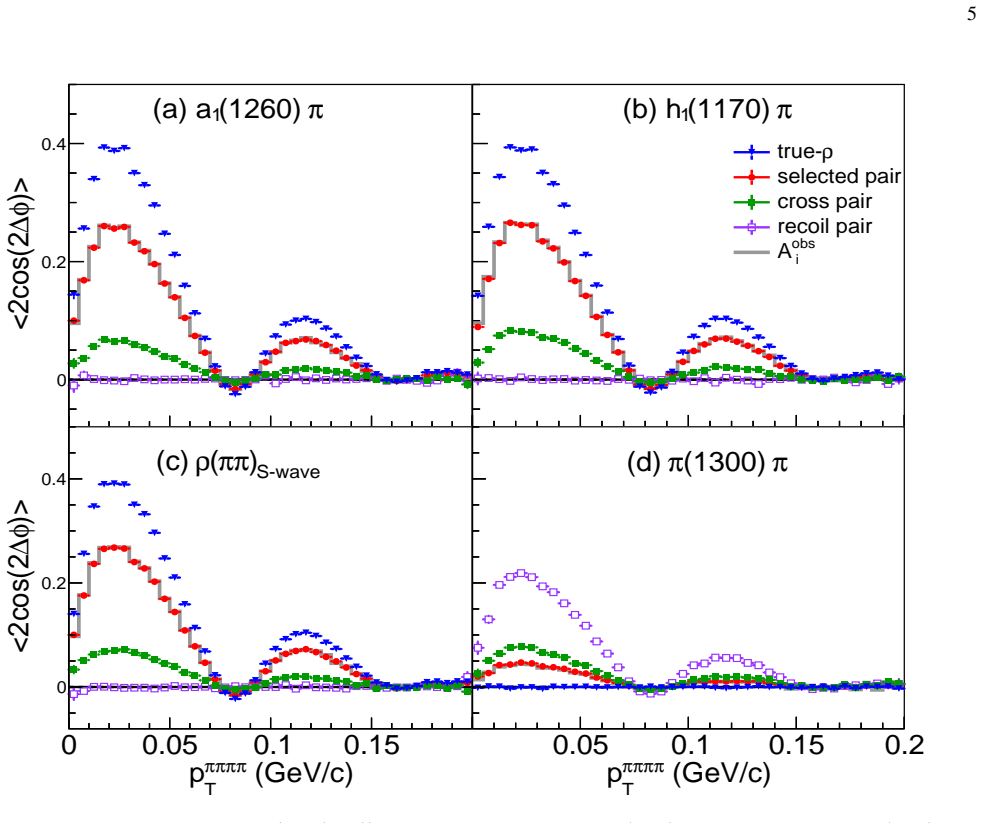
The superposition of amplitudes from two spatially separated production sites in ultra-peripheral collisions generates production-site entanglement, which manifests as entanglement-enabled spin-interference patterns in the angular distributions of decay products; these patterns serve as a sensitive probe of spin-alignment transfer, enabling the measurement of intermediate-state quantum numbers and relative branching ratios, demonstrated through distinct cos 2φ modulations in simulated decay channels of rho(1450) to four pions.
What carries the argument
Production-site entanglement from the quantum superposition of amplitudes at two indistinguishable, spatially separated photo-production sites, which imprints channel-dependent spin-interference visible as cos 2φ modulations in the decay angular distributions.
Load-bearing premise
The two production sites are spatially separated by a distance far exceeding the resonance lifetime, so their amplitudes superpose to generate observable entanglement effects.
What would settle it
If measured azimuthal distributions in rho(1450) four-pion decays from ultra-peripheral collisions fail to exhibit the predicted distinct cos 2φ modulations for the different channels, or if the pi(1300)pi mode does not show a uniquely separated response, the claimed ability to extract quantum numbers and branching ratios would be ruled out.
Figures


read the original abstract
Ultra-peripheral heavy-ion collisions (UPCs) coherently photo-produce vector mesons through two spatially separated and quantum-mechanically indistinguishable production sites, whose separation far exceeds the lifetime of the created resonance. The superposition of these amplitudes generates production-site entanglement, observed experimentally as entanglement-enabled spin-interference patterns in the angular distributions of the decay products. We show that these interference signatures provide a sensitive probe of spin-alignment transfer in hadronic decay chains, enabling intermediate-state quantum numbers and relative branching ratios to be measured from observed angular modulations. Using the decay $\rho(1450)\!\rightarrow\!\pi^{+}\pi^{-}\pi^{+}\pi^{-}$ as example, we simulate the $a_{1}(1260)\pi$, $h_{1}(1170)\pi$, $\rho(\pi\pi)_{S}$, and $\pi(1300)\pi$ channels and demonstrate that each produces a distinct azimuthal $\cos 2\phi$ modulation. The $\pi(1300)\pi$ mode shows a uniquely separated response, allowing its branching fraction to be extracted directly. These results establish production-site entanglement in UPCs as a selective tool for hadron spectroscopy, particularly for broad or overlapping resonances that are otherwise difficult to disentangle.
Editorial analysis
A structured set of objections, weighed in public.
Referee Report
Summary. The paper claims that ultra-peripheral heavy-ion collisions produce vector mesons via two spatially separated, indistinguishable sites whose superposition generates production-site entanglement, manifesting as spin-interference patterns in decay angular distributions. These patterns are asserted to probe spin-alignment transfer, enabling extraction of intermediate-state quantum numbers and relative branching ratios. Using ρ(1450)→π⁺π⁻π⁺π⁻ as example, simulations of the a₁(1260)π, h₁(1170)π, ρ(ππ)ₛ, and π(1300)π channels are said to yield distinct azimuthal cos2φ modulations, with the π(1300)π mode uniquely separable for direct branching-fraction extraction.
Significance. If the claimed distinction between channels survives explicit verification, the method would supply a new experimental handle on broad or overlapping resonances in hadron spectroscopy by exploiting entanglement-induced modulations rather than conventional amplitude analyses.
major comments (1)
- [Theoretical framework and simulation description] The central claim requires that the two indistinguishable production amplitudes generate an entangled initial state whose spin density matrix, after propagation through each decay chain, produces measurably distinct cos2φ modulations. No explicit construction of the joint production amplitude (including polarization entanglement) or its contraction with the decay matrix elements for the a₁π, h₁π, ρ(ππ)ₛ, and π(1300)π channels is provided; without this derivation it is impossible to confirm that the reported differences originate from production-site entanglement rather than from standard helicity structure and kinematics alone.
minor comments (1)
- [Abstract] The abstract states that simulations produce distinct modulations but supplies no information on the Monte Carlo method, acceptance corrections, or statistical uncertainties; these details should be added in the main text.
Simulated Author's Rebuttal
We thank the referee for the careful reading and constructive comments. We address the single major comment below.
read point-by-point responses
-
Referee: [Theoretical framework and simulation description] The central claim requires that the two indistinguishable production amplitudes generate an entangled initial state whose spin density matrix, after propagation through each decay chain, produces measurably distinct cos2φ modulations. No explicit construction of the joint production amplitude (including polarization entanglement) or its contraction with the decay matrix elements for the a₁π, h₁π, ρ(ππ)ₛ, and π(1300)π channels is provided; without this derivation it is impossible to confirm that the reported differences originate from production-site entanglement rather than from standard helicity structure and kinematics alone.
Authors: We agree that an explicit derivation is needed to rigorously establish the origin of the modulations. In the revised manuscript we will add a dedicated subsection that constructs the joint two-site production amplitude, including the polarization entanglement arising from the indistinguishable amplitudes in UPCs. We will then contract this density matrix with the decay amplitudes for each of the four channels (a₁(1260)π, h₁(1170)π, ρ(ππ)ₛ, π(1300)π), propagate the resulting spin density matrix through the decay chains, and extract the cos2φ coefficients. This will demonstrate that the channel-dependent patterns survive after subtracting the standard helicity contributions and are therefore attributable to production-site entanglement. revision: yes
Circularity Check
Derivation chain self-contained; no reductions to inputs by construction
full rationale
The paper presents a simulation of decay channels (a1(1260)π, h1(1170)π, ρ(ππ)S, π(1300)π) under production-site entanglement to show distinct cos2φ modulations, with the π(1300)π mode claimed separable. No equations appear that define a fitted parameter or amplitude in terms of the target observable and then rename it a prediction. No self-citations are used to import uniqueness theorems, ansatze, or load-bearing premises. The central mapping from entangled superposition to channel-specific angular patterns is asserted via explicit simulation rather than by re-expressing the input data or prior self-results, rendering the chain independent of the enumerated circularity patterns.
Axiom & Free-Parameter Ledger
axioms (1)
- domain assumption The two production sites are spatially separated far beyond the resonance lifetime, allowing superposition to produce observable production-site entanglement.
Reference graph
Works this paper leans on
-
[1]
Fermi, Z
E. Fermi, Z. Phys.29, 315 (1924)
1924
-
[2]
C. F. von Weizsacker, Z. Phys.88, 612 (1934)
1934
-
[3]
E. J. Williams, Phys. Rev.45, 729 (1934)
1934
-
[4]
Vidovic, M
M. Vidovic, M. Greiner, C. Best, and G. Soff, Phys. Rev. C47, 2308 (1993)
1993
-
[5]
J. D. Brandenburg, J. Seger, Z. Xu, and W. Zha, Rept. Prog. Phys.86, 083901 (2023), arXiv:2208.14943 [hep-ph]
arXiv 2023
-
[6]
G. Baur, K. Hencken, D. Trautmann, S. Sadovsky, and Y . Kharlov, Phys. Rept.364, 359 (2002), arXiv:hep- ph/0112211
arXiv 2002
-
[7]
J. D. Brandenburg, W. Zha, and Z. Xu, Eur. Phys. J. A57, 299 (2021), arXiv:2103.16623 [hep-ph]
arXiv 2021
-
[8]
X. Wang, J. D. Brandenburg, L. Ruan, F. Shao, Z. Xu, C. Yang, and W. Zha, Phys. Rev. C107, 044906 (2023), arXiv:2207.05595 [nucl-th]
arXiv 2023
-
[9]
C. A. Bertulani, S. R. Klein, and J. Nystrand, Ann. Rev. Nucl. Part. Sci.55, 271 (2005), arXiv:nucl-ex/0502005
Pith/arXiv arXiv 2005
-
[10]
A. J. Baltzet al., Phys. Rept.458, 1 (2008), arXiv:0706.3356 [nucl-ex]
Pith/arXiv arXiv 2008
-
[11]
G. Baur, K. Hencken, and D. Trautmann, Physics Reports453, 1 (2007)
2007
-
[12]
J. D. Brandenburg, S. R. Klein, Z. Xu, S. Yang, W. Zha, and J. Zhou, Prog. Part. Nucl. Phys.143, 104174 (2025), arXiv:2504.18342 [nucl-ex]
arXiv 2025
-
[13]
S. R. Klein, J. Nystrand, J. Seger, Y . Gorbunov, and J. Butterworth, Comput. Phys. Commun.212, 258 (2017), arXiv:1607.03838 [hep-ph]
Pith/arXiv arXiv 2017
-
[14]
C. Adleret al.(STAR), Phys. Rev. Lett.89, 272302 (2002), arXiv:nucl-ex/0206004
Pith/arXiv arXiv 2002
-
[15]
Z.-T. Liang and X.-N. Wang, Phys. Rev. Lett.94, 102301 (2005), arXiv:nucl-th/0410079
Pith/arXiv arXiv 2005
-
[16]
Z.-T. Liang and X.-N. Wang, Phys. Lett. B629, 20 (2005), arXiv:nucl-th/0411101
Pith/arXiv arXiv 2005
-
[17]
Adamczyket al.(STAR), Nature548, 62 (2017), arXiv:1701.06657 [nucl-ex]
L. Adamczyket al.(STAR), Nature548, 62 (2017), arXiv:1701.06657 [nucl-ex]
Pith/arXiv arXiv 2017
-
[18]
M. S. Abdallahet al.(STAR), Nature614, 244 (2023), arXiv:2204.02302 [nucl-ex]
arXiv 2023
-
[19]
Becattini, M
F. Becattini, M. Buzzegoli, T. Niida, S. Pu, A.-H. Tang, and Q. Wang, Int. J. Mod. Phys. E33, 2430006 (2024)
2024
-
[20]
J. Adamet al.(STAR), Phys. Rev. Lett.127, 052302 (2021), arXiv:1910.12400 [nucl-ex]
arXiv 2021
-
[21]
C. Li, J. Zhou, and Y .-J. Zhou, Phys. Lett. B795, 576 (2019), arXiv:1903.10084 [hep-ph]
Pith/arXiv arXiv 2019
-
[22]
S. Acharyaet al.(ALICE), Phys. Lett. B846, 137467 (2023), arXiv:2204.10684 [nucl-ex]
arXiv 2023
-
[23]
J. Adamet al.(ALICE), Phys. Rev. Lett.116, 222301 (2016), arXiv:1509.08802 [nucl-ex]
Pith/arXiv arXiv 2016
-
[24]
G. Aadet al.(ATLAS), Phys. Rev. C107, 054907 (2023), arXiv:2206.12594 [nucl-ex]
arXiv 2023
-
[25]
J. Adamet al.(STAR), Phys. Rev. Lett.121, 132301 (2018), arXiv:1806.02295 [hep-ex]
Pith/arXiv arXiv 2018
-
[26]
J. Adamet al.(STAR), Phys. Rev. Lett.123, 132302 (2019), arXiv:1904.11658 [hep-ex]
arXiv 2019
-
[27]
A. M. Sirunyanet al.(CMS), Phys. Rev. Lett.127, 122001 (2021), arXiv:2011.05239 [hep-ex]
arXiv 2021
-
[28]
W. Zha, L. Ruan, Z. Tang, Z. Xu, and S. Yang, Phys. Rev. C 99, 061901 (2019), arXiv:1810.10694 [hep-ph]
Pith/arXiv arXiv 2019
-
[29]
W. Zha, J. D. Brandenburg, L. Ruan, Z. Tang, and Z. Xu, Phys. Rev. D103, 033007 (2021), arXiv:2006.12099 [hep-ph]
arXiv 2021
-
[30]
H. Xing, C. Zhang, J. Zhou, and Y .-J. Zhou, JHEP10, 064 (2020), arXiv:2006.06206 [hep-ph]
arXiv 2020
-
[31]
M. Abdallahet al.(STAR), Sci. Adv.9, eabq3903 (2023), arXiv:2204.01625 [nucl-ex]
arXiv 2023
-
[32]
STAR Collaboration (STAR), (2025), arXiv:2512.02865 [nucl-ex]
arXiv 2025
-
[33]
S. Acharyaet al.(ALICE), Phys. Lett. B858, 139017 (2024), arXiv:2405.14525 [nucl-ex]
arXiv 2024
-
[34]
J. D. Brandenburg, H. Duan, Z. Tu, R. Venugopalan, and Z. Xu, Phys. Rev. Res.7, 013131 (2025), arXiv:2407.15945 [hep-ph]
arXiv 2025
-
[35]
B. I. Abelevet al.(STAR), Phys. Rev. C81, 044901 (2010), arXiv:0912.0604 [nucl-ex]
Pith/arXiv arXiv 2010
-
[36]
S. Acharyaet al.(ALICE), Phys. Lett. B872, 140006 (2026), arXiv:2404.07542 [nucl-ex]
arXiv 2026
-
[37]
L.-P. He, X. Wang, and X. Liu, Phys. Rev. D88, 034008 (2013), arXiv:1306.5562 [hep-ph]
Pith/arXiv arXiv 2013
-
[38]
F. E. Close and P. R. Page, Phys. Rev. D56, 1584 (1997), arXiv:hep-ph/9701425
Pith/arXiv arXiv 1997
-
[39]
F. J. Gilman, J. Pumplin, A. Schwimmer, and L. Stodolsky, Phys. Lett. B31, 387 (1970)
1970
-
[40]
Harari and Y
H. Harari and Y . Zarmi, Phys. Lett. B32, 291 (1970)
1970
-
[41]
Bialas, J
A. Bialas, J. Dabkowski, and L. Van Hove, Nucl. Phys. B27, 338 (1971)
1971
-
[42]
Amsler, Rev
C. Amsler, Rev. Mod. Phys.70, 1293 (1998)
1998
-
[43]
Abeleet al.(CRYSTAL BARREL), Eur
A. Abeleet al.(CRYSTAL BARREL), Eur. Phys. J. C21, 261 (2001)
2001
-
[44]
Fix and I
A. Fix and I. Dementjev, Eur. Phys. J. A60, 167 (2024)
2024
-
[45]
Ablikimet al.(BESIII), JHEP06, 181 (2021), arXiv:2103.15098 [hep-ex]
M. Ablikimet al.(BESIII), JHEP06, 181 (2021), arXiv:2103.15098 [hep-ex]
arXiv 2021
discussion (0)
Sign in with ORCID, Apple, or X to comment. Anyone can read and Pith papers without signing in.