REVIEW 4 major objections 4 minor 52 references
Federated Learning-based Semantic Segmentation for Lane and Object Detection in Autonomous Driving
T0 review · 4 major / 4 minor · reviewed 2026-08-16 · deepseek-v4-flash
Pith's one-line read The paper claims that federated learning with differential privacy can train lane and object segmentation across autonomous vehicles without centralizing image data, raising accuracy from 81.5% to 88.7% on RGB scenes and from 79.3% to…
desk verdict The reported accuracy numbers contradict each other across the abstract, conclusion, and results, and the experiments do not use the claimed hybrid architecture; the empirical core is unreliable. read the letter →
The pith
A machine-rendered reading of the paper's core claim, the machinery that carries it, and where it could break.
The reading
What carries the argument
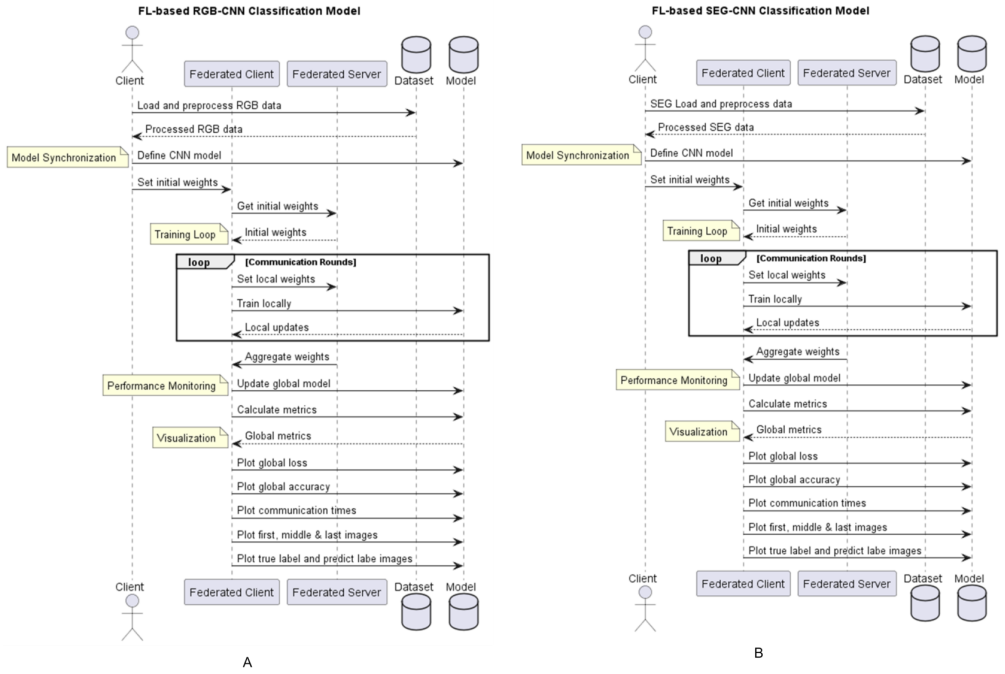
The mechanism that carries the argument is federated averaging with Gaussian-noise differential privacy: each client computes a local update, the server forms the weighted average $w_{t+1} = \sum_i \frac{n_i}{n} w^i_{t+1}$, and each update is perturbed with Gaussian noise $\tilde{w}^i_{t+1} = w^i_{t+1} + \mathcal{N}(0, \sigma^2)$ before sharing. The model the paper says it is training is a hybrid UNet-ResNet34 encoder-decoder, which would combine UNet's fine-grained segmentation with ResNet34's residual feature extraction. Repeated communication rounds then let the decentralized model converge: 20, 40, and 70 rounds define the experimental schedule, and accuracy rises with the number of rounds.
What would settle it
Run the identical 20-, 40-, and 70-round federated protocol twice, once with the simple convolutional stack listed in the parameter tables and once with a genuine UNet-ResNet34 encoder-decoder; if both reproduce the reported 88.7% RGB and 86.9% SEG accuracy curves, the hybrid architecture is not what carries the result.
Extended reading notes
Core claim
On the paper's own terms, the central discovery is that a federated semantic segmentation framework with differentially private updates can approach centralized accuracy while keeping data decentralized. Vehicles act as clients that train locally and share only parameter updates; the server aggregates them with a weighted average, and Gaussian noise is added to each update to provide a differential-privacy guarantee. The proposed pipeline pairs a hybrid UNet-ResNet34 segmentation architecture with federated averaging and DP noise. The paper reports accuracy rising from 81.5% to 88.7% on the RGB dataset and from 79.3% to 86.9% on the SEG dataset over 20 to 70 communication rounds, with global loss cut by more than 60%, and it further reports that the federated model reaches parity with, and in places exceeds, the centralized Phase-1 baselines.
Load-bearing premise
The load-bearing premise is that the model tested in the federated experiments is the hybrid UNet-ResNet34 architecture the paper describes; the experimental tables instead list a simple three-block convolutional network with no skip connections or residual blocks, so if the reported numbers came from that simpler model, the central architecture claim would be unsupported.
Editorial extensions
If this is right
- If the central claim is right, a fleet of vehicles could jointly improve a shared segmentation model by uploading only perturbed parameter updates, removing the need to pool sensitive camera footage on a central server.
- Increasing communication rounds from 20 to 70 would buy roughly 7 accuracy points on RGB data and more than 7 points on segmentation labels, giving operators a direct knob for trading bandwidth against performance.
- Differential privacy at $\varepsilon = 0.1$ would cost only about 1 to 3 accuracy points compared with $\varepsilon = 1.0$, so strong privacy could be adopted without a large performance penalty.
- The reported near-parity between the centralized phase and the federated phase suggests that federated deployment would not force a major regression in segmentation quality.
- Communication time scaling from about 90 seconds at 20 rounds to 240 seconds at 70 rounds indicates that update compression or asynchronous aggregation is the next practical bottleneck.
Reading between the lines
- Editorial extension: the accuracy figures would probably not transfer directly to real roads, because the experiments use balanced, simulator-generated data; a natural next test is the same protocol on uncurated, non-IID data from vehicles driving in different cities, weather, and camera hardware.
- Editorial extension: the paper's stated privacy guarantee depends on the noise scale and epsilon, but it does not report the noise variance or a formal DP accounting; a concrete follow-up is to compute the accumulated privacy budget across 70 rounds and report $\varepsilon$ versus $\sigma$ curves.
- Editorial extension: the parameter tables describe the federated model as a plain sequential CNN, so the claim that the hybrid UNet-ResNet34 is responsible for the gains is not yet tested; rerunning the same rounds with a true encoder-decoder residual network would settle whether the architectural contribution matters.
- Editorial extension: if DP noise is clipped and compressed along with the updates, communication time and privacy loss could be traded together, and the 90-to-240 second communication costs suggest this is where deployment would succeed or fail.
Signed reviews
Editorial analysis
A structured set of objections, weighed in public.
Referee Report
Summary. The paper proposes a federated learning (FL) framework with differential privacy (DP) for semantic segmentation in autonomous driving, applied to RGB and SEG datasets derived from the CARLA simulator and the Lyft Udacity Challenge dataset. The study is organized in two phases: Phase-1 uses a centralized hybrid UNet-ResNet34 architecture, and Phase-2 uses federated learning with DP across simulated autonomous vehicle clients. The central claim, stated in the abstract and introduction, is that the FL approach improves accuracy from 81.5% to 88.7% on the RGB dataset and from 79.3% to 86.9% on the SEG dataset as communication rounds increase from 20 to 70, while reducing global loss by over 60% and incurring only minor accuracy loss from DP. The paper also claims to demonstrate state-of-the-art performance compared with recent methods and to provide a scalable, privacy-preserving solution for real-world AV perception.
Significance. If the reported results were reliable, the paper would describe a useful privacy-preserving approach to federated semantic segmentation for autonomous driving, combining a hybrid UNet-ResNet34 architecture with differential privacy in a decentralized setting. The paper does document its experimental setup, including hyperparameters in Tables 2 through 5, and uses standard metrics such as accuracy, Mean IoU, sensitivity, specificity, and precision. However, the significance of the contribution is undermined by pervasive internal inconsistencies in the quantitative results and by a mismatch between the advertised architecture and the architecture actually described in the experimental tables. The paper provides no code, no training logs, and only a vague data-availability statement, so the conflicting numbers cannot be resolved by the reader.
major comments (4)
- [Abstract, Contribution 4, Section 5, Conclusion] The central empirical claim is not supported by a single coherent set of accuracy measurements. The abstract and Contribution 4 report RGB accuracy improving from 81.5% to 88.7% and SEG accuracy from 79.3% to 86.9% over 20 to 70 communication rounds. The Summary of Key Findings and the Conclusion instead report RGB accuracy of 88.7% at 20 CRs and 92.8% at 70 CRs, and SEG accuracy from 86.5% to 90.9%. The Phase-2 Results narrative claims global accuracy 'nearly 98% after 70 CRs' for RGB and about 95% for SEG. Table 12 reports Phase-2 accuracy of 0.93 at 70 CRs, while Table 8 reports RGB test accuracy of 0.3583 and Table 9 reports SEG test accuracy of 0.1750. These discrepancies span tens of percentage points, and because no code or training logs are provided, the reader cannot determine which, if any, of these numbers reflects the actual experiment. This directly undermines the paper's central claim of a competitive FL+DP framework.
- [Section 4, Tables 3 and 5] The architecture actually specified for the federated experiments is not the hybrid UNet-ResNet34 architecture claimed in the abstract and introduction. Tables 3 and 5 list a plain Sequential CNN consisting of three Conv2D-MaxPooling blocks, a Flatten layer, a Dense(64) layer, Dropout(0.5), and a final Dense layer with softmax activation. No encoder-decoder connections, residual blocks, or any UNet or ResNet34 components appear in the described architecture. The Phase-2 text refers to 'FL-CNN' models, not to the hybrid architecture. As a result, the Phase-2 results cannot be attributed to the proposed hybrid UNet-ResNet34 model, and the claimed advantages of that architecture are unsupported.
- [Section 4, Tables 6/8/9/11, Figure 19] The reported effect of differential privacy is contradictory. Table 6, 'Effect of Privacy Budget on Accuracy and Mean IoU,' shows accuracy increasing from 86.5% at epsilon=0.1 to 89.2% at epsilon=1.0, which is the expected trend. Table 11, 'Trade-off Between Privacy (Epsilon) and Model Accuracy,' reports accuracy of 0.31 at epsilon=0.1 and 0.22 at epsilon=1.0, which is the opposite trend with vastly different magnitudes. In addition, Tables 8 and 9 report test accuracies of 0.3583 (RGB) and 0.1750 (SEG) under DP, which are incompatible with the values in Table 6. Figure 19 shows RGB loss decreasing from 3.1 to 2.6 (roughly 16%) and SEG loss from 3.0 to 2.86 (roughly 5%), which is inconsistent with the abstract's claim that global loss was reduced by over 60%. These contradictions mean the paper's account of the privacy-performance trade-off is not reproducible and does not support the stated conclusions.
- [Section 4, 'Analysis of Performance Metrics across Different CRs on RGB Dataset'] The description of loss behavior is internally inconsistent. The text states that global loss starts at 2.8, 3.5, and 7.0 for 20, 40, and 70 CRs respectively and drops to 0.0 in all cases, while Figure 19 shows the loss decreasing only modestly, from 3.1 to 2.6 for RGB and from 3.0 to 2.86 for SEG, and nowhere near zero. Since the loss curves are presented as key evidence of successful training, this inconsistency further casts doubt on the validity of the reported results.
minor comments (4)
- [Section 2] The paragraphs on lane detection methods (LaneNet, SCNN, DeepLabV3+, ENet) are repeated nearly verbatim twice in the literature review; one copy should be removed.
- [Section 5] The Discussion section refers to 'different Compression Rates (CRs)' although 'CRs' is defined throughout the paper as 'Communication Rounds'. The terminology should be made consistent.
- [Table 8] In Table 8, the Kappa Score is listed as 0.2570 for both training and testing, which appears to be a typo; the text reports a testing Kappa of 0.3248 earlier in the same paragraph. The table and text should be reconciled.
- [Data Availability] The statement 'The data is available upon request through the corresponding author' is not sufficient for reproducibility; the authors should provide details on how to access the data, or release the code and trained model artifacts.
Circularity Check
No circularity: the central claims are empirical benchmarks, not derivations that reduce to their own inputs.
full rationale
The paper's central evidence consists of self-reported experimental measurements (accuracy, loss, Mean IoU, privacy budgets) obtained by training semantic-segmentation models in centralized and federated settings. There is no analytic derivation in which a claimed prediction is equivalent, by construction, to a fitted parameter or to an assumed ansatz. The formal equations presented (Eqs. 1-6) are standard definitions of CNN output, loss, differential privacy, federated averaging, and Gaussian noise injection; none of these equations is used to derive the reported accuracy numbers. The authors cite their own prior work in the literature review (for example, references on autonomous-vehicle control), but those citations do not provide any load-bearing theorem or fitted value used in the experimental results. The internal contradictions among the accuracy figures in the abstract, results narrative, tables, and summary are serious reproducibility and correctness concerns, but they are not circularity: the reported numbers are presented as observations rather than as conclusions forced by the paper's definitions. Consequently, no specific circular step can be exhibited, and the appropriate circularity score is 0.
Assumptions & free parameters
free parameters (4)
- DP noise scale (sigma) =
not reported
- Differential privacy epsilon =
0.1 in main experiments; 0.5 and 1.0 in Table 6
- Number of federated clients =
10
- Samples per round, batch size, and epochs =
14, 7, 4 samples; 32, 64, 128 batch; 5, 10, 20 epochs
assumptions (4)
- domain assumption FedAvg converges for the non-IID client distributions used here
- domain assumption Eq. 6 with unstated sigma provides (epsilon, delta)-differential privacy at epsilon=0.1
- domain assumption The CARLA and Lyft Udacity data are representative of AV segmentation evaluation
- ad hoc to paper The architecture described in Tables 3 and 5 is the hybrid UNet-ResNet34
Cite this review
Pith. "Pith review of Federated Learning-based Semantic Segmentation for Lane and Object Detection in Autonomous Driving." pith.science (2026). https://pith.science/paper/HE37BLY6
@misc{pith2026250418939,
  author       = {Pith},
  title        = {Pith review of: Federated Learning-based Semantic Segmentation for Lane and Object Detection in Autonomous Driving},
  year         = {2026},
  howpublished = {\url{https://pith.science/paper/HE37BLY6}},
  note         = {Machine review of arXiv:2504.18939}
}
read the original abstract
Autonomous Vehicles (AVs) require precise lane and object detection to ensure safe navigation. However, centralized deep learning (DL) approaches for semantic segmentation raise privacy and scalability challenges, particularly when handling sensitive data. This research presents a new federated learning (FL) framework that integrates secure deep Convolutional Neural Networks (CNNs) and Differential Privacy (DP) to address these issues. The core contribution of this work involves: (1) developing a new hybrid UNet-ResNet34 architecture for centralized semantic segmentation to achieve high accuracy and tackle privacy concerns due to centralized training, and (2) implementing the privacy-preserving FL model, distributed across AVs to enhance performance through secure CNNs and DP mechanisms. In the proposed FL framework, the methodology distinguishes itself from the existing approach through the following: (a) ensuring data decentralization through FL to uphold user privacy by eliminating the need for centralized data aggregation, (b) integrating DP mechanisms to secure sensitive model updates against potential adversarial inference attacks, and (c) evaluating the frameworks performance and generalizability using RGB and semantic segmentation datasets derived from the CARLA simulator. Experimental results show significant improvements in accuracy, from 81.5% to 88.7% for the RGB dataset and from 79.3% to 86.9% for the SEG dataset over 20 to 70 Communication Rounds (CRs). Global loss was reduced by over 60%, and minor accuracy trade-offs from DP were observed. This study contributes by offering a scalable, privacy-preserving FL framework tailored for AVs, optimizing communication efficiency while balancing performance and data security.
Figures


Figures from the paper (19 more)


Reference graph
Works this paper leans on
-
[1]
Gideon, F. S. et al. Autonomous lane navigation: Using hand-coded method and deep learning method. In Isa, K. et al. (eds.) Proceedings of the 12th National Technical Seminar on Unmanned System Technology 2020, 937–963 (Springer Singapore, Singapore, 2022)
work page 2020
-
[2]
Abubakar, A., Mohiuddin, M. B., Hay, O. A., Yakubu, M. & Alhammadi, R. Robust control for autonomous vehicle lateral dynamics: A comparative study of gain-schedule lpv and non-linear mpc*. In 2024 8th International Conference on Robotics, Control and Automation (ICRCA), 311–317, DOI: 10.1109/ICRCA60878.2024.10649172 (2024)
-
[3]
Bathla, G. et al. Autonomous vehicles and intelligent automation: Applications, challenges, and opportunities. Mob. Inf. Syst. 2022, 7632892 (2022)
work page 2022
-
[4]
Zhang, Q., Zhang, T. & Ma, L. Human acceptance of autonomous vehicles: Research status and prospects. Int. J. Ind. Ergonomics 95, 103458, DOI: https://doi.org/10.1016/j.ergon.2023.103458 (2023)
arXiv 2023
- [5]
-
[6]
Tahir, N. U. A., Zhang, Z., Asim, M., Chen, J. & ELAffendi, M. Object detection in autonomous vehicles under adverse weather: A review of traditional and deep learning approaches. Algorithms 17 (2024)
work page 2024
-
[7]
Tang, S. et al. A survey on automated driving system testing: Landscapes and trends (2023). 2206.05961
arXiv 2023
-
[8]
Yu, Y . et al. Techniques and challenges of image segmentation: A review. Electronics 12, DOI: 10.3390/ electronics12051199 (2023)
work page 2023
Show all 52 references
-
[9]
Ensuring Location Data Privacy in Connected and Automated Vehicles (CA Vs)
Dunphy, A. Ensuring Location Data Privacy in Connected and Automated Vehicles (CA Vs). ANU J. Law Technol. 4 (2024)
2024
-
[10]
Zhu, Z. et al. Fedprm: Federated personalized mixture representation for driver intention prediction. IEEE Transactions on Intell. Veh. 1–14, DOI: 10.1109/TIV .2024.3416846 (2024). 29/32
2024
-
[11]
Al-Huthaifi, R., Li, T., Huang, W., Gu, J. & Li, C. Federated learning in smart cities: Privacy and security survey. Inf. Sci. 632, 833–857, DOI: https://doi.org/10.1016/j.ins.2023.03.033 (2023)
2023 doi
-
[12]
K., Gupta, A
Paswan, V . K., Gupta, A. C. & Choudhary, A. Computer vision and deep learning based framework for road scene and surface segmentation in unstructured environment. In 2022 IEEE International Conference on Service Operations and Logistics, and Informatics (SOLI), 1–6, DOI: 10.1...
2022
-
[13]
Amonkar, V . A. S.A Comparative Perspectives on Data Protection Laws-with References to Europe, United States of America, the United Kingdom and India. Ph.D. thesis, Goa University (2023)
2023
-
[14]
R., Arigbabu, A
Mayeke, N. R., Arigbabu, A. T., Olaniyi, O. O., Okunleye, O. J. & Adigwe, C. S. Evolving Access Control Paradigms: A Comprehensive Multi-Dimensional Analysis of Security Risks and System Assurance in Cyber Engineering. SSRN Electron. J. DOI: 10.2139/ssrn.4752902 (2024)
2024 doi
-
[15]
I., Tan, S
Pavel, M. I., Tan, S. Y . & Abdullah, A. Vision-based autonomous vehicle systems based on deep learning: A systematic literature review. Appl. Sci. 12, DOI: 10.3390/app12146831 (2022)
2022 doi
-
[16]
& Kashef, R
Jebamikyous, H.-H. & Kashef, R. Autonomous vehicles perception (avp) using deep learning: Modeling, assessment, and challenges. IEEE Access 10, 10523–10535, DOI: 10.1109/ACCESS.2022.3144407 (2022)
2022
-
[17]
& Qureshi, A
Khan, A., Sohail, A., Zahoora, U. & Qureshi, A. S. A survey of the recent architectures of deep convolutional neural networks. CoRR abs/1901.06032 (2019). 1901.06032
2019 arXiv
-
[18]
Minaee, S. et al. Image segmentation using deep learning: A survey. CoRR abs/2001.05566 (2020). 2001.05566
2020 arXiv
-
[19]
Muhammad, K., Ullah, A., Lloret, J., Ser, J. D. & de Albuquerque, V . H. C. Deep learning for safe autonomous driving: Current challenges and future directions. IEEE Transactions on Intell. Transp. Syst. 22, 4316–4336, DOI: 10.1109/TITS.2020.3032227 (2021)
2021
-
[20]
Liang, W. et al. Advances, challenges and opportunities in creating data for trustworthy AI. Nat. Mach. Intell. 4, 669–677, DOI: 10.1038/s42256-022-00516-1 (2022)
2022 doi
-
[21]
& Abraham, A
Kumar Tyagi, A., Manoj Nair, M., Niladhuri, S. & Abraham, A. Security, Privacy Research issues in Various Computing Platforms: A Survey and the Road Ahead. J. Inf. Assur. Secur. 15, 001–016 (2020)
2020
-
[22]
Li, Q. et al. A survey on federated learning systems: Vision, hype and reality for data privacy and protection. CoRR abs/1907.09693 (2019). 1907.09693
2019 arXiv
-
[23]
A survey on security and privacy of federated learning
Mothukuri, V .et al. A survey on security and privacy of federated learning. Futur. Gener. Comput. Syst. 115, 619–640, DOI: https://doi.org/10.1016/j.future.2020.10.007 (2021)
2021 doi
-
[24]
S., Umer, T
Shaheen, M., Farooq, M. S., Umer, T. & Kim, B.-S. Applications of federated learning; taxonomy, challenges, and research trends. Electronics 11, DOI: 10.3390/electronics11040670 (2022)
2022 doi
-
[25]
Aledhari, M., Razzak, R., Parizi, R. M. & Saeed, F. Federated learning: A survey on enabling technologies, protocols, and applications. IEEE Access 8, 140699–140725, DOI: 10.1109/ACCESS.2020.3013541 (2020)
2020
-
[26]
P., Yuan, L., Brinton, C
Chellapandi, V . P., Yuan, L., Brinton, C. G., Zak, S. H. & Wang, Z. Federated learning for connected and automated vehicles: A survey of existing approaches and challenges (2023). 2308.10407
2023 arXiv
-
[27]
Li, Y ., Tao, X., Zhang, X., Liu, J. & Xu, J. Privacy-preserved federated learning for autonomous driving.IEEE Transactions on Intell. Transp. Syst. 23, 8423–8434, DOI: 10.1109/TITS.2021.3081560 (2022)
2022
-
[28]
& Wang, B
Sun, T., Li, D. & Wang, B. Decentralized federated averaging. CoRR abs/2104.11375 (2021). 2104.11375
2021 arXiv
-
[29]
Zhou, Y ., Ye, Q. & Lv, J. Communication-efficient federated learning with compensated overlap-fedavg. CoRR abs/2012.06706 (2020). 2012.06706
2020 arXiv
-
[30]
A., Mourad, A
Arisdakessian, S., Wahab, O. A., Mourad, A. & Otrok, H. Coalitional federated learning: Improving communication and training on non-iid data with selfish clients. IEEE Transactions on Serv. Comput. 16, 2462–2476, DOI: 10.1109/TSC.2023. 3246988 (2023)
2023 doi
-
[31]
& Hong, C
Tran, N., Bao, W., Zomaya, A., Nguyen, M. & Hong, C. Federated learning over wireless networks: Optimization model design and analysis. In INFOCOM 2019 - IEEE Conference on Computer Communications, Proceedings - IEEE INFOCOM, 1387–1395, DOI: 10.1109/INFOCOM.2019.8737464 (Insti...
2019
-
[32]
& Verma, G
Dhillon, A. & Verma, G. K. Convolutional neural network: a review of models, methodologies and applications to object detection. Prog. Artif. Intell. 9, 85–112, DOI: 10.1007/s13748-019-00203-0 (2020). 30/32
2020 doi
-
[33]
& Saraswat, M
Tiwari, T. & Saraswat, M. A new modified-unet deep learning model for semantic segmentation. Multimed. Tools Appl. 82, 3605–3625, DOI: 10.1007/s11042-022-13230-2 (2023)
2023 doi
-
[34]
& Wang, Z
Xu, Z. & Wang, Z. MCV-UNet: a modified convolution & transformer hybrid encoder-decoder network with multi-scale information fusion for ultrasound image semantic segmentation.PeerJ Comput. Sci.10, e2146, DOI: 10.7717/peerj-cs.2146 (2024)
2024 doi
-
[35]
Liu, X., Kong, W. & Oh, S. Differential privacy and robust statistics in high dimensions (2021). 2111.06578
2021 arXiv
-
[36]
& Yang, X
Wang, T., Zhang, X., Feng, J. & Yang, X. A comprehensive survey on local differential privacy toward data statistics and analysis. Sensors 20, DOI: 10.3390/s20247030 (2020)
2020 doi
-
[37]
& Flammini, F
Mohammadi, S., Balador, A., Sinaei, S. & Flammini, F. Balancing privacy and performance in federated learning: A systematic literature review on methods and metrics. J. Parallel Distributed Comput. 192, 104918, DOI: https: //doi.org/10.1016/j.jpdc.2024.104918 (2024)
2024
-
[38]
Ouadrhiri, A. E. & Abdelhadi, A. Differential privacy for deep and federated learning: A survey. IEEE Access 10, 22359–22380, DOI: 10.1109/ACCESS.2022.3151670 (2022)
2022
-
[39]
Yao, A. et al. Fedshufde: A privacy preserving framework of federated learning for edge-based smart uav delivery system. Futur. Gener. Comput. Syst. 166, 107706, DOI: https://doi.org/10.1016/j.future.2025.107706 (2025)
2025
-
[40]
& LIU, X
Y AO, A., PAL, S., DONG, C., LI, X. & LIU, X. A framework for user biometric privacy protection in uav delivery systems with edge computing. In 2024 IEEE International Conference on Pervasive Computing and Communications Workshops and other Affiliated Events, PerCom Workshops ...
2024
-
[41]
Zhang, C. et al. Fed4ul: A cloud–edge–end collaborative federated learning framework for addressing the non-iid data issue in uav logistics. Drones 8, DOI: 10.3390/drones8070312 (2024)
2024 doi
-
[42]
Yao, A. et al. A privacy-preserving location data collection framework for intelligent systems in edge computing. Ad Hoc Networks 161, 103532, DOI: https://doi.org/10.1016/j.adhoc.2024.103532 (2024)
2024
-
[43]
& LIU, X
DONG, C., PAL, S., CHEN, S., JIANG, F. & LIU, X. A privacy-aware task distribution architecture for uav communications system using blockchain. IEEE Internet Things J. DOI: 10.1109/JIOT.2025.3529808 (2025). Publisher Copyright: © 2014 IEEE
2025
-
[44]
A novel security framework for edge computing based uav delivery system
YAO, A.et al. A novel security framework for edge computing based uav delivery system. In ZHAO, L., KUMAR, N., HSU, R. & ZOU, D. (eds.) Proceedings : 2021 IEEE 20th International Conference on Trust, Security and Privacy in Computing and Communications, TrustCom 2021, 1031–103...
2021
-
[45]
& Liu, P
Tang, J., Li, S. & Liu, P. A review of lane detection methods based on deep learning. Pattern Recognit. 111, 107623, DOI: https://doi.org/10.1016/j.patcog.2020.107623 (2021)
2021
-
[46]
& Farah, H
Dong, Y ., Patil, S., van Arem, B. & Farah, H. A hybrid spatial-temporal deep learning architecture for lane detection. CoRR abs/2110.04079 (2021). 2110.04079
2021 arXiv
-
[47]
Wang, Z. et al. Semantic segmentation of high-resolution remote sensing images based on a class feature attention mechanism fused with deeplabv3+. Comput. & Geosci. 158, 104969, DOI: https://doi.org/10.1016/j.cageo.2021.104969 (2022)
2022
-
[48]
Wang, Z., Zhang, H., Huang, Z., Lin, Z. & Wu, H. Multi-scale dense and attention mechanism for image semantic segmentation based on improved DeepLabv3+. J. Electron. Imaging 31, 053006, DOI: 10.1117/1.JEI.31.5.053006 (2022)
2022 doi
-
[49]
& Luo, A
Yi, Q., Dai, G., Shi, M., Huang, Z. & Luo, A. ELANet: Effective Lightweight Attention-Guided Network for Real-Time Semantic Segmentation. Neural Process. Lett. 55, 6425–6442, DOI: 10.1007/s11063-023-11145-z (2023)
2023 doi
-
[50]
Tahir, N. U. A., Zhang, Z., Asim, M., Iftikhar, S. & A. Abd El-Latif, A. PVDM-YOLOv8l: a solution for reliable pedestrian and vehicle detection in autonomous vehicles under adverse weather conditions. Multimed. Tools Appl. DOI: 10.1007/s11042-024-20219-6 (2024)
2024 doi
-
[51]
I., Sulaiman, S
Abubakar, A., Dahiru, K. I., Sulaiman, S. H. & Mustapha, H. Robust polytopic lpv based adaptive cruise control design for autonomous vehicle system. Int. J. Sci. Eng. Res. 10, 1367–1373 (2019)
2019
-
[52]
Kaggle 2018
Kaggle. Kaggle 2018. 31/32 Acknowledgements The authors would like to thank all contributors who provided valuable insights and support throughout the course of this research. Author contributions statement G.K.A. conceived the study, designed the methodology, and supervised t...
2018
Reviewed August 16, 2026 · model on record in the stance chip above.
Discussion (0). Continue with ORCID to comment.