REVIEW 4 major objections 5 minor 2 cited by
Generative Models for Fast Simulation of Cherenkov Detectors at the Electron-Ion Collider
T0 review · 4 major / 5 minor · reviewed 2026-08-16 · deepseek-v4-flash
Pith's one-line read Trained generative models can reproduce Cherenkov detector hit patterns for pion and kaon tracks at a small fraction of Geant4's cost, and a discrete normalizing flow gives the best speed-fidelity trade-off.
desk verdict A useful open fast-simulation package, but the track-level fidelity claim needs a test that actually sees tracks. read the letter →
The pith
A machine-rendered reading of the paper's core claim, the machinery that carries it, and where it could break.
The reading
What carries the argument
The load-bearing mechanism is the translation of a track-level simulation problem into a photon-level tabular generation problem. Each Cherenkov photon is treated as approximately independent of the others given the parent track's kinematics, so the model learns a posterior over a photon's coordinates and arrival time; a look-up table sampled from training data supplies the number of photons per track. The pixelized readout is mapped to continuous coordinates through index transformations and a small uniform smearing during training, and a physical prior resamples any generated photon that falls outside the detector's active area or PMT boundaries. Among the five model families tested—discrete normalizing flows, continuous normalizing flows, flow matching, DDPM, and score-based diffusion—the discrete normalizing flow, a chain of invertible transformations from a Gaussian-mixture latent space to the photon-coordinate space, is selected as the best baseline because it combines exact likelihood training with the fastest generation and the lowest resampling fraction.
What would settle it
Generate a fixed-kinematic sample of tracks from both the fast simulator and Geant4, then train a classifier on per-track hit patterns without summing over tracks; if the classifier separates the two sources with high accuracy, the smoothing and missed discrete effects are large enough to matter for particle identification. A simpler version is to compare the per-track distribution of arrival-time gaps or pixel preferences, which the paper acknowledges differ through effects such as the kaleidoscopic pixel preferences at the readout.
Extended reading notes
Core claim
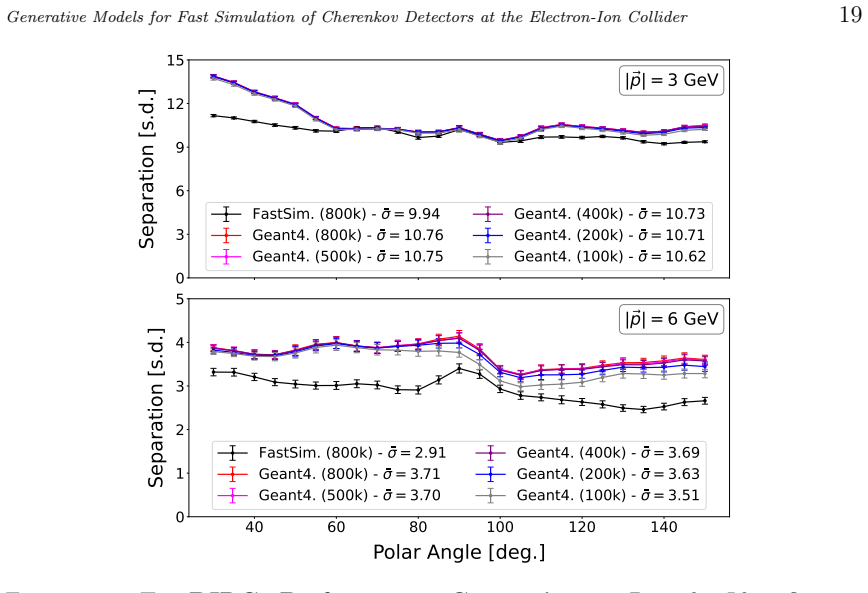
The paper's central claim is that Cherenkov-photon hit patterns in a DIRC detector can be learned as conditional distributions over position and arrival time given track momentum and polar angle, with each photon drawn independently and aggregated into tracks. Under this decomposition, generative models—especially a discrete normalizing flow—produce high-fidelity simulations: the authors report an order-of-magnitude speedup at the track level and multiple orders of magnitude at the photon level, with closure tests showing agreement with Geant4 in histogram ratios and photon yields. A GPU version of FastDIRC built on the fast-simulated reference PDFs reaches pion-kaon separation approaching the EIC requirement of 3σ at 6 GeV/c, about one to two standard deviations below the Geant4-based references because the generative models smooth the distributions. The authors conclude that this makes on-the-fly, virtually unlimited simulation practical for developing and benchmarking deep-learning-based particle identification.
Load-bearing premise
The framework rests on treating each Cherenkov photon as independent of the others once the track's momentum and polar angle are fixed, and on a simplified working point without azimuthal dependence or magnetic field; if photon-photon correlations or those omitted effects shape the readout pattern, the generated tracks will not fully match Geant4.
Editorial extensions
If this is right
- FastDIRC and time-imaging reconstruction can build per-track reference PDFs in real time, removing the need to store large Geant4 reference datasets.
- Researchers without a Geant4/ROOT software stack can produce hpDIRC training data on demand with a single GPU, lowering the barrier to deep-learning-based particle identification.
- Because the generative models smooth the pion and kaon distributions, fast-simulated separation power is slightly below Geant4-based values; the paper's closure tests indicate the gap is about one percent in full-phase-space AUC and one to two sigma in fixed-kinematics separation.
- The same modular pipeline—tabular photon generation, yield look-up table, physical resampling prior—is designed to be retrained for other detector geometries and to be extended to include azimuthal dependence and magnetic field.
Reading between the lines
- If photon-level correlations, such as arrival-time correlations among photons from the same track, turn out to matter for particle identification, the independence decomposition is the first point to test; a per-track likelihood comparison between fast and full simulation would reveal it.
- The current working point fixes azimuth and omits the magnetic field, so the strongest test of the framework's generality is whether the same models hold once those degrees of freedom are added to the conditioning.
- The residual smoothing could be measured directly: a classifier trained to distinguish fast-simulated from Geant4 track-level hit patterns in a fixed kinematic bin would quantify how much information the generative model loses, beyond what histogram ratios show.
- The conditional-photon formulation may transfer to other imaging Cherenkov detectors, but the pixel mapping, smearing width, and physical prior would each need to be re-derived for a new readout geometry.
Signed reviews
Editorial analysis
A structured set of objections, weighed in public.
Referee Report
Summary. The paper presents an open, GPU-accelerated fast simulation toolkit for the High-Performance DIRC (hpDIRC) detector at the Electron-Ion Collider, based on a suite of deep generative models: Discrete Normalizing Flows, Continuous Normalizing Flows, Flow Matching, Denoising Diffusion Probabilistic Models, and Score-Based Models. Following the decomposition approach of Fanelli et al., each track is replaced by an independent bag of Cherenkov photons conditioned on the parent track kinematics (momentum |p| and polar angle theta), with photon multiplicity sampled from a lookup table (LUT) fitted to training data. The models are compared via marginal density ratio plots in x, y, and time, through generation-time and resampling-fraction benchmarks, and via downstream particle-identification proxies: a GPU-ported FastDIRC separation study at fixed momenta and a full-phase-space Delta-Log-Likelihood (DLL) AUC test. The DNF is selected as the best model. The paper claims order-of-magnitude track-level speedups, multiple orders-of-magnitude photon-level speedups, and 'high-fidelity simulations' of Cherenkov detector responses.
Significance. If the track-level fidelity claim were established, this would be a practically useful tool for PID research at the EIC and for lowering the entry barrier for deep-learning researchers working on Cherenkov detectors. The manuscript has several concrete strengths: it ships open code, evaluates five generative architectures in a common framework, provides a GPU implementation of FastDIRC, and is explicit about the restricted working point (fixed azimuth, no magnetic field, no dark rate). The computational speedups reported are credible and clearly quantified. However, the paper's central claim of 'high-fidelity simulations' at the track level is not directly supported by the presented evidence: all quantitative validations exercise only per-photon marginals or per-photon likelihood sums, which are insensitive to the independence approximation that underlies the track decomposition. The photon-yield LUT validation also carries a circularity risk. These gaps are fixable with additional closure tests, so the contribution is defensible in principle but needs major revision before the advertised claims can be endorsed.
major comments (4)
- [Sec. 2, Sec. 3.1, Sec. 6] The headline claim that the generated samples are 'high-fidelity simulations' at the track level is not tested by the presented metrics. Section 2 and Section 3.1 replace each track by conditionally independent photons, with multiplicity drawn from a LUT, and the generators model only the marginal density p(x, y, t ||p|, theta). Every quantitative validation is invariant to photon-photon correlations within a track: the ratio plots in Figs. 3/4 and Appendices A/C show one-dimensional marginals; the FastDIRC DLL in Eq. (21) sums per-photon log-likelihoods under a diagonal covariance; and the full-phase-space AUC in Fig. 8 uses the same per-hit log-likelihood sum. Consequently, the observed 2.91 sigma vs. 3.71 sigma deficit at 6 GeV/c in Fig. 6 cannot be attributed solely to smoothing, as claimed in Section 4; it could equally reflect the independence decomposition. Please add at least one track-level closure test that is sensitive to joint structure, e.g., the per-track hit-multiplicity distribution, two-point correlation functions of hits within a track, or the distribution of a track-level discriminator (such as a DeepRICH-style embedding) evaluated on generated versus Geant4 tracks on held-out kinematics.
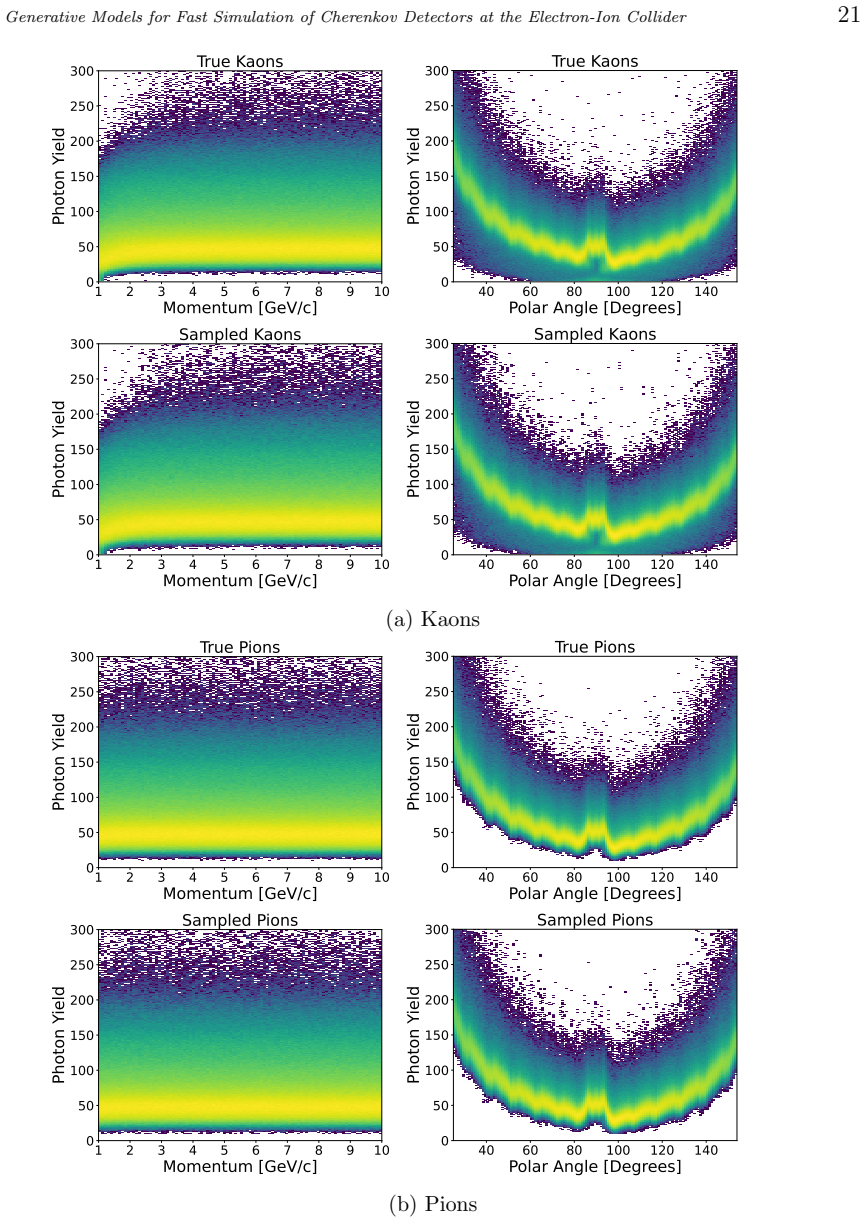
- [Sec. 3.4, Fig. 7] The photon-yield LUT is constructed 'using our training datasets' in bins of 100 MeV/c and 1 degree, and the closure test in Fig. 7 compares the sampled yields to the Geant4 reference distribution without specifying whether the comparison uses the held-out test split. As presented, this demonstrates only that the LUT reproduces the training histogram, not that it generalizes to unseen kinematics. Please evaluate the LUT on the held-out test set and report a quantitative distributional distance (e.g., chi-square per bin or Wasserstein distance) separately for train and test, with uncertainties.
- [Sec. 4, Figs. 6 and 8] Several load-bearing quantitative claims are reported without uncertainties or statistical significance. The separation values in Fig. 6 (e.g., 2.91 vs. 3.71 sigma) and the AUC values in Fig. 8 (0.933 vs. 0.943) are single numbers with no error bars; the claim that fast simulation differs from Geant4 'on the order of O(1%)' is therefore not statistically grounded. Given the finite Monte Carlo samples, bootstrap confidence intervals should be provided, and the 6 GeV/c separation deficit should be decomposed into the contributions of smoothing versus the independence/LUT approximations, using an analysis sensitive to each.
- [Sec. 2, Sec. 6, Abstract] The abstract and conclusions state the toolkit supports strategies 'spanning the full acceptance of the hpDIRC' and EIC-wide PID, while the actual generative scheme conditions only on |p| and theta with fixed azimuth, no magnetic field, and no dark rate, as acknowledged in Section 2. This is a mismatch between the stated scope and the demonstrated working point. Either add a validation that covers the azimuthal dependence and magnetic field, or soften the acceptance and EIC-wide claims to match the current restricted working point.
minor comments (5)
- [References] Reference [16] contains a typo in the title: 'Deep er) reconstruction' should likely read 'Deep(er) reconstruction'.
- [Sec. 3.2, Eq. (17)] In the paragraph following Eq. (17), the notation 'e_theta(xt,t,k)' should be 'epsilon_theta(xt,t,k)' for consistency with the loss expression.
- [Sec. 3.3] The text contains a typo: 'phsysical limitations' should be 'physical limitations'.
- [Fig. 5] The timing comparison in Fig. 5 mixes a single GPU (Nvidia A40) for the generative models with a single CPU core (AMD EPYC 7313P) for Geant4; while the caption states this, a per-core or equivalent-resource scaling estimate would make the 'order-of-magnitude speedup' claim more robust and less hardware-dependent.
- [Figs. 3/4 and Appendices A/C] The ratio plots would be much more informative with statistical uncertainty bands on the ratios; as presented, deviations in the tails cannot be distinguished from Poisson fluctuations.
Circularity Check
Core fidelity claims are benchmarked against held-out Geant4 data and are not circular; only the photon-yield LUT closure test is weakened by being an in-sample fit.
-
fitted input called prediction
[Section 3.4 (Photon Yield Sampling) and Section 4 (Photon Yield Sampling evaluation)]
"Specifically, we form a LUT for the photon yield using our training datasets in bins of ∆( |⃗ p|)∼ 100 MeV/c, ∆(θ)∼ 1◦. For each bin, we obtain the corresponding frequencies (probability) of each photon yield with respect to all possible values (contained in our reference dataset). ... First, we compare at the histogram level the generated photon yield to the ground truth from Geant4."
The LUT is constructed by tabulating empirical photon-yield frequencies from the training/reference dataset, smoothed with a Gaussian kernel. The validation is a closure test comparing samples drawn from this LUT to 'ground truth from Geant4,' with no statement that a held-out split is used. If the reference includes the training sample, the agreement is guaranteed by construction: the LUT is a smoothed histogram of exactly the data it is compared against. The closure test therefore demonstrates self-consistency rather than predictive accuracy. This is a minor issue because the paper's main fidelity claim is supported by out-of-sample ratio plots and FastDIRC comparisons against independent Geant4 reference populations.
full rationale
The central derivation is self-contained: conditional generative models are trained on Geant4 photon-level data with an explicit 70/15/15 train/validation/test split, and the headline fidelity claims are checked by comparing fast-simulated marginal distributions (x, y, time) and FastDIRC/DLL separation against independent Geant4 reference samples. These benchmarks are external to the fitted models and would fail if the generative models merely memorized training data, so the core claim is not circular. The paper's reliance on the authors' prior work [16] supplies the photon-level decomposition, resampling prior, and DLL evaluation method, but these are adopted as design choices with independent rationale (e.g., the combinatorial argument in Section 3.1), not as an unverified uniqueness theorem, so self-citation is not load-bearing in a circular way. The only circularity-adjacent element is the photon-yield LUT: it is fitted to training-data frequencies and then validated by a closure test against Geant4 'ground truth' without an explicit statement that the comparison uses held-out data; as described, that particular closure test reduces to checking the LUT against its own input. This does not undermine the overall fidelity argument, which also shows LUT-based yield sampling leaves full-phase-space AUC unchanged, but it should be read as an in-sample consistency check rather than independent validation.
Assumptions & free parameters
free parameters (4)
- Photon-yield lookup table (LUT) =
Data-derived histogram over bins of 100 MeV/c and 1 degree, smoothed with an unspecified Gaussian kernel
- CNF trainable integration window =
Learned upper time bound; 12 RK4 steps during training, 20 during generation
- Mixture-of-Gaussians base distribution with k=40 =
40 components
- Model architecture sizes and diffusion schedules =
e.g., 20 affine bijections for DNF, 4-6 residual blocks for diffusion/score models, 100 time steps with cosine noise…
assumptions (4)
- domain assumption Approximate independence of Cherenkov photons at the track level.
- domain assumption Azimuthal symmetry of the hpDIRC; generation at the central region of an individual bar.
- domain assumption Working point with no magnetic field and no PMT dark rate.
- standard math Probability theory for normalizing flows, neural ODEs, and diffusion SDEs.
Cite this review
Pith. "Pith review of Generative Models for Fast Simulation of Cherenkov Detectors at the Electron-Ion Collider." pith.science (2026). https://pith.science/paper/IVS75PCC
@misc{pith2026250419042,
  author       = {Pith},
  title        = {Pith review of: Generative Models for Fast Simulation of Cherenkov Detectors at the Electron-Ion Collider},
  year         = {2026},
  howpublished = {\url{https://pith.science/paper/IVS75PCC}},
  note         = {Machine review of arXiv:2504.19042}
}
read the original abstract
The integration of Deep Learning (DL) into experimental nuclear and particle physics has driven significant progress in simulation and reconstruction workflows. However, traditional simulation frameworks such as Geant4 remain computationally intensive, especially for Cherenkov detectors, where simulating optical photon transport through complex geometries and reflective surfaces introduces a major bottleneck. To address this, we present an open, standalone fast simulation tool for Detection of Internally Reflected Cherenkov Light (DIRC) detectors, with a focus on the High-Performance DIRC (hpDIRC) at the future Electron-Ion Collider (EIC). Our framework incorporates a suite of generative models tailored to accelerate particle identification (PID) tasks by offering a scalable, GPU-accelerated alternative to full Geant4-based simulations. Designed with accessibility in mind, our simulation package enables both DL researchers and physicists to efficiently generate high-fidelity large-scale datasets on demand, without relying on complex traditional simulation stacks. This flexibility supports the development and benchmarking of novel DL-driven PID methods. Moreover, this fast simulation pipeline represents a critical step toward enabling EIC-wide PID strategies that depend on virtually unlimited simulated samples, spanning the full acceptance of the hpDIRC.
Figures


Figures from the paper (5 more)



Forward citations
Cited by 2 Pith papers
-
Towards Foundation Models for Experimental Readout Systems Combining Discrete and Continuous Data
A single transformer with separate pixel and time vocabularies generates realistic Cherenkov detector hits and supports particle identification and noise filtering after fine-tuning.
-
Physics of the Electron-Ion Collider in China
A review of the EicC physics case argues that the proposed Chinese electron-ion collider, at 15-20 GeV collision energy, can complement the US EIC with high-precision measurements of sea-quark spin structure, proton m...
Reference graph
Works this paper leans on
-
[1]
Mikuni V, Nachman B and Pettee M Fast point cloud generation with diffusion models in high energy physics 2023 Phys. Rev. D 108(3) 036025
work page 2023
-
[2]
Araz J Y, Mikuni V, Ringer F, Sato N, Acosta F T and Whitehill R Point cloud-based diffusion models for the Electron-Ion Collider 2024 arXiv preprint arXiv:2410.22421
arXiv 2024
-
[3]
Mikuni V and Nachman B OmniLearn: A method to simultaneously facilitate all jet physics tasks 2024 arXiv preprint arXiv:2404.16091
arXiv 2024
-
[4]
Birk J, Hallin A and Kasieczka G OmniJet-α: the first cross-task foundation model for particle physics 2024 Machine Learning: Science and Technology 5 035031
2024
-
[5]
Birk J, Buhmann E, Ewen C, Kasieczka G and Shih D Flow matching beyond kinematics: Generating jets with particle identification and trajectory displacement information 2025 Physical Review D 111 052008
work page 2025
-
[6]
Buhmann E, Kasieczka G and Thaler J EPiC-GAN: Equivariant point cloud generation for particle jets 2023 SciPost Phys. 15 130
work page 2023
-
[7]
Birk J, Gaede F, Hallin A, Kasieczka G, Mozzanica M and Rose H OmniJet- {αC}: Learning point cloud calorimeter simulations using generative transformers 2025 arXiv preprint arXiv:2501.05534
arXiv 2025
-
[8]
Krause C and Shih D Fast and accurate simulations of calorimeter showers with normalizing flows 2023 Physical Review D 107 ISSN 2470-0029
work page 2023
Show all 39 references
-
[9]
Krause C and Shih D Accelerating accurate simulations of calorimeter showers with normalizing flows and probability density distillation 2023 Phys. Rev. D 107(11) 113004
2023
-
[10]
Favaro L, Ore A, Palacios Schweitzer S and Plehn T CaloDREAM–Detector response emulation via attentive flow matching 2025 SciPost Physics 18 088
2025
-
[11]
Paganini M, de Oliveira L and Nachman B CaloGAN: Simulating 3D high energy particle showers in multilayer electromagnetic calorimeters with generative adversarial networks 2018 Physical Review D 97 ISSN 2470-0029
2018
-
[12]
Mikuni V and Nachman B Score-based generative models for calorimeter shower simulation 2022 Physical Review D 106 ISSN 2470-0029
2022
-
[13]
Diefenbacher S, Eren E, Gaede F, Kasieczka G, Krause C, Shekhzadeh I and Shih D L2LFlows: generating high-fidelity 3D calorimeter images 2023 Journal of Instrumentation 18 P10017 ISSN 1748-0221
2023
-
[14]
Fanelli C, Giroux J and Papandreou Z ‘Flux+ Mutability’: a conditional generative approach to one-class classification and anomaly detection 2022 Machine Learning: Science and Technology 3 045012
2022
-
[15]
Devlin P, Qiu J W, Ringer F and Sato N Diffusion model approach to simulating electron- proton scattering events 2024 Physical Review D 110 016030
2024
-
[16]
Fanelli C, Giroux J and Stevens J Deep er) reconstruction of imaging Cherenkov detectors with swin transformers and normalizing flow models 2025 Machine Learning: Science and Technology 6 015028
2025
-
[17]
2020 Fast data-driven simulation of cherenkov detectors using generative adversarial networks Journal of Physics: Conference Series vol 1525 (IOP Publishing) p 012097
Maevskiy A, Derkach D, Kazeev N, Ustyuzhanin A, Artemev M, Anderlini L, Collaboration L et al. 2020 Fast data-driven simulation of cherenkov detectors using generative adversarial networks Journal of Physics: Conference Series vol 1525 (IOP Publishing) p 012097
2020
-
[18]
Kalicy G The high-performance DIRC for the ePIC detector at the EIC 2024 Nuclear Instruments and Methods in Physics Research Section A: Accelerators, Spectrometers, Detectors and Associated Equipment 169168
2024
-
[19]
Dzhygadlo R et al. Time imaging reconstruction for the PANDA Barrel DIRC 2020 Journal of Instrumentation 15 C09050 Generative Models for Fast Simulation of Cherenkov Detectors at the Electron-Ion Collider 26
2020
-
[20]
Hardin J and Williams M FastDIRC: a fast Monte Carlo and reconstruction algorithm for DIRC detectors 2016 J. Instrum. 11 P10007 (arXiv:1608.01180)
2016 arXiv
-
[21]
Fanelli C and Pomponi J DeepRICH: learning deeply Cherenkov detectors 2020 Machine Learning: Science and Technology 1 015010
2020
-
[22]
Dzhygadlo R 2024 EICDIRC accessed: 2025-03-22 URL https://github.com/rdom/eicdirc
2024
-
[23]
Kalicy G Developing high-performance DIRC detector for the future Electron Ion Collider experiment 2020 Journal of Instrumentation 15 C11006
2020
-
[24]
Dinh L, Sohl-Dickstein J and Bengio S 2017 Density estimation using Real NVP
2017
-
[25]
He K, Zhang X, Ren S and Sun J 2016 Deep residual learning for image recognition Proceedings of the IEEE conference on computer vision and pattern recognition pp 770–778
2016
-
[26]
Chen R T Q, Rubanova Y, Bettencourt J and Duvenaud D K 2018 Neural Ordinary Differential Equations Advances in Neural Information Processing Systems vol 31 ed Bengio S, Wallach H, Larochelle H, Grauman K, Cesa-Bianchi N and Garnett R (Curran Associates, Inc.)
2018
-
[27]
Skilling J 1989 The Eigenvalues of Mega-dimensional Matrices Maximum Entropy and Bayesian Methods: Cambridge, England, 1988 (Dordrecht: Springer Netherlands) pp 455– 466 ISBN 978-94-015-7860-8
1989
-
[28]
Hutchinson M A stochastic estimator of the trace of the influence matrix for laplacian smoothing splines 1990 Communications in Statistics - Simulation and Computation 19 433–450 (arXiv:https://doi.org/10.1080/03610919008812866)
1990 doi
-
[29]
Onken D, Fung S W, Li X and Ruthotto L 2021 OT-Flow: Fast and Accurate Continuous Normalizing Flows via Optimal Transport (arXiv: 2006.00104) URL https://arxiv.org/ abs/2006.00104
2021 arXiv
-
[30]
Evans L An introduction to mathematical optimal control theory version 0.2 2013
2013
-
[31]
Grathwohl W, Chen R T Q, Bettencourt J, Sutskever I and Duvenaud D 2018 FFJORD: Free- form Continuous Dynamics for Scalable Reversible Generative Models (arXiv: 1810.01367) URL https://arxiv.org/abs/1810.01367
2018 arXiv
-
[32]
Lipman Y, Chen R T Q, Ben-Hamu H, Nickel M and Le M 2023 Flow Matching for Generative Modeling (arXiv:2210.02747) URL https://arxiv.org/abs/2210.02747
2023 arXiv
-
[33]
Tong A, Fatras K, Malkin N, Huguet G, Zhang Y, Rector-Brooks J, Wolf G and Bengio Y 2024 Improving and generalizing flow-based generative models with minibatch optimal transport (arXiv:2302.00482) URL https://arxiv.org/abs/2302.00482
2024 arXiv
-
[34]
Sohl-Dickstein J, Weiss E A, Maheswaranathan N and Ganguli S 2015 Deep Unsupervised Learning using Nonequilibrium Thermodynamics (arXiv: 1503.03585) URL https:// arxiv.org/abs/1503.03585
2015 arXiv
-
[35]
Ho J, Jain A and Abbeel P 2020 Denoising Diffusion Probabilistic Models (arXiv: 2006.11239) URL https://arxiv.org/abs/2006.11239
2020 arXiv
-
[36]
Song Y, Sohl-Dickstein J, Kingma D P, Kumar A, Ermon S and Poole B 2021 Score-based generative modeling through stochastic differential equations (arXiv: 2011.13456) URL https://arxiv.org/abs/2011.13456
2021 arXiv
-
[37]
Science requirements and detector concepts for the electron-ion collider: EIC yellow report 2022 Nuclear Physics A 1026 122447
Khalek R A et al. Science requirements and detector concepts for the electron-ion collider: EIC yellow report 2022 Nuclear Physics A 1026 122447
2022
-
[38]
Va’vra J 2008 Simulation of the focusing DIRC optics with Mathematica 2008 IEEE Nuclear Science Symposium Conference Record (IEEE) pp 2408–2412
2008
-
[39]
Va’vra J Optical properties of RICH detectors 2014 Nuclear Instruments and Methods in Physics Research Section A: Accelerators, Spectrometers, Detectors and Associated Equipment 766 189–198 Generative Models for Fast Simulation of Cherenkov Detectors at the Electron-Ion Collid...
2014
Reviewed August 16, 2026 · model on record in the stance chip above.
Discussion (0). Continue with ORCID to comment.