REVIEW 3 major objections 7 minor 4 cited by
A Survey on Parameter-Efficient Fine-Tuning for Foundation Models in Federated Learning
T0 review · 3 major / 7 minor · reviewed 2026-08-16 · deepseek-v4-flash
Pith's one-line read A survey maps parameter-efficient fine-tuning inside federated learning onto three families—additive, selective, and reparameterized—and identifies a server-side aggregation bias that makes naive LoRA averaging deviate from the ideal…
desk verdict A useful but sloppy survey of PEFT in federated learning; the organization is sound, but the category assignments and citations need a careful pass before it can serve as a dependable reference. read the letter →
The pith
A machine-rendered reading of the paper's core claim, the machinery that carries it, and where it could break.
The reading
What carries the argument
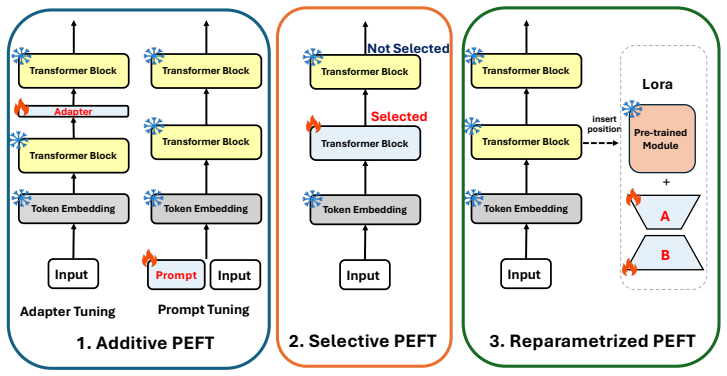
The load-bearing object is the PEFT taxonomy of [42]—additive, selective, and reparameterized—transplanted into the federated setting. Additive methods insert trainable adapters or soft prompts into a frozen foundation model; selective methods freeze most weights and update only distinguished subsets such as bias terms; reparameterized methods express weight updates as products of low-rank matrices, LoRA being the canonical case. The survey's analytical device is the comparison between the ideal federated update, a weighted sum of local full updates, and what naive LoRA aggregation actually computes, a product of weighted averages of low-rank factors; the mismatch, called server-side aggregation bias, organizes the reparameterized section and motivates the correction methods reviewed there.
What would settle it
Compile the set of federated PEFT methods published before the newest reference in the survey and check whether every one appears in Tables 1–3 under the correct category; one missing or misclassified method that is demonstrably part of the literature would show the comprehensiveness claim to be overstated. A second check: identify a method whose update rule mixes categories (such as FedRA, which the survey itself notes spans selective and additive) and show the taxonomy cannot accommodate it without double-labeling.
Extended reading notes
Core claim
The paper's central claim is that every current approach to parameter-efficient fine-tuning in federated learning falls into one of three PEFT families and can be reviewed against a standard set of FL challenges. Within additive tuning, adapters and soft prompts are the workhorses, with methods like FedPrompt reducing communication to prompt parameters and adapter methods personalizing per client. Within selective tuning, bias-only updates and parameter-selection strategies provide cheap adaptation. Within reparameterized tuning, LoRA dominates, and the survey identifies a distinctive federated failure mode: because clients send low-rank factors $A_k$ and $B_k$ rather than full updates, the server's weighted average of products is not the product of averages, so naive FedIT aggregation deviates from the ideal global update. Several methods (FFA-LoRA, RoLoRA, FLoRA, FedEx-LoRA, LoRA-FAIR) are reviewed as attempts to remove that bias. On the application side, the survey maps these methods onto NLP tasks (text classification, text generation, machine translation, recommendation) and CV tasks (image classification, domain adaptation, multimodal learning), with recommended datasets and foundation models for each.
Load-bearing premise
The survey's practical value rests on its coverage being complete and representative, yet it provides no search protocol, database list, inclusion criteria, or cutoff date, so any important FL-PEFT method missing from the three categories would undermine the map it offers.
Editorial extensions
If this is right
- A practitioner choosing a federated fine-tuning method can use the tables to shortlist by the bottleneck they face: adapters and prompts for communication savings, selective bias tuning for extreme resource limits, and LoRA variants for accuracy near full fine-tuning.
- FedIT-style naive LoRA aggregation is expected to be biased, so any new federated LoRA method should compare against a correction (fixed A, alternating freeze, stacking, or residual term) rather than treating FedIT as an unbiased baseline.
- The survey's application tables imply that BERT-family models and GLUE tasks are the default testbed for text classification, while CLIP and image-classification datasets are the default testbed for vision, giving new work a ready-made evaluation template.
- Scaling to trillion-parameter models will require federated PEFT to solve communication and memory bottlenecks even for the small trainable parts, a direction the survey flags as open.
Reading between the lines
- If the three-way taxonomy is as exhaustive as the survey claims, then any future FL-PEFT method that cannot be filed as additive, selective, or reparameterized would be a genuinely new category; the survey does not predict what that would look like.
- The server-side aggregation bias identified for LoRA should in principle afflict any reparameterized method whose local updates are averaged before being composed, so DoRA- or VeRA-style decompositions in federated settings would likely need the same correction machinery; the paper does not draw this extension.
- A testable next step would be a standardized benchmark that reuses the exact model-dataset pairs in Tables 4 and 5, so that additive, selective, and reparameterized methods could be compared head-to-head under identical non-IID partitions.
- Because the survey is a snapshot, its map will age quickly; the same taxonomy could be maintained as a living document that tracks new FL-PEFT methods as they appear.
Signed reviews
Editorial analysis
A structured set of objections, weighed in public.
Referee Report
Summary. This manuscript is a survey of parameter-efficient fine-tuning (PEFT) methods in federated learning (FL). It organizes the literature into three categories—additive, selective, and reparameterized PEFT—following the taxonomy of Han et al. [42], and it further groups works by application domain (NLP and vision). The survey also reviews challenges in FL (data heterogeneity, communication efficiency, computational constraints, privacy), discusses LoRA-specific issues such as server-side aggregation bias, and outlines future directions. The paper does not report a formal search protocol or inclusion criteria.
Significance. If the survey were accurate and comprehensive, it would be a useful reference map for the rapidly growing FL-PEFT area. The paper covers a broad set of recent methods, and the discussion of LoRA aggregation bias around Eq. (5)-(6) is a concrete technical contribution to the survey's conceptual framing. The application-oriented tables (Tables 4 and 5) also provide practical guidance. However, the manuscript's central claim is that it is a 'systematic and comprehensive review,' and that claim is weakened by internal taxonomy inconsistencies and citation/naming errors. The misclassification of FedRA in particular cuts against the survey's stated organizing principle, and the absence of a search protocol makes the comprehensiveness claim hard to verify.
major comments (3)
- [Section 3.2 and Table 2] FedRA [97] is listed under 'Selective PEFT' in Table 2, but the text at the end of Section 3.2 explicitly states that FedRA 'applies adapter-based fine-tuning,' and Section 4.2.1 / Table 5 describe FedRA as 'Selective and Additive.' Since the entire survey is organized around the Additive/Selective/Reparameterized taxonomy, this internal contradiction is load-bearing: a reader consulting Table 2 to identify selective-PEFT methods will be pointed to a method that the paper itself treats as hybrid. The taxonomy either needs a defined hybrid category or the tables and prose must be aligned.
- [Section 3.2 and Table 2] DepthFL [51] is included as a selective-PEFT method in Table 2, but the description in Section 3.2 (depth-wise pruning of a global model with mutual self-distillation) does not match the survey's definition of selective PEFT as fine-tuning a subset of the parameters of a frozen pre-trained backbone. The text correctly distinguishes 'traditional federated learning' methods such as CELL and HeteroFL from FL-PEFT methods, yet DepthFL is placed in the FL-PEFT portion and counted in Table 2. This blurs the boundary the survey needs to maintain to support its comprehensive-taxonomy claim. I do not find a comparable problem with CELL and HeteroFL, which the text frames only as background and which do not appear in Table 2.
- [Section 1 and Section 3] The abstract and introduction claim a 'systematic and comprehensive review,' but the manuscript does not provide a search protocol, database list, inclusion/exclusion criteria, or coverage cutoff date. Without such information, the reader cannot verify whether the reviewed set of papers is representative or whether omissions are intentional. Given that the central value of a survey is its reliability as a map of the literature, this lack of methodological transparency is a substantive weakness, not merely a presentation issue. The authors should either add a short methodology paragraph or soften the comprehensiveness claim.
minor comments (7)
- [Section 3.1.2 and Table 1] In Section 3.1.2, both PromptFL and PromptFolio are cited as reference [86], but Table 1 lists PromptFL as [41]. Please correct the in-text citation for PromptFL.
- [Section 3.2, Table 2, and Table 4] The method referenced as 'FedBF [127]' in Section 3.2 and Table 2 is called 'FedPETuning' in Table 4 and in the reference list entry itself. Please unify the method name and the table labels.
- [References] References [17] and [37] share the same title ('Prompt-enhanced federated content representation learning for cross-domain recommendation'); these appear to be the arXiv and published versions of the same work. The manuscript should cite one version consistently and distinguish them.
- [Table 4] The row for FedBiOT contains the typo 'AReparameterized'; it should read 'Reparameterized.'
- [Section 3.3 heading and elsewhere] The spelling 'Reparametrized' is used in the Section 3.3 heading while the rest of the paper uses 'Reparameterized.' Please make the spelling consistent.
- [Section 3.1.1 and Table 1] The text in Section 3.1.1 refers to 'ADAFEDSELECKD [32]' while Table 1 and the reference entry use 'ADAFED.' Please align the naming.
- [Table 5] The entry 'LLaV A 1.5' should be 'LLaVA 1.5'.
Circularity Check
No circularity: the survey's taxonomy is imported from an external source, and the only author self-citations are descriptive entries that do not carry the derivation.
full rationale
This paper is a literature survey and does not derive any predictive quantity, so the input-equals-output circularity patterns do not apply. The organizing taxonomy is explicitly attributed to an external survey rather than the authors' own prior work: "Following [42], we categorize PEFT techniques into three main approaches: Additive PEFT, Selective PEFT, and Reparameterized PEFT," where [42] is Han et al., an independent survey. The only author self-citations, LoRA-FAIR [10] and FedALT [11], appear as surveyed methods in Section 3.3 and Table 3; their role is descriptive, and the survey's structure or conclusions do not rest on them. The absence of a search protocol and possible taxonomy inconsistencies (e.g., FedAdapter listed as additive, FedRA as selective, and CELL/HeteroFL as selective PEFT) are correctness and completeness concerns, not circularity: they do not show that some output is equivalent to an input by construction. No quoted reduction, fitted parameter renamed as prediction, or self-citation chain forcing the central claim can be exhibited, so the honest finding is no significant circularity.
Assumptions & free parameters
assumptions (2)
- domain assumption The three-way PEFT taxonomy of Han et al. [42] (additive, selective, reparameterized) is the correct organizing scheme for FL-PEFT work.
- ad hoc to paper The reviewed set of papers is a comprehensive and representative sample of FL-PEFT research.
Cite this review
Pith. "Pith review of A Survey on Parameter-Efficient Fine-Tuning for Foundation Models in Federated Learning." pith.science (2026). https://pith.science/paper/VIZN2QN4
@misc{pith2026250421099,
  author       = {Pith},
  title        = {Pith review of: A Survey on Parameter-Efficient Fine-Tuning for Foundation Models in Federated Learning},
  year         = {2026},
  howpublished = {\url{https://pith.science/paper/VIZN2QN4}},
  note         = {Machine review of arXiv:2504.21099}
}
read the original abstract
Foundation models have revolutionized artificial intelligence by providing robust, versatile architectures pre-trained on large-scale datasets. However, adapting these massive models to specific downstream tasks requires fine-tuning, which can be prohibitively expensive in computational resources. Parameter-Efficient Fine-Tuning (PEFT) methods address this challenge by selectively updating only a small subset of parameters. Meanwhile, Federated Learning (FL) enables collaborative model training across distributed clients without sharing raw data, making it ideal for privacy-sensitive applications. This survey provides a comprehensive review of the integration of PEFT techniques within federated learning environments. We systematically categorize existing approaches into three main groups: Additive PEFT (which introduces new trainable parameters), Selective PEFT (which fine-tunes only subsets of existing parameters), and Reparameterized PEFT (which transforms model architectures to enable efficient updates). For each category, we analyze how these methods address the unique challenges of federated settings, including data heterogeneity, communication efficiency, computational constraints, and privacy concerns. We further organize the literature based on application domains, covering both natural language processing and computer vision tasks. Finally, we discuss promising research directions, including scaling to larger foundation models, theoretical analysis of federated PEFT methods, and sustainable approaches for resource-constrained environments.
Figures


Forward citations
Cited by 4 Pith papers
-
CoCo-Fed: A Unified Framework for Memory- and Communication-Efficient Federated Learning at the Wireless Edge
CoCo-Fed compresses each client's federated updates into a single fixed-size matrix via double low-rank projection and orthogonal superposition, cutting memory and backhaul traffic while maintaining convergence on an ...
-
FedCC: A Low-Resource Federated Adaptation of Foundation Models for Robust Corpus Callosum localization in Fetal Ultrasound Images
Frozen DINOv2 + LoRA + YOLO head, trained with FedAvg, localizes the fetal corpus callosum at mAP@50 0.857 with 8.5x lower communication than full fine-tuning.
-
FedRS-Bench: Realistic Federated Learning Datasets and Benchmarks in Remote Sensing
A realistic 135-client federated learning benchmark for remote sensing, assembled from eight datasets, with baseline results for ten FL algorithms.
-
DP-FedLoRA: Privacy-Enhanced Federated Fine-Tuning for On-Device Large Language Models
DP-FedLoRA clips and adds Gaussian noise to per-client LoRA matrices in federated LLM fine-tuning, claiming unbiased updates and bounded variance, but the privacy calibration and experiments have significant gaps.
Reference graph
Works this paper leans on
-
[86]
Advances in Neural Information Processing Systems 37, 30590–30623 (2024)
Pan, B., Huang, W., Shi, Y .: Federated learning from vision-language foundation models: Theoretical analysis and method. Advances in Neural Information Processing Systems 37, 30590–30623 (2024)
work page 2024
-
[41]
IEEE Transactions on Mobile Computing 23(5), 5179–5194 (2023)
Guo, T., Guo, S., Wang, J., Tang, X., Xu, W.: Promptfl: Let federated participants coopera- tively learn prompts instead of models–federated learning in age of foundation model. IEEE Transactions on Mobile Computing 23(5), 5179–5194 (2023)
2023
-
[17]
Prompt-enhanced Federated Content Representation Learning for Cross-domain Recommendation
Chen, X., et al.: Prompt-enhanced federated content representation learning for cross-domain recommendation. arXiv preprint arXiv:2401.14678 (2024)
work page Pith review arXiv 2024
-
[37]
In: Proceedings of the ACM Web Conference 2024
Guo, L., Lu, Z., Yu, J., Nguyen, Q.V .H., Yin, H.: Prompt-enhanced federated content rep- resentation learning for cross-domain recommendation. In: Proceedings of the ACM Web Conference 2024. pp. 3139–3149 (2024)
2024
-
[42]
arXiv preprint arXiv:2403.14608 (2024)
Han, Z., Gao, C., Liu, J., Zhang, J., Zhang, S.Q.: Parameter-efficient fine-tuning for large models: A comprehensive survey. arXiv preprint arXiv:2403.14608 (2024)
arXiv 2024
-
[97]
In: European Conference on Computer Vision
Su, S., Li, B., Xue, X.: Fedra: A random allocation strategy for federated tuning to unleash the power of heterogeneous clients. In: European Conference on Computer Vision. pp. 342–358. Springer (2024)
work page 2024
-
[51]
In: The Eleventh International Conference on Learning Representations (2023)
Kim, M., Yu, S., Kim, S., Moon, S.M.: Depthfl: Depthwise federated learning for hetero- geneous clients. In: The Eleventh International Conference on Learning Representations (2023)
2023
-
[1]
arXiv preprint arXiv:2303.08774 (2023)
Achiam, J., Adler, S., Agarwal, S., Ahmad, L., Akkaya, I., Aleman, F.L., Almeida, D., Altenschmidt, J., Altman, S., Anadkat, S., et al.: Gpt-4 technical report. arXiv preprint arXiv:2303.08774 (2023)
arXiv 2023
Show all 132 references
-
[2]
In: Proceedings of the 61st Annual Meeting of the Association for Computational Linguistics (ACL)
Adelani, D.I., Alabi, J., Dossou, B.F.P., et al.: Masakhanews: A multilingual news corpus for african languages. In: Proceedings of the 61st Annual Meeting of the Association for Computational Linguistics (ACL). pp. 10942–10959 (2023)
2023
-
[3]
In: Proceedings of the 2019 Conference of the North American Chapter of the Association for Computational Linguistics
Aharoni, R., Johnson, M., Firat, O.: Massively multilingual neural machine translation. In: Proceedings of the 2019 Conference of the North American Chapter of the Association for Computational Linguistics. pp. 3874–3884 (2019) 21
2019
-
[4]
arXiv preprint arXiv:2305.10403 (2023), https://arxiv.org/abs/2305.10403
Anil, R., Lee, S., et al.: Palm 2 technical report. arXiv preprint arXiv:2305.10403 (2023), https://arxiv.org/abs/2305.10403
2023 arXiv
-
[5]
arXiv preprint arXiv:2308.06522 (2023)
Babakniya, S., Elkordy, A.R., Ezzeldin, Y .H., Liu, Q., Song, K.B., El-Khamy, M., Avestimehr, S.: Slora: Federated parameter efficient fine-tuning of language models. arXiv preprint arXiv:2308.06522 (2023)
2023 arXiv
-
[6]
arXiv preprint arXiv:2402.11505 (2024)
Bai, J., Chen, D., Qian, B., Yao, L., Li, Y .: Federated fine-tuning of large language models under heterogeneous tasks and client resources. arXiv preprint arXiv:2402.11505 (2024)
2024 arXiv
-
[7]
In: Proceedings of the IEEE/CVF Conference on Computer Vision and Pattern Recognition
Bai, S., Zhang, J., Guo, S., Li, S., Guo, J., Hou, J., Han, T., Lu, X.: Diprompt: Disentangled prompt tuning for multiple latent domain generalization in federated learning. In: Proceedings of the IEEE/CVF Conference on Computer Vision and Pattern Recognition. pp. 27284–27293 (2024)
2024
-
[8]
In: Proceedings of the 60th Annual Meeting of the Association for Computational Linguistics (V olume 2: Short Papers)
Ben Zaken, E., Ravfogel, S., Goldberg, Y .: Bitfit: Simple parameter-efficient fine-tuning for transformer-based masked language-models. In: Proceedings of the 60th Annual Meeting of the Association for Computational Linguistics (V olume 2: Short Papers). pp. 1–9 (2022)
2022
-
[9]
In: Proceedings of the 15th ACM International Conference on Future and Sustainable Energy Systems
Bian, J., Wang, L., Ren, S., Xu, J.: Cafe: Carbon-aware federated learning in geographically distributed data centers. In: Proceedings of the 15th ACM International Conference on Future and Sustainable Energy Systems. pp. 347–360 (2024)
2024
-
[10]
arXiv preprint arXiv:2411.14961 (2024)
Bian, J., Wang, L., Zhang, L., Xu, J.: Lora-fair: Federated lora fine-tuning with aggregation and initialization refinement. arXiv preprint arXiv:2411.14961 (2024)
2024
-
[11]
arXiv preprint arXiv:2503.11880 (2025)
Bian, J., Wang, L., Zhang, L., Xu, J.: Fedalt: Federated fine-tuning through adaptive local training with rest-of-the-world lora. arXiv preprint arXiv:2503.11880 (2025)
2025
-
[12]
In: European Conference on Computer Vision (2014)
Bossard, L., Guillaumin, M., Van Gool, L.: Food-101 – mining discriminative components with random forests. In: European Conference on Computer Vision (2014)
2014
-
[13]
arXiv preprint arXiv:2205.10162 (2022)
Cai, D., Wu, Y ., Wang, S., Lin, F.X., Xu, M.: Fedadapter: Efficient federated learning for modern nlp. arXiv preprint arXiv:2205.10162 (2022)
2022 arXiv
-
[14]
Patterns 5(12) (2024)
Chen, C., Feng, X., Li, Y ., Lyu, L., Zhou, J., Zheng, X., Yin, J.: Integration of large language models and federated learning. Patterns 5(12) (2024)
2024
-
[15]
In: Proceedings of the AAAI Conference on Artificial Intelligence
Chen, H., Zhang, Y ., Krompass, D., Gu, J., Tresp, V .: Feddat: An approach for foundation model finetuning in multi-modal heterogeneous federated learning. In: Proceedings of the AAAI Conference on Artificial Intelligence. vol. 38, pp. 11285–11293 (2024)
2024
-
[16]
arXiv preprint arXiv:2502.01755 (2025)
Chen, S., Guo, Y ., Ju, Y ., Dalal, H., Khisti, A.: Robust federated finetuning of llms via alternating optimization of lora. arXiv preprint arXiv:2502.01755 (2025)
2025
-
[18]
See https://vicuna
Chiang, W.L., Li, Z., Lin, Z., Sheng, Y ., Wu, Z., Zhang, H., Zheng, L., Zhuang, S., Zhuang, Y ., Gonzalez, J.E., et al.: Vicuna: An open-source chatbot impressing gpt-4 with 90%* chatgpt quality. See https://vicuna. lmsys. org (accessed 14 April 2023) 2(3), 6 (2023)
2023
-
[19]
arXiv preprint arXiv:2401.06432 (2024)
Cho, Y .J., Liu, L., Xu, Z., Fahrezi, A., Joshi, G.: Heterogeneous lora for federated fine-tuning of on-device foundation models. arXiv preprint arXiv:2401.06432 (2024)
2024 arXiv
-
[20]
arXiv preprint arXiv:2208.09021 6, 17 (2022)
Chochlakis, G., Srinivasan, T., Thomason, J., Narayanan, S.: Vault: Augmenting the vision- and-language transformer with the propagation of deep language representations. arXiv preprint arXiv:2208.09021 6, 17 (2022)
2022 arXiv
-
[21]
arXiv preprint arXiv:2110.14168 (2021), https://arxiv.org/abs/2110.14168 22
Cobbe, K., Kosaraju, V ., Kale, M., et al.: Training verifiers to solve math word problems. arXiv preprint arXiv:2110.14168 (2021), https://arxiv.org/abs/2110.14168 22
2021 arXiv
-
[22]
In: Proceedings of the 58th Annual Meeting of the Association for Computational Linguistics (ACL)
Conneau, A., Khandelwal, K., Goyal, N., Chaudhary, V ., Wenzek, G., Guzmán, F., Grave, É., Ott, M., Zettlemoyer, L., Stoyanov, V .: Unsupervised cross-lingual representation learning at scale. In: Proceedings of the 58th Annual Meeting of the Association for Computational Ling...
2020
-
[23]
In: Proceedings of the 2018 Conference on Empirical Methods in Natural Language Processing (EMNLP)
Conneau, A., Rinott, R., Lample, G., Williams, A., Bowman, S.R., Schwenk, H., Stoyanov, V .: Xnli: Evaluating cross-lingual sentence representations. In: Proceedings of the 2018 Conference on Empirical Methods in Natural Language Processing (EMNLP). pp. 2475–2485 (2018)
2018
-
[24]
Proceedings of the 2nd International Workshop on Compiler Compilers (1992), https://dl
Cordy, J., Hall, R., Carmichael, I., et al.: Rosetta: a generator of data language compilers. Proceedings of the 2nd International Workshop on Compiler Compilers (1992), https://dl. acm.org/doi/10.1145/258368.258412
1992
-
[25]
In: Machine learning challenges workshop
Dagan, I., Glickman, O., Magnini, B.: The pascal recognising textual entailment challenge. In: Machine learning challenges workshop. pp. 177–190. Springer (2005)
2005
-
[26]
Databricks Blog (2023), https://www.databricks.com/blog/2023/04/12/ dolly-first-open-commercially-viable-instruction-tuned-llm
Databricks: Dolly: Open instruction-tuned llm. Databricks Blog (2023), https://www.databricks.com/blog/2023/04/12/ dolly-first-open-commercially-viable-instruction-tuned-llm
2023
-
[27]
In: Proceedings of the IEEE/CVF Conference on Computer Vision and Pattern Recognition
Deng, W., Thrampoulidis, C., Li, X.: Unlocking the potential of prompt-tuning in bridging generalized and personalized federated learning. In: Proceedings of the IEEE/CVF Conference on Computer Vision and Pattern Recognition. pp. 6087–6097 (2024)
2024
-
[28]
In: Proceedings of NAACL-HLT
Devlin, J., Chang, M.W., Lee, K., Toutanova, K.: Bert: Pre-training of deep bidirectional transformers for language understanding. In: Proceedings of NAACL-HLT. pp. 4171–4186 (2019)
2019
-
[29]
arXiv preprint arXiv:2010.01264 (2020)
Diao, E., Ding, J., Tarokh, V .: Heterofl: Computation and communication efficient federated learning for heterogeneous clients. arXiv preprint arXiv:2010.01264 (2020)
2020 arXiv
-
[30]
In: International Conference on Learning Representations (ICLR) (2021)
Dosovitskiy, A., Beyer, L., Kolesnikov, A., Weissenborn, D., Zhai, X., Unterthiner, T., De- hghani, M., Minderer, M., Heigold, G., Gelly, S., Uszkoreit, J., Houlsby, N.: An image is worth 16x16 words: Transformers for image recognition at scale. In: International Conference on...
2021
-
[31]
Fei-Fei, L., Fergus, R., Perona, P.: Learning generative visual models from few training examples: An incremental bayesian approach tested on 101 object categories. Tech. rep., California Institute of Technology (2004)
2004
-
[32]
IEEE/ACM Transactions on Audio, Speech, and Language Processing (2024)
Feng, X., Feng, X., Du, X., Kan, M.Y ., Qin, B.: Adapter-based selective knowledge distilla- tion for federated multi-domain meeting summarization. IEEE/ACM Transactions on Audio, Speech, and Language Processing (2024)
2024
-
[33]
AI 5(4), 2773–2800 (2024)
Feretzakis, G., Verykios, V .S.: Trustworthy ai: Securing sensitive data in large language models. AI 5(4), 2773–2800 (2024)
2024
-
[34]
for Research on Foundation Models, S.C.: Alpaca: A strong, replicable instruction-following model (2023), https://crfm.stanford.edu/2023/03/13/alpaca.html
2023
-
[35]
CS224N project report, Stanford 1(12), 2009 (2009)
Go, A., Bhayani, R., Huang, L.: Twitter sentiment classification using distant supervision. CS224N project report, Stanford 1(12), 2009 (2009)
2009
-
[36]
In: Proceedings of the IEEE Conference on Computer Vision and Pattern Recognition (2012)
Gong, B., Shi, Y ., Sha, F., Grauman, K.: Geodesic flow kernel for unsupervised domain adap- tation. In: Proceedings of the IEEE Conference on Computer Vision and Pattern Recognition (2012)
2012
-
[38]
arXiv preprint arXiv:2012.07463 (2021) 23
Guo, M., Rush, A.M.: Parameter-efficient transfer learning with diff pruning. arXiv preprint arXiv:2012.07463 (2021) 23
2021 arXiv
-
[39]
arXiv preprint arXiv:2410.01463 (2024)
Guo, P., Zeng, S., Wang, Y ., Fan, H., Wang, F., Qu, L.: Selective aggregation for low-rank adaptation in federated learning. arXiv preprint arXiv:2410.01463 (2024)
2024 arXiv
-
[40]
In: Proceedings of the ACM Web Conference 2023
Guo, T., Guo, S., Wang, J.: Pfedprompt: Learning personalized prompt for vision-language models in federated learning. In: Proceedings of the ACM Web Conference 2023. pp. 1364– 1374 (2023)
2023
-
[43]
arXiv preprint arXiv:2503.03920 (2025)
Hao, J., Wu, Y ., Payani, A., Lee, M., Liu, M.: Personalized federated fine-tuning for het- erogeneous data: An automatic rank learning approach via two-level lora. arXiv preprint arXiv:2503.03920 (2025)
2025 arXiv
-
[44]
In: Proceed- ings of the IEEE Conference on Computer Vision and Pattern Recognition (2016)
He, K., Zhang, X., Ren, S., Sun, J.: Deep residual learning for image recognition. In: Proceed- ings of the IEEE Conference on Computer Vision and Pattern Recognition (2016)
2016
-
[45]
In: Proceedings of the 9th International Conference on Learning Representations (ICLR) (2021)
He, P., Liu, X., Gao, J., Chen, W.: Deberta: Decoding-enhanced bert with disentangled attention. In: Proceedings of the 9th International Conference on Learning Representations (ICLR) (2021)
2021
-
[46]
In: Proceedings of the 36th International Conference on Machine Learning
Houlsby, N., Giurgiu, A., Jastrzebski, S., Morrone, B., de Laroussilhe, Q., Gesmundo, A., Attariyan, S., Gelly, S.: Parameter-efficient transfer learning for nlp. In: Proceedings of the 36th International Conference on Machine Learning. pp. 2790–2799. PMLR (2019)
2019
-
[47]
ICLR 1(2), 3 (2022)
Hu, E.J., Shen, Y ., Wallis, P., Allen-Zhu, Z., Li, Y ., Wang, S., Wang, L., Chen, W., et al.: Lora: Low-rank adaptation of large language models. ICLR 1(2), 3 (2022)
2022
-
[48]
In: Proceedings of the IEEE/CVF Conference on Computer Vision and Pattern Recognition (2019)
Hudson, D.A., Manning, C.D.: Gqa: A new dataset for real-world visual reasoning and compositional question answering. In: Proceedings of the IEEE/CVF Conference on Computer Vision and Pattern Recognition (2019)
2019
-
[49]
arXiv preprint arXiv:2310.06825 (2023), https://arxiv.org/abs/2310.06825
Jiang, A.Q., Sablayrolles, A., et al.: Mistral 7b. arXiv preprint arXiv:2310.06825 (2023), https://arxiv.org/abs/2310.06825
2023 arXiv
-
[50]
In: Proceedings of the 2014 Conference on Empirical Methods in Natural Language Processing (2014)
Kazemzadeh, S., Ordonez, V ., Matten, M., Berg, T.L.: Referitgame: Referring to objects in photographs of natural scenes. In: Proceedings of the 2014 Conference on Empirical Methods in Natural Language Processing (2014)
2014
-
[52]
In: International conference on machine learning
Kim, W., Son, B., Kim, I.: Vilt: Vision-and-language transformer without convolution or region supervision. In: International conference on machine learning. pp. 5583–5594. PMLR (2021)
2021
-
[53]
In: Findings of the Association for Computational Linguistics: ACL 2023
Kim, Y ., Kim, J., Mok, W.L., Park, J.H., Lee, S.: Client-customized adaptation for parameter- efficient federated learning. In: Findings of the Association for Computational Linguistics: ACL 2023. pp. 1159–1172 (2023)
2023
-
[54]
arXiv preprint arXiv:2410.22815 (2024)
Koo, J., Jang, M., Ok, J.: Towards robust and efficient federated low-rank adaptation with heterogeneous clients. arXiv preprint arXiv:2410.22815 (2024)
2024 arXiv
-
[55]
arXiv preprint arXiv:2310.11454 (2023)
Kopiczko, D.J., Blankevoort, T., Asano, Y .M.: Vera: Vector-based random matrix adaptation. arXiv preprint arXiv:2310.11454 (2023)
2023 arXiv
-
[56]
Krizhevsky, A.: Learning multiple layers of features from tiny images. Tech. rep., University of Toronto (2009) 24
2009
-
[57]
In: Machine learning proceedings 1995, pp
Lang, K.: Newsweeder: Learning to filter netnews. In: Machine learning proceedings 1995, pp. 331–339. Elsevier (1995)
1995
-
[58]
arXiv preprint arXiv:2502.04387 (2025)
Lee, R., Kim, M., Rezk, F., Li, R., Venieris, S.I., Hospedales, T.: Fedp 2eft: Federated learning to personalize parameter efficient fine-tuning for multilingual llms. arXiv preprint arXiv:2502.04387 (2025)
2025
-
[59]
In: Proceedings of the 2021 Conference on Empirical Methods in Natural Language Processing
Lester, B., Al-Rfou, R., Constant, N.: The power of scale for parameter-efficient prompt tuning. In: Proceedings of the 2021 Conference on Empirical Methods in Natural Language Processing. pp. 3045–3059. Association for Computational Linguistics (2021)
2021
-
[60]
arXiv preprint arXiv:1910.13461 (2019), https://arxiv.org/abs/1910.13461
Lewis, M., Liu, Y ., Goyal, N., et al.: Bart: Denoising sequence-to-sequence pre-training for natural language generation, translation, and comprehension. arXiv preprint arXiv:1910.13461 (2019), https://arxiv.org/abs/1910.13461
2019 arXiv
-
[61]
In: Proceedings of the IEEE International Conference on Computer Vision (2017)
Li, D., Yang, Y ., Song, Y .Z., Hospedales, T.M.: Deeper, broader and artier domain generaliza- tion. In: Proceedings of the IEEE International Conference on Computer Vision (2017)
2017
-
[62]
In: Proceedings of the IEEE/CVF Conference on Computer Vision and Pattern Recognition
Li, H., Huang, W., Wang, J., Shi, Y .: Global and local prompts cooperation via optimal transport for federated learning. In: Proceedings of the IEEE/CVF Conference on Computer Vision and Pattern Recognition. pp. 12151–12161 (2024)
2024
-
[63]
thirsty
Li, P., Yang, J., Islam, M.A., Ren, S.: Making ai less" thirsty": Uncovering and addressing the secret water footprint of ai models. arXiv preprint arXiv:2304.03271 (2023)
2023 arXiv
-
[64]
arXiv preprint arXiv:2406.12844 (2024)
Li, S., Ye, F., Fang, M., Zhao, J., Chan, Y .H., Ngai, E.C.H., V oigt, T.: Synergizing foundation models and federated learning: A survey. arXiv preprint arXiv:2406.12844 (2024)
2024
-
[65]
In: Advances in Neural Information Processing Systems
Lian, D., Zhou, D., Feng, J., Wang, X.: Scaling & shifting your features: A new baseline for efficient model tuning. In: Advances in Neural Information Processing Systems. vol. 35, pp. 24829–24840 (2022)
2022
-
[66]
In: Proceedings of the 2020 Conference on Empirical Methods in Natural Language Processing (EMNLP)
Liang, Y ., Duan, N., Gong, Y ., Wu, N., Guo, F., Qi, W., Gong, M., Shou, L., Jiang, D., Cao, G., Fan, X., Zhang, R., Agrawal, R., Cui, E., Wei, S., Bharti, T., Qiao, Y ., Chen, J.H., Wu, W., Liu, S., Yang, F., Majumder, R., Zhao, M., Yu, Q., Liu, Y ., Liu, W., Zhou, M.: Xglue...
2020
-
[67]
In: European Conference on Computer Vision (2014)
Lin, T.Y ., Maire, M., Belongie, S., et al.: Microsoft coco: Common objects in context. In: European Conference on Computer Vision (2014)
2014
-
[68]
In: Advances in Neural Information Processing Systems
Liu, H., Tam, D., Mohammed, M., Mohta, J., Huang, T., Bansal, M., Raffel, C.: Few-shot parameter-efficient fine-tuning is better and cheaper than in-context learning. In: Advances in Neural Information Processing Systems. vol. 35, pp. 13299–13312 (2022)
2022
-
[69]
Liu, H., Li, C., Zhang, Y ., Hu, Z., Shen, S., Li, B., Li, Y ., Lee, Y .J.: Visual instruction tuning (2023)
2023
-
[70]
arXiv preprint arXiv:2412.20004 (2024)
Liu, J., Liao, Y ., Xu, H., Xu, Y ., Liu, J., Qian, C.: Adaptive parameter-efficient federated fine-tuning on heterogeneous devices. arXiv preprint arXiv:2412.20004 (2024)
2024 arXiv
-
[71]
In: Forty-first International Conference on Machine Learning (2024)
Liu, S.Y ., Wang, C.Y ., Yin, H., Molchanov, P., Wang, Y .C.F., Cheng, K.T., Chen, M.H.: Dora: Weight-decomposed low-rank adaptation. In: Forty-first International Conference on Machine Learning (2024)
2024
-
[72]
arXiv preprint arXiv:2305.12449 (2023)
Liu, Y ., Bi, X., Li, L., Chen, S., Yang, W., Sun, X.: Communication efficient federated learning for multilingual neural machine translation with adapter. arXiv preprint arXiv:2305.12449 (2023)
2023 arXiv
-
[73]
arXiv preprint arXiv:1907.11692 (2019) 25
Liu, Y ., Ott, M., Goyal, N., Du, J., Joshi, M., Chen, D., Levy, O., Lewis, M., Zettlemoyer, L., Stoyanov, V .: Roberta: A robustly optimized bert pretraining approach. arXiv preprint arXiv:1907.11692 (2019) 25
2019 arXiv
-
[74]
Advances in Neural Information Processing Systems 37, 39409–39433 (2024)
Long, G., Shen, T., Jiang, J., Blumenstein, M., et al.: Dual-personalizing adapter for federated foundation models. Advances in Neural Information Processing Systems 37, 39409–39433 (2024)
2024
-
[75]
Long, G., Zhou, T., Lu, Q., Ye, S., Jiang, J., et al.: Federated adapter on foundation models: An out-of-distribution approach
-
[76]
arXiv preprint arXiv:2204.08582 (2022)
Lu, P., Wei, J., Chang, M.Y ., et al.: Learn to explain: Multimodal reasoning via thought chains for science question answering. arXiv preprint arXiv:2204.08582 (2022)
2022 arXiv
-
[77]
arXiv preprint arXiv:2410.10114 (2024)
Luo, J., Chen, C., Wu, S.: Mixture of experts made personalized: Federated prompt learning for vision-language models. arXiv preprint arXiv:2410.10114 (2024)
2024 arXiv
-
[78]
arXiv preprint arXiv:2405.17267 (2024)
Ma, Y ., Cheng, L., Wang, Y ., Zhong, Z., Xu, X., Wang, M.: Fedhpl: Efficient heterogeneous federated learning with prompt tuning and logit distillation. arXiv preprint arXiv:2405.17267 (2024)
2024 arXiv
-
[79]
In: Artificial intelligence and statistics
McMahan, B., Moore, E., Ramage, D., Hampson, S., y Arcas, B.A.: Communication-efficient learning of deep networks from decentralized data. In: Artificial intelligence and statistics. pp. 1273–1282. PMLR (2017)
2017
-
[80]
arXiv preprint arXiv:1609.07843 (2016)
Merity, S., Xiong, C., Bradbury, J., Socher, R.: Pointer sentinel mixture models. arXiv preprint arXiv:1609.07843 (2016)
2016 arXiv
-
[81]
In: Proceedings of the IEEE/CVF International Conference on Computer Vision (2019)
Mishra, A., Alahari, K., Jawahar, C.V .: Ocr-vqa: Visual question answering by reading text in images. In: Proceedings of the IEEE/CVF International Conference on Computer Vision (2019)
2019
-
[82]
mtgv: Mobilellama-1.4b-base (2023), https://huggingface.co/mtgv/MobileLLaMA-1. 4B-Base
2023
-
[83]
NIPS Workshop on Deep Learning and Unsupervised Feature Learning (2011)
Netzer, Y ., Wang, T., Coates, A., Bissacco, A., Wu, B., Ng, A.Y .: Reading digits in natural im- ages with unsupervised feature learning. NIPS Workshop on Deep Learning and Unsupervised Feature Learning (2011)
2011
-
[84]
In: Proceedings of the 2019 Conference on Empirical Methods in Natural Language Processing (EMNLP)
Ni, J., Li, J., McAuley, J.: Justifying recommendations using distantly-labeled reviews and fine-grained aspects. In: Proceedings of the 2019 Conference on Empirical Methods in Natural Language Processing (EMNLP). pp. 188–197 (2019)
2019
-
[85]
In: Proceedings of the Indian Conference on Computer Vision, Graphics and Image Processing (2008)
Nilsback, M.E., Zisserman, A.: Automated flower classification over a large number of classes. In: Proceedings of the Indian Conference on Computer Vision, Graphics and Image Processing (2008)
2008
-
[87]
In: Proceedings of the IEEE Conference on Computer Vision and Pattern Recognition (2012)
Parkhi, O.M., Vedaldi, A., Zisserman, A.: Cats and dogs. In: Proceedings of the IEEE Conference on Computer Vision and Pattern Recognition (2012)
2012
-
[88]
In: Proceedings of the IEEE/CVF International Conference on Computer Vision (2019)
Peng, X., Bai, Q., Xia, X., Huang, Z., Saenko, K., Wang, B.: Moment matching for multi- source domain adaptation. In: Proceedings of the IEEE/CVF International Conference on Computer Vision (2019)
2019
-
[89]
In: Forty-first International Conference on Machine Learning (2024)
Piao, H., Wu, Y ., Wu, D., Wei, Y .: Federated continual learning via prompt-based dual knowledge transfer. In: Forty-first International Conference on Machine Learning (2024)
2024
-
[90]
In: Proceedings of the International Conference on Machine Learning (2021)
Radford, A., Kim, J.W., Hallacy, C., et al.: Learning transferable visual models from natural language supervision. In: Proceedings of the International Conference on Machine Learning (2021)
2021
-
[91]
arXiv preprint arXiv:1606.05250 (2016) 26
Rajpurkar, P., Zhang, J., Lopyrev, K., Liang, P.: Squad: 100,000+ questions for machine comprehension of text. arXiv preprint arXiv:1606.05250 (2016) 26
2016 arXiv
-
[92]
RyokoAI: Sharegpt dataset (2023), https://huggingface.co/datasets/RyokoAI/ ShareGPT52K
2023
-
[93]
arXiv preprint arXiv:1910.01108 (2019)
Sanh, V ., Debut, L., Chaumond, J., Wolf, T.: Distilbert, a distilled version of bert: smaller, faster, cheaper and lighter. arXiv preprint arXiv:1910.01108 (2019)
2019 arXiv
-
[94]
In: 2021 IEEE 22nd International Workshop on Signal Processing Advances in Wireless Communications (SPAWC)
Seo, S., Ko, S.W., Park, J., Kim, S.L., Bennis, M.: Communication-efficient and personalized federated lottery ticket learning. In: 2021 IEEE 22nd International Workshop on Signal Processing Advances in Wireless Communications (SPAWC). pp. 581–585. IEEE (2021)
2021
-
[95]
arXiv preprint arXiv:2410.09432 (2024)
Singhal, R., Ponkshe, K., Vepakomma, P.: Exact aggregation for federated and efficient fine-tuning of foundation models. arXiv preprint arXiv:2410.09432 (2024)
2024 arXiv
-
[96]
In: Proceedings of the 2013 conference on empirical methods in natural language processing
Socher, R., Perelygin, A., Wu, J., Chuang, J., Manning, C.D., Ng, A.Y ., Potts, C.: Recursive deep models for semantic compositionality over a sentiment treebank. In: Proceedings of the 2013 conference on empirical methods in natural language processing. pp. 1631–1642 (2013)
2013
-
[98]
In: Proceedings of the AAAI Conference on Artificial Intelligence
Su, S., Yang, M., Li, B., Xue, X.: Federated adaptive prompt tuning for multi-domain collaborative learning. In: Proceedings of the AAAI Conference on Artificial Intelligence. vol. 38, pp. 15117–15125 (2024)
2024
-
[99]
In: 2024 IEEE International Confer- ence on Big Data (BigData)
Sun, G., Khalid, U., Mendieta, M., Wang, P., Chen, C.: Exploring parameter-efficient fine- tuning to enable foundation models in federated learning. In: 2024 IEEE International Confer- ence on Big Data (BigData). pp. 8015–8024. IEEE (2024)
2024
-
[100]
arXiv preprint arXiv:2403.12313 (2024)
Sun, Y ., Li, Z., Li, Y ., Ding, B.: Improving lora in privacy-preserving federated learning. arXiv preprint arXiv:2403.12313 (2024)
2024 arXiv
-
[101]
arXiv preprint arXiv:2306.13264 (2023)
Tamirisa, R., Won, J., Lu, C., Arel, R., Zhou, A.: Fedselect: Customized selection of parame- ters for fine-tuning during personalized federated learning. arXiv preprint arXiv:2306.13264 (2023)
2023 arXiv
-
[102]
Advances in neural information processing systems 35, 19332–19344 (2022)
Tan, Y ., Long, G., Ma, J., Liu, L., Zhou, T., Jiang, J.: Federated learning from pre-trained models: A contrastive learning approach. Advances in neural information processing systems 35, 19332–19344 (2022)
2022
-
[103]
In: Advances in Neural Information Processing Systems (NeurIPS)
Tolstikhin, I., Houlsby, N., Kolesnikov, A., Beyer, L., Zhai, X., Unterthiner, T., Yung, J., Keysers, D., Uszkoreit, J., Lucic, M., Dosovitskiy, A.: Mlp-mixer: An all-mlp architecture for vision. In: Advances in Neural Information Processing Systems (NeurIPS). vol. 34, pp. 242...
2021
-
[104]
arXiv preprint arXiv:2302.13971 (2023), https://arxiv.org/abs/2302.13971
Touvron, H., Lavril, T., et al.: Llama: Open and efficient foundation language models. arXiv preprint arXiv:2302.13971 (2023), https://arxiv.org/abs/2302.13971
2023 arXiv
-
[105]
arXiv preprint arXiv:2307.09288 (2023), https://arxiv.org/abs/2307.09288
Touvron, H., Martin, L., et al.: Llama 2: Open foundation and fine-tuned chat models. arXiv preprint arXiv:2307.09288 (2023), https://arxiv.org/abs/2307.09288
2023 arXiv
-
[106]
arXiv preprint arXiv:2210.07558 (2022)
Valipour, M., Rezagholizadeh, M., Kobyzev, I., Ghodsi, A.: Dylora: Parameter efficient tuning of pre-trained models using dynamic search-free low-rank adaptation. arXiv preprint arXiv:2210.07558 (2022)
2022 arXiv
-
[107]
arXiv preprint arXiv:1804.07461 (2018)
Wang, A., Singh, A., Michael, J., Hill, F., Levy, O., Bowman, S.R.: Glue: A multi- task benchmark and analysis platform for natural language understanding. arXiv preprint arXiv:1804.07461 (2018)
2018 arXiv
-
[108]
In: Findings of the Association for Computational Linguistics: NAACL 2024
Wang, R., Yu, T., Zhang, R., Kim, S., Rossi, R., Zhao, H., Wu, J., Mitra, S., Yao, L., Henao, R.: Personalized federated learning for text classification with gradient-free prompt tuning. In: Findings of the Association for Computational Linguistics: NAACL 2024. pp. 4597–4612 ...
2024
-
[109]
arXiv preprint arXiv:2409.05976 (2024)
Wang, Z., Shen, Z., He, Y ., Sun, G., Wang, H., Lyu, L., Li, A.: Flora: Federated fine- tuning large language models with heterogeneous low-rank adaptations. arXiv preprint arXiv:2409.05976 (2024)
2024 arXiv
-
[110]
In: International Conference on Learning Representations (2022)
Wei, J., Bosma, M., Zhao, V ., Guu, K., Yu, A.W., Lester, B., Du, N., Dai, A.M., Le, Q.V .: Finetuned language models are zero-shot learners. In: International Conference on Learning Representations (2022)
2022
-
[111]
arXiv preprint arXiv:1704.05426 (2017)
Williams, A., Nangia, N., Bowman, S.R.: A broad-coverage challenge corpus for sentence understanding through inference. arXiv preprint arXiv:1704.05426 (2017)
2017 arXiv
-
[112]
In: Proceedings of the 30th ACM SIGKDD Conference on Knowledge Discovery and Data Mining
Wu, F., Li, Z., Li, Y ., Ding, B., Gao, J.: Fedbiot: Llm local fine-tuning in federated learning without full model. In: Proceedings of the 30th ACM SIGKDD Conference on Knowledge Discovery and Data Mining. pp. 3345–3355 (2024)
2024
-
[113]
arXiv preprint arXiv:2501.13985 (2025)
Xiong, B., Yang, X., Song, Y ., Wang, Y ., Xu, C.: Pilot: Building the federated multimodal instruction tuning framework. arXiv preprint arXiv:2501.13985 (2025)
2025 arXiv
-
[114]
arXiv preprint arXiv:2304.12244 (2023), https://arxiv.org/abs/2304.12244
Xu, C., Sun, Q., Zheng, K., Geng, X., Zhao, P., Feng, J., Tao, C., Lin, Q., Jiang, D.: Wizardlm: Empowering large pre-trained language models to follow complex instructions. arXiv preprint arXiv:2304.12244 (2023), https://arxiv.org/abs/2304.12244
2023 arXiv
-
[115]
In: The Thirteenth International Conference on Learning Representations
Yan, Y ., Feng, C.M., Zuo, W., Zhu, L., Goh, R.S.M., Liu, Y .: Federated residual low-rank adaption of large language models. In: The Thirteenth International Conference on Learning Representations
-
[116]
In: Proceedings of the IEEE/CVF International Conference on Computer Vision
Yang, F.E., Wang, C.Y ., Wang, Y .C.F.: Efficient model personalization in federated learning via client-specific prompt generation. In: Proceedings of the IEEE/CVF International Conference on Computer Vision. pp. 19159–19168 (2023)
2023
-
[117]
arXiv preprint arXiv:2409.15723 (2024)
Yao, Y ., Zhang, J., Wu, J., Huang, C., Xia, Y ., Yu, T., Zhang, R., Kim, S., Rossi, R., Li, A., et al.: Federated large language models: Current progress and future directions. arXiv preprint arXiv:2409.15723 (2024)
2024 arXiv
-
[118]
arXiv preprint arXiv:2310.13283 (2023)
Yi, L., Yu, H., Wang, G., Liu, X., Li, X.: pfedlora: model-heterogeneous personalized federated learning with lora tuning. arXiv preprint arXiv:2310.13283 (2023)
2023 arXiv
-
[119]
arXiv preprint arXiv:2305.11414 (2023)
Yu, S., Muñoz, J.P., Jannesari, A.: Federated foundation models: Privacy-preserving and collaborative learning for large models. arXiv preprint arXiv:2305.11414 (2023)
2023 arXiv
-
[120]
arXiv preprint arXiv:2106.10199 (2021)
Zaken, E.B., Ravfogel, S., Goldberg, Y .: Bitfit: Simple parameter-efficient fine-tuning for transformer-based masked language-models. arXiv preprint arXiv:2106.10199 (2021)
2021
-
[121]
In: ICASSP 2024-2024 IEEE International Conference on Acoustics, Speech and Signal Processing (ICASSP)
Zhang, J., Vahidian, S., Kuo, M., Li, C., Zhang, R., Yu, T., Wang, G., Chen, Y .: Towards build- ing the federatedgpt: Federated instruction tuning. In: ICASSP 2024-2024 IEEE International Conference on Acoustics, Speech and Signal Processing (ICASSP). pp. 6915–6919. IEEE (2024)
2024
-
[122]
arXiv preprint arXiv:2410.07738 (2024)
Zhang, J., Duan, Y ., Niu, S., Cao, Y ., Lim, W.Y .B.: Enhancing federated domain adaptation with multi-domain prototype-based federated fine-tuning. arXiv preprint arXiv:2410.07738 (2024)
2024 arXiv
-
[123]
In: Proceedings of the 60th Annual Meeting of the Association for Computational Linguistics (ACL)
Zhang, N., Chen, M., Bi, Z., Liang, X., Li, L., Shang, X., Yin, K., Tan, C., Xu, J., Huang, F., et al.: Cblue: A chinese biomedical language understanding evaluation benchmark. In: Proceedings of the 60th Annual Meeting of the Association for Computational Linguistics (ACL). p...
2022
-
[124]
arXiv preprint arXiv:2401.02385 (2023), https://arxiv.org/abs/2401.02385
Zhang, P., et al.: Tinyllama: An open-source small language model. arXiv preprint arXiv:2401.02385 (2023), https://arxiv.org/abs/2401.02385
2023 arXiv
-
[125]
arXiv preprint arXiv:2303.10512 (2023) 28
Zhang, Q., Chen, M., Bukharin, A., Karampatziakis, N., He, P., Cheng, Y ., Chen, W., Zhao, T.: Adalora: Adaptive budget allocation for parameter-efficient fine-tuning. arXiv preprint arXiv:2303.10512 (2023) 28
2023 arXiv
-
[126]
Advances in neural information processing systems 28 (2015)
Zhang, X., Zhao, J., LeCun, Y .: Character-level convolutional networks for text classification. Advances in neural information processing systems 28 (2015)
2015
-
[127]
In: Annual Meeting of the Association of Computational Linguistics 2023
Zhang, Z., Yang, Y ., Dai, Y ., Wang, Q., Yu, Y ., Qu, L., Xu, Z.: Fedpetuning: When feder- ated learning meets the parameter-efficient tuning methods of pre-trained language models. In: Annual Meeting of the Association of Computational Linguistics 2023. pp. 9963–9977. Associ...
2023
-
[128]
In: ICASSP 2023-2023 IEEE International Conference on Acoustics, Speech and Signal Processing (ICASSP)
Zhao, H., Du, W., Li, F., Li, P., Liu, G.: Fedprompt: Communication-efficient and privacy- preserving prompt tuning in federated learning. In: ICASSP 2023-2023 IEEE International Conference on Acoustics, Speech and Signal Processing (ICASSP). pp. 1–5. IEEE (2023)
2023
-
[129]
In: The Twelfth International Conference on Learning Representations (2024)
Zhao, W., Chen, Y ., Lee, R., Qiu, X., Gao, Y ., Fan, H., Lane, N.D.: Breaking physical and linguistic borders: Multilingual federated prompt tuning for low-resource languages. In: The Twelfth International Conference on Learning Representations (2024)
2024
-
[130]
In: 2023 IEEE 8th International Conference on Big Data Analytics (ICBDA)
Zhao, Y ., Zhao, T., Xiang, P., Li, Q., Chen, Z.: Multi-task federated learning medical analysis algorithm integrated into adapter. In: 2023 IEEE 8th International Conference on Big Data Analytics (ICBDA). pp. 24–30. IEEE (2023)
2023
-
[131]
In: Proceedings of the 2021 Conference of the North American Chapter of the Association for Computational Linguistics: Human Language Technologies (NAACL-HLT)
Zhong, M., Yin, D., Yu, T., Zaidi, A., Mutuma, M., Jha, R., Awadallah, A.H., Celikyilmaz, A., Liu, Y ., Qiu, X., Radev, D.: Qmsum: A new benchmark for query-based multi-domain meeting summarization. In: Proceedings of the 2021 Conference of the North American Chapter of the As...
2021
-
[132]
arXiv preprint arXiv:2306.15546 (2023) 29
Zhuang, W., Chen, C., Lyu, L.: When foundation model meets federated learning: Motivations, challenges, and future directions. arXiv preprint arXiv:2306.15546 (2023) 29
2023 arXiv
Reviewed August 16, 2026 · model on record in the stance chip above.
Discussion (0). Continue with ORCID to comment.