REVIEW 2 major objections 4 minor 16 references
Turbo-Annihilation of Hook Errors in Stabilizer Measurement Circuits
T0 review · 2 major / 4 minor · reviewed 2026-08-16 · deepseek-v4-flash
Pith's one-line read A decoder that treats hook errors as finite-state memory channels and integrates BCJR equalizers into the code graph comes close to BPOSD0 performance while keeping $O(n)$ complexity.
desk verdict A genuinely new decoder construction with a plausible but unverified modeling step; the near-BPOSD0 claim needs a restricted-noise test before it can be called solid. read the letter →
The pith
A machine-rendered reading of the paper's core claim, the machinery that carries it, and where it could break.
The reading
What carries the argument
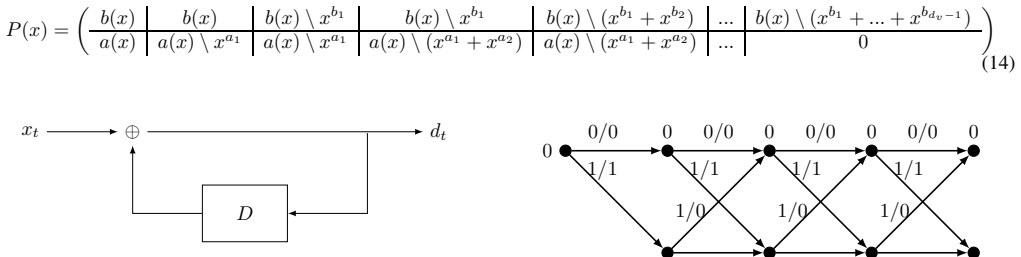
The load-bearing object is the upper-triangular propagation matrix $G$, whose recursive relation $d_t = d_{t-1} \oplus x_t$ turns each ancilla fault process into a two-state finite-state machine with a trellis. BCJR runs on that trellis to produce extrinsic log-likelihood ratios for the effective data errors, and Lemma 1 shows that every column block of the fault-to-data matrix $P$ reduces to $G$ after a row permutation, so the noisy fault graph can be replaced by equalizer nodes without changing the code's Tanner graph structure. The resulting joint graph $H_J$, with top block $[H_Z\,0]$ and bottom block $[I_n\,H_X^T]$, preserves variable and check degrees and girth, which is what lets standard min-sum message passing succeed where circuit-level belief propagation fails.
What would settle it
Simulate the same $X$-error circuit with an independent depolarizing error channel on data qubits in addition to ancilla and CNOT faults, feed the same syndrome to the turbo annihilation decoder while forcing direct data errors to be represented only through the per-ancilla fault priors, and compare with BPOSD0 on the $[90,8,10]$ code at $p=10^{-3}$; if the decoder's logical error rate no longer tracks BPOSD0, then the assumed reduction of all data errors to per-ancilla fault patterns is refuted.
Extended reading notes
Core claim
The central discovery is that hook errors look like a channel with memory when seen from the data qubits. For a stabilizer of weight $\rho$, an $X$ fault on the ancilla at time step $t$ propagates to data qubits $d_t,\ldots,d_\rho$, and the accumulated error satisfies $d_t = d_{t-1} \oplus x_t$, so each ancilla defines a two-state finite-state machine. The paper proves (Lemma 1) that for bivariate bicycle codes the fault-to-data matrix $P$ can be row-permuted into the upper-triangular staircase matrix $G$, which lets all faults belonging to one ancilla be merged into a single 'equalizer node' decoded by BCJR. The joint Tanner graph then collapses to the matrix $H_J$ with top block $[H_Z\,0]$ and bottom block $[I_n\,H_X^T]$, with one equalizer per $X$ stabilizer, and decoding alternates min-sum updates on the code graph with BCJR extrinsic messages. The paper's simulations show this turbo annihilation decoder outperforms normalized min-sum on the circuit-level Tanner graph and approaches BPOSD0 on both tested bivariate bicycle codes, at linear per-iteration complexity.
Load-bearing premise
The model assumes every error on a data qubit can be represented as the output of the small memory process attached to the measuring ancilla, with the prior chance of an ancilla fault set to $p$; if direct data-qubit depolarizing errors and target-side CNOT faults cannot be absorbed into those virtual ancilla fault patterns, the decoder's priors are misspecified and the reported near-BPOSD0 performance may not hold outside the simulated noise regime.
Editorial extensions
If this is right
- Per-iteration decoding cost becomes $2n(\gamma+1)+10m\rho$, which is $O(n)$, so the decoder remains practical for large codes and for repeated rounds of syndrome extraction.
- The joint graph $H_J$, with top block $[H_Z\,0]$ and bottom block $[I_n\,H_X^T]$, keeps the degree regularity and girth of the original code graph, eliminating the short cycles and degree-1 variable nodes that hurt circuit-level belief propagation.
- On the $[90,8,10]$ and $[144,12,12]$ bivariate bicycle codes, the decoder beats normalized min-sum on the circuit-level graph and approaches BPOSD0 at low fault probability $p$.
- Because the same reasoning applies with $X$ and $Z$ swapped, the method covers $Z$-type hook errors as long as the corresponding stabilizer measurement uses perfect CNOTs in the symmetric experiment.
- Diversity decoding with three variants, two layered schedules and one flooding schedule, using min-sum with past influence and a normalization factor $\beta=0.875$, is part of the method that achieves convergence without ordered-statistics post-processing.
Reading between the lines
- Beyond the paper: if the $e=Pf$ reduction generalizes to measurement errors, the same equalizer-node construction could treat consecutive syndrome-extraction rounds as an outer memory channel, potentially removing OSD from full fault-tolerant decoding pipelines.
- Beyond the paper: the per-ancilla trellis has only two states, so replacing BCJR with a cheaper soft-input soft-output estimator such as MMSE equalization could reduce the reported 9 operations per trellis layer and make the decoder attractive at very high code rates.
- Beyond the paper: since the decoder estimates effective data errors rather than fault locations, its error floor will depend on the weight distribution of effective errors induced by the circuit schedule; different CNOT orderings should shift that distribution and are a testable design knob.
- Beyond the paper: the observation that the first columns of $P(x)$ coincide with $H_X(x)^T$ suggests an algebraic characterization of which stabilizer-measurement schedules admit the staircase reduction; codes or schedules that fail Lemma 1 would need a different node grouping to avoid 4-cycles.
Signed reviews
Editorial analysis
A structured set of objections, weighed in public.
Referee Report
Summary. The paper proposes a decoder for QLDPC codes under a simplified circuit-level X-noise model. Rather than decoding on the full circuit-level Tanner graph, the authors model hook errors from each ancilla as a finite-state memory channel, group the per-ancilla fault variables into equalizer nodes that are processed by BCJR, and couple these equalizers to the Z Tanner graph of the code through constraint nodes. The resulting joint Tanner graph is claimed to preserve the degree and girth properties of the original code graph, to have O(n) complexity per iteration, and to outperform normalized min-sum decoding on the circuit-level graph while closely approaching BPOSD0 performance. Numerical results are reported for the [90,8,10] and [144,12,12] bivariate bicycle codes using a stim-based circuit-level noise model.
Significance. The equalizer-node construction is a conceptually interesting way to handle correlated hook errors without building the irregular circuit-level Tanner graph. If the model-fidelity issue raised below is resolved, the framework could be a useful scalable alternative to BPOSD. The paper contains a coherent derivation of the triangular propagation matrix, a plausible proof sketch in Lemma 1, an explicit complexity count, and comparisons against independent external baselines (MS and BPOSD0), which is the right kind of evidence for the central performance claim. The main weakness is that the reduced model's prior over effective data errors is not shown to match the simulated noise model, and no code or numerical data files are provided.
major comments (2)
- [Section III.A, Eqs. (15) and (22); Section IV, Eq. (25)] The factor graph defines the joint law over data errors e and ancilla faults f only through the deterministic constraint e = P f (or e = HX^T f after the equalizer merge), and the variable-node update in Eq. (25) has no explicit channel term for e. Under the noise model of Section II.C, however, there are independent depolarizing errors on data qubits at the start of the circuit and X errors on the target side of faulty CNOTs; neither is an ancilla fault. For a single stabilizer, the relation d_t = d_{t-1} + x_t in Eq. (17) maps a lone data error at an interior position to a pair of adjacent ancilla faults, so the induced prior on that data error is proportional to p^2 rather than the physical p/3 (initial depolarizing X) or p/15 (CNOT target X). Consequently, the BCJR branch metrics in Eq. (9) systematically down-weight the most probable physical explanation for a single-qubit data error. The paper does not add explicit data-error LLRs, nor does it prove that the column space of P contains weight-1 representatives with matching priors for every data qubit of the simulated codes. Without this, the near-BPOSD0 curves in Section V are an empirical property of a mismatched decoder rather than a consequence of the memory-channel derivation. I would ask for either a restricted-noise validation (only ancilla faults) or a corrected model that includes data-error channel priors, or a proof that the effective prior induced by e = P f with p(x_t=1)=p coincides with the simulated noise model.
- [Section V, Figs. 9 and 10] The central performance claim rests on two plots with no numerical tables, no confidence intervals beyond the stated stopping rule, and no code or data release. Given the model-mismatch concern above, the reader cannot distinguish a robust advantage of the equalizer architecture from a parameter-regime coincidence. The authors should provide the underlying logical error rates with uncertainties, or a public implementation of the decoder and the stim circuit, and should also report the sensitivity of the results to the diversity-decoding configuration and to the normalized min-sum parameter beta = 0.875, since these choices come from prior work and are not optimized in this paper.
minor comments (4)
- [Section II.E] There is a typo: 'An FSM is can be represented by its state diagram' should read 'An FSM can be represented by its state diagram'.
- [Example 1 and Eq. (21)] The displayed matrices are difficult to verify because of the line breaks and row alignment. Please ensure the matrices are typeset with explicit dimensions or delimiters so that the reader can check the claim that P(1) reduces to G under the row permutation.
- [Section V] The captions of Figs. 9 and 10 state only the codes; please state explicitly in the text or captions that the ordinate is the logical error rate and the abscissa is the per-component fault probability p, and clarify how the 'minimum number of failures to stop' rule translates into error bars.
- [References] Reference [4] is missing publication year and venue information; please complete the citation.
Circularity Check
No significant circularity: the hook-error memory-channel construction is derived from the circuit, the reduction to HX^T is proved in-paper (Lemma 1), and the decoder is benchmarked externally via stim against standard MS and BPOSD0.
full rationale
The central derivation is self-contained. The matrix P in Eq. (14) is constructed directly from the CNOT schedule of Fig. 2, and the subsequent equalizer-node reduction giving HJ = [[HZ, 0], [In, HX^T]] in Eq. (22) is justified by Lemma 1, whose proof is presented in the paper. The BCJR equalizers use a physical fault probability p as the prior, with no fitted parameter renamed as a prediction. The reported logical error rates come from stim sampling and are compared with normalized MS and BPOSD0 on the circuit-level Tanner graph, so the performance claim is externally falsifiable and not derived from the target quantity. The only same-group citation is [15], used for the MS-PI update rule and the normalization factor beta = 0.875; these are convergence heuristics from prior work and are not fitted to the error-rate curves in this paper. A possible concern is that direct data-qubit depolarizing errors and target-side CNOT X errors are not explicit columns of P and must be absorbed by the equalizer prior; however, this is a correctness / model-fidelity risk, not a circularity, because the decoder is tested against independent baselines on the full simulated noise model. Overall, no load-bearing step reduces by construction or by self-citation to its own input.
Assumptions & free parameters
free parameters (3)
- Min-sum normalization factor beta =
0.875
- Diversity decoding configuration =
3 decoders, layered and flooding schedules, MS-PI applied to L or R variables
- Maximum iteration counts =
300 iterations for TA and BPOSD0, 900 for MS
assumptions (4)
- standard math Min-sum and BCJR update rules correctly approximate MAP decoding on the joint graph.
- domain assumption Noise is restricted to X errors, with no idling or measurement errors, and noisy X stabilizer measurements are followed by perfect Z measurements.
- domain assumption An X error on an X ancilla at time t propagates to a suffix of the data qubits, so e = P f with independent inputs x_t captures hook-error statistics.
- ad hoc to paper Merging the P columns into equalizer nodes reduces the joint graph to HJ = [[HZ, 0], [In, HX^T]] without losing needed information.
invented entities (1)
-
Equalizer node (generalized variable node)
Cite this review
Pith. "Pith review of Turbo-Annihilation of Hook Errors in Stabilizer Measurement Circuits." pith.science (2026). https://pith.science/paper/HC63JW57
@misc{pith2026250421200,
  author       = {Pith},
  title        = {Pith review of: Turbo-Annihilation of Hook Errors in Stabilizer Measurement Circuits},
  year         = {2026},
  howpublished = {\url{https://pith.science/paper/HC63JW57}},
  note         = {Machine review of arXiv:2504.21200}
}
read the original abstract
We propose a scalable decoding framework for correcting correlated hook errors in stabilizer measurement circuits. Traditional circuit-level decoding attempts to estimate the precise location of faults by constructing an extended Tanner graph that includes every possible source of noise. However, this results in a highly irregular graph with many short cycles, leading to poor performance of message-passing algorithms. To compensate, ordered statistics decoding is typically employed, but its cubic complexity renders it impractical for large codes or repeated stabilizer measurements. Our approach instead focuses on estimating the effective data errors caused by hook faults, modeling them as memory channels. We integrate trellis-based soft-input soft-output equalizers into the Tanner graph of the code, and show that the resulting decoding graph preserves the structural properties of the original Tanner graph such as node degree and girth, enabling efficient message passing. Applied to bivariate bicycle quantum LDPC codes, our decoder outperforms standard belief propagation on the circuit-level graph and closely approaches OSD0 performance, all while maintaining linear complexity and scalability.
Figures


Figures from the paper (6 more)


Reference graph
Works this paper leans on
-
[1]
Improved Decoding of Circuit Noise and Fragile B oundaries of Tailored Surface Codes,
O. Higgott, T. C. Bohdanowicz, A. Kubica, S. T. Flammia, a nd E. T. Campbell, “Improved Decoding of Circuit Noise and Fragile B oundaries of Tailored Surface Codes,” Physical Review X , vol. 13, p. 031007, July 2023
work page 2023
-
[2]
Toward Low-latenc y Iterative Decoding of QLDPC Codes Under Circuit-Level Noise,
A. Gong, S. Cammerer, and J. M. Renes, “Toward Low-latenc y Iterative Decoding of QLDPC Codes Under Circuit-Level Noise,” arXiv preprint arXiv:2403.18901, 2024
arXiv 2024
-
[3]
Fault-Tolerant Belief Propaga tion for Practical Quantum Memory,
K.-Y . Kuo and C.-Y . Lai, “Fault-Tolerant Belief Propaga tion for Practical Quantum Memory,” arXiv preprint arXiv:2409.18689 , 2024
arXiv 2024
-
[4]
Ambiguity Clustering: an Acc urate and Efficient Decoder for qLDPC codes,
S. Wolanski and B. Barber, “Ambiguity Clustering: an Acc urate and Efficient Decoder for qLDPC codes,” arXiv preprint arXiv:2406.14527
-
[5]
Turbo Equalization: An Ove rview,
M. T ¨ uchler and A. C. Singer, “Turbo Equalization: An Ove rview,” IEEE Transactions on Information Theory , vol. 57, no. 2, pp. 920–952, 2011
work page 2011
-
[6]
Error Bounds for Convolutional Codes and an Asymptoti- cally Optimum Decoding Algorithm,
A. Viterbi, “Error Bounds for Convolutional Codes and an Asymptoti- cally Optimum Decoding Algorithm,” IEEE Transactions on Information Theory, vol. 13, no. 2, pp. 260–269, 1967
work page 1967
-
[7]
Optimal Deco ding of Linear Codes for Minimizing Symbol Error Rate (Corresp.),
L. Bahl, J. Cocke, F. Jelinek, and J. Raviv, “Optimal Deco ding of Linear Codes for Minimizing Symbol Error Rate (Corresp.),” IEEE Transactions on Information Theory , vol. 20, no. 2, pp. 284–287, 1974
work page 1974
-
[8]
Graph-Based Decoding in t he Presence of ISI,
M. H. Taghavi and P . H. Siegel, “Graph-Based Decoding in t he Presence of ISI,” IEEE Transactions on Information Theory , vol. 57, no. 4, pp. 2188–2202, 2011
work page 2011
Show all 16 references
-
[9]
Joint Message-Pass ing Decoding of LDPC Codes and Partial-Response Channels,
B. Kurkoski, P . Siegel, and J. Wolf, “Joint Message-Pass ing Decoding of LDPC Codes and Partial-Response Channels,” IEEE Transactions on Information Theory , vol. 48, no. 6, pp. 1410–1422, 2002
2002
-
[10]
Good Quantum Error-Cor recting Codes Exist,
A. R. Calderbank and P . W. Shor, “Good Quantum Error-Cor recting Codes Exist,” Physical Review A , vol. 54, pp. 1098–1105, Aug. 1996
1996
-
[11]
High-Threshold and Low-Overhead Fault-Tolerant Q uantum Memory,
S. Bravyi, A. W. Cross, J. M. Gambetta, D. Maslov, P . Rall , and T. J. Y oder, “High-Threshold and Low-Overhead Fault-Tolerant Q uantum Memory,” Nature, vol. 627, no. 8005, pp. 778–782, 2024
2024
-
[12]
Tutorial on the quantikz package,
A. Kay, “Tutorial on the quantikz package,” arXiv preprint arXiv:1809.03842, 2023
2023
-
[13]
Doubly Generalized LDPC Code s,
Y . Wang and M. Fossorier, “Doubly Generalized LDPC Code s,” in 2006 IEEE International Symposium on Information Theory , pp. 669–673, 2006
2006
-
[14]
Reduced-Complexity Decoding of LDPC Codes,
J. Chen, A. Dholakia, E. Eleftheriou, M. Fossorier, and X.-Y . Hu, “Reduced-Complexity Decoding of LDPC Codes,” IEEE Transactions on Communications , vol. 53, no. 8, pp. 1288–1299, 2005
2005
-
[15]
Enhanced Min- Sum Decoding of Quantum Codes Using Previous Iteration Dynamics,
D. Chytas, N. Raveendran, and B. V asi´ c, “Enhanced Min- Sum Decoding of Quantum Codes Using Previous Iteration Dynamics,” arXiv preprint arXiv:2501.05021, 2025
2025 arXiv
-
[16]
Stim: a Fast Stabilizer Circuit Simulator,
C. Gidney, “Stim: a Fast Stabilizer Circuit Simulator, ” Quantum, vol. 5, p. 497, July 2021
2021
Reviewed August 16, 2026 · model on record in the stance chip above.
Discussion (0). Continue with ORCID to comment.