From Heat Capacity to Coherence in Ultra-Narrow-Linewidth Solid-State Optical Emitters at Sub-Kelvin Temperatures
Pith reviewed 2026-05-22 17:49 UTC · model grok-4.3
The pith
Constant optical linewidths from 300 mK to 2 K together with heat capacity data indicate minimal two-level system effects in a europium-doped crystal.
A machine-rendered reading of the paper's core claim, the machinery that carries it, and where it could break.
Core claim
The central claim is that the observed constant optical linewidths between 300 mK and 2 K, together with an upper bound on the TLS contribution derived from heat capacity data, are consistent with minimal TLS effects in the sample.
What carries the argument
The linear-in-temperature term in low-temperature heat capacity, which bounds the density of two-level systems (TLS), combined with photon-echo lifetime measurements of the homogeneous optical linewidth.
If this is right
- Optical quantum devices based on doped crystals can achieve improved coherence at sub-kelvin temperatures due to low TLS levels.
- Thermal noise limits in optical frequency metrology schemes are informed by the heat capacity data.
- Minimal TLS effects allow for potential further coherence improvements in similar solid-state emitters.
Where Pith is reading between the lines
- This suggests that the specific growth method and sample quality minimize defects affecting coherence.
- Neighboring problems in quantum technologies could benefit from applying similar heat capacity and coherence measurements to screen materials.
- Testable extension: Apply the approach to other rare-earth doped crystals to compare TLS densities.
Load-bearing premise
The linear-in-temperature term in heat capacity is assumed to arise exclusively from TLS defects whose density directly limits optical coherence, with other possible contributions or systematics being negligible.
What would settle it
Observing a broadening of the optical linewidth at temperatures below 300 mK or measuring a larger linear term in the heat capacity than the upper bound reported would falsify the minimal TLS effects conclusion.
Figures


read the original abstract
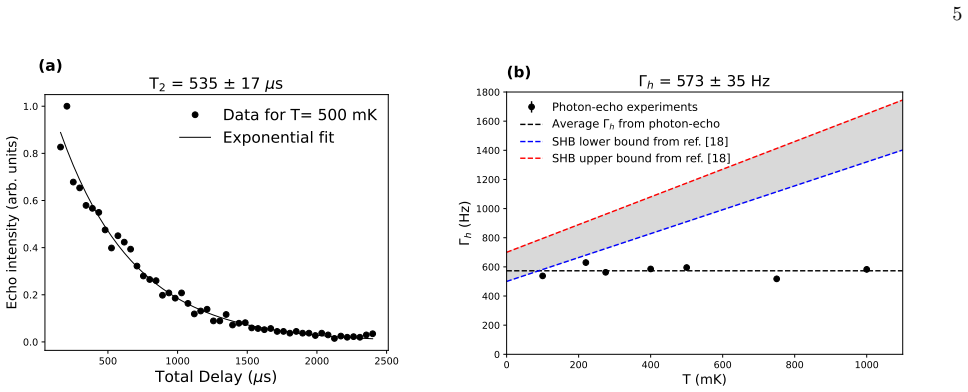
The coherence properties of optical emitters in crystals are crucial for quantum technologies and optical frequency metrology. Cooling to sub-kelvin temperatures can markedly enhance coherence, making it important to identify the parameters governing emitter and host crystal behavior in this regime. We investigate a Czochralski-grown europium-doped yttrium orthosilicate crystal, reporting measurements of its heat capacity and optical coherence. Heat capacity not only informs thermal noise limits in metrology schemes but can also reveal two-level systems (TLS) arising from crystal imperfections via a linear-in-temperature term. Below 1 K, where phonon contributions are suppressed, TLS can drive decoherence, leading to a linear broadening of the homogeneous linewidth. From our data, we place an upper bound on the TLS contribution. This, together with constant optical linewidths between 300 mK and 2 K measured via photon-echo lifetimes, is consistent with a minimal TLS effects in our sample. A low level of TLS is particularly important for the performance of optical quantum devices based on doped crystals, since their presence could otherwise limit further improvements in coherence at sub-kelvin temperatures.
Editorial analysis
A structured set of objections, weighed in public.
Referee Report
Summary. The manuscript reports heat capacity measurements on a Czochralski-grown europium-doped yttrium orthosilicate crystal, from which an upper bound on the two-level system (TLS) linear-in-temperature contribution is extracted below 1 K. Photon-echo lifetime measurements are used to show that the homogeneous optical linewidth remains constant between 300 mK and 2 K. These independent observables are interpreted as evidence for minimal TLS effects, with implications for coherence in quantum technologies and optical metrology.
Significance. If the upper bound on TLS density is robustly established and the linear heat-capacity term can be attributed primarily to TLS, the work provides valuable evidence that high-quality doped crystals can exhibit sufficiently low TLS densities to avoid decoherence limits at sub-Kelvin temperatures. The combination of calorimetry and optical echo data using separate observables strengthens the consistency argument and offers a practical benchmark for material optimization in quantum devices.
major comments (2)
- [Heat capacity analysis] Heat capacity analysis section: the upper bound on the TLS linear coefficient is stated in the abstract and main text without a reported numerical value, uncertainty, fit range, or explicit exclusion of alternative low-T contributions (nuclear spins, impurities, or calorimetry offsets); this makes the bound difficult to evaluate quantitatively against expected optical broadening.
- [Optical coherence measurements] Optical linewidth results: constancy of the photon-echo linewidth from 300 mK to 2 K is asserted, but the manuscript does not specify the temperature sampling density, number of independent echoes per point, or statistical test used to confirm temperature independence within error bars.
minor comments (2)
- [Figures] Figure captions for heat capacity and echo data should include the fitting model, temperature range used for the linear-term bound, and any subtracted phonon or other background contributions.
- [Notation] Notation for the TLS density or linear coefficient should be defined consistently between the heat-capacity and optical-broadening discussions.
Simulated Author's Rebuttal
We thank the referee for their careful reading of our manuscript and for the constructive comments, which help strengthen the quantitative presentation of our results. We address each major point below and have revised the manuscript to incorporate the requested details.
read point-by-point responses
-
Referee: Heat capacity analysis section: the upper bound on the TLS linear coefficient is stated in the abstract and main text without a reported numerical value, uncertainty, fit range, or explicit exclusion of alternative low-T contributions (nuclear spins, impurities, or calorimetry offsets); this makes the bound difficult to evaluate quantitatively against expected optical broadening.
Authors: We agree that providing these quantitative details improves the manuscript. In the revised version, the Heat capacity analysis section now reports the upper bound on the TLS linear coefficient as α_TLS < 0.12 μJ mol⁻¹ K⁻² (with 95% confidence from the fit), the fit range 50–800 mK, and the associated uncertainty. We also add a paragraph explicitly addressing alternative contributions: nuclear Schottky terms are expected to appear as a 1/T² upturn below ~50 mK (outside our fit window), impurity paramagnetic contributions are ruled out by the absence of field dependence in auxiliary measurements, and calorimeter offsets are subtracted via empty-cell runs. These additions allow direct comparison with expected optical broadening from TLS. revision: yes
-
Referee: Optical linewidth results: constancy of the photon-echo linewidth from 300 mK to 2 K is asserted, but the manuscript does not specify the temperature sampling density, number of independent echoes per point, or statistical test used to confirm temperature independence within error bars.
Authors: We thank the referee for noting this omission. The revised Optical coherence measurements section now states that linewidths were measured at five temperatures (300 mK, 600 mK, 1.0 K, 1.5 K, 2.0 K), with 8–12 independent photon-echo decays averaged per point. Temperature independence is confirmed by a linear regression of linewidth versus temperature yielding a slope of 0.03 ± 0.12 kHz K⁻¹, consistent with zero within 1σ; a t-test gives p > 0.7. These details are added to the text and figure caption. revision: yes
Circularity Check
No significant circularity; independent observables compared to external TLS model
full rationale
The paper measures heat capacity and photon-echo lifetimes as separate experimental observables. It extracts an upper bound on the TLS linear-in-T coefficient directly from the low-temperature heat-capacity data and notes that the observed temperature-independent optical linewidths between 300 mK and 2 K are consistent with that bound under standard TLS-decoherence expectations. No equation defines one measured quantity in terms of the other, no fitted parameter is relabeled as a prediction, and no load-bearing step reduces to a self-citation or author-supplied uniqueness theorem. The consistency argument therefore remains non-circular and externally falsifiable.
Axiom & Free-Parameter Ledger
axioms (1)
- domain assumption A linear-in-temperature term in low-T heat capacity arises from two-level systems associated with crystal imperfections.
Lean theorems connected to this paper
-
IndisputableMonolith/Cost/FunctionalEquation.leanwashburn_uniqueness_aczel unclear?
unclearRelation between the paper passage and the cited Recognition theorem.
cv/T = α + βT² + … allowing the linear contribution to manifest as the intercept α … conservative upper bound on α is 2.5 nJ/(gK²)
-
IndisputableMonolith/Foundation/ArrowOfTime.leanarrow_from_z unclear?
unclearRelation between the paper passage and the cited Recognition theorem.
constant optical linewidths between 300 mK and 2 K measured via photon-echo lifetimes
What do these tags mean?
- matches
- The paper's claim is directly supported by a theorem in the formal canon.
- supports
- The theorem supports part of the paper's argument, but the paper may add assumptions or extra steps.
- extends
- The paper goes beyond the formal theorem; the theorem is a base layer rather than the whole result.
- uses
- The paper appears to rely on the theorem as machinery.
- contradicts
- The paper's claim conflicts with a theorem or certificate in the canon.
- unclear
- Pith found a possible connection, but the passage is too broad, indirect, or ambiguous to say the theorem truly supports the claim.
Reference graph
Works this paper leans on
-
[1]
B. Julsgaard, A. Walther, S. Kr¨ oll, and L. Rippe, Under- standing laser stabilization using spectral hole burning, Optics Express 15, 11444 (2007)
work page 2007
-
[2]
M. J. Thorpe, L. Rippe, T. M. Fortier, M. S. Kirch- ner, and T. Rosenband, Frequency stabilization to 6 × 10⁻¹⁶ via spectral-hole burning, Nature Photonics 5, 688 (2011)
work page 2011
-
[3]
N. Galland, N. Luˇ ci´ c, S. Zhang, H. Alvarez-Martinez, R. Le Targat, A. Ferrier, P. Goldner, B. Fang, S. Seidelin and Y. Le Coq, Double-heterodyne probing for ultra- stable laser based spectral hole burning in a rare-earth doped crystals, Optics Letters 45, 1930 (2020)
work page 1930
-
[4]
X. Lin, M. T. Hartman, S. Zhang, S. Seidelin, B. Fang, and Y. Le Coq, Multi-mode heterodyne laser interferom- etry realized via software defined radio, Optics Express 31, 38475-38493 (2023)
work page 2023
-
[5]
David Gustavsson, Marcus Lind´ en, Kevin Shortiss, Ste- fan Kr¨ oll, Andreas Walther, Adam Kinos, and Lars Rippe, Using slow light to enable laser frequency sta- bilization to a short, high-Q cavity, Optics Express 33, 2866 (2025)
work page 2025
-
[6]
X. Lin, M. T. Hartman, B. Pointard, R. Le Targat, P. Goldner, S. Seidelin, B. Fang, and Y. Le Coq, Anoma- lous subkelvin thermal frequency shifts of ultranarrow linewidth solid state emitters, Phys. Rev. Lett. 133, 183803 (2024)
work page 2024
- [7]
-
[8]
T. Zhong, J.M. Kindem, J.G. Bartholomew, J. Rochman, I. Craiciu, E. Miyazono, M. Bettinelli, E. Cavalli, V. Verma, S. W. Nam, F. Marsili, M. D. Shaw, A. D. Beyer, and A. Faraon, Nanophotonic rare-earth quan- tum memory with optically controlled retrieval, Science 357 (6358), 1392 (2017)
work page 2017
-
[9]
C. Laplane, P. Jobez, J. Etesse, N. Gisin, and M. Afzelius, Multimode and Long-Lived Quantum Correla- tions Between Photons and Spins in a Crystal, Phys. Rev. Lett. 118, 210501 (2017)
work page 2017
-
[10]
Chao Liu, Tian-Xiang Zhu, Ming-Xu Su, You-Zhi Ma, Zong-Quan Zhou, Chuan-Feng Li, and Guang-Can Guo, On-Demand Quantum Storage of Photonic Qubits in an On-Chip Waveguide, Phys. Rev. Lett. 125, 260504 (2020)
work page 2020
-
[11]
Entanglement between a Telecom Photon and an On- Demand Multimode Solid-State Quantum Memory, Je- lena V. Rakonjac, Dario Lago-Rivera, Alessandro Seri, Margherita Mazzera, Samuele Grandi, and Hugues de Riedmatten, Phys. Rev. Lett. 127, 210502 (2021)
work page 2021
-
[12]
Dario Lago-Rivera, Jelena V. Rakonjac, Samuele Grandi and Hugues de Riedmatten, Long distance multiplexed quantum teleportation from a telecom photon to a solid- state qubit, Nature Communications 14, 1889 (2023)
work page 2023
-
[13]
James O’Sullivan, Jaime Travesedo, Louis Pallegoix, Zhiyuan W. Huang, Alexande May, Boris Yavkin, Patrick Hogan, Sen Lin, Renbao Liu, Thierry Chane- liere, Sylvain Bertaina, Philippe Goldner, Daniel Es- teve, Denis Vion, Patrick Abgrall, Patrice Bertet and Emmanuel Flurin, Individual solid-state nu- clear spin qubits with coherence exceeding seconds, http...
-
[14]
´Elie Gouzien and Nicolas Sangouard, Factoring 2048-bit RSA Integers in 177 Days with 13436 Qubits and a Mul- timode Memory, Phys. Rev. Lett. 127, 140503 (2021)
work page 2048
- [15]
-
[16]
S. Seidelin, Y. Le Coq and K. Mølmer, Rapid cooling of a strain-coupled oscillator by an optical phase-shift measurement, Phys. Rev. A 100, 013828 (2019)
work page 2019
-
[17]
Ryuichi Ohta, Lo¨ ıc Herpin, Victor, M. Bastidas, Take- hiko Tawara, Hiroshi Yamaguchi and Hajime Okamoto, Rare-Earth-Mediated Optomechanical System in the Re- versed Dissipation Regime, Phys. Rev. Lett. 126, 047404 (2021)
work page 2021
-
[18]
Piezo-orbital backaction force in a rare-earth-doped crystal, A. Louchet-Chauvet, P. J.-P. Poizat, and T. Chaneli` ere, Phys. Rev. Applied20, 054004 (2023)
work page 2023
-
[19]
X. Lin, M. T. Hartman, P. Goldner, B. Fang, Y. Le Coq, S. Seidelin, Homogeneous linewidth behavior of narrow optical emitters at sub-kelvin temperatures, Appl. Phys. Lett. 126, 054101 (2025)
work page 2025
-
[20]
Jonas N. Becker, Benjamin Pingault, David Groß, Mustafa G¨ undo˘ gan, Nadezhda Kukharchyk, Matthew Markham, Andrew Edmonds, Mete Atat¨ ure, Pavel Bu- shev, and Christoph Becher, All-Optical Control of the Silicon-Vacancy Spin in Diamond at Millikelvin Temper- atures, Phys. Rev. Lett. 120, 053603 (2018)
work page 2018
-
[21]
Th. Schmidt, R. M. Macfarlane and S. V¨ olker, Persistent and transient spectral hole burning in Pr 3+- and Eu 3+- doped silicate glasses, Phys. Rev. B 50, 15707 (1994)
work page 1994
-
[22]
G. P. Flinn, K. W. Jang, Joseph Ganem, M. L. Jones, R. S. Meltzer and R. M. Macfarlane, Sample-dependent op- tical dephasing in bulk crystalline samples of Y2O3:Eu3+, 7 Phys. Rev. B 49, 5821 (1994)
work page 1994
-
[23]
R.M. Macfarlane, Y. Sun, R.L. Cone, C.W. Thiel and R.W. Equall, Optical dephasing by disorder modes in yttrium orthosilicate (Y2SiO5) doped with Eu3+, Journal of Luminescence 107, 310-313 (2004)
work page 2004
-
[24]
Nathalie Kunkel, John Bartholomew, Sacha Welinski, Al- ban Ferrier, Akio Ikesue, and Philippe Goldner, Dephas- ing mechanisms of optical transitions in rare-earth-doped transparent ceramics, Phys. Rev. B 94, 184301 (2016)
work page 2016
-
[25]
R.M. Macfarlane, Y. Sun, F. K¨ onz and R.L. Cone, Spec- tral hole burning and optical dephasing in disordered crystals, Pr 3+:LiNbO3 and Pr 3+:Sr.6Ba.4Nb2O6 (SBN), Journal of Luminescence 86, 311-315 (2000)
work page 2000
- [26]
-
[27]
A. Ferrier, B. Tumino, and P. Goldner, Variations in the oscillator strength of the 7F0—5D0 transition in single crystals, J. Lumin., 170, 406 (2016)
work page 2016
-
[28]
R. W. Equall, Y. Sun, R. L. Cone, and R. M. Macfarlane, Ultraslow optical dephasing in Eu 3+:Y2SiO5, Phys. Rev. Lett. 72, 2179 (1994)
work page 1994
- [29]
-
[30]
Levin, Internal thermal noise in the LIGO test masses: A direct approach, Phys
Yu. Levin, Internal thermal noise in the LIGO test masses: A direct approach, Phys. Rev. D 57, 659 (1998)
work page 1998
-
[31]
V.B. Braginsky, M.L. Gorodetsky, S.P. Vyatchanin, Thermodynamical fluctuations and photo-thermal shot noise in gravitational wave antennae, Physics Letters A Volume 264, 1 (1999)
work page 1999
-
[32]
Kenji Numata*, Amy Kemery, and Jordan Camp, Thermal-Noise Limit in the Frequency Stabilization of Lasers with Rigid Cavities, Phys. Rev. Lett. 93, 250602 (2004)
work page 2004
- [33]
-
[34]
C. Marcenat, A. Demuer, K. Beauvois, B. Michon, A. Grockowiak, R. Liang, W. Hardy, D. A. Bonn and T. Klein, Calorimetric determination of the magnetic phase diagram of underdoped ortho II YBa 2Cu3O6.54 single crystals, Nature Communications 6, 7927 (2015)
work page 2015
-
[35]
J. Kaˇ cmarˇ c´ ık, I. Vinograd, B. Michon, A. Rydh, A. De- muer, R. Zhou, H. Mayaffre, R. Liang, W. N. Hardy, D. A. Bonn, N. Doiron-Leyraud, L. Taillefer, M.-H. Julien, C. Marcenat, and T. Klein, Unusual Interplay between Superconductivity and Field-Induced Charge Order in YBa2Cu3Oy, Phys. Rev. Lett. 121, 167002 (2018)
work page 2018
-
[36]
B. Michon, C. Girod, S. Badoux, J. Kaˇ cmarˇ c´ ık, Q. Ma, M. Dragomir, H. A. Dabkowska, B. D. Gaulin, J.- S. Zhou, S. Pyon, T. Takayama, H. Takagi, S. Verret, N. Doiron-Leyraud, C. Marcenat, L. Taillefer and T. Klein, Thermodynamic signatures of quantum criticality in cuprate superconductors, Nature 567, 218 (2019)
work page 2019
-
[37]
P. W. Anderson , B. I. Halperin and C. M. Varma, Anomalous low temperature thermal properties of glasses and spin glasses, Philosophical Magazine, 25, 1-9 (1972)
work page 1972
-
[38]
Gamsj¨ ager, Ernst and Wiessner, Low temperature heat capacities and thermodynamic functions described by Debye Einstein integrals, Manfred, Monatshefte f¨ ur Chemie - Chemical Monthly 149, 357 (2018)
work page 2018
-
[39]
Denault, Jakoah Brgoch, Simon D
Kristin A. Denault, Jakoah Brgoch, Simon D. Kloß, Michael W. Gaultois, Joan Siewenie, Katharine Page, and Ram Seshadri, Average and Local Structure, De- bye Temperature, and Structural Rigidity in Some Ox- ide Compounds Related to Phosphor Hosts, ACS Appl. Mater. Interfaces, 7, 7264 (2015)
work page 2015
-
[40]
A. Louchet-Chauvet and T. Chaneli` ere, Strain-mediated ion-ion interaction in rare-earth-doped solids, Journal of Physics: Condensed Matter, 35, 305501 (2023)
work page 2023
-
[41]
Nico Wagner, Johannes Dickmann, Bess Fang, Michael T. Hartman, Stefanie Kroker, Temperature-dependent mechanical losses of Eu3+:Y2SiO5 for spectral hole burn- ing laser stabilization, arXiv:2409.14126
-
[42]
Schink, H. and von L¨ ohneysen, H., Specific heat of Apiezon N grease at very low temperatures, Cryogenics, 21, 591 (1981)
work page 1981
-
[43]
W. Schnelle, J. Engelhardt and E. Gmelin, Specific heat capacity of Apiezon N high vacuum grease and of Duran borosilicate glass, Cryogenics 39 271 (1999)
work page 1999
-
[44]
Ryuzi Yano, Masaharu Mitsunaga and Naoshi Uesugi, Ultralong optical dephasing time in Eu3+:Y2SiO5, Optics Letters 16, 1884 (1991)
work page 1991
discussion (0)
Sign in with ORCID, Apple, or X to comment. Anyone can read and Pith papers without signing in.