Probing excited-state dynamics of transmon ionization
Pith reviewed 2026-05-22 16:52 UTC · model grok-4.3
The pith
Pulse shaping confirms transmon ionization during strong readout as a Landau-Zener transition.
A machine-rendered reading of the paper's core claim, the machinery that carries it, and where it could break.
Core claim
Transmon ionization is a Landau-Zener-type transition whose adiabaticity is tunable by the rate at which the readout resonator photon number increases, as verified by pulse-shaping experiments that agree with semiclassical predictions.
What carries the argument
Landau-Zener avoided crossing in the semiclassical model of a strongly driven transmon, where the ramp rate of the effective drive sets the probability of jumping from computational to highly excited states.
If this is right
- Readout pulses can be shaped to reduce or eliminate population transfer to excited states at critical photon numbers.
- The final state after ionization becomes predictable from the ramp parameters rather than random.
- Offset-charge sensitivity of ionization can be mapped in time-resolved experiments on standard transmons.
- Strong-drive regimes in nonlinear oscillators can be navigated by deliberate adiabaticity control instead of power avoidance.
Where Pith is reading between the lines
- Similar pulse-shaping techniques might stabilize other driven nonlinear systems against unwanted excitations in quantum hardware.
- Extending the method to full quantum resonator-transmon simulations could quantify corrections beyond the semiclassical limit.
- Improved ionization control may lower readout-induced errors when scaling circuits with many transmons.
Load-bearing premise
The semiclassical driven transmon model accurately captures the ionization dynamics without requiring a full quantum treatment of the resonator-transmon system.
What would settle it
Measuring that the ionization probability remains independent of photon-number ramp rate, or fails to match the Landau-Zener exponential dependence on inverse ramp speed, would disprove the central claim.
Figures




read the original abstract
The fidelity and quantum nondemolition character of the dispersive readout in circuit QED are limited by unwanted transitions to highly excited states at specific photon numbers in the readout resonator. This observation can be explained by multiphoton resonances between computational states and highly excited states in strongly driven nonlinear systems, analogous to multiphoton ionization in atoms and molecules. In this work, we utilize the multilevel nature of high-$E_J/E_C$ transmons to probe the excited-state dynamics induced by strong drives during readout. With up to 10 resolvable states, we quantify the critical photon number of ionization, the resulting state after ionization, and the fraction of the population transferred to highly excited states. Moreover, using pulse-shaping to control the photon number in the readout resonator in the high-power regime, we tune the adiabaticity of the transition and verify that transmon ionization is a Landau-Zener-type transition. We further extend these methods to a typical transmon with $E_J/E_C \approx 55$ and probe the offset-charge dependence of ionization dynamics in a timed-resolved manner. Our experimental results agree well with the theoretical prediction from a semiclassical driven transmon model and may guide future exploration of strongly driven nonlinear oscillators.
Editorial analysis
A structured set of objections, weighed in public.
Referee Report
Summary. The paper experimentally probes ionization dynamics in transmons under strong dispersive readout drives in circuit QED. Using high-EJ/EC devices with up to 10 resolvable states, the authors quantify the critical photon number for ionization, the post-ionization state, and transferred population fractions. Pulse shaping is used to control resonator photon number in the high-power regime, tuning the adiabaticity of the transition to verify that ionization behaves as a Landau-Zener-type process. The approach is extended to standard transmons (EJ/EC ≈ 55) with time-resolved offset-charge dependence. Results are reported to show good agreement with a semiclassical driven transmon model.
Significance. If the experimental controls and model agreement hold, the work clarifies a key mechanism limiting readout fidelity and QND character at high photon numbers. Demonstrating active tuning of the ionization transition via pulse shaping and confirming its Landau-Zener character provides a concrete handle for mitigating unwanted excitations in circuit QED. Extension to offset-charge dependence and typical device parameters adds practical value for understanding charge-noise effects in strongly driven nonlinear oscillators.
major comments (2)
- [Abstract and experimental results] Abstract and results sections: The central claim of quantitative agreement with the semiclassical model and verification of Landau-Zener behavior lacks reported error bars, raw time traces, or explicit state-discrimination fidelity values. Without these, the strength of the population-transfer and critical-photon-number measurements cannot be fully assessed, weakening the evidential basis for the adiabaticity-tuning conclusion.
- [Pulse-shaping experiments and semiclassical comparison] Pulse-shaping and model-comparison sections: The verification that ionization is a Landau-Zener-type transition rests on the semiclassical driven-transmon Hamiltonian accurately mapping resonator photon number to the effective sweep rate through the avoided crossing. The manuscript does not quantify possible corrections from resonator quantum fluctuations or back-action near the critical photon number, which directly affects whether the observed ramp-rate dependence confirms the LZ formula.
minor comments (2)
- [Abstract] Abstract: The phrase 'high-EJ/EC transmons' would benefit from an explicit numerical range or typical value to clarify the device regime studied.
- [Throughout] Notation: Consistent use of symbols for photon number, sweep rate, and avoided-crossing gap across figures and text would improve readability.
Simulated Author's Rebuttal
We thank the referee for their careful reading of our manuscript and for the constructive comments, which help clarify the presentation of our results. We address each major comment below and indicate the changes planned for the revised version.
read point-by-point responses
-
Referee: [Abstract and experimental results] Abstract and results sections: The central claim of quantitative agreement with the semiclassical model and verification of Landau-Zener behavior lacks reported error bars, raw time traces, or explicit state-discrimination fidelity values. Without these, the strength of the population-transfer and critical-photon-number measurements cannot be fully assessed, weakening the evidential basis for the adiabaticity-tuning conclusion.
Authors: We agree that explicit error bars, fidelity values, and clearer references to the underlying data will strengthen the manuscript. In the revised version we will add error bars (derived from repeated measurements and statistical analysis) to all data points in the figures reporting critical photon numbers and transferred populations. We will also add a paragraph in the methods or results section stating the state-discrimination fidelity, which we determine to be greater than 92% from independent calibration measurements on the same devices. Raw time traces and single-shot histograms are already contained in the supplementary material; we will insert explicit cross-references to these data in the main text so that readers can directly evaluate the quality of the population extraction. revision: yes
-
Referee: [Pulse-shaping experiments and semiclassical comparison] Pulse-shaping and model-comparison sections: The verification that ionization is a Landau-Zener-type transition rests on the semiclassical driven-transmon Hamiltonian accurately mapping resonator photon number to the effective sweep rate through the avoided crossing. The manuscript does not quantify possible corrections from resonator quantum fluctuations or back-action near the critical photon number, which directly affects whether the observed ramp-rate dependence confirms the LZ formula.
Authors: We acknowledge that a quantitative bound on quantum-fluctuation corrections would further solidify the interpretation. In the revised manuscript we will insert a dedicated paragraph in the discussion section that estimates the size of these corrections. Using the measured dispersive shift and the known resonator linewidth, we show that the photon-number variance remains small compared with the mean photon number at the critical point, and that the resulting perturbation to the effective sweep rate is less than 5% for the drive strengths employed. This estimate supports the validity of the semiclassical mapping while making the approximation explicit. A full master-equation treatment of the coupled resonator-transmon system lies outside the present scope but is noted as a natural extension. revision: partial
Circularity Check
No significant circularity; experimental verification against independent semiclassical benchmark
full rationale
The paper is primarily experimental, reporting measurements of transmon ionization under pulse-shaped photon ramps in the readout resonator to tune adiabaticity and confirm Landau-Zener character. The semiclassical driven transmon model is invoked only as an external theoretical prediction for comparison, with experimental results stated to agree with it. No derivation chain within the paper reduces a claimed prediction to a fitted parameter or self-citation by construction; the central claim rests on direct observation of state populations and ramp-rate dependence rather than internal redefinition. Self-citations, if present for the model, are not load-bearing because the model serves as a falsifiable benchmark outside the fitted values of this dataset.
Axiom & Free-Parameter Ledger
axioms (2)
- domain assumption The transmon can be treated as a multilevel nonlinear oscillator whose states remain resolvable up to at least the tenth level under strong driving.
- domain assumption The semiclassical driven transmon model supplies accurate predictions for ionization thresholds and dynamics without additional quantum corrections.
Lean theorems connected to this paper
-
IndisputableMonolith/Cost/FunctionalEquation.leanwashburn_uniqueness_aczel unclear?
unclearRelation between the paper passage and the cited Recognition theorem.
Our experimental results agree well with the theoretical prediction from a semiclassical driven transmon model
-
IndisputableMonolith/Foundation/ArrowOfTime.leanforward_accumulates unclear?
unclearRelation between the paper passage and the cited Recognition theorem.
verify that transmon ionization is a Landau-Zener-type transition
What do these tags mean?
- matches
- The paper's claim is directly supported by a theorem in the formal canon.
- supports
- The theorem supports part of the paper's argument, but the paper may add assumptions or extra steps.
- extends
- The paper goes beyond the formal theorem; the theorem is a base layer rather than the whole result.
- uses
- The paper appears to rely on the theorem as machinery.
- contradicts
- The paper's claim conflicts with a theorem or certificate in the canon.
- unclear
- Pith found a possible connection, but the passage is too broad, indirect, or ambiguous to say the theorem truly supports the claim.
Forward citations
Cited by 1 Pith paper
-
Measurement-induced state transitions across the fluxonium qubit landscape
Lighter fluxonium qubits show lower susceptibility to measurement-induced state transitions than heavier counterparts due to reduced multi-photon resonance density, smaller required coupling, and more harmonic charge ...
Reference graph
Works this paper leans on
-
[1]
III, we identify|1⟩ ↔ |7⟩as a pairwise ioniza- tion process
Identification of the resulting states In Sec. III, we identify|1⟩ ↔ |7⟩as a pairwise ioniza- tion process. However, the population changes of|7⟩at ¯nr,max ∼880 in Fig. 2(c) and (d) are both less significant compared to the population changes of|1⟩. This is due 11 TABLE I. Device parameters. DeviceQ A QB QC Usage Sects. III and IV Sec. V Sec. VI First anh...
work page 1968
-
[2]
2 and 8 are corrected populations
Mitigation of readout errors The populations reported in Figs. 2 and 8 are corrected populations. To obtain these populations, each readout signal is sampled, integrated, and assigned to a certain state. The populations of these states are then normal- ized and further corrected to mitigate readout errors due to limited readout assignment fidelity. We fir...
work page 2000
-
[3]
Conversion between the instrument amplitude and the maximum photon number In Sec. III of the main text, we show the transmon populations as a function of the maximum photon num- ber reached during the sequence. In practice, the ex- periments were performed by sweeping the instrument amplitude. For a small range of values, this amplitude is typically propo...
work page 2000
-
[4]
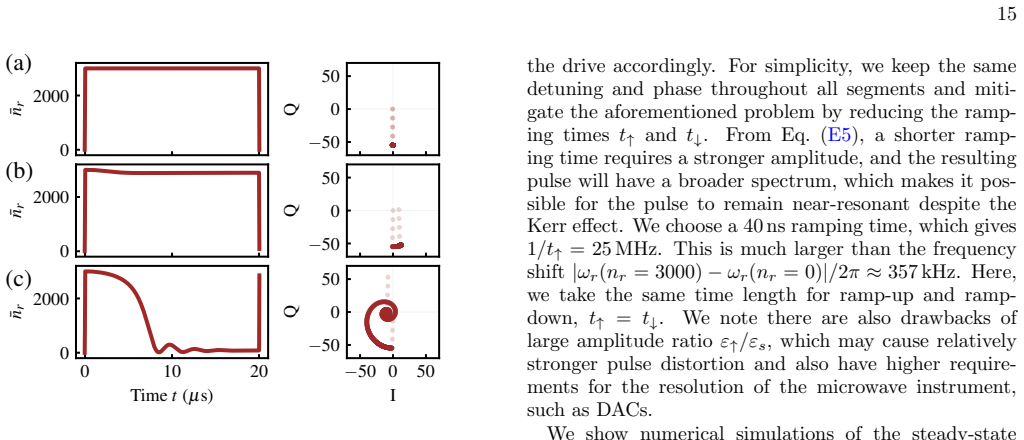
Classical resonator model Consider a classical driven and damped Kerr resonator in a frame rotating at the drive frequencyω d. The equa- tion of motion of its fieldα(t) is ˙α(t) =i∆α(t)−iK r|α(t)|2α(t)− κ 2 α(t) −i ε(t) 2 e−iϕd , (E1) where ∆≡ω d −ω r is the drive-resonator detuning,K r is the Kerr coefficient of the resonator, andε(t) andϕ d are the ampl...
-
[5]
Linear resonator and three-segment pulse For a linear resonator (K r = 0) under a constant res- onant drive [ε(t) =ε, ∆ = 0], the solution of Eq. (E1) is α(t) =Ce −κt/2 −ie −iϕd ε κ ,(E2) whereCis an integral constant depending on the initial condition. If the resonator starts in the vacuum state, α(0) = 0, then α(t) =−ie −iϕd ε κ(1−e −κt/2),(E3) and the ...
work page 2000
-
[6]
E 2 can stabilize linear res- onators because the drive term in Eq
Kerr resonator and detuning The pulse introduced in Sec. E 2 can stabilize linear res- onators because the drive term in Eq. (E1) balances the damping term. However, the Kerr effect induces field- dependent rotations in the phase plane, such that an initially resonant pulse becomes off-resonant as the field builds up. To balance this effect, we detune the...
-
[7]
Pulse in Landau-Zener sequence In previous sections, we explained the method to con- struct the pulse in our steady-state experiments. In our Landau-Zener experiments, we want to control the res- onator such that the average photon number changes from ¯nr,i to ¯nr,f in a given timet s. Here, we choose the ramping amplitudes such that they correspond to th...
work page 2000
-
[8]
Calibration procedures In this section, we describe the calibration procedures for the steady-state sequence and the Landau-Zener se- quence. We show the results forR 4, the readout res- onator coupled toQ B, and we focus on the case where QB is prepared in|0⟩at the beginning of the sequence. The first step to calibrate the shaped pulse is to mea- sure th...
-
[9]
E 5, the photon numbers are extracted using Eq
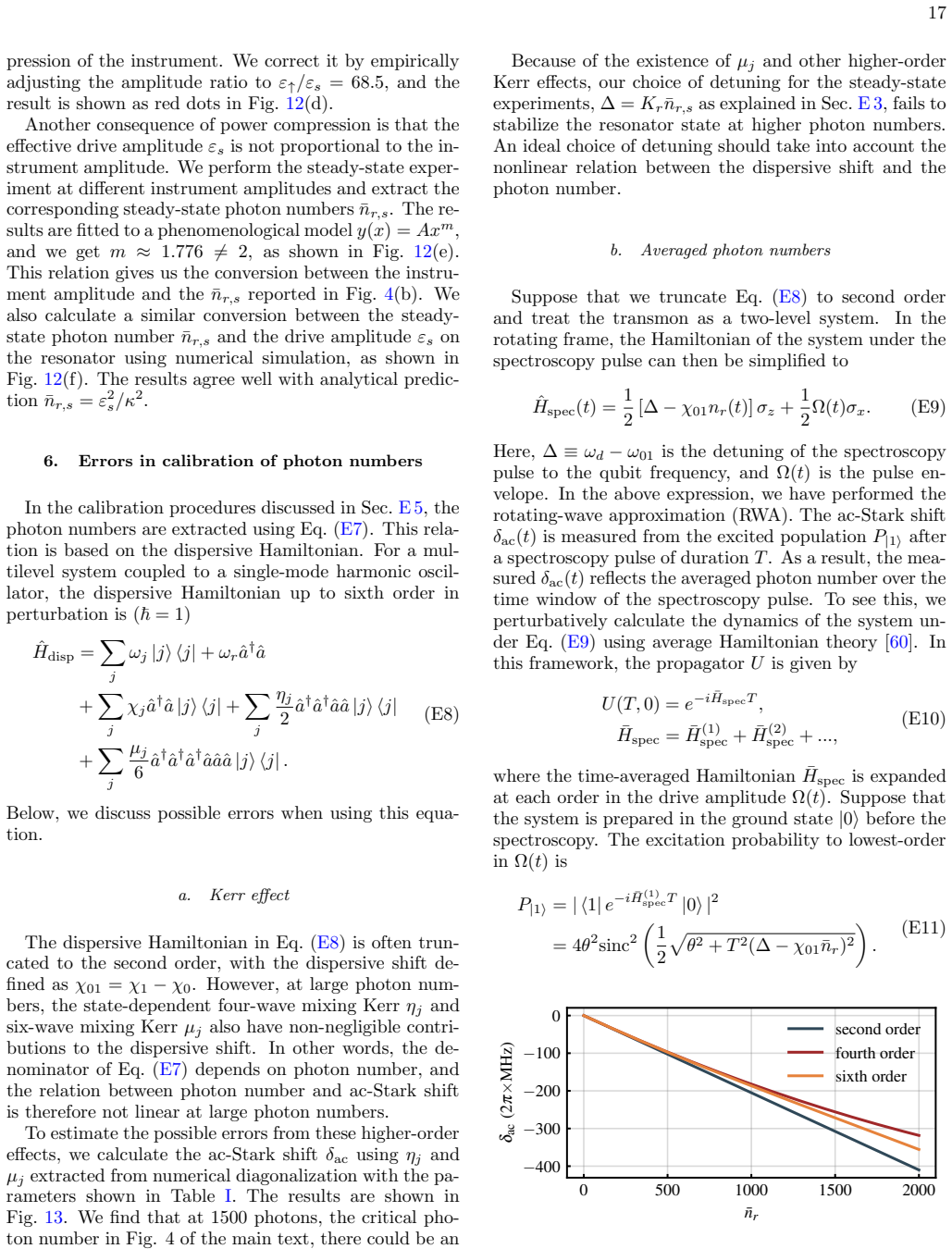
Errors in calibration of photon numbers In the calibration procedures discussed in Sec. E 5, the photon numbers are extracted using Eq. (E7). This rela- tion is based on the dispersive Hamiltonian. For a mul- tilevel system coupled to a single-mode harmonic oscil- lator, the dispersive Hamiltonian up to sixth order in perturbation is (ℏ= 1) ˆHdisp = X j ω...
work page 2000
-
[10]
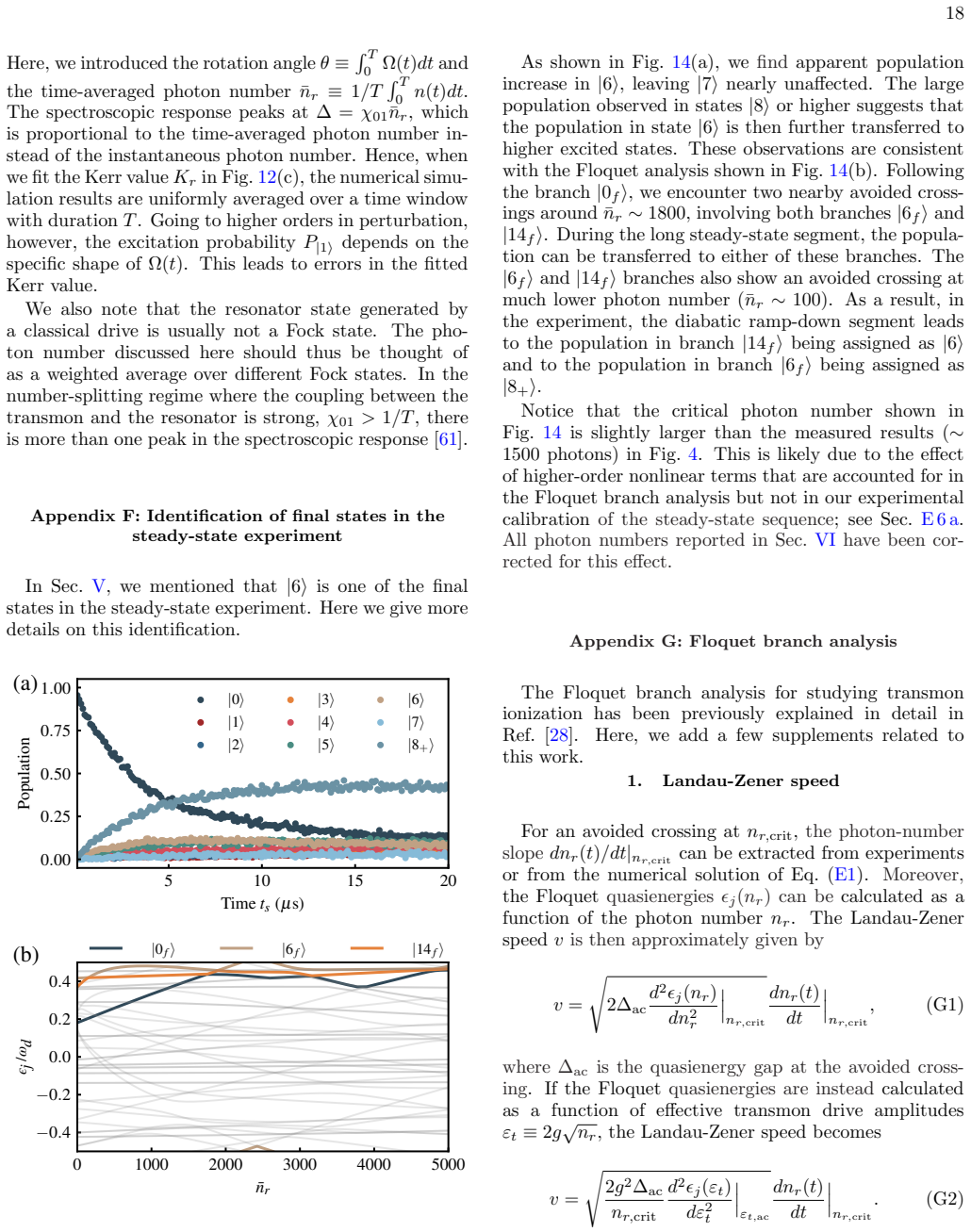
Landau-Zener speed For an avoided crossing atn r,crit, the photon-number slopedn r(t)/dt|nr,crit can be extracted from experiments or from the numerical solution of Eq. (E1). Moreover, the Floquet quasienergiesϵ j(nr) can be calculated as a function of the photon numbern r. The Landau-Zener speedvis then approximately given by v= s 2∆ac d2ϵj(nr) dn2r nr,c...
-
[11]
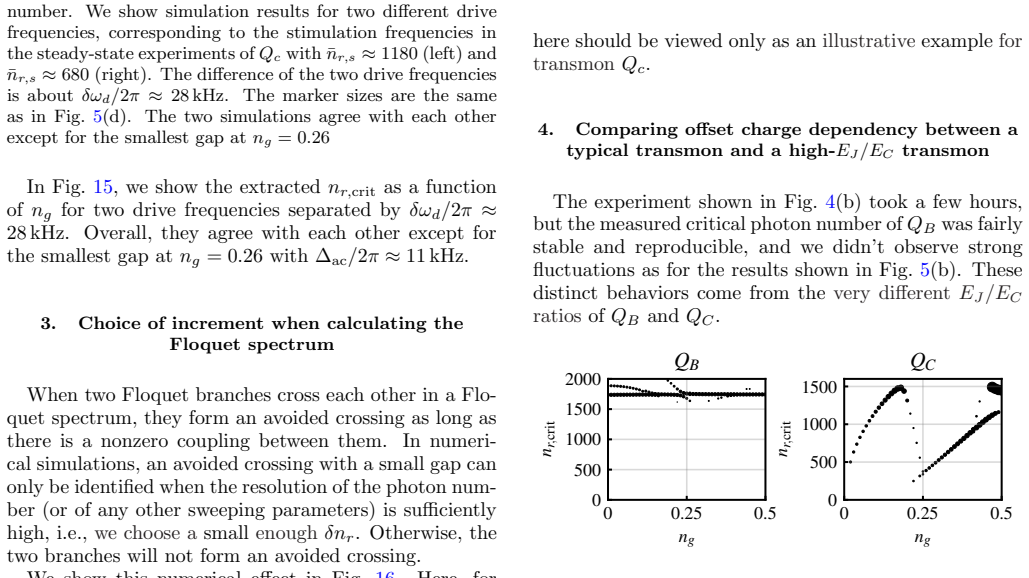
Frequency dependence of the Floquet spectrum The simulatedn r,crit values shown in Fig. 5(d) and Fig. 6(a) are extracted from Floquet spectra calculated over differentn g values, assuming a fixed drive frequency. In contrast, the steady-state experiment in Fig. 5(b), used to measuren r,crit is performed with varying drive detuning ∆ =K r¯nr,s for each ¯nr...
-
[12]
Choice of increment when calculating the Floquet spectrum When two Floquet branches cross each other in a Flo- quet spectrum, they form an avoided crossing as long as there is a nonzero coupling between them. In numeri- cal simulations, an avoided crossing with a small gap can only be identified when the resolution of the photon num- ber (or of any other ...
-
[13]
Comparing offset charge dependency between a typical transmon and a high-E J /EC transmon The experiment shown in Fig. 4(b) took a few hours, but the measured critical photon number ofQB was fairly stable and reproducible, and we didn’t observe strong fluctuations as for the results shown in Fig. 5(b). These distinct behaviors come from the very different...
- [14]
-
[15]
A. Blais, R.-S. Huang, A. Wallraff, S. M. Girvin, and R. J. Schoelkopf, Cavity quantum electrodynamics for superconducting electrical circuits: An architecture for quantum computation, Physical Review A69, 062320 (2004)
work page 2004
-
[16]
J. Koch, T. M. Yu, J. Gambetta, A. A. Houck, D. I. Schuster, J. Majer, A. Blais, M. H. Devoret, S. M. Girvin, and R. J. Schoelkopf, Charge-insensitive qubit design de- rived from the Cooper pair box, Physical Review A76, 042319 (2007)
work page 2007
-
[17]
V. E. Manucharyan, J. Koch, L. I. Glazman, and M. H. Devoret, Fluxonium: Single Cooper-Pair Circuit Free of Charge Offsets, Science326, 113 (2009)
work page 2009
- [18]
- [19]
- [20]
-
[21]
F. Swiadek, R. Shillito, P. Magnard, A. Remm, C. Hellings, N. Lacroix, Q. Ficheux, D. C. Zanuz, G. J. Norris, A. Blais, S. Krinner, and A. Wallraff, Enhancing Dispersive Readout of Superconducting Qubits through Dynamic Control of the Dispersive Shift: Experiment and Theory, PRX Quantum5, 040326 (2024)
work page 2024
- [22]
- [23]
-
[24]
P. A. Spring, L. Milanovic, Y. Sunada, S. Wang, A. F. van Loo, S. Tamate, and Y. Nakamura, Fast Multi- plexed Superconducting-Qubit Readout with Intrinsic Purcell Filtering Using a Multiconductor Transmission Line, PRX Quantum6, 020345 (2025)
work page 2025
-
[25]
R. Acharya, I. Aleiner, R. Allen, T. I. Andersen, M. Ans- mann, F. Arute, K. Arya, A. Asfaw, J. Atalaya, R. Bab- bush, D. Bacon, J. C. Bardin, J. Basso, A. Bengtsson, S. Boixo, G. Bortoli, A. Bourassa, J. Bovaird, L. Brill, M. Broughton, B. B. Buckley, D. A. Buell, T. Burger, B. Burkett, N. Bushnell, Y. Chen, Z. Chen, B. Chiaro, J. Cogan, R. Collins, P. C...
work page 2023
-
[26]
R. Acharya, D. A. Abanin, L. Aghababaie-Beni, I. Aleiner, T. I. Andersen, M. Ansmann, F. Arute, K. Arya, A. Asfaw, N. Astrakhantsev, J. Atalaya, R. Babbush, D. Bacon, B. Ballard, J. C. Bardin, J. Bausch, A. Bengtsson, A. Bilmes, S. Blackwell, S. Boixo, G. Bortoli, A. Bourassa, J. Bovaird, L. Brill, M. Broughton, D. A. Browne, B. Buchea, B. B. Buck- ley, D...
work page 2025
-
[27]
E. Jeffrey, D. Sank, J. Y. Mutus, T. C. White, J. Kelly, R. Barends, Y. Chen, Z. Chen, B. Chiaro, A. Dunsworth, A. Megrant, P. J. J. O’Malley, C. Neill, P. Roushan, A. Vainsencher, J. Wenner, A. N. Cleland, and J. M. Martinis, Fast Accurate State Measurement with Super- conducting Qubits, Physical Review Letters112, 190504 (2014)
work page 2014
-
[28]
D. Sank, Z. Chen, M. Khezri, J. Kelly, R. Barends, B. Campbell, Y. Chen, B. Chiaro, A. Dunsworth, A. Fowler, E. Jeffrey, E. Lucero, A. Megrant, J. Mu- tus, M. Neeley, C. Neill, P. J. J. O’Malley, C. Quin- tana, P. Roushan, A. Vainsencher, T. White, J. Wen- ner, A. N. Korotkov, and J. M. Martinis, Measurement- Induced State Transitions in a Superconducting...
work page 2016
-
[29]
Z. K. Minev, S. O. Mundhada, S. Shankar, P. Rein- hold, R. Guti´ errez-J´ auregui, R. J. Schoelkopf, M. Mir- rahimi, H. J. Carmichael, and M. H. Devoret, To catch and reverse a quantum jump mid-flight, Nature570, 200 (2019)
work page 2019
- [30]
-
[31]
M. Khezri, A. Opremcak, Z. Chen, K. C. Miao, M. McEwen, A. Bengtsson, T. White, O. Naaman, D. Sank, A. N. Korotkov, Y. Chen, and V. Smelyan- skiy, Measurement-induced state transitions in a super- conducting qubit: Within the rotating-wave approxima- tion, Physical Review Applied20, 054008 (2023)
work page 2023
-
[32]
P. D. Kurilovich, T. Connolly, C. G. L. Bøttcher, D. K. Weiss, S. Hazra, V. R. Joshi, A. Z. Ding, H. Nho, S. Di- amond, V. D. Kurilovich, W. Dai, V. Fatemi, L. Frun- zio, L. I. Glazman, and M. H. Devoret, High-frequency readout free from transmon multi-excitation resonances (2025), arXiv:2501.09161 [quant-ph]
-
[33]
T. Connolly, P. D. Kurilovich, V. D. Kurilovich, C. G. L. Bøttcher, S. Hazra, W. Dai, A. Z. Ding, V. R. Joshi, H. Nho, S. Diamond, D. K. Weiss, V. Fatemi, L. Frunzio, L. I. Glazman, and M. H. Devoret, Full characterization of measurement-induced transitions of a superconducting qubit (2025), arXiv:2506.05306 [quant-ph]
-
[34]
W. Dai, S. Hazra, D. K. Weiss, P. D. Kurilovich, T. Con- nolly, H. K. Babla, S. Singh, V. R. Joshi, A. Z. Ding, P. D. Parakh, J. Venkatraman, X. Xiao, L. Frunzio, and M. H. Devoret, Characterization of Drive-Induced Un- wanted State Transitions in Superconducting Circuits, Physical Review X16, 011011 (2026)
work page 2026
-
[35]
M. F´ echant, M. F. Dumas, D. B´ enˆ atre, N. Gosling, P. Lenhard, M. Spiecker, S. Geisert, S. Ihssen, W. Werns- dorfer, B. D’Anjou, A. Blais, and I. M. Pop, Offset charge dependence of measurement-induced transitions in trans- mons, Phys. Rev. Lett.135, 180603 (2025)
work page 2025
- [36]
-
[37]
R. Shillito, A. Petrescu, J. Cohen, J. Beall, M. Hauru, M. Ganahl, A. G. Lewis, G. Vidal, and A. Blais, Dynam- ics of Transmon Ionization, Physical Review Applied18, 034031 (2022)
work page 2022
-
[38]
M. Lachapelle,Mesure optimale des qubits supraconduc- teurs, Master’s thesis, Universit´ e de Sherbrooke (2018)
work page 2018
- [39]
- [40]
-
[41]
M. F. Dumas, B. Groleau-Par´ e, A. McDonald, M. H. Mu˜ noz-Arias, C. Lled´ o, B. D’Anjou, and A. Blais, Measurement-Induced Transmon Ionization, Physical Review X14, 041023 (2024)
work page 2024
- [42]
-
[43]
K. N. Nesterov and I. V. Pechenezhskiy, Measurement- induced state transitions in dispersive qubit-readout schemes, Physical Review Applied22, 064038 (2024)
work page 2024
- [44]
- [45]
-
[46]
A. Bengtsson, A. Opremcak, M. Khezri, D. Sank, A. Bourassa, K. J. Satzinger, S. Hong, C. Erickson, B. J. Lester, K. C. Miao, A. N. Korotkov, J. Kelly, Z. Chen, and P. V. Klimov, Model-Based Optimization of Super- conducting Qubit Readout, Physical Review Letters132, 100603 (2024)
work page 2024
-
[47]
A. A. Chapple, O. Benhayoune-Khadraoui, S. Richer, and A. Blais, Balanced Cross-Kerr Coupling for Super- conducting Qubit Readout, Physical Review Letters135, 256002 (2025)
work page 2025
-
[48]
A. A. Chapple, A. McDonald, M. H. Mu˜ noz-Arias, 23 M. Lachapelle, and A. Blais, Robustness of longitudinal transmon readout to ionization, Physical Review Applied 24, 034026 (2025)
work page 2025
-
[49]
Y. Li, W. Nuerbolati, C. Deng, X. Ma, H. Xiong, and H. Yu, Mitigating state transition errors during readout with a synchronized flux pulse (2025), arXiv:2507.14436 [quant-ph]
work page internal anchor Pith review arXiv 2025
-
[50]
C. Mori, F. D. Esposito, A. Petrescu, L. Ruela, S. Ku- mar, V. N. Suresh, W. Ardati, D. Nicolas, G. Cap- pelli, A. Ranadive, G. L. Gal, M. Esposito, Q. Ficheux, N. Roch, and O. Buisson, Suppression of measurement- induced state transitions in cosφ-coupling transmon readout (2025), arXiv:2509.05126 [quant-ph]
-
[51]
G. Mainfray and G. Manus, Multiphoton ionization of atoms, Reports on Progress in Physics54, 1333 (1991)
work page 1991
-
[52]
P. Agostini, G. Barjot, J. Bonnal, G. Mainfray, C. Manus, and J. Morellec, Multiphoton ionization of hydrogen and rare gases, IEEE Journal of Quantum Electronics4, 667 (1968)
work page 1968
-
[53]
G. Mainfray and C. Manus, Resonance effects in mul- tiphoton ionization of atoms, Applied Optics19, 3934 (1980)
work page 1980
-
[54]
E. A. Martin and L. Mandel, Electron energy spectrum in laser-induced multiphoton ionization of atoms, Applied Optics15, 2378 (1976)
work page 1976
-
[55]
Z. Deng and J. H. Eberly, Effect of Coherent Continuum- Continuum Relaxation and Saturation in Multiphoton Ionization, Physical Review Letters53, 1810 (1984)
work page 1984
-
[56]
Z. Deng and J. H. Eberly, Multiphoton absorption above ionization threshold by atoms in strong laser fields, Jour- nal of the Optical Society of America B2, 486 (1985)
work page 1985
-
[57]
H. P. Breuer and M. Holthaus, Adiabatic processes in the ionization of highly excited hydrogen atoms, Zeitschrift f¨ ur Physik D Atoms, Molecules and Clusters11, 1 (1989)
work page 1989
-
[58]
Z. Wang, R. W. Parker, E. Champion, and M. S. Blok, High-EJ /EC transmon qudits with up to 12 levels, Phys. Rev. Appl.23, 034046 (2025)
work page 2025
-
[59]
E. Champion, Z. Wang, R. W. Parker, and M. S. Blok, Efficient Control of a Transmon Qudit Using Effective Spin-$7/2$Rotations, Physical Review X15, 021096 (2025)
work page 2025
-
[60]
D. Willsch, D. Rieger, P. Winkel, M. Willsch, C. Dickel, J. Krause, Y. Ando, R. Lescanne, Z. Leghtas, N. T. Bronn, P. Deb, O. Lanes, Z. K. Minev, B. Dennig, S. Geisert, S. G¨ unzler, S. Ihssen, P. Paluch, T. Reisinger, R. Hanna, J. H. Bae, P. Sch¨ uffelgen, D. Gr¨ utzmacher, L. Buimaga-Iarinca, C. Morari, W. Wernsdorfer, D. P. DiVincenzo, K. Michielsen, G...
work page 2024
-
[61]
C. Lled´ o, R. Dassonneville, A. Moulinas, J. Cohen, R. Shillito, A. Bienfait, B. Huard, and A. Blais, Cloak- ing a qubit in a cavity, Nature Communications14, 6313 (2023)
work page 2023
-
[62]
Kidger,On Neural Differential Equations, Ph.D
P. Kidger,On Neural Differential Equations, Ph.D. the- sis, University of Oxford (2021)
work page 2021
-
[63]
M. Grifoni and P. H¨ anggi, Driven quantum tunneling, Physics Reports304, 229 (1998)
work page 1998
-
[64]
O. V. Ivakhnenko, S. N. Shevchenko, and F. Nori, Nona- diabatic Landau–Zener–St¨ uckelberg–Majorana transi- tions, dynamics, and interference, Physics Reports995, 1 (2023)
work page 2023
-
[65]
K. Serniak, M. Hays, G. De Lange, S. Diamond, S. Shankar, L. D. Burkhart, L. Frunzio, M. Houzet, and M. H. Devoret, Hot Nonequilibrium Quasiparticles in Transmon Qubits, Physical Review Letters121, 157701 (2018)
work page 2018
-
[66]
D. Rist` e, C. C. Bultink, M. J. Tiggelman, R. N. Schouten, K. W. Lehnert, and L. DiCarlo, Millisecond charge-parity fluctuations and induced decoherence in a superconduct- ing transmon qubit, Nature Communications4, 1913 (2013)
work page 1913
-
[67]
K. Serniak, S. Diamond, M. Hays, V. Fatemi, S. Shankar, L. Frunzio, R. Schoelkopf, and M. Devoret, Direct Dis- persive Monitoring of Charge Parity in Offset-Charge- Sensitive Transmons, Physical Review Applied12, 014052 (2019)
work page 2019
-
[68]
X. Pan, Y. Zhou, H. Yuan, L. Nie, W. Wei, L. Zhang, J. Li, S. Liu, Z. H. Jiang, G. Catelani, L. Hu, F. Yan, and D. Yu, Engineering superconducting qubits to reduce quasiparticles and charge noise, Nature Communications 13, 7196 (2022)
work page 2022
-
[69]
T. Connolly, P. D. Kurilovich, S. Diamond, H. Nho, C. G. L. Bøttcher, L. I. Glazman, V. Fatemi, and M. H. Devoret, Coexistence of Nonequilibrium Density and Equilibrium Energy Distribution of Quasiparticles in a Superconducting Qubit, Physical Review Letters132, 217001 (2024)
work page 2024
-
[70]
L. Chen, H.-X. Li, Y. Lu, C. W. Warren, C. J. Kriˇ zan, S. Kosen, M. Rommel, S. Ahmed, A. Osman, J. Bizn´ arov´ a, A. Fadavi Roudsari, B. Lienhard, M. Ca- puto, K. Grigoras, L. Gr¨ onberg, J. Govenius, A. F. Kockum, P. Delsing, J. Bylander, and G. Tancredi, Transmon qubit readout fidelity at the threshold for quantum error correction without a quantum-lim...
work page 2023
- [71]
-
[72]
Z. Wang, B. D’Anjou, P. Gigon, A. Blais, and M. Blok, Data, code and figures for: Probing excited-state dynam- ics of transmon ionization (2026)
work page 2026
-
[73]
Brinkmann, Introduction to average Hamiltonian the- ory
A. Brinkmann, Introduction to average Hamiltonian the- ory. I. Basics, Concepts in Magnetic Resonance Part A 45A, e21414 (2016)
work page 2016
-
[74]
D. I. Schuster, A. A. Houck, J. A. Schreier, A. Wallraff, J. M. Gambetta, A. Blais, L. Frunzio, J. Majer, B. John- son, M. H. Devoret, S. M. Girvin, and R. J. Schoelkopf, Resolving photon number states in a superconducting cir- cuit, Nature445, 515 (2007)
work page 2007
discussion (0)
Sign in with ORCID, Apple, or X to comment. Anyone can read and Pith papers without signing in.