REVIEW 3 major objections 5 minor 54 references
Wasserstein Policy Optimization
T0 review · 3 major / 5 minor · reviewed 2026-08-16 · deepseek-v4-flash
Pith's one-line read Wasserstein Policy Optimization claims a single closed-form update that uses action-value gradients yet works for arbitrary stochastic policies without reparameterization.
desk verdict A genuinely new parametric update for stochastic control with a clean Gaussian analysis, but the 'completely general' claim is undercut by a dropped boundary term in Eq. 5 and a missing ascent proof for non-Gaussians. read the letter →
The pith
A machine-rendered reading of the paper's core claim, the machinery that carries it, and where it could break.
The reading
What carries the argument
The load-bearing object is the Wasserstein gradient-flow PDE $\partial \pi / \partial t = -\nabla_a \cdot (\pi \nabla_a Q^\pi)$ (with sign chosen for ascent), the steepest descent of expected return under the 2-Wasserstein metric. The paper's step is to project this nonparametric flow onto a parametric family by minimizing the KL divergence between the updated and the target policy; expanding that KL to second order gives the Fisher matrix $F_{\theta\theta}$ and the cross term $F_{t\theta} = \mathbb{E}_{a\sim\pi}[\nabla_\theta \nabla_a \log \pi_\theta(a|s) \, \nabla_a Q^\pi(s,a)]$, obtained by integration by parts. The resulting closed-form update $\theta \leftarrow \theta + F_{\theta\theta}^{-1} F_{t\theta}$ is what carries the argument. In practice the paper specializes to diagonal Gaussian policies, rescales mean and variance gradients by $\sigma_i^2$ and $\tfrac{1}{2}\sigma_i^2$ to approximate the Fisher inverse, and adds a KL penalty against the previous policy to prevent premature collapse; it also notes that the c-Wasserstein extension replaces $\nabla_a Q$ by a squashed version $\nabla c^*(\nabla_a Q)$.
What would settle it
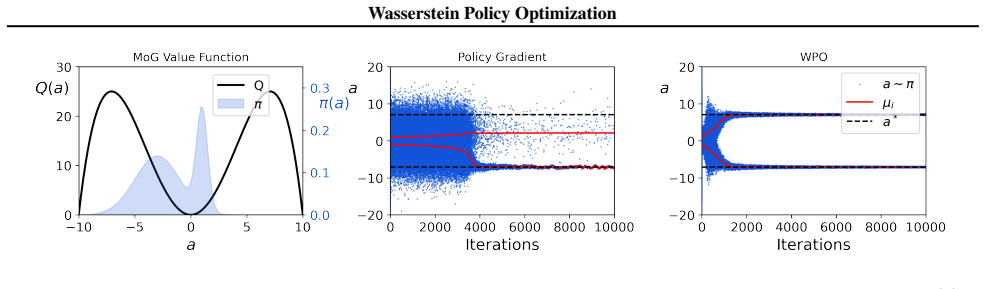
Take a one-state MDP with action-value $Q(a) = -a^4/100 + a^2$ and a two-component Gaussian-mixture policy initialized with means at $\pm 1$ and large variances, the setting of the paper's Figure 3; compute the exact expected WPO update with the full Fisher matrix and no KL penalty, and check whether the return $J[\pi]$ increases for a sufficiently small step size. A step that decreases $J$, or fails to increase it as the step size tends to zero, would contradict the claim that WPO is an ascent direction.
Extended reading notes
Core claim
The central claim is that WPO is a simple and completely general closed-form policy update that is a parametric approximation to the Wasserstein gradient flow of the expected-return functional. For any policy $\pi$, the update is $\theta \leftarrow \theta + F_{\theta\theta}^{-1} \mathbb{E}_{a\sim\pi}[\nabla_\theta \nabla_a \log \pi_\theta(a|s) \, \nabla_a Q^\pi(s,a)]$, where $F_{\theta\theta}$ is the Fisher information matrix of the policy; the mixed score-function derivative lets the algorithm carry the action-value gradient through the policy without reparameterizing the sampling distribution. The functional derivative $\delta J/\delta \pi = (1/(1-\gamma)) Q^\pi d^\pi$ makes $Q^\pi$ the driving field, so the update inherits DPG's use of $\nabla_a Q^\pi$, while the expectation over $a \sim \pi$ keeps it a stochastic-policy method. For Gaussian policies the expected WPO update equals both the classic policy gradient and the reparameterized DPG update, so the paper argues that the differences surface only for non-Gaussian distributions such as mixtures of Gaussians, where WPO is applicable and behaves distinctly. Empirically, WPO is competitive with DDPG, SAC, and MPO across the DeepMind Control Suite, learns faster on replicated high-dimensional control tasks (up to 105 action dimensions), and matches MPO on a simulated tokamak magnetic-control task while driving the policy variance down.
Load-bearing premise
The central assumption is that replacing the true Wasserstein steepest-descent direction with its best local KL-divergence approximation inside the parameterized policy family still points uphill in expected return; the paper gives no proof of this for non-Gaussian policies.
Editorial extensions
If this is right
- WPO gives a single update rule that reduces to the standard policy gradient for Gaussian policies while matching the reparameterized DPG update, so the method inherits exploration from stochastic sampling and the variance reduction of action-value gradients.
- Because no reparameterization is needed, any policy with a computable mixed score-function gradient—including mixture-of-Gaussians or exponential distributions—can be trained by WPO, opening a class of policies that stochastic DPG methods cannot handle exactly.
- On high-dimensional continuous control (replicated Humanoid tasks with 21, 65, and 105 action dimensions), the paper reports that WPO learns faster than DDPG, SAC, and MPO, with the advantage growing as the action dimension grows.
- On the tokamak magnetic-control task, WPO matches MPO's reward while its policy variance shrinks toward deterministic over training, which the paper interprets as the expected behavior for a fully observed environment.
Reading between the lines
- If the KL projection is a faithful surrogate for the Wasserstein flow, WPO's dynamics are governed by the 2-Wasserstein geometry rather than by the Fisher metric; a testable consequence is that WPO should be more robust to reparameterizations of the policy than natural policy gradient, a contrast the paper's exponential-policy example begins to illustrate.
- The paper's observation that sampled WPO updates have zero variance for locally linear $Q$ suggests that its variance reduction should become more pronounced as the action dimension grows; one can test this directly by measuring gradient variance of WPO versus classic policy gradient on the replicated high-dimensional tasks.
- The c-Wasserstein squashing variant (cube root applied to $\nabla_a Q$) opens a family of updates, each a valid descent direction for a different cost function; comparing squashing functions on tasks with rapidly changing $Q$ could identify which geometric penalization is best for stability.
- Because WPO is presented as a genuine gradient method in distribution space, it may combine naturally with entropy or KL bonuses as regularizers rather than as parts of the objective, potentially yielding a cleaner exploration-exploitation trade-off than a tuned entropy coefficient.
Signed reviews
Editorial analysis
A structured set of objections, weighed in public.
Referee Report
Summary. The manuscript proposes Wasserstein Policy Optimization (WPO), an actor-critic algorithm whose update is obtained by projecting the Wasserstein gradient flow of the return functional onto a parametric policy family. The central object is the closed-form update Δθ = F^{-1} E_π[∇θ∇a log π ∇a Q] (Eq. 6). The paper shows that for Gaussian policies this update coincides with the standard policy gradient and with reparameterized DPG/SVG-style updates, analyzes a mixture-of-Gaussians example, and then introduces a practical diagonal-Gaussian implementation with variance rescaling and KL regularization. Experiments cover DeepMind Control Suite, replicated high-dimensional tasks, and a TCV tokamak magnetic-control task, reporting competitive or faster learning relative to MPO, SAC, and DDPG.
Significance. WPO is an interesting and potentially useful update: it gives a stochastic-policy analogue of deterministic policy gradients without the reparameterization trick, and the Gaussian analysis is clean. The paper contributes a broad empirical comparison, an open-source Acme implementation, and an exact derivation for full-support Gaussian policies. However, the headline claim of a 'completely general' update is currently stronger than what is proved: the derivation has a boundary-term flaw for constrained-support policies, and the non-Gaussian projection step is not shown to preserve ascent. If the generality claim were restricted or proved, the paper would be a solid contribution; as written, the theoretical part needs revision.
major comments (3)
- [§2.3 / App. A.2, Eq. (26)] The integration by parts leading to Eq. (5) drops the boundary term under the assumption that ∇θπθ(a|s) vanishes at infinity. This fails for any policy with constrained support. A concrete counterexample is the exponential policy π(a)=β^{-1}e^{-a/β} on [0,∞) used in §4.1: ∇βπ(0)=-β^{-2}, so the corrected identity is F_tβ=(Eπ[∇aQ]-∇aQ(0))/β², not Eπ[∇aQ]/β², and the update shown in that section is not the WPO update for this family. The 'completely general' claim in the abstract and §2.3 should be restricted to policies whose support is the full action space with appropriate decay, or the update should be modified to include the boundary term.
- [§2.3] The projection step from the nonparametric Wasserstein flow to the parametric update minimizes a local KL/Fisher quadratic, but no argument shows that the resulting discrete step increases J[πθ] for non-Gaussian policies. The continuous-time flow is an ascent in the Wasserstein metric on densities; ascent does not automatically survive projection in the KL/Fisher metric, and the paper provides no bound on or sign analysis of ⟨∇θJ, F^{-1}F_tθ⟩ outside the Gaussian case. The mixture-of-Gaussians example in §4.2 is a single favorable numerical instance, so the 'completely general' update is not established by the evidence presented.
- [§4.2 / §5] The non-Gaussian evidence is weakened by the fact that the mixture-of-Gaussians experiment uses the heuristic rescaling of gradients by σ_i² rather than the FIM of the mixture, and the practical algorithm in §5 additionally restricts to diagonal Gaussian policies and replaces the full Fisher by a variance rescaling. The text is transparent about these choices, but the experimental results therefore do not validate Eq. (6) for arbitrary stochastic policies; the abstract and conclusion should align the generality claim with what is actually implemented and tested.
minor comments (5)
- [Fig. 3 caption] The caption refers to the 'left plot' twice and is inconsistent about which panel shows the policy-gradient evolution versus the WPO evolution; please relabel or re-describe the panels.
- [Fig. 6 caption] The caption says 'fusion task discussed in Section 6.2', but the fusion task is presented in Section 6.3.
- [§4.1] The claim that the Gaussian equivalences extend 'straightforwardly' to multivariate normals would benefit from an appendix derivation, because the covariance parameterization introduces off-diagonal terms.
- [Footnote 1] The footnote states that the public Acme implementation is not the version used for the experiments; please state clearly in the main text whether the exact experimental configuration will be released.
- [App. A.2, Eq. (26)] The integration-by-parts assumption should be stated as a decay condition on the full boundary term, e.g., ∇θlogπ(a|s) π(a|s) ∇aQ(s,a) → 0, rather than only on ∇θπ(a|s); this is the condition actually needed for Eq. (30) to hold.
Circularity Check
No significant circularity: WPO's update is derived from an independent variational argument and validated against external benchmarks.
full rationale
The central derivation is self-contained. Starting from the functional derivative of J[pi] with respect to the policy, Eq. 4, the paper constructs the Wasserstein gradient flow (Eq. 1), then projects it onto a parametric family by minimizing a local KL/Fisher quadratic form (Sec. 2.3). The resulting closed-form update, Eq. 6, is not an input or a renamed fit: no parameter of the update is fitted to the data used to test it, and the action-value gradient E[grad_theta grad_a log pi grad_a Q] follows from integration by parts rather than from assuming the conclusion. The Gaussian-case equivalence with DPG and classic policy gradient is an independently derived identity, not a definitional restatement, and the mixture-of-Gaussians and Control Suite experiments test the method against external baselines rather than assuming its success. Self-citations (e.g., Tracey et al. 2024 for the fusion task, Degrave et al. 2022 for TCV, Hoffman et al. 2020 for Acme) concern benchmark settings, implementations, and prior experimental conventions; they do not carry the mathematical derivation. The stated boundary assumption in App. A.2 that grad_theta pi vanishes at infinity is an explicit technical assumption, and the exponential-policy counterexample in the skeptic note is a correctness or generality concern about that assumption, not a circularity: the paper does not define the conclusion in terms of the assumption. No load-bearing step reduces by construction to its own inputs, so the appropriate finding is no significant circularity.
Assumptions & free parameters
free parameters (3)
- WPO KL penalty weights alpha_mu and alpha_Sigma =
alpha_mu = log(2), alpha_Sigma = 10000 (Table 2)
- Variance rescaling in diagonal Fisher approximation =
grad_bar_mu = sigma^2 grad_mu, grad_bar_sigma = 1/2 sigma^2 grad_sigma
- Cube-root squashing (fusion task) =
grad c*(x) = x^{1/3}
assumptions (5)
- domain assumption The functional derivative of the expected return with respect to a continuous policy is delta J / delta pi = (1/(1-gamma)) Q^pi(s,a) d^pi(s).
- standard math The PDE d(pi)/dt = -nabla_a dot (pi nabla_a Q) is the steepest ascent of J in the 2-Wasserstein metric.
- ad hoc to paper KL divergence is locally approximated by the Fisher quadratic form, and minimizing it yields the correct parametric projection of the flow.
- standard math Integration by parts boundary term vanishes: nabla_theta pi_theta(a|s) -> 0 as |a| -> infinity.
- domain assumption Per-state updates can ignore the discounted occupancy d^pi(s) and the (1-gamma)^{-1} factor.
Cite this review
Pith. "Pith review of Wasserstein Policy Optimization." pith.science (2026). https://pith.science/paper/P2XFTJ5K
@misc{pith2026250500663,
  author       = {Pith},
  title        = {Pith review of: Wasserstein Policy Optimization},
  year         = {2026},
  howpublished = {\url{https://pith.science/paper/P2XFTJ5K}},
  note         = {Machine review of arXiv:2505.00663}
}
read the original abstract
We introduce Wasserstein Policy Optimization (WPO), an actor-critic algorithm for reinforcement learning in continuous action spaces. WPO can be derived as an approximation to Wasserstein gradient flow over the space of all policies projected into a finite-dimensional parameter space (e.g., the weights of a neural network), leading to a simple and completely general closed-form update. The resulting algorithm combines many properties of deterministic and classic policy gradient methods. Like deterministic policy gradients, it exploits knowledge of the gradient of the action-value function with respect to the action. Like classic policy gradients, it can be applied to stochastic policies with arbitrary distributions over actions -- without using the reparameterization trick. We show results on the DeepMind Control Suite and a magnetic confinement fusion task which compare favorably with state-of-the-art continuous control methods.
Figures


Figures from the paper (9 more)


Reference graph
Works this paper leans on
-
[1]
write newline
" write newline "" before.all 'output.state := FUNCTION n.dashify 't := "" t empty not t #1 #1 substring "-" = t #1 #2 substring "--" = not "--" * t #2 global.max substring 't := t #1 #1 substring "-" = "-" * t #2 global.max substring 't := while if t #1 #1 substring * t #2 global.max substring 't := if while FUNCTION format.date year duplicate empty "emp...
-
[2]
T., Tassa, Y., Munos, R., Heess, N., and Riedmiller, M
Abdolmaleki, A., Springenberg, J. T., Tassa, Y., Munos, R., Heess, N., and Riedmiller, M. Maximum a posteriori policy optimisation. In International Conference on Learning Representations, 2018
work page 2018
-
[3]
Abdullah, M. A., Ren, H., Ammar, H. B., Milenkovic, V., Luo, R., Zhang, M., and Wang, J. Wasserstein robust reinforcement learning, 2019. URL https://arxiv.org/abs/1907.13196
arXiv 2019
-
[4]
M., Lee, J
Agarwal, A., Kakade, S. M., Lee, J. D., and Mahajan, G. On the theory of policy gradient methods: Optimality, approximation, and distribution shift. Journal of Machine Learning Research, 22 0 (98): 0 1--76, 2021
2021
-
[5]
Gradient flows: in metric spaces and in the space of probability measures
Ambrosio, L., Gigli, N., and Savar \'e , G. Gradient flows: in metric spaces and in the space of probability measures. Springer Science & Business Media, 2008
2008
-
[6]
W., Budden, D., Dabney, W., Horgan, D., Tb, D., Muldal, A., Heess, N., and Lillicrap, T
Barth-Maron, G., Hoffman, M. W., Budden, D., Dabney, W., Horgan, D., Tb, D., Muldal, A., Heess, N., and Lillicrap, T. Distributed distributional deterministic policy gradients. International Conference on Learning Representations, 2018
work page 2018
-
[7]
Barto, A. G., Sutton, R. S., and Anderson, C. W. Neuronlike adaptive elements that can solve difficult learning control problems. IEEE transactions on systems, man, and cybernetics, 0 (5): 0 834--846, 1983
work page 1983
-
[8]
Bellemare, M. G., Dabney, W., and Munos, R. A distributional perspective on reinforcement learning. In International Conference on Machine Learning, pp.\ 449--458. PMLR, 2017
work page 2017
Show all 54 references
-
[9]
and Brenier, Y
Benamou, J.-D. and Brenier, Y. A computational fluid mechanics solution to the monge-kantorovich mass transfer problem. Numerische Mathematik, 84 0 (3): 0 375--393, 2000
2000
-
[10]
Development of free-boundary equilibrium and transport solvers for simulation and real-time interpretation of tokamak experiments
Carpanese, F. Development of free-boundary equilibrium and transport solvers for simulation and real-time interpretation of tokamak experiments. Technical report, EPFL, 2021
2021
-
[11]
S., Kastner, T., Panangaden, P., and Rowland, M
Castro, P. S., Kastner, T., Panangaden, P., and Rowland, M. Mico: Improved representations via sampling-based state similarity for markov decision processes, 2022. URL https://arxiv.org/abs/2106.08229
2022 arXiv
-
[12]
T., Rubanova, Y., Bettencourt, J., and Duvenaud, D
Chen, R. T., Rubanova, Y., Bettencourt, J., and Duvenaud, D. K. Neural ordinary differential equations. Advances in neural information processing systems, 31, 2018
2018
-
[13]
Fast and accurate deep network learning by exponential linear units (elus)
Clevert, D.-A., Unterthiner, T., and Hochreiter, S. Fast and accurate deep network learning by exponential linear units (elus). arxiv 2015. International Conference on Learning Representations, 2016
2015
-
[14]
Magnetic control of tokamak plasmas through deep reinforcement learning
Degrave, J., Felici, F., Buchli, J., Neunert, M., Tracey, B., Carpanese, F., Ewalds, T., Hafner, R., Abdolmaleki, A., de Las Casas, D., et al. Magnetic control of tokamak plasmas through deep reinforcement learning. Nature, 602 0 (7897): 0 414--419, 2022
2022
-
[15]
Experimental research on the TCV tokamak
Duval, B., Abdolmaleki, A., Agostini, M., Ajay, C., Alberti, S., Alessi, E., Anastasiou, G., Andrèbe, Y., Apruzzese, G., Auriemma, F., et al. Experimental research on the TCV tokamak. Nuclear Fusion, 64 0 (11): 0 112023, oct 2024. doi:10.1088/1741-4326/ad8361. URL https://dx.d...
2024 doi
-
[16]
Sigmoid-weighted linear units for neural network function approximation in reinforcement learning
Elfwing, S., Uchibe, E., and Doya, K. Sigmoid-weighted linear units for neural network function approximation in reinforcement learning. Neural Networks, 107: 0 3--11, 2018
2018
-
[17]
and Castro, P
Farebrother, J. and Castro, P. S. Cale: Continuous arcade learning environment. arXiv preprint arXiv:2410.23810, 2024
2024 arXiv
-
[18]
Metrics for finite markov decision processes
Ferns, N., Panangaden, P., and Precup, D. Metrics for finite markov decision processes. In Uncertainty in Artificial Intelligence, 2004
2004
-
[19]
Soft actor-critic: Off-policy maximum entropy deep reinforcement learning with a stochastic actor
Haarnoja, T., Zhou, A., Abbeel, P., and Levine, S. Soft actor-critic: Off-policy maximum entropy deep reinforcement learning with a stochastic actor. In International conference on machine learning, pp.\ 1861--1870. PMLR, 2018
2018
-
[20]
H., Tirumala, D., Humplik, J., Wulfmeier, M., Tunyasuvunakool, S., Siegel, N
Haarnoja, T., Moran, B., Lever, G., Huang, S. H., Tirumala, D., Humplik, J., Wulfmeier, M., Tunyasuvunakool, S., Siegel, N. Y., Hafner, R., et al. Learning agile soccer skills for a bipedal robot with deep reinforcement learning. Science Robotics, 9 0 (89): 0 eadi8022, 2024
2024
-
[21]
Wasserstein unsupervised reinforcement learning, 2021
He, S., Jiang, Y., Zhang, H., Shao, J., and Ji, X. Wasserstein unsupervised reinforcement learning, 2021. URL https://arxiv.org/abs/2110.07940
2021 arXiv
-
[22]
Learning continuous control policies by stochastic value gradients
Heess, N., Wayne, G., Silver, D., Lillicrap, T., Erez, T., and Tassa, Y. Learning continuous control policies by stochastic value gradients. Advances in neural information processing systems, 28, 2015
2015
-
[23]
W., Shahriari, B., Aslanides, J., Barth-Maron, G., Momchev, N., Sinopalnikov, D., Sta \'n czyk, P., Ramos, S., Raichuk, A., Vincent, D., et al
Hoffman, M. W., Shahriari, B., Aslanides, J., Barth-Maron, G., Momchev, N., Sinopalnikov, D., Sta \'n czyk, P., Ramos, S., Raichuk, A., Vincent, D., et al. Acme: A research framework for distributed reinforcement learning. arXiv preprint arXiv:2006.00979, 2020
2006 arXiv
-
[24]
Howard, R. A. Dynamic P rogramming and M arkov P rocesses . 1960
1960
-
[25]
Huang, S., Dossa, R. F. J., Raffin, A., Kanervisto, A., and Wang, W. The 37 implementation details of proximal policy optimization. The ICLR Blog Track 2023, 2022
2023
-
[26]
Categorical reparameterization with G umbel-softmax
Jang, E., Gu, S., and Poole, B. Categorical reparameterization with G umbel-softmax. ICLR, 2017
2017
-
[27]
Kakade, S. M. A natural policy gradient. Advances in neural information processing systems, 14, 2001
2001
-
[28]
M., and Restelli, M
Likmeta, A., Sacco, M., Metelli, A. M., and Restelli, M. Wasserstein actor-critic: Directed exploration via optimism for continuous-actions control, 2023. URL https://arxiv.org/abs/2303.02378
2023 arXiv
-
[29]
Continuous control with deep reinforcement learning
Lillicrap, T. Continuous control with deep reinforcement learning. arXiv preprint arXiv:1509.02971, 2015
2015 arXiv
-
[30]
J., Mnih, A., and Teh, Y
Maddison, C. J., Mnih, A., and Teh, Y. W. The C oncrete D istribution: A C ontinuous R elaxation of D iscrete R andom V ariables. ICLR, 2017
2017
-
[31]
and Grosse, R
Martens, J. and Grosse, R. Optimizing neural networks with K ronecker-factored approximate curvature. In International Conference on Machine Learning, pp.\ 2408--2417. PMLR, 2015
2015
-
[32]
M., Likmeta, A., and Restelli, M
Metelli, A. M., Likmeta, A., and Restelli, M. Propagating uncertainty in reinforcement learning via wasserstein barycenters. In Advances in Neural Information Processing Systems, volume 32. Curran Associates, Inc., 2019
2019
-
[33]
Efficient W asserstein natural gradients for reinforcement learning
Moskovitz, T., Arbel, M., Huszar, F., and Gretton, A. Efficient W asserstein natural gradients for reinforcement learning. arXiv preprint arXiv:2010.05380, 2020
2010 arXiv
-
[34]
Wasserstein quantum M onte C arlo: a novel approach for solving the quantum many-body schr \"o dinger equation
Neklyudov, K., Nys, J., Thiede, L., Carrasquilla, J., Liu, Q., Welling, M., and Makhzani, A. Wasserstein quantum M onte C arlo: a novel approach for solving the quantum many-body schr \"o dinger equation. Advances in Neural Information Processing Systems, 36, 2023
2023
-
[35]
Learning to score behaviors for guided policy optimization
Pacchiano, A., Parker-Holder, J., Tang, Y., Choromanski, K., Choromanska, A., and Jordan, M. Learning to score behaviors for guided policy optimization. In International Conference on Machine Learning, pp.\ 7445--7454. PMLR, 2020
2020
-
[36]
and Bengio, Y
Pascanu, R. and Bengio, Y. Revisiting natural gradient for deep networks. arXiv preprint arXiv:1301.3584, 2013
2013 arXiv
-
[37]
Prokhorov, D. V. and Wunsch, D. C. Adaptive critic designs. IEEE transactions on Neural Networks, 8 0 (5): 0 997--1007, 1997
1997
-
[38]
Richemond, P. H. and Maginnis, B. Diffusing policies : Towards W asserstein policy gradient flows, 2018. URL https://openreview.net/forum?id=rk3mjYRp-
2018
-
[39]
Trust region policy optimization
Schulman, J., Levine, S., Moritz, P., Jordan, M., and Abbeel, P. Trust region policy optimization. International Conference on Machine Learning, 2015 a
2015
-
[40]
High-dimensional continuous control using generalized advantage estimation
Schulman, J., Moritz, P., Levine, S., Jordan, M., and Abbeel, P. High-dimensional continuous control using generalized advantage estimation. arXiv preprint arXiv:1506.02438, 2015 b
2015 arXiv
-
[41]
Proximal policy optimization algorithms
Schulman, J., Wolski, F., Dhariwal, P., Radford, A., and Klimov, O. Proximal policy optimization algorithms. arXiv preprint arXiv:1707.06347, 2017
2017 arXiv
-
[42]
Deterministic policy gradient algorithms
Silver, D., Lever, G., Heess, N., Degris, T., Wierstra, D., and Riedmiller, M. Deterministic policy gradient algorithms. In International Conference on Machine Learning, pp.\ 387--395. PMLR, 2014
2014
-
[43]
F., Abdolmaleki, A., Springenberg, J
Song, H. F., Abdolmaleki, A., Springenberg, J. T., Clark, A., Soyer, H., Rae, J. W., Noury, S., Ahuja, A., Liu, S., Tirumala, D., et al. V-MPO : O n-policy maximum a posteriori policy optimization for discrete and continuous control. arXiv preprint arXiv:1909.12238, 2019
1909 arXiv
-
[44]
Sutton, R. S. and Barto, A. G. Reinforcement learning: An introduction. MIT press, 2018
2018
-
[45]
S., McAllester, D., Singh, S., and Mansour, Y
Sutton, R. S., McAllester, D., Singh, S., and Mansour, Y. Policy gradient methods for reinforcement learning with function approximation. Advances in Neural Information Processing Systems, 12, 1999
1999
-
[46]
Tassa, Y., Doron, Y., Muldal, A., Erez, T., Li, Y., Casas, D. d. L., Budden, D., Abdolmaleki, A., Merel, J., Lefrancq, A., et al. Deepmind control suite. arXiv preprint arXiv:1801.00690, 2018
2018 arXiv
-
[47]
Mujoco: A physics engine for model-based control
Todorov, E., Erez, T., and Tassa, Y. Mujoco: A physics engine for model-based control. In 2012 IEEE/RSJ international conference on intelligent robots and systems, pp.\ 5026--5033. IEEE, 2012
2012
-
[48]
D., Michi, A., Chervonyi, Y., Davies, I., Paduraru, C., Lazic, N., Felici, F., Ewalds, T., Donner, C., Galperti, C., et al
Tracey, B. D., Michi, A., Chervonyi, Y., Davies, I., Paduraru, C., Lazic, N., Felici, F., Ewalds, T., Donner, C., Galperti, C., et al. Towards practical reinforcement learning for tokamak magnetic control. Fusion Engineering and Design, 200: 0 114161, 2024
2024
-
[49]
dm\_control: Software and tasks for continuous control
Tunyasuvunakool, S., Muldal, A., Doron, Y., Liu, S., Bohez, S., Merel, J., Erez, T., Lillicrap, T., Heess, N., and Tassa, Y. dm\_control: Software and tasks for continuous control. Software Impacts, 6: 0 100022, 2020
2020
-
[50]
Double q-learning
van Hasselt , H. Double q-learning. In Lafferty, J., Williams, C., Shawe-Taylor, J., Zemel, R., and Culotta, A. (eds.), Advances in Neural Information Processing Systems, volume 23. Curran Associates, Inc., 2010
2010
-
[51]
and Wiering, M
van Hasselt , H. and Wiering, M. A. Reinforcement learning in continuous action spaces. In 2007 IEEE International Symposium on Approximate Dynamic Programming and Reinforcement Learning, pp.\ 272--279. IEEE, 2007
2007
-
[52]
Beyond regression: N ew tools for prediction and analysis in the behavioral sciences
Werbos, P. Beyond regression: N ew tools for prediction and analysis in the behavioral sciences. PhD thesis, Committee on Applied Mathematics, Harvard University, Cambridge, MA, 1974
1974
-
[53]
Williams, R. J. Simple statistical gradient-following algorithms for connectionist reinforcement learning. Machine learning, 8: 0 229--256, 1992
1992
-
[54]
Policy optimization as W asserstein gradient flows
Zhang, R., Chen, C., Li, C., and Carin, L. Policy optimization as W asserstein gradient flows. In International Conference on Machine Learning, pp.\ 5737--5746. PMLR, 2018
2018
Reviewed August 16, 2026 · model on record in the stance chip above.
Discussion (0). Continue with ORCID to comment.